From DSC:
As I looked at the article below, I couldn’t help but wonder…what is the role of the American Bar Association (ABA) in this type situation? How can the ABA help the United States deal with the impact/place of emerging technologies?


Clearview AI will get a US patent for its facial recognition tech — from engadget.com by J. Fingas
Critics are worried the company is patenting invasive tech.

Excerpt:

Clearview AI is about to get formal acknowledgment for its controversial facial recognition technology. Politico reports Clearview has received a US Patent and Trademark Office “notice of allowance” indicating officials will approve a filing for its system, which scans faces across public internet data to find people from government lists and security camera footage. The company just has to pay administrative fees to secure the patent.

In a Politico interview, Clearview founder Hoan Ton-That claimed this was the first facial recognition patent involving “large-scale internet data.” The firm sells its tool to government clients (including law enforcement) hoping to accelerate searches.

As you might imagine, there’s a concern the USPTO is effectively blessing Clearview’s technology and giving the company a chance to grow despite widespread objections to its technology’s very existence. 

Privacy, news, facial recognition, USPTO, internet, patent,
Clearview AI, surveillance, tomorrow, AI, artificial intelligence


 

Why It’s so Difficult to Recruit Diverse Teachers in Early Childhood — from edsurge.com by Meredith Whye

Excerpt (emphasis DSC):

Wisconsin mandates that student teachers experience one semester, approximately 18 weeks, of full-time work in the classroom. That means during the final semester of their senior year, students are working full-time without pay. The university advises student teachers to save up money and not work another job during this semester. However, the majority of the students I work with simply cannot stop working for 18 weeks.


BLOCKCHAIN INNOVATION CHALLENGE — from the American Council on Education (ACE)
About the Challenge
The challenge sought technology-enabled solutions that reoriented the education and employment ecosystem around the individuals that they aim to serve. It invited teams to articulate a vision and design pilots that addressed an ecosystem-first designed approach driving interoperability, social mobility, and learner control expanding on these essential themes:

  • Empower all learners: 
    How can learners exercise agency over their digital identities, including all records of learning, so they can share them in a secure, validated, and machine-readable way?
  • Unlock lifelong learning: 
    How can learning be better documented, validated, and shared no matter where it occurs? How can control or ownership of learning records improve the way underserved learners connect and unlock disparate learning opportunities?
  • Improve economic mobility: 
    How can blockchain help learners to find in-demand education in employment-relevant skills to advance economic mobility and to fulfill the promise of higher education???

The four winners of the Blockchain Innovation Challenge were…


The Humanities May Be Declining at Universities — But They’re Thriving on Zoom — from edsurge.com by Rebecca Koenig

Excerpt:

Throughout the pandemic, versions of this close-reading conversation have taken place week after week. Organized through new nonprofits and small startups including the Catherine Project, Night School Bar and Premise, they bring together adults who want to spend their free time talking to strangers about literature and philosophy.

It sounds at first like an ambitious book club—except for the fact that many of these seminars are organized and led by college professors, some so eager to participate that they do it for free.

“Mostly it’s a way for them to do a kind of teaching they can’t do at their regular jobs,” explains Zena Hitz, founder of the Catherine Project and a tutor (faculty member) at St. John’s College in Annapolis, Maryland.

From DSC:
I’ve often thought that online-based learning may be the thing that saves the liberal arts (i.e., available throughout one’s lifetime and would be far less expensive). It would be ironic though, as many liberal arts institutions have not been proponents of online-based learning.


Antonio Sacre on the Power of Storytelling in Education — from spencerauthor.com by John Spencer

Per John:

I had the honor of interviewing celebrated author Antonio Sacre on the power of storytelling in education. Check out the podcast below.

The power of story in education -- Spencer and Sacre

Born in Boston to a Cuban father and Irish-American mother, Sacre is an internationally touring storyteller, author, and solo performance artist, based in Los Angeles. He has performed at the National Book Festival at the Library of Congress, the Kennedy Center, the National Storytelling Festival, as well as museums, schools, libraries, and festivals. Deemed “a charismatic, empathetic presence” by the Chicago Tribune, his stories have appeared in numerous magazines, journals, and on National Public Radio.


What motivates students to learn? — from edte.ch by Tom Barrett
In this article, we explore the key factors that influence and predict student academic motivation.

Excerpt:

Here are the top three ranked, according to this meta-analysis, from l’Université Laval, Monash University and Curtin University.

1 — Competence (I can do this!)
2 — Autonomy (I get to choose)
3 — Belonging (I am not alone)


From DSC:
I’m once again reminded of the following graphic:

Tom’s posting also reminds me of the power of storytelling, as Tom makes a solid point:

A notable missing piece of the student motivation paper is the role of emotion in learning. When I search the document for reference to ‘emotion’, the only returns I get are from citations and other works.

Along these lines, see/listen to:


Making Your Research Applicable for Mainstream Audiences — from insidehighered.com by Diana Brazzell
Four ways to extend the reach of your scholarly work beyond academe.

Excerpt:

Many academics I work with struggle to make their research applicable for audiences outside academia. They’re doing important, even ground-breaking work, but they aren’t sure how their ideas can make the leap from labs and libraries to newspapers, boardrooms, hospitals and the halls of government.

Below are four ways you can make your research applicable to policy, business, public health and people’s everyday lives, along with examples of how some of the academics we collaborate with at Footnote have used these techniques.

From DSC:
Faculty members, doing this could help reduce the backlash that’s been building against higher education. Folks out in society could see how the work that you are doing is relevant to them. For example, your podcasts, Tweets, postings out on LinkedIn, your vidcasts, or your blog postings could be read by students, teachers, administrators or others within the K-12 space. And the topic could peak their interest and curiosity. Who knows, your research may just jump start someone else’s passion in that area or even someone else’s career. But at minimum, it could show that some faculty members are interested in talking to/with a far wider audience than just the peers in their discipline.


Michigan Chief Justice Bridget Mary McCormack on the Transformative Possibilities of this Moment — from law.upenn.edu with Michigan Chief Justice Bridget Mary McCormack

Excerpt:

Bridget Mary McCormack is Chief Justice of the Michigan Supreme Court and is a leading voice on modernizing court systems to expand access to justice and deepen public confidence in legal systems.

On this episode, she joins us to share her thoughts on how courts can learn from the experiences COVID-19 has created to better serve the public in a post-pandemic world. She also shares her views on how regulatory reform can transform legal services and why improving legal systems matters for the entire American experiment.


Addendum on 12/13/21:
Ontario Court Lays Down the Law on Technology Competence and Video Proceedings — from legaltechmonitor.com by Bob Ambrogi

An Ontario judge has laid down the law on technology competence, ruling in no uncertain terms that every lawyer has a duty to keep pace with changing technology, and that a lawyer’s discomfort with new technologies — in this case, video depositions — is no excuse for reverting to pre-pandemic methods.


Top 7 Artificial Intelligence Trends In 2022 — from techfunnel.com by Anirudh Menon

Excerpt:

If we look at the last couple of years, we have seen a significant leap in the way Artificial Intelligence is becoming an integral part of many organizations’ business plans. Already the journey of digital transformation has catapulted thanks to Machine Learning and Artificial Intelligence and because of the pandemic situation, we saw significant innovation in the technology front, which will reach new heights in the year 2022 and further.

As strongly claimed by Sundar Pichai, CEO of Google Inc, the impact of artificial intelligence will be far greater than fire and electricity on humanity. Well, it might sound a bit exaggerated but what it implies is that the year 2022 is going to see new developments in this space and it will constantly create new benchmarks.


Cisco and Google join forces to transform the future of hybrid work — from blog.webex.com by Kedar Ganta

Cisco and Google join forces to transform the future of hybrid work

Excerpts:

Webex [on 12/7/21] announced the public preview of its native meeting experience for Glass Enterprise Edition 2 (Glass), a lightweight eye wearable device with a transparent display developed by Google. Webex Expert on Demand on Glass provides an immersive collaboration experience that supports natural voice commands, gestures on touchpad, and head movements to accomplish routine tasks.


Upskilling to engage your people: attracting and retaining talent during the great resignation — from protocol.com by Suneet Dua and Cy Coons

Excerpt:

Digital skills development is now table stakes — in a few short years, almost a third of all jobs globally will be transformed by technology. Nearly half of respondents to a recent National Association for Business Economics (NABE) survey reported a shortage of skilled workers in the third quarter. Digital skills will continue to be in high demand. The good news is that 77% of workers are ready to learn new skills or completely retrain.

Upskilling programs should encourage the critical thinking and digital acumen needed for future success. And they should provide opportunities for scenario-based applied learning that demonstrates competency and translates to immediate business impact. Upskilling should focus on job- and function-specific skills so organizations can be less reliant on institutional knowledge.

If you persevere and implement the right kinds of programs, the payoffs can be huge: 93% of CEOs who introduce upskilling programs have seen increased productivity, an improvement in talent acquisition and retention and a more resilient workforce.


Uncertainty lurks as college leaders eye end of federal relief funding — from highereddive.com by Rick Seltzer

Excerpt:

  • Presidents described their colleges as resilient or “struggling, but persevering” after the pandemic’s first year. They needed to frequently adapt or alter plans in the face of lost revenue, new demands for online operations, changing student needs and frequently revised government requirements. “I got tired of hearing the word pivot, but we had to do a lot of pivoting,” the president of a regional public four-year college said.
 

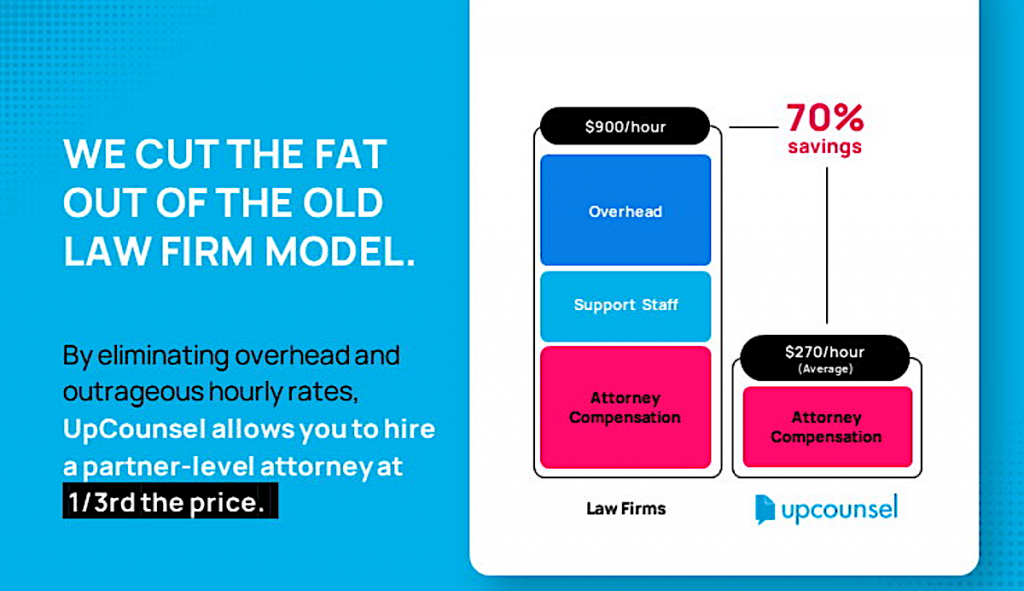
UpCounsel Crowdfunds $3.3m, Plans IPO + Cuts Legal Costs By 75%! — from artificiallawyer.com

By eliminating overhead and outrageous hourly rates, UpCounsel allows you to kire a partner-level attorney at a third of the price

Excerpt:

The last point is how this helps to encourage more crowdfunding in this sector. Ruby Datum the VDR company is also currently doing a crowdfunding, and Clocktimizer was funded in the same way before it was bought up by Litera. So, perhaps we will see more approaches like this. That said, UpCounsel is itself owned by an investment group – along with 1,630 others now, so it’s not a pure-play crowdfunding in its entirety.

This will be watched by the VC world and the legal market in general for signs of whether it is succeeding with its goals.

Also see:

TECHREPORT 2021: Technology Training — from lawtechnologytoday.org by Sofia Lingos

ABA Techreport 2021 -- technology training


Prisons are training inmates for the next generation of in-demand jobs — from hechingerreport.org by Danielle Dreilinger
Revamping career-tech education in prison with the goal of reducing recidivism

Excerpt:

And postsecondary education in prison, both vocational and more traditionally academic, will soon become more widespread: This perennially low-funded, essentially hidden part of the education world will be getting more money, thanks to three decisions in Washington: the First Step Act criminal justice reforms, the newest version of the federal Perkins Act for career and technical education and, most notably, the recent expansion of Second Chance Pell college grants for prisoners.

That’s good news, the evidence shows. Inmates who participate in correctional education — from GED certificates to college degrees and trade training and everything in between — are up to 43 percent less likely to return to prison, and such education provides a $5 return for every taxpayer dollar spent, according to the Rand Corp. And that’s just within three years of a prisoner’s release.

 
© 2025 | Daniel Christian