200 learning theorists… 2500 years of learning theory… from Greeks to Geeks! — from donaldclarkplanb.blogspot.com by Donald Clark
These were written as quick, readable introductions to the many theorists who have shaped the world of learning. For Greeks to Geeks! Note that this is a personal selection, not a definitive list.


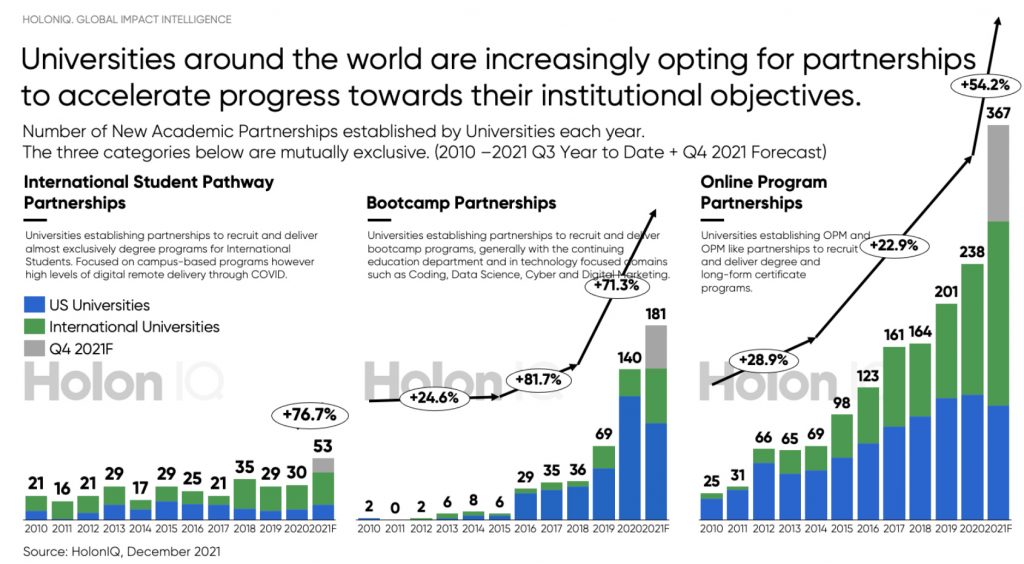
450+ University Partnerships in the first three quarters of 2021 — from holoniq.com
Presidents, Vice Chancellors, Provosts and Deans around the world are increasingly opting for partnerships to accelerate progress towards their institutional objectives.

Excerpts:

International Education is ramping back up, potentially bigger than ever. Bootcamps are booming and the OPM model is evolving further and expanding globally. Behind this growth are University administrators with less funding, more competition and a ‘mid’ COVID student cohort who demand world class flexible learning with competitive job prospects. Partnerships are increasingly part of the strategic solution.


At the current rate of partnership growth, 2021 will see approximately 600 University Partnerships established, around 200 more partnerships than was established in 2020 and double pre-pandemic levels of 300+ in 2019.


Also see:


2022 Predictions – The Market View: Part 1 — from artificiallawyer.com

Excerpt:

What do people want to see happen in 2022? And what do they think will really take place next year? These were the two questions Artificial Lawyer asked a range of legal tech experts from across the market. The quality of responses was so good, and the views expressed so detailed, that this year the 2022 Predictions will be published in two instalments.

Here we go…

We would like to see states across the U.S. tear down regulatory barriers to innovation in legal services. We would like to see human-centred design thinking at the heart of every product, process, and service. We would like to see our community – from law schools to tech companies – advance the cause of access to justice.


15 best new fonts, December 2021 — from webdesignerdepot.com by Suzanne Scacca

Excerpt:

Are you tired of using the same old Google fonts from website to website? You’re in luck!

In this month’s roundup of the best new fonts, we’re showcasing the latest and greatest fonts from independent type foundries and designers worldwide.


From DSC:
When I ran across the items below, I couldn’t help but wonder…”What does the legal realm need to know here?”

The Ultimate List Of Crypto Lending Platforms — from 101blockchains.com by Diego Geroni

The Ultimate List Of Crypto Lending Platforms

Know The Vulnerabilities And Security Concerns Associated With NFT — from 101blockchains.com by Diego Geroni

Know The Vulnerabilities And Security Concerns Associated With NFT

Radar trends to watch: December 2021 — from oreilly.com by Mike Loukides
Developments in Programming, Quantum Computing, Cryptocurrency, and More

Radar trends to watch: December 2021

NFT sales reached $27 billion this year — from protocol.com by Nat Rubio-Licht
OpenSea dominated the business.

UNISWAP – Know Everything About The Largest Decentralized Exchange (DEX) — from 101blockchains.com by Diego Geroni

UNISWAP – Know Everything About The Largest Decentralized Exchange (DEX)


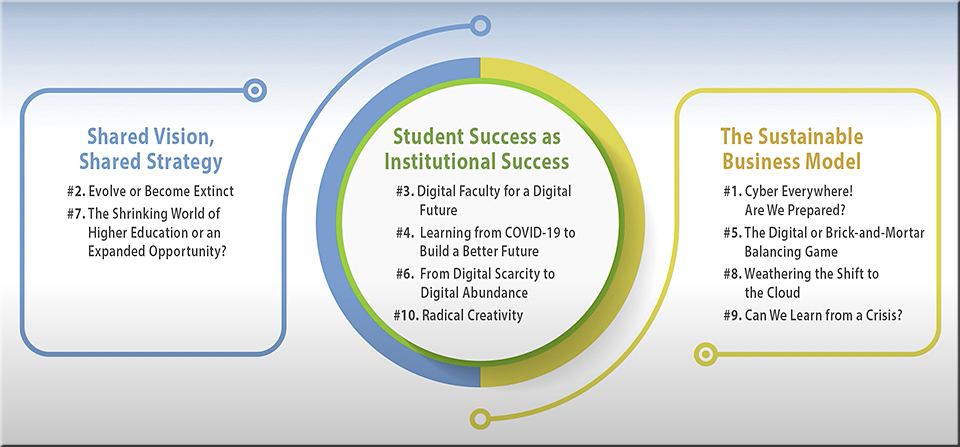
EDUCAUSE 2022 Top 10 IT Issues — from educause.edu

EDUCAUSE's 2022 Top 10 IT Issues


EDUCAUSE's 2022 Top 10 IT Issues

Excerpt (emphasis DSC):

The EDUCAUSE 2022 Top 10 IT Issues take an optimistic view of how technology can help create the higher education we deserve —through a shared transformational vision and strategy for the institution, a recognition of the need to place student success at the center, and a sustainable business model that redefines “the campus.”

See the 2022 Top 10 IT Issues

Almost two years into a global pandemic, it’s clear the higher education we knew will never return and now we can focus on getting the higher education we deserve.


From DSC:
I’m assuming that the we in the we deserve (as highlighted above) includes the students, as *the students* are the ones who most need for things to change.

That said, I’m doubtful such profound change will occur within higher education as it stands today. The existing cultures may prevent such significant and necessary change from occurring — and higher ed isn’t used to dealing with the current exponential pace of change that we’re experiencing. Plus, the downward spirals that many institutions are in don’t always allow for the new investments, programs, and/or experiments to occur. But who knows? When institutions of traditional higher education have their backs pressed up against the walls, perhaps such institutions and the people within them will be forced to change. There are innovative individuals and institutions out there. (I’m just not sure how much they’ve been listened to in many cases.)

To help students truly succeed means to change one’s core products/services — one’s story. But higher ed loves to play around the edges…rarely letting the core products/services get touched. 

To me, student success includes having students pay far less and, while still getting a solid liberal arts education/foundation, can get solid jobs immediately upon graduation. At least that’s my hope as we head into 2022. 

But what student success looks like may be different in the future.

Perhaps in 5 years, we will have moved much more towards a lifelong learning situation. Individuals may have joined a global, next-generation learning platform whereby one teaches for X minutes of the day, and learns for Y minutes of that same day. AI-based dashboards let people know which skills are in high demand, and then offer a menu of choices for how to acquire those skills.

A couple of lasts comments:

  • Being data-driven won’t save an institution. Vision might. But being data-driven has its limits.
  • The digital transformations being talked about within institutions of traditional higher education may be too little, too late. This conversation should have taken place a decade or more ago. (I think I just heard an “Amen!” from some folks who used to work at Blockbuster. They didn’t think a transformation was necessary either….but they learned their lesson the hard way. We should have learned from their situation…a long time ago. And I’m sure that you can think of other examples as well.)


Teaching in the ‘Metaverse’? Roblox Looks to Make It a Reality — from edweek.org by Benjamin Herold
With millions in new grants to STEM organizations like Project Lead the Way, the gaming platform is moving into K-12 education.

Excerpts:

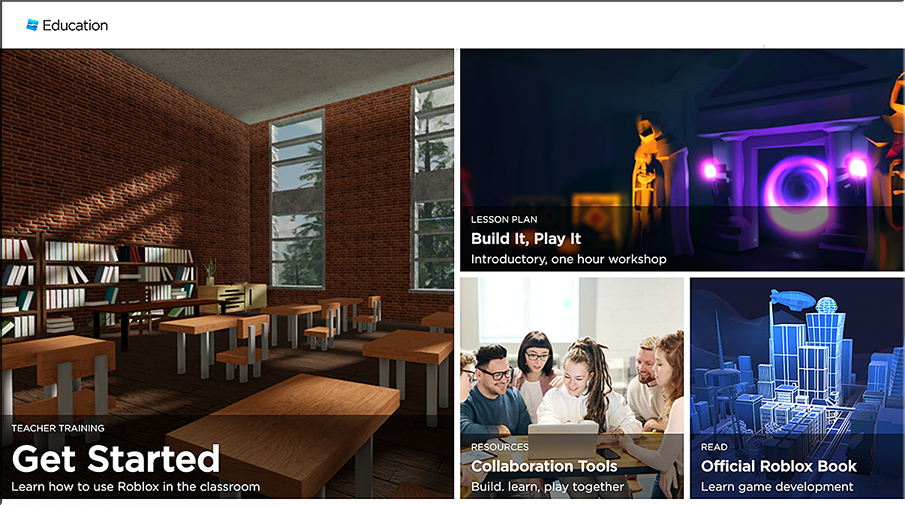
Hoping to expand its presence in K-12 schools, gaming company Roblox announced this month a new $10 million fund to support the creation of online learning experiences that take advantage of its platform’s unique way of letting users play, explore, and socialize in an endlessly evolving virtual world.

Roblox aims to play a major role in the emerging metaverse. Expanding into classroom education is a key vehicle for making that happen, Kantar told investors at a November conference. The company’s stated goal is to reach 100 million students worldwide by the end of the decade.

Making such inroads with K-12 schools, however, is no sure bet.

Also see:

Roblox Education


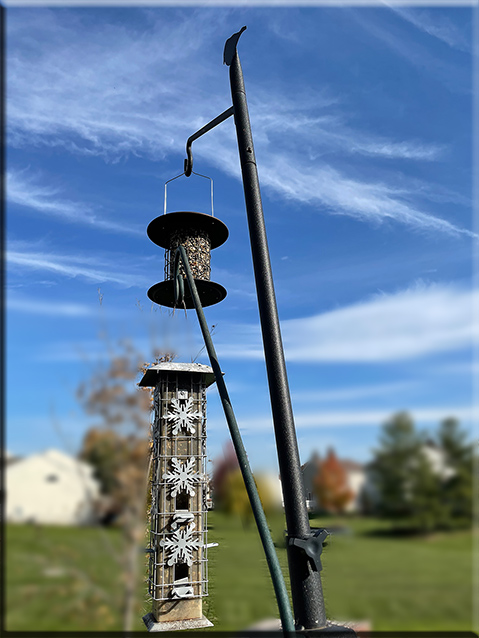
The birds have fled from the bird feeders...

From DSC:
Each day, I try to ensure that there’s enough bird seed in the bird feeders. You see, I’m a bird watcher and I especially enjoy the different kinds of birds in our area as well as appreciating the variety of colors and designs of the birds. But it often perplexes me when the birds fly away when they see motion in our kitchen. They become afraid and in a spirit of looking out for #1, they fly away.

Hmmm. I’m setting out food to help you survive, yet you fly away in fear when I come close.

I wonder if that’s how the LORD feels with me/us sometimes. He provides so richly, deeply, and generously (waaaaayyy more than I do). Yet I can’t help but wonder if He senses our fears, doubts, and our “flying away” from Him at times…? He provides. We fly.

The situation is getting better. And my trying to be faithful helps the birds overcome their anxieties. They are staying on the bird feeder more often, even when they see me approach. It appears that the trust levels are growing. 


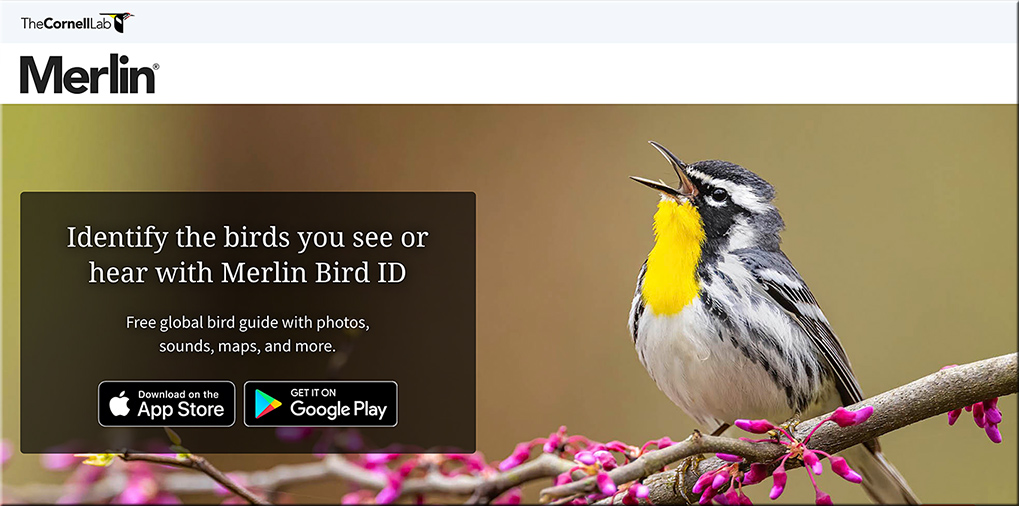
Along the lines of bird watching, below is a very cool app I just recently saw. I can use all the help I can get in this area (not to mention a ton of other areas)!

Identify the birds that you see of hear with Merlin Bird ID


Will Microcredentials be the Rx Needed to Fix Our Ailing Degree Systems? — from evolllution.com by David Leaser | Senior Program Executive of Innovation and Growth Initiatives, IBM
Amidst the dramatic social and economic upheaval caused by the pandemic, microcredentials are presenting themselves as the viable solution to getting learners prepared quickly and effectively for desperately needed jobs. 

Excerpts:

Pace of Change Accelerates Beyond Our Wildest Imagination 
But the world of work is changing at a pace that traditional education systems cannot match. Cloud computing, big data and AI technologies are replaced or improved monthly—and often faster than that.

The U.S. college system is organized around an all-or-none framework: You only get a credential after completing the entire learning path.  But when a large number of students cannot commit to a long-term commitment (the situation we have faced for decades), shouldn’t we break the learning down into credentials along the way?

The MicroBachelors: A Major Win for Credential As You Go
Today, most microcredentials provide the opposite of college degrees: high skill-signal strength but low social-signal strength.

MicroBachelors programs are a series of college classes that have been customized and grouped together to meet employers’ real-world needs. The programs typically take two to four months to complete and provide credentials and college credits.


No Textbooks, No Lectures, and No Right Answers. Is This What Higher Education Needs? — from chronicle.com by Beth McMurtrie
From DSC: Though this was back from 2/10/19, Beth recently linked to it on The Chronicle and it caught my eye due to it’s focus on solving real-world issues and problems.

Excerpts:

Tackling big problems is the point of JMU X-Labs, a four-year-old experiment in undergraduate education. Through a blend of interdisciplinary collaboration, project-based learning, and unscripted, open-ended research, each course takes students through the long and often aggravating process of developing new ways of thinking about complex problems.

They might design drones to help with environmental problems, tackle foreign-policy challenges, build autonomous vehicles, or develop medical innovations to help with the opioid crisis.


Got Teacher Burnout? Launch A Microschool — from forbes.com by Kerry McDonald

Rather than abandoning their passion for teaching, some educators are discovering that they can do what they love and avoid the bureaucracy and stress of a conventional classroom by starting their own microschools.

Microschools are modern twists on the quaint, one-room schoolhouse model, where small, multi-age groups of students learn together in more intimate educational settings, such as private homes, with individualized attention from adult educators and facilitators. Interest in microschools accelerated over the past year, as school shutdowns led parents to consider home-based “pandemic pods” to help their children learn in small, safe groups. 


Top Resources For Students To Discover Real World Problems and Issues

Top Resources For Students To Discover Real World Problems & Issues — from edtechreview.in by Saniya Khan

Are you looking for ways to help students learn about world issues: climate change, cultural diversity, biodiversity, education, water crisis, [homelessness] and more to build awareness about global issues and develop global competence?


Report Finds US Workers Lagging in Digital Skills — from technewsworld.com by John P. Mello Jr.

Excerpt:

Many Americans lack the digital skills needed to be productive members of the workforce in the 21st century, according to a report released Monday by a Washington, D.C. think tank.

One-third of U.S. workers lack digital skills, with 13 percent having no digital skills and 18 percent having, at best, limited digital skills, noted the report by the Information Technology & Innovation Foundation, a science and technology institute.

In essence, the ITIF reported, one in six working-age Americans are unable to use email, web search, or other basic online tools.

Also see:

Even though we may not be able to predict the jobs of the future, we can begin to crack the labor market code in today’s economy and home in on the hybrid, or human and technical skills that will help working-age adults prepare for the jobs of today and tomorrow.


VRJAM -- the metaverse platform for music

The VRJAM metaverse platform is coming to transform the world of live entertainment 

VRJAM, the UK’s leading creator of live music experiences in virtual reality, today teased the launch of the VRJAM platform, a revolutionary new metaverse events platform and NFT creation solution. 

To bring the VRJAM metaverse platform to life, VRJAM has partnered with market leading NFT software developer Enjin.io to launch a rich virtual reality world that offers a host of new solutions for artists to render and monetize their music and live shows in amazing new ways using NFT’s, blockchain and immersive technology.  

The VRJAM platform promises to open up completely new ways for both fans and artist to experience live music events and represents the next step in the evolution of live music. 

Ownership of this virtual world will be shared by a guild of globally recognised artists and record labels who will cooperate to create value and define new possibilities for music inside the metaverse. 

VRJAM’s metaverse platform offers solutions for true live performance using technology that is years ahead of other similar platforms. It provides unsurpassed user experience and offers fans, artists and labels an array of unique features:
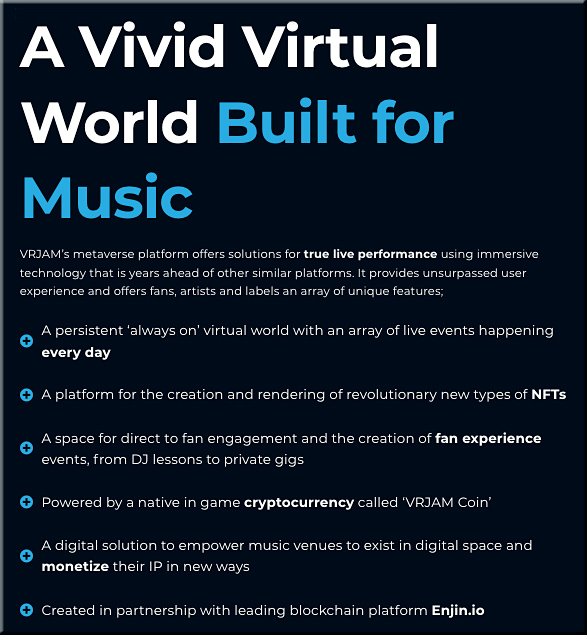
VRJAM's metaverse -- a vivid virtual world built for music

At the heart of the VRJAM metaverse platform is a blockchain based trading and finance system, VRJAM Coin. This revolutionary new cryptocurrency will create ways for both artists and fans to earn money inside the metaverse and promises to create entirely new business models for artists, venues and labels at a time when their traditional ways of making money have been turned upside down by the Covid 19 pandemic. 

The VRJAM cryptocurrency is backed by investment from 5 of the world’s leading blockchain specialist investment and venture capital firms, demonstrating the exciting potential of VRJAM’s tech.

The VRJAM platform is scheduled to go live in early 2022, follow on social media to stay up to date.


From DSC:
Hmmmmm….might this type of thing spill over into the worlds of teaching and learning? More direct-to-consumer (learner) types of offerings? Will this open up the doors for new methods of earning a living or for  those interested in building a teaching & learning-based brand?

Alternatively, will this impact what actors, actresses, and comedians will be able to do?


Addendum on 12/2/21:


EduMAX 2021 recap: Together for student success around the globe — from blog.adobe.com by Sebastian Distefano

Excerpt:

University CIOs, deans, provosts, faculty and staff from more than 100 institutions convened online for the Adobe EduMAX 2021 conference, where academic leaders shared how they are transforming teaching and learning practices across their campuses. Key discussion points included:

  • How digital literacy increases engagement to bring faculty and students together, whether they are in-person, online or in a hybrid environment.
  • How digital literacy closes the skills gap in higher education and industry by fostering critical essential skills that employers value.
  • How faculty can integrate digital literacy across the curriculum for all students.
 
© 2025 | Daniel Christian