Journalism program sees positive changes in move from traditional Journalistic Writing courses to Multimedia Communication Model — from jeadigitalmedia.org by Jason Block

Excerpt:

Change is hard.

Change after 15 years? Now that can be downright painful.

Yet that was the exact situation I was in when my district in suburban Chicago decided that we were doing away with our traditional Journalistic Writing courses and shifting to a Multimedia Communication model. This was a part of our larger mission to create a “career pathway” for prospective journalists in our building and district, and while I was excited about that possibility, it made me itchy to remove both the words “journalism” and “writing” from my course titles.

Without getting into the logistics of the shift — that should definitely not be the purpose of this post, unless my purpose is to put you all to sleep — I can tell you definitively and without hesitation that this has been a blessing in disguise, a journalistic silver lining that has not only invigorating me, but also my program as a whole.

The most notable change has been in my enrollment numbers. Whereas I used to struggle to fill one section of “J1,” I now for the first time in my 18 years at Prospect have two full sections of the Introduction to Multimedia Comm course. With all of us fighting the constant recruiting battle to keep our numbers up, having a broader base of students to appeal to has made that job infinitely easier.
 

From DSC:
I’m not saying not to go there…but one has to be very careful when dealing with cryptocurrencies. As the items below show, you can mess up…big time.

From DSC:
And that bit about the decimal point is key! I tried to locate an article that I recently read that described how one person lost hundreds of thousands of dollars because he misplaced the decimal in his asking price for a cryptocurrency. It was worth hundreds of thousands of dollars, but he said that his big thumbs got in the way. He mistyped the asking price and hit the Enter key before he recognized his mistake. He sold the cryptocurrency for a fraction of its real value. In that case, one would hope that the buyer would extend some grace and readjust the price. But that didn’t happen in this case. Ouch!


From DSC:
Again, I’m not saying that this area may not represent an enormous new, impactful, prosperous wave to ride. But I need to do a whole lot more learning before I feel comfortable jumping into this ocean.

That said when I read the quote below…I wondered:


Quality Matters > Higher Education News > December 2021

Throughout the year, we — along with members of our amazing community — share resources to help all of us deliver on our online promise. Here are some of the most popular items from 2021 for you to use and share:


AI bots to user data: Is there space for rights in the metaverse? — from news.trust.org by Sonia Elks
In a virtual world populated by digital characters, privacy and property rights face unprecedented challenges, campaigners say

From virtual goods to AI-powered avatars that can be hired out by companies, a fast-growing digital world is pushing ownership and privacy rights into unchartered territory.

NYC Targets Artificial Intelligence Bias in Hiring Under New Law — from news.bloomberglaw.com by Erin Mulvaney

New York City has a new law on the books—one of the boldest measures of its kind in the country—that aims to curb hiring bias that can occur when businesses use artificial intelligence tools to screen out job candidates.

Employers in the city will be banned from using automated employment decision tools to screen job candidates, unless the technology has been subject to a “bias audit” conducted a year before the use of the tool.

‘Innovation Averse’ Law Schools Risk Missing Out on the Legal Industry’s Regulatory Renaissance — from law.com

“If law professors and legal educators and law school administrators aren’t in tune with how the practice of law is changing, not just in terms of how you deliver legal services, but these new areas that are emerging, then we’re doing a great disservice to our students,” said April Dawson, associate dean of Technology and Innovation at North Carolina Central University School of Law, during the “Redesigning Legal” speaker series panel discussion this week.


From DSC:
The following items are from a recent presentation by Zach Abramowitz entitledLegal Disruption: Key Trends to Watch in 2022.” By the way, you can sign up for Zach’s legal newsletter at zachabramowitz.substack.com/


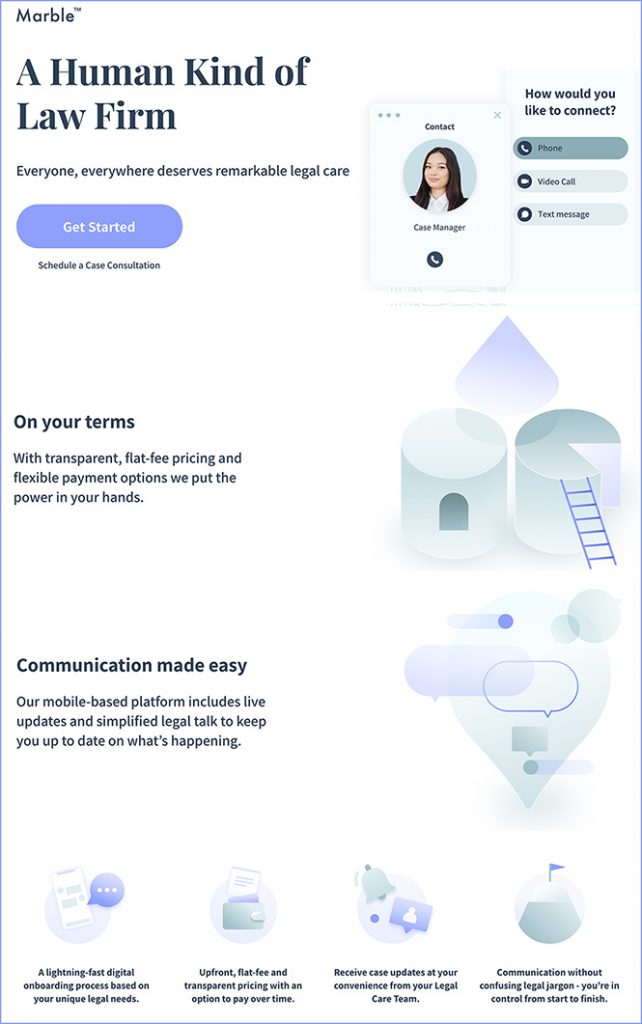
Marble Law


Darrow raises $20 million to uncover corporate legal violations and bring justice to all — from calcalistech.com by Meir Orbach
The Israeli startup is focused on locating violations that have caused damage to millions of people on average – the threshold for a potential class-action lawsuit

Excerpt:

Darrow has developed a machine learning-based platform which discovers legal violations by some of the biggest corporations in the world. Operating chiefly in the U.S., the company is focused on locating violations that have caused damage to millions of people on average – the threshold for a potential class-action lawsuit.


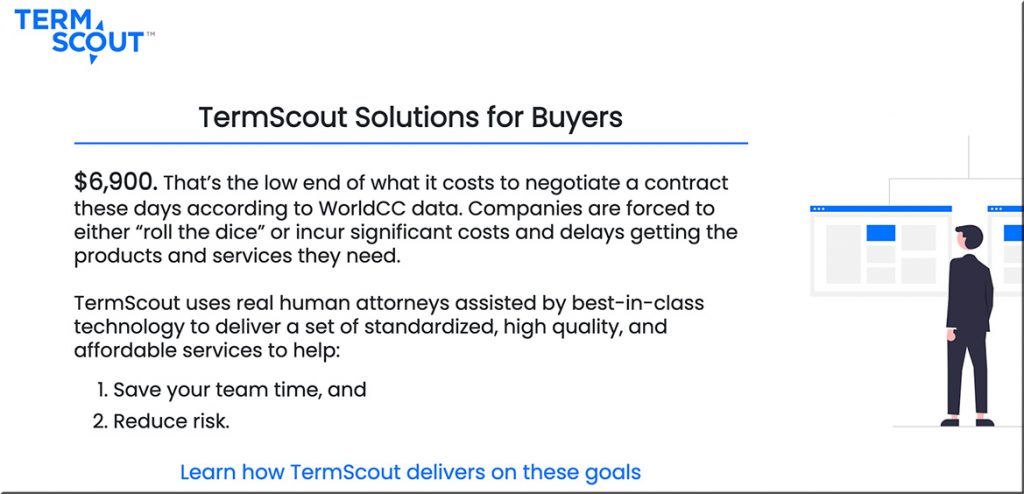
TermScout

Term Scout


Digital Learning Talent In Demand & More 2022 Hiring Trends — from teamedforlearning.com
2022 Hiring Trends in digital learning put job seekers in the driver’s seat. Learn how to use these trends to your advantage in education or corporate L&D.

Excerpt:

Now is an amazing time to look for a job in digital learning. The events of the last few years have boosted the demand for digital learning experts in all areas. That includes corporate L&D, higher ed, K-12, edtech, and commercial e-learning. As more organizations embrace a digital learning model, the demand for talent will continue to grow. The 2022 Hiring Trends in Digital Learning are all headed in one direction: up.

Our work connecting talented digital learning professionals with the organizations that need their skills has given us a sneak peek at the 2022 hiring trends in digital learning. And we’re ready to share those insights with you. Here’s what you need to know if you’re a job seeker in the digital learning industry.


UNC’s $97 Million Plan to Reach Adult Online Learners — from insidehighered.com by Suzanne Smalley
University of North Carolina will create an internal unit to build and manage online programs from the system’s 17 campuses for learners largely ignored by many universities.

Excerpt:

The University of North Carolina system is leveraging $97 million in pandemic recovery funding to launch a nonprofit ed-tech start-up intended to bolster adult online education in a state with a looming need for more skilled workers.

Project Kitty Hawk is named after the North Carolina beach town the Wright brothers returned to repeatedly before achieving their dream of flight, an apt metaphor for an undertaking that UNC leaders herald as a transformative effort to reach the state’s estimated one million working adults who have some college education but no degree.


Autumn morning — from 500px.com by David Dai


Desert Camel by Xiao Yang — from 500px.com

Discover by Reacto Carbon — from 500px.com

Discover by Reacto Carbon


Adobe’s Creative Cloud Express brings content editing to the masses — from protocol.com by Lizzy Lawrence
It’s competing directly with Canva, a template-builder for non-professionals.

Excerpt:

Historically, Adobe’s software was made for the pros. Applications like Photoshop, Illustrator and Premiere Pro all require a paid Creative Cloud subscription and a certain level of expertise. But with Monday’s launch of Creative Cloud Express, Adobe is targeting anyone who might find graphic design useful: small businesses, students and social media influencers.

Also see:

Also see:

Adobe Creative Cloud Express


Top 10 Healthcare Artificial Intelligence News Of 2021 — from medicalfuturist.com by Dr. Bertalan Meskó & Dr. Pranavsingh Dhunnoo

Excerpt:

As 2021 is about to wrap up, we are reflecting on some of the most important news revolving around artificial intelligence (A.I.) in healthcare. These range from the principles laying the groundwork for the safe and effective development of A.I.-powered medical devices to a sober look at the technology’s role in the pandemic. Without further ado, let’s take a look at the top 10 healthcare A.I. news of the year that was.


A handful of colleges are finally providing training in a way consumers want it: fast — from hechingerreport.org by Jon Marcus
‘Rapid reskilling’ seeks to speed up the frustratingly slow pace of switching careers

Excerpts:

Such so-called rapid reskilling remains surprisingly rare in public and nonprofit higher education, which generally has been slow to respond to the need for accelerated training among the nation’s many career-switchers.

While conventional education institutions have long offered what they call short-term training, what they often mean by that is “shorter than it takes to get a degree.” Such programs still typically follow academic semesters that start only in the fall or spring and meet for a few hours a week, stretching on for months or years.

“We have really picked up the pace,” said Urban. “That’s something that is very, very attractive to career-switchers. People want it faster and they want it cheaper and they want it more conveniently. And that’s not a mode of operation in which traditional colleges and universities have thrived.”


29 Big Ideas that will change our world in 2022 — from linkedin.com by LinkedIn News

Excerpts:

Students skipped out on college in droves during the pandemic: undergraduate enrollment has fallen 7.8% since the fall of 2019. To get students to return to school — or come at all — colleges will need to make their pandemic-era flexible options permanent and adopt new approaches to education.

With a demographic cliff coming in the middle of this decade as the number of high-school graduates falls off, providing something different is the only way all but the biggest brand names in higher education will survive. — Jeff Selingo, author of “Who Gets In and Why: A Year Inside College Admissions


Virtual law firms see 38% jump in recruitment — from personneltoday.com by Adam McCulloch

Excerpt:

In late 2020, 1,355 lawyers worked for such virtual firms, a number that has risen to 1,875 by autumn of 2021. In 2019, 1,272 worked for such firms.

Also see:

 
© 2025 | Daniel Christian