



On 12/22/2021,
in Daniel S. Christian, faith, global / globalization, hearts -- matters of the heart, relationships, religion, society,
by Daniel Christian
On 12/22/2021,
in A/V -- audio/visual, animation, art, career development, content development, aggregation, repositories, creativity, digital audio, digital learning, digital photography, digital storytelling, digital video, education technology, engagement / engaging students, experimentation, homeschooling/homeschoolers, human-computer interaction (HCI), ideas, innovation, instructional design, interactivity, K-12 related, learning, learning ecosystem, Learning Experience Design, media/film, participation, passions, project-based learning, skills, story, storytelling, student-related, teachers, teaching & learning, technologies for your home, tools, vendors, vision/possibilities, web-based collaboration, youth,
by Daniel Christian
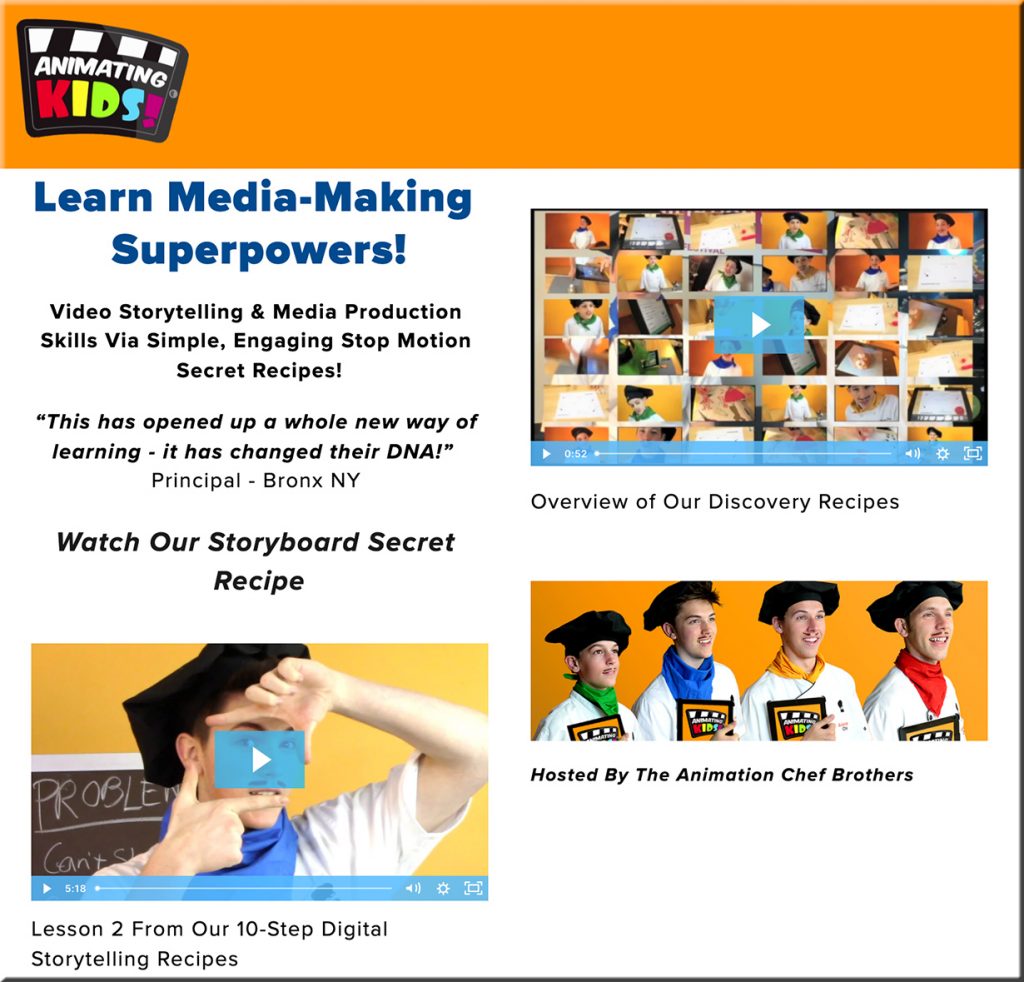
AnimatingKids.com — with thanks to Mrs. Julie Bender (an excellent art teacher within the K-12 space) for this resource
Free examples:
- 4 New Animation Kits Below
PDFs with How-to videos, secret animation recipes, and printable coloring sheets.
On 12/22/2021,
in 21st century, 24x7x365 access, A/V -- audio/visual, adult learning, Apple, cloud-based computing / apps / other cloud-related, communities of practice, digital audio, digital learning, digital storytelling, digital video, e-publishing related items (EPUB and more), e-readers, education, education technology, engagement / engaging students, Google, homeschooling/homeschoolers, ideas, innovation, K-12 related, learning, learning ecosystem, Learning from the Living [Class] Room, learning hubs & pods & microschooling, library / librarians, media/film, mobile learning, multimedia, music, online media, passions, play, reading, story, storytelling, student-related, television, tools, United States, vendors,
by Daniel Christian
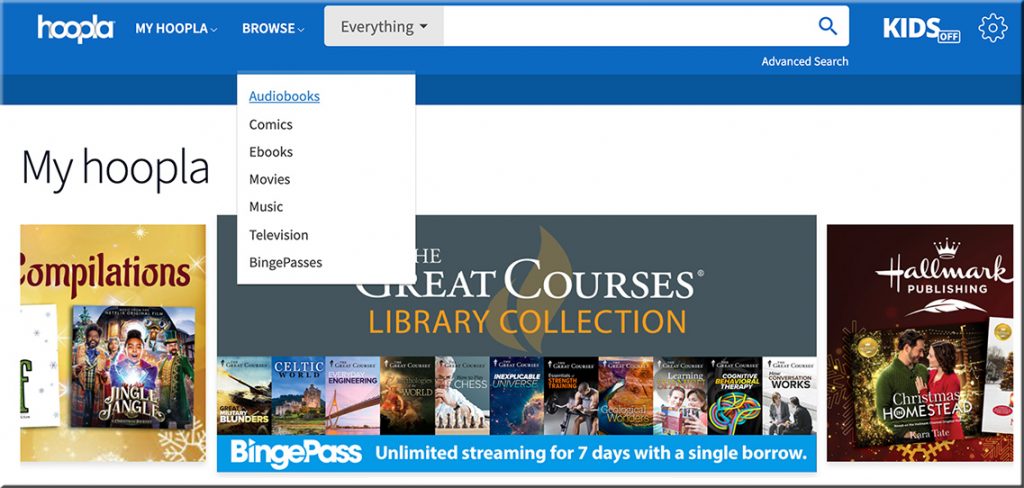
hoopla digital is a digital streaming service for library users to access eBooks, eAudiobooks, music, movies, and TV shows using portable devices like smartphones and tablets.
From DSC:
I downloaded this app yesterday and borrowed a classical Christmas album on the spot. Our local library gives us 10 items per month:
- Books are available for 21 days
- Videos are available for 72 hours
- Music titles are available for 7 days
NOTE: hoopla is available on desktops, phones, tablets, Alexa devices, Rokus, Apple TVs, Fire TVs, and Android TVs.
On 12/21/2021,
in animation, art, attention, Canada, communications, creativity, design, digital audio, digital learning, digital storytelling, digital video, education technology, educational games / serious games, elearning, engagement / engaging students, Google, graphics, mathematics, media/film, more voice more choice more control, motivation, multimedia, music, online learning, online media, participation, pedagogy, platforms, play, presentations, productivity / tips and tricks, professional development, remote teaching and learning, science, society, STEAM-related, story, storytelling, student-related, teachers, teaching & learning, teaching online, tools, vendors, youth,
by Daniel Christian
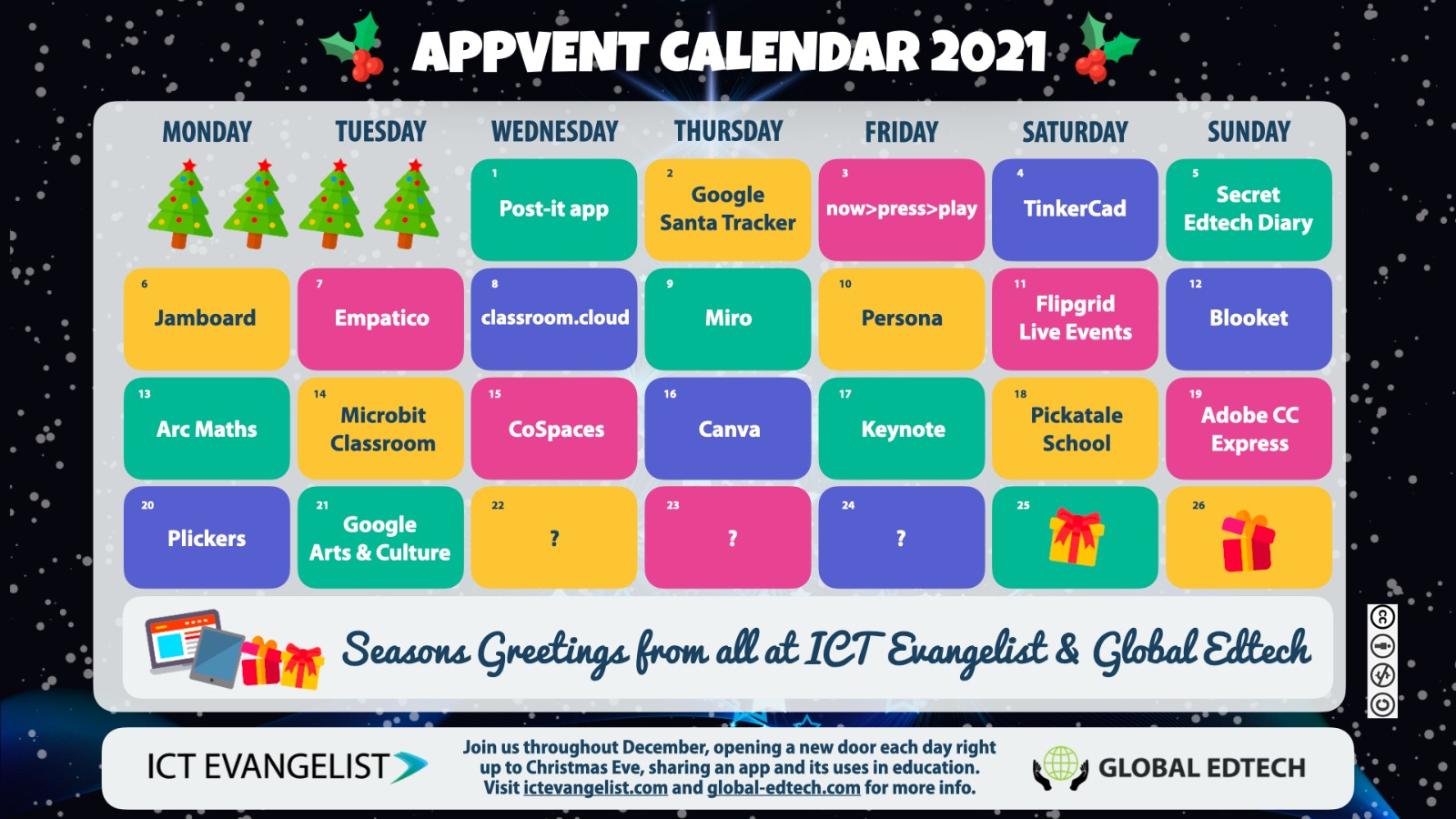
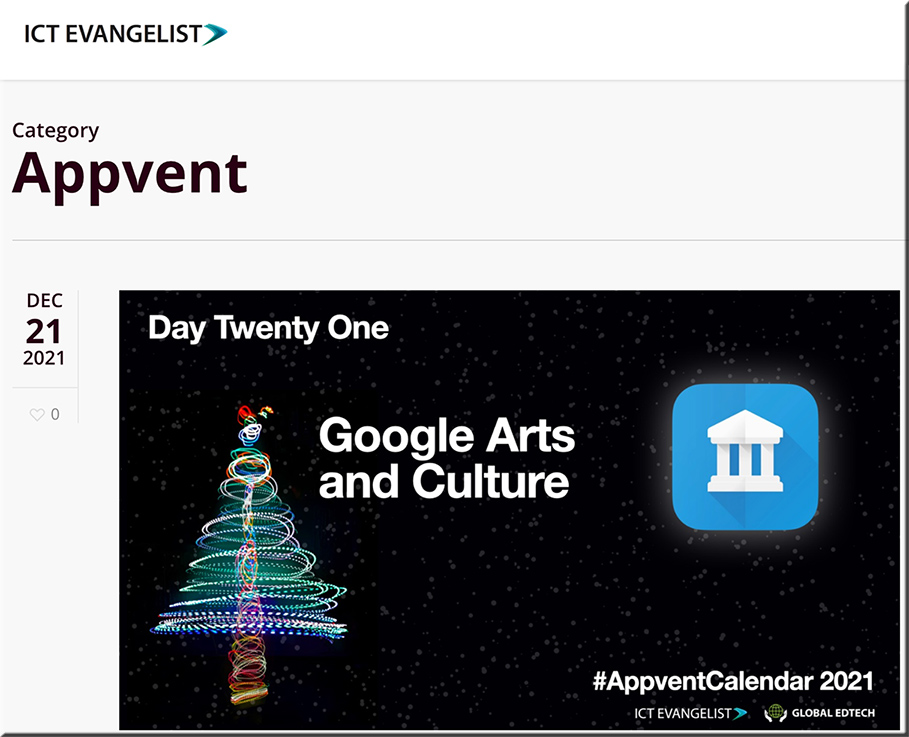
Excerpt from this posting:
Welcome to day 21 of the 2021 Appvent Calendar. It’s been so much fun sharing all of these amazing tools each day across the month so far. With Google featuring twice already on the calendar, it’s great to share again the awe and wonder of human history in the arts and within our cultures with the sharing of this amazing free app. Thanks to Gustavo Calderón De Anda for suggesting it!
Also see:
- 14 measurement apps for teaching math & science — from teachthought and Glenda Stewart-Smith
Glenda Stewart-Smith of Surrey School District #36 in Canada, along with TeachThought staff, helped put together this collection of iPhone and iPad apps that offer all of these measuring abilities and more.
On 12/21/2021,
in business, law schools, Legal operations, legal reform, legal technologies, legislatures / government / legal, vendors,
by Daniel Christian
The top 5 legal technology news of 2021 — fromabajournal.com by Nicole Black
Excerpt:
There were also a significant number of acquisitions, resulting in the unprecedented consolidation of legal technology companies. What follows are the more notable examples, although there were many others that are not listed below.
- Litera acquired Kira Systems, Clocktimizer, DocsCorp and Foundation Software.
- MyCase acquired Soluno, Casepeer and Woodpecker.
- Clio acquired CalendarRules and Lawyaw.
- Francisco Partners acquired Paradigm, which had previously acquired PracticePanther, Headnote, Bill4Time and MerusCase.
- Private equity firm Warburg Pincus acquired NetDocuments.
- Smokeball-Leap-InfoTrack Group acquired LawLytics and Lawgical.
- ProfitSolv acquired Tabs3 (and also owns Rocket Matter, Cosmolex, LexCharge, ImagineTime and TimeSolv).
- Veritext acquired Reportex.
- Intapp acquired Repstor.
- Onit acquired Bodhala and BusyLamp.
- Consilio acquired Xact Data Discovery.
Also see:
- Legal Transformation Is A Business Story — from forbes.com by Mark Cohen
Excerpt:
The first step in law’s transformation journey is to align the legal function with the mission, purpose, and culture of business and to instill a customer- centric, team-oriented mindset. This is not an easy or quick process, but it is a necessary one. The legal function cannot achieve alignment unless it: speaks the language of business and understands its goals and risk profile, works proactively and at the speed of business, operates as a team (internally and across the enterprise), upskills, and adopts a customer-centric, results-oriented approach to everything it does. Legal must embrace the data-backed, tech-enabled, multidisciplinary approach to problem-solving, value-creation, and customer-centricity of business.
On 12/21/2021,
in Blockchain, business, business side of he, career development, change, changing business models, collaboration, communications, copyright/ownership/NFTs, corporate / business world, creativity, cryptocurrencies, disruption, economics, future, game-changing environment, generational differences, ideas, innovation, interaction design, interactivity, internet, IT in HE, new business models, platforms, play, vendors, Virtual Reality (VR) / worlds / learning, vision/possibilities, workplace, XR - extended reality,
by Daniel Christian
Web 3.0 vs Metaverse: What’s the difference? — from homo-digitalis.net by Fabian Schmidt
Excerpt:
So what is Web 3.0?
On Twitter, a user asked if someone could explain the term in baby talk. I thought one answer was good:
-
- Web 1.0 = Read
- Web 2.0 = Read/Write
- Web 3.0 = Read/Write/Own
This is a sufficient simplification to gain an initial understanding. Yet a bit more information is still important.
Let’s get one thing straight right away. As with all things in the making, there is not yet a clear-cut definition of Web 3.0. Tim Berners-Lee, the inventor of the classic web, thinks of the semantic web as the next big step.
…
Since 2020/2021, there is another idea of Web3, and it is inspired by a new form of technology: Blockchains. At its core is a new wave of decentralization.
Besides decentralization, other key topics related to Web 3.0 include Decentralized Autonomous Organizations (DAO), Non-fungible-tokens (NFT), and Decentralized Finance (DeFi).
The metaverse is a digital world that is meant to feel as real as possible and can represent all concerns of human existence. From leisure to work.
Fabian Schmidt, Homo Digitalis, 2021
Bill Gates: Most Work Meetings Will Happen In The Metaverse In 3 Years — from vrscout.com by Kyle Melnick
Excerpt:
“Within the next two or three years, I predict most virtual meetings will move from 2D camera image grids—which I call the Hollywood Squares model, although I know that probably dates me—to the metaverse, a 3D space with digital avatars,” said Gates in the post. “Both Facebook and Microsoft recently unveiled their visions for this, which gave most people their first view of what it will look like”.
Adidas to enter the metaverse with first NFT products — from dezeen.com by Rima Sabina Aouf
Excerpt:
Adidas has announced its next collection will be a mix of digital and physical items, and will be sold as NFTs produced with collaborators such as Bored Ape Yacht Club.
Titled Into the Metaverse, the collection will comprise virtual wearables that buyers can use in online platforms, but also the physical clothing to match.
It is Adidas’ first collection of NFTs, or non-fungible tokens – essentially, digital collectibles with proven authenticity. NFTs act as a blockchain-based certificate of ownership, allowing pieces to be authenticated, bought and collected.
How Coinbase thinks about the Metaverse — from blog.coinbase.com by Brian Armstrong & Alex Reeve
Excerpt:
Primitive Metaverse platforms are selling virtual land for millions of dollars. Billions more are being invested in Metaverse startups. And Mark Zuckerberg recently renamed his entire company to reflect a focus on building the Metaverse.
…
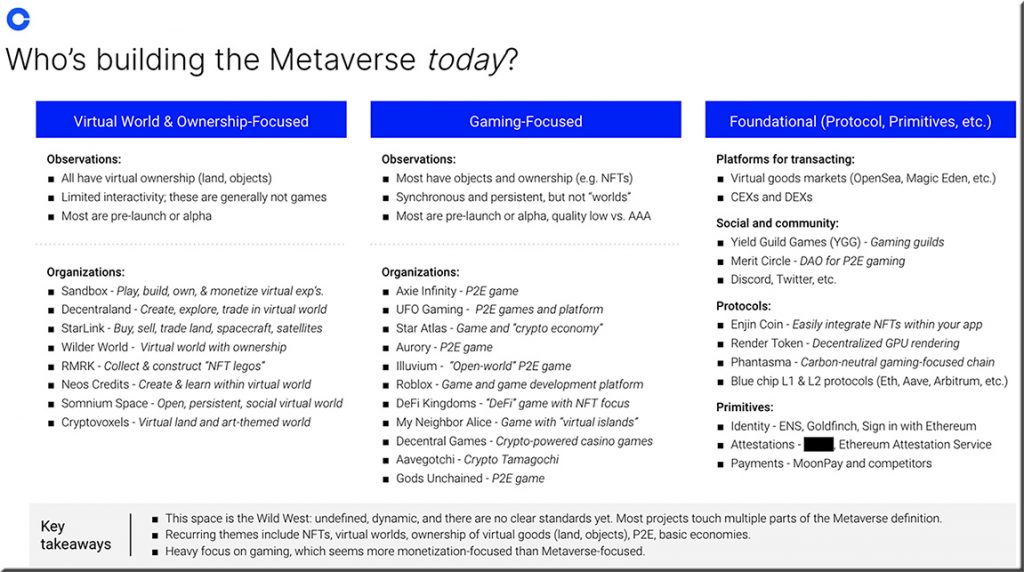
Recently, our team put together an internal presentation about the Metaverse, who’s working on it, and how crypto will help make it real. I thought the presentation was well done, so I’m sharing most of the slides here.
…
Like Matt[hew Ball], we define the Metaverse as:
The future of the internet: A massively-scaled, persistent, interactive, and interoperable real-time platform comprised of interconnected virtual worlds where people can socialize, work, transact, play, and create.
…
The Metaverse is the distant evolution of Web3. In its most complete form, it will be a series of decentralized, interconnected virtual worlds with a fully functioning economy where people can do just about anything they can do in the physical world.
On 12/21/2021,
in 21st century, 24x7x365 access, adult learning, Alternatives, business side of he, change, changing business models, collaboration, colleges, community colleges, competency-based learning/education, disruption, education technology, future of higher education, game-changing environment, learning ecosystem, Learning from the Living [Class] Room, learning preferences, MOOCs -- Massive Open Online Courses, online learning, skills, trends, universities, vendors,
by Daniel Christian
3 major trends affecting ed tech companies — from highereddive.com by Natalie Schwartz
We reviewed what executives said during their latest earnings calls to better understand patterns in the growing sector.
Excerpts:
Earlier on the call, he said Coursera’s entry-level certificates — which are developed by the likes of Facebook, Google, IBM, Intuit and Salesforce — attracted more than 2 million student enrollments since 2018.
“New entrants to the sector, such as corporations and online education companies, will offer genuine competition to traditional colleges, especially as pricing becomes more of a focus,” analysts wrote in the report.
Several ed tech companies are seeing returns from efforts to work with companies to train their employees.
Officials at Udemy, a major MOOC platform that went public in October, said during a call with analysts in early December that their work with companies now accounts for 39% of their revenue – up from 23% a year ago.
On 12/21/2021,
in 21st century, Access to Justice (A2J), Legal operations, legal reform, legislatures / government / legal, policy, United States,
by Daniel Christian
California Lawmakers Ignore Data in Calls to Restrict the Expansion of Legal Services — from iaals.du.edu
Excerpt:
Earlier this week, two California lawmakers spoke up about these issues. Cheryl Miller, writing for Law.com’s The Recorder, reports: “The chairs of California’s two legislative judiciary committees this week accused the state bar of ‘divert[ing] its attention from its core mission of protecting the public’ by pursuing proposals to allow nonlawyers to offer a limited range of legal services.”
California Supreme Court Justice Tani Cantil-Sakauye called the criticism “not surprising,” and we would agree. After all, it is the same message we’ve heard time and again from opponents to any real, impactful change within the legal profession. And the assumptions underlying that message have been discredited by our organization and many other scholars, researchers, and even regulators in other countries. So it is frustrating just how widespread and misleading opponent claims can be.
In response to CA Judiciary letter’s concern about encouraging legal innovation, Professor David Engstrom, CLP’s Lucy Ricca, former LSC President Jim Sandman, Prof. Rebecca Sandefur and others: The A2J crisis is “too urgent to put on the back burner.” https://t.co/Uzo6lej0ti
— SLS Legal Profession (@StanfordCLP) December 17, 2021
Professor @DavidEngstrom5, co-director of @StanfordCLP, discusses the urgent access-to-justice crisis currently gripping CA and the CA State Bar’s Closing the Justice Gap working group. https://t.co/zpbPlwBIhO
— StanfordLaw (@StanfordLaw) December 17, 2021
Heart of the Forest — from 500px.com

Dezeen’s top 10 Chinese architecture projects of 2021 — from dezeen.com

????? by ??? https://t.co/x2akypEnXI #Photography pic.twitter.com/TJpqTudQyW
— #LuxuryTravel (@ZaibatsuPlanet) December 18, 2021
4 shades of blue. pic.twitter.com/88LBwKD1qX
— 3:00am (@3hr00am) December 18, 2021
Yosemite National Park pic.twitter.com/KTRkCAUhkl
— On the Road (@OnTheRoad34) December 20, 2021
On 12/21/2021,
in accessibility / UDL, career development, neurodivergent/special needs, society, workplace,
by Daniel Christian
Guide to Trade School For People with Disabilities — from primeweld.com, with thanks to Sarah Breckon for this resource.
Per Sarah:
The guide includes advice on what people with disabilities should look for in a trade school, common challenges they may face, where to find additional resources, as well as career options in the trades available to people depending on their disability.
Excerpt:
Professionally successful people living with a disability sometimes credit their impairment for boosting their career prospects, because it taught them perseverance and commitment. Others believe that their physical or cognitive differences in certain areas have led them to develop stronger abilities in others.
Choosing a trade school is an opportunity to assess one’s traits and capabilities, and find the right career for applying them.
Jump to a section:
On 12/17/2021,
in Alternatives, Amazon, cloud-based computing / apps / other cloud-related, corporate / business world, corporate universities / corporate training, future, future of higher education, game-changing environment, higher education, human-computer interaction (HCI), professional development, training / L&D,
by Daniel Christian
AWS Expands Access to Free Cloud Skills Training on its Mission to Educate 29 Million People by 2025 — from businesswire.com; with thanks to Ryan Craig for the resource
New AWS digital learning experience, technical courses on Amazon.com, expanded access to AWS re/Start, and Amazon’s first dedicated in-person cloud learning center will put cloud skills training into the hands of millions of people
New AWS Global Digital Skills Study finds the need for digital skills training is greater than ever, with 85% of workers feeling they need more technical knowledge than they did pre-pandemic
Excerpt:
SEATTLE–(BUSINESS WIRE)–[On 11/28/21], Amazon Web Services, Inc. (AWS), an Amazon.com, Inc. company (NASDAQ: AMZN), announced four initiatives to empower learners and make it even easier for anyone with a desire to learn to access free cloud computing skills training and unlock new career possibilities in the cloud. The initiatives announced today include the launch of AWS Skill Builder—a new digital learning experience, the addition of AWS courses to the Amazon.com website, the expansion of the AWS re/Start global reskilling program, and the opening of the AWS Skills Center—Amazon’s first dedicated, in-person cloud learning space.
On 12/17/2021,
in 21st century, 24x7x365 access, A/V -- audio/visual, art, business, change, changing business models, content development, aggregation, repositories, creativity, innovation, new business models,
by Daniel Christian
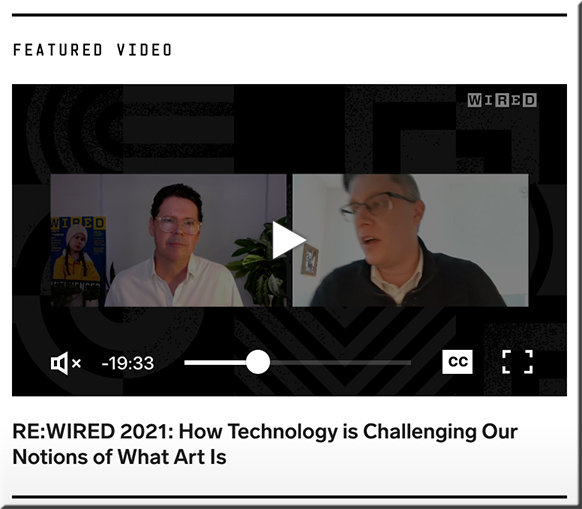
RE:WIRED 2021: Beeple on Art as a Subscription — from wired.com by Greg Williams and Mike Winkelmann
Digital artist Mike Winkelmann, a.k.a. Beeple, shares how his latest piece, “Human One,” will continue to update over time—and what that means for how digital art will be viewed in the future.
From DSC:
The idea was that you buy some digital art — and that art can change at any time. One day, you walk down the stairs, and it looks one way. The next day, things have changed in it.
NOTE:
I saw a much longer version of the above excerpted video when I was viewing the article at “LaTurbo Avedon Is Way Ahead of the Metaverse.” It looked like this:
On 12/17/2021,
in change, digital audio, digital learning, digital video, journalism, multimedia,
by Daniel Christian
Journalism program sees positive changes in move from traditional Journalistic Writing courses to Multimedia Communication Model — from jeadigitalmedia.org by Jason Block
Excerpt:
Change is hard.
Change after 15 years? Now that can be downright painful.
Yet that was the exact situation I was in when my district in suburban Chicago decided that we were doing away with our traditional Journalistic Writing courses and shifting to a Multimedia Communication model. This was a part of our larger mission to create a “career pathway” for prospective journalists in our building and district, and while I was excited about that possibility, it made me itchy to remove both the words “journalism” and “writing” from my course titles.
Without getting into the logistics of the shift — that should definitely not be the purpose of this post, unless my purpose is to put you all to sleep — I can tell you definitively and without hesitation that this has been a blessing in disguise, a journalistic silver lining that has not only invigorating me, but also my program as a whole.
The most notable change has been in my enrollment numbers. Whereas I used to struggle to fill one section of “J1,” I now for the first time in my 18 years at Prospect have two full sections of the Introduction to Multimedia Comm course. With all of us fighting the constant recruiting battle to keep our numbers up, having a broader base of students to appeal to has made that job infinitely easier.