Zechariah 8:16-17 — from biblegateway.com

16 These are the things you are to do: Speak the truth to each other, and render true and sound judgment in your courts; 17 do not plot evil against each other, and do not love to swear falsely. I hate all this,” declares the Lord.


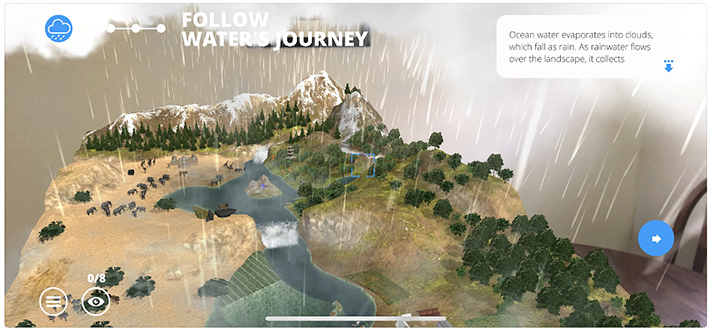
WWF Free Rivers puts an entire landscape in your hands. Through this immersive, augmented reality experience, you’ll discover a river that flows through the lives of people and wildlife, and how their homes depend on those flows. Dam the river to see what happens, and then try different options for sustainable development that keeps the river healthy and flowing. Collect stories of people and animals along the way!

Features

  • In-depth, educational storytelling experience for environmental science
  • Stunning, animated, augmented reality model users can interact with and learn from
  • Five distinct habitats based on real places: the Himalayan mountains, tropical jungles, African savannah, South American grasslands, and Southeast Asian deltas.
  • Opportunity to get involved and help protect rivers, and the people and wildlife that depend on them
  • An augmented reality map of the world’s rivers—and some of the biggest threats and opportunities they face.

A snapshot from the AR-based app called WWW Free Rivers featauring mountains, trees, and a river running through the terrain


American Bar Association (ABA) calls on lawyers to join push to tackle the student debt crisis — from abajournal.com by Reginald Turner

Excerpts:

Graduating from law school and starting a legal career should be an exciting and hopeful time. But for far too many, student debt causes apprehension and struggle.

A 2020 ABA survey found the average debt for law school graduates has increased to more than $150,000—a staggering amount that affects their personal and professional lives and adversely impacts the economy.

The survey found 95% of respondents borrowed money for their JD degrees. Of those who borrowed, more than 80% indicated student debt has disrupted the trajectory of their career or personal life, causing them to weigh salary more heavily in their job selection or put off home purchases, marriage, children or vacations.

While some law school graduates land high-paying jobs at big firms, that is not the reality for the majority. Many new lawyers work at lower-paying public sector jobs—at nonprofits serving disadvantaged individuals; in prosecutors’ and public defenders’ offices; and at local, state and federal government agencies.


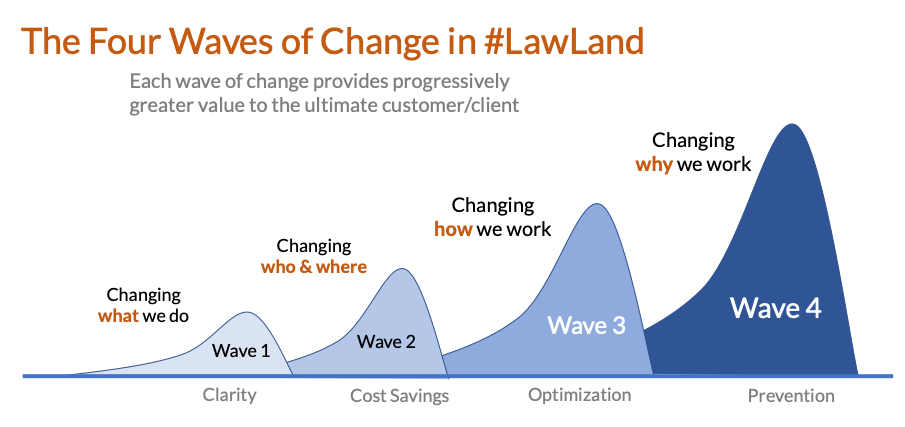
Four waves of change in #LawLand (282) — from legalevolution.org by Jeff Carr

To get to the view of true “better” in legal service delivery, it is useful to return to first principles.  We are not here for ourselves, for the guild.  We are here to promote and protect the social good called “the law” for the benefit and service of those we call clients.   As such, when access to legal assistance is too difficult, too expensive, too unpredictable — and yes, too unfair — it is our job to fix the imbalance. To the extent we — members of the legal profession — ignore the imbalance in order to make another dollar out of a broken status quo, we have become corrupt guardians who betray our professional values.

Unfortunately, the more broken the status quo becomes, the greater our eventual professional reckoning. Thus, in my view, we have no time to waste.

Four waves of change in #LawLand


Reflecting and Planning With Four Lists — from byrdseed.com by Ian Byrd

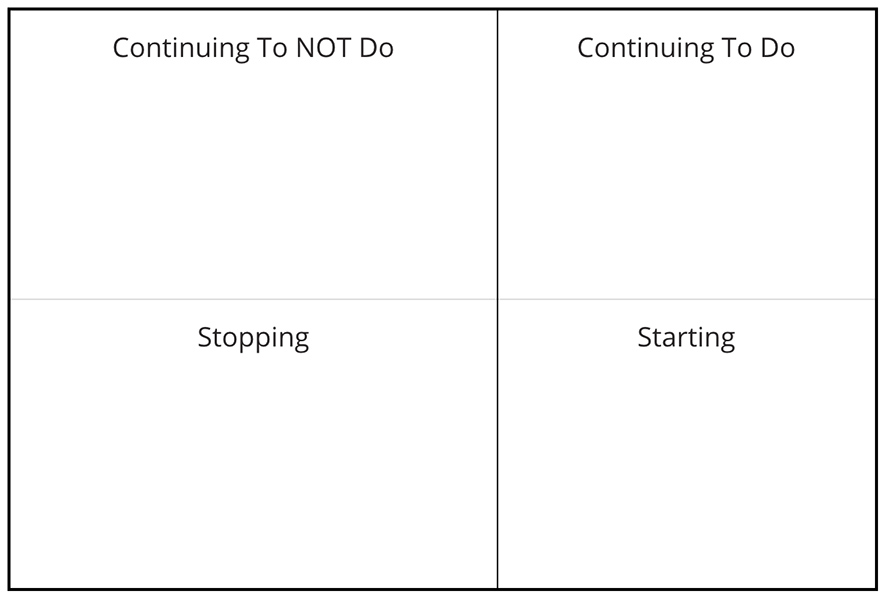
Reflecting and Planning With Four Lists - continuing to NOT do, continuing to do, stopping, and starting

(Parenthetically, be sure to see
Ian’s list of items he put into Byrdseed TV in the year 2021.)


A Case for ‘Radical Simplification’ in Higher Education — from edsurge.com by Robert Talbert
This article is part of the guide Survival Mode: Educators Reflect on a Tough 2021 and Brace for the Future.

Excerpt:

The practice is a common retrospective technique known as Start/Stop/Continue, and it poses three questions:

• What are we not doing, that we should start doing?

• What are we doing, that we should stop doing?

• What are we doing, that we should keep doing?

Sitting in my home office running through this mental exercise, here’s what I came up with…


From DSC:
I haven’t tried this Chrome extension, but it looks interesting.


lunanotes.io — websiteChrome extension page

LunaNotes helps you take notes within YouTube, while still watching the video(s). You can customize your notes with their easy-to-use editor, take screenshots of the video and write, draw or add shapes over the screenshot with their screenshot editor.


7 Hard Truths and a Few Lies — from insidehighered.com by Jennifer Snodgrass

Excerpt:

Would I do it all over again? Am I glad I became an academic? Absolutely. I love my job as a mentor, scholar, administrator and teacher. The moments in my classroom and lab continually make me think, and I am forever learning. Yet I also know that I could have saved myself years of anxiety, disappointment, self-doubt and frustration if I had gone into academe knowing more about what I might encounter. I was taught so much about research deadlines, how to create a syllabus and appropriate scholarship, but not about how to live a successful life as an academic. So now, I am keeping it real for those new scholars coming along.

At the same time, I also plan to keep working to change some of these uncomfortable truths. As full professors, we must look out for our graduate students and junior faculty. We must listen to their concerns and share the realities. We must also recognize that we do hold some power on our campuses. And it is up to us if we choose to use that power and status to be part of the solution, not the problem.


Legal Technology Sector Sees Advancements, Unicorns in 2021 — from pymnts.com

Excerpt:

Legal technology saw numerous advances in 2021 as the still-blooming sector saw greater activity, Reuters reported Wednesday (Dec. 29).

Legal tech involves companies making a variety of tools and services for law firms, corporate legal departments and consumers to use. The sector involves products for eDiscovery, legal spend analytics, lawyer selection, document review and contract management.

LegalZoom.com, CS Disco and Intapp all had initial public offerings (IPOs) this year, and multiple legal tech companies attracted venture capital and private equity investors. Some of their funding rounds reached into the hundreds of millions.


The biggest tech trends of 2022, according to over 40 experts — from fastcompany.com by Mark Sullivan
Startup founders, Big Tech execs, VCs, and tech scholars offer their predictions on how Web3, the metaverse, and other emerging ideas will shape the next year.

We asked startup founders, Big Tech execs, VCs, scholars, and other experts to speculate on the coming year within their field of interest. Altogether, we collected more than 40 predictions about 2022. Together, they offer a smart composite look at the things we’re likely to be talking about by this time next year.


28 Website Accessibility Terms to Know in 2022 — from blog.hubspot.com by Jamie Juviler

Excerpt:

No matter the type of website you run or the industry that you’re in, prioritizing web accessibility is key to your success.

To ensure your website meets today’s standards for web accessibility, you’ll first need to understand the terminology. Accessibility is a big, dense area with a lot of jargon, acronyms, and codes — enough to steer a new website owner away from the topic altogether.

That’s why we’ve put together this glossary of 28 essential web accessibility terms any website owners should be aware of. By knowing the language, you’ll find it much easier to adopt accessibility principles on your own site and better serve visitors with disabilities.

Addendum on 12/31/21:

Accessibility awareness is on the rise, but is it turning into action? — from techcrunch.com by Joe Devon

Excerpts:

Harris Poll reveals that more than half of American adults increased their online activities because of the pandemic. That number grows to 60% for people with disabilities.

The increase in online activities does not mean that everyone is able to achieve their goals. So, what kind of impact is the crisis having on accessibility? Are organizations finally getting the message on the importance of accessibility?

With that, here are the key results from the Alexa top 100 website testing:

    • Out of the websites tested, 62% were accessible to screen readers, up from 40% in 2020.
    • Every single page passed for having the valid document “lang” attribute.
    • Only 11% of websites tested had errors in input field labels.
    • The most common error was the use of ARIA (Accessible Rich Internet Applications specification)
    • The second most common error was color contrast.

From DSC:
That last article linked to:


From DSC:
As the article below clearly relays, MOOCs did NOT fail! In the last decade, they have reached 220 million learners worldwide!

I don’t know the total number of graduates from the Ivy League — throughout all of the relevant institutions’ histories — but I would bet you that MOOCs have reached far more learners. And MOOCs did so in less than a decade. 

And you’re going to tell me MOOCs have been a failure?!!!! Are you being serious!?!?!  You can talk about completion rates all that you want to (and that misses the point, as some people sign up for MOOCs without ever intending to finish the entire course). As with other things, people get out of something what they put into that thing.


A Decade of MOOCs: A Review of Stats and Trends for Large-Scale Online Courses in 2021 — from edsurge.com by Dhawal Shah

Excerpts:

Now, a decade later, MOOCs have reached 220 million learners, excluding China where we don’t have as reliable data, . In 2021, providers launched over 3,100 courses and 500 microcredentials.

Originally, MOOC providers relied on universities to create courses. But that dependence is declining as more and more of the courses are created by companies every year. These corporate partners in course creation include tech giants Google, Microsoft, Amazon and Facebook.

…the majority of the new courses launched on Coursera in 2021 are not from universities anymore.

These mass online courses were born without a business model. Yet within a decade, MOOCs went from no revenue to bringing in well over a half a billion dollars annually.


From DSC:
An interesting approach.


Gaimin has developed an innovative solution to a modern computing problem — from innotechtoday.com by Corey Noles

Excerpt:

Rather than spending billions of dollars on building dedicated resource farms, Gaimin.io are accessing the worldwide gaming community, and utilizing and rewarding this global network of untapped, globally distributed resources of 1.5 billion processing power providers, connected by high-speed internet connections, which can be aggregated, consolidated and then utilized to satisfy any of the myriad of profitable current, and future, needs for processing power.

The Gaimin.io project connects the world’s largest supply of GPU processing power, which belongs to the 1.5 billion gaming PCs in the global gaming community, with the rapidly growing, worldwide demand for massive processing power.


Also see:


The Future of Digital Court Reporting — from legaltalknetwork.com by Tony Sirna, Jim Calloway and Sharon Nelson
Tony Sirna gives an overview of the evolution of digital court reporting and the improvement it has brought about in court proceedings.

Also see:

Webinar: What NOT to do in 2022. Legal Tech trends to ignore! — from onit.com

Excerpt:

How can you sort the helpful trends from the hype?

Three experts from Buying Legal, Consilio and Onit recently gathered to discuss just that. Together, they explored the current state of legal tech and AI, how corporate legal departments should function as we enter the new year and which current legal trends are better to avoid.

Read on to learn which legal tech trends you might want to pass on as we enter 2022.

 
© 2025 | Daniel Christian