Visions of the Internet in 2035 — from pewresearch.org

Excerpt:

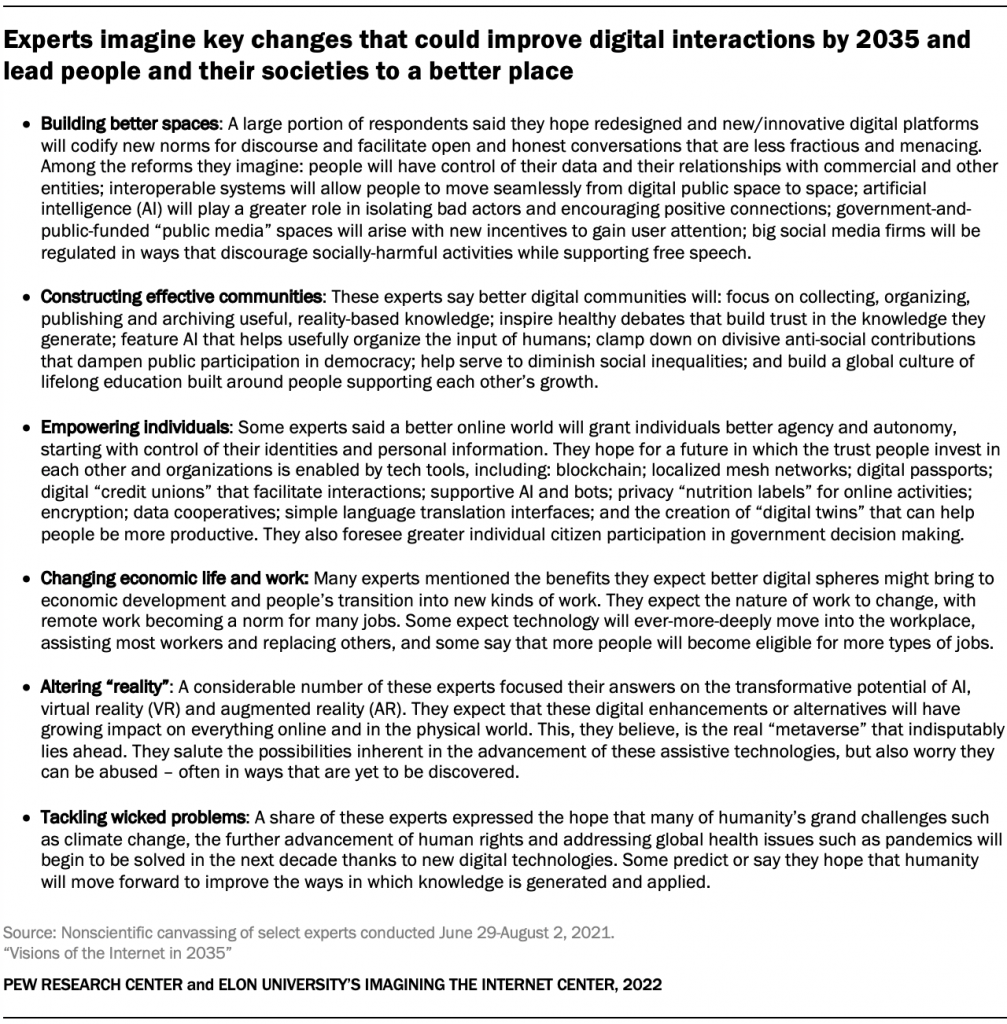
This report is the second of two analyzing the insights of hundreds of technology experts who responded in the summer of 2021 to a canvassing of their predictions about the evolution of online public spaces and their role in democracy in the coming years. In response to the primary research question, many said they expect that these forums will be significantly improved by 2035 if reformers, big technology firms, governments and activists tackle the problems created by misinformation, disinformation and toxic discourse. At the same time, they expressed ongoing concerns about the destructive forces in culture and technology that could continue to plague online life and disrupt beneficial change in the coming years.

Visions of the Internet in 2035


As seen/accessible from this page.

A brief insert from DSC:
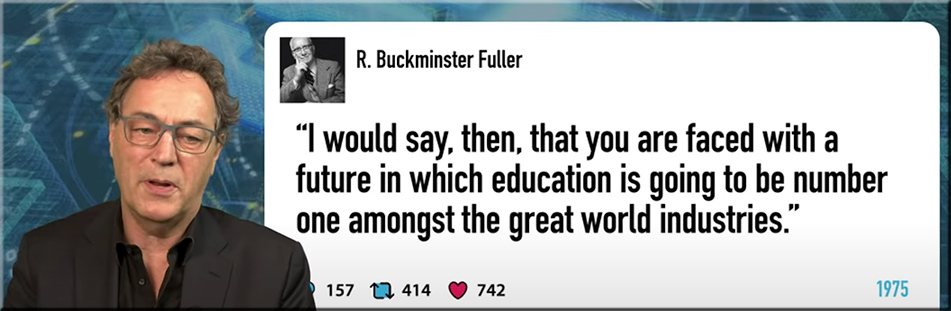
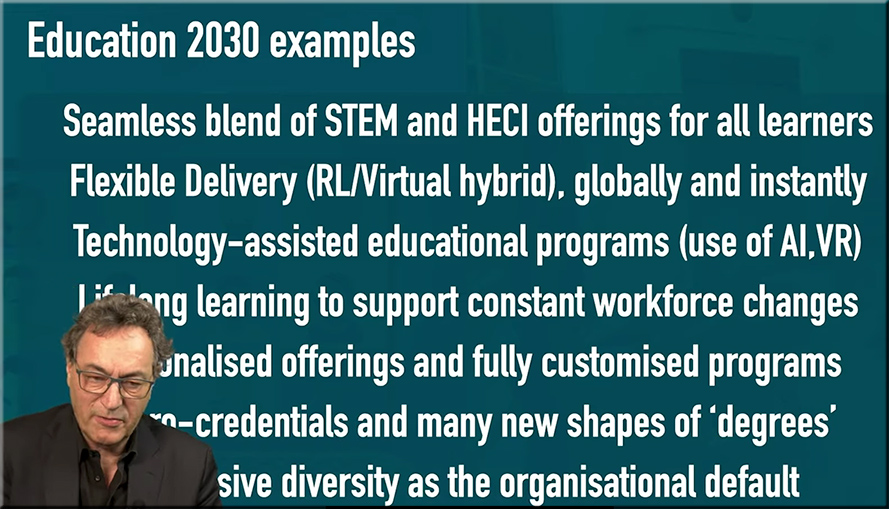
Another futurist Thomas Frey has some thoughts along this same line.

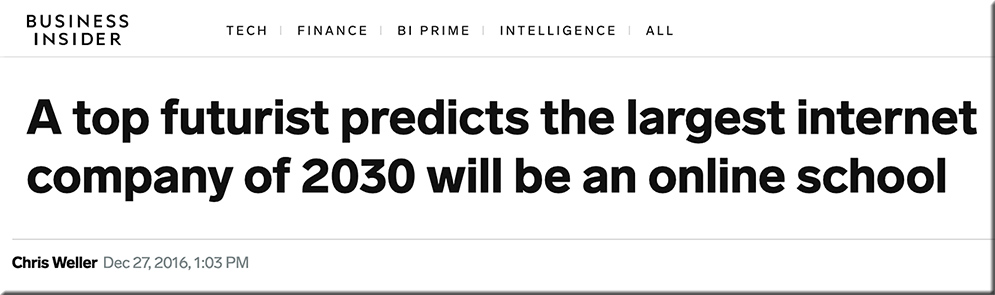
A top futurist predicts the largest internet company of 2030 will be an online school

#Canada #education #future #trends #careerdevelopment #change #paceofchange #automation #robotics #education #AI #learnhowtolearn #unlearn #learningecosystems #lifelonglearning #endofroutine #experientiallearning


Machines are for answers. Humans are for questions. 


Also relevant/see:


Beyond traditional learning programs — from chieflearningofficer.com by Gorana Sandric
To prepare for Industry 4.0 and a diverse, shrinking workforce, we need to open the door of meaningful learning to everyone.

Excerpt:

Hybrid learning creates an ecosystem of various stakeholders and methods that produce a desired outcome. This type of ecosystem is vivid, playful and allure, and therefore capable of transforming attention into intention to learn, grow and reach the maximum potential. Starting with the end in mind (SPP), building blocks of engagement with stakeholders into multifaceted L&D programs delivers a learning experience that is diverse, engaging and inclusive.


The Trends Driving Educational Technology’s Expansion and Growth — from realclearmarkets.com by Rick Amato; with thanks to Michael Moe for this resource

Excerpt:

According to the EdTech Market: Global Industry Analysis, Trends, Market Size, and Forecasts up to 2027 report from ResearchAndMarkets.com, the global educational technology market was valued at around $85 Billion in 2021 and is expected to reach approx $218 billion in 2027, growing with a CAGR of around 17% during the forecast period from 2021-2027. When a tech sector is expected to more than double its size over the next few years, it means the rest of us need to pay attention.


Tech skill gaps are decimating the global workforce and could put workers—and companies—in crisis — from fortune.com by Colin Lodewick

Excerpt:

The pandemic laid bare the value of digital skills when it forced people around the world to shift their lives even more online. Understanding and using technology is no longer a “nice-to-have” but essential for anyone looking for a job. Still, is the workforce ready for this change?

Salesforce released its Global Digital Skills Index* on Thursday, which offers insights into how the global workforce feels about the future of work in a world that continues to prioritize tech savviness and a digital-first mindset.

The report found 76% of respondents said they do not feel prepared for that future.

*An excerpt from that skills index:
Across 19 surveyed countries, workers scored 33 out of a possible 100 points on the Digital Skills Readiness Index across areas such as preparedness, access to learning resources, skill level, and participation in training. Workers in the United States fared slightly better at 36 out of 100 points.


Psalm 33:4-5 — from biblegateway.com

For the word of the Lord is right and true;
    he is faithful in all he does.
The Lord loves righteousness and justice;
    the earth is full of his unfailing love.

Hear, O Israel: The Lord our God, the Lord is one.  Love the Lord your God with all your heart and with all your soul and with all your strength.


Addendum on 2/12/22:


A Legal Minority Report — from abovethelaw.com by Olga V. Mack
Each of the following is a viable and exciting career path for anyone passionate about the law.

Excerpt:

This means it takes a firm stance against legalese, trying to make contracts engaging and readable — something that they rarely are. The creativity of legal design allows for infographics and “cheat sheets” of terms and terminology, using language with which the “audience” is familiar. It is a revolutionary approach to the law.


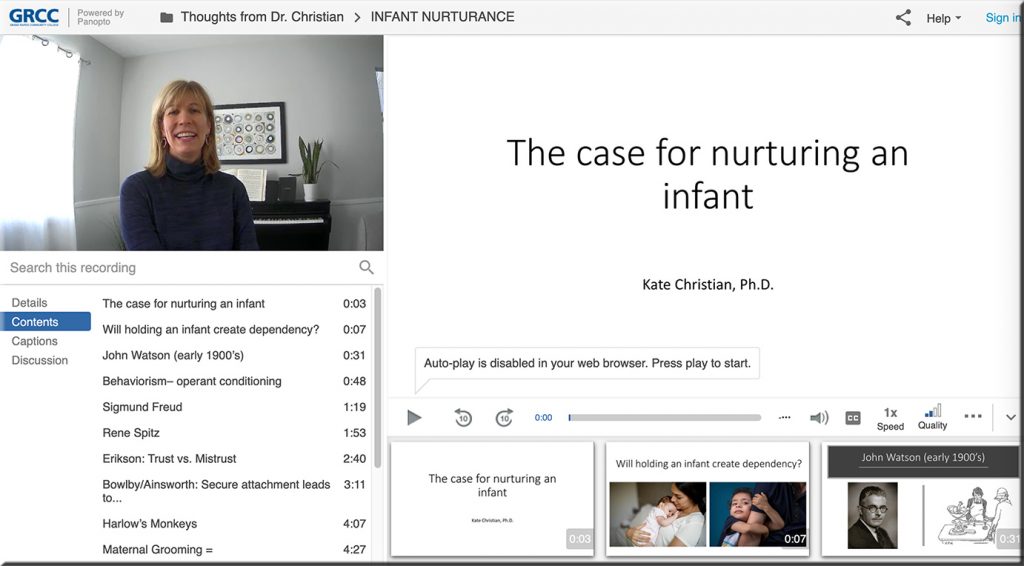
The case for nurturing an infant -- a recording by Dr. Kate Christian

The case for nurturing an infant — from grcc.hosted.panopto.com by Dr. Kate Christian

Yes, Kate is one of my wonderful, talented, intelligent, and compassionate sisters! She is a Professor of Psychology at the Grand Rapids Community College.

Notes:

TITLE/THEME:   The relationship between infant nurturance and the developing brain, and implications for long term physical and mental health

Question: How much time should you spend in direct interaction with your infant? 

  1. CONCERNS: Many people are concerned that paying too much attention to an infant will have negative consequences. (Words like “spoiled”, “dependent”, “mama’s boy”, etc.) 
    1. John Watson (1878-1958) wrote “The Psychological Care of Infant and Child” in 1928, arguing that infants and children should be treated like young adults, and that too much love and affection were damaging—children should not be kissed, hugged, or touched. Ideas such as strict feeding schedules (withholding nourishment if not on schedule) for infants were not uncommon during the first half of the twentieth century. 
    2. Behaviorist views emphasize rewards and punishment in shaping behavior. Today few behaviorists would argue for limiting affection. However, some may argue to let an infant “cry it out”, citing research that indicates infants can learn to self-soothe by about 7 months.
  2. HOWEVER, a wealth of evidence (theoretical, observations, animal studies, and neuroscience research) shows that nurturing an infant provides long term physical and mental health benefits. 
    1. PSYCHOANALYTIC theory:
      1. Sigmund Freud (1836-1959) coined the term “schizophrenogenic mothers”, claiming that especially for male infants, a failure of attachment to the mother could lead to schizophrenia, and that the mother’s lack of sensitive, caring behavior was the cause of attachment failure.
      2. Erik Erikson (1902-1994) established the idea of a psychosocial “crisis” during infancy in which the infant either learns to develop a sense of trust in the world (due to sensitive caregiving) or mistrust (due to unreliable, unpredictable or abusive care). 
      3. John Bowlby (1907-1990) is the founder of Attachment Theory, which maintains that caregiving in the first year of life sets up an unconscious, internal working model of relationships that shapes behavior and thoughts later in life. (Mary Ainsworth (1913-1999) came up with a measurement tool.) Secure attachment develops from sensitive, responsive caregiving, according to Ainsworth and Bowlby.Support for attachment theory varies, and many developmental psychologists today believe that early attachment is moderately predictive of later outcomes. (Things like divorce or death of a parent change the internal working model, or therapy, etc.) But infants with a secure attachment are more likely to explore their environment and be INDEPENDENT!!
    2. OBSERVATIONS: Rene Spitz (1887-1974) compared infants raised in orphanages to infants whose mothers were with them but in prison (in the 1940’s), the primary difference being maternal vs. professional nurse care. When the infants were first placed in the orphanage, Spitz found that for the 1st two months of separation, the infant would weep, scream, and/or be unapproachable. After 3 months, the infant would often become listless, lethargic, and demonstrated bizarre finger movements, and couldn’t sit or talk. 38% of the infants in the orphanage developed marasmus and died within 2 years, whereas all of the infants raised in prison with their moms were alive at follow up (age 5).  You can see video Click Here of infants who appeared dull and listless, or engaged in rocking back and forth or beating their heads on the crib. The infants were well fed and diapers changed, etc, but they had negligible physical touch or affection.Infants in institutions are less likely to play and interact with toys in the environment: Click here for video examples
      .
    3. ANIMAL STUDIES:
    1. Rat pups   The amount of licking given to rat pups by maternal dams has predicted the level of anxiousness (vs. relaxation) in the rat, as well as inhibitory (vs. exploratory) behavior on a maze. Research has shown there are changes in neurobiology (such as hormones and brain receptors in the amygdala) that impact how the rats react to stress. In other words, the more the mother rat licks/grooms the pup, the more she sets up that rat to stay calm and resilient in the face of stress, and to feel confident to explore the environment.  nih.gov
    2. Harlow’s monkeys Monkeys in Harry Harlow’s experiment chose to spend nearly 23 hours a day in close contact with an artificial monkey that was covered in soft cloth and had big eyes (vs. a wire mother than administered food and drink). 
    3. Rhesus monkeys: Neuroscientists have found changes in the basic architecture of the amygdala and areas in the limbic system among rhesus monkeys deprived of touch, eye contact, and adult nurturing during infancy. (p. 129 Marian Diamond, Ph.D.) 
  3. NEUROSCIENCE:
    1. Face-to-face interaction between infant and caregiver help wire the infant brain (use-dependent) and set up the basic architecture of the brain. Infants who experience positive interactions have a neurophysiological response (being smiled at calms the brain!) and neural connections that interact with biological hormones and systems regarding stress regulation get established in a positive way. This leads the infant to grow up better able to handle stress and adversity. 

Research using the ACE scale (adverse childhood experiences) found that children who face a great deal of adversity but are in relationally healthy, nurturing environments will show few long term negative effects (and the reverse is true—a child with even one ACE in an emotionally deprived environment will show significant poor outcomes).   (From Bruce Perry lecture) 

This infant nurturance also shapes the brain’s reward centers. Dr. Bruce Perry argues that infants deprived of nurturance grow up to feel dysregulated, and seek rewards in unhealthy behaviors (overeating/poor diet, substance use, thrill seeking, etc.) 

    1. Example: kangaroo care is the practice of holding an infant skin to skin, and it has been shown to increase weight gain among premature infants. 
    2. What about CELL PHONES?
      • Using a cell phone while caring for an infant has been shown to increase the risk of infant injury by 10%.
      • It also interferes with the face-to-face interaction needed for the neurobiological positive effects to occur!!
    3. Again… how much time to spend in direct interaction with an infant?
      • It doesn’t have to be 24/7, but most infants are not getting enough time. (Hunter gather—spend nearly all day in close proximity to adults, infant child care centers,  4:1 ratio)
      • Hold, sign, rock, touch, play together!
    4. But can’t you overdo it? Are you SURE you won’t spoil the infant or make him/her dependent?
      • There is virtually NO evidence to suggest that “too much” attention in the first year of life is harmful. (Again, you don’t have to spend every minute together… both you and the infant need breaks!) But this cultural perception that it is possible to “over nurture” an infant has got to change!!
    5. What about Co-Sleeping?
      • Worldwide, some form of co-sleeping is the norm.
      • A study found that in the U.S., infants who co-sleep grow up to be MORE independent (secure attachment) than those who don’t.
      • However, there are physical concerns, such as studies finding higher SIDS rates among infants who co-sleep. Also, if a parent is a deep sleeper, is drunk, or sleeps in a chair, if space between wall, etc, these are hazards.

BOTTOM LINE…. HOLD THAT BABY!!!


10 things you didn’t know you could do with Google Arts and Culture — from ditchthattextbook.com

Excerpt:

Google Arts and Culture is a massive collection of videos and images of cultural artifacts from over 2,000 museums around the world. But virtually visiting art exhibits is just one of the many things you can do with Google Arts and Culture. From virtually displaying life-sized art inside your house to playing in a blob opera, Google Arts and Culture runs an impressive gamut of ways to explore culture from your own home or classroom.


Students first in K-12: A conversation with Paul LeBlanc — from michaelbhorn.com

Speakers:

  • Paul LeBlanc, President, Southern New Hampshire University and Author, Student First
  • Lisa Hite-McIntyre, Vice President, Learning Innovation (Moderator)
  • Michael Horn, Founder, Clayton Christensen Institute
  • Dennis Littky, Co-Founder, Big Picture Learning
  • Lisa Scruggs, Partner, Duane Morris LLC

From DSC:
I wish there were more collaborations and/or discussions like this — i.e., those that involve leaders/administrators, teachers/faculty, instructional designers, curriculum planners, etc. from both K-12 and higher education.

Then, on the other side of the fence, it would be good to have these same folks within K-12 and within higher education talk with leaders in the corporate and vocational worlds — as we need better alignment. 


The metaverse: three legal issues we need to address — from theconversation.com by Pin Lean Lau

Excerpt:

The “metaverse” seems to be the latest buzzword in tech. In general terms, the metaverse can be viewed as a form of cyberspace. Like the internet, it’s a world – or reality, even – beyond our physical world on Earth.

The difference is that the metaverse allows us to immerse a version of ourselves as avatars in its environment, usually through augmented reality (AR) or virtual reality (VR), which people are and will increasingly be able to access using tools like VR goggles.

While it all seems very exciting, a curious lawyer like me is inclined to ask: who or what governs the metaverse? The way I see it, there are three key areas which, at this stage, are legally murky.

From DSC:
There are a lot more than three legal issues to be addressed with the metaverse, especially as it further develops. That said, I posted this in the hopes of raising the level of awareness within the legal arena on this particular area of emerging technologies. 


Matthew 11:28-30 (NIV) — from biblegateway.com

28 “Come to me, all you who are weary and burdened, and I will give you rest. 29 Take my yoke upon you and learn from me, for I am gentle and humble in heart, and you will find rest for your souls. 30 For my yoke is easy and my burden is light.”


How Schools and Families Can Work Together to Strengthen Students’ Social-Emotional Health — from blog.edmentum.com by Nicole Plegge

Excerpts:

While it took a worldwide health crisis for the general public to embrace the importance of devoting resources to nurturing the mental health of our youth, educators were already integrating social-emotional learning (SEL) into their classrooms to support whole child development. By continuing to proactively promote positive mental health—even in the best of times—schools help students better comprehend their emotions, build necessary skills to cope with adversity, and form positive relationships with others.

To strengthen students’ resiliency and confidence, schools, teachers, and parents must work together as an unwavering support system. Here are six ways that districts can get all stakeholders on board to provide a solid foundation moving forward.


© 2025 | Daniel Christian