Universities can combat misinformation by sharing research with the public — from edsurge.com by Avery M. D. Davis

Here’s my New Year’s resolution for higher education: extend the reach of research to the people.

Avery M. D. Davis

Excerpt:

It’s part of a growing recognition that research really belongs to the people. Even as the postsecondary industry opened its doors to become a more-accessible system for students, it locked up the research conducted by its faculty and staff. But it’s often individuals from outside of academia who construct topical questions of interest for scholars, serve as study participants, and fund organizations producing such work.

And yet, open science ambitions have cautions worth noting, such as the challenges of interpreting research publicly and the potential political misuse of study findings. To address this, higher education must revisit its roots in educating citizens, preparing both students for society and society for itself.

From DSC:
Yet another benefit/reason for faculty members to write for a public audience! I wish citizens could tap into more faculty/staff-driven streams of content.

streams of content are ever flowing by -- we need to tap into them and contribute to them


Several sharp photos out at 500px.com


Rethinking the Faculty Role in Students’ Career Readiness — from insidehighered.com by Rachel Toor; with thanks to Ryan Craig for this solid, well-written resource
It’s time for all of us on campuses, not just the people in career services, to step up and help offer the competencies employers say they’re looking for, Rachel Toor writes.

Excerpts:

Career centers on campuses can offer students coaching, resources and connections. But, as Angle points out, they tend to be a just-in-time service. They are also, he says, “scary places for a lot of students.” Many young people don’t want to face the reality of life after graduation. Often, it’s a case of too little, too late.

Instead, they come to people they know—professors like me—for help with cover letters and résumés. And while I can comment on language, until recently I had no idea about how most résumés are read first by a version of R2-D2 and his little robot friends who make up automated tracking systems. If an applicant doesn’t include the right keywords in a résumé or cover letter, into the trash bin they go.

The truth is, I have not applied for a job in 15 years; for many of my colleagues it’s been even longer, and some of them have never worked outside academe. It’s not surprising that employers are seeing recent college grads—smart students, hard workers—who don’t know how to present themselves as potential employees.


From DSC:
I can relate to that part about R2-D2 reading the resumes first (i.e., trying to get by the Applicant Tracking Systems before one’s resume ever makes it in front of the eyes of a fellow human being). Many faculty/staff members and members of administrations haven’t been out interviewing in a long while. So it can be a rude awakening when they/we need to do that.

Also, I wanted to say that it’s not fair to assess the learners coming out of higher education using a different set of learning objectives:

  • That is, faculty members within higher ed have one set of learning objectives and their students work hard to learn and meet those learning objectives. Unfortunately, those students did what was asked of them, and then they…
  • …come to find out that the corporate/business/legal/etc. worlds have different ideas about what they should know and be able to do. That is, these other organizations and communities of practice are assessing them on different sets of learning objectives that these same students didn’t cover. Some (many?) of these graduates leave their interviews discouraged and think, “Well, it must be me.” Or they can leave frustrated and angry at their former institutions who didn’t prepare them for this new assessment.

As I’ve said on this blog before, this disconnect is not fair to the students/graduates. We need more mechanisms by which faculty and staff members within higher ed can work more collaboratively with those within the corporate world to better align the learning objectives and the curriculum being covered. If this doesn’t occur more frequently, the constant appearance and growth of new alternatives will likely continue to build further momentum (as they should, given the incredibly steep price of obtaining a degree these days!).

P.S. This disconnect of learning objectives can also be found in what happens with legal education — including having to pass today’s Bar Exams — and then these graduates get out into the real world to find employers who are frustrated that these graduates don’t have the “right”/necessary skills.

“The incentive structure is for law schools to teach students how to pass the bar exam, not necessarily to do the things that employers expect,” Gallini said.

A quote from this article, which I also
want to thank Ryan Craig for.


Rapid DNA Sequencing Promises Timely Diagnosis for Thousands of Rare Diseases — from innotechtoday.com

Excerpt:

In just 7 hours, 18 minutes, a team of researchers at Stanford Medicine went from collecting a blood sample to offering a disease diagnosis. This unprecedented turnaround time is the result of ultra-rapid DNA sequencing technology paired with massive cloud storage and computing. This improved method of diagnosing diseases allows researchers to discover previously undocumented sources of genetic diseases, shining new light on the 6 billion letters in the human genome.


How to manage slow-working students in your classroom — from blog.neolms.com by Diana Z

Excerpt:

If you have slow-working students in your classroom and want to help them catch up and reach milestones, you should first make sure to rule out any possible psychological barriers that could affect their processing speed or other cognitive issues.

Next, you should devise an intervention scheme that is structured on the three A’s principle:

  • Accepting means that the students need to feel accepted in the learning environment and teachers can provide them a safe place for growth;
  • Accommodating refers to the due diligence a teacher has to exercise to provide a suitable learning environment for all students;
  • Advocating implies the support teachers offer slow-working students throughout their learning journey. It also involves other stakeholders, such as parents and the community, who can also support students.

From DSC:
This is an important topic, because not everyone can work with the (often) fast pace of the current train. One of our daughters has experienced this first hand, and I continue to learn from/through her experience.

K-12 education in America is a like a quickly moving train that stops for no one.


Turning Girls Loose to Build in STEM — from innotechtoday.com by Katherine Rieder

Excerpt:

To elementary-school science teachers and nostalgic postsecondary STEM students, it sounds like a dream. Yet the refrain resounding through the room is one of “this isn’t fair,” or “it’s too hard,” often accompanied by low grumbles and furrowed brows. This reaction to a relatively unstructured learning activity where the learning process takes priority over finding a concrete and “correct” answer is, in fact, typical with this age group and gender.

It results from the mutually reinforcing combination of girls’ decreasing confidence in their innate intellectual ability and the fixed mindset many develop as they move through the early years of their formal education. These same factors are incredibly detrimental to a young woman’s engagement with STEM and a future career in the field.


The US is testing robot patrol dogs on its borders. Should we worry? — from interestingengineering.com by Loukia Papadopoulos
Bow-wow just got darker.

However, we can’t shake the feeling that their deployment is creating a dystopian future, one we are not sure is a completely safe one especially if the dogs are trained to operate autonomously. That is a capability we are not sure the robots yet have. Will this be the next stop for border control? If so, how can we trust machines with rifles? Time will tell how this situation evolves.
 

Skill assessments: The future of personalization in learning — from edyoucated.org by Julian Rasch

The future of personalization in professional online learning lies in detailed, but fast and effective skill assessments. Here’s how we do it at edyoucated.


22 Augmented Reality Trends to Keep an Eye on for 2022 — from linkedin.com by Tom Emrich

Excerpts:

#1 Metaverse remains at peak hype as the next iteration of the Internet feels so close but is actually much further away

#2 The smartphone continues to become an even more powerful augmented reality machine with advancements in chips, displays and connectivity

#3 Early consumer smartglasses reinforce the need for smartphones rather than attempt to replace them

The metaverse is defined differently by different people but for me, the metaverse is an aha moment. It is a realization by industry that the next wave of computing is comprised of a stack of emerging technologies (including blockchain, AI, IoT, AR and VR) that will all work together to create a fundamental shift in our relationship with technology. 


Also see:


Why The Metaverse Is More Than Hype — from linkedin.com by Amy LaMeyer

Excerpt:

There are fundamental reasons why there is more to the current Metaverse enthusiasm than hype. As an angel investor, start-up advisor and fund manager, I’ve been studying this space for almost six years, have ridden the trough of disillusionment, and have seen the shift that promises signs of growth. In particular, it is not about the virtual worlds themselves,  although content is very important, it is the growth in the surrounding technology ecosystem that is supporting and signaling an accelerated virtual future. I’ll highlight those building blocks below.

Also relevant/see:

My night in the metaverse — from axios.com by Thomas Wheatley

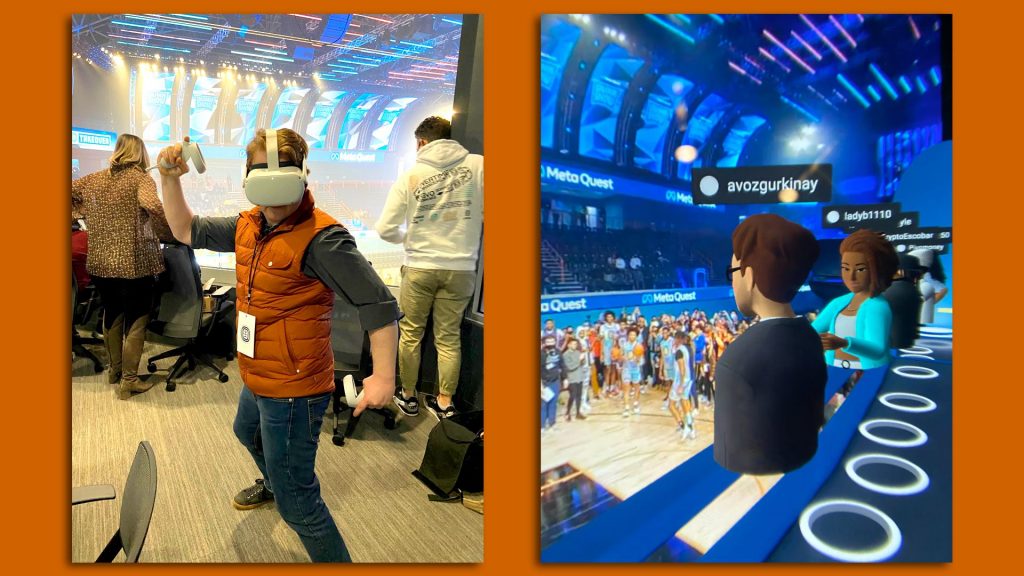
Two images -- on left is person wearing a VR headset. On right side, image of being in a virtual place..

Excerpt:

Sports teams and brands are cannonballing into the metaverse, giving fans new ways to experience games in a way TV can’t offer.

Why it matters: Boosters of the virtual reality realm say the metaverse could create a new economy, new experiences, new relationships — essentially a whole new life, and a new revenue source for the brands, teams, bands and companies that want to be there when the crowds arrive.


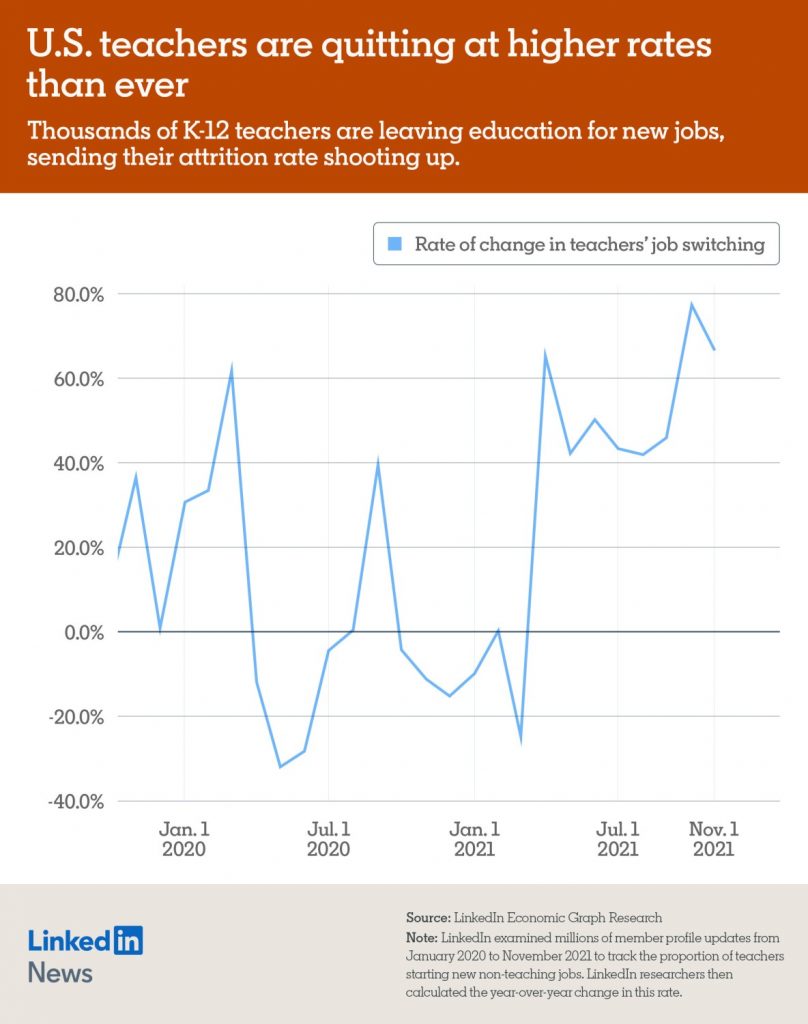
Teachers sprint into new careers, amid a 66% rise in school-job departures — from linkedin.com by George Anders

Excerpt:

Across the United States, thousands of other long-time teachers are walking away from the field they loved for a long time, in favor of fresh starts in areas ranging from healthcare to software engineering.

Thousands of K-12 teachers are leaving education for new jobs, sending their attrition rate shooting up.

Also related/see:

  • NEA Survey Shows Big Jump in Educators Planning to Leave Teaching Sooner Than Planned — from thejournal.com by Kristal Kuykendall
    Excerpt:
    The National Education Association, the nation’s largest union representing nearly 3 million educators, on Tuesday released its latest survey conducted last month showing 90% of educators responded that burnout is a “serious problem” for them.Also notable: more than half, 55%, of the 3,621 educators surveyed said the pandemic has made them “more likely to retire or leave education earlier than planned” — representing a significant increase from the 37% with this response to the same question in an August 2021 NEA survey.
  • When Toxic Positivity Seeps Into Schools, Here’s What Educators Can Do — from edweek.org by Arianna Prothero
    Excerpt:
    “Look on the bright side” and “it could be worse” are statements we hear all the time, and likely even more so during the pandemic.On the surface, these remarks might seem to inject much-needed optimism into a tough situation. But rather than motivating students or teachers to push through stressful times, experts say statements like these have the opposite effect.


Both of the items below are from Sam DeBrule’s Machine Learnings e-newsletter:


Also see:


© 2025 | Daniel Christian