Trade Schools Vs. Traditional College: What You Should Know — from forbes.com by Robert Farrington

Excerpt:

We all know that a college education is usually worth the financial cost, but what about attending trade school instead? Unfortunately, many adults with influence over high schoolers never take the time to ask this important question.

I’m not only talking about school guidance counselors and other educators, but I’m also talking about parents themselves. For far too many parents with kids in their junior or senior years of school, the stigma surrounding having a child skip four-year college would just be too much to bear.

Have you tried to hire a contractor lately? How about an electrician? If you have, you probably already know these jobs are in high demand.

These are just some of the reasons to consider trade school, but there are others. And if you have your child’s best interest in mind, you will at least hear me out.
 

I’m a college president. Teaching a 101-level course reminded me how important compassion is right now. — from highereddive.com by Marvin Krislov
Kindness is key in helping students succeed during the pandemic, Pace University’s president writes. Faculty and staff need compassion, too.

Those of us who choose to work in education know that we need to be kind and empathetic. The experience of teaching last semester drove home to me that kindness isn’t just nice; it’s crucial for enabling our students to succeed.


China Is About to Regulate AI—and the World Is Watching — from wired.com by Jennifer Conrad
Sweeping rules will cover algorithms that set prices, control search results, recommend videos, and filter content.

Excerpt:

On March 1, China will outlaw this kind of algorithmic discrimination as part of what may be the world’s most ambitious effort to regulate artificial intelligence. Under the rules, companies will be prohibited from using personal information to offer users different prices for a product or service.

The sweeping rules cover algorithms that set prices, control search results, recommend videos, and filter content. They will impose new curbs on major ride-hailing, ecommerce, streaming, and social media companies.


“Good night.”

And here’s another amazing picture:


Robots help kids tell stories—with a little help from stuffed animals — from colorado.edu by Daniel Strain

Excerpt:

Through a series of recent studies, Hubbard and her colleagues at CU Boulder have put the technology to the test, revealing the promise and limitations of storytelling technology.

Educational robotics to top $4 billion by 2028 — from thejournal.com by David Nagel
The need for robotics in education will help drive double-digit annual growth worldwide through 2028.

Excerpt:

According to a new forecast from market research firm Emergen Research, the market for educational robotics technologies, including software and professional development, will grow at a compound annual rate of 17.9%, reaching $4.02 billion in global expenditures in 2028.


Howard University to digitize its archive of thousands of Black newspapers — from nbcnews.com by Curtis Bunn
A $2 million grant will be used to digitize Howard’s Black Press Archives, the largest collection of newspapers from the U.S., Africa and the African diaspora.

Excerpt:

Now, with the help of a $2 million grant announced Monday, Howard University’s Moorland-Spingarn Research Center will make available countless articles that captured in real-time the impact of historical events on Black people that have long been difficult, if not impossible, to access. By digitizing its extensive Black Press Archives, anyone will be able to access Howard’s collection of more than 2,000 newspapers from the United States, Africa and the African diaspora online.


A new hybrid learning methodology — from chieflearningofficer.com by Robert O. Brinkerhoff, Edward L. Boon
The proliferation of digital learning transfer platforms offers the opportunity for a new and impact-enhancing hybrid: learning programs that are at the same time standardized and personalized.

Excerpt:

Such a program in the context of our example of the global manufacturing company training its shop floor managers might have the following elements, all created with the expertise of a centralized corporate L&D function:

  • Classroom-style presentations on video with breakout room discussion options embedded for local facilitation.
  • Facilitator’s guides (translated into local languages) for leading the classroom breakouts.
  • Coaching tools and resources for managers to conduct one-on-ones.
  • A library of brief videos of good (and bad) examples of managers interacting with direct reports with second-language subtitles.
  • Guidelines for facilitating periodic virtual check-in meetings (schedules weekly, bi-weekly, etc. to be decided locally).
  • Assignments, with associated resources, for learners to complete by requesting coaching sessions with their manager.

We propose that the proliferation of digital learning transfer platforms (also known as learning experience platforms or LXPs) offers the opportunity for a new and impact-enhancing hybrid: Learning programs that are at the same time standardized and personalized.

Along the lines of corporate training / Learning & Development (L&D), see:


From “Summarize” to “Synthesize” — from byrdseed.com by Ian Byrd

Excerpt:

Here’s how you can take a plain ol’ “summarize this story/book/article” task, raise the thinking, and (yes) make it actually interesting.

We’re going to use my favorite Bloom’s Taxonomy sequence. We use Analyze to set up Evaluate and then let it naturally flow into Synthesis.

The criteria is so important when we ask students to form an opinion! Dull and predictable criteria will lead to dull thinking. Unexpected criteria will lead to unexpected thinking.


Living in a world of unicorns — from pwc.com by Vicki Huff Eckert
Venture-backed giants are scaling up and transforming markets as varied fintech, electric vehicles, and healthcare.

Excerpt:

During the pandemic, edtech unicorns raised (on an annualized basis) eight times the annual amount raised from 2016 through 2019. Tutoring platforms Byju (based in India) and Yuanfudao and Zuoyebang (based in China) received massive investment (each attracted $3 billion to $4 billion in funding between 2016 and 2021). The Business Standard reported that Byju had 100 million registered students and 6.5 million paid subscribers as of September 2021.

This trend is just getting started—the convergence of the metaverse, crypto, and 5G has the potential to create a web 3.0 economy that we can’t yet fully envision, and that will evolve over the course of the decade.


10 As the rain and the snow
    come down from heaven,
and do not return to it
    without watering the earth
and making it bud and flourish,
    so that it yields seed for the sower and bread for the eater,
11 so is my word that goes out from my mouth:
    It will not return to me empty,
but will accomplish what I desire
    and achieve the purpose for which I sent it.


Rebalancing: Children first — from brookings.edu by Natasha Cabrera, David Deming, Veronique de Rugy, Lisa A. Gennetian, Ron Haskins, Dayna Bowen Matthew, Richard V. Reeves, Isabel V. Sawhill, Diane Whitmore Schanzenbach, Kosali Simon, Katharine B. Stevens, Michael R. Strain, Ryan Streeter, James Sullivan, W. Bradford Wilcox, and Lauren Bauer

A report of the AEI-Brookings Working Group on Childhood in the United States

Excerpts (emphasis DSC):

The future of America rests in part on how the country prepares the next generation to live and to lead. Childhood is a consequential and cost-effective time to make investments that last a lifetime. Yet, many children in the United States do not have the resources or relationships they need to build a strong foundation for their future.

Yet, one area of resounding agreement among this diverse group is the need to rebalance national investments toward children. What follows is a consensus report on our conclusions, laying out actionable policies across a range of policy areas to improve the life of every child in the United States.

Along these lines, also see:


The Top Six Leading Corporate Legal Operations Trends for 2022 — from jdsupra.com

Excerpt:

The pandemic changed everything about our world seemingly in the blink of an eye—corporate legal operations included. However, with change comes opportunity: to unlock novel technology solutions and discover cutting-edge ways of catapulting efficiency and catalyzing transformation for enterprise-wide excellence.

Consider these six corporate legal operations trends, compiled from the latest metrics and data, to tackle your ever-evolving law department challenges.


The innovation imperative: Lessons from high-growth companies — from deloitte.com by Khalid Kark, Tim Smith, Lou DiLorenzo Jr, and Mike Bechtel
Successful innovation functions display unique characteristics, one of them being technology’s prominent role in driving these initiatives. How can CIOs and technology leaders seize this opportunity and ensure they play a pivotal role in their company’s growth?

Excerpt:

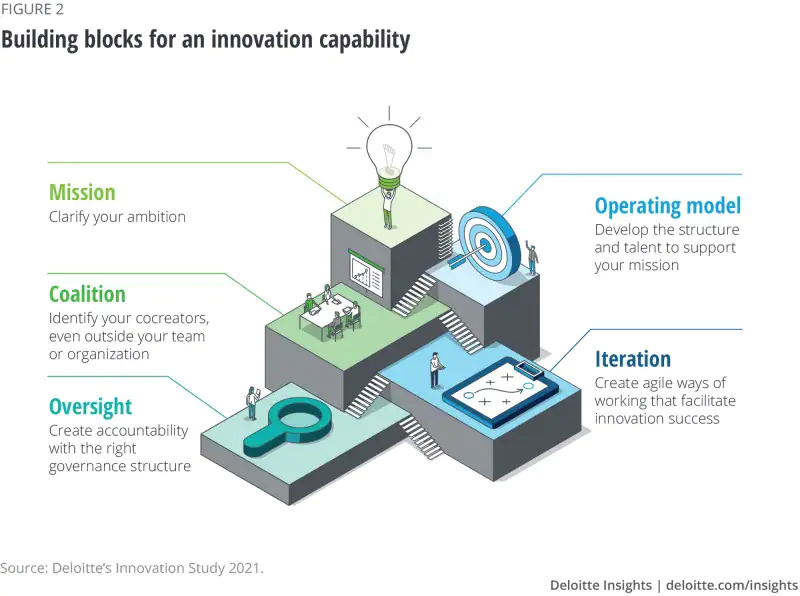
Many enterprises now have an innovation function, whether it be a team that is dedicated to seeking out new opportunities or an executive tasked with finding new ways of working. But according to the latest Deloitte survey, only half of innovation efforts are achieving their desired value, and companies with successful innovation functions have unique characteristics. The study revealed that most leading companies view innovation as something both new—which can include new applications of existing tools—and improved—which may mean simply a measurable advance over legacy alternatives. This covers everything from incremental gains to moonshots.

Five key differentiators of successful innovation programs

Also see Deloitte’s Ten Types of Innovations.


9 emerging tech trends IT leaders need to watch — from enterprisersproject.com by Stephanie Overby
As CIOs focus on enabling their businesses for the future, these key technologies will be front and center in 2022 and beyond

Excerpt (emphasis DSC):

Keeping on top of the newest new thing is fast becoming a tall order. At the same time, it’s never been more important to IT and enterprise success. More than two-thirds (68 percent) of IT leaders told IEEE that determining what technologies are needed for their company in the post-pandemic future will be challenging.

Looking at 2022 and beyond, CIOs charged with outfitting hybrid workplaces, enabling more resilient and flexible supply chains, and continuing the digital transformation march will be eyeing multiple new capabilities in concert. “Rather than single technologies, CIOs will have to focus on confluence of these to drive transformation,” says Yugal Joshi, who leads Everest Group’s digital, cloud, and application services research practices.

Also from enterprisersproject.com, see:

What does it mean to have a team when no two members are working in the same room? In one of Gartner’s more eye-popping predictions for 2022, they stated that “by 2024, 30% of corporate teams will be without a boss due to the self-directed and hybrid nature of work.”


The Vendor Landscape is Making Big Changes: eLearning Brothers — from learningsolutionsmag.com by Bill Brandon

Excerpt:

The eLearning vendor landscape is changing. Try to keep up if you can! Learn about the acquisitions and changes being made by major eLearning vendors.

Many vendors continue to be specialists, concentrating on one or two proprietary products or approaches to design and development. A small number of others are expanding their offerings to cover the common needs of eLearning development teams and to add newer approaches to design.

Learning Solutions will continue to look at the specialists and proprietary products. In 2022, however, we will publish occasional articles that cover vendors who provide broader coverage and a diversity of approaches to design and delivery. This article is the first of this latter type.


© 2025 | Daniel Christian