Look inward, not outward — from mckinsey.com
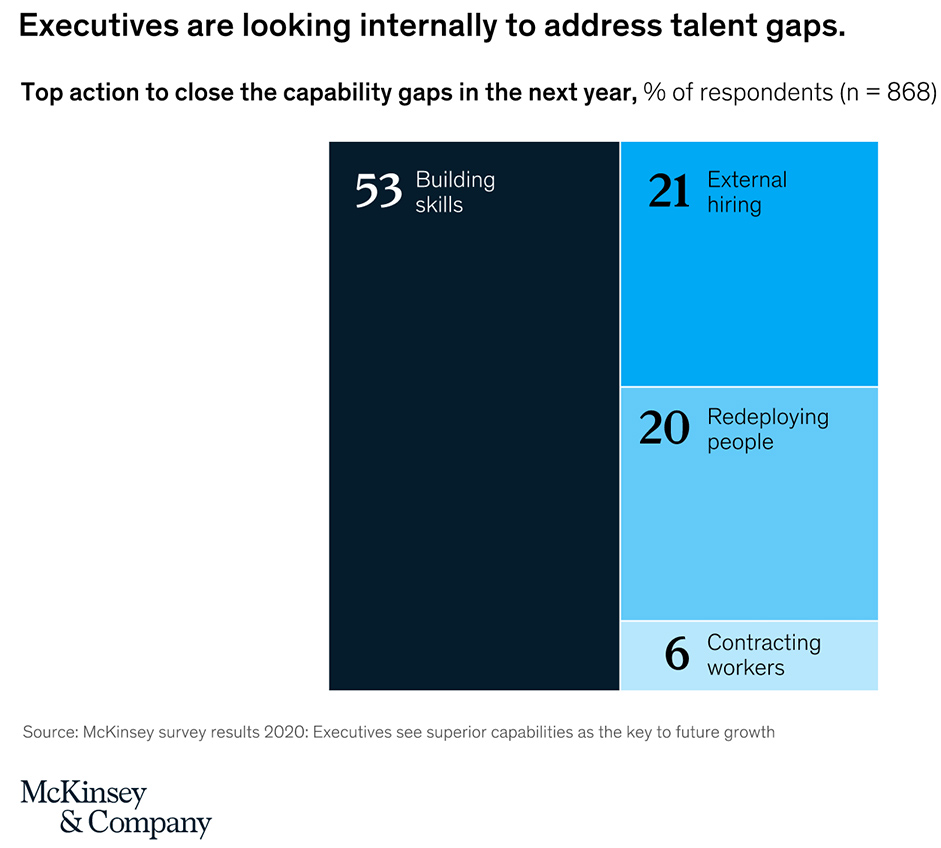
More companies are building talent internally rather than externally. Over 50 percent of executives believe that developing the skills of their existing workforce is the most useful approach to address capability gaps—rather than hiring new workers, redeploying talent, and contracting in skilled workers.


A Podpourri of Learning Options: Pods, Hubs, and Microschools in the Wake of the Pandemic — from gettingsmart.com by Tom Vander Ark

Excerpts:

The Center on Reinventing Public Education (CRPE) recently published a report, Pandemic Pods and the Future of Education, based on a survey of families and educators who organized or participated in a pandemic pod. While it was challenging to collect representative data on pods, CRPE concluded that pods were an important pandemic response with long-term implications for education.

The CRPE defines pods as an in person or intensive virtual support that meets multiple times per week. While a broad definition, it is more narrowly defined than many of the previous attempts at categorizing small group learning experiences.

Despite the “moment” that pods had during the pandemic, once in-person learning became more available there was a snapback of about 85%, with the numbers of students shifting from pods to classroom attendance. Those students remaining in pods, typically counted as homeschooled, are part of what is likely to be a 1-2% long-term enrollment shift (perhaps 1 million students) away from traditional public schools.

Addendum on 3/2/22:

Along the lines of learning options, see:


Why the World’s First Virtual Reality High School Changes Everything — from steve-grubbs.medium.com by Steve Grubs

Excerpts:

The recipe required key ingredients to happen. In addition to an accredited school to manage students, admissions and the for-credit learning, it also needed a platform. That’s where EngageVR comes in. There are other platforms that will ultimately host schools, perhaps AltSpace, Horizon or others, but the first is on Engage.

The bottom line is this: creators, coders, educators, entrepreneurs, investors, corporations, parents and students all played a role in finally bringing the first global virtual reality high school to life. It won’t be the last school to open in the metaverse, but to all those involved in this inaugural launch — the Neil Armstrongs of your age — a special tip of the hat today for having the vision and the willingness to launch a better and more equitable era of education.

Also see:

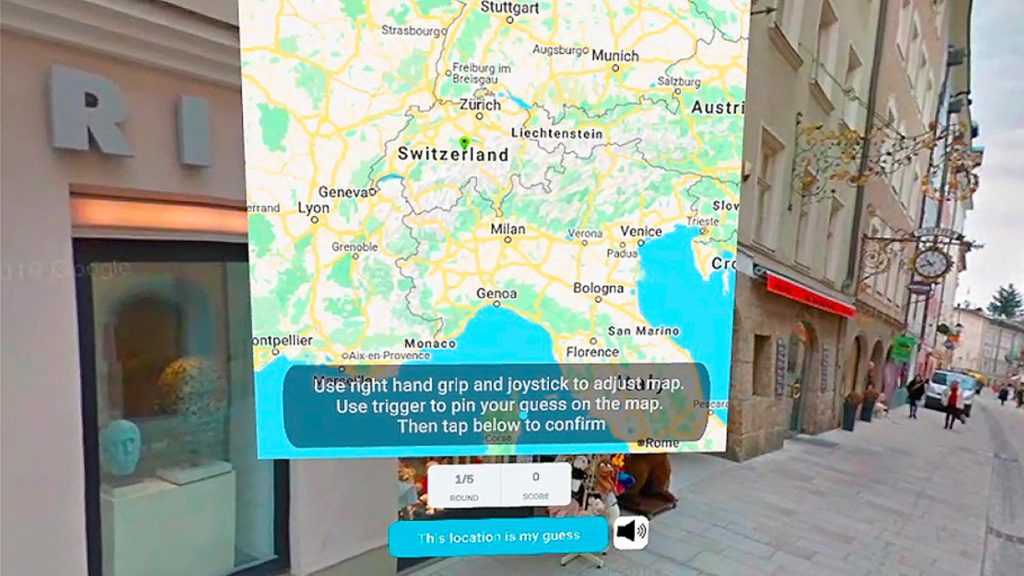
This is a snapshot from the Geo Guesser VR game


Triumphs and Troubles in Online Learning Abroad — from edsurge.com by Robert Ubell

Excerpt:

In Canada, for example, about two-thirds of colleges offer online degrees—and many have for years. While here in the U.S., a far smaller number grant degrees online.

I thought it would be good to do some digging to explore a more nuanced appreciation of the status of virtual instruction outside the U.S.

From DSC:
I would also like to mention that there’s a lot happening in Australia and in India along these lines, and likely in many other countries as well. But I think that one can only cover so much in one posting.   🙂


Universal Dyslexia Screening: What You Need to Know — from techlearning.com by Erik Ofgang
Universal dyslexia screening can help school districts identify students who are at risk and provide additional support, even though it is not required in every state.

Excerpt:

Dyslexia affects approximately 20 percent of the population and accounts for 80 to 90 percent of learning disabilities, according to the Yale Center for Dyslexia & Creativity. Early recognition of the risk for dyslexia and other word-level disabilities through universal screening in kindergarten, and then providing those students with intensive intervention, is a key early literacy strategy, says the National Center on Improving Literacy in a white paper.


Meet The Secretive Surveillance Wizards Helping The FBI And ICE Wiretap Facebook And Google Users — from forbes.com by Thomas Brewster
A small Nebraska company is helping law enforcement around the world spy on users of Google, Facebook and other tech giants. A secretly recorded presentation to police reveals how deeply embedded in the U.S. surveillance machine PenLink has become.

Excerpts:

PenLink might be the most pervasive wiretapper you’ve never heard of.

With $20 million revenue every year from U.S. government customers such as the Drug Enforcement Administration, the FBI, Immigration Customs Enforcement (ICE) and almost every other law enforcement agency in the federal directory, PenLink enjoys a steady stream of income. That doesn’t include its sales to local and state police, where it also does significant business but for which there are no available revenue figures. Forbes viewed contracts across the U.S., including towns and cities in California, Florida, Illinois, Hawaii, North Carolina and Nevada.


What Do We Mean by Accessibility, Inclusion & Belonging? — from inclusionhub.com by Jeffrey Howard
Accessibility, also referred to as a11y, is about ensuring systems are designed so everyone can fully participate in public or professional life, while inclusion means everyone has the resources and opportunities they need to realize that. Belonging goes one step further, fostering a culture where everyone feels accepted and supported.

Excerpts:

In this spirit, “a11y” has become a globally recognized rallying cry for greater accessibility—the 11 referring to the software engineering convention of shortening long words to the number of letters they use. A11y has transformed into a symbol for increased accessibility, inclusion, and belonging.

So, if accessibility ensures everybody has the means or tools to reach the table, and inclusion guarantees a seat and relevant opportunities, belonging encourages an emotionally and socially supportive space where each person feels welcome and valued.

It’s easy to tell the difference between when you feel merely tolerated and when you belong.


2 Corinthians 12:9 — from biblegateway.com

But he said to me, “My grace is sufficient for you, for my power is made perfect in weakness.” Therefore I will boast all the more gladly about my weaknesses, so that Christ’s power may rest on me.


Why some teams boost motivation while others totally sap it — from psyche.co by Ann-Kathrin Torka, Jens Mazei, Joachim Hüffmeieris, and edited by Matt Huston. With thanks to Mr. Tom Barrett for this resource via his weekly newsletter.

Excerpts:

In contrast, when people perceive their contribution to the team’s outcome as indispensable, they tend to show greater effort than they would when working alone. These ‘effort gains’ can be due to team members aiming to be prosocial: they care about others and want to make a difference to the team. By helping their team succeed, members also feel better about themselves – they can see themselves as helpful and competent human beings.

Managers, instructors, coaches, and other leaders can use this knowledge to design teamwork that boosts team members’ efforts. Remember the student from the introduction: maybe she felt that she could not contribute much to the academic team because the project did not include a specific (sub-)taskfor her to work on and to feel responsible for. If the instructor or a teammate had broken down the project into subtasks for each member, she might have felt that her efforts were indispensable.


The doctor is in—the video call — from mckinsey.com

Excerpt:

More patients than ever were willing to try virtual health services after COVID-19 emerged. Last year, the use of telehealth care was 38 times higher than prepandemic levels, as appointments such as follow-ups could easily be delivered remotely. A recent McKinsey survey shows that up to $265 billion in Medicare spending could shift to patients’ homes by 2025, with greater physician participation in the transition from telehealth to at-home care.

From facility to home: How healthcare could shift by 2025 — from mckinsey.com by Oleg Bestsennyy, Michelle Chmielewski, Anne Koffel, and Amit Shah

Also see the other charts via their daily chart feature:
A daily chart from McKinsey Dot Com that helps explain a changing world—during the pandemic and beyond.


Using Telehealth to Expand Student Access to Care — from techlearning.com by Erik Ofgang
Renee Kotsopoulo, director of health services for the Garland ISD in Texas, helped bring telehealth to her students and believes technology can help keep kids healthy and in school.

Can Teletherapy Companies Ease the Campus Mental-Health Crisis? — from chronicle.com by Kate Hidalgo Bellows

From DSC:
Telehealth has been booming during the pandemic. I think telelegal will ride on the coattails of telehealth.


Companies are making serious money with AI — from sloanreview.mit.edu by Thomas Davenport and Randy Bean

Excerpt:

Just a few years later, things are beginning to change. In the 2022 survey of senior data and technology executives by NewVantage Partners (where Randy Bean is CEO and cofounder, and Tom Davenport is a fellow), 92% of large companies reported that they are achieving returns on their data and AI investments. That’s up markedly from 48% in 2017. The same percentage (92%) said that they are increasing investments in data and AI, equaling last year’s percentage.


Innovation & Tech Today Names the Top 50 Most Innovative Products of 2021 — from innotechtoday.com by Corey Noles

Excerpt:

The Top 50 Most Innovative Products is I&TT’s most popular feature every year. The feature includes a collection of business innovations, new products, and connected services, along with gadgets from industries such as healthcare, smart home, outdoor and adventure, STEM, gaming, and entertainment.


© 2025 | Daniel Christian