MUHC uses artificial intelligence to train neurosurgery students — from montreal.ctvnews.ca by Rob Lurie

Excerpt:

“I think above all it just provides an opportunity for junior learners to get some hands-on exposure,” said medical student Ali Fazlollahi.

“Basically, it was inspired by the idea of how do we prevent error in the operating room,” said Neurosurgeon Dr. Rolando De Maestro. Maestro says virtual reality has been a game-changer when it comes to teaching.


From DSC:
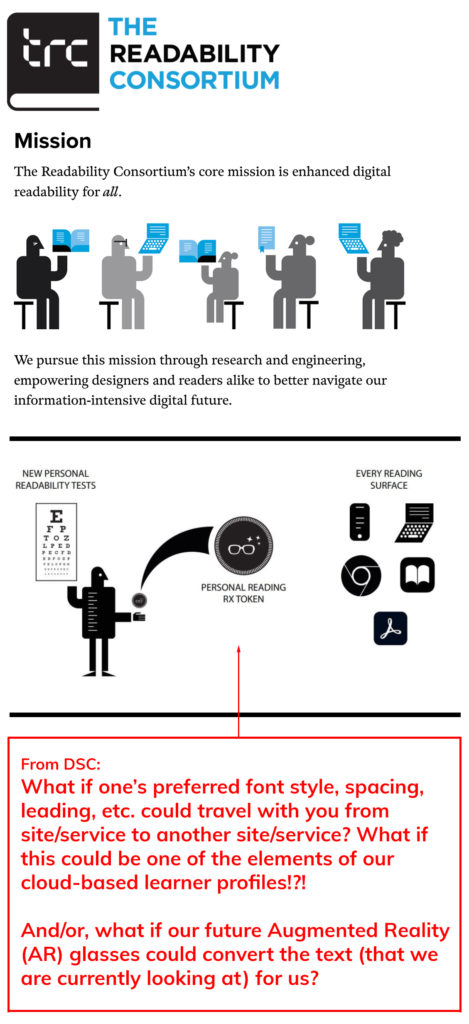
After checking out the following two links, I created the graphic below:

  1. Readability initiative > Better reading for all. — from Adobe.com
    We’re working with educators, nonprofits, and technologists to help people of all ages and abilities read better by personalizing the reading experience on digital devices.
  2. The Readability Consortium > About page


What if one's preferred font style, spacing, leading, etc. could travel with you from site to site? Or perhaps future AR glasses will be able to convert the text that we are looking at for us


Also related/see:


RESULTS ARE IN: HERE ARE THE 15 LEGAL TECH WINNERS OF THE 2022 ABA TECHSHOW STARTUP ALLEY COMPETITION — from techshow.com

Excerpts:

After nearly 32,000 votes, the results are in. Readers have been voting to select the 15 legal technology startups that will get to participate in the sixth-annual Startup Alley at ABA TECHSHOW 2022, taking place March 2-5, 2022.

These 15 will face off in an opening night pitch competition that will be the opening event of this year’s TECHSHOW, with the conference’s attendees voting to pick the top winner. The first-place winner gets a package of marketing and advertising prizes.

Here are the winners in order of their vote tallies. The descriptions were provided by each company.


Web Accessibility on a Budget: How to Get Started for Free or Little Cost — from boia.org

Excerpt:

How to improve web accessibility for little to no cost:

  • Get a free accessibility assessment.
  • Learn what accessibility updates you can make yourself.
  • Use free assistive technology and accessibility tools.
  • Read content and continue learning from the accessibility community.
  • Publish an accessibility statement.
  • Create a long-term plan to full accessibility compliance.

Also related/see:  The #accessibilityChecker hashtag on Twitter.


The best lighting for video conferencing, according to experts— from blog.webex.com

A home office lighting setup for video conferencing.

Contents:

  • What is the best lighting for video conferencing?
  • Where should the light be for a video call?
  • What kind of lighting is best for video meetings?
  • What are the best lighting products for a video conference?
  • What is the best lighting for video conferencing on-the-go?
  • Good lighting means good communication:
 

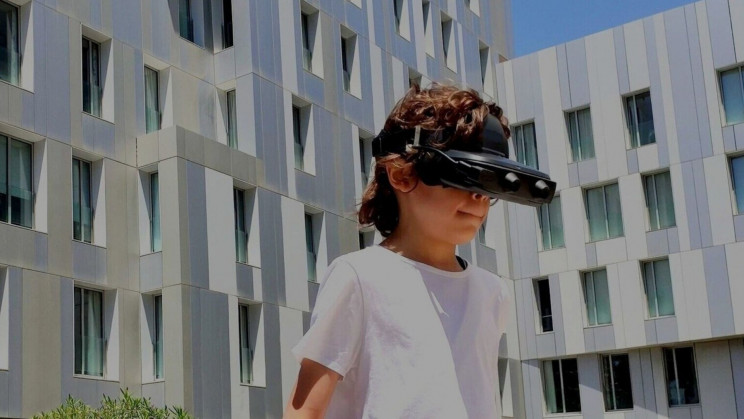
A couple from Barcelona built A.I. smart glasses to help their son see — from interestingengineering.com by Chris Young
Showing visually impaired people the way with their A.I. smart glasses.

Biel wearing the Biel Glasses

Excerpt:

He and his wife, Constanza Lucero designed a pair of smart glasses that use artificial intelligence and augmented reality to indicate oncoming obstacles to wearers.

The couple drew from their respective fields — Puig is an electrical engineer and Lucero a doctor — to build smart glasses that overlay text and graphics over the real-time video feed of their users’ surroundings. They use A.I. algorithms that detect obstacles, signaling them to the wearer as they approach. Users gain added independence, and parents’ and loved ones’ peace of mind.


Want to leave law? Here are some alternative careers to consider — from abovethelaw.com by Wendi Weiner
Your law degree does not limit you but rather expands career and business opportunities for you.

Excerpt:

Nearly six years ago, I wrote an article in the Huffington Post about how I used my law degree to get out of law. It became one of my most-read articles to date, as I transparently discussed my feelings about practicing law (the things I resented versus the things that I loved about it), the emotions I felt about staying versus leaving, and how I made a successful exit.

One thing I emphasized in the article was the notion that your law degree is invaluable to the business world and there is life after law. Each week, I receive multiple emails from readers of my column about how they can make the leap while leveraging the power of their law degree.


Metaverse and the practice of law (Part II) — from abovethelaw.com by Ken Crutchfield
In the Metaverse, many rules that will govern interaction will be defined by terms and conditions in the contract signed to participate on a Metaverse platform.

Excerpt:

We could see more business applications emerge as well. Telemedicine might be an example. Could an MRI be analyzed in real time by a doctor in another state? Would someone trust a specialist in a particular type of cancer to perform laser surgery from thousands of miles away? There is already precedence for remote surgery, so the possibilities may not be that far off.

Overall, what we can expect to see is the Metaverse’s increasing ability to enable virtual transactions and experiences that we had not previously thought possible — and the world of legal technology may be no exception.


How Art Class Became a Rare Bright Spot for Students and Families During the Pandemic — from edsurge.com by Daniel Lempres

Excerpt:

When schools went remote two years ago, the National Art Education Association (NAEA) was quick to offer guidance on how best to reach students who have experienced trauma. They offered strategies for remote learning, as well as mental and emotional wellbeing.

Now more than ever, art educators must employ the tenets of social emotional learning, the NAEA says. In a recent report, the association recommended trauma-informed teaching strategies to promote mental health through self-expression—for their students’ sake and their own.

But with asynchronous lessons and virtual events, the amount of parental participation skyrocketed, she says.


Power Lesson: Poetry Gallery Walk — from cultofpedagogy.com by Marcus Luther

Excerpt:

So three months into the school year, it was time to “pay the piper” in our AP Literature classroom in a major way. This meant veering away from normal processes of literary analysis and having students not only write their own reflective narrative poems, but spend time in an incredible, silent space moving around the library and writing notes of affirmation on each other’s writing.

Here is “how” we made it happen, then, as well as “why.”


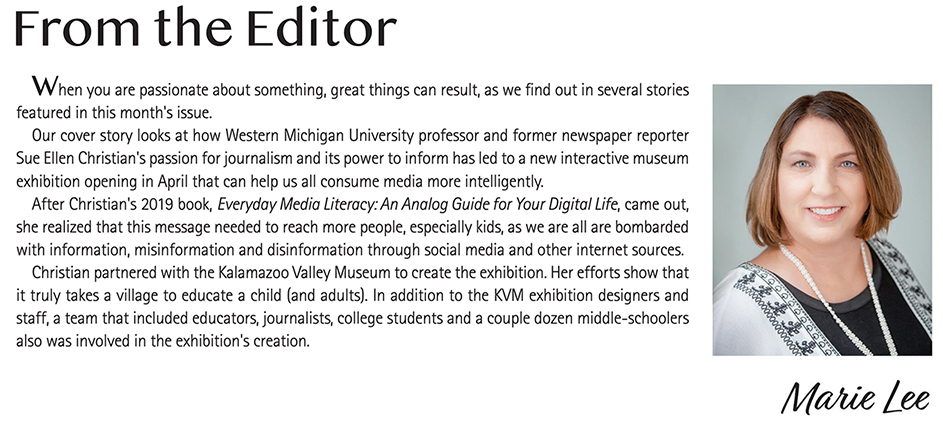
Taking Aim at Disinformation — from encorekalamazoo.com with the work of one of our sisters, Sue Ellen Christian, highlighted in it
Southwest Michigan’s Magazine: WMU Professor Sue Ellen Christian and the Kalamazoo Valley Museum team up to teach media literacy…


From the Editor of Encore Magazine


Accelerated Digital Skills and the ‘Bootcamp Boom’. — from holoniq.com
The market for accelerated digital skills is stepping up to a whole new level. Bootcamps, among others, are evolving rapidly to meet the opportunity.

Excerpt:

Tech Bootcamps re-skilled and up-skilled over 100,000 professionals globally in 2021, up from less than 20,000 in 2015. We expect this number to reach over 380,000 by 2025 representing over $3B of expenditure with significant upside as tech up-skilling models and modes overlap and converge. Governments, employers, universities and colleges everywhere are embracing rapid, high ROI training to build capacity in software, marketing, cyber and tech sales to drive their economies and growth.

Also from holoniq.com, see:

Also relevant/see:


The future of AR — from 900lbs.com

Some of the topics include:

  • Where is #AR today and where’s it going? 
  • What options/deployment methods are available & what are their limitations?
  • Web AR
  •  We’ve heard a lot about AR headsets. Are they the best option?
  • Ok, I’m interested in creating an AR experience. What now? 
  • What is the biggest piece of advice you have for brands diving into AR for the first time?
  • …and more

Also see:


Right Now, Your Best Employees Are Eyeing the Exits– from chronicle.com by Marci K. Walton
To stay, they need better pay, reasonable hours, and an end to mission-based gaslighting.

Excerpt:

Right now, your best midlevel manager is updating her résumé. Your hardest-working director is controlling his excitement after learning the salary range for a private-sector opening. Your most trustworthy entry-level professional is writing a resignation letter because her new corporate position doubles her pay and doesn’t require nights or weekends.

Two years of pandemic life have left campus staff members beyond burned out. They are done. And they are leaving or thinking about it in droves. I know because I was one of them. After nearly 13 years working in residence life — a field to which I was deeply committed — I left higher education last March for the private sector. The move increased my salary by 50 percent and cut my workload in half.

This tweet was mentioned/linked to in the above article:


The US Copyright Office says an AI can’t copyright its art — from theverge.com by Adi Robertson; resource via Sam DeBrule’s Machine Learnings newsletter

Excerpt:

The US Copyright Office has rejected a request to let an AI copyright a work of art. Last week, a three-person board reviewed a 2019 ruling against Steven Thaler, who tried to copyright a picture on behalf of an algorithm he dubbed Creativity Machine. The board found that Thaler’s AI-created image didn’t include an element of “human authorship” — a necessary standard, it said, for protection.

Also, along the lines of emerging technologies and the legal realm, see:

Law Firms Turn to AI to Vet Recruits, Despite Bias Concerns — from news.bloomberglaw.com by Erin Mulvaney and Chris Opfer; resource also via Sam DeBrule

Excerpt:

Law firms struggling to expand candidate pools and diversify workforces are turning to AI for help, even as regulators scrutinize the technology to ensure it doesn’t exacerbate biases rather than lessen them. A law set to take effect in New York City next year will limit the use of the technology in hiring and require that employers test recruiting algorithms for bias, while the U.S. Equal Employment Opportunity Commission is taking a closer look at the tools.


© 2025 | Daniel Christian