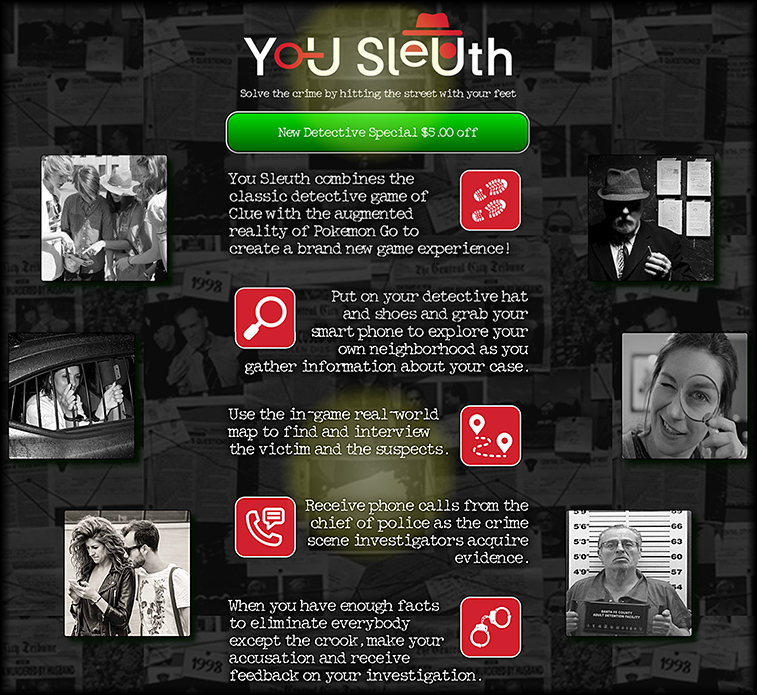
You Sleuth = The game of Clue + Augmented Reality (AR)

You Sleuth is a family-friendly outdoor game that requires a moderate amount of walking. You can play by yourself or with a group of friends or family. If you are looking for something new that will stimulate your mind while sneaking in a little exercise and fresh air then register today. Read the rest of the FAQ for more details about how You Sleuth works.


From DSC:
What might this look/work like for learning-related applications? Also, if you are studying to be an actor or actress, might there be some new opportunities for you here!? If you are a writer, might there be some new sorts of collaborations opening up here? As the next version of the internet is developed, what new affordances/opportunities might exist in this area?



TurnSignl wins ABA Techshow 2022’s Startup Alley competition — from abajournal.com

Excerpt:

TurnSignl, an app that helps drivers record roadside interactions with law enforcement and immediately access lawyers via videoconferencing, won the Startup Alley pitch competition at the ABA Techshow 2022 on Wednesday evening.

“Our mission is simple and three pronged: It’s to protect drivers’ civil rights, to de-escalate roadside interactions and third, and most importantly, ensure every driver and law enforcement officer returns home safe at the end of the day,” said Jazz Hampton, the CEO and general counsel at TurnSignl.


Reading Month with MLC and PBS Kids — from michiganlearning.org
Read aloud videos from Michigan bookworms and famous faces.

March is reading month, and students everywhere are finding new books to read. We’re celebrating the most literary time of the year with read aloud videos for blossoming bookworms and little ones who are just learning their letters.

Each series below has different ways to extend learning. Answer questions about the characters and plot, try a hands-on STEM activity, and more!


Amazon Boosts Upskilling Opportunities for Hourly Employees by Partnering with More Than 140 Universities and Colleges to Fully Fund Tuition — from press.aboutamazon.com

Excerpt:

  • Amazon employees in the U.S. will benefit from new Career Choice partnerships with Southern New Hampshire University, Colorado State University–Global, Western Governors University, National University, and numerous local universities
  • Amazon also partners with GEDWorks and Smart Horizons to provide employees with free high school completion and GED preparation, Voxy EnGen and goFLUENT to provide English language proficiency training, and Outlier to provide college preparation courses
  • New benefits are part of Amazon’s Career Choice program and move the company closer to meeting its Upskilling 2025 pledge—a $1.2 billion commitment to upskill more than 300,000 Amazon employees by 2025

Also see:

Amazon’s announcement is an eye-catching development in the yearslong effort across higher education to enroll more adult learners and increase the share of the U.S. population that has some education beyond high school. While the jury’s still out on whether tuition-benefit programs deliver on all their promises, as most are relatively new, they have become an increasingly popular offering for major corporations. Last fall, Amazon announced a $1.2 billion investment to expand its efforts.

Amazon employees will have choices. They can enroll at a local participating college and take a few courses en route to a certificate or credential, or they can enroll in a full associate- or bachelor’s-degree program


I’d like to thank Mr. Ryan Craig for the following resources (via his weekly e-newsletter): 

Reducing Barriers: Indeed Removes Degree Requirements From Eligible Roles — from inside.indeed.jobs

In keeping with this commitment, we have removed university degree requirements from all eligible job profiles. This change has impacted 700+ job profiles across all of our business units and we will continue to use our degree evaluation process when creating new job profiles. Removing this barrier will allow us to engage, attract, and hire a wider pool of qualified applicants applying for jobs across Indeed. 

Why America Has So Few Doctors — from theatlantic.com by Derek Thompson
As a matter of basic economics, fewer doctors means less care and more expensive services.

Trying to give students in low-wage majors some extra skills they can cash in on — from hechingerreport.org by Olivia Sanchez
A pilot program offers microcredentials that can help students find success after graduation


MUHC uses artificial intelligence to train neurosurgery students — from montreal.ctvnews.ca by Rob Lurie

Excerpt:

“I think above all it just provides an opportunity for junior learners to get some hands-on exposure,” said medical student Ali Fazlollahi.

“Basically, it was inspired by the idea of how do we prevent error in the operating room,” said Neurosurgeon Dr. Rolando De Maestro. Maestro says virtual reality has been a game-changer when it comes to teaching.


From DSC:
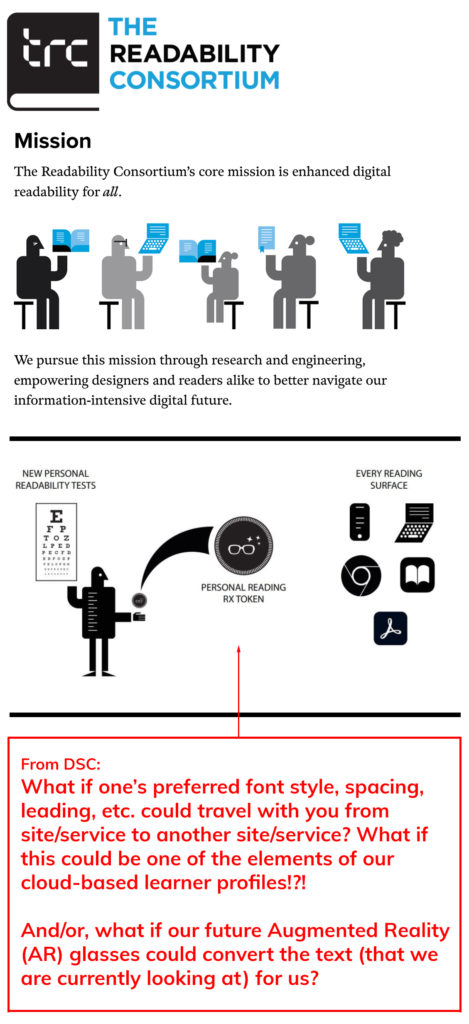
After checking out the following two links, I created the graphic below:

  1. Readability initiative > Better reading for all. — from Adobe.com
    We’re working with educators, nonprofits, and technologists to help people of all ages and abilities read better by personalizing the reading experience on digital devices.
  2. The Readability Consortium > About page


What if one's preferred font style, spacing, leading, etc. could travel with you from site to site? Or perhaps future AR glasses will be able to convert the text that we are looking at for us


Also related/see:


RESULTS ARE IN: HERE ARE THE 15 LEGAL TECH WINNERS OF THE 2022 ABA TECHSHOW STARTUP ALLEY COMPETITION — from techshow.com

Excerpts:

After nearly 32,000 votes, the results are in. Readers have been voting to select the 15 legal technology startups that will get to participate in the sixth-annual Startup Alley at ABA TECHSHOW 2022, taking place March 2-5, 2022.

These 15 will face off in an opening night pitch competition that will be the opening event of this year’s TECHSHOW, with the conference’s attendees voting to pick the top winner. The first-place winner gets a package of marketing and advertising prizes.

Here are the winners in order of their vote tallies. The descriptions were provided by each company.


Web Accessibility on a Budget: How to Get Started for Free or Little Cost — from boia.org

Excerpt:

How to improve web accessibility for little to no cost:

  • Get a free accessibility assessment.
  • Learn what accessibility updates you can make yourself.
  • Use free assistive technology and accessibility tools.
  • Read content and continue learning from the accessibility community.
  • Publish an accessibility statement.
  • Create a long-term plan to full accessibility compliance.

Also related/see:  The #accessibilityChecker hashtag on Twitter.


The best lighting for video conferencing, according to experts— from blog.webex.com

A home office lighting setup for video conferencing.

Contents:

  • What is the best lighting for video conferencing?
  • Where should the light be for a video call?
  • What kind of lighting is best for video meetings?
  • What are the best lighting products for a video conference?
  • What is the best lighting for video conferencing on-the-go?
  • Good lighting means good communication:
 

A couple from Barcelona built A.I. smart glasses to help their son see — from interestingengineering.com by Chris Young
Showing visually impaired people the way with their A.I. smart glasses.

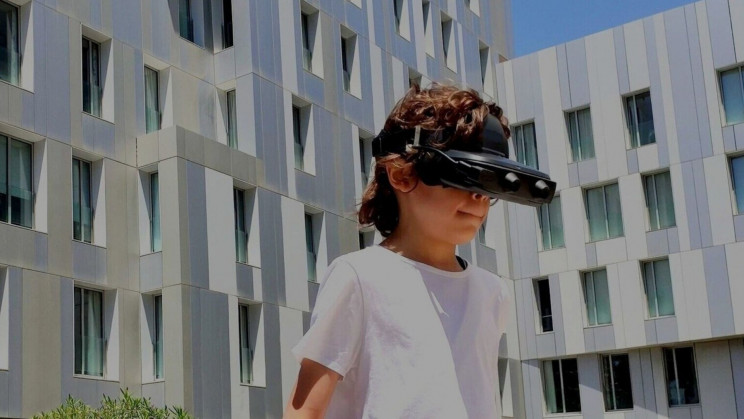
Biel wearing the Biel Glasses

Excerpt:

He and his wife, Constanza Lucero designed a pair of smart glasses that use artificial intelligence and augmented reality to indicate oncoming obstacles to wearers.

The couple drew from their respective fields — Puig is an electrical engineer and Lucero a doctor — to build smart glasses that overlay text and graphics over the real-time video feed of their users’ surroundings. They use A.I. algorithms that detect obstacles, signaling them to the wearer as they approach. Users gain added independence, and parents’ and loved ones’ peace of mind.


Want to leave law? Here are some alternative careers to consider — from abovethelaw.com by Wendi Weiner
Your law degree does not limit you but rather expands career and business opportunities for you.

Excerpt:

Nearly six years ago, I wrote an article in the Huffington Post about how I used my law degree to get out of law. It became one of my most-read articles to date, as I transparently discussed my feelings about practicing law (the things I resented versus the things that I loved about it), the emotions I felt about staying versus leaving, and how I made a successful exit.

One thing I emphasized in the article was the notion that your law degree is invaluable to the business world and there is life after law. Each week, I receive multiple emails from readers of my column about how they can make the leap while leveraging the power of their law degree.


Metaverse and the practice of law (Part II) — from abovethelaw.com by Ken Crutchfield
In the Metaverse, many rules that will govern interaction will be defined by terms and conditions in the contract signed to participate on a Metaverse platform.

Excerpt:

We could see more business applications emerge as well. Telemedicine might be an example. Could an MRI be analyzed in real time by a doctor in another state? Would someone trust a specialist in a particular type of cancer to perform laser surgery from thousands of miles away? There is already precedence for remote surgery, so the possibilities may not be that far off.

Overall, what we can expect to see is the Metaverse’s increasing ability to enable virtual transactions and experiences that we had not previously thought possible — and the world of legal technology may be no exception.

 
© 2025 | Daniel Christian