How Art Class Became a Rare Bright Spot for Students and Families During the Pandemic — from edsurge.com by Daniel Lempres

Excerpt:

When schools went remote two years ago, the National Art Education Association (NAEA) was quick to offer guidance on how best to reach students who have experienced trauma. They offered strategies for remote learning, as well as mental and emotional wellbeing.

Now more than ever, art educators must employ the tenets of social emotional learning, the NAEA says. In a recent report, the association recommended trauma-informed teaching strategies to promote mental health through self-expression—for their students’ sake and their own.

But with asynchronous lessons and virtual events, the amount of parental participation skyrocketed, she says.
 

Power Lesson: Poetry Gallery Walk — from cultofpedagogy.com by Marcus Luther

Excerpt:

So three months into the school year, it was time to “pay the piper” in our AP Literature classroom in a major way. This meant veering away from normal processes of literary analysis and having students not only write their own reflective narrative poems, but spend time in an incredible, silent space moving around the library and writing notes of affirmation on each other’s writing.

Here is “how” we made it happen, then, as well as “why.”


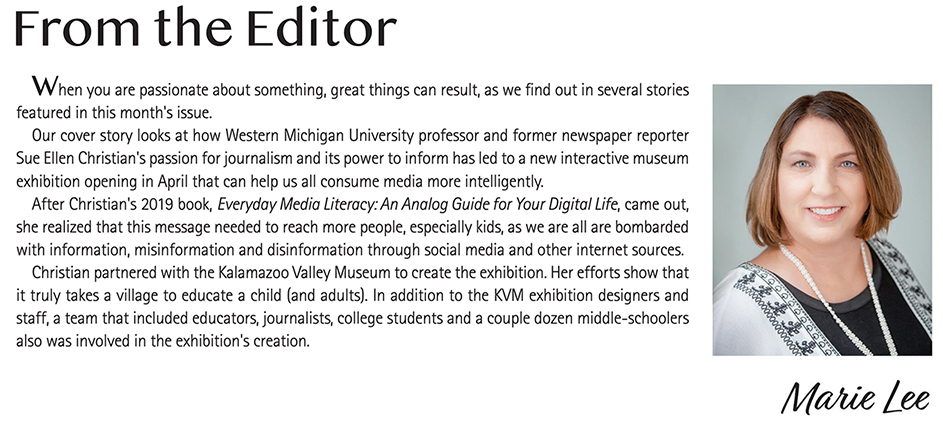
Taking Aim at Disinformation — from encorekalamazoo.com with the work of one of our sisters, Sue Ellen Christian, highlighted in it
Southwest Michigan’s Magazine: WMU Professor Sue Ellen Christian and the Kalamazoo Valley Museum team up to teach media literacy…


From the Editor of Encore Magazine


Accelerated Digital Skills and the ‘Bootcamp Boom’. — from holoniq.com
The market for accelerated digital skills is stepping up to a whole new level. Bootcamps, among others, are evolving rapidly to meet the opportunity.

Excerpt:

Tech Bootcamps re-skilled and up-skilled over 100,000 professionals globally in 2021, up from less than 20,000 in 2015. We expect this number to reach over 380,000 by 2025 representing over $3B of expenditure with significant upside as tech up-skilling models and modes overlap and converge. Governments, employers, universities and colleges everywhere are embracing rapid, high ROI training to build capacity in software, marketing, cyber and tech sales to drive their economies and growth.

Also from holoniq.com, see:

Also relevant/see:


The future of AR — from 900lbs.com

Some of the topics include:

  • Where is #AR today and where’s it going? 
  • What options/deployment methods are available & what are their limitations?
  • Web AR
  •  We’ve heard a lot about AR headsets. Are they the best option?
  • Ok, I’m interested in creating an AR experience. What now? 
  • What is the biggest piece of advice you have for brands diving into AR for the first time?
  • …and more

Also see:


Right Now, Your Best Employees Are Eyeing the Exits– from chronicle.com by Marci K. Walton
To stay, they need better pay, reasonable hours, and an end to mission-based gaslighting.

Excerpt:

Right now, your best midlevel manager is updating her résumé. Your hardest-working director is controlling his excitement after learning the salary range for a private-sector opening. Your most trustworthy entry-level professional is writing a resignation letter because her new corporate position doubles her pay and doesn’t require nights or weekends.

Two years of pandemic life have left campus staff members beyond burned out. They are done. And they are leaving or thinking about it in droves. I know because I was one of them. After nearly 13 years working in residence life — a field to which I was deeply committed — I left higher education last March for the private sector. The move increased my salary by 50 percent and cut my workload in half.

This tweet was mentioned/linked to in the above article:


The US Copyright Office says an AI can’t copyright its art — from theverge.com by Adi Robertson; resource via Sam DeBrule’s Machine Learnings newsletter

Excerpt:

The US Copyright Office has rejected a request to let an AI copyright a work of art. Last week, a three-person board reviewed a 2019 ruling against Steven Thaler, who tried to copyright a picture on behalf of an algorithm he dubbed Creativity Machine. The board found that Thaler’s AI-created image didn’t include an element of “human authorship” — a necessary standard, it said, for protection.

Also, along the lines of emerging technologies and the legal realm, see:

Law Firms Turn to AI to Vet Recruits, Despite Bias Concerns — from news.bloomberglaw.com by Erin Mulvaney and Chris Opfer; resource also via Sam DeBrule

Excerpt:

Law firms struggling to expand candidate pools and diversify workforces are turning to AI for help, even as regulators scrutinize the technology to ensure it doesn’t exacerbate biases rather than lessen them. A law set to take effect in New York City next year will limit the use of the technology in hiring and require that employers test recruiting algorithms for bias, while the U.S. Equal Employment Opportunity Commission is taking a closer look at the tools.


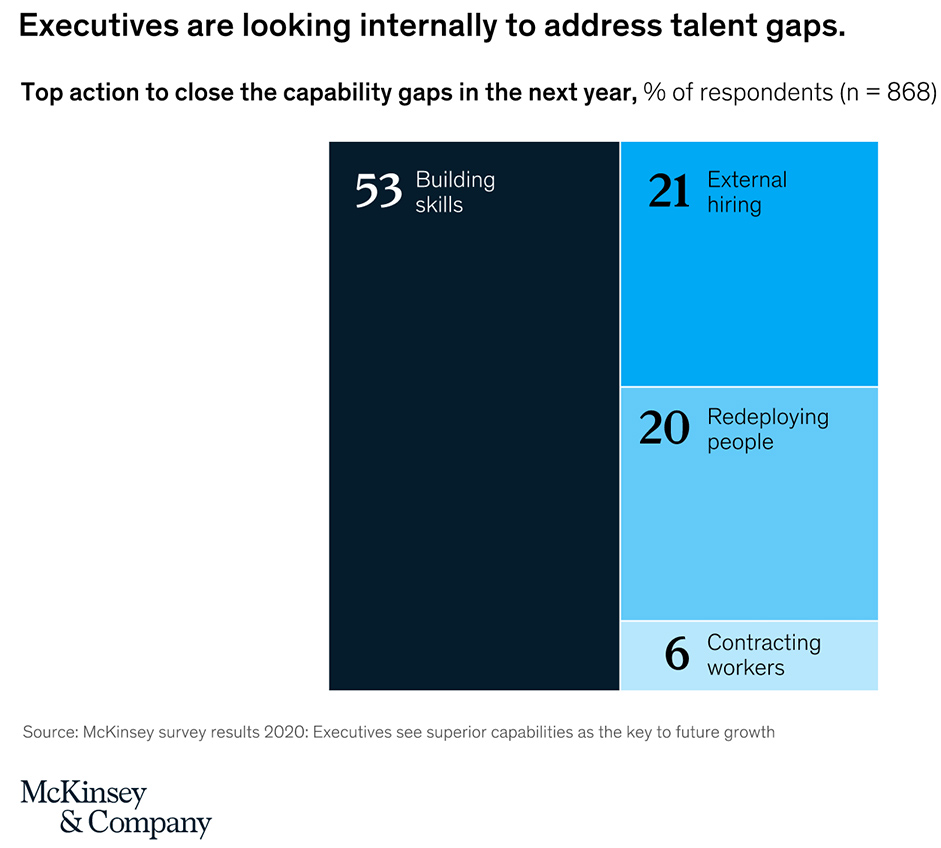
Look inward, not outward — from mckinsey.com
More companies are building talent internally rather than externally. Over 50 percent of executives believe that developing the skills of their existing workforce is the most useful approach to address capability gaps—rather than hiring new workers, redeploying talent, and contracting in skilled workers.


A Podpourri of Learning Options: Pods, Hubs, and Microschools in the Wake of the Pandemic — from gettingsmart.com by Tom Vander Ark

Excerpts:

The Center on Reinventing Public Education (CRPE) recently published a report, Pandemic Pods and the Future of Education, based on a survey of families and educators who organized or participated in a pandemic pod. While it was challenging to collect representative data on pods, CRPE concluded that pods were an important pandemic response with long-term implications for education.

The CRPE defines pods as an in person or intensive virtual support that meets multiple times per week. While a broad definition, it is more narrowly defined than many of the previous attempts at categorizing small group learning experiences.

Despite the “moment” that pods had during the pandemic, once in-person learning became more available there was a snapback of about 85%, with the numbers of students shifting from pods to classroom attendance. Those students remaining in pods, typically counted as homeschooled, are part of what is likely to be a 1-2% long-term enrollment shift (perhaps 1 million students) away from traditional public schools.

Addendum on 3/2/22:

Along the lines of learning options, see:


Why the World’s First Virtual Reality High School Changes Everything — from steve-grubbs.medium.com by Steve Grubs

Excerpts:

The recipe required key ingredients to happen. In addition to an accredited school to manage students, admissions and the for-credit learning, it also needed a platform. That’s where EngageVR comes in. There are other platforms that will ultimately host schools, perhaps AltSpace, Horizon or others, but the first is on Engage.

The bottom line is this: creators, coders, educators, entrepreneurs, investors, corporations, parents and students all played a role in finally bringing the first global virtual reality high school to life. It won’t be the last school to open in the metaverse, but to all those involved in this inaugural launch — the Neil Armstrongs of your age — a special tip of the hat today for having the vision and the willingness to launch a better and more equitable era of education.

Also see:

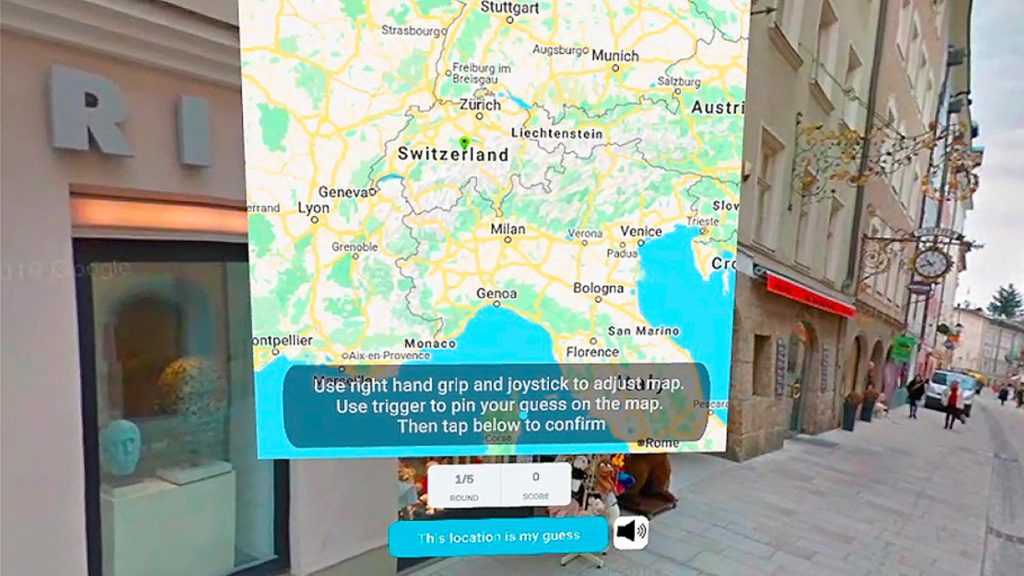
This is a snapshot from the Geo Guesser VR game


Triumphs and Troubles in Online Learning Abroad — from edsurge.com by Robert Ubell

Excerpt:

In Canada, for example, about two-thirds of colleges offer online degrees—and many have for years. While here in the U.S., a far smaller number grant degrees online.

I thought it would be good to do some digging to explore a more nuanced appreciation of the status of virtual instruction outside the U.S.

From DSC:
I would also like to mention that there’s a lot happening in Australia and in India along these lines, and likely in many other countries as well. But I think that one can only cover so much in one posting.   🙂


Universal Dyslexia Screening: What You Need to Know — from techlearning.com by Erik Ofgang
Universal dyslexia screening can help school districts identify students who are at risk and provide additional support, even though it is not required in every state.

Excerpt:

Dyslexia affects approximately 20 percent of the population and accounts for 80 to 90 percent of learning disabilities, according to the Yale Center for Dyslexia & Creativity. Early recognition of the risk for dyslexia and other word-level disabilities through universal screening in kindergarten, and then providing those students with intensive intervention, is a key early literacy strategy, says the National Center on Improving Literacy in a white paper.


© 2025 | Daniel Christian