Prioritizing Mental Health and Well-Being in the Workplace is Evolving and Driving Change in the Legal Profession — from law.upoenn.edu by Daniel T. Lukasik, Esq.; with thanks to PennLaw’s Future of the Profession Initiative (from 6/9/22) for this resource

Excerpt:

I now know I was never the only one with a mental health problem. Over the past five years, numerous surveys have confirmed what I and others suspected: anxiety, burnout, depression, and problems with alcohol are rampant throughout the legal profession. Compared to the general population, the magnitude of lawyer distress is deeply troubling.

In a confidential ABA survey of 13,000 lawyers, twenty-eight percent reported they had experienced a problem with depression within the past twelve months, a rate four times that found in the general population. Yet, given this sobering fact, there’s good cause to feel optimistic about the profession’s future.

Today, there is nothing short of a revolution in the law at all levels regarding mental health.

Two other relevant items from PennLaw’s Future of the Profession Initiative from 6/9/22:

From DSC:
I post this for:

  • Undergrad students within higher education — as you should go into a career in the legal profession with your eyes wide open.
  • For the rest of us in society — for a better understanding of others’ situations. If you know of a lawyer in the family or as a friend, you may want to check in with them as to how they are really doing.
 

From DSC:
The following items made me reflect upon the place of COVID-19 in causing the current ills within higher education — but also thinking about the ills that were present long before Covid hit us.

Key point:
We should be careful not to conveniently use COVID-19 as the scapegoat for all that’s wrong within higher education.


On the faculty/staff side of the house


The Season of Our Professorial Discontent — from chronicle.com by Paul Musgrave
The pandemic irrevocably changed the student-teacher relationship — and not for the better.

Excerpts:

As pandemic slides into endemic, it’s worth asking: Did the pandemic break something fundamental about academe? Was the spring of 2022 the end of pandemic disruptions, or the start of a new normal?

This time, as I delivered the lines to an audience of 30 in a course with 200 students enrolled, I was wondering whether I wanted to give a lecture ever again.

From DSC:
Regarding the first quote…several things were broken within academe long before COID-19. Re: the second quote, what should that tell us if only 30 students showed up in a class with 200 students in it?

Faculty autonomy and faculty satisfaction are being whittled away.

From DSC:
From what I can tell, that’s been happening for years within the K-12 learning ecosystem. It seems like this trend is now occurring within the higher ed learning ecosystem. (I could go off on a tangent about why we didn’t help our fellow educators within K-12 — whose “product” directly impacts those working within higher ed — but I better not. This posting is already packed with reflections.)

Below are some relevant quotes from Kevin McClure’s 5/27/22 article out at The Chronicle of Higher Education (emphasis DSC). I agree with much of what Kevin is saying here.

Don’t Blame the Pandemic for Worker Discontent
It hasn’t just been a tough two years. It’s been a tough two decades.

Excerpt:

The pandemic alone didn’t cause the low morale and turnover you might be seeing among your faculty and staff members just as the lack of personal protective equipment didn’t solely give rise to the Amazon Labor Union. Yes, today’s workers are re-evaluating their workplaces, seeking reassignment within their institutions, and in some cases resigning from jobs altogether. But they are doing so for many of the same reasons they did 20 years ago — poor working conditions.

So burnout isn’t just about people struggling to cope with stress; it’s about people struggling in workplaces where stress never subsides.

In my own interviews on morale, higher-education workers have talked about leaders who aren’t listening, low compensation, and understaffing.

We see our workplaces differently, and our tolerance of poor working conditions has evaporated.


On the student side of the house


“It hasn’t just been a tough two years. It’s been a tough two decades.” The same — and likely more — could be said for the student side of the house, especially in regards to the price of education and how relevant/up-to-date the content has been. As the prices of obtaining a degree have skyrocketed over the last several decades, students and parents now HAVE to ask, “What’s the Return On Investment (ROI) here? Am I gaining the skills in college that will get me hired after college?”

Again, the point I’m trying to make here is that we should be careful not to conveniently use COVID-19 as the scapegoat for all that’s wrong within higher education.

Along these lines, the following two quotes seem relevant to me from Beth McMurtrie’s (6/2/22) Teaching e-newsletter (also from The Chronicle):

I asked Walton to tell me more about the setup at his university. He said classes were fully in person but instructors were encouraged to record lectures and be highly flexible with due dates. The result: Most days he had less than 50-percent attendance, and he received a lot of last-minute emails from students who said they woke up that morning with a headache or otherwise not feeling well. A few filed documented absence requests, but not many, suggesting that these were not serious illnesses, like Covid.

I’ve never had more incompletes for courses than in the last two years, so signaling to students that their distribution courses are flexible and accommodating has only let them de-emphasize them even more.

There’s likely a variety of causes/possibilities here — and I’m sure that Covid-related reasons are among them. But it makes me really wonder if students don’t think that the content is all that valuable or relevant to begin with these days. Is college even worth it anymore? Why am I here in the first place? Where is the motivation coming from? Is it extrinsic or intrinsic motivation?

Perhaps it’s time to change the curriculum/content as well as the price.
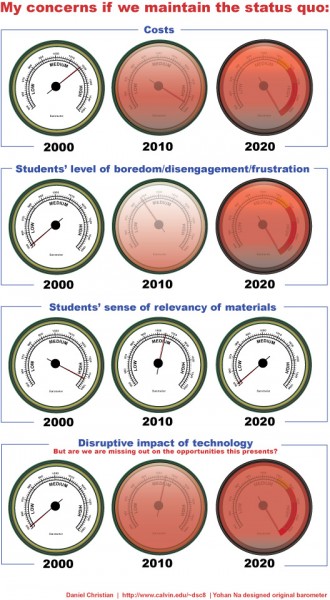

Daniel S. Christian: My concerns with just maintaining the status quo (from 2009).

A graphic I created back in 2009, with Yohan Na’s assistance.


Hebrews 9:28 — from biblegateway.com

28 so Christ was sacrificed once to take away the sins of many; and he will appear a second time, not to bear sin, but to bring salvation to those who are waiting for him.

11 Yours, Lord, is the greatness and the power
    and the glory and the majesty and the splendor,
    for everything in heaven and earth is yours.
Yours, Lord, is the kingdom;
    you are exalted as head over all.


Radar Trends to Watch: June 2022 — from oreilly.com

Excerpt:

The explosion of large models continues. Several developments are especially noteworthy. DeepMind’s Gato model is unique in that it’s a single model that’s trained for over 600 different tasks; whether or not it’s a step towards general intelligence (the ensuing debate may be more important than the model itself), it’s an impressive achievement. Google Brain’s Imagen creates photorealistic images that are impressive, even after you’ve seen what DALL-E 2 can do. And Allen AI’s Macaw (surely an allusion to Emily Bender and Timnit Gebru’s Stochastic Parrots paper) is open source, one tenth the size of GPT-3, and claims to be more accurate. Facebook/Meta is also releasing an open source large language model, including the model’s training log, which records in detail the work required to train it.


As Challenges in Education Persist, Our Coverage Will Elevate Educator Voices — from edsurge.com by EdSurge Staff

Excerpt:

Elevating the diverse voices of educators—particularly the perspectives of those traditionally marginalized—is critical for making change. That’s especially important at this moment, during what appears to be an inflection point in the history of American education.

During this period of upheaval, we’ve amplified the voices of educators as they navigate the fallout from the pandemic through our Voices of Change project, creating opportunities for educators to reflect, share and learn from one another through journalism, storytelling and research.

From DSC:
This is great to see, especially seeing as we are in a game-changing environment. These folks are on the front lines, so to speak. As such, we need to listen to them very carefully. Their voices should be the first to be considered and heard as we move forward into the future of education.


Also relevant/see:

Teachers of the Year Say Educators Deserve More Trust — — from edsurge.com by Rebecca Koenig

Excerpt:

“We have this idea that they’ve lost learning, but I really want to change that narrative into: Their learning has shifted,” she explains. “They learned a lot. It might not have been the science I wanted them to learn, but they learned how to learn online and in person; they learned how to change at a moment’s notice, they learned how to keep themselves and … their family safe. I’m pretty sure they all have graduate degrees in technology at this point.”

Rivera believes that education would improve if leaders at every level listened to teachers more, trusted them as experts and drew on their insight when making decisions.


Designing for Autism, ADHD, and More: Representing Neurodivergence — from learningsolutionsmag.com by Judy Katz

Excerpt:

Understanding inclusion from a neurodiversity perspective has both a DEI component (addressed in this article), and an accessibility component (addressed in the two articles to come in this series). As learning and development professionals, applying both is not just about accommodating impairment or staying compliant with the ADA. It’s about unlocking the talents that diverse neurotypes bring.

Positives of neurodivergence
One of the best things you can do to lead to greater acceptance of neurodivergence in the workplace is to learn and reinforce to others that neurodivergent brains are often different in positive ways, despite broad negative stereotypes. Here are some examples, but remember, not all traits apply to all individuals; if you know one neurodivergent, you know one neurodivergent.

#autistics #ADHD #Aspergers #neurodivergence #DEI


Also from learningsolutionsmag.com:

Automation, AI Will Advance—and Challenge—Learning Leadership — by Markus Bernhardt

Excerpt:

The current momentum of change, seen across all sectors and industries, is unparalleled in magnitude and speed; both are accelerating. The need for businesses to adapt has arguably never been more pressing, while challenges continue to grow at an increasing pace.

The digital revolution has arrived, and we already find ourselves in the thick of it. For learning and development (L&D), the time has come that deploying automation will be key. When we look at other departments within organizations, we can no longer imagine how marketing, sales, finance, or HR would fare without automation. Here, automation has celebrated some huge successes, gathering momentum as available technology is deployed more broadly. The results are increasing efficiencies, accuracy, and speed, and at scale.

This article introduces a short series on automation and AI and their impact on L&D.


The DNA of a strong learning culture — from chieflearningofficer.com by Stella Collins
How is the learning culture where you work now? What’s stayed the same? What’s changed?

Excerpt:

In this article, I will explore real stories through the lens of the DNA for an effective learning culture and discover practical examples you can apply in your own organization.

They recognized every single person in the business needs to learn, from the CEO to the most junior recruit. Everyone is a learner when “the times they are a-changin’.”

When people talk about changed behaviors, upskilling or knowledge acquisition, what they really mean, at a fundamental level, are changes to the structure, chemistry and function of our brain. These become our perceptions, memories, behaviors, habits and skills. When you don’t know any of the science, your training interventions are more likely to be hit and miss. Your training can become much more effective and armed with some proven tools to drive attention, build memories and create new habits.


Into the metaverse: What does it hold for the future of L&D? — from chieflearningofficer.com by Calvin Coffee

Excerpt:

Instead of putting learners in front of 2D videos where they’re answering questions or just clicking boxes, the metaverse allows learners to experience what a job is actually like before accepting and will enable leaders to see if employees are ready for the next level of work. In the same way flight simulators can prepare pilots for many aspects of operating and flying an aircraft, through technologies like VR the metaverse can prepare employees for almost anything at work.

“This technology can impact every stage of the HR journey for an employee,” Belch says. “We all know the interviewing process is flawed and riddled with bias. Let’s have someone do the job and show us whether or not they can do the job.” And if they mess up in VR, they’re not going to take down the whole factory. From hiring and beyond, there is an abundance of potential spaces that the metaverse can capitalize on and improve.

Research in medical training has found that information retention rates can reach 80 percent after a full year of training through immersive simulated experiences compared to just 20 percent for traditional training. “People are picking it up and are much more comfortable performing their tasks after going through the simulation,” Jordan says. “It’s incredibly powerful.”

Also from chieflearningofficer.com:


CLASSROOM AND AT-HOME ACCOMMODATIONS FOR DYSLEXIA — from thetechedvocate.org by Matthew Lynch

Excerpt:

For most kids of school age, recognizing letters and learning to pronounce them comes as easy as possible. However, for children living with Dyslexia, it is typically an uphill task to achieve. Dyslexia is a reading disorder that impedes a child’s early academic development by significantly decreasing the ability to process graphic symbols, especially where it concerns language. Such children may struggle with language development before school age and experience difficulties learning to spell when they eventually enroll in school. Some symptoms commonly exhibited by dyslexic children include reversed letter and word sequences, weak literacy skills, and poor handwriting.

In all these, the good news for parents and educators with dyslexic children in their care is that with early diagnosis and suitable accommodations, they can learn to read like the other children.

CLASSROOM AND AT-HOME ACCOMMODATIONS FOR DYSCALCULIA — from thetechedvocate.org by Matthew Lynch

Excerpt:

If you have a child struggling with basic math skills and you’ve done everything else to resolve the situation yet it persists, the child might be suffering from Dyscalculia. Dyscalculia is a learning disorder typified by an inability to grasp basic math skills. The peculiar thing about this learning disorder is how it seems only to concern itself with foundational math skills. Lots of people living with this disorder will go on to learn advanced mathematical principles and concepts without any problems. Although manifestations of Dyscalculia will differ from person to person, another symptom commonly associated with the disorder is visual-spatial struggles or difficulty in processing what they hear.

It does not matter whether you are a parent or a teacher; if you are looking for the right accommodations needed to aid students with Dyscalculia, you have come to the right post. These are some steps you can take both in the classroom and at home to ease learning for students with Dyscalculia.

CLASSROOM AND AT-HOME ACCOMMODATIONS FOR DYSNOMIA — from thetechedvocate.org by Matthew Lynch

Excerpt:

When kids struggle with recalling words, numbers, names, etc., off the top of their heads without recourse to a visual or verbal hint, they might likely be suffering from Dysnomia. Dysnomia is a learning disability marked by an inability to recollect essential aspects of the oral or written language.

CLASSROOM AND AT-HOME ACCOMMODATIONS FOR DYSGRAPHIA — from thetechedvocate.org by Matthew Lynch

Excerpt:

Like most learning disabilities, Dysgraphia makes learning difficult for students. In this case, this learning disorder is peculiar to handwriting and motor skills proficiency. Students living with Dysgraphia can suffer from problems ranging from forming letters accordingly, transferring their thoughts onto paper, tying their shoelaces, and zipping a jack. It is pretty standard that Dysgraphia sufferers compensate for their struggles with handwriting by developing remarkable verbal skills. However, this disorder is prone to misdiagnosis. It is due to a lack of sufficient research on the subject.

As a parent or an educator, if you have students who live with Dysgraphia, this post will show you which accommodations you need to put in place to help them learn correctly.


Also relevant/see:

EARLY INTERVENTION: A GUIDE — from thetechedvocate.org by Matthew Lynch

Excerpt:

Educators must effectively identify a student who needs early intervention, whether for autism, learning disorders, or even reading difficulties. The more serious the issue, the more essential early action becomes.


How to ensure we benefit society with the most impactful technology being developed today — from deepmind.com by Lila Ibrahim

In 2000, I took a sabbatical from my job at Intel to visit the orphanage in Lebanon where my father was raised. For two months, I worked to install 20 PCs in the orphanage’s first computer lab, and to train the students and teachers to use them. The trip started out as a way to honour my dad. But being in a place with such limited technical infrastructure also gave me a new perspective on my own work. I realised that without real effort by the technology community, many of the products I was building at Intel would be inaccessible to millions of people. I became acutely aware of how that gap in access was exacerbating inequality; even as computers solved problems and accelerated progress in some parts of the world, others were being left further behind. 

After that first trip to Lebanon, I started reevaluating my career priorities. I had always wanted to be part of building groundbreaking technology. But when I returned to the US, my focus narrowed in on helping build technology that could make a positive and lasting impact on society. That led me to a variety of roles at the intersection of education and technology, including co-founding Team4Tech, a non-profit that works to improve access to technology for students in developing countries. 


Also relevant/see:

Microsoft AI news: Making AI easier, simpler, more responsible — from venturebeat.com by Sharon Goldman

But one common theme bubbles over consistently: For AI to become more useful for business applications, it needs to be easier, simpler, more explainable, more accessible and, most of all, responsible


UX, Accessibility, & More: ID Links 5/24/22 — from christytuckerlearning.com by Christy Tucker

Excerpt:

As I read online, I bookmark resources I find interesting and useful. I share these links periodically here on my blog. This post includes links on UX, accessibility, branching scenarios, Twine, instructional design blogs, free/freemium tools, and systems thinking.


Also from Christy Tucker, see:


How an Escape Room Is Building Students’ Digital Skills at Northampton Community College — from campustechnology.com by Rhea Kelly

Excerpt of description of podcast:

We spoke with Beth Ritter-Guth, associate dean of online learning and educational technology at the college, to find out how the Learning Lab is engaging students, building digital literacy and providing valuable training in the job skills of the future.

Also see:

Breakout EDU gamifies learning to create an engaging and empowering experience for students of all grade levels.

Five Concepts You Can Teach Through Geocaching — from freetech4teachers.com by Richard Byrne

Excerpt:

Geocaching is one of the things that I spend a good bit of time talking about in both my workshop and in my webinar about blending technology into outdoor learning. Geocaching is a great activity to do to get kids outside for hands-on learning experiences. Here are five things that you can teach through geocaching activities.

From DSC:
This next one may be useful for educators and/or parents, but it’s useful for pretty much all of us

Tip of the week: A great group packing tool — from Jared newman

Excerpt:

As an alternative to clunky spreadsheets or endless email chains, WhoBrings is a brilliantly simple way to figure out who’s bringing what.

Just type the name of your packing list into this free website, add some items, then share the link with the rest of the group. Anyone who has the link can then claim responsibility for an item or add new items to the list. You can also specify a number of units for any item—12 beach towels, for instance, or three packs of beer—and people can choose how many they’ll bring.


Also see:

Learning, doing, and teaching biology through multimedia — from MIT Open Learning
Producing multimedia for online courses involves lifelong learning


Defining Futures Thinking — from foresightpresent.foresightfutures.net by Maree Conway
It’s not easy to define futures thinking and foresight because it seems to be the norm in this field to re-invent definitions on a regular basis.

Excerpt:

The terms we use to describe the study of alternative futures is important. Disciplines and discourses do not emerge from a vacuum but have a history and a cultural context; and their names can hide as much as they reveal.

Speaking of the future…here’s a somewhat related item:

What should be the biggest change to wearables in the next five years? — from protocol.com by various
A greater emphasis on recommendations, better clinical integration and more accessibility are the changes that ought to be in store, the experts say.

Excerpt:

What makes wearable technology great is the opportunity to actually change lives by improving health, increasing fitness and enhancing performance. Whether we actually see it or not over the next five years, the change we should see is a greater emphasis on the insights and recommendations generated by wearable technology, rather than ever-larger piles of charts and graphs.


I saw the Holy City, the new Jerusalem, coming down out of heaven from God, prepared as a bride beautifully dressed for her husband. And I heard a loud voice from the throne saying, “Look! God’s dwelling place is now among the people, and he will dwell with them. They will be his people, and God himself will be with them and be their God. ‘He will wipe every tear from their eyes. There will be no more death’[a] or mourning or crying or pain, for the old order of things has passed away.”

 
© 2025 | Daniel Christian