Ways that artificial intelligence is revolutionizing education — from thetechedvocate.org by Matthew Lynch

Excerpt:

I was speaking with an aging schoolteacher who believes that AI is destroying education. They challenged me to come up with 26 ways that artificial intelligence (AI) is improving education, and instead, I came up with. They’re right here.


AI Startup Speeds Healthcare Innovations To Save Lives — from by Geri Stengel

Excerpt:

This project was a light-bulb moment for her. The financial industry had Bloomberg to analyze content and data to help investors uncover opportunities and minimize risk, and pharmaceutical, biotech, and medical device companies needed something similar.


Trends in State Courts — from ncsc.org

Excerpt:

Trends in State Courts is an annual, peer-reviewed publication that highlights innovative practices in critical areas that are of interest to courts, and often serves as a guide for developing new initiatives and programs and informing and supporting policy decisions. Trends in State Courts is the only publication of its kind and enjoys a wide circulation among the state court community.

Trends in State Courts 2022
External events continue to drive change and innovation in the courts. The 2022 edition of Trends in State Courts highlights post-pandemic eviction courts and eliminating racism and bias in the courts.


Also from ncsc.org:

The key role of non-lawyer practitioners — by Dimarie Alicea-Lozada

Excerpt:

Over the last 20 years, a variety of different states have developed efforts to try to provide for non-lawyer practitioners with varying degrees of success. The intention was simple: provide affordable legal services to those who cannot afford an attorney but need help. With 1 out of 10 people in the United States involved in newly filed cases each year and 3 out of 5 in civil cases not having a lawyer, state courts have been trying to help people who otherwise will not be able to afford access legal representation. Since the COVID-19 pandemic, several states have made changes in this area.


From DSC:
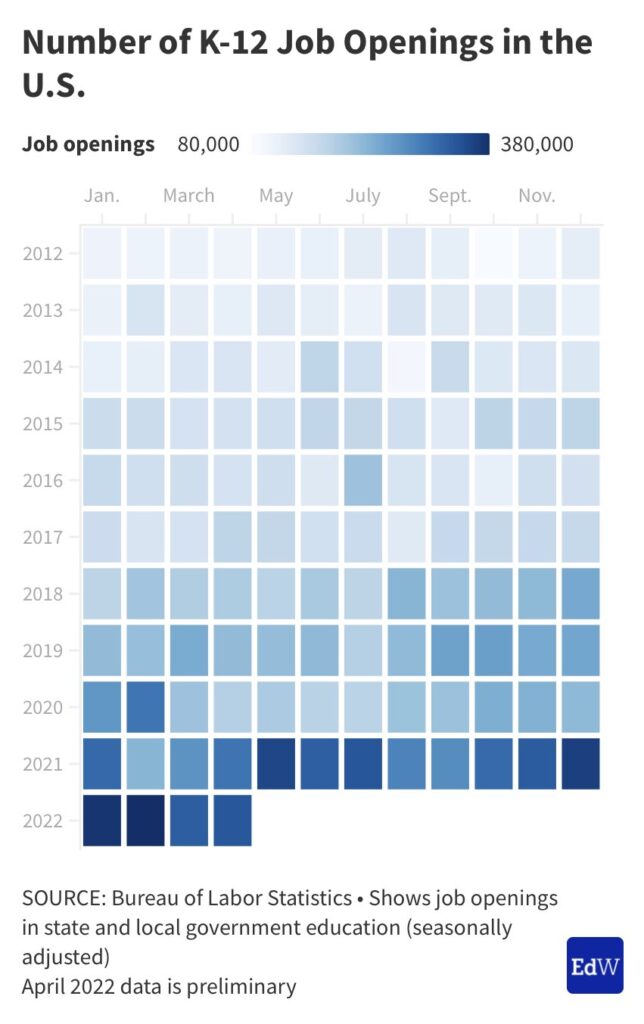
Is the use of virtual instructors going to be used more to fill vacancies within K12? Hmmm…time will tell. 

By the way, I think online-based learning works for many people, but certainly it isn’t for everyone (even with the likely unfair assumption that everyone has Internet access and the equipment/setup that they need). From what I’ve observed, it works best for very disciplined, motivated students — they need to be a bit more independent in their learning. But school systems should have backup plans in place if the exodus continues.


Education tech companies bring virtual teaching to the table as solution to teacher shortage — from thedenverchannel.com by Chloe Nordquist

Excerpts:

Education technology companies like Elevate K-12, which is a live streaming instruction platform, are growing. Especially in areas where hiring a teacher can be tough.

The company is seeing more interest from teachers in joining their platform. One is for schedule flexibility.


New: Futurist Friday Podcast Interview with Gerd Leonhard: TheGoodFuture? — from futuristgerd.com by Gerd Leonhard

Excerpt:

Over the course of the summer of 2022, DonMacPherson and 12 Geniuses are releasing 12 interviews with futurists and forward thinkers in order to help their global audience of leaders become better visionaries for their organizations and be more prepared for the uncertain future.

In this episode, Gerd Leonhard joins the show. First, he points out that “the future is already here, we just haven’t paid enough attention to it.” He talks about how technology is promising to make us superhuman, that we are in the biggest shift era in recent history as far as energy and climate is concerned, and that machines and artificial intelligence are starting to emulate humanity.


7 Amazing Ways Technology Is Changing Higher Education for the Better — from innotechtoday.com by Emily Newton

Excerpt:

As society has stepped decidedly into the digital age, there’s been a lot of debate about how technology is changing higher education. Some people believe there are benefits of technology in education, while others are concerned about tech’s impact on learning and motivation. Technology in higher education can be a major distraction or an incredibly helpful resource.

Technology is only as good or as bad as what you do with it. In education, AI, coding, and media creation are tools that teachers can use to motivate their students and help them grasp new ideas. Keeping pace with everyday tech is important for modern students. Here are seven amazing ways technology is changing higher education for the better.


Forget long screen recordings. These tools automate your company’s how-tos. — from protocol.com by Lizzy Lawrence
Scribe and Tango take screen recordings and automatically turn them into step-by-step lists.

Excerpt (emphasis DSC):

If only there were a better way of transferring this knowledge, Smith thought at the time. Later, she worked in venture capital and kept hearing the same thing: How do we efficiently spread the company wisdom that’s trapped inside people’s heads? Without the thick binder or the 45-minute screen recording? Thus began Scribe.

To use Scribe, you record your screen as you go through a standard workplace process. When you finish recording, Scribe automatically generates a step-by-step written guide with screenshots that you can edit and share with whomever you want. It’s a browser extension and a desktop app, meant to be as easy as possible for both the sender and recipient of information.


Should you Switch from Teacher to Instructional Designer? — from teamedforlearning.com
It takes more than a new headline on your resume to transition from teacher to instructional designer.

Excerpts:

If you’re a teacher you may be looking for ways to make the most of the boom in digital learning job opportunities. You’ve developed some new skills in elearning and want to put them to use. It may be tempting to rebrand yourself as an instructional designer. Not so fast. The shift to instructional design is more than a title change, it demands additional credentials and skills that you might not have yet.

Before you try to make the leap, you should understand the real differences between the two roles. You may need to seek out new skills and credentials. It takes more than a new headline on your resume to transition from teacher to instructional designer.

You Can Make The Switch From Teacher To Instructional Designer

By now, we hope you understand why instructional design is more than a title, it’s a unique role in the digital learning ecosystem. Although switching roles isn’t as easy as just using new vocabulary, it can be done. With a little planning and the right credentials, you can make the switch from teacher to instructional designer.

The digital learning industry is evolving everyday.


Higher Ed Is Looking to Refill Jobs. But It’s Finding a ‘Shallow and Weak’ Candidate Pool. — from chronicle.com by Megan Zahneis

Excerpt (emphasis DSC):

While higher education has largely recovered nearly all of its pandemic-associated job losses, the task of recruiting and hiring administrators and staff members has become a daunting one, according to a Chronicle survey of college leaders, hiring managers, and administrators that was conducted with support from the Huron Consulting Group.

Nearly 80 percent of the 720 respondents said their campus has more open positions this year than last, and 84 percent said that hiring for administrative and staff jobs has been more difficult in the last year.

Those positions are harder than ever to fill, too: 78 percent of leaders said their campus had received fewer applications for open jobs in the last year, and 82 percent agreed that they’d fielded fewer applications from qualified candidates. Said one person who took the survey: “The pools have been shallow and weak.”

From DSC:
Ask any ***staff*** member who has been working within higher education these last 10-20 years if this development is surprising to them, and they would tell you, “No, this is not a surprise to me at all.” Working within higher education has lost much of its value and appeal:

  • Budgets have been shrinking for years — so important/engaging new projects get taken off the plate (or indefinitely postponed). So opportunities for personal growth and new knowledge for staff members have been majorly curtailed. Also, members of administrations may decide to outsource those exciting projects that do survive to external consultants.
  • Oftentimes, salaries don’t match inflation — and they were never stellar to begin with.
  • Staff are second-class citizens within the world of higher education
    • They aren’t part of the governing bodies (i.e., the Faculty Senates out there don’t include staff). Faculty members have much more say, control, and governance over things and get the opportunities to travel, learn, present, grow, share their knowledge, etc. much more so than staff members.
    • There are few — if any — sabbaticals for staff members.
    • Even those working within teaching and learning centers and instructional designers don’t have their hands on many steering wheels out there. Many faculty members prefer to hold their own steering wheels and they won’t listen to others who aren’t people they consider their “peers” (i.e., essentially other faculty members).
    • They often don’t get the chance to do research and to make money off that research, like faculty members do
  • Staffing levels are inadequate, so one takes on an ever-increasing amount of work for the same pay.

And others could add more items to this list. So no, this is not a surprise to me at all. In a potential future where team-based content creation may thrive, it appears that some team members are dropping out.


States Look Beyond Bar Exam to License Lawyers — from iaals.du.edu by Jonna Perlinger

Excerpt:

The bar exam has been under growing scrutiny, due to the undue financial burden it places on law graduates as well as its long history of disparate racial outcomes. In addition, minimum competence—the very thing the exam purports to assess—has historically lacked a comprehensive, evidence-based definition, prompting some to say that it’s “ineffective in gauging the knowledge and skills new lawyers need to be successful.” IAALS’ Building a Better Bar project provided the first empirically grounded definition of minimum competence and offered recommendations for how  our process for licensing lawyers must change to better serve the public; our findings indicate that many aspects of the current bar exam, including multiple-choice questions, time constraints, and being closed-book, fail to align with what we know about how to best assess minimum competence to practice law.

Fortunately, however, a growing number of states are now exploring the permanent implementation of alternative licensure approaches that would allow law school graduates to obtain their license through nontraditional avenues.


Criminal Justice Algorithm Predicts Risk of Biased Sentencing — from courttechbulletin.blogspot.com

Excerpt:

A new algorithm aims to assess the likelihood of defendants being treated unfairly in court.

The tool considers details that ought to be immaterial to the ruling — such as the judge’s and defendant’s gender and race — and then predicts how likely the judge is to award an unusually long sentence. This can suggest when socio-demographic details may be swaying judgments, resulting in especially punitive treatments.


Matthew Ball on the metaverse: We’ve never seen a shift this enormous — protocol.com by Janko Roettgers
The leading metaverse theorist shares his thoughts on the sudden rise of the concept, its utility for the enterprise and what we still get wrong about the metaverse.

Excerpts:

What are the biggest misconceptions about the metaverse?
First, the idea that the metaverse is immersive virtual reality, such as an Oculus or Meta Quest. That’s an access device. It would be akin to saying the mobile internet is a smartphone.

We should think of the metaverse as perhaps changing the devices we use, the experiences, business models, protocols and behaviors that we enjoy online. But we’ll keep using smartphones, keyboards. We don’t need to do all video conferences or all calls in 3D. It’s supplements and complements, doesn’t replace everything.

Also relevant/see:

A former Amazon exec thinks Disney will win the metaverse — from protocol.com by

Excerpt:

This month, Ball is publishing his book, “The Metaverse: And How It Will Revolutionize Everything.” The work explains in detail what the metaverse is all about and which shifts in tech, business and culture need to fall into place for it to come into existence.

How will the metaverse change Hollywood? In his book, Ball argues that people tend to underestimate the changes new technologies will have on media and entertainment.

  • Instead of just seeing a movie play out in 360 degrees around us, we’ll want to be part of the movie and play a more active role.
  • One way to achieve that is through games, which have long blurred the lines between storytelling and interactivity. But Ball also predicts there will be a wide range of adjacent content experiences, from virtual Tinder dates in the “Star Wars” universe to Peloton rides through your favorite movie sets.

Addendum on 7/24/22:

Neurodiversity, Inclusion And The Metaverse — from workdesign.com by Derek McCallum

Excerpt:

Innovation in virtual and augmented reality platforms and the vast opportunities connected to the metaverse are driving innovation in nearly every industry. In the workplace, future-focused companies are increasingly exploring ways to use this nascent technology to offer workers more choices and better support for neurodiverse employees.

It would be nearly impossible to list all the challenges and opportunities associated with this technology in a single article, so I’ll keep things focused on an area that is top-of-mind right now as many of us start to make our way back into the office—the workplace. The truth is, while we can use our expertise and experience to anticipate outcomes, no one truly knows what the metaverse will become and what the wide-ranging effects will be. At the moment, the possibilities are exciting and bring to mind more questions than answers. As a principal and hands-on designer in a large, diverse practice, my hope is that we will be able to collectively harness the inherent opportunities of the metaverse to support richer, more accessible human experiences across all aspects of the built environment, and that includes the workplace.


Now 2,627+ OPM, Bootcamp and Pathways Partnerships with Universities globally — from holoniq.com
Slower partnership growth for the first half of 2022 with 186 new OPM, Bootcamp or Pathways partnerships. Another ‘post-COVID’ transition?


© 2025 | Daniel Christian