


Good will come to those who are generous and lend freely,
who conduct their affairs with justice.
On 07/26/2022,
in faith, global / globalization, hearts -- matters of the heart, relationships, society,
by Daniel Christian
On 07/25/2022,
in adjunct faculty, content development, aggregation, repositories, corporate / business world, corporate universities / corporate training, digital learning, elearning, faculty/staff, ideas, India, instructional design, learning, learning ecosystem, Learning Experience Design, training / L&D, UK, United States, vendors, workplace,
by Daniel Christian
L&D Go Beyond Podcast: Bridging the Gap between Learning and Performance, with Charles Jennings — from upsidelearning.com by Gabriella Daniels
Excerpt:
Often, there is a vast gap between learning and performance in many organizations. Given Charles’ experience in the field, here are the key takeaways from this episode:
- Identifying the difference between schooling and learning and the business paradigm and the learning paradigm
- Learning through experience, practice, conversation, and reflection
- Looking at ‘learning for performance’ in a holistic way
- Recognizing the purpose of learning
- Understanding the relevance and application of training
- Uncovering the aspects of 70:20:10 or the performance-based learning methodology
- Determining learning through observation
- Moving from a learning-based culture to a performance-based culture
- Working with stakeholders to define performance metrics
- Conducting a performance analysis before every L&D project
Training with Branching Scenarios — from christytuckerlearning.com by Christy Tucker
You can do live training with branching scenarios using full group discussions, polls, small groups, or assignments.
Excerpt:
How do you use branching scenarios in instructor-led training, rather than self-paced elearning? I think there are a couple of possibilities for doing live training with branching scenarios. These could work for either classroom-based training or vILT (virtual instructor-led training). For example, you can use branching scenarios in training as a full group with discussion or polls, in small groups, or outside of class as a discussion prompt.
Learning Content Maintenance: Don’t Skip This Essential Step — from learningsolutionsmag.com Adam Weisblatt
Excerpt:
L&D departments get bombarded with requests for new content, and they are reward for their responsiveness. As soon as one eLearning module is completed and loaded in the LMS, it is forgotten and the next course in the queue is started. Multiply this by all the organizations that share the LMS. The result is a catalog of thousands of courses that no one has time to look at.
It is important to see this from the perspective of the learner.
Second Career Satisfaction — from learningsolutionsmag.com by Natalie Schoof
Excerpt:
Hey teachers: In case you didn’t realize it, you’re an instructional designer.
I attended a conference (Learning Solutions 2022) where I met two other former teachers, who, like myself, had recently transitioned from the classroom to the field of instructional design (ID). We instantly bonded over our shared experiences—the rewards and challenges of teaching, of course, but also why and how we decided to move on.
Our stories had striking resemblances. I’m sharing mine here in the hopes that it might encourage other would-be instructional designers.
“Lawyers and the Metaverse”, 3 warnings re: virtual hearings, using tech to advance legal ed, & more
On 07/25/2022,
in 21st century, Access to Justice (A2J), Asia, Blockchain, business, Canada, change, changing business models, cloud-based computing / apps / other cloud-related, collaboration, communications, copyright/ownership/NFTs, corporate / business world, cryptocurrencies, emerging technologies, experimentation, face-to-face, future, game-changing environment, human-computer interaction (HCI), immersion, innovation, interaction design, interactivity, law schools, legal technologies, legislatures / government / legal, new business models, platforms, privacy, society, strategy, telelegal, tools, United States, vendors, Virtual courts and law firms, Virtual Reality (VR) / worlds / learning, vision/possibilities, wearables,
by Daniel Christian
How will the Metaverse Influence Business and Legal Processes? — from jdsupra.com
Excerpt:
While some will be hesitant to use the metaverse and adoption is difficult to predict, it is not going away and will undoubtedly affect internal processes, business dealings, case strategy, and more. Organizations should start thinking about the possibilities now to be better prepared for future challenges. Below are some predictions on how the metaverse will influence operations, strategy, and investments across different areas of the enterprise.
Lawyers & the Metaverse — from joetechnologist.com by Elizabeth Beattie and Joseph Raczynski
Excerpt:
In a new Q&A interview, Thomson Reuters’ technologist and futurist Joseph Raczynski offers his insight about the Metaverse and how it will impact the legal industry.
I have likely spoken to thousands of lawyers over the last several years. They are extraordinarily bright, but with one limiting factor — their dedication to their craft. This means that they do not have the time to lift their heads to see what is coming. All these emerging technologies will impact their practices in some way, as well as the business of law. At a minimum, lawyers need the opportunity to focus on the big four: AI, blockchain, workflow, and the grab bag of general emerging technology. There are a multitude of places to learn about these things, but I would include some of the classics such as Google Alerts, Twitter threads on these topics, and magazines like Wired, which should be a staple for everyone.
These legal issues should be on college business officers’ radars — from highereddive.com by Rick Seltzer
A panel at the National Association of College and University Business Officers’ annual meeting covered legal questions spanning many offices on campus.
Let’s not presume that virtual hearings are the best solution in family law — from canadianlawyermag.com by John Silvester
Excerpts:
Proponents argue that virtual hearings are less expensive for clients, leading to enhanced access to justice for those who cannot afford to pay for their lawyers to travel to a courthouse and then sit and wait for hearings to commence. Sounds reasonable, right?
Not so fast.
…
Virtual hearings are advantageous in some scenarios, but there are at least three reasons why moving to an almost entirely virtual legal world may prove problematic.
LawNext Podcast: CALI Executive Director John Mayer on Using Tech to Advance Legal Education and Access to Justice — from lawnext.com by Bob Ambrogi and John Mayer
Excerpt:
In this episode of LawNext, Mayer joins host Bob Ambrogi to discuss the history and mission of CALI and to share his thoughts on the use of technology to enhance legal education. They also talk about how and why A2J Author was developed and how it is used by courts and legal services organizations to help those who are without legal representation. Mayer also shares his thoughts on the future of innovation in law and on the future of CALI.
Louisiana Approves Virtual Custody Services and Proposes Virtual Currency Business Licensing Rules — from natlawreview.com by Moorari Shah and A.J. S. Dhaliwal
Excerpt:
Recently, the Louisiana lawmakers and regulators have taken steps to legalize operations in the state involving virtual currencies. On June 15, the Louisiana governor signed a bill that, effective August 1, 2022, will allow financial institutions and trust companies to provide virtual currency custody services to their customers as long as they satisfy certain requirements on risk-management and compliance. On June 20, the Louisiana Office of Financial Institutions (OFI) published proposed rules on licensing and regulation of virtual currency businesses in the state pursuant to the Louisiana Virtual Currency Business Act, which went into effect on August 1, 2020.
On 07/25/2022,
in 21st century, business, corporate / business world, future, leadership, organizational change, pace of change, strategy, vision/possibilities, workplace,
by Daniel Christian
The Future of Futures — from maried.substack.com by Marie Dollé; with thanks to Robert Ferraro this resource
Anticipating tomorrow, demystifying the hype, making the ambient chaos a little more intelligible… Faced with a world in crisis, the futures industry is experiencing a ‘big bang’!
Excerpt:
As Matt Klein, trend lead at Reddit and author of the Zine newsletter, very wisely explains, “Overwhelmed with data and headlines, we have more opportunities to connect the dots and identify trends. But without a framework or ability to actually differentiate worthy signal versus noise, we become conspirators cooking up meaningless and ephemeral things (…) It’s not enough to just paint a picture of the zeitgeist. Analysts, consultants and service providers need to help their clients decode a trend’s drivers, opportunities and threats, and then strategize.” A view shared by David Mattin: according to the trend expert and former Trendwatching consulting director, the pandemic has accelerated the growing awareness within many organizations of the need for some form of structured thinking around the future. “There is a necessary shift away from tactical trends and toward strategic thinking and transformation of organizations and systems. There is also a need for new and more rigorous ways to combine quantitative and qualitative data with future thinking,” he says.
On 07/25/2022,
in 21st century, 24x7x365 access, A/V -- audio/visual, adult learning, Artificial Intelligence/Agents/LLMs/and Related, assistive technologies, Augmented Reality (AR), content development, aggregation, repositories, corporate / business world, corporate universities / corporate training, Daniel S. Christian, emerging technologies, experimentation, future, training / L&D, workplace, XR - extended reality,
by Daniel Christian
‘It’s a mess and I’ve never seen anything like it’: global lost luggage crisis mounts — from theguardian.com by Mattha Busby

From DSC:
After seeing the above article, I wondered:
- How might the future #AR glasses help with this situation?
- Could such devices help the relevant employees automatically scan each bar code for where to route (or not) the luggage? (As I’m sure is already happening in many situations that occur away from what’s occurring on the tarmac.)
Will AR glasses be used for such training-related applications in the future? For such logistical applications? Hmmm…time will tell.
On 07/25/2022,
in 21st century, accreditation, adult learning, Artificial Intelligence/Agents/LLMs/and Related, Augmented Reality (AR), Blockchain, change, changing business models, cloud-based computing / apps / other cloud-related, communities of practice, copyright/ownership/NFTs, corporate / business world, Cost of legal services - including access, credentialing, cryptocurrencies, dangers of the status quo, Daniel S. Christian, distance education, emerging technologies, engineering, entrepreneurship, experimentation, face-to-face, future, higher education, human-computer interaction (HCI), hybrid learning, Hyflex learning, ideas, innovation, instructional design, law schools, leadership, learning ecosystem, Learning Experience Design, Learning from the Living [Class] Room, learning preferences, learning spaces, Legal operations, legal reform, legal technologies, legislatures / government / legal, Michigan, Mixed Reality (MR), Natural Language Processing (NLP), Near Field Communication (NFC), online learning, organizational change, pace of change, platforms, policy, productivity / tips and tricks, reinvent, robotics, skills, society, staying relevant, strategy, surviving, technology (general), telelegal, trends, Uncategorized, United States, universities, using teams, vendors, Virtual courts and law firms, Virtual Reality (VR) / worlds / learning, vision/possibilities, workplace, XR - extended reality,
by Daniel Christian
From DSC:
Given:
- the accelerating pace of change that’s been occurring over the last decade or more
- the current setup of the legal field within the U.S. — and who can practice law
- the number of emerging technologies now on the landscapes out there
…I think we’ve run out of time to effectively practice law in the U.S. — at least in terms of dealing with emerging technologies. Consider the following items/reflections.
Inside one of the nation’s few hybrid J.D. programs — from highereddive.com by Natalie Schwartz
Shannon Gardner, Syracuse law school’s associate dean for online education, talks about the program’s inaugural graduates and how it has evolved.
Excerpt (emphasis DSC):
In May, Syracuse University’s law school graduated its first class of students earning a Juris Doctor degree through a hybrid program, called JDinteractive, or JDi. The 45 class members were part of almost 200 Syracuse students who received a J.D. this year, according to a university announcement.
The private nonprofit, located in upstate New York, won approval from the American Bar Association in 2018 to offer the three-year hybrid program.
The ABA strictly limits distance education, requiring a waiver for colleges that wish to offer more than one-third of their credits online. To date, the ABA has only approved distance education J.D. programs at about a dozen schools, including Syracuse.
Many folks realize this is the future of legal education — not that it will replace traditional programs. It is one route to pursue a legal education that is here to stay. I did not see it as pressure, and I think, by all accounts, we have definitely proven that it is and can be a success.
Shannon Gardner, associate dean for online education
From DSC:
It was March 2018. I just started working as a Director of Instructional Services at a law school. I had been involved with online-based learning since 2001.
I was absolutely shocked at how far behind law schools were in terms of offering 100% online-based programs. I was dismayed to find out that 20+ years after such undergraduate programs were made available — and whose effectiveness had been proven time and again — that there were no 100%-online based Juris Doctor (JD) programs in the U.S. (The JD degree is what you have to have to practice law in the U.S. Some folks go on to take further courses after obtaining that degree — that’s when Masters of Law programs like LLM programs kick in.)
Why was this I asked? Much of the answer lies with the extremely tight control that is exercised by the American Bar Association (ABA). They essentially lay down the rules for how much of a law student’s training can be online (normally not more than a third of one’s credit hours, by the way).
Did I say it’s 2022? And let me say the name of that organization again — the American Bar Association (ABA).

Graphic by Daniel S. Christian
Not to scare you (too much), but this is the organization that is supposed to be in charge of developing lawyers who are already having to deal with issues and legal concerns arising from the following technologies:
- Artificial Intelligence (AI) — Machine Learning (ML), Natural Language Processing (NLP), algorithms, bots, and the like
- The Internet of Things (IoT) and/or the Internet of Everything (IoE)
- Extended Reality (XR) — Augmented Reality (AR), Mixed Reality (MR), Virtual Reality (VR)
- Holographic communications
- Big data
- High-end robotics
- The Metaverse
- Cryptocurrencies
- NFTs
- Web3
- Blockchain
- …and the like
I don’t think there’s enough time for the ABA — and then law schools — to reinvent themselves. We no longer have that luxury. (And most existing/practicing lawyers don’t have the time to get up the steep learning curves involved here — in addition to their current responsibilities.)
The other option is to use teams of specialists, That’s our best hope. If the use of what’s called nonlawyers* doesn’t increase greatly, the U.S. has little hope of dealing with legal matters that are already arising from such emerging technologies.
So let’s hope the legal field catches up with the pace of change that’s been accelerating for years now. If not, we’re in trouble.
* Nonlawyers — not a very complimentary term…
I hope they come up with something else.
Some use the term Paralegals.
I’m sure there are other terms as well.
From DSC:
There is hope though. As Gabe Teninbaum just posted the resource below (out on Twitter). I just think the lack of responsiveness from the ABA has caught up with us. We’ve run out of time for doing “business as usual.”
Law students want more distance education classes, according to ABA findings — from abajournal.com by Stephanie Francis Ward
Excerpt:
A recent survey of 1,394 students in their third year of law school found that 68.65% wanted the ability to earn more distance education credits than what their schools offered.
On 07/25/2022,
in 21st century, 24x7x365 access, active learning, adult learning, Alternatives, assessment, Bias | Diversity Equity & Inclusion (DE&I), career development, change, changing business models, collaboration, colleges, communities of practice, community colleges, competency-based learning/education, corporate / business world, corporate universities / corporate training, Design Thinking, education, education reform, engagement / engaging students, experimentation, future, future of higher education, game-changing environment, higher education, ideas, innovation, instructional design, K-12 related, leadership, learning, learning ecosystem, Learning Experience Design, Learning from the Living [Class] Room, learning preferences, legislatures / government / legal, lifelong learning, love of learning, more voice more choice more control, motivation, participation, passions, personalized/customized learning, policy, real-world assignments, reinvent, skills, society, staying relevant, strategy, student-related, surviving, teachers, teaching & learning, training / L&D, United States, user experience (UX), vision/possibilities, vocational / trades, workplace, youth,
by Daniel Christian
“We must invest in building the new policies, practices, and infrastructure that drive transformational
change toward aligned, lifelong learning ecosystems w/personalized + #CBE pathways. In learning ecosystems, learning is organized around individuals…” https://t.co/xWCIngcEV5— Emily Liebtag, Ed.D. (@EmilyLiebtag) July 21, 2022
Aurora Institute: Federal Policy Priorities and Recommendations 2022 — from aurora-institute.org
Introduction:
It is critically important for our country to reimagine education and focus on investing in our future, not our past. The current K-12 education system has not produced equitable outcomes for all students. We must change policies and invest in innovation to transform our education systems. Student-centered policies are needed for true systems change and innovations for equity. We must challenge frames and investments that perpetuate tinkering with the existing system, rather than reimagining it. The time is ripe to redesign education to align with future needs and purposes to achieve human flourishing.
To ensure all learners are prepared for life’s uncertainties, as well as a more knowledge-driven workforce and economy, we must restructure the education system to universally recognize anytime, anywhere learning. Many states and districts have taken steps to move in new and improved directions, but more work must be done to meet students where they are and accelerate them to successful futures and prosperity. We must question the fundamental purposes of our education system, align our goals to that purpose, and expand learning to anytime and anyplace, with greater opportunities for next generation learning.
Aurora Institute’s latest Federal Policy Priorities represent an equity-oriented and future-focused set of recommendations designed to ensure that the nation’s education system moves from its current state to a system capable of preparing all learners with the knowledge and skills necessary to achieve lifelong success.

From DSC:
I post this because I like the design thinking exhibited herein. I love the idea of greater collaboration between K-12, higher education, vocational training, and the workforce/workplace. We should consider eliminating — or at least building much better bridges between the — existing silos. These silos seem to be easier to put up than they are to take down.
On 07/25/2022,
in change, colleges, community colleges, education technology, future of higher education, higher education, ideas, India, instructional design, leadership, learning ecosystem, online learning, online media, United States, universities, vendors,
by Daniel Christian
An Overseas Ed-Tech Firm Wants to Buy 2U. What Could That Mean for Colleges? — from chronicle.com by Taylor Swaak
Excerpt (emphasis DSC):
What happens to a college’s online programs if the company operating them changes hands? It’s a question on the minds of higher-ed leaders as an overseas ed-tech company attempts to buy 2U.
Byju’s, an ed-tech behemoth based in India, has put more than $1 billion on the table to acquire the online program manager, Bloomberg first reported late last month. 2U is one of the largest online-program managers, or OPMs, in the United States, known for scaling up online-degree programs and teaming up with more than 130 American colleges, including large institutions such as Arizona State, New York, and Syracuse Universities. It’s also the parent company of the online-course provider edX.
On 07/24/2022,
in Uncategorized,
by Daniel Christian
SDNY and SEC bring first cryptocurrency insider trading case — from nortonrosefulbright.com by [Celia Cohen, Kevin J. Harnisch, Andrew James Lom, Matthew Niss, Rachael Browndorf]
Excerpt:
In the midst of the “crypto winter,” cryptocurrency enforcement activity is heating up. On July 21, 2022 the US Attorney’s Office for the Southern District of New York (SDNY) and Securities and Exchange Commission (SEC) brought the first insider trading case involving cryptocurrency against a former cryptocurrency exchange employee and his brother and friend, following last month’s first ever indictment for insider trading involving non-fungible tokens. In a prior New York Law Journal article, we discussed the mounting prevalence of frauds and other crimes utilizing cryptocurrency, how these crimes often resemble conventional crimes with which the public is all too familiar, and enforcement agencies’ response: funneling resources to the cryptocurrency space to address such crimes. These insider trading charges are the latest example of traditional crimes being committed through cryptocurrencies and, given the continued direction of enforcement efforts towards the cryptocurrency space, they are unlikely to be the last.
On 07/24/2022,
in creativity, education, Emotion, future, hearts -- matters of the heart, higher education, ideas, K-12 related, learning, learning ecosystem, Learning Experience Design, learning hubs & pods & microschooling, learning preferences, learning spaces, learning theories, lifelong learning, love of learning, passions, pedagogy, podcasting, programming, society, sociology, student-related, teachers, teaching & learning, workplace,
by Daniel Christian
On 07/24/2022,
in 21st century, 24x7x365 access, 3D, A/V -- audio/visual, Amazon, Apple, collaboration, digital learning, emerging technologies, Facebook / Meta Platforms, future, Google, Microsoft, multimedia, NVIDIA, Virtual Reality (VR) / worlds / learning, vision/possibilities, wearables, web-based collaboration, XR - extended reality,
by Daniel Christian
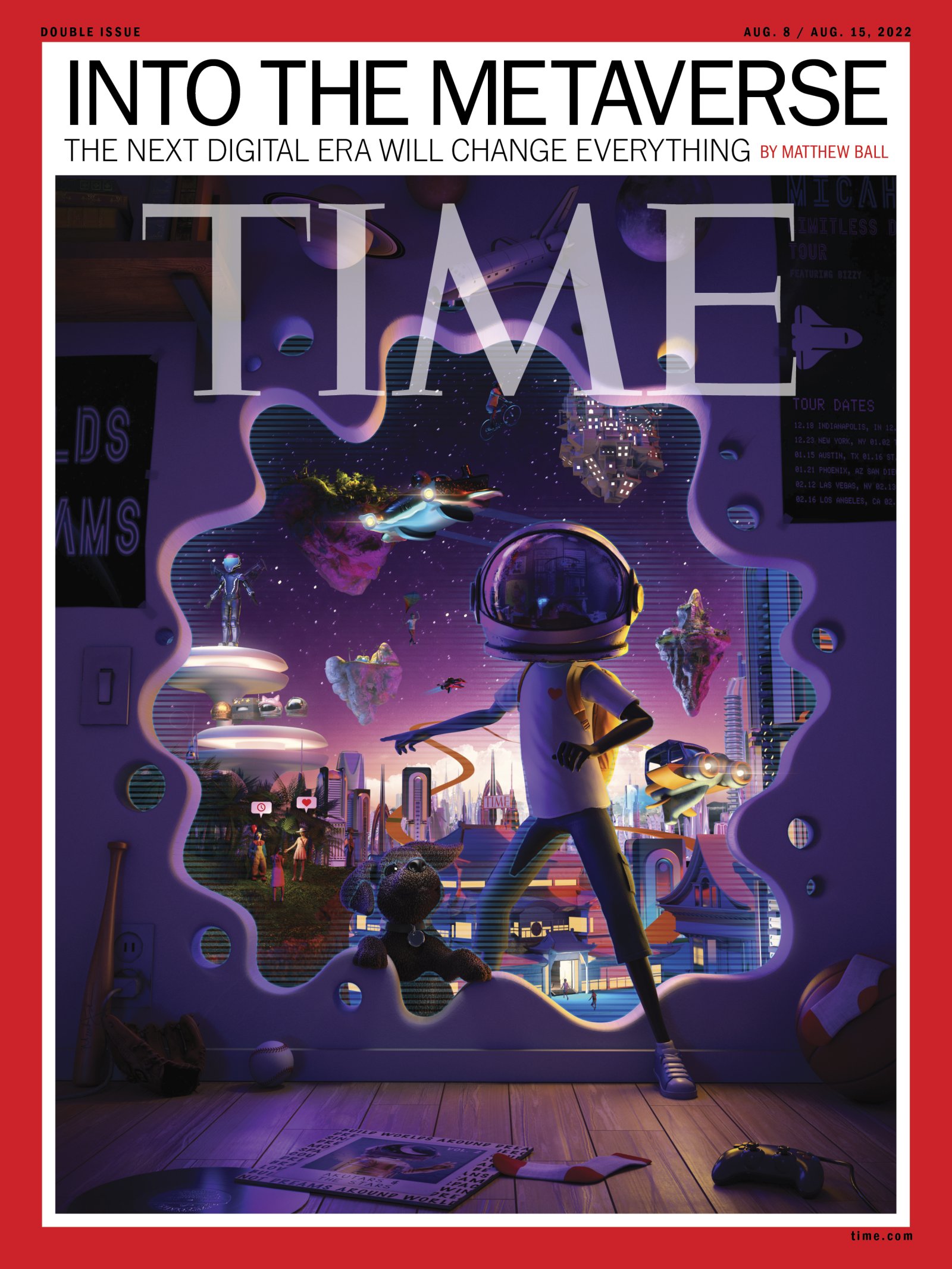
The Metaverse Will Reshape Our Lives. Let’s Make Sure It’s for the Better. — from time.com by Matthew Ball
Excerpts (emphasis DSC):
The metaverse, a 30-year-old term but nearly century-old idea, is forming around us. Every few decades, a platform shift occurs—such as that from mainframes to PCs and the internet, or the subsequent evolution to mobile and cloud computing. Once a new era has taken shape, it’s incredibly difficult to alter who leads it and how. But between eras, those very things usually do change. If we hope to build a better future, then we must be as aggressive about shaping it as are those who are investing to build it.
The next evolution to this trend seems likely to be a persistent and “living” virtual world that is not a window into our life (such as Instagram) nor a place where we communicate it (such as Gmail) but one in which we also exist—and in 3D (hence the focus on immersive VR headsets and avatars).
On 07/24/2022,
in Asia, change, education, health, India, innovation, learning, learning ecosystem, Learning from the Living [Class] Room, morals/values, technology (general), telecommunications, ubiquitous learning,
by Daniel Christian
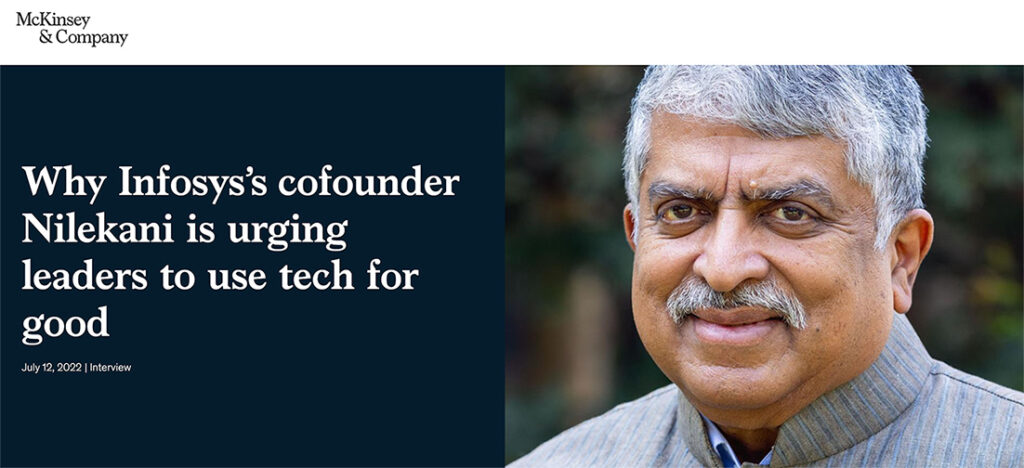
Why Infosys’s cofounder Nilekani is urging leaders to use tech for good — from mckinsey.com by Gautam Kumra
The cofounder of the multinational IT company believes Indian start-ups will soon develop technologies to transform education, healthcare, and other social challenges.
Excerpts:
McKinsey: The world has also become a more complex place, with recent geopolitics, inflation complexity, rocketing energy prices, excessive liquidity, and digitization challenges. How do you personally keep adapting and learning?
Nandan Nilekani: In the last 40 years, I think we have gone through every transition: mainframes to minicomputers to LANs [local area networks] to internet to smartphones to AI. It has been fun understanding and riding these waves.
In my view, if a billion people can use something, then that’s a benefit. A billion people can learn using technology. A billion people can get better healthcare using technology. A billion people can move around and change jobs using technology.
From DSC:
I hope I can meet Nandan Nilekani someday. I feel that he is a kindred spirit. Several things that he said really resonated with me.