Summer Learning Programs Struggle — and Devise Solutions — as Staff Shortages Persist — from edsurge.com by Emily Tate Sullivan

Excerpt:

It’s summer time, and the learning is not easy.

That’s in large part because the widespread staffing shortages that plagued the 2021-22 school year have stretched into summer programming, which, in many cases, relies on licensed school teachers to sign up to continue working with students.

But teachers are exhausted. They may want—even need—the extra income from summer jobs, but many are also desperate for a break after the last two-and-a-half years and trying to prioritize their mental health.

From DSC:
In futurism speech, this is a strong signal of what could be a tough year ahead. If that turns out to the case, what are some possible scenarios and what are some possible solutions to those scenarios?


Accommodations for students with ADHD — from thetechedvocate.org by Matthew Lynch

Accommodations for students with Dyspraxia — from thetechedvocate.org by Matthew

Excerpt:

Dyspraxia, also known as Apraxia, is a learning disability that is noticeable by difficulty in carrying out routines that need balance, fine motor skills, and coordination. Often, we think of these kids as being ordinarily “clumsy” or “awkward.” Kids with Dyspraxia need to be that an occupational therapist treats them to help boost their fine gross motor skills. Verbal Dyspraxia describes a reduction in the capacity to use speech sounds, which is commonly the sign of a developmental delay. Verbal Dyspraxia can either be separate or accompany Dyspraxia. Children with Dyspraxia may also suffer from a bit of impediment in speech and short-term memory loss.

From DSC:
If you don’t think teaching is incredibly tough, check out these lists of potential accommodations for just a few of the potential students in a classroom.


Just Because You Can Doesn’t Mean You Should: What Genetic Engineers Can Learn From ‘Jurassic World’ — from singularityhub.com by Andrew Maynard

Excerpt:

Maybe this is the abiding message of Jurassic World: Dominion—that despite incredible advances in genetic design and engineering, things can and will go wrong if we don’t embrace the development and use of the technology in socially responsible ways.

The good news is that we still have time to close the gap between “could” and “should” in how scientists redesign and reengineer genetic code. But as Jurassic World: Dominion reminds moviegoers, the future is often closer than it might appear.


Reflecting on identities in educational development — from educationalist.substack.com by Alexandra Mihai

Introduction:

Welcome to a new issue of “The Educationalist”! In the past weeks I had the chance to reflect a lot on my identity as an educational developer, through inspiring conversations with colleagues and peers from my global personal learning network passionate about the topic. For me this is one of the professional identities, alongside being a scholar and an educator. Believe it or not, I think I found a way to combine them that works well and helps me stay enthusiastic about my work. In the past years I’ve been fortunate to hear so many interesting stories from faculty developers around the world, and I am always fascinated by them. It is a complex space, a diverse space and what I’m bringing to you this week are only some initial reflections, by no means a comprehensive account of what being an educational developer (or faculty developer, will use the terms interchangeably here) means. I hope that, even if this is more like an essay than a curated collection of practical tips and resources, it will still resonate with some of you, whether you are working as Faculty, educational developers, in university administration or leadership roles. I added some articles for those of you who would like to dive deeper into the topic, I can guarantee they make very thought-provoking reads. As usual, I welcome your ideas and comments. Have a nice week!


Taking construction education into a new age — from highereddive.com by Jonathan Arnholz

Excerpt:

In 2021, the sixth edition of our top textbook, Core: Introduction to Basic Construction Skills was released in collaboration with our publishing partner Pearson. In addition to the standard updates to the content, this new edition introduced QR codes to our textbooks, directing students to digital resources to reinforce the material found in the book. In conjunction with the release of the printed book came a new Core eText and a fully re-imagined NCCERconnect online course with integrated augmented reality lessons, dozens of videos on performance tasks, construction math and employability skills, dynamic presentations to support classroom engagement, project-based learning assignments and more.


Addendum on 7/21/22:

Skilled Trades Labor Scarcity: Workforce Aging as Fewer Recruits Enter Trades — from finance.yahoo.com

Excerpt:

TACOMA, Wash., July 19, 2022 /PRNewswire/ — The skilled trades industry is proving to be one of the hardest hit by worker scarcity. According to a new analysis by PeopleReady Skilled Trades, a specialized division of staffing giant PeopleReady, the COVID-19 pandemic resulted in a skilled labor shortage that companies are still struggling with today. In the period from March 2020 to December 2021, four million jobs were open in key skilled trades industries like construction—more than double the amount of vacancies pre-pandemic.


Set Against a Backdrop of World Events, Tim Okamura’s Bold Portraits Emanate Commanding Energy — from thisiscolossal.com by Grace Ebert and Tim Okamura

Fire Fighter” (2021)

“Fire Fighter” (2021), oil on canvas, 60 x 76 inches


A Stunning Double Rainbow Frames a Lightning Bolt as It Strikes the Mountainous Virginia Horizon — from thisiscolossal.com


Microlearning Basics — from trainlikeachampion.blog by Brian Washburn, Robyn Defelice and Karl Kapp

Excerpts:

The Six Different Types of Microlearning

  • primary microlearning
  • preparation microlearning
  • pensive microlearning
  • performance-based
  • persuasive microlearning
  • post instruction
  • practice-based
 

In Fight Against Ableism, Disabled Students Build Centers of Their Own — from chronicle.com by Adrienne Lu

Excerpt:

Thanks to student advocates, including Sullivan and Lockwood, the university recently became the latest in a growing number with disability cultural centers, which aim to shine light on the perspectives and experiences of disabled people, foster a sense of community, and promote activism and disability justice. Altogether, at least 12 disability cultural centers now exist nationwide; in addition, students are working to create new centers on about a dozen other campuses.


Also relevant/see:

What is Norton Rose Fulbright’s LX Studio? — from artificiallawyer.com

Excerpts:

‘From tiny acorns, mighty oak trees grow’ so the saying goes, and it’s fair to say that US-based LX Studio, the new innovation project of global firm Norton Rose Fulbright (NRF), is very much still an acorn – but it has plenty of potential.

Artificial Lawyer spoke to Jeff Cody, Managing Partner for the US side of 3,700-lawyer NRF, which was formed by the merger of the UK’s Norton Rose and America’s Fulbright & Jaworski in 2013, to find out some more.

But, with a more optimistic outlook one might say that this is a beginning; and that although the US is home to many pioneering legal tech companies and ALSPs, the reality is that few law firms in the US have dedicated innovation groups which mirror the full range of what NRF has in the UK, for example.

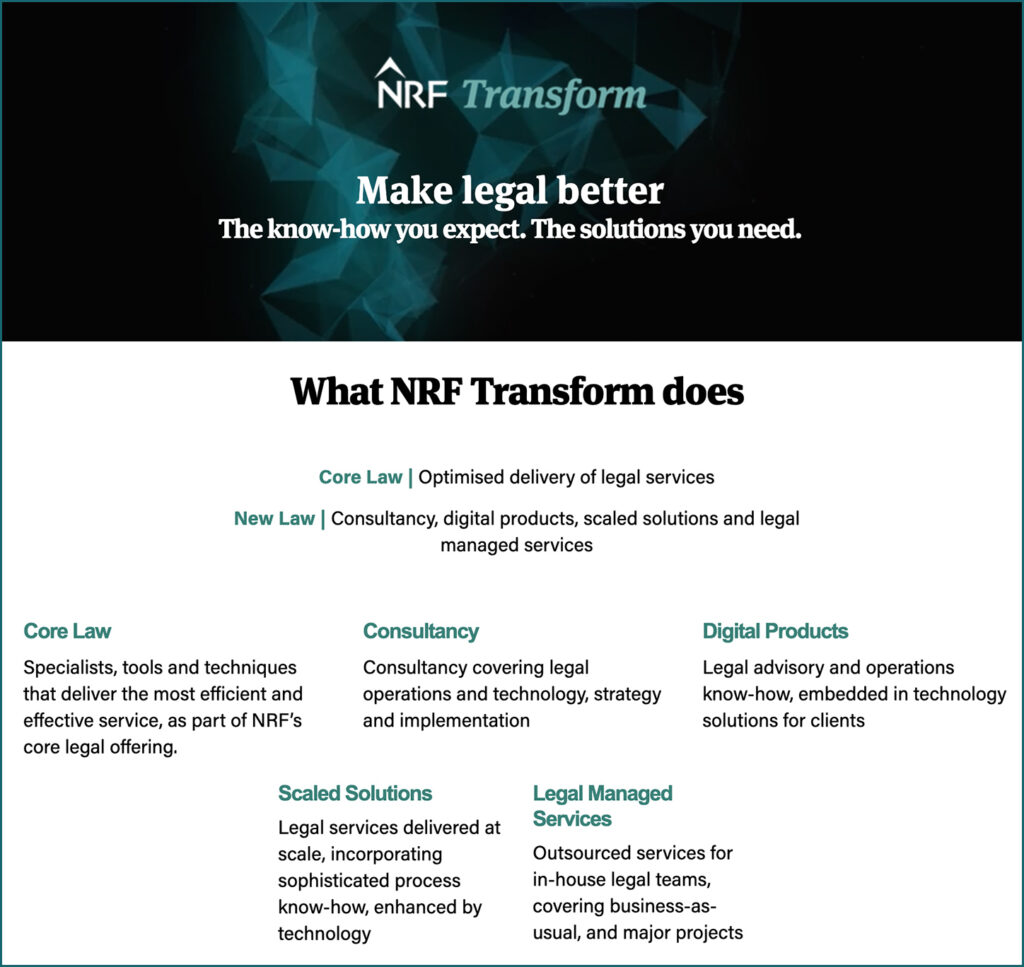
NRF Transform -- global legal operations


‘Hologram patients’ and mixed reality headsets help train UK medical students in world first — from uk.news.yahoo.com

Excerpts:

Medical students in Cambridge, England are experiencing a new way of “hands-on learning” – featuring the use of holographic patients.

Through a mixed reality training system called HoloScenarios, students at Addenbrooke’s Hospital, part of the Cambridge University Hospitals NHS Foundation Trust, are now being trained via immersive holographic patient scenarios in a world first.

The new technology is aimed at providing a more affordable alternative to traditional immersive medical simulation training involving patient actors, which can demand a lot of resources.

Developers also hope the technology will help improve access to medical training worldwide.


What’s the current state of OPM and UK university partnerships? — from neilmosley.com by Neil Mosley

Excerpt:

One of the big changes of the past couple of years has been the number of universities getting serious about what they are doing in the online distance education space.

Whilst the number of online distance education courses on offer in UK higher education has been steadily growing, the events of the last couple of years have spurred some universities to more intentionally consider what they are doing in this space.

For universities looking to develop an online distance education portfolio there has tended to be two main choices – make the necessary investment to do this themselves or partner with an online programme management (OPM) company.

In the UK, OPM partnerships tend to go under the radar and there’s not much widespread knowledge about who they are and what they do. I think more people in UK higher education should have an understanding of these types of partnership, not least because the number of new partnerships are accelerating.

Also from Neil, check out:

What role will MOOC platforms play in UK universities online futures?

Excerpt:

Nevertheless, as we enter a new era for online education, one in which there seems to be more universities developing partnerships to offer an online portfolio of courses, it will be interesting to observe whether MOOC platform partnerships will play a role in that and what this ultimately begins to look like.


Top Content Providers For Immersive Learning (2022) — from elearningindustry.com by Christopher Pappas

Summary: 

Immersive learning experiences allow learners to interact by simulating real-life scenarios. Are you ready to offer engaging virtual environments and experiences to your workforce? Dive right into this thoroughly curated top list featuring the best content providers for VR training and bring your teams one step closer to the Metaverse.


After an AI bot wrote a scientific paper on itself, the researcher behind the experiment says she hopes she didn’t open a ‘Pandora’s box’ — from insider.com by Hannah Getahun

Excerpt:

  • An artificial-intelligence algorithm called GPT-3 wrote an academic thesis on itself in two hours.
  • The researcher who directed the AI to write the paper submitted it to a journal with the bot’s consent.
  • “We just hope we didn’t open a Pandora’s box,” the researcher wrote in Scientific American.

AI Empowers Scalable Personalized Learning and Knowledge Sharing — from learningsolutionsmag.com by Markus Bernhardt

Excerpt:

AI aids in providing true personalization
Automation through AI is providing us with the tools necessary to deploy fully personalized digital learning, extremely fast and at scale. With the advent of this technology, we will see a revolution in digital training; in addition, I predict that the impact the digital piece will have on human-led efforts will lead to a further revolution of education, training, workshops, mentoring, and coaching.

How A.I. Could Help You Design Your Perfect Office (or Store) — from inc.com by Ben Sherry
Artificial intelligence may soon help fill the gap between your interior design skills and your imagination.

Excerpt:

Boom Interactive is one of several companies attempting to streamline the interior design process using automation. The Salt Lake City-based startup’s free app, Bubbles, which is scheduled to soft launch in the third quarter of 2022, uses artificial intelligence to read floor plans and create a “digital twin” of your real-life space, according to CEO and founder Timber Barker. Once a “twin” has been created, users have full freedom to customize the space by adding doors, erasing walls, and placing furniture.

The Increasing Role of Artificial Intelligence in Our Lives — from rdene915.com by Rachelle Dene Poth

Excerpt:

All of this recent information has made me even more curious about the role artificial intelligence will play over the next few months as we hopefully get back to more of a normal life experience and can engage in work and learning but also in leisure activities. What can we learn from the recent uptick in AI information and how can it help us in the future?

Optical illusions could help us build the next generation of AI — from digitaltrends.com by Luke Dormehl


10 ways to deal with stakeholders’ beliefs in learning — from 3starlearningexperiences.wordpress.com by Mirjam Neelen & Paul A. Kirschner

From DSC:
I thought the skit below was funny. But there’s some truth in here as well.

Excerpts:

Don’t we all have stakeholders – including bosses! – like this? We know we do! Our expertise isn’t always taken seriously – and we’re not the only ones:

 
© 2025 | Daniel Christian