New Mexico College Publishes Report to Advance a National Learning and Employment Record for Skills-based Credentialing and Hiring — from prnewswire.com by Central New Mexico Community College

Excerpt (emphasis DSC):

ALBUQUERQUE, N.M.Oct. 11, 2022 /PRNewswire/ — In the current job market, applicants are usually asked to provide a broad résumé that lists the basics of their qualifications including college degrees and past work experience. It’s an outdated and inefficient system and one that Central New Mexico Community College (CNM) is now helping to improve.

Thanks to a grant from Walmart, CNM produced a comprehensive report that researches several independent efforts underway in order to build a model for creating a national Learner and Employment Records (LER) infrastructure. An LER enables the exchange of skills-based digital records that facilitate more efficient pathways from learning to earning.

An LER is more efficient and secure for both employers and job-seekers because it uses blockchain technology to provide security, trust, and transparency.

From DSC:
I still am learning about how secure blockchain-based applications are — or aren’t. But this idea of a Learner and Employment Record — which I’ve referred to on this blog as a “cloud-based learner profile” — seems to hold a lot of potential as we move into the future. Especially when the focus is increasingly on which skills a position needs and which skills an individual has.
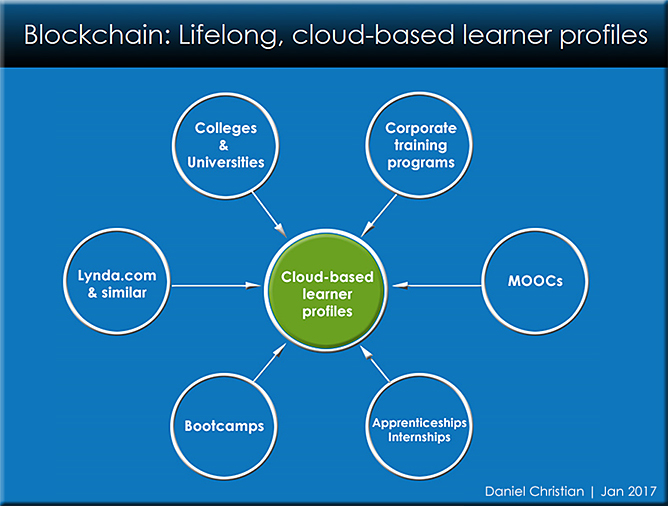
I have used the term cloud-based learner profiles instead of LERs but the idea is the same


How Older Adults Access Resources Online — from blog.getsetup.io

Top Insights:

  • It’s clear that how older adults are using technology has changed. COVID has seen more and more older adults using a wide range of devices which means there is no one-size-fits-all approach to this audience.
  • In the United States, desktop devices are still the most common form of media consumption for virtual learning and health.
  • But, mobile devices are still the dominant device for passive content consumption.
  • Consumption by different US states varies based on the quality of internet infrastructure and availability of newer devices.
  • In India and Australiamobile devices outperform desktops for virtual learning.
  • Developing browser-first solutions for engagement is key to reaching a wider audience.
  • Applications and websites that aim to make the user experience as seamless as possible across multiple devices have a greater chance of being used and picked up more effectively by older adults of a variety of ages.
  • The variations in device types make it very challenging to build LIVE streaming technology that can scale across platforms.
  • Chrome is a dominant browser with the 55+ group allowing sophisticated video streaming applications to be built that was not possible over Internet Explorer.
  • While Zoom became the de facto standard for video-based sessions, older adult learners were 11x more likely to attend class in our browser Lounge than enter the Zoom classes.

Also relevant/see:


Creating a Culture to Support Student Voice & Choice — from techlearning.com by Matthew X. Joseph
Encouraging student voice and choice helps foster a more engaging learning environment

Excerpt:

During my time as a district and school leader, I observed and conferenced with students entering high school, and only about a third of those reported feeling engaged with their education. I believe education should provide students with meaningful learning experiences in a classroom of engaged learners.

One way to enhance student engagement is to allow for student voice. Students who feel their voices are heard are more likely to feel academically engaged and respected in the school community. In addition, students feel valued when they feel heard. Students learn for someone, not just from someone. Thus, feeling valued is essential in creating a safe culture for students to share their voice.

Providing students with multiple options for an assignment helps them choose the content that is relevant, meaningful, and exciting to them. As a result, they are a part of their own learning process, rather than having to move through assignments that are not engaging.


Data Science: Re-Imagining Our Institutions at the Systems Level — from campustechnology.com by Mary Grush
A Q&A with George Siemens

Excerpt:

We know that higher education institutions have been exploring data science for decades. Many began by leveraging institutional data to serve administrative computing needs and efficiencies, later taking on an additional learning science focus, at least to some, often limited degree.

What can institutions do now, to use data science better and perhaps reinvent themselves in the process? Are they taking advantage of all the access they have to so many disciplines and researchers, to help move data science ahead in the real world? Here, George Siemens, who is a professor of practice at the University of Texas-Arlington and co-leads the Centre for Change and Complexity in Learning at the University of South Australia, talks with CT about data science in higher education.


DSC: What?!?! How might this new type of “parallel reality” impact smart classrooms, conference rooms, and board rooms? And/or our living rooms? Will it help deliver more personalized learning experiences within a classroom?


What Ails Our Labor Market Is Evident in College — from insidehighered.com by Brandon Busteed
Both colleges and employers must fix work-readiness failures and inequitable work-readiness practices, writes Brandon Busteed.

Excerpts:

The price tag for college continues to rise, while doubts about the work readiness of college graduates are rampant. This is very bad news for higher education, given the No. 1 reason Americans value a college degree is to get a good or better job.

Higher education isn’t alone in needing to fix what ails us. Employers of all shapes and sizes need to step up. After all, what they want most from a college graduate is one with relevant job or internship experience. State and federal governments can and should provide more incentives (whether matching funds or tax subsidies) to encourage more paid internships offered by employers. And why not an addition to the Pell program to provide stipends for unpaid or low-paid internships?

Unfortunately, only 14 percent of current college students received academic credit for their internship.


Clio’s 2022 Legal Trends Report
Learn how lawyers are balancing the flexibility of hybrid work, and what clients look for when hiring a lawyer.

Also relevant/see:

Clio’s 2022 Legal Trends Report Finds Lawyers’ Business Growing But Fees Fail to Keep Pace — from lawnext.com by Bob Ambrogi

Top law schools have been slow to add women faculty members, research finds — from highereddive.com

Excerpt:

Law schools have increasingly sorted along gender lines, and the makeup of faculties has become a reflection of schools’ student population, according to preprint research published on the SSRN, an open access platform for early-stage research.

Five digital trends to watch in the legal tech sector — from information-age.com by Leanne Aldrich

Excerpt:

Technology is changing the legal sector. The UK government has recently announced that it is investing £4m to modernise the UK legal industry through its LawTechUK programme. The initiative is a part of a drive to keep the UK at the global forefront of legal services..

ILTA’s Annual Technology Survey: Highlights — from legaltechnology.com

What does it take to be a legal technologist? — legalfutures.co.uk

Excerpt:

When the first seeds of the legal technologist role were planted in the early 2010s, they took some time to germinate. A decade later, after a seemingly slow start, there has been an explosion of investment, awareness and new job opportunities in legal technology.

But as this new strand of the legal profession sets its roots deeper in the industry, what exactly does it take to be a legal technologist?

Shearman & Sterling Launches Legal Ops Service In Sign of the Times — from artificiallawyer.com

Excerpt:

In another sign of the changing times we are in, leading New York law firm Shearman & Sterling is formally launching a Legal Operations capability. The move follows fellow elite rival Cleary Gottlieb launching Cleary X, its innovation-focused legal delivery arm.

A decade ago many would not have expected New York’s top firms to be that bothered with anything other than high-end legal advisory and disputes work, but the legal world is evolving.

‘Legal Operations by Shearman’ will offer a range of services including legal tech help, data analytics, and inhouse department design, but may work with ALSPs and other groups when it comes to CLM onboarding, with these other providers handling actual implementation and with Shearman focused on the bigger legal ops picture.

#legal #trends #legaltech #lawyers #law #lawschools


What might the ramifications be for text-to-everything? [Christian]

From DSC:

  • We can now type in text to get graphics and artwork.
  • We can now type in text to get videos.
  • There are several tools to give us transcripts of what was said during a presentation.
  • We can search videos for spoken words and/or for words listed within slides within a presentation.

Allie Miller’s posting on LinkedIn (see below) pointed these things out as well — along with several other things.


This raises some ideas/questions for me:

  • What might the ramifications be in our learning ecosystems for these types of functionalities? What affordances are forthcoming? For example, a teacher, professor, or trainer could quickly produce several types of media from the same presentation.
  • What’s said in a videoconference or a webinar can already be captured, translated, and transcribed.
  • Or what’s said in a virtual courtroom, or in a telehealth-based appointment. Or perhaps, what we currently think of as a smart/connected TV will give us these functionalities as well.
  • How might this type of thing impact storytelling?
  • Will this help someone who prefers to soak in information via the spoken word, or via a podcast, or via a video?
  • What does this mean for Augmented Reality (AR), Mixed Reality (MR), and/or Virtual Reality (VR) types of devices?
  • Will this kind of thing be standard in the next version of the Internet (Web3)?
  • Will this help people with special needs — and way beyond accessibility-related needs?
  • Will data be next (instead of typing in text)?

Hmmm….interesting times ahead.


A Philosophy of Faculty Development — from derekbruff.org by Derek Bruff

Excerpts:

Fortunately, a few questions at the beginning of a conversation can go a long way here. “Tell me about your teaching experience over the last few years?” “What does a typical class session look like for you?” “What can you tell me about the students who are taking your course?”

Asking good questions is a key skill for a faculty developer. You ask questions to understand an instructor’s beliefs about teaching and to figure out what’s driving some problem they’ve identified. You also ask questions to help an instructor explore possible solutions or changes to their teaching practice.

Faculty are professionals, and if they’re going to make a change to their practice that’s successful, they need to own that change. Leading with a non-directive consulting approach is usually the best approach.


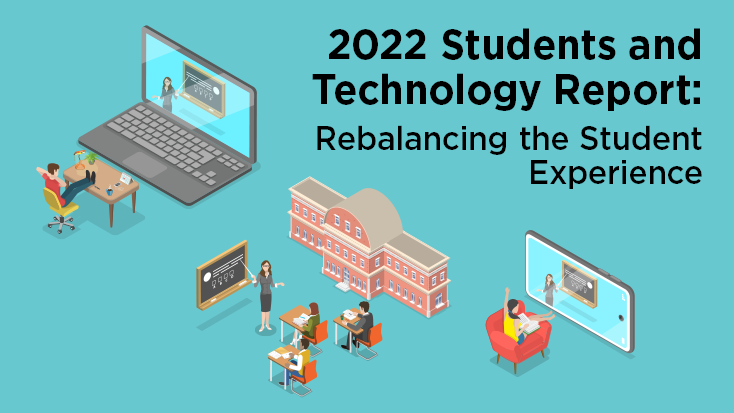
2022 Students and Technology Report: Rebalancing the Student Experience — from library.educause.edu by Jenay Robert

2022 Students and Technology Report: Rebalancing the Student Experience

Excerpt:

In this report, we describe the findings of the survey in four key areas:

Key Findings

  • Educational technology impacts student wellness.
  • Physical campus spaces continue to play an important role in students’ access to education.
  • The online versus face-to-face dichotomy is being disrupted.
  • Device access is not a simple issue when examined through an equity lens.
  • Assistive technology can help all students.
  • Students are whole people with complex learning needs and goals.
 

New Unionization, Upskilling And The Future Of Work — from forbes.com by Daphne Kis

From DSC:
I’m not sure what I think of this article as a whole, but I like the emphasis on lifelong learning! here are some relevant excerpts, for example:

In particular, workers and businesses should take this moment to partner around the issue of education and forge new agreements about employer-provided training and reskilling.

This approach, however, is inadequate to deal with the demands of today’s global information economy, which demands continual upskilling on the part of workers.

As true job security can only be generated by continued education and training, this is in the interest of all parties.

“We need to replenish skills throughout a working career, and this calls for revisiting the models and concept of lifelong learning to create the future we want.”


Learning from Our Students: Student Perspectives on Good Teaching — from everylearnereverywhere.org; with thanks to Beth McMurtrie for this resource

Excerpt (emphasis DSC):

Twenty-two students trusted us with their stories and their reflections on good teaching. We honor that trust and hope that instructors who read this document gain as much insight about teaching from the students as we did. While we often write of students in the plural, each one of these students had an individual experience with learning and therefore a unique story to tell about good teaching. The key takeaways from their stories are:

  1. Students want to be recognized as individuals and appreciated in the classroom.
  2. Students want real life in the classroom.
  3. Students want to be treated with respect and trust.

We hope readers will likewise ask their own students, “What do your best instructors do?” and use that feedback to continuously improve their craft as teachers.

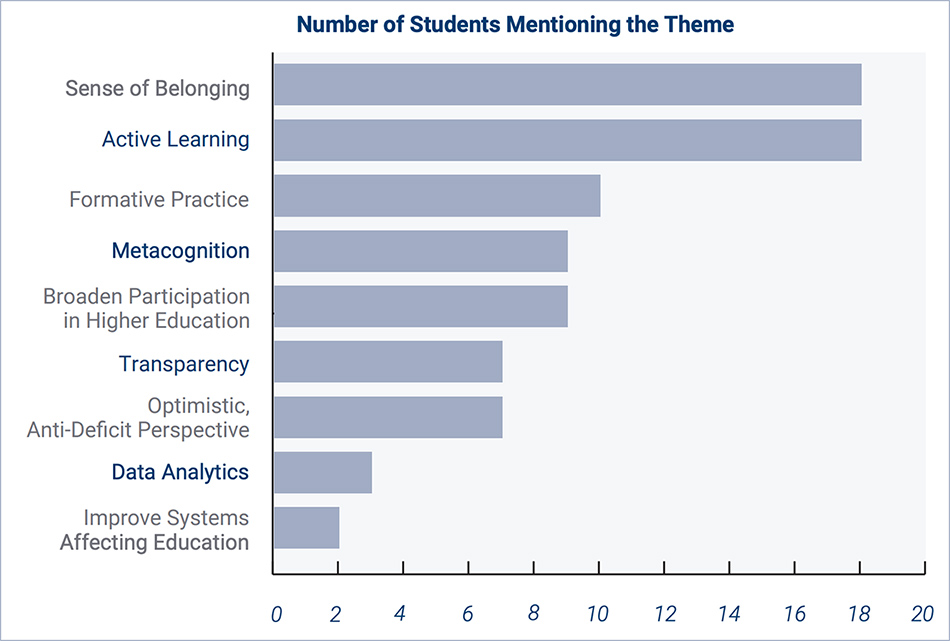
Out of 22 students:

active learning and a sense of belonging were the most frequently mentioned items from these 22 students


The Future of Virtual Legal Proceedings Just Became More Certain with the Launch of Calloquy — from businesswire.com by Calloquy
Hundreds gathered in Atlanta to celebrate and hear from leading legal innovation voices about The Next Era of Litigation

Excerpts:

The event celebrated the launch of Calloquy’s new virtual legal proceeding platform, which offers distinct usability benefits on a foundation of world-class security and industry-specific videoconferencing technology, including:

  • The platform’s intuitive design delivers a virtual experience that is akin to conventional legal proceedings, with clearly marked titles for all participants and traditional seating arrangements. The participants in a remote deposition, for example, are organized with plaintiffs on one side and defendants on the other.
  • Robust collaboration tools, combined with role-based security, ensure that only the right people have access to only the right information—and only at the right time. Documents or comments cannot accidentally be passed to an adversary.
  • The platform’s integrated case management tools streamline the complex litigation process by enabling meetings and proceedings to be scheduled, exhibits to be managed and transcripts to be created and archived all in one place.

“My goal in starting Calloquy is to help drive ‘the next era of litigation’, which means improving the way all people experience the legal system, from the most high-profile commercial litigator to the most underserved defendant and the lawyer who works pro bono on their behalf.”


This Company Aims to Become the Amazon of Lifelong Learning — from edsurge.com by Daniel Mollenkamp

Excerpt (emphasis DSC):

The Singapore-based company Genius Group has turned some of its attention to the U.S. edtech market recently.

While some companies have seen layoffs, the Genius Group lifelong learning platform is growing among users at a rate of greater than 50 percent, they claim. Currently, it has 2.7 million students across 200 countries, according to its website.

But we decided that rather than looking to solve the problem for just some, if we could be one of the companies that was looking to solve it for all, that would be a great market opportunity for us. And at the same time, it would be something which would enable us to attract the best educators, and the best content creators from around the world as well.

[The intent was] to really tackle the full, lifelong learning journey that we’re on, and to put in place a pathway, and more importantly, a platform that would enable anyone to be able to come and take their curriculum, bring it on board, and in the same way that YouTube allows anyone to be a creator.


Also from Edsurge.com, see:


© 2025 | Daniel Christian