If We’re Serious About Student Well-Being, We Must Change the Systems Students Learn In — from highereddive.com by Tim Klein and Belle Liang
Here are five steps high schools can take to support students’ mental health.

Excerpt:

The truth is, the best school systems in the world succeed without homework, standardized test scores or an obsession with rigorous courses. And many U.S. schools have found creative and empowering ways to showcase student merit beyond rankings and test scores.

If we aren’t willing to change policies and practices that have been shown to harm students’ well-being, we have to ask ourselves: Do we really value mental health?

Thankfully, it doesn’t have to be an either/or scenario: We can design school systems that help students thrive academically and psychologically.


How college leaders can create a culture shift to stop burnout — from highereddive.com by Laura Spitalniak
Competitive pay and work schedules are important to attracting and retaining employees, according to a new ACE report. But so is valuing employees’ time.

Excerpt:

Amid the Great Resignation, higher education is facing particularly high rates of employee burnout and possible attrition. But there are tangible ways college leaders can change workplace culture and increase worker retention, according to a new report from the American Council on Education.

Another highly requested benefit is a hybrid work schedule with the ability to work remotely. Nearly 70% of surveyed college employees want to work remotely at least part time, but almost two-thirds are working mostly or completely on campus, according to the College and University Professional Association for Human Resources.


Students Are Calling BS on High School and Opportunity Knocks — from gettingsmart.com by Trace Pickering

Excerpts:

Let’s be clear. These students are not wrong. The pandemic showed students that much of what they were required to do and endure during pre-pandemic high school was a lot of busywork and tasks that held little relevance or interest to them, and apparently didn’t really matter since they were able to be successful without all that extra work. When schools lost their ability to command and control a student’s time, it forced a different economy for schools and educators. It required the curriculum to be pared down to only the essential standards and information. It now had a very real and powerful competitor for the student’s time – a job, a hobby, sports, music, sleep…

Students are no longer a captive audience. They have more options and choices. To avoid obsolescence, perhaps schools should focus on making school a place where kids see value and want to come to each day.

This is a wonderful opportunity to put in place the things that really drive 21st-century skills and give students the keys to their own learning and growth. To truly personalize learning for students, and unlock teacher professionalism and creativity in the process. That extra time could allow students to pursue areas of passion and interest, to dive deep into a subject that interests them, pursue job shadows and internships, and earn and learn on a job.


The Most STOP-Enabled Innovators of 2022 — from yassprize.org
MEET THE 32

Excerpt:

This year’s 32 semifinalists come from 23 different states and really prove that innovation is alive and well in education.  Micro schools, pods and hybrid learning environments almost unheard of two years ago are now being utilized by parents and educators across the nation.  Traditional public schools that operate more like a charter and charters that continue to flourish outside of traditional systems, private schools serving specialized populations that are often overlooked and leaders in the ed tech space who provide remarkable tools that can be integrated into any of the other full service models we are celebrating today.  Truly a remarkable group of visionaries that are transformational exemplars for all in this tumultuous 2022!

Also relevant/see:


The New Library at Magdalene College by Niall McLaughlin Architects wins 2022 Stirling Prize — from dezeen.com by Lizzie Crook


Lessons From Higher Education To Guide Office Design — from allwork.space
The design successes and struggles of colleges and universities provide useful insight for organizations planning space for hybrid and coworking offices.


The 5 Biggest Artificial Intelligence (AI) Trends In 2023 — from forbes.com by Bernard Marr

Excerpt:

Today, the technology most commonly used to achieve AI is machine learning – advanced software algorithms designed to carry out one specific task, such as answering questions, translating languages or navigating a journey – and become increasingly good at it as they are exposed to more and more data.

Worldwide, spending by governments and business on AI technology will top $500 billion in 2023, according to IDC research. But how will it be used, and what impact will it have? Here, I outline what I believe will be the most important trends around the use of AI in business and society over the next 12 months.


Also relevant/see:


‘A tipping point for higher ed’: Google launches new, low-cost online programs for high-demand jobs — from fortune.com by Sydney Lake

Excerpt:

Higher education has benefits ranging from career development to skill building to network development—but it certainly can come at a high cost. The average cost of college in the U.S. is more than $35,000 per year, according to the Education Data Initiative. And these students average about $37,000 in student loan debt.

Lisa Gevelber, founder of Grow with Google, came to the tech giant with a proposition: Help people “realize their full economic potential” by offering low-cost educational programs focused on high-demand industries. In 2017, Gevelber saw her idea come to life when Google committed $1 billion toward this Grow with Google mission, and the following year the tech giant launched the Google Career Certificates.

[On 10/13/22], Grow with Google takes this program a step further by developing university-industry partnerships. Grow with Google tells Fortune exclusively of the launch of its partnerships with top universities to offer specialized career certificates. These specialized programs build on Grow with Google’s existing programs, but offer more industry-specific take on the material.


4 Tips for Choosing Accessible WordPress Plugins — from boia.org

Excerpt:

WordPress plugins can change how your website operates — typically, that’s why you want to install them in the first place. If you need to add a form or a video player on your WordPress site, you’ll probably look for a plugin before attempting to code your own solution.

But unfortunately, some plugins can alter your content in unpredictable ways and create accessibility barriers. Needless to say, you’ll want to avoid those issues if possible. Fortunately, WordPress is a fairly accessibility-friendly platform — and by following a few simple tips, you can reach a wider audience.

Are Hamburger Menus Bad for Accessibility? — from boia.org

Excerpt:

In web design, a hamburger menu is a button — usually with three horizontal lines — that typically opens a navigation menu.  The icon vaguely resembles a hamburger (or any other sandwich), hence the name.

Like many trends in web design, hamburger menus are controversial: They can cause accessibility issues, depending on their implementation, and they might obscure important navigational information. However, they’re extremely common — and while they pose a few potential issues for users with disabilities, sidebars can be accessible with appropriate markup.


Addendum on 10/18/22:


From DSC:
Many of the items below are from Laurence Colletti’s posting, Clio Cloud Conference – The Big Return


Clio Cloud 2022: Innovation in the Courts with Judge Schlegel — from legaltalknetwork.com by Laurence Colletti and Judge Scott Schlegel

Episode notes:

The pandemic was a driver for change in justice systems around the globe, but one court’s innovative and inexpensive approach is worth a closer look. Judge Scott Schlegel manages what may be one of the most advanced courts in the United States for delivering justice online. Tune in for his tips on how any jurisdiction in the country can modernize its justice system for under a thousand dollars. Go to https://www.onlinejudge.us/ for all of Judge Schlegel’s recommendations.

Clio Cloud 2022: The Benefits of a Legal Blog — from legaltalknetwork.com by Laurence Colletti and Teresa Matich, Kevin O’Keefe, and Iffy Ibekwe
Legal blog posts are great tools for building relationships with potential clients because they build trust, credibility, and allow you to create a personal connection with your clients.

LawNext Podcast: What Is Justice Tech? A Conversation with Maya Markovich — from lawnext.com by

Excerpt:

An increasing number of startups are defining themselves not as legal tech, but as justice tech. So what, exactly, is justice tech, who are some of the companies that represent it, and what is the business opportunity they present for potential investors? Our guest this week is Maya Markovich, executive director of the Justice Technology Association, an organization formed earlier this year to support companies in the justice tech sector.

Clio Cloud 2022: Insights from Clio’s 2022 Legal Trends Report — from legaltalknetwork.com by Laurence Colletti, Joshua Lenon, and Rio Peterson
Amid Inflation, Rising Interest Rates, and Volatile Employment Markets, Clio takes a look at How Global Trends have Impacted Business and Productivity among law firms.

Clio Cloud 2022: What Lies Ahead for Legal with Jack Newton — from legaltalknetwork.com by Laurence Colletti and Jack Newton

Episode notes:

The world of lawyering has surged in spite of the pandemic, but new adversity looms. Fears over inflation, war, hiring markets, and a recession have left many attorneys wondering how to prepare for the coming months. Jack Newton discusses the concept of anti-fragility and its place as a mental model for law firms as they face an uncertain future. Jack outlines how deliberate preparation can help your law firm thrive in the midst of opposition.

Jack Newton is CEO and co-founder of Clio.

Clio Cloud 2022: How Content Creation Can Grow Your Law Firm — from legaltalknetwork.com by Laurence Colletti


Also related, see:

Virtual Courts Are Not Going Away — from news.bloomberglaw.com by Jon David Kelley
As the pandemic winds down, courts are shifting to a hybrid approach that incorporates remote with live proceedings. Jon David Kelley of Kirkland says virtual courts can expand access to justice, but care should be taken to maintain credible representation.


How Long Should a Branching Scenario Be?— from christytuckerlearning.com by Christy Tucker
How long should a branching scenario be? Is 45 minutes too long? Is there an ideal length for a branching scenario?

Excerpt:

Most of the time, the branching scenarios and simulations I build are around 10 minutes long. Overall, I usually end up at 5-15 minutes for branching scenarios, with interactive video scenarios being at the longer end.

From DSC:
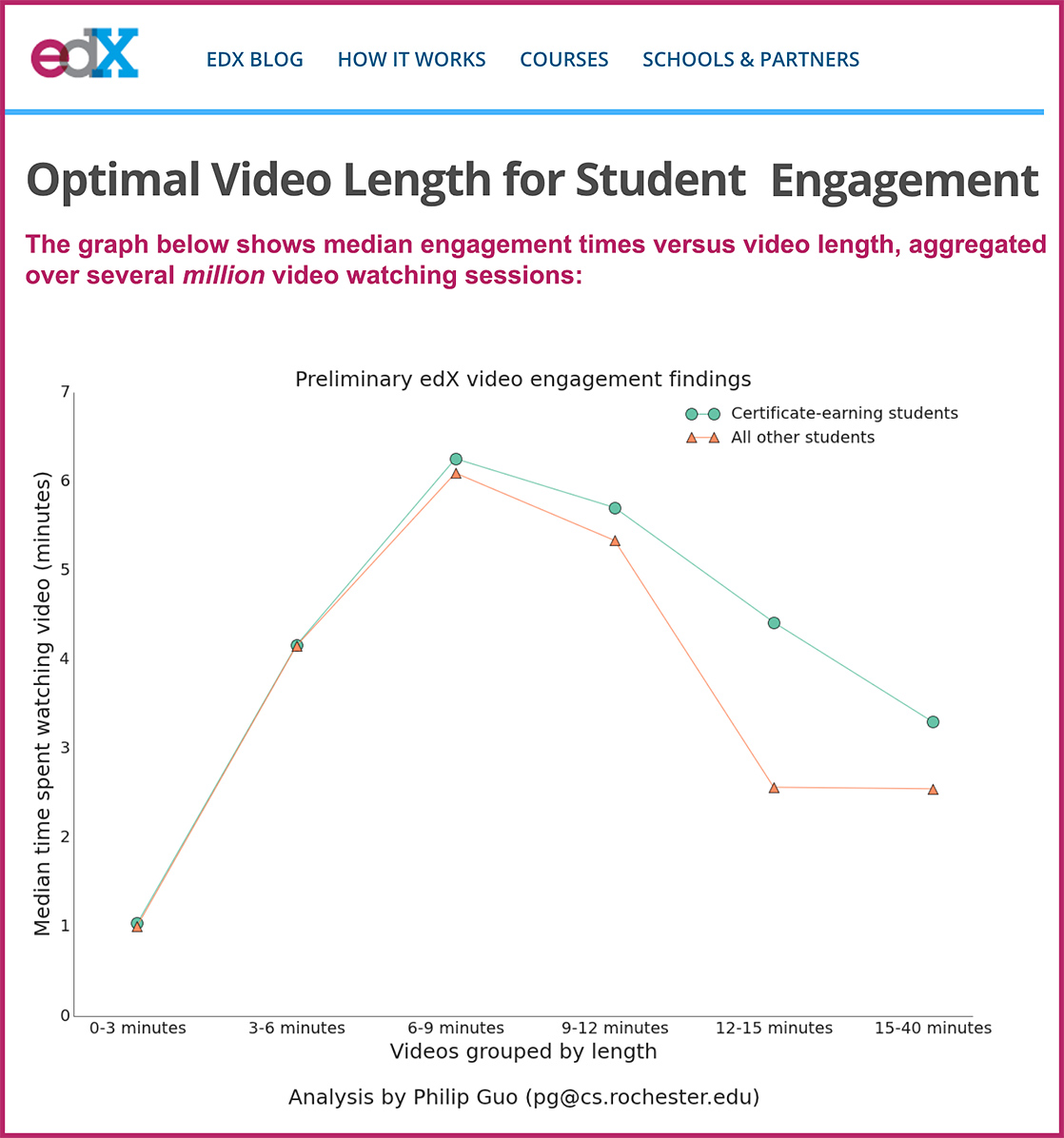
This makes sense to me, as (up to) 6 minutes turned out to be an ideal length for videos.

Excerpt from Optimal Video Length for Student Engagement — from blog.edx.org

The optimal video length is 6 minutes or shorter — students watched most of the way through these short videos. In fact, the average engagement time of any video maxes out at 6 minutes, regardless of its length. And engagement times decrease as videos lengthen: For instance, on average students spent around 3 minutes on videos that are longer than 12 minutes, which means that they engaged with less than a quarter of the content. Finally, certificate-earning students engaged more with videos, presumably because they had greater motivation to learn the material. (These findings appeared in a recent Wall Street Journal article, An Early Report Card on Massive Open Online Courses and its accompanying infographic.)

The take-home message for instructors is that, to maximize student engagement, they should work with instructional designers and video producers to break up their lectures into small, bite-sized pieces.


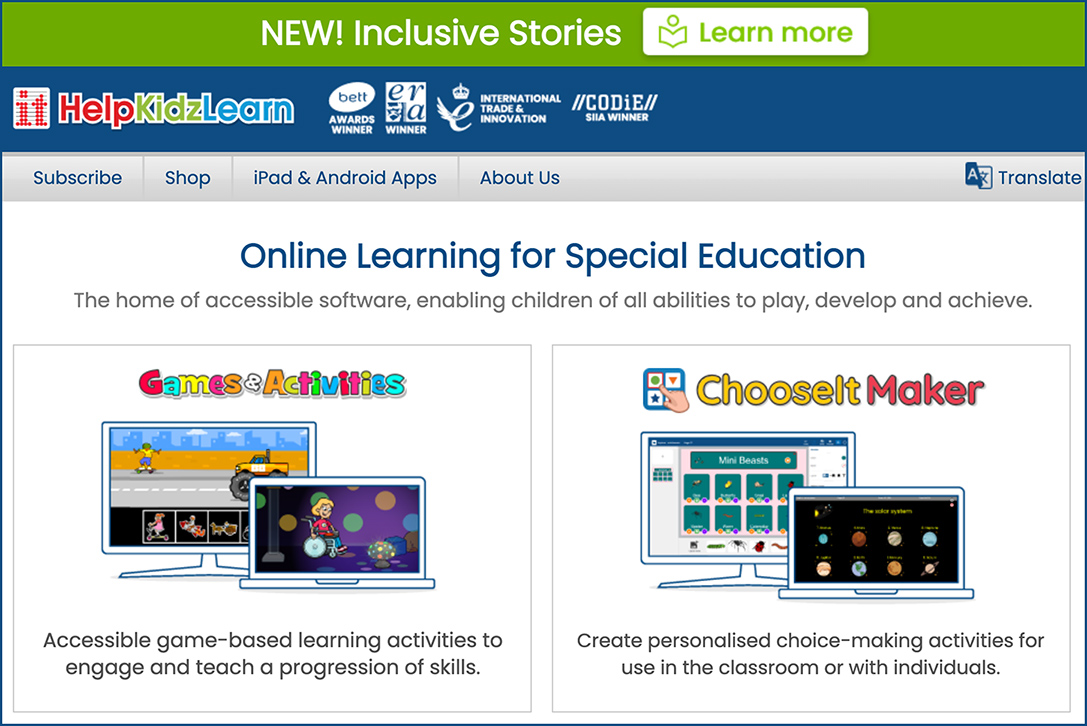
Assistive Technology for Kids with Multiple Disabilities — from equalentry.com

Help Kids Learn dot com -- online learning for special education -- uses assistive technologies


Lego Owner to Acquire Education-Technology Firm Brainpop — from nytimes.com by Trefor Moss
Kirkbi, the family-run company behind the world’s largest toy maker, plans to establish an education business

Excerpt:

Lego owner Kirkbi A/S is buying U.S. video-learning firm Brainpop for $875 million, according to the companies, as the family behind the world’s largest toy maker expands into the education business.

The Danish company said the purchase of Brainpop, which produces short animations used in schools to help children learn everything from math to music, was part of a plan to build a new business pillar. The deal—through which Kirkbi is acquiring Brainpop’s owner FWD Media Inc.—is expected to close Tuesday, the companies said.

“We are definitely on the path to establishing the Lego idea of learning through play in the formal education space,” said Jørgen Vig Knudstorp, executive chairman of the Lego Brand Group, the Kirkbi entity that oversees the toy brand.


U-M partners with Google to offer job-ready tech skills program — from record.umich.edu by Sean Corp

Excerpt:

A new flexible online training program on data science will prepare job-seekers in Michigan and beyond to quickly enter one of the fastest-growing labor markets and advance their careers.

The Center for Academic Innovation created the program, “Data Analytics in the Public Sector with R,” for data science and other professionals interested in how public data sets can drive decisions and policymaking in the public sector. The course complements current Google career certificates, flexible online “Grow with Google” job-training programs for high-demand fields.

Also relevant/see:

Google Cloud and edX Partner to Launch Cloud Computing Professional Certificate — from prnewswire.com 2U, Inc.

Excerpt:

MOUNTAIN VIEW, Calif. and CAMBRIDGE, Mass., Oct. 12, 2022 /PRNewswire/ — Google Cloud and edX, a leading global online learning platform from 2U, Inc. (Nasdaq: TWOU), today announced the launch of a Professional Certificate program in Google Cloud Computing Foundations. The certificate will bring edX’s global community of 45 million learners access to skills that are central to cloud basics, big data, machine learning, and where and how Google Cloud fits in. Registration is open today at www.edx.org, with courses beginning November 2022.

“We are excited to launch our Google Cloud training content on the edX platform,” said Chris Pirie, Director of Google Cloud Learning Profile and Partnerships. “This partnership presents a fantastic opportunity for learners around the world to build in-demand cloud skills on a proven learning platform.”


Amazon ups its cloud training investments — from workshift.opencampusmedia.org by Byelyse Ashburn
Amazon Web Services just launched a new skills center near D.C. and is expanding both its in-person and online training programs for cloud careers.

Excerpt:

The big idea: The skills center is just one part of AWS’ plan to spend hundreds of millions of dollars providing free training in cloud computing to 29 million people globally by 2025. In the past year, the company has dramatically increased its free cloud skills offerings, adding AWS Skill Builder, an online library of 500-plus self-paced courses. It’s also twice expanded re/Start, its cohort-based training program for workers who are unemployed or underemployed.

Thus far, the company has helped more than 13 million people gain cloud skills for free through its various offerings—seven million more than this time last year.


77% of adults think it would be hard to pay for college, according to survey — from highereddive.com by Rick Seltzer

Excerpt:

  • Women were more likely than men to call a college education unaffordable, 82% vs. 73%. The survey found 80% of Black respondents, 78% of Hispanic respondents, and 77% of White respondents said college would be difficult to afford.
  • Community colleges and two-year colleges were viewed as the most affordable option — 65% of respondents said they considered them affordable. That was ahead of vocational and professional certificate programs, which 57% of respondents viewed as affordable.
 

More Than 3 in 4 Americans Believe College Is Difficult to Afford — from morningconsult.com by Amanda Jacobson Snyder
And about half of U.S. adults say in-state public universities are “not affordable,” as shifting trends in enrollment may make flagship state schools seem financially out of reach

Excerpt:

  • A college education is widely perceived as unaffordable for most Americans, with 77% of U.S. adults saying a college degree would be difficult for someone like them to afford.
  • 82% of women said a college degree would be difficult to afford, compared with 73% of men.
  • Roughly 4 in 5 Black and Hispanic adults said college would be difficult to afford.
 
© 2025 | Daniel Christian