Teaching: Flipping a Class Helps — but Not for the Reason You’d Think — from the Teaching newsletter out at The Chronicle of Higher Education by Beckie Supiano

Excerpt:

The authors propose a different model of flipping that gives their paper its title, “Fail, Flip, Fix, and Feed — Rethinking Flipped Learning: A Review of Meta-Analyses and a Subsequent Meta-Analysis.”

Their model:

  • Fail: Give students a chance to try solving problems. They won’t have all the information needed to arrive at the solution, but the attempt activates their prior learning and primes them for the coming content.
  • Flip: Deliver the content ahead of class, perhaps in a video lecture.
  • Fix: During class time, a traditional lecture can deepen understanding and correct misperceptions.
  • Feed: Formative assessment lets students check their level of understanding.

I find this paper interesting for a number of reasons. It ties into a challenge I’d like to dig into in the future: the gap that can exist between a teaching approach as described in research literature and as applied in the classroom.

From DSC:
Though I haven’t read this analysis (please accept my apology here), I would hope that it would also mention one of the key benefits of the flipped classroom approach — giving students more control over the pacing of the content. Students can stop, fast-forward, rewind, and pause the content as necessary. This is very helpful for all students, but especially for students who don’t have English as their primary language.

I like this approach because if students fail to solve the problem at first, they will likely be listening more/very carefully as to how to solve it:

Drawing on related research, we proposed a more specific model for flipping, “Fail, Flip, Fix, and Feed” whereby students are asked to first engage in generating solutions to novel problems even if they fail to generate the correct solutions, before receiving instructions.

Plus, students will begin to recall/activate their prior knowledge on a subject in order to try to solve the problem. That retrieval practice in and of itself can be helpful.


 

The Shrinking of Higher Ed — A Special Report from The Chronicle of Higher Education
A special report on the implications of the enrollment contraction.

Excerpt:

Nearly 1.3 million students have disappeared from American colleges since the Covid-19 pandemic began. That enrollment contraction comes at a precarious moment for the sector. Inflation is driving up costs and straining budgets, stock-market volatility is putting downward pressure on endowment returns, and federal stimulus funds are running out. Why is the enrollment crunch happening now? How are colleges responding? What might turn things around? Those are the questions fueling this special report.

A Public Regional on the Edge — from chronicle.com by Eric Kelderman
New Jersey City University’s plan to grow its way out of financial trouble backfired. What went wrong?

Excerpts:

NJCU’s story is a cautionary tale for similar institutions — small public regional colleges with ambitions to expand in a crowded higher-education market. While its real-estate dealings have drawn unfavorable scrutiny, the university was responding to challenges that face its peers, in northern New Jersey and around the country: increased competition for a declining number of high-school graduates.

Public regional universities, like NJCU, enroll about 40 percent of all college students nationally, and a far larger percentage of minority, low-income, and first-generation students than better-known flagships and top research universities do.

But a lack of state support, limited ability to attract students from outside the region, and sparse fund raising have made the university vulnerable to economic downturns and demographic shifts that have led to fewer high-school graduates, especially in the Northeast and upper Midwest.

Linked to in the above article was this article:

Declining enrollment has Western Michigan University on budgetary tightrope — from mlive.com by Julie Mack

Excerpts:

KALAMAZOO, MI — Western Michigan University has 17,835 students this fall, its lowest enrollment since the 1960s.

The number is down 6% from last fall. Down 27% from a decade ago, when the fall headcount was 24,598. Down 41% from 20 years ago, when WMU’s fall count peaked at 29,732.

And thanks to a declining birthrate and a shrinking percentage of new high school graduates enrolling in college, that downward enrollment trend is likely to continue indefinitely.

Rather, “what COVID did was force our hand after years of pressure created by declining enrollment and demographic trends that suggest declines will continue for the next decade,” she said. “So while COVID brought our financial situation into sharp relief, the budget cut was a measure taken to relieve pressure created over many, many years.”


A relevant addendum here:

Avoiding the Trap of Too Little Too Late — from tytonpartners.com by Trace Urdan; with thanks to Ryan Craig for this resource

Excerpt:

The challenges facing higher education are well understood: a demographic cliff of traditional-aged applicants, a declining proportion of full-pay families, and a growing skepticism of the value of (ever-more) expensive post-secondary degrees with resulting student consumerism. Add to this rapidly rising technological complexity, deferred maintenance on deteriorating physical assets, escalating administrative costs associated with student services and supports, and a burgeoning array of college substitutes, and the challenges are clear. The combination of lower tuition revenue and higher costs points toward an inevitable sector consolidation. And while many college administrators will readily acknowledge this point in the abstract, few will consider that it might apply to them.


ABA advances proposal to end LSAT requirements — from highereddive.com by Jeremy Bauer-Wolf

Dive Brief:

  • An American Bar Association governing body will vote next week whether to ax a requirement that ABA-accredited law schools use an entrance exam, like the Law School Admission Test, or LSAT, eroding the assessment’s long-standing influence in admissions.
  • A key ABA committee, the Strategic Review Committee, on Friday recommended the association end admissions test requirements.
  • If the governing board votes Nov. 18 to repeal assessment mandates, the ABA House of Delegates will be in line to finalize the new policy at its February meeting.
 

From Teaching to Tech – Q&A With Joanna Cappuccilli — from devlinpeck.com by Devlin Peck and Joanna Cappuccilli
Would you like to transition out of the classroom and into a corporate instructional design role?

Excerpt:

In this Q&A session, we talk with Joanna Cappuccilli about how she transitioned from full-time teacher to full-time curriculum developer at Amazon Web Services, as well as the steps she took to get there.

Joanna and I discuss how developing a portfolio, networking effectively, and preparing extensively for interviews led to her successfully landing a tech role.


A student debt study unravels the American Dream ideal that college will propel you to the middle class — from fortune.com by Bytrey Williams with thanks to Ray Schroeder for this resource out on LinkedIn


Excerpts:

Looking at a cohort of borrowers from 2009, the report highlights that 50% of undergraduate debtors hadn’t repaid their loans. Across different types of loans, borrowers owed between 50% to 110% of their original loan 10 years after repayment began.

A college degree is undoing the American Dream
Getting a college degree has long been heralded as a staple to the American Dream, viewed as the path to wealth that will eventually buy a house in suburbs with a white picket fence. But the Jain Institute report shows that’s no longer the case.


Artist Spotlights: Shingo Yamazaki & Alberto Ortega

Artist Spotlight: Shingo Yamazaki — from booooooom.com


Artist Spotlight: Alberto Ortega — from booooooom.com


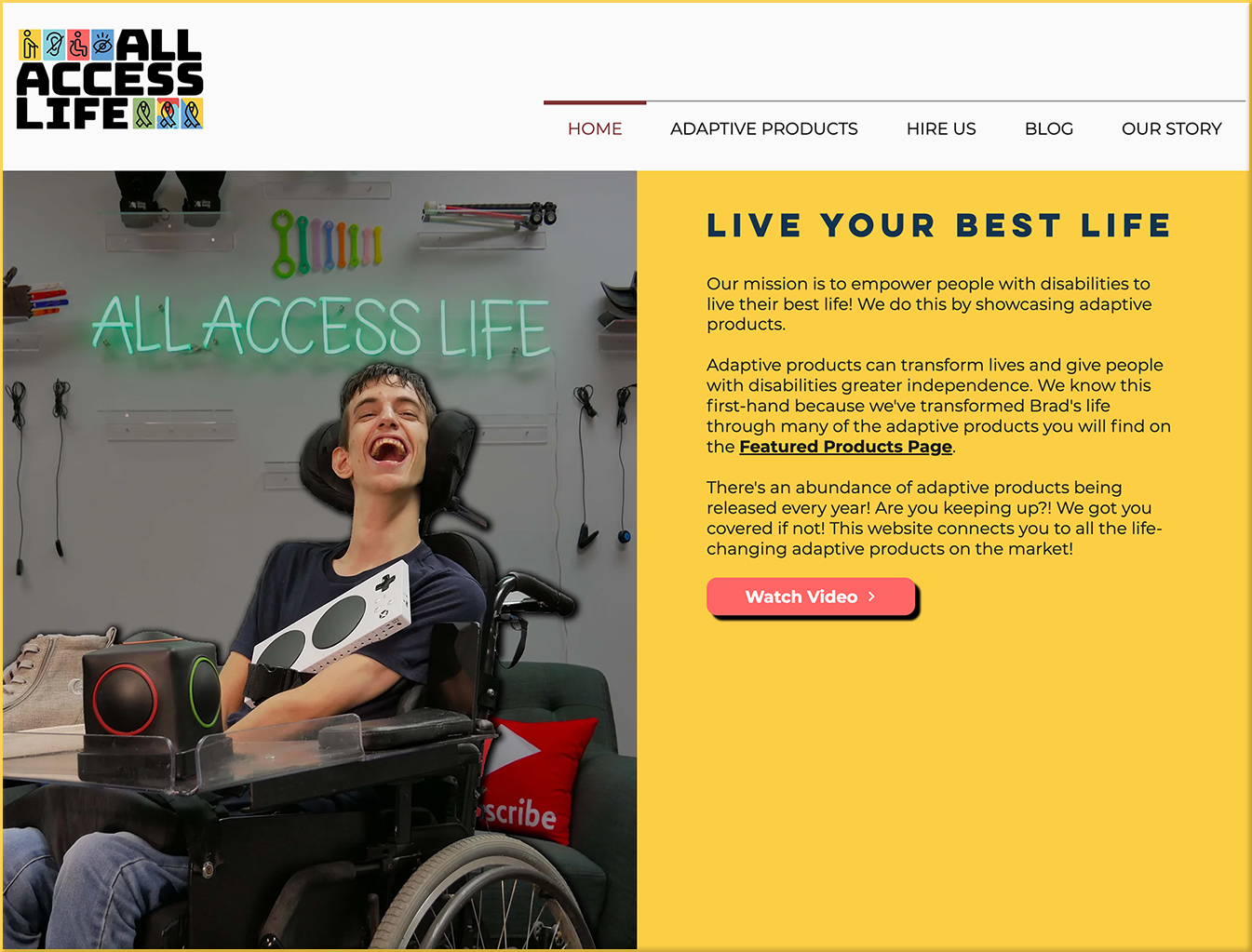
Our mission is to empower people with disabilities to live their best life! We do this by showcasing adaptive products.

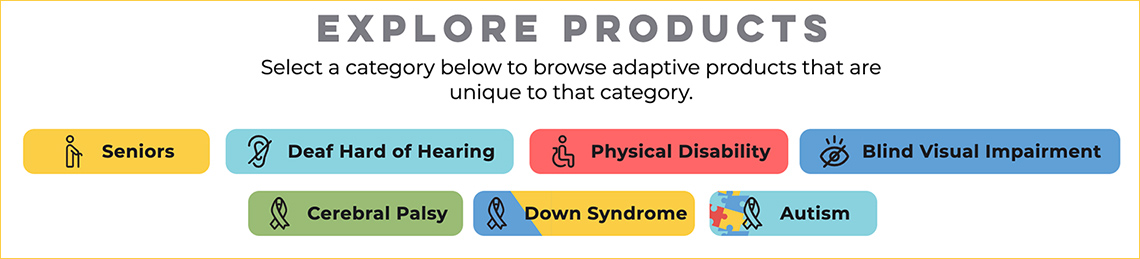
The product categories out at allaccesslife.org


Addendum on 11/14/22:

clusiv.io — as mentioned at The Accelerator at WGU Labs Invests in Platform for the Blind or Visually Impaired

Clusiv is an online learning platform for the blind and visually impaired that teaches occupational training, technology skills, and educational courses to empower employment. We help remove barriers to successful employment by teaching the skills you need to be equipped for the modern workforce.


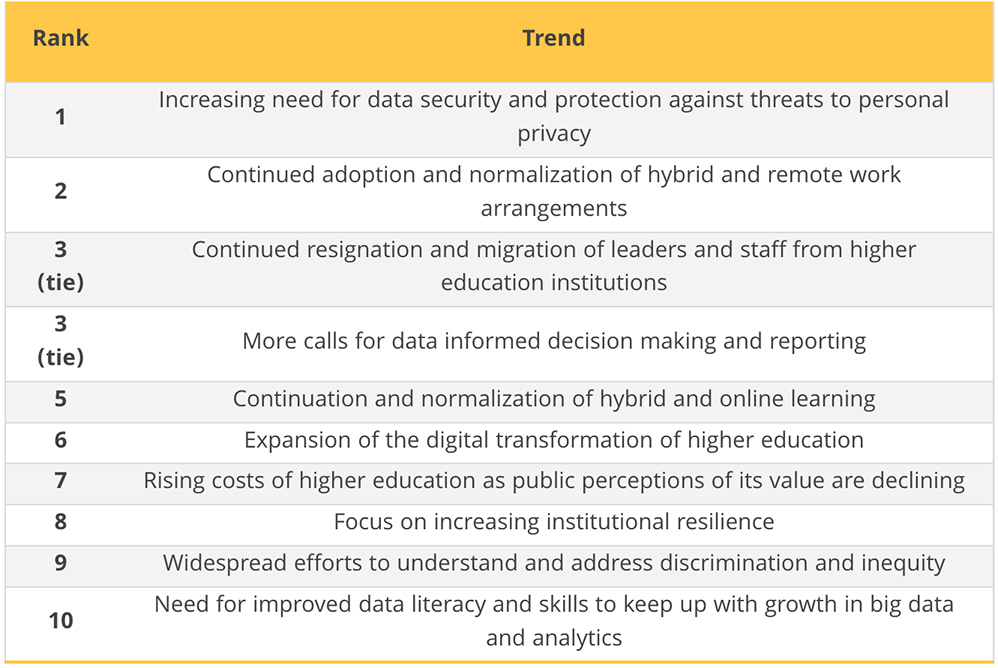
2023 Higher Education Trend Watch — from educause.edu

Excerpt:

This report focuses on the workforce, cultural, and technological shifts for ten macro trends emerging in higher education in 2023. Across these three areas of shift, we report the major impacts and steps that institutions are taking in response to each trend. Some trends overlap with the 2022 Higher Education Trend Watch report. However, while some topics and issues remain consistent, significant shifts have occurred across many of the trends for 2023.


To future-proof a workforce, kill the perpetual hiring machine and embrace lifelong learning — from fortune.com by Clay Dillow

Excerpt:

A looming economic slowdown, the Great Resignation, a relentlessly expanding skills gap, and employees that would simply rather work from home. This week at Fortune’s CEO Initiative forum, a panel of company executives discussed the litany of challenges they face in developing and maintaining their workforces over the next several years.


You want your students back in the classroom? Give them a good reason! — from educationalist.substack.com by Alexandra Mihai

Excerpt:

Right now what I would like to do is turn things upside- down and bring the physical classroom and the in-person teaching and learning into the spotlight. After almost three years of doing things differently, for better or worse, I believe this is a crucial exercise that will help us calibrate our practice moving further. Ironically, despite our expectations that students will happily rush back to campus, many of us noticed a different reality: low attendance levels and in some cases also low engagement.

So, a few questions we could start by asking ourselves are…

So the next time someone asks “why should students come to class?” let’s try to answer anything else than “because they have to”.


From DSC:
This article contains some interesting ideas for professional development.


Improving the Exit Ticket — from theeffortfuleducator.com by Blake Harvard

Excerpts (emphasis DSC):

So, how can the exit ticket be improved upon? How can it be a more effective assessment of learning?

Allow time for forgetting. The main problem with the traditional usage of the exit ticket is that there’s no time to forget, which leads to the measuring of performance and not learning.

Opt for an entrance ticket. Instead of assessing the day’s lesson as they leave, provide students with an index card (or sticky note or whatever) on their way in the next day and assess their knowledge then. Asking those same questions twenty-four hours after the lesson is much more indicative of their true level of understanding.

From DSC:
Though not quite related to the item above, it does have to do with instructional design:


Post-Conference LMS Market News — from philonedtech.com by Phil Hill

Excerpt:

Educause used to be THE EdTech conference, and the LMS market news tended to deliberately coincide with the fall event – with vendors releasing news that week. The conference competition has heated up and Educause is now one among several EdTech conferences, but it does tend to remain the premier event in North American higher ed in terms of combined exhibitor booths and marketing presence.

Having seen so many LMS vendors at #Edu22 (Instructure Canvas, Google Classroom sort of, D2L Brightspace, Anthology Learn, Open LMS, Sakai, and Cypher Learning), it is worth collecting some items in one place after the conference, organized this time around market wins of significance.


From DSC:
Will this become a trend within higher education (i.e., more transparent, accurate pricing)?


Why so many colleges have been resetting their tuition — from highereddive.com by Lilah Burke
Colby-Sawyer College is reducing its prices by 60% so tuition more accurately reflects what students pay. Other institutions are doing the same.

Excerpt:

Starting next academic year, Colby-Sawyer College will be decreasing tuition, but it’s not just shaving a few hundred dollars off its sticker price. The college is cutting its price from $46,364 to $17,500, a drop of more than 60%.

The move, said President Susan Stuebner, is intended to make more students consider attending the private New Hampshire college.

“We really recognize the need for transparency in pricing and we’re trying to align the published price more closely with what students currently pay,” she said.

But for Stuebner at Colby-Sawyer, the choice was clear. 

“The pattern of higher education being on this trajectory of high-price, high-discount has just gotten so confusing for families. We’re really doing a disservice to them,” she said. “And they’re starting to push back.”


Beyond Courses: Instructional Approaches in 2022 — from learningguild.com by Jane Bozarth

Excerpts (emphasis DSC):

 In researching “upskilling for L&D practitioners” earlier this year, Learning Guild members were asked what they feel has been the biggest shift in their work over time: While technology has driven much change, sometimes seemingly exponentially, nearly everyone talked about a different sort of shift. This was true even of those who landed on the younger end of the experience spectrum. According to respondents, the biggest change is the move away from the idea that the primary role of L&D is to create “courses.” Technology changed and became easier to use, enabling development of myriad digital solutions. As noted in that report, respondents viewed this change as welcome and positive.

When asked what other types of content respondents created to be delivered OUTSIDE of a traditional course, the most common responses were creating video and job aids/performance support materials. Microlearning and curated content were also frequently mentioned, and curated collections of existing material was popular with those engaged in traditional design.

Also relevant/see:

Games, Organizing, & Motivation: ID Links 10/25/22 — from christytuckerlearning.com by Christy Tucker
Curated links on games built in Twine, storytelling, organization, useful tools, motivation, and transitioning from teaching to ID.

From DSC:
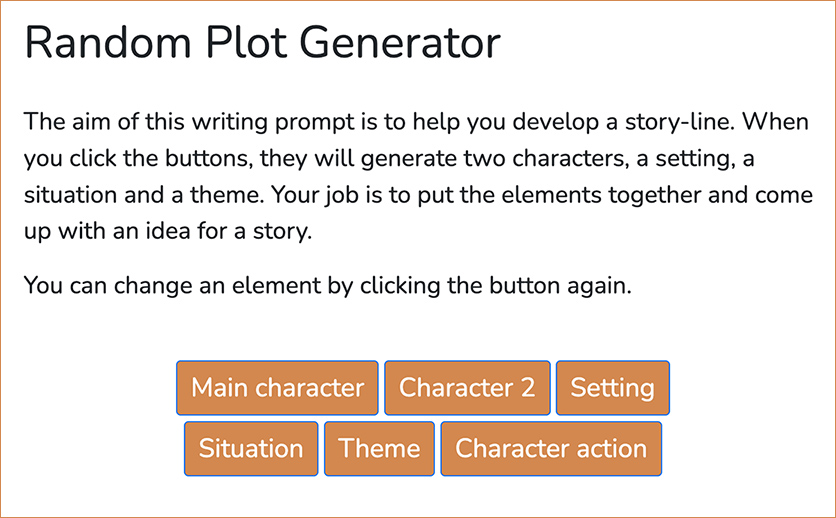
Under the Storytelling and CYOA books section, it was interesting to see the Random Plot Generator, where Christy wrote: “A writing prompt tool to generate two characters, a setting, situation, theme, and character action. This could be a fun way to start scenarios if you’re feeling stuck. h/t Jean Marrapodi.”

I thought this might be a good tool for developing writers, improv actors, and likely others as well!  🙂  

Random Plot Generator

Also from Christy Tucker, see:

If the content is very stable and unlikely to change much over time, voice over might make sense in a branching scenario. Investing in creating video also makes more sense for more stable content and skills than for something that changes every 6 months.

 
© 2025 | Daniel Christian