From DSC:
And while I’m adding Tweets here…


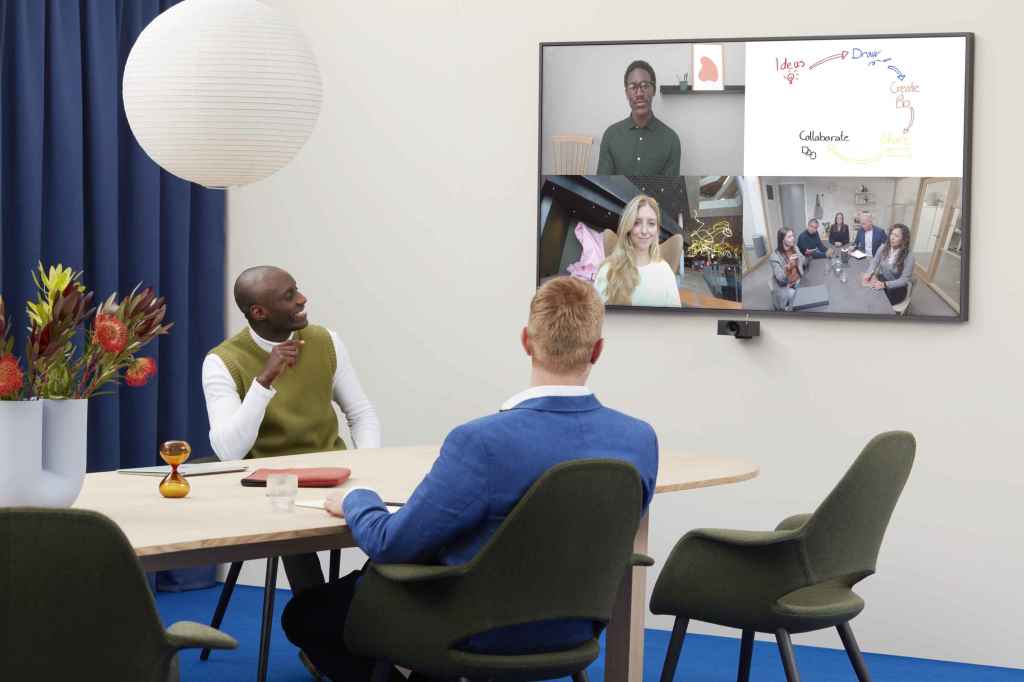
How to survive as the only remote person in the hybrid room — from protocol.com by Tim Stevens
Experts weigh in on how remote tech workers can be seen and heard when everyone in a meeting is in the office.

Excerpt:

The hybrid approach to remote work can meet the needs of diverse teams of people, but too often those who sign in from afar can feel left out, absent from impromptu hallway discussions or outright ignored on Zoom calls.

When you’re on the outside it’s tempting to just stay quiet and hope things will improve, but if your team isn’t aware of your struggles, things will only get worse. I spoke with three experts in remote work and here are their pro tips on how to survive and even thrive.

Addendum on 11/14/22:

84% of meetings have at least one remote participant — from inavateonthenet.net
Excerpt:

A report commissioned by Crestron has found that 84% of employees regularly have at least one remote participant in their meetings.

The report, titled Tackling the Modern Workplace by the Numbers, explores employee behaviors and preferences in a hybrid workplace, the technology tools they need and lack, and what employers are (and could be) doing to enable more consistently productive collaboration remotely and in-office.

“The findings of this report reveal that for the first time in years, we have a reliable sense of what to expect from the enterprise workplace in terms of where work is done and how meetings have to be held,” said Brad Hintze, exec VP, global marketing, Crestron. “If every meeting isn’t equipped to be hybrid, the data unequivocally shows teams will experience challenges in staying connected to each other, to leadership, and to the company culture, no matter where they’re working.”


In one giant classroom, four teachers manage 135 kids – and love it — from hechingerreport.org by Neal Morton
Schools in Mesa, Arizona, piloted a team teaching model to combat declining enrollment and teacher shortages; now the approach is spreading

Excerpts (emphasis DSC):

Five years ago, faced with high teacher turnover and declining student enrollment, Westwood’s leaders decided to try something different. Working with professors at Arizona State University’s teachers college, they piloted a classroom model known as team teaching. It allows teachers to voluntarily dissolve the walls that separate their classes across physical or grade divides.

Here, more than 130 freshmen at Westwood High School learn in one giant classroom overseen by four teachers. 

Team teaching is taking hold in Mesa, Arizona’s largest school district. Here, more than 130 freshmen at Westwood High School learn in one giant classroom overseen by four teachers. Credit: Matt York/Associated Press


By giving teachers more opportunities to collaborate and greater control over how and what they teach, Mesa’s administrators hoped to fill staffing gaps and boost teacher morale and retention. Initial research suggests the gamble could pay off.


Also see:

Educator shortages are a real crisis — especially in special education — from k12dive.com
Administrators are straining under the pressure of finding qualified personnel to meet federal requirements on specialized instruction and related services.

The Council of Administrators of Special Education is keenly aware of the shortage of qualified teachers, specialized instructional support personnel and administrators to fill vacancies in school districts across the country, with shortages particularly acute in special education. We hear daily from administrators citing the impossibility of finding qualified personnel to meet mandates of the federal law requiring specialized instruction and related services for children with disabilities.


I Never Wanted to Be a School Administrator. Here’s Why I Changed My Mind. — from edsurge.com by Patrick Harris II

Excerpt:

What made him so unique? Maybe it was his humility. He didn’t claim to have all the answers. Maybe it was the trust he put in me as a new teacher on his team. When I asked him which curriculum we used, he said, “I trust you to collaborate with the team and build it. I have some resources here to help us ensure that we create a scope-and-sequence for the literacy skills our students need. But we have to create it.” Maybe it was how frequently he said “we.”

Principal Williams had to answer to the school board, to our school’s executive director and to parents, but when it came down to decision-making, everything was up for discussion. I could walk into his office for anything. I felt motivated to become more involved in the school community because he made room for me.

He was flattening the hierarchy.

Cultivating a culture where every voice matters is not the quickest solution, nor is it the easiest, but my hope is that it will have a long-lasting impact at our school. The more that we flatten the hierarchy, focus our attention on building trust and talk more with one another, the better chance we have of creating schools that teachers want to stay at and that students want to learn in.


Recent Advancements In Artificial Intelligence — from forbes.com by Gaurav Tewari

Excerpts:

As the founder of a technology investment firm, I’ve seen firsthand just how much AI has advanced in such a short period of time. The underlying building blocks of the technology are getting astonishingly better at an exponential rate, far outpacing our expectations. Techniques like deep learning allow us to run complex AI models to solve the most difficult problems. But while those who work in technology-centric careers are aware of AI’s explosive capabilities, the public at large is still largely unaware of the depth of AI’s potential.

Enterprise functions such as marketing, sales, finance and HR are all areas that can utilize new AI-enabled applications; these applications include providing customers with 24/7 financial guidance, predicting and assessing loan risks and collecting and analyzing client data.

Also relevant/see:

What is the Future of Artificial Intelligence? — from thedigitalspeaker.com by Dr. Mark van Rijmenam

Excerpts:

Let’s explore some real-life artificial intelligence applications.

  1. Using Artificial Intelligence for Navigation
  2. Marketers Use Artificial Intelligence to Increase Their Efficiency
  3. The use of Artificial Intelligence in robotics
  4. Gaming and Artificial Intelligence
  5. Incorporating Artificial Intelligence into Lifestyles

Artificial intelligence (AI): 7 roles to prioritize now — from enterprisersproject.com by Marc Lewis; with thanks to Mr. Stephen Downes for this resource
Which artificial intelligence (AI) jobs are hottest now? Consider these seven AI/ML roles to prioritize in your organization

While these seven AI roles are critical, finding talent to fill them is difficult.  AI, machine learning, and data analytics are new fields, and few people have relevant experience.

This leads us back to the fact: We are dealing with a Great Reallocation of the labor force to an AI/Machine learning, data-driven world.

3 ways AI is scaling helpful technologies worldwide — from blog.google by Jeff Dean
Decades of research have led to today’s rapid progress in AI. Today, we’re announcing three new ways people are poised to benefit.

Excerpts:

  1. Supporting 1,000 languages with AI
  2. Empowering creators and artists with AI
  3. Addressing climate change and health challenges with AI
 

How can colleges better serve students with autism? — from by Laura Spitalniak
Professor Sarah Howorth says her program at the University of Maine helps bridge the gap between high school and college for students with autism.

Excerpts:

In 2019, Howorth led the pilot for the University of Maine’s Step Up to College, a program meant to model how colleges can effectively support students with autism spectrum disorder.

There are so many myths and misunderstandings out there about what a person with autism is like. Autism is not necessarily associated with cognitive impairment. I have a 16-year-old son who is on the autism spectrum. He is also very intelligent, and he’s definitely college bound. There’s a lot of kids out there like him on the autism spectrum.

Individuals on the spectrum bring a lot to communities, whether that be university campuses, or high schools or businesses. Oftentimes, we focus on the challenges they face, but I think they have many, many more strengths than challenges.

Look at things from a Universal Design for Learning perspective. The things that you offer for students with autism on college campuses, like peer mentors, will help all students.


Also relevant/see:

So what can we do to decrease the exclusion and bullying that leads to trauma? We need to create activities and spaces where autistic people can be their authentic selves and be accepted without having to mask to fit in. We need to eradicate the isolation that is so commonplace by creating supportive communities that are truly safe and inclusive.


When It Comes to Picking Edtech, Are Schools Listening to Teachers? — from edsurge.com by Nadia Tamez-Robledo

Excerpt:

But where in the conversation are the people implementing those tools: the teachers? And how much say do they—or should they—have in edtech decisions?

For both questions, as it turns out, it depends on who you ask.

In a survey released earlier this year, the edtech company Clever found that 85 percent of administrators say teachers are involved in choosing tools. When the company asked teachers, more than 60 percent said they were hardly ever—or never—involved in those choices.

As we started asking educators, administrators and experts about the issue as part of an investigation into how teachers inform the development of edtech products, everyone agreed: teacher voice should be part of edtech decisions.

So what explains the disconnect?


Addendum on 11/9/22:

Lessons from Treadmills and Owls: The Most Important Feature in Educational Technology Products — from opencontent.org by David Wiley; with thanks to Mr. Stephen Downes for this resource

Excerpt:

The primary point, of course, is this: unused features in exercise technologies and educational technologies can improve neither fitness nor learning. From this perspective, one might argue:

The most important feature in educational technology products is the nudge – the feature that persuades you to actually use the features that will improve learning.

Duolingo is a great example here. On its surface, the language learning app may appear rather straightforward. But there are some pretty sophisticated things happening behind the scenes that make your language learning more effective.


Virtual or in-person: The next generation of trial lawyers must be prepared for anything — from reuters.com by Stratton Horres and Karen L. Bashor

A view of the jury box (front), where jurors would sit in and look towards the judge's chair (C), the witness stand (R) and stenographer's desk (L) in court room 422 of the New York Supreme Court

Excerpt:

In this article, we will examine several key ways in which COVID-19 has changed trial proceedings, strategy and preparation and how mentoring programs can make a difference.

COVID-19 has shaken up the jury trial experience for both new and experienced attorneys. For those whose only trials have been conducted during COVID-19 restrictions and for everyone easing back into the in-person trials, these are key elements to keep in mind practicing forward. Firm mentoring programs should be considered to prepare the future generation of trial lawyers for both live and virtual trials.

From DSC:
I think law firms will need to expand the number of disciplines coming to their strategic tables. That is, as more disciplines are required to successfully practice law in the 21st century, more folks with technical backgrounds and/or abilities will be needed. Web front and back end developers, User Experience Designers, Instructional Designers, Audio/Visual Specialists, and others come to my mind. Such people can help develop the necessary spaces, skills, training, and mentoring programs mentioned in this article. As within our learning ecosystems, the efficient and powerful use of teams of specialists will deliver the best products and services.


“Dissolution” by Artist Huntz Liu

“Dissolution” by Artist Huntz Liu — from booooooom.com


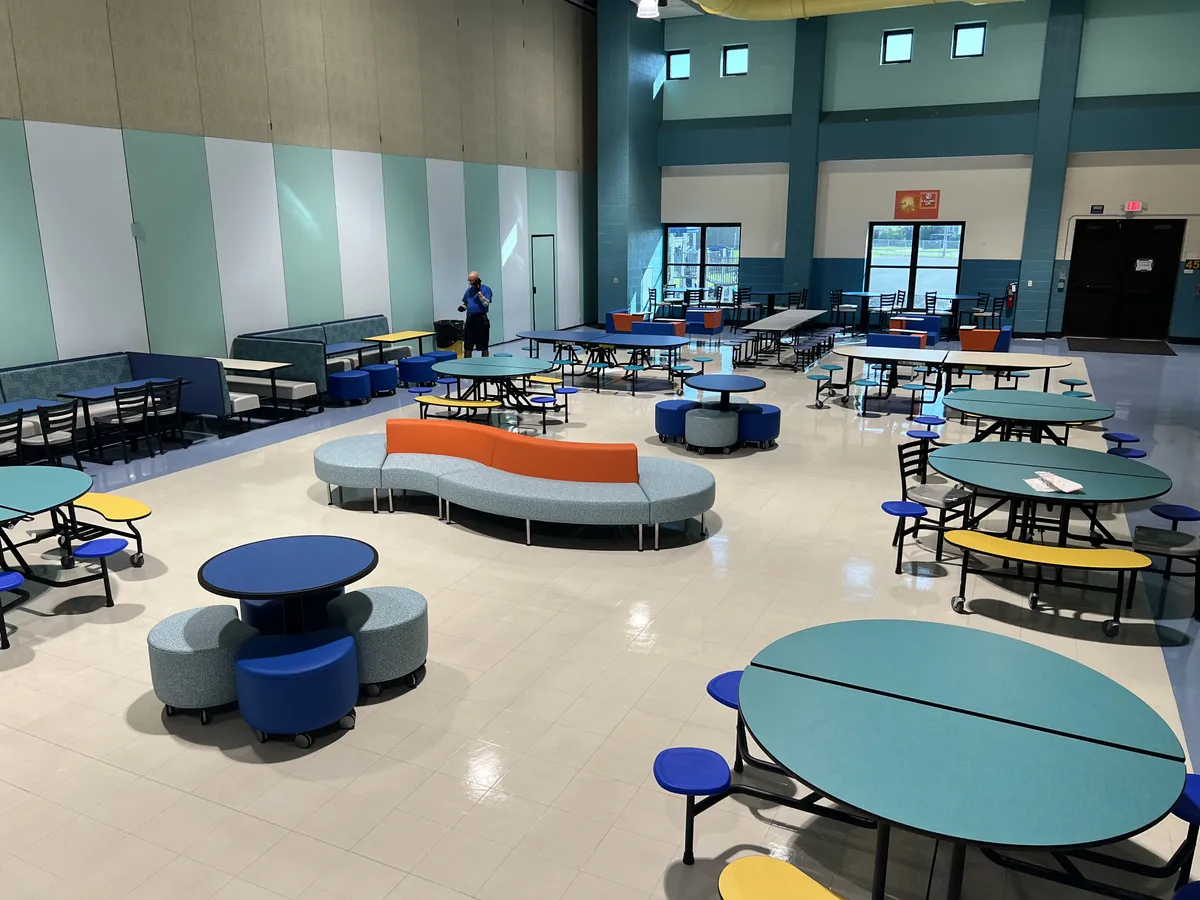
Rethinking Learning Spaces: 4 Strategies for Student-Centered Learning — from techlearning.com by Erik Ofgang
The Brigantine Public School district has redesigned its learning spaces and rethought how and where learning takes place. Superintendent Glenn Robbins shares how others districts can do the same and prioritize student-centered learning in the process.

Excerpt:

Robbins shares how other educators can rethink their learning spaces and encourage student voice and choice in the process.


Sparking Curiosity for Learning — from rdene915.com by Rachelle Dene Poth

Excerpt:

When students are curious about learning, they become more invested in the process. Sparking curiosity will lead students to become problem solvers and critical thinkers and shift from being simply consumers to becoming creators and innovators. To bring these opportunities to our classrooms, we must first engage students in learning. But how?

 
  1. Radar Trends to Watch: November 2022 — from oreilly.com by Mike Loukides
    Developments in AI, Programming, Quantum Computing, and More

Excerpts:

Maintaining a separate category for AI is getting difficult. We’re seeing important articles about AI infiltrating security, programming, and almost everything else; even biology. That sounds like a minor point, but it’s important: AI is eating the world. What does it mean when an AI system can reconstruct what somebody wants to say from their brainwave? What does it mean when cultured brain cells can be configured to play Pong? They don’t play well, but it’s not long since that was a major achievement for AI.

The creators of StableDiffusion have announced HarmonyAI, a community for building AI tools for generating music. They have released an application called Dance Diffusion.

Google’s new AI can hear a snippet of song—and then keep on playing — from technologyreview.com by Tammy Xuarchive
The technique, called AudioLM, generates naturalistic sounds without the need for human annotation.


25 Transferable Skills Employers Look For in 2022 — from wikijob.co.uk by Nikki Dalea; with thanks to Ryan Mein for this resource

Excerpt:

Transferable skills combine competencies, knowledge and skills that you have gained from the workplace during your career path, from school, internships or elsewhere and take with you to your next employment or career change.

General skills that can be used in different employment roles come under the transferable skills banner; they can be used in various industries and in roles at other seniority levels.

These can be hard skills – technical knowledge like using specific software – and soft skills, the competencies and abilities that are harder to be taught, like active listening and communication.

Communication, problem solving and teamwork are all examples of transferable job skills because they can be used in any employed role, your education or vocational training.


Building Rural Learning Pathways to Strengthen the Future of Community — from gettingsmart.com by Nate McClennen, Guest Author

Key Points

  • Some rural areas continue to have durable and empowered economies.
  • Others need to build a new vision for prosperity while simultaneously maintaining core talent to support community infrastructure needs.
  • By integrating dual enrollment, credentials and CTE, high school students are better able to graduate with college credit and viable credentialed experiences to support entry into the postsecondary workforce.

Also from Getting Smart:

Science Fairs as Pathways To Passion, Problem-Solving and Careers

Key Points

  • Science Fairs inspire the problem-solvers that touch the future.
  • Science fairs provide a great opportunity to form a community and present your ideas.
 

How AI will change Education: Part I | Transcend Newsletter #59 — from transcend.substack.com by Alberto Arenaza; with thanks to GSV’s Big 10 for this resource

Excerpt:

You’ve likely been reading for the last few minutes my arguments for why AI is going to change education. You may agree with some points, disagree with others…

Only, those were not my words.

An AI has written every single word in this essay up until here.

The only thing I wrote myself was the first sentence: Artificial Intelligence is going to revolutionize education. The images too, everything was generated by AI.

 
© 2025 | Daniel Christian