Inspiring Goals: Educators Share Their Vision for the Classroom in 2023 — from blog.edmentum.com

Excerpt:

We asked educators on Facebook and Twitter to share with us what their goals for the classroom are for 2023. Here are a few of our favorite responses that we think will inspire you as you set your own goals for 2023:

MAKING THE BENEFITS OF PRE-K EDUCATION LAST — from thetechedvocate.org by Matthew Lynch

Excerpt:

Pre-K education has come to the forefront recently. Earlier, a kid’s first five years of education were essentially the family’s responsibility. However, research has revealed that these first five years establish the foundation for their further development.

It’s worth investing your time and effort in early education programs as they offer several benefits. Pre-K learning gets the children ready for academic success and empowers them for adulthood. Children who have attended early education programs are more likely to pursue higher education and receive higher salaries when they join the workforce, thus securing a better life for themselves.

9 Tech-Friendly Hobby Ideas for High School Students That Will Help Their Career Prospects — from emergingedtech.com by Lucy Manole

Excerpt:

Hobbies and interests are great additions to your resume. They provide potential employers with a fair idea about your personality and help them understand whether you’re the right fit for the position you are applying for.

Hobbies increase your chances of employability by demonstrating your passion and dedication. They help you become more adaptable and reduce stress thereby influencing your performance at school.

Finding a new hobby can be challenging as there are so many hobbies to choose from. A hobby is something that keeps you engaged and happy in your free time. Hence, you must choose a hobby that helps you relax your mind while, ideally, complementing your existing skills. This will give you a competitive edge over others when searching for a new job.

Here’s a list of top hobbies that will boost your resume and make you more employable.

9 Hobby Ideas You Can Add to Your Resume
#1. Blogging

The School That Calls the Police on Students Every Other Day — from propublica.org by Jennifer Smith Richards, Chicago Tribune, and Jodi S. Cohen, ProPublica

Excerpt:

On the last street before leaving Jacksonville, there’s a dark brick one-story building that the locals know as the school for “bad” kids. It’s actually a tiny public school for children with disabilities. It sits across the street from farmland and is 2 miles from the Illinois city’s police department, which makes for a short trip when the school calls 911.

Administrators at the Garrison School call the police to report student misbehavior every other school day, on average. And because staff members regularly press charges against the children — some as young as 9 — officers have arrested students more than 100 times in the last five school years, an investigation by the Chicago Tribune and ProPublica found. That is an astounding number given that Garrison, the only school that is part of the Four Rivers Special Education District, has fewer than 65 students in most years.

This year, the Tribune and ProPublica have been exposing the consequences for students when their schools use police as disciplinarians. The investigation “The Price Kids Pay” uncovered the practice of Illinois schools working with local law enforcement to ticket students for minor misbehavior. Reporters documented nearly 12,000 tickets in dozens of school districts, and state officials moved quickly to denounce the practice.

Best YouTube Math Channels — from educatorstechnology.com by Med Kharbach, PhD

Excerpt:

The list below features some of the best Math YouTube channels to help your students and kids learn math in engaging ways.  I was so picky in my selection and I  handpicked only those math channels that I believe would provide real educational value to students.

Some solid math YouTube Channels

.

.

How Inflation Is Squeezing Early Childhood Educators — from edsurge.com by Emily Tate Sullivan
Rationing heat, taking on extra jobs, dipping into savings, raising wages for staff — child care providers are using a mishmash of methods to manage rising prices and keep their doors open.

 

NextGen Justice Tech: What regulatory reform could mean for justice tech — from thomsonreuters.com Kristen Sonday

Excerpts (emphasis DSC):

One year in, the Utah Supreme Court had approved 30 companies, including those that created initiatives to provide individuals help completing court forms and receiving legal advice via chatbot.

The ruling is monumental because it allows legal professionals to provide guidance on completing legal forms that might be applied to other areas of law, including through online tools that can reach exponentially more individuals.

“By ruling in favor of Upsolve, the Southern District of New York… established a new First Amendment right in America: the right for low-income families to receive free, vetted, and accountable legal advice from professionals who aren’t lawyers,” said Rohan Pavuluri, Upsolve’s Co-Founder and CEO.

UChicago Medicine partners with legal aid lawyers to offer legal help to victims of violence — from abajournal.com by Debra Cassens Weiss

Excerpt:

The University of Chicago Medicine is working with Legal Aid Chicago to embed lawyers at the system’s trauma center in Chicago’s Hyde Park neighborhood to help victims of violence.

Legal AI: A Lawyer’s New Best Friend? — from legaltechmonitor.com by Stephen Embry

Excerpt:

The real question AI poses for the legal profession, says Susskind, is to what extent machines can be used to reduce uncertainty posed by problems. The fundamental question, says Susskind, is thus what problems lawyers are currently trying to solve that machines can solve better and quicker. The lawyer’s job in the future will be to focus on what clients really want: outcomes. Machines can’t provide outcomes, only reduce the uncertainty surrounding the potential outcomes, according to Susskind.

What Does Copyright Say about Generative Models? Not much. — from oreilly.com by Mike Loukides

Excerpt:

Ultimately we need both solutions: fixing copyright law to accommodate works used to train AI systems, and developing AI systems that respect the rights of the people who made the works on which their models were trained. One can’t happen without the other.

‘Complicit bias’ and ‘lawfare’ among top new legal terms in 2022 — from abajournal.com by Debra Cassens Weiss

Excerpt:

“Complicit bias” tops a list of new legal terms and expressions in 2022 compiled by law professors and academics who are on a committee for Burton’s Legal Thesaurus.

Law360 has a story on the top new terms and their meanings. According to the story, “complicit bias” refers to “an institution or community’s complicity in sustaining discrimination and harassment.”

Law360 listed 10 top legal terms, including these:

Why 2023 Will Be The Year of AI + My First Music Video — from legallydisrupted.com by Zach Abramowitz
ChatGPT Did Not Write This Song


Stop the Presses | Journalism Employment and the Economic Value of 850 Journalism and Communication Programs — from cew.georgetown.edu

Summary

The number of journalism jobs has been declining for decades and will continue to fall over the next decade. Projected job losses for journalists are primarily due to newspaper downsizing and closures. Stop the Presses: Journalism Employment and the Economic Value of 850 Journalism and Communication Programs explores the transformation of the journalism profession and ranks journalism and communication programs at 850 institutions by their payoff for graduates in the labor market. The report finds that only about 15 percent of journalism majors become editors or news analysts, reporters, and correspondents early in their careers.


FutureFit AI:

Using AI to help workers navigate their careers
We use advanced labor market data and ethical machine learning algorithms to identify an individual’s ‘starting point’ in the labor market, recommend best fit career path ‘destinations’, and build a personalized roadmap of learning, resources, and work opportunities to successfully guide them from point A to point B in their career


From DSC:
This is a likely component of the Learning from the [Class]room vision that I’ve been tracking for several years now.

Learning from the living class room


Imagine my delight when co-founder of Coursera Daphne Koehler came into my office in 2012 to explain the radical concept behind her new business. What if you could Partner with the World’s best universities and professors to provide FREE online courses? Like other successful FREEMIUM models, you monetize the platform downstream by creating massive network effects and convert a small percentage to paying customers (we had invested in other successful FREEMIUM models such as Facebook, Twitter, Spotify and Snap, so why wouldn’t that work here?)

Today, over 113 million learners from around the world access the platform to gain knowledge, to earn certificates and get diplomas from the top universities.

The Coursera ride has been amazing for most of the past decade, with over 100 million students, 200 universities and 5000 courses on the platform. And while the vast majority of the students on Coursera don’t pay a dime, the company has built a business with over $500 million in revenue and nearly a $2 billion market cap today.

Estimates are for the company to do $520 million in revenue in 2022, up from $415 million in 2021 and estimated $623 million in 2023. Coursera is losing money currently but has $424 million in cash and could turn profitable if it prioritized that and sells at 1.3x 2023 sales.


From DSC:
For all you folks out there who like to fish, you have to check this out! (Though I don’t think even this high-tech fishing rod could help me out.)

Overengineered Fishing Rod

A modified excerpt:

Handy Geng [shows off his] latest build: a multifunctional fishing rod with an ice-breaking shovel on one end, a smartphone-controlled motorized reel, accent lighting, and the ability to detect when a fish is on the hook. It also works as a pot stand for cooking your fresh catch.


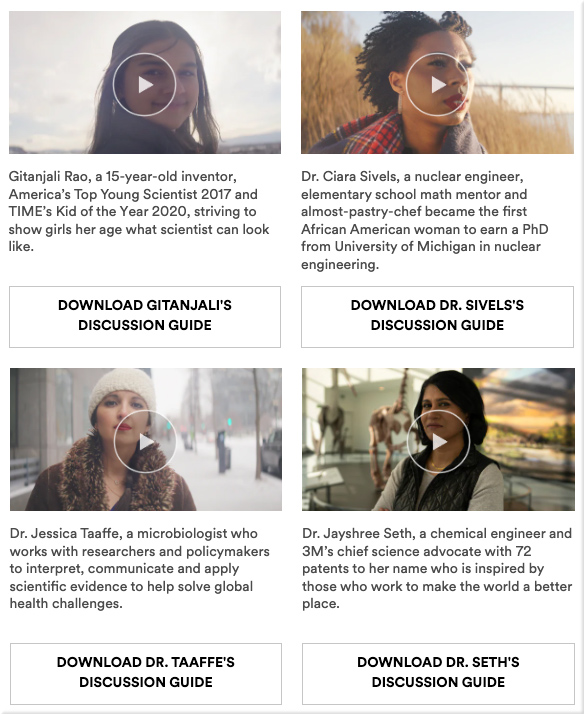
Female scientists challenge stereotypes | Not the Science Type — from 3M.com
Female scientists challenge stereotypes and blaze paths for future generations in this 3M-produced docuseries

Excerpt:

STEM education has an access issue: let’s change that.

Around the world, people believe the we need more people in STEM careers. Eighty-seven percent of people believe we need to do more to encourage and retain girls in STEM education. At the same time, barriers remain – 73% of people believe underrepresented minorities often lack equal access STEM education.

Not The Science Type gets to the heart of access and gender inequity in STEM education and STEM fields. This four-part docuseries features four female scientists who are challenging stereotypes and confronting gender, racial and age discrimination as they rise to prominence.

Not The Science Type highlights four brilliant minds, showcasing women who break down boundaries within their fields – biology, engineering and science and technology-based applications.
.

Female scientists challenge stereotypes and blaze paths for future generations in this 3M-produced docuseries.

While each woman has taken a different path to pursue scientific excellence, they are bound by the common experience of feeling excluded, or “not the type” in traditionally homogenous fields.


How Skills Are Disrupting Work: The Transformational Power of Fast-Growing, In-Demand Skills — from burningglassinstitute.org by Nik Dawson, Alexandra Martin, Matt Sigelman, Gad Levanon, Stephanie Blochinger, Jennifer Thornton, and Janet Chen
A “State of Skills” Report from the Burning Glass Institute, the Business-Higher Education Forum, and Wiley

On average, 37% of the top 20 skills requested for the average U.S. job have changed since 2016.

Excerpt:
By analyzing hundreds of millions of recent U.S. job postings, the Burning Glass Institute and the Business–Higher Education Forum (BHEF) identified four of the fastest-growing, highest-demand emerging skill sets:

  • Artificial Intelligence/Machine Learning
  • Cloud Computing
  • Product Management
  • Social Media

These four skill sets serve as a laboratory for understanding what business and education leaders can do to prepare workers and students for skills disruption. To illustrate how programs can help learners and workers acquire essential skills, this report includes profiles of recent innovations from the BHEF network.

The future belongs to those who seek to understand, anticipate, and harness the power of emerging skills, rather than maintain a posture of reaction/response.

The prospect of helping all those who are challenged by skill disruption hinges on the readiness of business and higher education to engage in understanding and planning for skill disruption over the long term.

From DSC:
“On average, 37% of the top 20 skills requested for the average U.S. job have changed since 2016.” That’s what I’m talking about when I talk about the exponential pace of change. It’s hard to deal with. Our institutions of education are not used to this pace of change. Our legal system isn’t used to this pace of change. And there are other industries struggling to keep up.

Should the pace of change be an element of our design when we think about using Design Thinking to create a new lifelong learning ecosystem?


ChatGPT, Chatbots and Artificial Intelligence in Education — from ditchthattextbook.com by Matt Miller
AI just stormed into the classroom with the emergence of ChatGPT. How do we teach now that it exists? How can we use it? Here are some ideas.

Excerpt:
Now, we’re wondering …

  • What is ChatGPT? And, more broadly, what are chatbots and AI?
  • How is this going to impact education?
  • How can I teach tomorrow knowing that this exists?
  • Can I use this as a tool for teaching and learning?
  • Should we block it through the school internet filter — or try to ban it?

Also relevant/see:

We gave ChatGPT a college-level microbiology quiz. It blew the quiz away. — from bigthink.com by Dr. Alex Berezow
ChatGPT’s capabilities are astonishing.

Key takeaways:

  • The tech world is abuzz over ChatGPT, a chat bot that is said to be the most advanced ever made.
  • It can create poems, songs, and even computer code. It convincingly constructed a passage of text on how to remove a peanut butter sandwich from a VCR, in the voice of the King James Bible.
  • As a PhD microbiologist, I devised a 10-question quiz that would be appropriate as a final exam for college-level microbiology students. ChatGPT blew it away.

ChatGPT Is Dumber Than You Think — from theatlantic.com by Ian Bogost
Treat it like a toy, not a tool.

Excerpt:

On the one hand, yes, ChatGPT is capable of producing prose that looks convincing. But on the other hand, what it means to be convincing depends on context. The kind of prose you might find engaging and even startling in the context of a generative encounter with an AI suddenly seems just terrible in the context of a professional essay published in a magazine such as The Atlantic. And, as Warner’s comments clarify, the writing you might find persuasive as a teacher (or marketing manager or lawyer or journalist or whatever else) might have been so by virtue of position rather than meaning: The essay was extant and competent; the report was in your inbox on time; the newspaper article communicated apparent facts that you were able to accept or reject.

I Would Have Cheated in College Using ChatGPT — from eliterate.us by Michael Feldstein

Excerpt:

These lines of demarcation—the lines between when a tool can do all of a job, some of it, or none of it—are both constantly moving and critical to watch. Because they define knowledge work and point to the future of work. We need to be teaching people how to do the kinds of knowledge work that computers can’t do well and are not likely to be able to do well in the near future. Much has been written about the economic implications to the AI revolution, some of which are problematic for the employment market. But we can put too much emphasis on that part. Learning about artificial intelligence can be a means for exploring, appreciating, and refining natural intelligence. These tools are fun. I learn from using them. Those two statements are connected.

Google to Rival OpenAI’s ChatGPT? New AI Bot for Chats in 2023, CEO Claims to Use it for Search — from techtimes.com by Isaiah Richard
Google to expand its Search engine with AI for 2023, but not in a creepy way.

Excerpt:

Google is planning to create a new AI feature for its Search engine, one that would rival the recently released and controversial ChatGPT from OpenAI. The company revealed this after a recent Google executive meeting that involved the likes of its CEO Sundar Pichai and AI head, Jeff Dean, that talked about the technology that the internet company already has, soon for development.

Employees from the Mountain View giant were concerned that it was behind the current AI trends to the likes of OpenAI despite already having a similar technology laying around.


And more focused on the business/vocational/corporate training worlds:

Sana raises $34M for its AI-based knowledge management and learning platform for workplaces — from techcrunch.com by Ingrid Lunden

There are a lot of knowledge management, enterprise learning and enterprise search products on the market today, but what Sana believes it has struck on uniquely is a platform that combines all three to work together: a knowledge management-meets-enterprise-search-meets-e-learning platform.

Exclusive: ChatGPT owner OpenAI projects $1 billion in revenue by 2024 — from reuters.com by Jeffrey Dastin, Krystal Hu, and Paresh Dave

Excerpt:

Three sources briefed on OpenAI’s recent pitch to investors said the organization expects $200 million in revenue next year and $1 billion by 2024.

The forecast, first reported by Reuters, represents how some in Silicon Valley are betting the underlying technology will go far beyond splashy and sometimes flawed public demos.

“We’re going to see advances in 2023 that people two years ago would have expected in 2033. It’s going to be extremely important not just for Microsoft’s future, but for everyone’s future,” he said in an interview this week.


Addendum on 12/21/22:

ChatGPT and higher education: last week and this week — from bryanalexander.org by Bryan Alexander


The talent needed to adopt mobile AR in industry — from chieflearningofficer.com by Yao Huang Ph.D.

Excerpt:

Therefore, when adopting mobile AR to improve job performance, L&D professionals need to shift their mindset from offering training with AR alone to offering performance support with AR in the middle of the workflow.

The learning director from a supply chain industry pointed out that “70 percent of the information needed to build performance support systems already exists. The problem is it is all over the place and is available on different systems.”

It is the learning and development professional’s job to design a solution with the capability of the technology and present it in a way that most benefits the end users.

All participants revealed that mobile AR adoption in L&D is still new, but growing rapidly. L&D professionals face many opportunities and challenges. Understanding the benefits, challenges and opportunities of mobile AR used in the workplace is imperative.

A brief insert from DSC:
Augmented Reality (AR) is about to hit the mainstream in the next 1-3 years. It will connect the physical world with the digital world in powerful, helpful ways (and likely in negative ways as well). I think it will be far bigger and more commonly used than Virtual Reality (VR). (By the way, I’m also including Mixed Reality (MR) within the greater AR domain.) With Artificial Intelligence (AI) making strides in object recognition, AR could be huge.

Learning & Development groups should ask for funding soon — or develop proposals for future funding as the new hardware and software products mature — in order to upskill at least some members of their groups in the near future.

As within Teaching & Learning Centers within higher education, L&D groups need to practice what they preach — and be sure to train their own people as well.


From DSC:
Unless students see how the topics that you are introducing are relevant to *their futures*, it just develops a mindset of “how do I play the game/system?” and “what’s the least I can do to get an A?”

On a somewhat-related tangent:


14 charts this year that helped us better understand COVID’s impact on students, teachers, & schools — from the 74million.org by  Kevin Mahnken

Excerpt:

By the end of last year, a steady trickle of research had already begun to reveal the harm wrought by prolonged school closures and the transition to virtual instruction. But this fall brought the most definitive evidence yet of the scale of learning lost over more than two years of COVID-disrupted schooling: fresh testing data from the National Assessment of Educational Progress, sometimes called the Nation’s Report Card, pointing to severe declines in core subjects.

From DSC:
While not minimizing the impact of the “learning loss” that is often written about, I do wonder if maybe the types of learning going on during the pandemic weren’t captured on a standardized test. Maybe the types of learning that our youth and families learned about help set them up for our present VOCA (Volatility, Uncertainty, Complexity and Ambiguity) world. And for a future where change doesn’t seem to be slowing down anytime soon.

Some of the types of learning that might not show up on the standardized tests include:

  • Dealing with life’s challenges and tumultuous changes
  • Being flexible
  • Adapting
  • The importance of having sufficient Internet connections and the corresponding hardware and software to keep on learning remotely
  • Where or to whom does one go to for help?

Also, as has been said elsewhere, bashing online learning or virtual instruction is often unfair. The remote learning that teachers and faculty members were thrust into lacked appropriate instructional design. Many teachers and faculty members hadn’t yet been trained on how to put together solid online-based courses and/or to use the tools that are required to offer such courses. Also, many in society didn’t have Internet access (or insufficient access), a quiet place to study and/or participate in online-based learning.


Skills, Skills, Skills Now is the time. — from by Katelyn Donnelly and Eric Scott Lavin
Skills matter more than ever.

Excerpt:

For years, the importance of building demonstrable skills has been growing. The research is clear: skills acquired through work experience increase lifetime earnings. Yet, a massive shift in how learners, educators, and employers think about skills is just beginning.

Three subtrends set the stage for a massive inflection point in how we think about skills…

Learning will be the only constant throughout a career.  Success in the modern workforce is learning experiences to build skills, and the best way to build skills is to do real-world projects.

Below is a sampling of organizations and companies pushing the boundaries. Some of these are established players with mature businesses and tested business models.

Also relevant/see:

The Job Skills of 2023 — from Coursera

The job skills of 2023 -- from Coursera

Excerpt from the Executive Summary Section

  1. The fastest-growing skills are digital skills
    The top ten overall fastest-growing skills are digital skills. The ongoing evolution of technology means employers are regularly seeking new digital competencies from potential hires while also reskilling existing workers.
  2. The fastest-growing digital skills are changing more significantly than the fastest-growing human skills
    The top ten digital skills vary significantly from last year—only two have carried over year-on-year: data visualization and user experience. The human skills in demand remain steadier, suggesting an evergreen demand for skills like change management and communication.

The job skills of 2023 -- from Coursera


Luke 1:30-33 — from biblegateway.com

But the angel said to her, “Do not be afraid, Mary; you have found favor with God. You will conceive and give birth to a son, and you are to call him Jesus. He will be great and will be called the Son of the Most High. The Lord God will give him the throne of his father David, and he will reign over Jacob’s descendants forever; his kingdom will never end.”

 
© 2025 | Daniel Christian