In the last quarter of 2022, edtech layoffs have hit venture-backed businesses including but not limited to BloomTech, Vedantu, Teachmint, Reforge, Coursera, Unacademy, Byju’s, Udacity and Brainly. Executive shifts include Quizlet CEO stepping down, Degreed’s CEO stepping aside for the founder’s return, and Invact Metaversity’s co-founder leaving after irreconcilable differences with his co-founder.
Class, an edtech company that neared unicorn status only 10 months after launching its Zoom School alternative, also conducted layoffs this year. The company raised a total of $146 million in known venture funding to date, including a SoftBank Vision Fund II check. CEO and founder Michael Chasen did not respond to a request for comment
The e-mail sent to staff was even more direct. “The truth is the layoffs in our sector are widespread for a reason,” Amir Nathoo, the co-founder of edtech unicorn Outschool, wrote in an email sent to staff. “The funding atmosphere has been dramatically impacted by the anticipation of a recession, higher interest rates and an increased need to show [return on investment] to investors.”
Addendum on 12/15/22 — and focuses on India:
Will Edtech See a Paradigm Shift In 2023? — from entrepreneur.com by S. Shanthi Higher education, phygital models, vernacular learning, re-skilling, up-skilling are some of the trends that are expected to stay attractive
From DSC: I continue to think about the idea of wiping the slate completely clean. If we were to design a lifelong learning ecosystem, what would it look like? How could we apply Design Thinking to this new slate/canvas?
Perhaps we could start by purposefully creating more pathways to weave in and out of the various siloes — and then come back into the “silos” with new ideas, knowledge, and experiences:
PreK-12
Higher education
Vocational programs
Business and the corporate world
Government
Communities of practice
Other
Integrate apprenticeships, jobs, sabbaticals, rest, purpose, passions, intrinsic motivations, other into this lifelong learning ecosystem. Take one’s new learning back to one’s former silo(s) and improve things therein. Such a design would help keep curricula and learning/training environments up-to-date and relevant.
It would also allow people more pathways through their careers — and to keep learning while doing real-world projects. It would help people — and institutions— grow in many ways.
Professors, programmers and journalists could all be out of a job in just a few years, after the latest chatbot from the Elon Musk-founded OpenAI foundation stunned onlookers with its writing ability, proficiency at complex tasks, and ease of use.
The system, called ChatGPT, is the latest evolution of the GPT family of text-generating AIs. Two years ago, the team’s previous AI, GPT3, was able to generate an opinion piece for the Guardian, and ChatGPT has significant further capabilities.
In the days since it was released, academics have generated responses to exam queries that they say would result in full marks if submitted by an undergraduate, and programmers have used the tool to solve coding challenges in obscure programming languages in a matter of seconds – before writing limericks explaining the functionality.
Is the college essay dead? Are hordes of students going to use artificial intelligence to cheat on their writing assignments? Has machine learning reached the point where auto-generated text looks like what a typical first-year student might produce?
And what does it mean for professors if the answer to those questions is “yes”?
…
Scholars of teaching, writing, and digital literacy say there’s no doubt that tools like ChatGPT will, in some shape or form, become part of everyday writing, the way calculators and computers have become integral to math and science. It is critical, they say, to begin conversations with students and colleagues about how to shape and harness these AI tools as an aide, rather than a substitute, for learning.
“Academia really has to look at itself in the mirror and decide what it’s going to be,” said Josh Eyler, director of the Center for Excellence in Teaching and Learning at the University of Mississippi, who has criticized the “moral panic” he has seen in response to ChatGPT. “Is it going to be more concerned with compliance and policing behaviors and trying to get out in front of cheating, without any evidence to support whether or not that’s actually going to happen? Or does it want to think about trust in students as its first reaction and building that trust into its response and its pedagogy?”
ChatGPT is incredibly limited, but good enough at some things to create a misleading impression of greatness.
it’s a mistake to be relying on it for anything important right now. it’s a preview of progress; we have lots of work to do on robustness and truthfulness.
1/Large language models like Galactica and ChatGPT can spout nonsense in a confident, authoritative tone. This overconfidence – which reflects the data they’re trained on – makes them more likely to mislead.
The thing is, a good toy has a huge advantage: People love to play with it, and the more they do, the quicker its designers can make it into something more. People are documenting their experiences with ChatGPT on Twitter, looking like giddy kids experimenting with something they’re not even sure they should be allowed to have. There’s humor, discovery and a game of figuring out the limitations of the system.
And on the legal side of things:
In the legal education context, I’ve been playing around with generating fact patterns and short documents to use in exercises.
From DSC: “How to retain talented staff members should be high on every administrator’s 2023 agenda.” This highlight from a recent email from The Chronicle of Higher Education linked to:
How to Retain Your Best Staff Members — from chronicle.com by Meredith Davis Four tips from a former student-affairs administrator on how to improve work culture on campus.
Unfortunately, this important item wasn’t high on the agenda in the majority of the years that I was working in higher education. I often thought that folks in higher education could have learned from the corporate world in this regard. Although even the corporate world hasn’t been doing a good job these days about treating their people well. But that wasn’t the case in my experience at Baxter Healthcare, Kraft Foods, and Wells Fargo from years ago.
Perhaps we should have more people “crossing over” between the silos that we seem to have established. That is, a person could work within higher education for 2-3 years, move over to a corporate environment/government/vocational space/other, and then works a few years there before coming back to higher education in a different capacity. Perhaps more pathways and tighter collaboration could exist in this manner.
Hmmm…design thinking…there’s got to be something here…
This month’s news has been overshadowed by the implosion of SBF’s TFX and the possible implosion of Elon Musk’s Twitter. All the noise doesn’t mean that important things aren’t happening. Many companies, organizations, and individuals are wrestling with the copyright implications of generative AI. Google is playing a long game: they believe that the goal isn’t to imitate art works, but to build better user interfaces for humans to collaborate with AI so they can create something new. Facebook’s AI for playing Diplomacy is an exciting new development. Diplomacy requires players to negotiate with other players, assess their mental state, and decide whether or not to honor their commitments. None of these are easy tasks for an AI. And IBM now has a 433 Qubit quantum chip–an important step towards making a useful quantum processor.
A growth mindset can help us view feedback as a good thing, which ultimately makes performance reviews more effective. After all, we want to learn, grow, and improve our skills. People with a fixed mindset view criticism as an attack on their self-worth. Growth mindset, by contrast, leaves room for the possibility that we all have blind spots — and that your manager may have valuable insights on how you can hone your skills. Feedback, in other words, isn’t personal. A manager may critique our performance, but a growth mindset helps keep us from tying our performance to our identity.
…
The beauty of growth mindset is that it’s self-reinforcing. As you gain more confidence in your own ability to learn and grow, each feedback conversation becomes easier than the last. You become more capable of discussing high-stakes issues with honesty and transparency because neither side feels threatened.
I got lucky—my encounter was with a drone in virtual reality as part of an experiment by a team from University College London and the London School of Economics. They’re studying how people react when meeting police drones, and whether they come away feeling more or less trusting of the police.
It seems obvious that encounters with police drones might not be pleasant. But police departments are adopting these sorts of technologies without even trying to find out.
“Nobody is even asking the question: Is this technology going to do more harm than good?” says Aziz Huq, a law professor at the University of Chicago, who is not involved in the research.
“These are the urban high minority districts, right? So they were the ones that had the highest death rates, the highest case rates, the highest income and economic hits because of the pandemic,” she said. “We know that all of this goes into what we label as school quality even though it’s about so much more than the school or the district.”
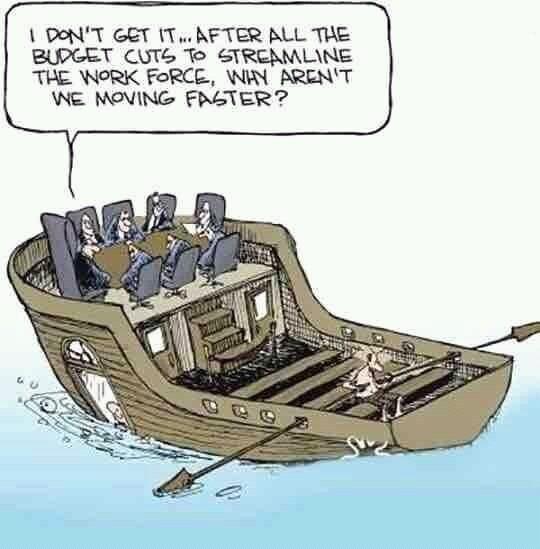
From DSC: I surely hope that what’s going on in the image below isn’t what’s going on within the state of Michigan (as well as other states) — but I have my fears/concerns in that regard. Though admittedly, my focus here isn’t so much about the financial pictures, but rather it has to do with the straight-jacketing of the teachers and students by legislators in Lansing (and other state capitals). If I were to redraw this image, I would have legislators in (far-away) Lansing seated in comfortable chairs and offices while frazzled/overworked educators are straight-jacketed in the classrooms.
We have too many standardized tests and too many one-size-fits-all methods of “doing school” that aren’t coming from the people on the front lines. Those same people, given the right environment, could unleash a far greater amount of joy, wonder, relevance, creativity, and counsel — for themselves as well as for their students. .
And that means, more than ever, getting an education requires access to fast, reliable internet. But while the infrastructure to make sure that everyone can use the internet has improved in the last couple of years, the process isn’t complete.
If we want to keep the digital divide from growing, experts say, it’ll mean districts thinking about themselves as just one part of the larger community composed of families, nonprofits, businesses—all of them potential partners in expanding internet access for students.
The challenge of cost of entry into the profession and concerns of return on investment, the GAO report found, is also significantly straining the country’s supply of teachers. Compounding the financial reality, many candidates fear being overworked and mistreated.
“The COVID-19 pandemic laid bare teachers’ discontent with aspects of their jobs, including a lack of support for their safety and value as professionals and an increasingly disrespectful and demanding workplace culture—and exacerbated teacher shortages nationwide,” the GAO stated, pulling data from focus groups held throughout the pandemic.
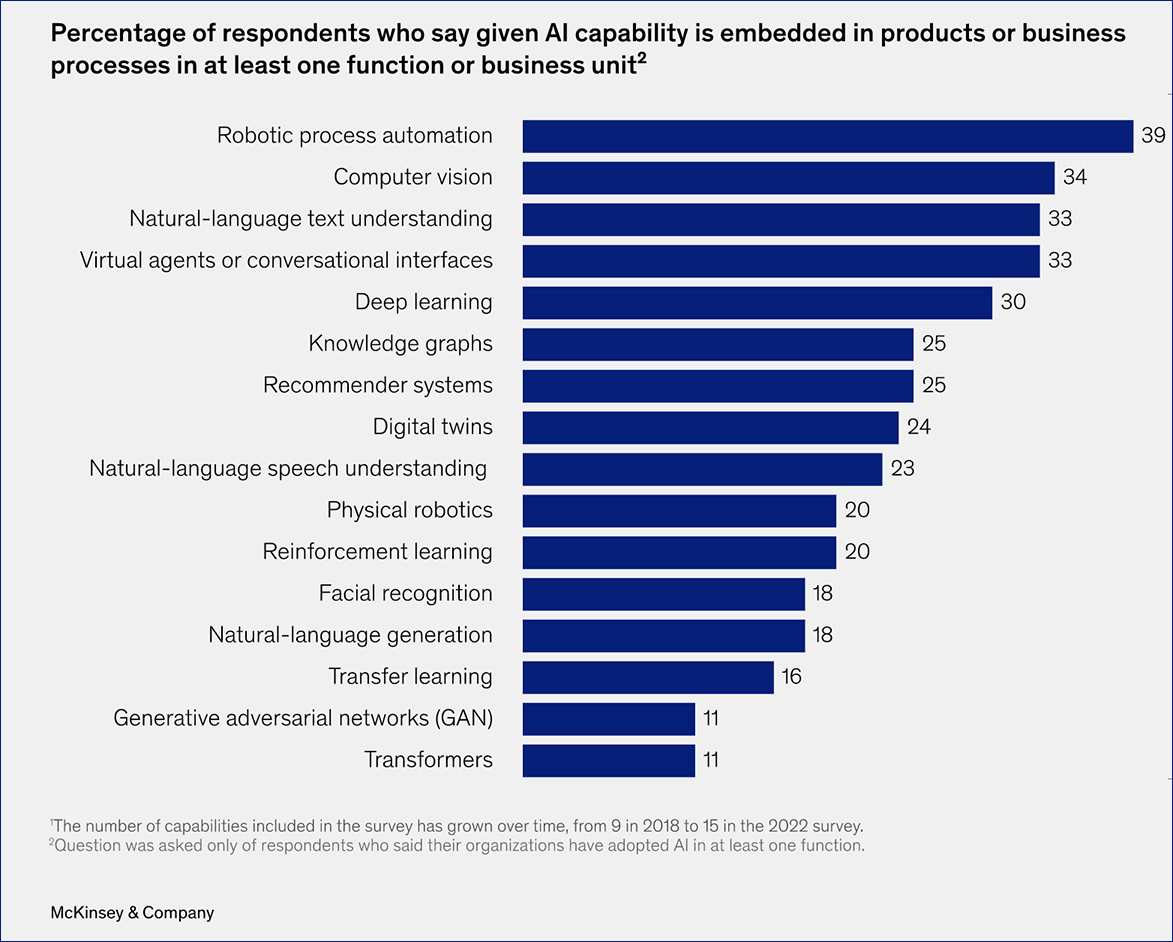
The state of AI in 2022—and a half decade in review — from mckinsey.com The results of this year’s McKinsey Global Survey on AI show the expansion of the technology’s use since we began tracking it five years ago, but with a nuanced picture underneath.
A few weeks ago, Wharton professor Ethan Mollick told his MBA students to play around with GPT, an artificial intelligence model, and see if the technology could write an essay based on one of the topics discussed in his course. The assignment was, admittedly, mostly a gimmick meant to illustrate the power of the technology. Still, the algorithmically generated essays — although not perfect and a tad over-reliant on the passive voice — were at least reasonable, Mollick recalled. They also passed another critical test: a screening by Turnitin, a popular anti-plagiarism software. AI, it seems, had suddenly gotten pretty good.
It certainly feels that way right now. Over the past week or so, screenshots of conversations with ChatGPT, the newest iteration of the AI model developed by the research firm OpenAI, have gone viral on social media.
The future looks very different in some parts of the country than in others, and will also vary among national four-year universities, regional universities like Ship, and community colleges. Grawe projects that, despite the overall demographic decline, demand for national four-year universities on the West Coast will increase by more than 7.5 percent between now and the mid-2030s. But in states like New York, Ohio, Michigan, Wisconsin, Illinois, and Louisiana, it will decline by 15 percent or more.
Higher ed’s eight-decade run of unbroken good fortune may be about to end.
Demand for regional four-year universities, per Grawe,will drop by at least 7.5 percent across New England, the mid-Atlantic, and Southern states other than Florida and Texas, with smaller declines in the Great Plains. Community colleges will be hit hard in most places other than Florida, which has a robust two-year system with a large Latino population.
The next generation of higher education leaders will take scarcity as a given and “return on investment” as both sales pitch and state of mind.
Nine out of 10 colleges either exclude or understate the net cost of attendance in their financial-aid offers to students, according to estimates published in a new report by the Government Accountability Office. The watchdog agency recommended that Congress consider legislation that would require institutions to provide “clear and standard information.”
The lack of clarity makes it hard for students to decide where to enroll and how much to borrow.
The report, published on Monday, paints a troubling picture of an industry that makes it difficult for consumers to understand the bottom line by presenting insufficient if not downright misleading information. Federal law does not require colleges to present financial-aid offers in a clear, consistent way to all students.
U.S. higher education faces a stable but deteriorating credit outlook in 2023, Fitch Ratings said Thursday, taking a more pessimistic view of the sector’s future than it had at the same time last year.
Operating performance at colleges and universities will be pressured by enrollment, labor and wage challenges, according to the bond ratings agency. Colleges have been able to raise tuition slightly because of inflation, but additional revenue they generate generally isn’t expected to be enough to offset rising costs.
While not all institutions can (or should be) saved, most institutional closures reflect the failure of past governing boards to face the fiscal reality of their institution — and to plan accordingly and in a timely manner. Leaders should always consider and, if necessary, pursue potential partnerships, mergers, or consolidations before a school has exhausted its financial and political capital. The inability or unwillingness of many leaders to take such action is reflected in the fact that the number of institutional closures in higher education far outweighs the number of successful mergers.
In fact, the risk of closure can be predicted. In a prior analysis several coauthors and I reported on a number of risk factors predictive of closure, noting that most schools at risk for closure are small and financially fragile, with declining enrollment and limited resources to mount significant online programs. While there are many clear signs that a school is at risk for closure, the major challenge to mounting a response seems to be the unwillingness of institutional leaders to understand, face and act on these signs.
Journalism jobs are hard to find. But it’s nice work when you can get it.
That’s the takeaway from a new report from the Georgetown University Center on Education and the Workforce on the payoff of journalism programs. An analysis of federal education and labor data reveals that journalism and communication bachelor’s degrees offer moderate payoff to their graduates, but only 15% of majors end up working in the field early in their careers. Newsroom employment has declined 26% since 2008, and researchers predict it will fall 3% over the next nine years.
Addendum on 12/10/22:
A Sectorwide Approach to Higher Ed’s Future — from insidehighered.com by Sylvia M. Burwell Institutions must seek ways to differentiate themselves even as they work together to address common challenges facing all of higher education, writes Sylvia M. Burwell.
We have to think differently about the future of higher education. And rather than limit our work to what one type of institution or program can achieve, we should look across the entire higher education sector.
A sectorwide [insert DSC:system-wide] approach is needed because the economics of higher education are not going to hold.
…
To evolve our thinking on these questions, we should focus on the value proposition of higher education and market differentiation.
12 I thank Christ Jesus our Lord, who has given me strength, that he considered me trustworthy, appointing me to his service.13 Even though I was once a blasphemer and a persecutor and a violent man, I was shown mercy because I acted in ignorance and unbelief.14 The grace of our Lord was poured out on me abundantly, along with the faith and love that are in Christ Jesus.
15 Here is a trustworthy saying that deserves full acceptance: Christ Jesus came into the world to save sinners—of whom I am the worst.16 But for that very reason I was shown mercy so that in me, the worst of sinners, Christ Jesus might display his immense patience as an example for those who would believe in him and receive eternal life.17 Now to the King eternal, immortal, invisible, the only God, be honor and glory for ever and ever. Amen.
From DSC: I was watching a sermon the other day, and I’m always amazed when the pastor doesn’t need to read their notes (or hardly ever refers to them). And they can still do this in a much longer sermon too. Not me man.
It got me wondering about the idea of having a teleprompter on our future Augmented Reality (AR) glasses and/or on our Virtual Reality (VR) headsets. Or perhaps such functionality will be provided on our mobile devices as well (i.e., our smartphones, tablets, laptops, other) via cloud-based applications.
One could see one’s presentation, sermon, main points for the meeting, what charges are being brought against the defendant, etc. and the system would know to scroll down as you said the words (via Natural Language Processing (NLP)). If you went off script, the system would stop scrolling and you might need to scroll down manually or just begin where you left off.
For that matter, I suppose a faculty member could turn on and off a feed for an AI-based stream of content on where a topic is in the textbook. Or a CEO or University President could get prompted to refer to a particular section of the Strategic Plan. Hmmm…I don’t know…it might be too much cognitive load/overload…I’d have to try it out.
And/or perhaps this is a feature in our future videoconferencing applications.
But I just wanted to throw these ideas out there in case someone wanted to run with one or more of them.
Along these lines, see:
Tell me you’re not going to want a pair of #AR glasses ?
Thanks for dropping by my Learning Ecosystems blog!
My name is Daniel Christian and this blog seeks to cover the teaching and learning environments within the K-12 (including homeschooling, learning pods/micro-schools), collegiate, and corporate training spaces -- whether those environments be face-to-face, blended, hyflex, or 100% online.
Just as the organizations that we work for have their own learning ecosystems, each of us has our own learning ecosystem. We need to be very intentional about enhancing those learning ecosystems -- as we all need to be lifelong learners in order to remain marketable and employed. It's no longer about running sprints (i.e., getting a 4-year degree or going to a vocational school and then calling it quits), but rather, we are all running marathons now (i.e., we are into lifelong learning these days).