The legal industry is struggling to find enough work for its lawyers – and layoffs are beginning to bite — from fortune.com by Eleanor Pringle

Excerpt:

He said: “This is not simply a U.S. issue or a legal services issue. It is a global one.

“Any economic downturn will inevitably also hit the legal services sector. However many international law firms have practice areas that are both cyclical and counter-cyclical, so those differing components of the practice become busier to support that which is less so.

“We all hope that any downturn is short lived. Everyone has been through a lot these past few years, no business wants to have to restructure at this stage.”

Speaking of legal-related items, also see:


Job Titles: It’s Not Only Instructional Design — from idolcourses.com by Ivett Csordas

Excerpt:

When I first came across the title “Instructional Designer” while looking for alternative career options, I was just as confused as anybody would be hearing about our job for the first time. I remember asking questions like: What does an Instructional Designer do? Why is it called Instructional Design? Wouldn’t a title such as Learning Experience Designer or Training Content Developer suit them better? How are their skill sets different from curriculum developers like teachers’? etc.

Then, the more I learnt about the different roles of Instructional Designers, and the more job interviews I had, ironically, the less clarity I had over the companies’ expectations of us.

The truth is that the role of an Instructional Designer varies from company to company. What a person hired with the title “Instructional Designer” ends up doing depends on a range of factors such as the company’s training portfolio, the profile of their learners, the size of the L&D team, the way they use technology, just to mention a few.

From DSC:
I don’t know a thing about idolcourses.com, but I really appreciated running across this posting by Ivett Csordas about the various job titles out there and the differences between some of these job titles. The posting deals with job titles associated with developers, designers, LXD, LMS roles, managers, L&D Coordinators, specialists, consultants, and strategists.


9 ways ChatGPT saves me hours of work every day, and why you’ll never outcompete those who use AI effectively. — from linkedin.com by Santiago Valdarrama

Excerpts:

A list for those who write code:

  1. Explaining code…
  2. Improve existing code…
  3. Rewriting code using the correct style…
  4. Rewriting code using idiomatic constructs…
  5. Simplifying code…
  6. Writing test cases…
  7. Exploring alternatives…
  8. Writing documentation…
  9. Tracking down bugs…

Also relevant/see:

A Chat With Dead Legends & 3 Forecasts: The Return of Socratic Method, Assertive Falsehoods, & What’s Investable? — from implications.com by Scott Belsky
A rare “Cambrian Moment” is upon us, and the implications are both mind blowing and equally concerning, let’s explore the impact of a few forecasts in particular.

Excerpts:

Three forecasts are becoming clear…

  • Education will be reimagined by AI tools.
  • AI-powered results will be both highly confident and often wrong, this dangerous combo of inconsistent accuracy with high authority and assertiveness will be the long final mile to overcome.
  • The defensibility of these AI capabilities as stand-alone companies will rely on data moats, privacy preferences for consumers and enterprises, developer ecosystems, and GTM advantages. (still brewing, but let’s discuss)

As I suggested in Edition 1, ChatGPT has done to writing what the calculator did to arithmetic. But what other implications can we expect here?

  • The return of the Socratic method, at scale and on-demand…
  • The art and science of prompt engineering…
  • The bar for teaching will rise, as traditional research for paper-writing and memorization become antiquated ways of building knowledge.


Speaking of L&D-related items, also see:

Does Your L&D Team Need More T’s? — from learningguild.com by Pamela Hogle and Barry Nadler

Excerpt:

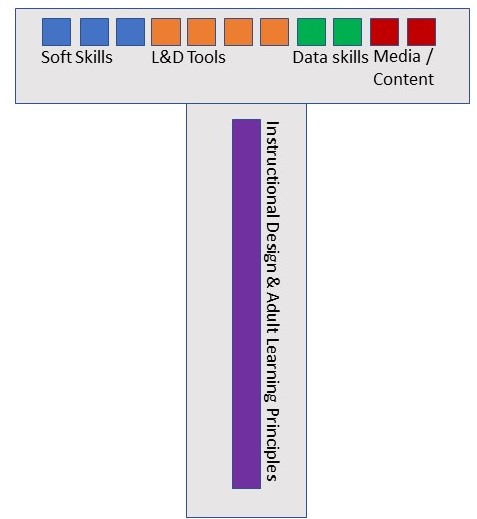
An idea that was used internally at McKinsey and Company as far back as the 1980s, the concept of a T-shaped skills profile (Figure 1) features:

  • A horizontal bar — the broad skill set comprising interpersonal, functional, and industry-specific skills
  • A vertical bar — in-depth, specialized knowledge in areas related to the employee’s field, specific role, and individual interests, focus topics, or experience
    .

Figure 1: T-shaped skills profile (Illustration by Pamela Hogle)


Unlocking the Secrets of Online Peer Learning — from learningguild.com by Kelly Palmer

Excerpt:

By experimenting with online, cohort-based learning programs, we learned that peer learning is one of the most effective ways to broaden horizons. People can share real-world challenges or questions that arise during the work week and get a range of advice and tactics from their peers.

Peer learning gives a way to make learning stick by encouraging people to discuss ideas, explain themselves, actively listen to others, and refine their thinking.


It takes a village — from chieflearningofficer.com by Joe Mitchell
Colleges, companies and training providers have a unique opportunity to work together to address tech worker shortages and create more opportunities and upward mobility.

Excerpt (emphasis DSC):

But what higher education institutions and companies need isn’t a totally new approach that ignores the old systems — it’s someone to act as connective tissue between them. Fortunately, an emerging cadre of education providers are doing just that: developing the curriculum to help students earn industry-recognized credentials that can help them get good jobs right away in high-demand fields, and then working with universities to get that curriculum to their students.

The environment seems ripe for this type of collaboration.2020 survey of business leaders found that 70 percent think higher education institutions should be more involved in job training. Nearly 90 percent say colleges and universities could help their students learn industry-specific knowledge and advanced technical skills.


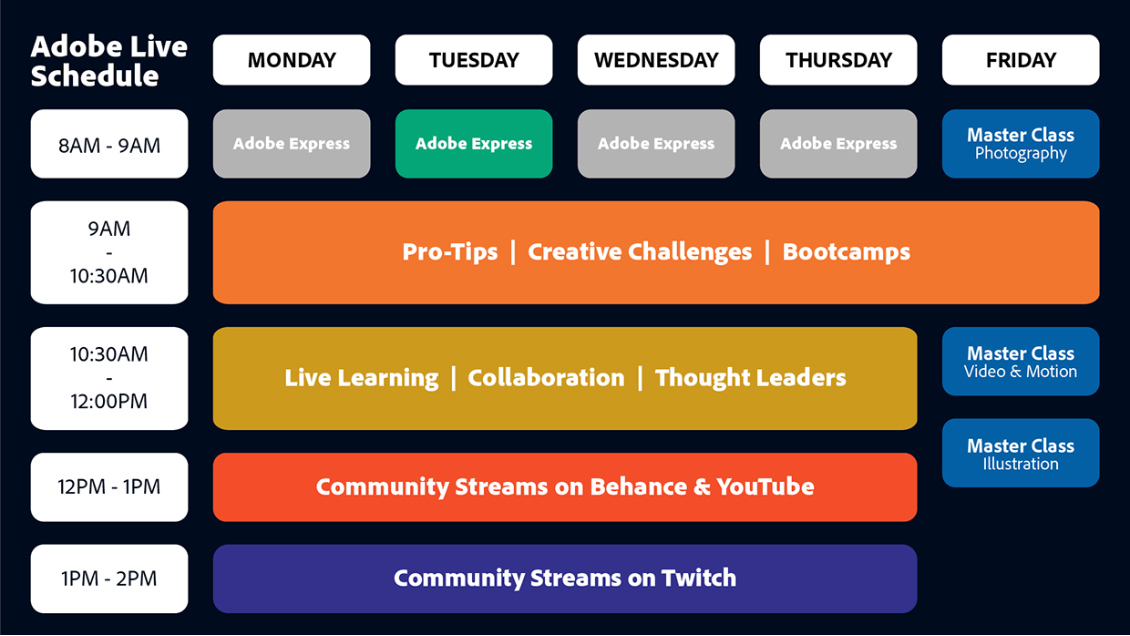
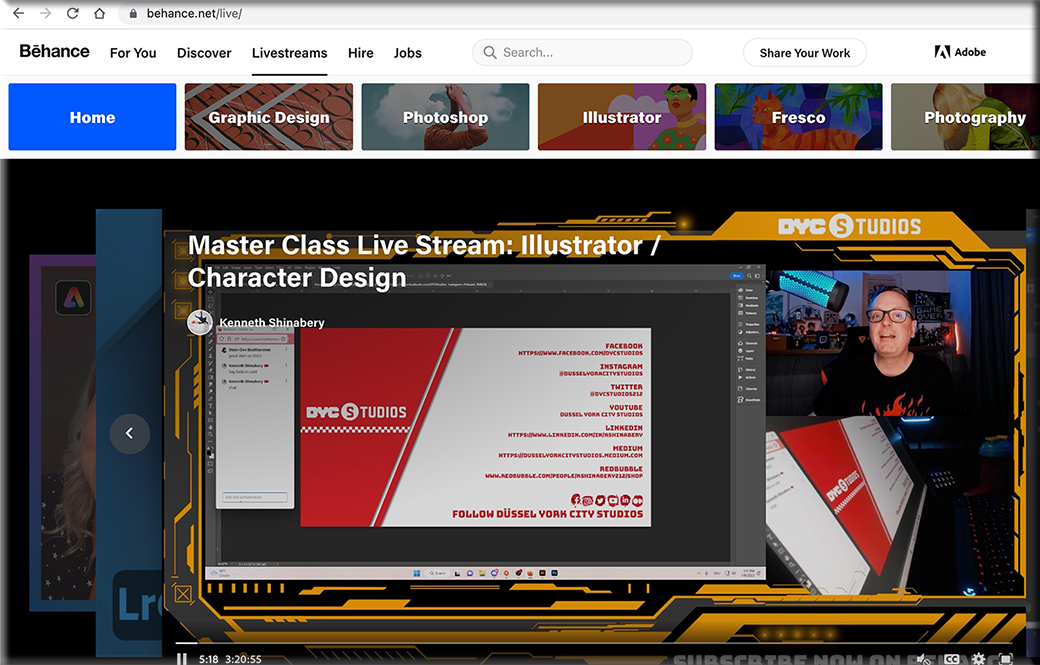
behance.net/live/   <— Check out our revamped schedule!

Join us in the morning for Adobe Express streams — If you are an aspiring creative, small business owner, or looking to kickstart a side hustle – these live streams are for you!

Then level up your skills with Creative Challenges, Bootcamps, and Pro-Tips. Get inspired by artists from all over the world during our live learning events. Tune in to connect directly with your instructors and other creatives just like you.

In the afternoon, join creatives in their own Community Streams! Laugh and create along side other Adobe Live Community members on Behance, Youtube and Twitch!

For weekly updates on the Adobe Live schedule + insight into upcoming guests and content, join our discord communities!

Watch Adobe Live Now!


16 Wash and make yourselves clean.
    Take your evil deeds out of my sight;
    stop doing wrong.
17 Learn to do right; seek justice.
    Defend the oppressed.
Take up the cause of the fatherless;
    plead the case of the widow.

From DSC:
Obviously, all of this goes for me as well. I constantly thank the LORD for His patience with me as well as His grace and forgiveness. I often seek His help, wisdom, and strength. Anyway, the above verse caught my eye due to Isaiah’s focus on justice and to seeing that justice is had by all.

And those reflections caused me to think about what the church is all about — at least for me. This brought to mind an old pastor friend of mine who once exclaimed, “The church is a hospital.”

Wow. That thought hit me powerfully. And you know what? I agree with him.

My pastor friend said that the church is a hospital -- and I agree with him

“The church” is a place for “sick” people who are in need of hope, healing, teaching, support, forgiveness, grace, love, wisdom, community, and more. Besides a place to worship the LORD, those are some of the reasons why I continue to go to church.

12 On hearing this, Jesus said, “It is not the healthy who need a doctor, but the sick.


Along these lines, I’m trying to figure out what the LORD wants me to do (during this next year and beyond). I want to make a contribution. For those who pray out there, I could use your prayers on where He wants me to plug in.


Is your Law Firm Ready for Continued Virtual Legal Proceedings? — from jdsupra.com

Excerpt:

For 2023, one trend is obvious: legal professionals prefer remote work. According to an ABA report on the future of the profession, 87% of lawyers say their workplaces allow them to work remotely. And in just a few years, the percentage of attorneys working exclusively in the office has dropped to less than 30%.

Also relevant/see:

The Metaverse: What Is It? How Does It Affect Law Firms? — from by Annette Choti
A new set of legal issues and advertising opportunities.

Excerpt:

Law Firms And The Metaverse
Since the Metaverse is so new, it will continue to develop and change. Distinct kinds of legal issues and implications have not been uncovered yet. The Metaverse will likely create various legal challenges in the future. This creates a new legal landscape for law firms and lawyers.

Those who anticipate the questions and challenges that may arise will be able to take advantage of this new digital market. Here are some ways a law firm can capitalize on the virtual realities of the Metaverse:

From DSC:
My point in posting this item about “The Metaverse” is not to say that it’s here…but to be sure that it’s on your legal radar. There will be enough legal ramifications of AI to last a while, but I would still recommend someone in your firm look at the place of emerging technologies — those techs not only to be leveraged by your firm but also as to what types of legal issues your lawyers will need to be up-to-speed on.

 
Follow God’s example, therefore, as dearly loved children and walk in the way of love, just as Christ loved us and gave himself up for us as a fragrant offering and sacrifice to God.
 

Digital Trends’ Tech For Change CES 2023 Awards — from digitaltrends.com by Drew Prindle

Excerpt:

CES is more than just a neon-drenched show-and-tell session for the world’s biggest tech manufacturers. More and more, it’s also a place where companies showcase innovations that could truly make the world a better place — and at CES 2023, this type of tech was on full display. We saw everything from accessibility-minded PS5 controllers to pedal-powered smart desks. But of all the amazing innovations on display this year, these three impressed us the most…

Samsung's Relumino Mode helps those with low vision

Also relevant/see:


Five Ways to Strengthen the Employee-Employer Relationship in 2023 — from sloanreview.mit.edu by Ally MacDonald; with thanks to Roberto Ferraro for this resource
Organizational experts offer insights on how to make meaningful changes to engage employees in the coming year.

Excerpt (emphasis DSC):

Before 2020, the structure of jobs evolved sluggishly and unimaginatively, despite evidence that traditional ways of working often harmed employee well-being. The past two years have provided leaders with an opportunity to rethink how their employees work. Those seizing this chance are applying an R&D mindset to how jobs are designed, with the goal of structuring work in ways that allow their employees to thrive while on the job and in their nonwork lives as well. It is these forward-thinking leaders who will make 2023 the most innovative year ever when it comes to how people work.

From DSC:
I like the idea of an R&D mindset. Very nice.


Education is about to radically change: AI for the masses — from gettingsmart.com by Nate McClennen and Rachelle Dené Poth

Key Points:

  • AI already does and will continue to impact education – along with every other sector.
  • Innovative education leaders have an opportunity to build the foundation for the most personalized learning system we have ever seen.

Action

Education leaders need to consider these possible futures now. There is no doubt that K-12 and higher ed learners will be using these tools immediately. It is not a question of preventing “AI plagiarism” (if such a thing could exist), but a question of how to modify teaching to take advantage of these new tools.

From DSC:
They go on to list some solid ideas and experiments to try out — both for students and for teachers. Thanks Nate and Rachelle!


Also from Rachelle, see:


From DSC:
A few items re: ChatGPT — with some items pro-chat and other items against the use of ChatGPT (or at least to limit its use).


How About We Put Learning at the Center? — from insidehighered.com by John Warner
The ongoing freak-out about ChatGPT sent me back to considering the fundamentals.

Excerpt:

So, when people express concern that students will use ChatGPT to complete their assignments, I understand the concern, but what I don’t understand is why this concern is so often channeled into discussions about how to police student behavior, rather than using this as an opportunity to exam the kind of work we actually ask students (and faculty) to do around learning.

If ChatGPT can do the things we ask students to do in order to demonstrate learning, it seems possible to me that those things should’ve been questioned a long time ago. It’s why I continue to believe this technology is an opportunity for reinvention, precisely because it is a threat to the status quo.

Top AI conference bans use of ChatGPT and AI language tools to write academic papers — from theverge.com by James Vincent; with thanks to Anna Mills for this resource
AI tools can be used to ‘edit’ and ‘polish’ authors’ work, say the conference organizers, but text ‘produced entirely’ by AI is not allowed. This raises the question: where do you draw the line between editing and writing?

Excerpt:

The International Conference on Machine Learning (ICML) announced the policy earlier this week, stating, “Papers that include text generated from a large-scale language model (LLM) such as ChatGPT are prohibited unless the produced text is presented as a part of the paper’s experimental analysis.” The news sparked widespread discussion on social media, with AI academics and researchers both defending and criticizing the policy. The conference’s organizers responded by publishing a longer statement explaining their thinking. (The ICML responded to requests from The Verge for comment by directing us to this same statement.)

How to… use AI to teach some of the hardest skills — from oneusefulthing.substack.com by Ethan Mollick
When errors, inaccuracies, and inconsistencies are actually very useful

Excerpt:

Instead, I want to discuss the opportunity provided by AI, because it can help us teach in new ways. The very things that make AI scary for educators — its tedency to make up facts, its lack of nuance, and its ability to make excellent student essays — can be used to make education better.

This isn’t for some future theoretical version of AI. You can create assignments, right now, using ChatGPT, that we will help stretch students in knew ways. We wrote a paper with the instructions. You can read it here, but I also want to summarize our suggestions. These are obviously not the only ways to use AI to educate, but they solve some of the hardest problems in education, and you can start experimenting with them right now.

NYC education department blocks ChatGPT on school devices, networks — from ny.chalkbeat.org by Michael Elsen-Rooney

Excerpt:

New York City students and teachers can no longer access ChatGPT — the new artificial intelligence-powered chatbot that generates stunningly cogent and lifelike writing — on education department devices or internet networks, agency officials confirmed Tuesday.

Teachers v ChatGPT: Schools face new challenge in fight against plagiarism — from straitstimes.com by Osmond Chia; with thanks to Stephen Downes for this resource

Excerpt:

SINGAPORE – Teachers in Singapore say they will likely have to move from assignments requiring regurgitation to those that require greater critical thinking, to stay ahead in the fight against plagiarism.

This comes on the back of the rise of ChatGPT, an intelligent chatbot that is able to spin essays and solve mathematical equations in seconds.

ChatGPT Is Not Ready to Teach Geometry (Yet) — from educationnext.org by Paul T. von Hippel
The viral chatbot is often wrong, but never in doubt. Educators need to tread carefully.

Excerpt:

Can ChatGPT provide feedback and answer questions about math in a more tailored and natural way? The answer, for the time being, is no. Although ChatGPT can talk about math superficially, it doesn’t “understand” math with real depth. It cannot correct mathematical misconceptions, it often introduces misconceptions of its own; and it sometimes makes inexplicable mathematical errors that a basic spreadsheet or hand calculator wouldn’t make.

Here, I’ll show you.


Addendum on 1/9/23:

9 ways ChatGPT saves me hours of work every day, and why you’ll never outcompete those who use AI effectively. — from .linkedin.com by Santiago Valdarrama

A list for those who write code:

  1. 1. Explaining code…
  2. Improve existing code…
  3. Rewriting code using the correct style…
  4. Rewriting code using idiomatic constructs…
  5. Simplifying code…
  6. Writing test cases…
  7. Exploring alternatives…
  8. Writing documentation…
  9. Tracking down bugs…
 

Teaching: Will ChatGPT Change the Way You Teach? — from Chronicle.com by Beth McMurtrie

Excerpt:

Want to get involved in the conversation around AI writing tools? Here are a few resources you might find helpful.

Anna Mills has put together several documents:

Elsewhere, a group of professors is compiling examples of how instructors are using text generation technologies in their assignments. The results will be published in an open-access collection. You can find out more about the project on this site, Teaching with Text Generation Technologies.

If you’re rather listen to a discussion, here are a couple of webinars:


© 2025 | Daniel Christian