The Difference Between ‘Playtime’ + ‘Production’ for AI + Legal Tech — from by Jim Wagner, CEO, Lean Law Labs.

Excerpt:

It’s fascinating to see what GPT-3 can do and the possibilities are in some cases nothing short of mind blowing. But before you plan your early 2023 implementation, you may want to exercise a bit of caution.  When it comes to using AI in a production environment – i.e., serving real customers with real expectations – you need solutions that deliver reliable results that you can explain to your clients … and potentially to a lot of other stakeholders, including courts and regulatory authorities.

Maybe in 2023 you can also try this line: ‘Dear client / court / regulator, we know it’s hard to believe, but a lot of the time you can rely on what we tell you.’

NOTE: Artificial Lawyer and its Founder are
now on sabbatical during 2023, returning in 2024.

From DSC:
My guess is that they are pursuing some serious, new opportunities involving using AI within the legaltech realm. Time will tell.
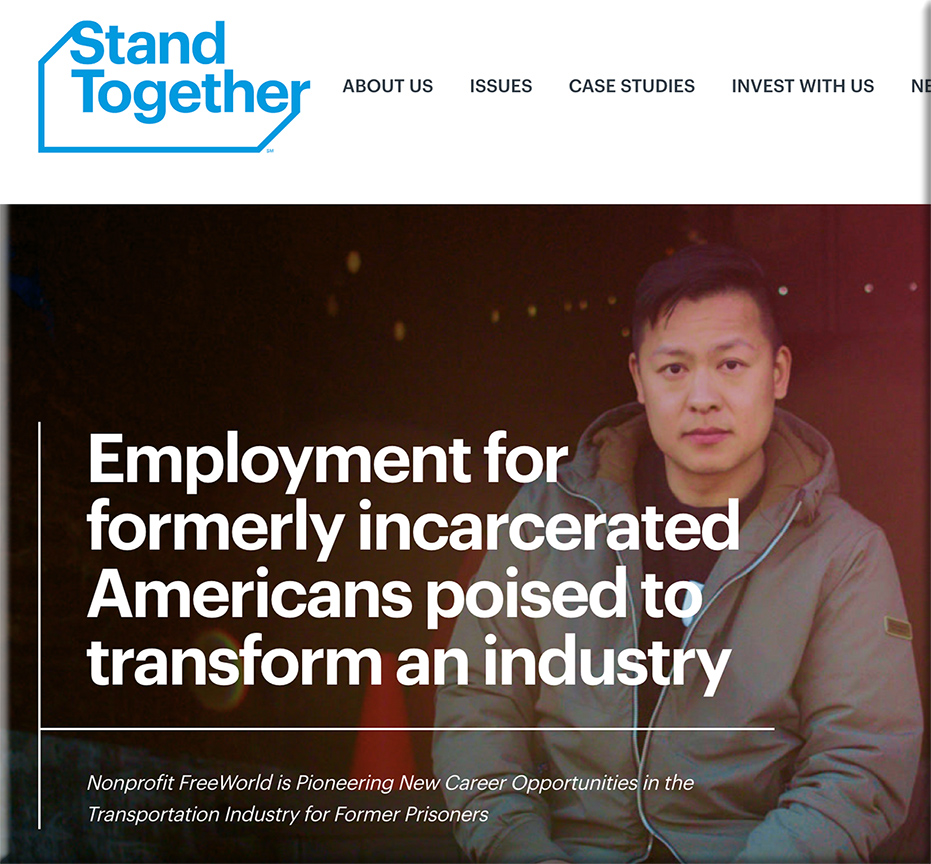
 

Employment for formerly incarcerated Americans poised to transform an industry — from standtogether.org

Excerpt:

Jason Wang’s worst moment came in his home driveway at age 15. While his mother watched in shock, he was arrested for aggravated robbery and began a four-year journey through the California prison system.

Jason had been on a path to prison his entire life: born into poverty, raised by an abusive father, and groomed by a gang. His arrest put the final nail in place to seal himself into a cycle of prison, recidivism, poverty, and hopelessness that defines generations of American families.

But Jason’s story didn’t end in a downward spiral. Today, Jason is the head of a pioneering nonprofit called FreeWorld. His organization lifts people who have been in prison into successful careers and gives them the stabilizing support systems to experience healthy families and fulfilling work. FreeWorld is a model for reducing recidivism, improving public safety, and progressing towards a better future.

Employment for formerly incarcerated Americans poised to transform an industry

“We now serve 1,400 people all across the nation. We have a less than 2% recidivism rate and our graduates are now taking care of their families. They’re eliminating all of their debt, they’re tax-paying citizens, and we’re saving the state and federal government millions of dollars in re-incarceration costs while keeping our communities safe.”


Will Law Schools Respond to ‘U.S. News’ Changes? — from .insidehighered.com by Scott Jaschik
Reactions were muted or critical to a series of ways the magazine said it would improve its rankings.

Excerpt:

U.S. News & World Report announced Monday that it would change how it ranks law schools in response to the decision by many top law schools to no longer participate in the ranking process. However, it is unclear whether the changes will lead law schools to accept (or even participate in) the new process.


37 predictions about edtech’s impact in 2023 — from eschoolnews.com by Laura Ascione
What edtech trends will take top billing in schools and districts in the new year?

Excerpts:

School districts will begin to offer microschool options. With 65% of K-12 parents backing school choice, school districts will realize that in order to stay competitive and meet the needs of students and parents, adopting and offering innovative learning models is key. One of the shifts the industry can expect to see in the coming years is school districts offering mircoschool options within the district itself. While historically independent learning institutions, microschools will be adopted within school districts that are responsive to this need for choice and evolving learning needs of students.
—Carlos Bortoni, Principal, Industry Advisor, K-12 Education, Qualtrics

In 2023, educators nationwide will benefit from the most recent wave of edtech consolidation. The various services and products acquired by consolidators over the last year or two will be integrated into increasingly comprehensive platforms offering instructional content, assessments, and classroom tools all in one place.  As this occurs, the power and effectiveness of those edtech resources will grow as they begin to work in concert with each other seamlessly. The combination of these resources will empower administrators, teachers, families, and students to better leverage edtech’s ability to improve learning.
–Kelli Campbell, President, Discovery Education

From DSC:
Vision is key here…not just data. If data provided all of the answers, being an effective, impactful leader/administrator would be far easier.


Also from Laura Ascione, see:


From DSC:
Below is another example of the need for Design Thinking as we rethink a cradle-to-grave learning ecosystem.


The United States Needs a Comprehensive Approach to Youth Policy — from cew.georgetown.edu

Excerpt (emphasis DSC):

On the education front, federal legislation serves as an umbrella for many state and local policies and programs. Education policy is further fragmented into K–12 and postsecondary silos.

An all-one-system approach to youth policy would support young people along the entire continuum of their journey from school to work. It would help them attain both postsecondary education and quality work experience to support their transitions from education to good jobs. In this modernized approach, preschools, elementary and secondary schools, community colleges, four-year universities, employers, and governments would all follow an integrated playbook, helping to smooth out young people’s path from pre-K–12 to college and work. To transform youth policy, systemic reforms should incorporate the following:


17 Therefore, if anyone is in Christ, the new creation has come: The old has gone, the new is here!

From DSC:
Being transformed in our thinking is one of the LORD’s key goals for us and one of the areas where He is active in our lives. (Also see Romans 12:2.) Our thinking impacts many things, including our behaviors, attitudes, and perspectives.

But my reflection here is especially meant for new believers in Christ. This process of transformation takes time. Don’t expect immediate changes in some areas of your life. After you received Christ into your heart, you may doubt that anything has changed. But you will begin to see the world, God, and others differently over time. (Reading scripture regularly helps this process along.)


AI legal assistant will help defendant fight a speeding case in court —  from newscientist.com by Matthew Sparkes (behind paywall)
In February, an AI from DoNotPay is set to tell a defendant exactly what to say and when during an entire court case. It is likely to be the first ever case defended by an artificial intelligence

Picture of an empty courtroom


Also relevant/see:


Also relevant/see:

ChatGPT Can Negotiate Comcast Bills Down For You
“That’s the future of bureaucracy: bots negotiating with each other,” said Joshua Browder, CEO of DoNotPay, which is rolling out the service.

Excerpt:

Joshua Browder, founder and chief executive of “robot lawyer” app DoNotPay, revealed last week he had created a bot based on the large language model to help people save money on their internet bill.


From Jared Newman’s advisorator from January 3, 2023

Unhook is a great browser extension for Chrome and Firefox that strips away YouTube’s unwanted elements. Just click the extension icon, and you’ll see a menu of features to remove from the website, including the recommendations sidebar, ending screen cards, autoplay, and even comments.

.

Use unhook.app to watch YouTube free of distractions. Block suggestion feeds, comments, and more.


Playing with ChatGPT: now I’m scared (a little) — from tonybates.ca by Tony Bates

Excerpt:

Over the holiday season, lots of people play games such as Scrabble, cards or crossword puzzles. I decided to play with ChatGPT by testing it in areas where I consider myself an expert. (For more about ChatGPT, go to Broom, 2022)

I will first of all show you the responses I got from ChatGPT, then I will discuss the results, comparing them to what I wrote about these topics in Teaching in a Digital Age.

Example questions that Tony asked (emphasis DSC):

  • What is the difference between synchronous and asynchronous learning? Give references.
  • What are the limitations of teaching chemistry online? Give references
  • What are the affordances of video in teaching? Give references
 

From DSC:
Check out the items below. As with most technologies, there are likely going to be plusses & minuses regarding the use of AI in digital video, communications, arts, and music.


Also see:


Also somewhat relevant, see:


The Edge Newsletter from Goldie Blumenstyk

Subject: The Edge: Today’s Issues in Schools; Tomorrow’s Higher-Ed Challenges

Excerpts:

Issues like chronic absenteeism in big urban and rural districts, the impact of classroom shootings on kids, and schools’ struggles to handle teenagers’ mental-health challenges might not be day-to-day concerns for college leaders and those who work with them. But these will matter to higher ed in the not-so-distant future, as those K-to-12 students make their way to college. And they could matter even more if those students don’t ever even make it to college.

Words of wisdom:

Those of us who might be a little higher-ed siloed in our thinking on education would do well to widen our perspective. 

From DSC:
And it isn’t just about the impacts of COVID-19 either — though those things are very important. We would do well to get out of our siloes and practice some high-level design thinking to implement a cradle-to-grave, lifelong learning ecosystem. The vocational and corporate training worlds are highly relevant here as well.


He has shown you, O mortal, what is good. And what does the Lord require of you? To act justly and to love mercy and to walk humbly with your God.


Isaiah 10:1

10 Woe to those who make unjust laws,
    to those who issue oppressive decrees,


Adult learners can help solve higher education’s enrollment crisis. But here’s what colleges will need to know. — from by Terah Crews
A slowing economy could push employees back to college, but institutions still have work to do to serve adult students, the CEO of ReUp Education writes.

Excerpts:

If the U.S. economy contracts over the next year or two, as a majority of experts anticipate, there will be an enormous need for education and training. Workers will want to reskill and retrain for a reshaped world of work. Colleges and universities will have a critical role to play in getting Americans back to work and on a path toward more stable careers.

The 39 million Americans with some college but no credential will be the key to recovery, and colleges and universities must redouble their efforts to get these learners back in school and on a path toward new careers.

From DSC:
Given the above is true/occurs, my question is this: Has higher ed kept up curriculum- and content-wise?


The Society of American Law Teachers (SALT) is committed to advancing teaching excellence, social justice and diversity. SALT is a community of progressive law teachers, law school administrators, librarians, academic support experts, students and affiliates. SALT has been working for more than 40 years to improve the legal profession, the law academy and expand the power of law to under-served communities.  SALT engages in work within and beyond the law school to advance social justice.


© 2025 | Daniel Christian