Incremental Change Didn’t Save Blockbuster. It Won’t Save Education, Either — from the74million.org by Mike Miles; with thanks to Rob Reynolds for this resource
Broken public school systems need wholescale change if they are going to prepare students for the skills they will need by 2035

Excerpt:

Perhaps the biggest failure of the current education ecosystem is its inability to envision what the future holds for our students and to make systemic changes now to prepare them for that future. Shackled to a monolithic, change-resistant system, school and district leaders continue to make incremental and piecemeal changes to a broken system expecting to get different outcomes.

In an analogous way, almost all public-school systems are like Blockbusters in the late 1990s — unwilling to assess the impact of technological advances and consider how they might need to revisit their design principles. In the end, if an organization does not move purposefully toward some likely future, then any path forward will do, and it is likely to be the path they are currently on.

From DSC:
The following quote…

Using a split-screen strategy, a district would not attempt to make systemic changes district-wide. Rather, it would implement transformative changes in one or two schools while continuing to make incremental improvements in the rest of the district. Once the schools operating with the new system principles achieve the outcomes and succeed, they will become proof points to allow the district to implement systemic change in even more schools over a period of time.

…made me think of a graphic (see below) — and an article out at evoLLLtion.com — I developed a while back re: the need for more Trim Tab Groups. I think we’re talking about the same thing here.



Addendum on 2/4/23:

A Few Educators ‘Going the Extra Mile’ Cannot Save the Education System — from edsurge.com by Jennifer Yoo-Brannon

Excerpt (emphasis DSC):

Not a Pyramid, But a Garden
Instead of a pyramid, let’s adopt a new image, a more organic one. School communities are webs of complex relationships, like gardens. Imagine if we all understood a school community like a Three Sisters Garden. In this Indigenous agricultural practice, corn, beans and squash grow together to create a sustainable cycle of growth in which the whole garden can thrive. Corn provides the tall stalks for the beans to climb. The large squash plant leaves provide shade so the soil can retain moisture, and the beans provide the nitrogen to fertilize the soil. The garden does not rely on the exploitation of one crop to allow the rest to grow.

From DSC:
Re: the emphasized text immediately above…that sounds like a learning ecosystem to me!  🙂


Meet MathGPT: a Chatbot Tutor Built Specific to a Math Textbook — from thejournal.com by Kristal Kuykendall

Excerpt:

Micro-tutoring platform PhotoStudy has unveiled a new chatbot built on OpenAI’s ChatGPT APIs that can teach a complete elementary algebra textbook with “extremely high accuracy,” the company said.

“Textbook publishers and teachers can now transform their textbooks and teaching with a ChatGPT-like assistant that can teach all the material in a textbook, assess student progress, provide personalized help in weaker areas, generate quizzes with support for text, images, audio, and ultimately a student customized avatar for video interaction,” PhotoStudy said in its news release.

Some sample questions the MathGPT tool can answer:

    • “I don’t know how to solve a linear equation…”
    • “I have no idea what’s going on in class but we are doing Chapter 2. Can we start at the top?”
    • “Can you help me understand how to solve this mixture of coins problem?”
    • “I need to practice for my midterm tomorrow, through Chapter 6. Help.”


Contracts Company Ironclad Taps Into GPT-3 For Instant Document Redlining Based On A Company’s Playbook — from lawnext.com by Robert Ambrogi

Excerpt:

The contract lifecycle management company Ironclad has tapped into the power of OpenAI’s GPT-3 to introduce AI Assist, a beta feature that instantly redlines contracts based on a company’s playbook of approved clauses and language.

The redlines, made using GPT-3’s generative artificial intelligence, appear as tracked changes in Microsoft Word, where a user can then scan the recommended changes and either accept or reject them.


Addendum:


Educator considerations for ChatGPT — from platform.openai.com; with thanks to Anna Mills for this resource

Excerpt:

Streamlined and personalized teaching
Some examples of how we’ve seen educators exploring how to teach and learn with tools like ChatGPT:

  • Drafting and brainstorming for lesson plans and other activities
  • Help with design of quiz questions or other exercises
  • Experimenting with custom tutoring tools
  • Customizing materials for different preferences (simplifying language, adjusting to different reading levels, creating tailored activities for different interests)
  • Providing grammatical or structural feedback on portions of writing
  • Use in upskilling activities in areas like writing and coding (debugging code, revising writing, asking for explanations)
  • Critique AI generated text

While several of the above draw on ChatGPT’s potential to be explored as a tool for personalization, there are risks associated with such personalization as well, including student privacy, biased treatment, and development of unhealthy habits. Before students use tools that offer these services without direct supervision, they and their educators should understand the limitations of the tools outlined below.

Also relevant/see:

Excerpt (emphasis DSC):
David Wiley wrote a thoughtful post on the ways in which AI and Large Language Models (LLMs) can “provide instructional designers with first drafts of some of the work they do.” He says “imagine you’re an instructional designer who’s been paired with a faculty member to create a course in microeconomics. These tools might help you quickly create first drafts of” learning outcomes, discussion prompts, rubrics, and formative assessment items.  The point is that LLMs can quickly generate rough drafts that are mostly accurate drafts, that humans can then “review, augment, and polish,” potentially shifting the work of instructional designers from authors to editors. The post is well worth your time.

The question that I’d like to spend some time thinking about is the following: What new knowledge, capacities, and skills do  instructional designers need in their role as editors and users of LLMs?

This resonated with me. Instructional Designer positions are starting to require AI and ML chops. I’m introducing my grad students to AI and ChatGPT this semester. I have an assignment based on it.

(This ain’t your father’s instructional design…)

Robert Gibson


63% of educators consider leaving profession — from k12dive.com by Anna Merod

Dive Brief:

  • Thirty percent of surveyed educators said they plan to leave the education profession within the next three years, while another 33% said they would “maybe” do the same, according to a report released Wednesday by Horace Mann Educators Corp., a financial services company that focuses on educators.
  • For those thinking of leaving, the largest share — 42% — said they would retire. Another 28% said they would consider the private sector, and 10% would move to another public sector position, the survey found.
  • What would keep teachers in education?  Respondents largely said higher salaries (57%), followed by improved parent or community support (42%), and better school or district leadership (41%).

From DSC:
Ouch! At one of our daughter’s schools (where she teaches third grade and is in her first year of teaching), many teachers left even before Christmas. As but one example of a flawed system, our daughter and other teachers are required to be there way before school begins (for early dropoffs) and way after school ends (for late pickups). If our society doesn’t start valuing teachers, all Americans are going to pay the price eventually.

And a heads up to the faculty and staff members working in higher education. These students are coming your way. 

And then they’ll be at your doorsteps corporate world. 

Bottom line: We all should care about what’s going on — or what’s NOT going on — in the PreK-12 learning ecosystem!


Learning the ‘Unspoken Rules’ — from chronicle.com by Kelly Field

Excerpt:

Welcome to Rochester Institute of Technology’s Career Ready Bootcamp, a two- to three-week program that is part of a nascent effort to tackle stubbornly high unemployment rates among autistic college graduates. Though few colleges are as far along as RIT, more than 50 institutions have joined a newly formed council focused on better preparing autistic students for employment.

Many of the things colleges are trying — from mock interviews and performance reviews, to meetings with employers — would benefit all students, says Cristina M. Giannantonio, co-editor of the book Generation A: Research on Autism in the Workplace. But they’re especially helpful for students on the spectrum, who often struggle through the hiring process.

Young adults with autism have some of the highest joblessness rates of individuals with disabilities, with more than 30 percent of autistic college graduates unemployed, one study found.


1 Corinthians 2:9

However, as it is written: “What no eye has seen, what no ear has heard, and what no human mind has conceived”— the things God has prepared for those who love him—
 

Top List: The Best Mobile Learning Content Development Companies (2023) — from elearningindustry.com by Christopher Pappas

Summary: 

Working remotely has brought a major shift to corporate training, making mobile learning more important than ever. Your top assets, and frankly your whole staff, will need to adjust to this new reality. To help you out, we decided to gather the best content providers for mobile learning in one place. Explore our top list and find the right partner to start your mobile learning project or even develop your own mobile app. Are you ready?


2022 European edtech report: Smaller rounds and fewer deals, but more angel activity — from techcrunch.com by Rhys Spence

Excerpt:

Against this background, we formed our annual review of European edtech activity for 2022. For the first time since 2014, venture capital funding to European edtech startups saw a decline year-over-year, with startups raking in $1.8 billion in 2022 compared to $2.5 billion a year earlier.

The global ecosystem has been on an upward trajectory, albeit less consistently, but the declines in new investment in 2022 were steep: globally funding declined to $9.1 billion last year from $20.1 billion in 2021. This is in line with macro trends in the public markets as well as other tech sectors (both trends were highlighted in our October report with Dealroom).


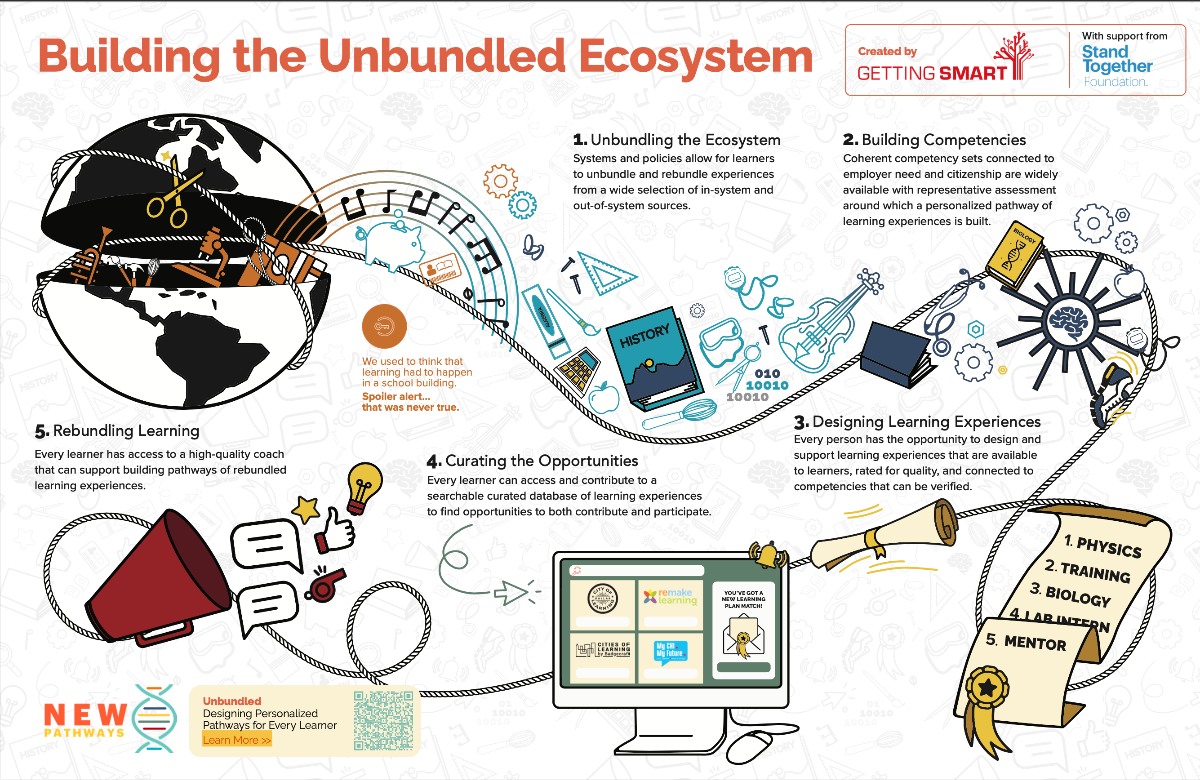
Unbundled: Designing Personalized Pathways for Every Learner — from gettingsmart.com by Nate McClennen “with contributions from the Getting Smart team and numerous friends and partners in the field”

Excerpts:

In this publication, we articulate the critical steps needed to unbundle the learning ecosystem, build core competencies, design learning experiences, curate new opportunities, and rebundle these experiences into coherent pathways.
.

Building the Unbundled Ecosystem

Vision

Every learner deserves an unlimited number of unbundled opportunities to explore, engage, and define experiences that advance their progress along a co-designed educational pathway. Each pathway provides equitable and personalized access to stacked learning experiences leading to post-secondary credentials and secure family-sustaining employment. Throughout the journey, supportive coaches focus on helping learners build skills to navigate with agency. In parallel, learners develop foundational skills (literacy, math), technical skills, and durable skills and connect these to challenging co-designed experiences. The breadth and depth of experiences increase over time, and, in partnership, learners and coaches map progress towards reaching community-defined goals. This vision is only enabled by an unbundled learning ecosystem.

Recommendations

Solutions already exist in the ecosystem and need to be combined and scaled. Funding models (like My Tech High), badging/credentialing at the competency level (like VLACS), coaching models (like Big Thought), and open ecosystems (like NH Learn Everywhere) provide an excellent foundation. Thus, building unbundled systems has already begun but needs systemic changes to become widely available and accepted.

      1. Build a robust competency-based system.
      2. Create a two-way marketplace for unbundled learning.
      3. Implement policy to support credit for out-of-system experiences.
      4. Invest in technology infrastructure for Learning and Employment Records.
      5. Design interoperable badging systems that connect to credentials.
 

Take Your Words From Lecture to Page — from chronicle.com by Rachel Toor
What compelling lecturers do, and how their techniques can translate to good writing.

Excerpts:

Thing is, many of the moves that the best lecturers make on the stage can translate to the page and help you draw in readers. That is especially important in writing textbooks and other work for general readers. If you can bring the parts of yourself that work in the classroom to the prose, you will delight readers as much as you do your students.

Narrative can be key. Data and research aren’t enough in either the classroom or on the page. People like to be told stories. If you want to be persuasive in both realms, use narrative to make arguments. Don’t forget that much scholarly work is really a quest. What journey can you take a reader on?

It’s a performance on the page, too. A great lecture is a performance. So is great writing.

Raise real questions the reader will want answers to. 


What is college for? Gov. Shapiro raises the question. Higher ed leaders are listening. — from The Philadelphia Inquirer by Will Bunch; with thanks to Ray Schroeder out on LinkedIn for the resource
Pa.’s new governor Josh Shapiro’s first move was to question the need of a college diploma as a job credential. U.S. universities, pay attention.

Excerpt:

NEW HAVEN, Conn. — What is college actually for?

No one expected this to be the initial question raised by Pennsylvania’s new governor, Josh Shapiro, in his first full day on the job. While he may not have stated it explicitly, this was the essence of the Democrat’s very first executive order, which opened up some 92% of job listings in state government — about 65,000 in all — to applicants who don’t have a four-year college degree.

In branding degree requirements for many jobs as “arbitrary” and declaring “there are many different pathways to success,” the Keystone State’s new chief executive was tugging at the shaky Jenga block that has undergirded the appalling rise of a $1.75 trillion student debt bomb in the U.S. and led, arguably, to a college/non-college divide driving our nation’s bitter politics. The notion is this: You can’t make it in 21st-century America without that most expensive piece of sheepskin: the college diploma.

So the $64,000 question (OK, $80,000 … for one year on some elite private campuses) is this: If you don’t need the credential, do you actually need college?

Something is clearly gained by giving America’s young people more career options that won’t contribute to that $1.75 trillion college debt bomb. But are we talking enough about what could be lost in a new system that not only devalues the university but also seems to ratify a dubious idea — that higher education is almost solely about careerism, and not the wider knowledge and critical-thinking skills that come from liberal arts learning?

From DSC:
To me — and to many other parents and families — it all boils down to the price tag of obtaining a liberal arts education. It’s one thing to get a liberal arts education at $5K per year. It’s another thing when the pricetag runs at $40K and above (per year)! Most people ARE FORCED to question the ROI of a liberal arts education. They simply have to.

On a relevant tangent here…many inside the academy have traditionally looked with disdain at the corporate world. The thinking went something like this:

Business! Ha! We are not a business! Students are not customers. Don’t ever compare us to the corporate world.

Having spent half of my career in the corporate world, I do not subscribe to that perspective. In fact, I’d like to ask those who still hold this point of view:
  • Where else can you pay tens of thousands of dollars for something and not be treated as a customer?! Don’t you typically expect value on your own purchases and positive returns on your investments?
  • How will you collaborate with the corporate world if you look upon them with disdain?!

But now that colleges and universities enrollments are not doing so well, perhaps there will be more openness to change and towards developing more impactful collaborations.


Virtual Exam Case Primes Privacy Fight Over College Room Scans — from news.bloomberglaw.com by Skye Witley

  • Cleveland State case centers on remote proctoring software
  • Fourth Amendment protections in question before Sixth Circuit

Excerpt:

A legal dispute over a university’s use of exam proctoring software that allegedly scanned students’ rooms is set to shape the scope of Fourth Amendment and privacy protections for online college tests.

Cleveland State University last week asked a federal appeals court in Cincinnati to review a district court finding that the “room scans” were unconstitutional searches. The case could influence how other students litigate their privacy rights and change how universities virtually monitor their students during exams, attorneys said.


Colleges consider overhauling grading system for freshmen to ease transition to higher learning — from mercurynews.com by Kate Hull
Supporters say ‘ungrading’ could result in less stress and a more level playing field for students from less rigorous high schools  

Excerpt:

Dubbed “weed-out” or “gatekeeper” classes, they can be dream-crushing for many students — especially those hoping to enter the science, technology, engineering and math (STEM) fields. And a growing body of research says the courses can be particularly discriminatory toward historically excluded groups such as Latinos and Black and Indigenous people.

One possible remedy, some educators say, is “ungrading,” a style of teaching and assessment that seeks to evaluate students in other ways besides A-F letter grades — usually just in their freshman year.

“You’re trying to move the focus from a score to the learning,” said Robin Dunkin, who teaches biology and is the assistant faculty director at UCSC’s Center for Innovations in Teaching and Learning.  “For that reason, it’s immensely powerful.”


Also relevant see the #Ungrading hashtag on Twitter, from which the below item was taken:

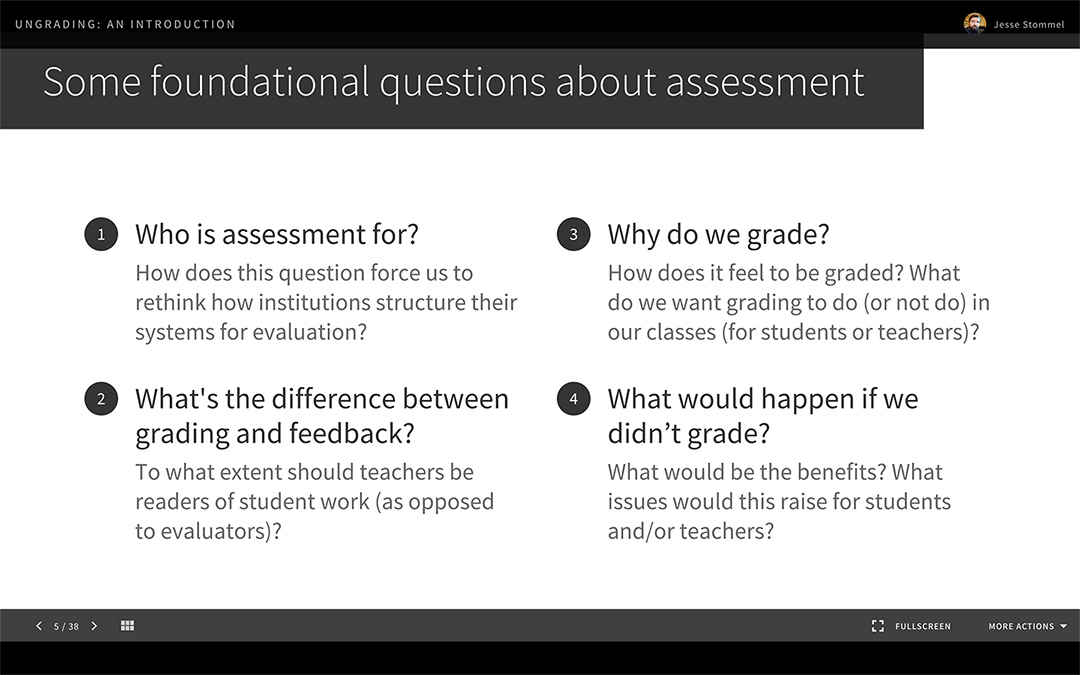
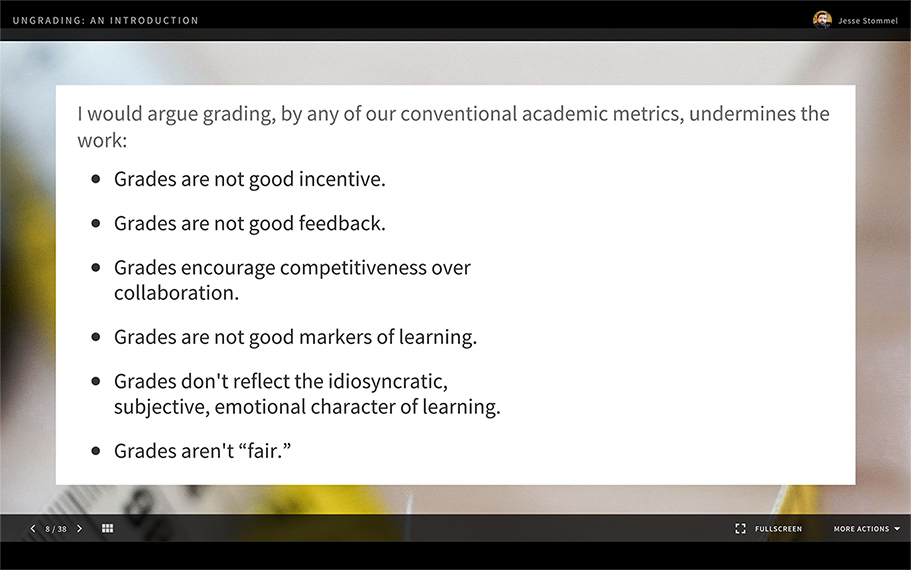
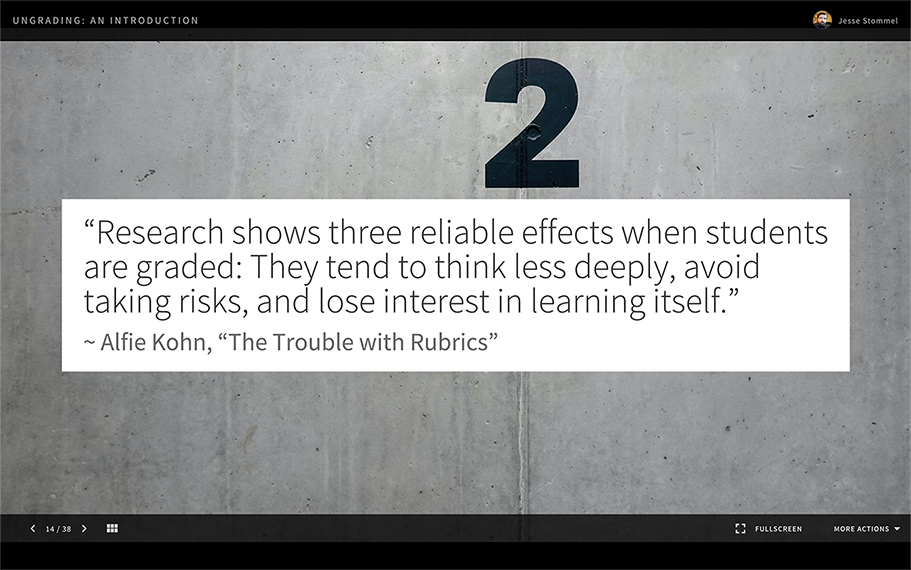
Excerpts from Jesse Stommel’s Ungrading: an Introduction presentation:

An excerpt from Ungrading - an Introduction by Jesse Stommel

An excerpt from Ungrading - an Introduction by Jesse Stommel

An excerpt from Ungrading - an Introduction by Jesse Stommel


Also relevant/see Robert Talbert’s Grading for Growth.


© 2025 | Daniel Christian