AutoGPT is the next big thing in AI— from therundown.ai by Rowan Cheung

Excerpt:

AutoGPT has been making waves on the internet recently, trending on both GitHub and Twitter. If you thought ChatGPT was crazy, AutoGPT is about to blow your mind.

AutoGPT creates AI “agents” that operate automatically on their own and complete tasks for you. In case you’ve missed our previous issues covering it, here’s a quick rundown:

    • It’s open-sourced [code]
    • It works by chaining together LLM “thoughts”
    • It has internet access, long-term and short-term memory, access to popular websites, and file storage

.


From DSC:
I want to highlight that paper from Stanford, as I’ve seen it cited several times recently:.

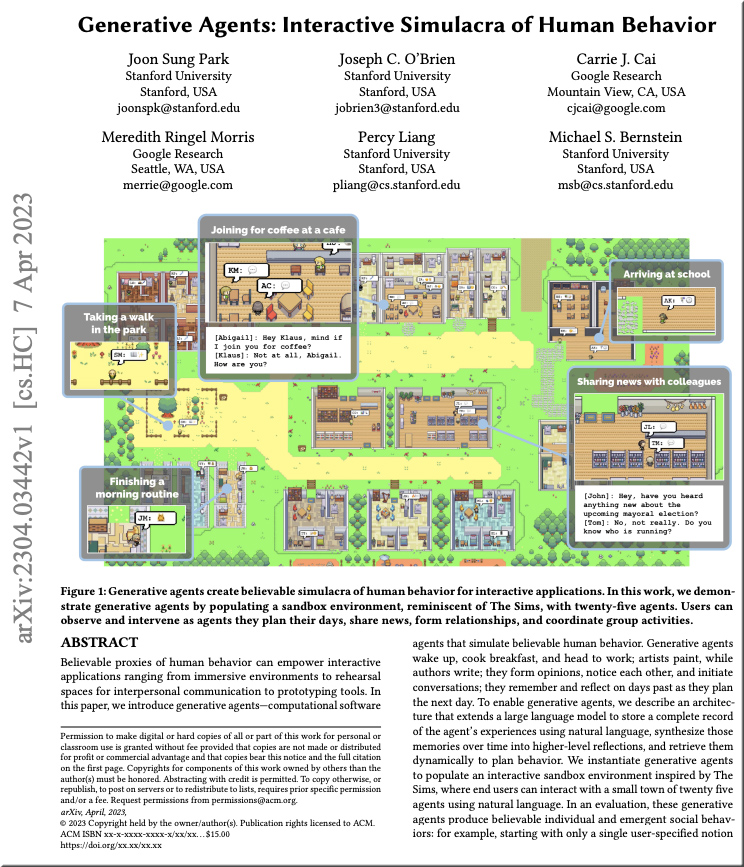
Generative Agents: Interactive Simulacra of Human Behavior -- a paper from Stanford from April 2023


From DSC:
And for a rather fun idea/application of these emerging technologies, see:

  • Quick Prompt: Kitchen Design — from linusekenstam.substack.com by Linus Ekenstam
    Midjourney Prompt. Create elegant kitchen photos using this starting prompt. Make it your own, experiment, add, remove and tinker to create new ideas.

…which made me wonder how we might use these techs in the development of new learning spaces (or in renovating current learning spaces).


From DSC:
On a much different — but still potential — note, also see:

A.I. could lead to a ‘nuclear-level catastrophe’ according to a third of researchers, a new Stanford report finds — from fortune.com by Tristan Bove

Excerpt:

Many experts in A.I. and computer science say the technology is likely a watershed moment for human society. But 36% don’t mean that as a positive, warning that decisions made by A.I. could lead to “nuclear-level catastrophe,” according to researchers surveyed in an annual report on the technology by Stanford University’s Institute for Human-Centered A.I., published earlier this month.


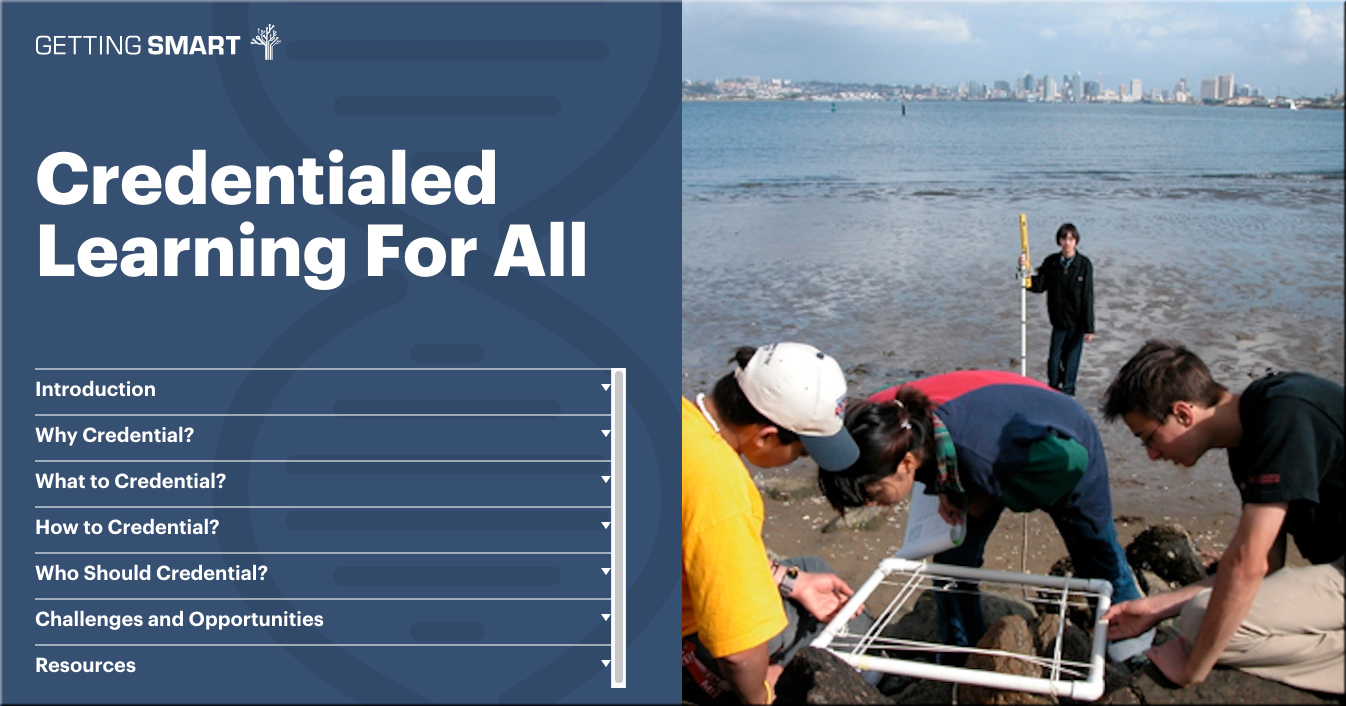
Credentialed learning for all -- from Getting Smart


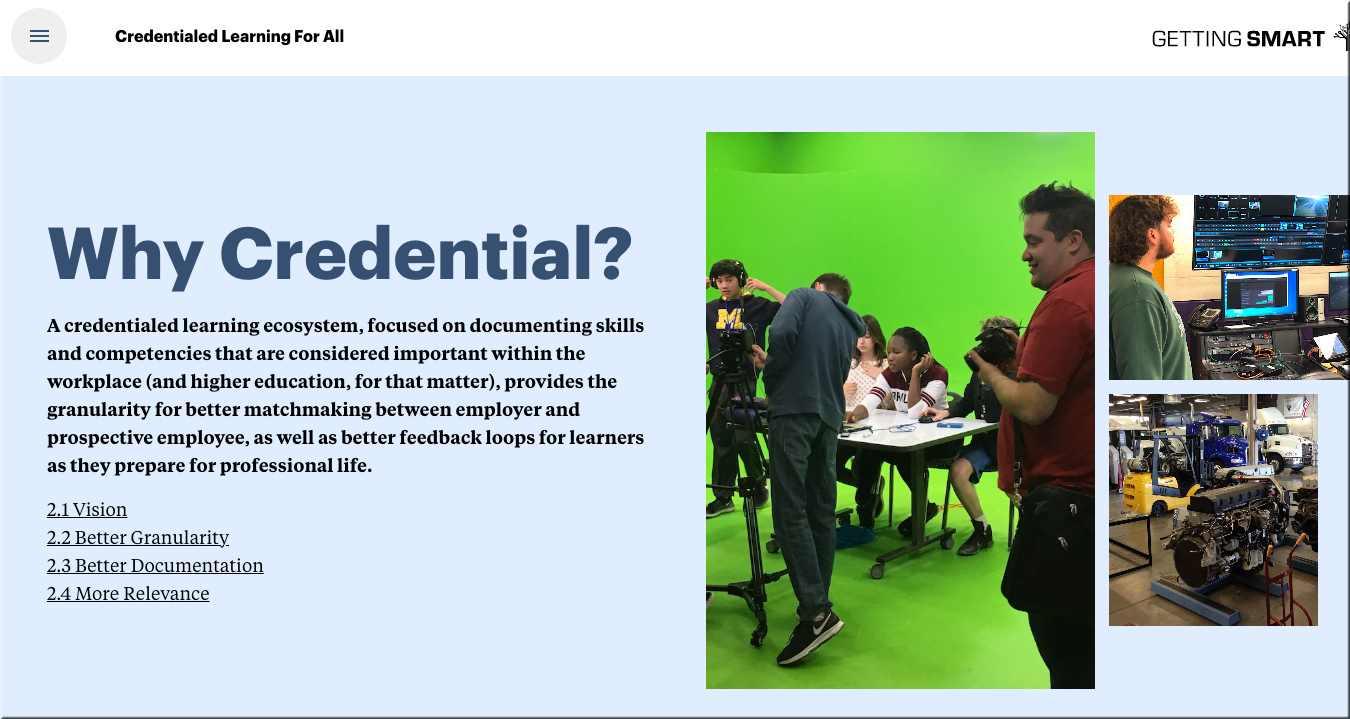
Why credential section -- from Getting Smart's Credentialed Learning for All

Credentialed Learning For All — from gettingsmart.com

Vision

Learning happens throughout life and is not isolated to the K-12 or higher education sectors. Yet, often, validations of learning only happen in these specific areas. The system of evaluation based on courses, grades, and credit serves as a poor proxy for communicating skills given the variation in course content, grade inflation, and inclusion of participation and extra credit within course grades.

Credentialed learning provides a way to accurately document human capability for all learners throughout their life. A lifetime credentialed learning ecosystem provides better granularity around learning, better documentation of the learning, and more relevance for both the credential recipient and reviewer. This improves the match between higher education and/or employment with the individual, while also providing a more clear and accurate lifetime learning pathway.

With a fully-credentialed system, individuals can own well-documented evidence of a lifetime of learning and choose what and when to share this data. This technology enables every learner to have more opportunities for finding the best career match without today’s existing barriers around cost, access, and proxies.


Addendum on 4/28/23 — speaking of credentials:

First Rung — from the-job.beehiiv.com by Paul Fain
New research shows stacking credentials pays off for low-income learners.

Stacking credentials pays off for many low-income students, new research finds, but only if learners move up the education ladder. Also, Kansas is hoping a new grant program will attract more companies to participate in microinternships.


Proverbs 8:27-31 NIV

Proverbs 8:27-31 NIV (speaking about wisdom)

I was there when he set the heavens in place, when he marked out the horizon on the face of the deep, when he established the clouds above and fixed securely the fountains of the deep, when he gave the sea its boundary so the waters would not overstep his command, and when he marked out the foundations of the earth. Then I was constantly at his side. I was filled with delight day after day, rejoicing always in his presence, rejoicing in his whole world and delighting in mankind.


The future of education in a world of AI — from oneusefulthing.org by Ethan Mollick
A positive vision for the transformation to come

Excerpt:

Imagine introducing high-quality AI tutors into the flipped classroom model. These AI-powered systems have the potential to significantly enhance the learning experience for students and make flipped classrooms even more effective. They provide personalized learning, where AI tutors can tailor instruction to each student’s unique needs while continually adjusting content based on performance. This means that students can engage with the content at home more effectively, ensuring they come to class better prepared and ready to dive into hands-on activities or discussions.

With AI tutors taking care of some of the content delivery outside of class, teachers can devote more time to fostering meaningful interactions with their students during class. They can also use insights from the AI tutors to identify areas where students might need extra support or guidance, enabling them to provide more personalized and effective instruction. And with AI assistance, they can design better active learning opportunities in class to make sure learnings stick.


Also relevant/see:

ChatGPT is going to change education, not destroy it — from technologyreview.com by Will Douglas Heaven
The narrative around cheating students doesn’t tell the whole story. Meet the teachers who think generative AI could actually make learning better.

Advanced chatbots could be used as powerful classroom aids that make lessons more interactive, teach students media literacy, generate personalized lesson plans, save teachers time on admin, and more.

Will ChatGPT Change How Professors Assess Learning? — from chronicle.com by Becky Supiano
It won’t be easy without their colleges’ support.

What the Past Can Teach Us About the Future of AI and Education — from campustechnology.com by Dr. David Wiley
Current attitudes toward generative AI hearken back to early skepticism about the impact of the internet on education. Both then and now, technology has created challenges but also opportunities that can’t be ignored.


How to Use Logic Pro X: The Ultimate Guide for Beginners — from soundswow.com by  Donovan Sharpe; with thanks to Yana Mogyla for this resource. Yana is the content manager at SoundsWow — “a resource blog dedicated to helping individual musicians build home recording studios.”

Excerpts:

Logic Pro X is one of the best DAWs for music creation and production. It’s an extremely capable tool that provides you with everything you need to make music professionally in any way you can dream up.

With all this power at your fingertips, getting started with Logic Pro X can be challenging if you don’t have any experience. This guide was written with beginners in mind and will direct you through all the first steps to using the app.
.

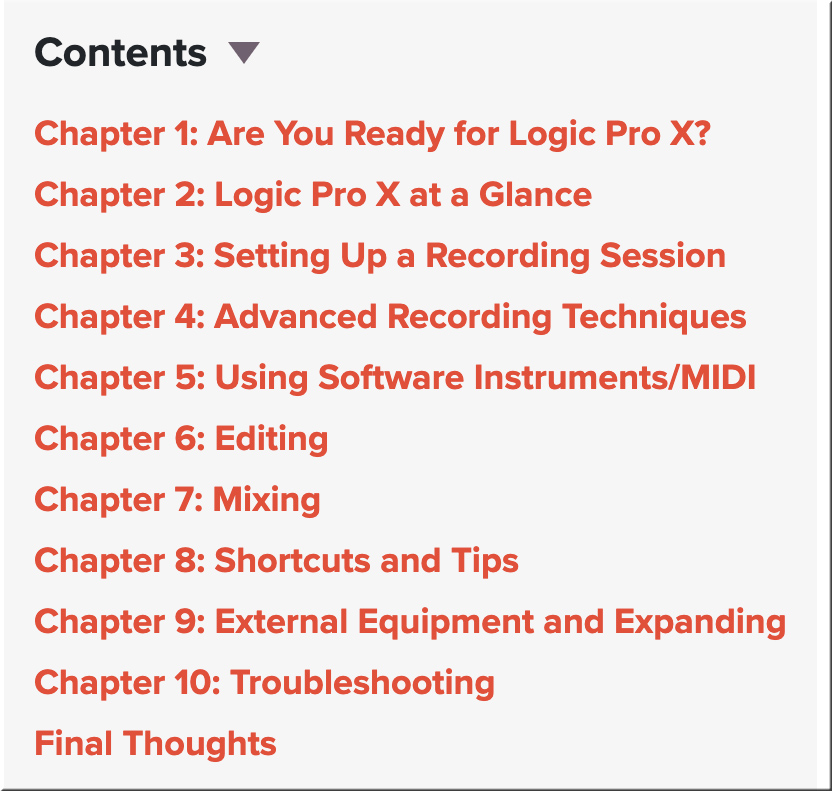
Table of contents for how to use Logic Pro X


Improve Objectives By Asking “Then What?” — from byrdseed.com by Ian Byrd

Excerpt:

As a new teacher, so many of my objectives stopped at a very low level of thinking.

  • Students will understand Z.
  • Students will know the difference between X and Y.
  • Students will be able to explain C.

When I look at these objectives now, they leave me asking, “then what?”

Ok. My students know the difference between X from Y. They can explain C. They understand fact Z. “What do they do now?”


From DSC:
Regarding the core curricula of colleges and universities…

For decades now, faculty members have taught what they wanted to teach and what interested them. They taught what they wanted to research vs. what the wider marketplace/workplace needed. They were not responsive to the needs of the workplace — nor to the needs of their students!

And this situation has been all the more compounded by the increasing costs of obtaining a degree plus the exponential pace of change. We weren’t doing a good job before this exponential pace of change started taking place — and now it’s (almost?) impossible to keep up.

The bottom line on the article below: ***It’s sales.***

Therefore, it’s about what you are selling — and at what price. The story hasn’t changed much. The narrative (i.e., the curricula and more) is pretty much the same thing that’s been sold for years.

But the days of faculty members teaching whatever they wanted to are over, or significantly waning.

Faculty members, faculty senates, provosts, presidents, and accreditors are reaping what they’ve sown.

The questions are now:

  • Will new seeds be sown?
  • Will new crops arise in the future?
  • Will there be new narratives?
  • Will institutions be able to reinvent themselves (one potential example here)? Or will their cultures not allow such significant change to take place? Will alternatives to institutions of traditional higher education continue to pick up steam?

A Profession on the Edge — from chronicle.com by Eric Hoover
Why enrollment leaders are wearing down, burning out, and leaving jobs they once loved.

Excerpts:

Similar stories are echoing throughout the hallways of higher education. Vice presidents for enrollment, as well as admissions deans and directors, are wearing down, burning out, and leaving jobs they once loved. Though there’s no way to compile a chart quantifying the churn, industry insiders describe it as significant. “We’re at an inflection point,” says Rick Clark, executive director of undergraduate admission at Georgia Tech. “There have always been people leaving the field, but not in the numbers we’re seeing now.”

Some are being shoved out the door by presidents and boards. Some are resigning out of exhaustion, frustration, and disillusionment. And some who once sought top-level positions are rethinking their ambitions. “The pressures have ratcheted up tenfold,” says Angel B. Pérez, chief executive of the National Association for College Admission Counseling, known as NACAC. “I talk with someone each week who’s either leaving the field or considering leaving.”


From DSC:
This quote points to what I’m trying to address here:

Dahlstrom and other veterans of the field say they’ve experienced something especially disquieting: an erosion of faith in the transformational power of higher education. Though she sought a career in admissions to help students, her disillusionment grew after taking on a leadership role. She became less confident that she was equipped to effect positive changes, at her institution or beyond, especially when it came to the challenge of expanding college access in a nation of socioeconomic disparities: “I felt like a cog in a huge machine that’s not working, yet continues to grind while only small, temporary fixes are made.”


How Easy Is It/Will It Be to Use AI to Design a Course? — from wallyboston.com by Wally Boston

Excerpt:

Last week I received a text message from a friend to check out a March 29th Campus Technology article about French AI startup, Nolej. Nolej (pronounced “Knowledge”) has developed an OpenAI-based instructional content generator for educators called NolejAI.

Access to NolejAI is through a browser. Users can upload video, audio, text documents, or a website url. NolejAI will generate an interactive micro-learning package which is a standalone digital lesson including content transcript, summaries, a glossary of terms, flashcards, and quizzes. All the lesson materials generated is based upon the uploaded materials.


From DSC:
I wonder if this will turn out to be the case:

I am sure it’s only a matter of time before NolejAI or another product becomes capable of generating a standard three credit hour college course. Whether that is six months or two years, it’s likely sooner than we think.


Also relevant/see:

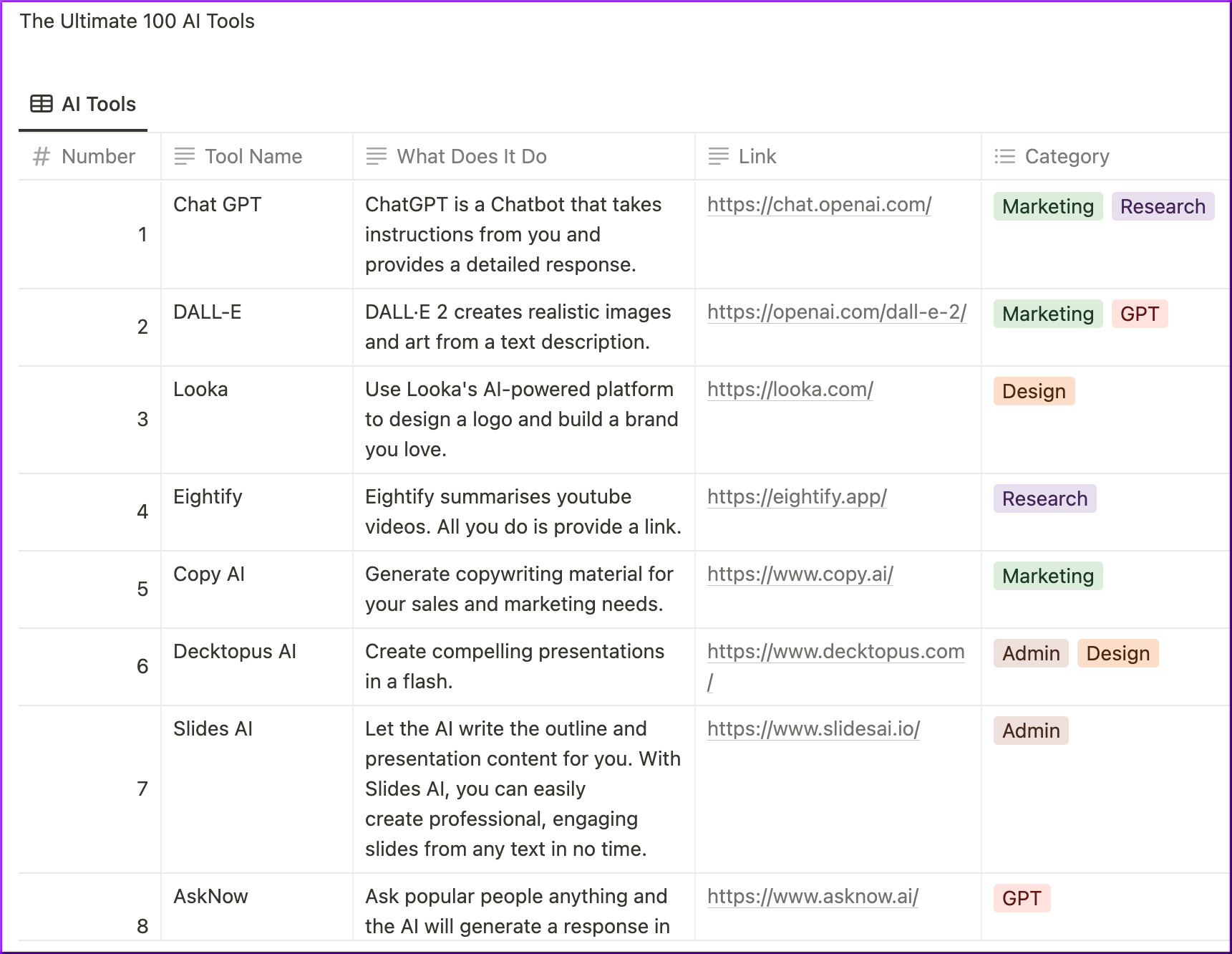
The Ultimate 100 AI Tools

The Ultimate 100 AI Tools -- as of 4-12-23


From DSC:
Before we get to Scott Belsky’s article, here’s an interesting/related item from Tobi Lutke:


Our World Shaken, Not Stirred: Synthetic entertainment, hybrid social experiences, syncing ourselves with apps, and more. — from implications.com by Scott Belsky
Things will get weird. And exciting.

Excerpts:

Recent advances in technology will stir shake the pot of culture and our day-to-day experiences. Examples? A new era of synthetic entertainment will emerge, online social dynamics will become “hybrid experiences” where AI personas are equal players, and we will sync ourselves with applications as opposed to using applications.

A new era of synthetic entertainment will emerge as the world’s video archives – as well as actors’ bodies and voices – will be used to train models. Expect sequels made without actor participation, a new era of ai-outfitted creative economy participants, a deluge of imaginative media that would have been cost prohibitive, and copyright wars and legislation.

Unauthorized sequels, spin-offs, some amazing stuff, and a legal dumpster fire: Now lets shift beyond Hollywood to the fast-growing long tail of prosumer-made entertainment. This is where entirely new genres of entertainment will emerge including the unauthorized sequels and spinoffs that I expect we will start seeing.


Also relevant/see:

Digital storytelling with generative AI: notes on the appearance of #AICinema — from bryanalexander.org by Bryan Alexander

Excerpt:

This is how I viewed a fascinating article about the so-called #AICinema movement.  Benj Edwards describes this nascent current and interviews one of its practitioners, Julie Wieland.  It’s a great example of people creating small stories using tech – in this case, generative AI, specifically the image creator Midjourney.

Bryan links to:

Artists astound with AI-generated film stills from a parallel universe — from arstechnica.com by Benj Edwards
A Q&A with “synthographer” Julie Wieland on the #aicinema movement.

An AI-generated image from an #aicinema still series called Vinyl Vengeance by Julie Wieland, created using Midjourney.


From DSC:
How will text-to-video impact the Learning and Development world? Teaching and learning? Those people communicating within communities of practice? Those creating presentations and/or offering webinars?

Hmmm…should be interesting!


1 Peter 2:24

“He himself bore our sins” in his body on the cross, so that we might die to sins and live for righteousness; “by his wounds you have been healed.”
 

The Future of Teaching is Here — from samchaltain.substack.com by Sam Chaltain

Excerpts (emphasis DSC):

It’s not sexy, but I feel like Sal Khan’s recent video introducing his Academy’s GPT-fueled AI tutor augurs the future of the teaching profession — and not just at Khan Academy.

The tutor is already fully capable of offering personalized feedback, hints and suggestions for just about any topic for which there are already clearly established answers — from solving math equations with parentheses to digesting John Locke’s political philosophy.

But now we’ve entered a new chapter — dare I say, a Technological Singularity (20 years early) — one in which Chat-GPT in particular, and the daily flood of AI tools more generally, has changed the nature of the teacher/student relationship even more irrevocably than before.

As a result, from this day forward, the job of a teacher REALLY needs to stop being about transmission.

So what should it start being instead?

In which case, the future of teaching is not about transmission, but it is about the other trans- words: transmedia exploration, transdisciplinary weaving, transcultural understanding, and, yes, personal and societal transformation.


ChatGPT is the hottest new job skill that can help you get hired, according to HR experts — from cnbc.com by Morgan Smith

Excerpt:

The hottest new job qualification could be how well you work with a chatbot.

ChatGPT is the latest in-demand job skill companies are hiring for, according to recent research from the career site Resume Builder.

Since its public unveiling in late 2022, ChatGPT has been quickly adopted by companies like Microsoft and Slack which are incorporating the chatbot into their products or using it to work more efficiently.

“Hiring managers care less about whether or not you use ChatGPT, what’s more important is what you can accomplish with it,” says Juan Pablo Gonzalez, a senior client partner at the global consulting firm Korn Ferry. 


How to Create Compelling Writing Assignments in a ChatGPT Age — from chronicle.com by James M. Lang
A recent book offers a road map to new kinds of assignments to inspire your students to write.

Excerpt:

A few days after I returned from the conference, I received a book in the mail that affirmed my newfound sense that 2023 has the potential to usher in an age of creative thinking about teaching and writing: Jessica Singer Early’s Next Generation Genres: Teaching Writing for Civic and Academic Engagement. Although her book doesn’t directly address ChatGPT, it offers exactly the kind of innovative ideas we need as we wrestle — or dance — with the implications of artificial intelligence for college teaching.

Clearly Jessica Singer Early has joined the leaning-into camp, seeing artificial intelligence as another invitation to reinvent ourselves in the classroom — just as she encourages readers to do in Next Generation Genres, and as this teacher plans to do in the fall.

 
© 2025 | Daniel Christian