Cleveland Cavaliers Turn Their Arena Into An AR Arcade — from vrscout.com by Kyle Melnick

.

How Audi Used AR Tech To Build Its New Concept Car  — from vrscout.com by Kyle Melnick

.

Celebrate Earth Day With An Out-Of-This-World VR Film — from vrscout.com by Kyle Melnick


The 2023 Global Sentiment Survey — from donaldhtaylor.co.uk by Don Taylor

Excerpt:

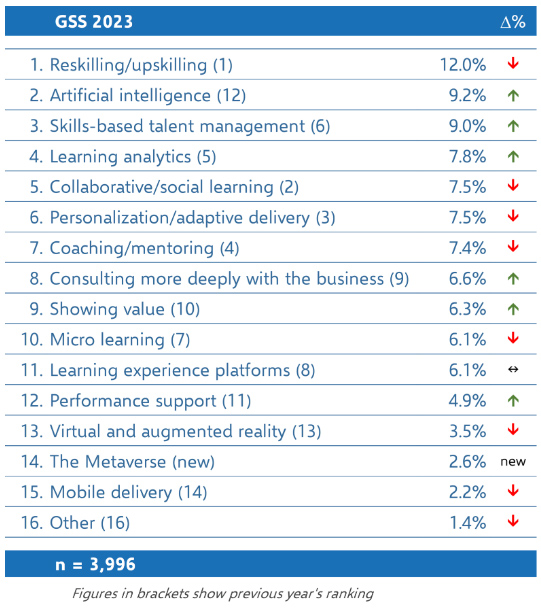
This year’s Global Sentiment Survey – the tenth – paints a picture that is both familiar and unusual. In our 2020 survey report, we noted that ‘Data dominates this year’s survey’. It does so again this year, with the near 4,000 respondents showing a strong interest in AI, Skills-based talent management and Learning analytics (in positions #2, #3 and #4), all of which rely on data. The table is topped by Reskilling/upskilling, in the #1 spot for the third year running.
.

Donald Taylor's GSS 2023

.

Also see Don’s report here >>


In a talk from the cutting edge of technology, OpenAI cofounder Greg Brockman explores the underlying design principles of ChatGPT and demos some mind-blowing, unreleased plug-ins for the chatbot that sent shockwaves across the world. After the talk, head of TED Chris Anderson joins Brockman to dig into the timeline of ChatGPT’s development and get Brockman’s take on the risks, raised by many in the tech industry and beyond, of releasing such a powerful tool into the world.


Also relevant/see:


35 Ways Real People Are Using A.I. Right Now — from nytimes.com by Francesca Paris and Larry Buchanan

From DSC:
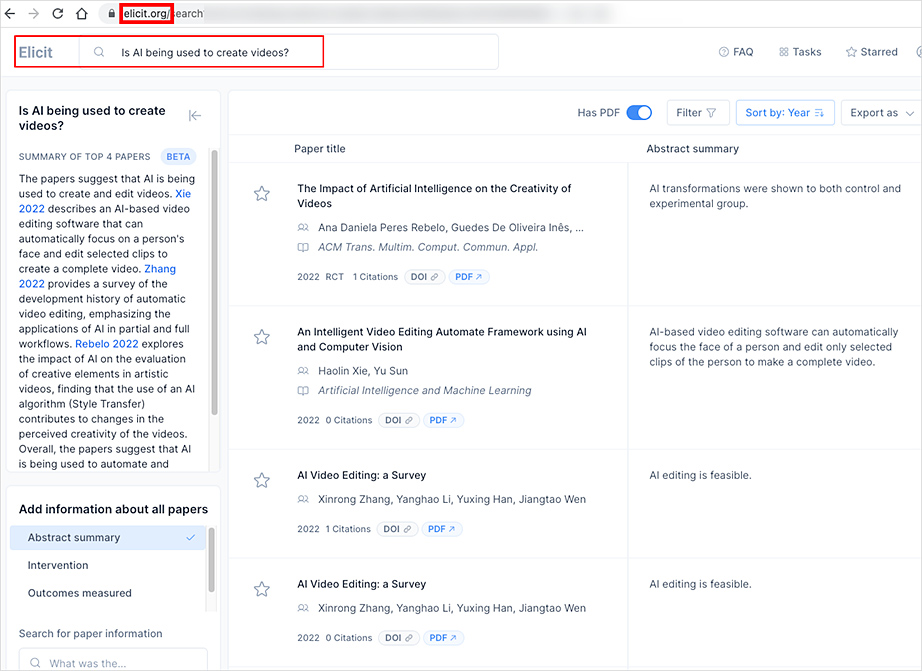
It was interesting to see how people are using AI these days. The article mentioned things from planning Gluten Free (GF) meals to planning gardens, workouts, and more. Faculty members, staff, students, researchers and educators in general may find Elicit, Scholarcy and Scite to be useful tools. I put in a question at Elicit and it looks interesting. I like their interface, which allows me to quickly resort things.
.

Snapshot of a query result from a tool called Elicit


There Is No A.I. — from newyorker.com by Jaron Lanier
There are ways of controlling the new technology—but first we have to stop mythologizing it.

Excerpts:

If the new tech isn’t true artificial intelligence, then what is it? In my view, the most accurate way to understand what we are building today is as an innovative form of social collaboration.

The new programs mash up work done by human minds. What’s innovative is that the mashup process has become guided and constrained, so that the results are usable and often striking. This is a significant achievement and worth celebrating—but it can be thought of as illuminating previously hidden concordances between human creations, rather than as the invention of a new mind.


Resource per Steve Nouri on LinkedIn


Verified Skills — from the-job.beehiiv.com by Paul Fain
Hunting for a common thread amid the hype around skills.

Excerpt:

The glitzy ASU+GSV gathering this week was titled “Brave New World.” But Tim Knowles wanted to talk about 1906.

That was when the organization Knowles leads, the Carnegie Foundation for the Advancement of Teaching, created the credit-hour standard. The time has arrived, argue Knowles and Amit Sevak, CEO of ETS, to move away from the Carnegie Unit and toward a new currency of education based on meaningful skills and accomplishments, demonstrated through assessment.

Our old way of training Americans for ‘good jobs’ is past its sell-by date — from workshift.opencampusmedia.org by JB Holston
We’re at a pivot point in education and workforce development. Employers in the U.S. and its allies have an opportunity to accelerate their economies by collaborating to scale new pathways to prosperity. They need to seize that opportunity, writes JB Holston, former CEO of the Greater Washington Partnership.

The country is at a pivot point. COVID’s acceleration of remote work and training; an increased dedication to inclusion, equity, and diversity since the murder of George Floyd; the inexorable pace of technological change; and America’s new, well-funded industrial policy have created an opportunity for the most significant re-set in the relationship between employers and our education systems in the last 150 years.

The old path to family-supporting career positions—which depended on large employers recruiting graduates from a small universe of ranked colleges whose education stopped with that degree—is past its sell-by date.

AI in Hiring and Evaluating Workers: What Americans Think — from pewresearch.org by Lee Rainie, Monica Anderson, Colleen McClain, Emily A. Vogels, and Risa Gelles-Watnick
62% believe artificial intelligence will have a major impact on jobholders overall in the next 20 years, but far fewer think it will greatly affect them personally. People are generally wary and uncertain of AI being used in hiring and assessing workers

Excerpt:

A new Pew Research Center survey finds crosscurrents in the public’s opinions as they look at the possible uses of AI in workplaces. Americans are wary and sometimes worried. For instance, they oppose AI use in making final hiring decisions by a 71%-7% margin, and a majority also opposes AI analysis being used in making firing decisions. Pluralities oppose AI use in reviewing job applications and in determining whether a worker should be promoted. Beyond that, majorities do not support the idea of AI systems being used to track workers’ movements while they are at work or keeping track of when office workers are at their desks.


EP 7 – AI Fever Continues: What Does it Mean for Online Education? — from the Online Learning Podcast with John Nash and Jason Johnston
In this episode, John and Jason talk about Jason’s recent bout with AI fever and what the rapid development of AI means for online education. 


5 Playful Strategies That Reduce Language Learning Anxiety — from edutopia.org by Paige Tutt
We visited a classroom in Denmark to see how a playful learning philosophy can put students at ease and make language learning joyful and engaging.

Excerpt:

Instead of trying to convince students that their fears aren’t warranted, Belouahi makes a point of creating a positive, mistake-friendly classroom where students feel comfortable experimenting. One of the ways she does this is by incorporating playful learning strategies. “It doesn’t have to be perfect from the beginning,” Belouahi says. “The goal is for them to use their English language as much as possible and as best as they can. Not perfectly.”

Here are five playful learning strategies from Belouahi’s classroom designed to make the act of learning a new language less daunting, and more joyful, social, and engaging.

Also from edutopia.org, see:

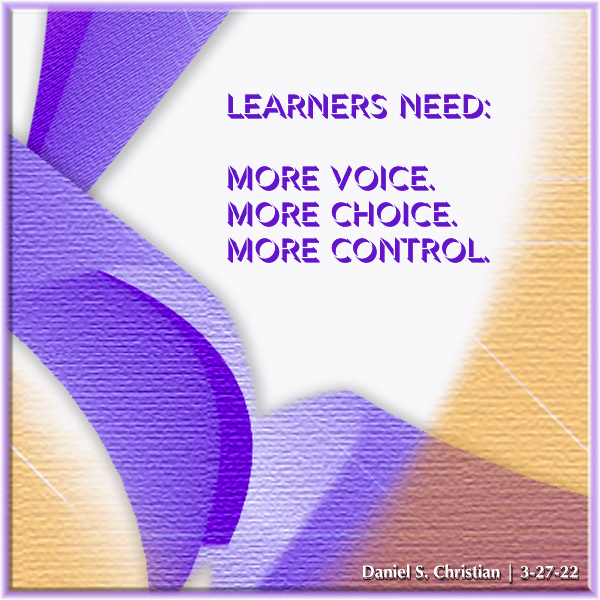
Learners need: More voice. More choice. More control. -- this image was created by Daniel Christian


The Good and the Bad of Solo Practice, Per Clio’s Latest Legal Trends Report for Solos — from lawnext.com by Bob Ambrogi

Excerpt:

As a solo myself, I can tell you that there is much to be said for practicing on your own – freedom and independence not least among them. In fact, during 2022’s “Great Resignation,” a third of lawyers who quit their jobs did so to start their own solo practices, according to Legal Trends for Solo Law Firms, a report published today by law practice management company Clio.

But there are also disadvantages to practicing alone and challenges unique to solo lawyers, as this latest report documents.


A New Era for Education — from linkedin.com by Amit Sevak, CEO of ETS and Timothy Knowles, President of the Carnegie Foundation for the Advancement of Teaching

Excerpt (emphasis DSC):

It’s not every day you get to announce a revolution in your sector. But today, we’re doing exactly that. Together, we are setting out to overturn 117 years of educational tradition.

The fundamental assumption [of the Carnegie Unit] is that time spent in a classroom equals learning. This formula has the virtue of simplicity. Unfortunately, a century of research tells us that it’s woefully inadequate.


From DSC:
It’s more than interesting to think that the Carnegie Unit has outlived its usefulness and is breaking apart. In fact, the thought is very profound.

It's more than interesting to think that the Carnegie Unit has outlived its usefulness and is breaking apart. In fact, the thought is very profound.

If that turns out to be the case, the ramifications will be enormous and we will have the opportunity to radically reinvent/rethink/redesign what our lifelong learning ecosystems will look like and provide.

So I appreciate what Amit and Timothy are saying here and I appreciate their relaying what the new paradigm might look like. It goes with the idea of using design thinking to rethink how we build/reinvent our learning ecosystems. They assert:

It’s time to change the paradigm. That’s why ETS and the Carnegie Foundation have come together to design a new future of assessment.

    • Whereas the Carnegie Unit measures seat time, the new paradigm will measure skills—with a focus on the ones we know are most important for success in career and in life.
    • Whereas the Carnegie Unit never leaves the classroom, the new paradigm will capture learning wherever it takes place—whether that is in after-school activities, during a work-experience placement, in an internship, on an apprenticeship, and so on.
    • Whereas the Carnegie Unit offers only one data point—pass or fail—the new paradigm will generate insights throughout the learning process, the better to guide students, families, educators, and policymakers.

I could see this type of information being funneled into peoples’ cloud-based learner profiles — which we as individuals will own and determine who else can access them. I diagrammed this back in January of 2017 using blockchain as the underlying technology. That may or may not turn out to be the case. But the concept will still hold I think — regardless of the underlying technology(ies).
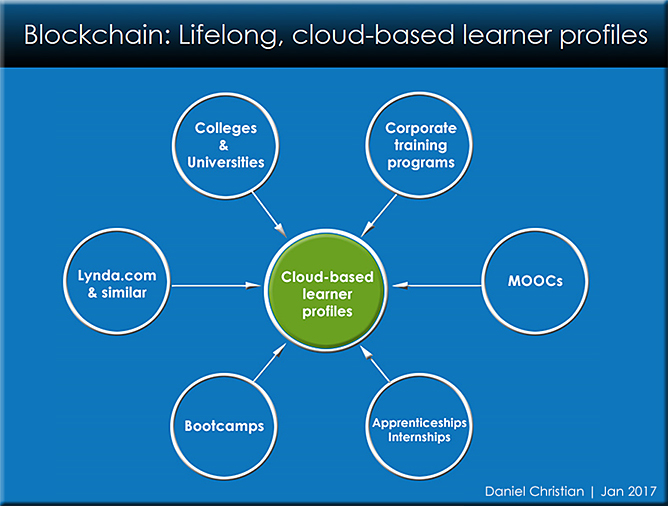
Perhaps blockchain will be the underlying technology to provide us with cloud-based learner profiles

For example, we are seeing a lot more articles regarding things like Comprehensive Learner Records (CLR) or Learning and Employment Records (LER; example here), and similar items.

LER — The Learning and Employment Record for a Skills-Based Economy


Speaking of reinventing our learning ecosystems, also see:


New NVIDIA Research — excerpted section from this version of The Rundown

The NVIDIA research team just dropped a new research paper on creating high-quality short videos from text prompts. This technique uses Video Latent Diffusion Models (Video LDMs), which work efficiently without using too much computing power.

It can create 113 frame-long videos at 1280×2048 resolution, rendered at 24 FPS, resulting in 4.7-second clips. The team first trained the model on images, then added a time dimension to make it work with videos.

This new research is impressive. At the current pace of development, we may soon be able to generate full-length movies from just a handful of text prompts within the next few years.


Also relevant/see:


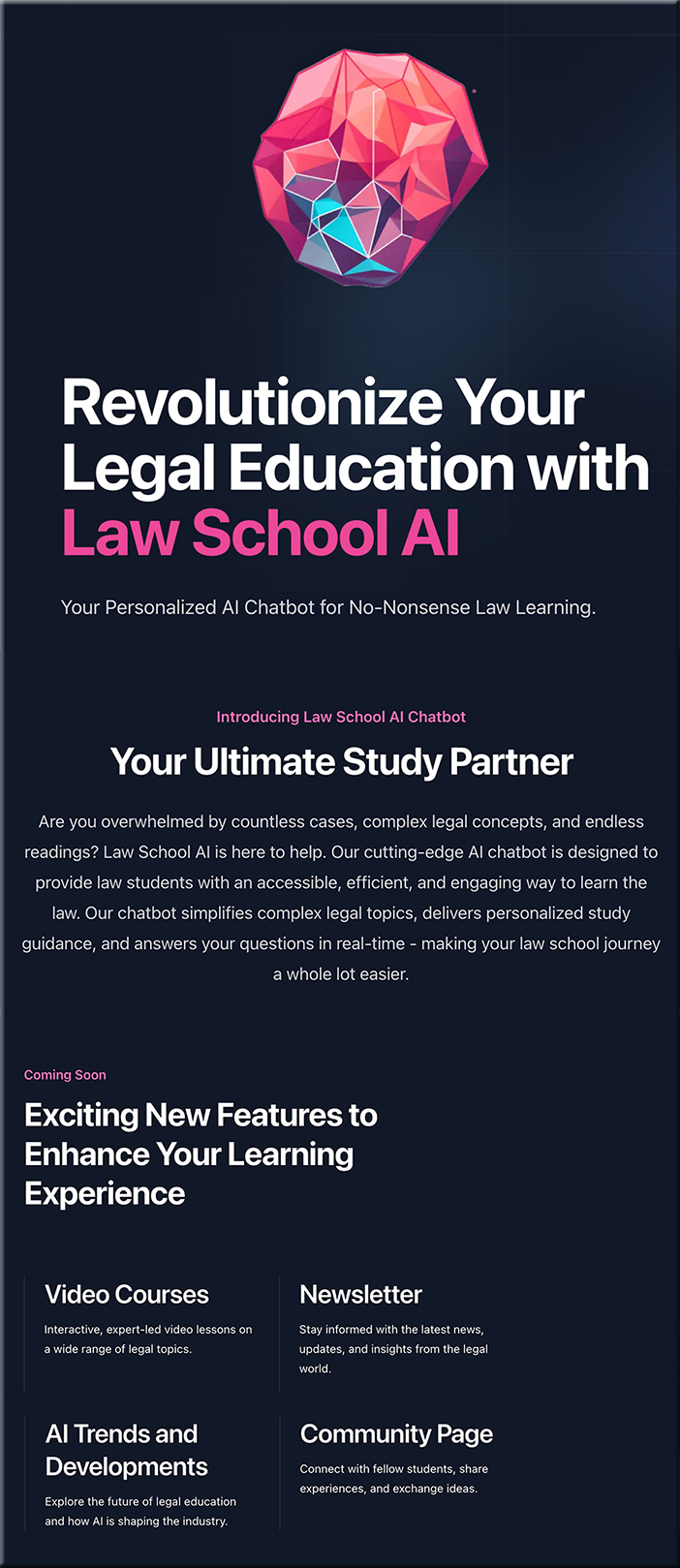
law-school-ai.vercel.app -- Your Personalized AI Chatbot for No-Nonsense Law Learning.


From DSC:
I haven’t used this app or their website (which seems to have a lot of broken links!). But my question/reflection is…is this a piece of legal education’s future? Or even larger than that? I can easily see a LegalGPT type of service out there for ***society at large.***


© 2025 | Daniel Christian