Love is patient, love is kind. It does not envy, it does not boast, it is not proud. It does not dishonor others, it is not self-seeking, it is not easily angered, it keeps no record of wrongs. Love does not delight in evil but rejoices with the truth. It always protects, always trusts, always hopes, always perseveres. Love never fails. But where there are prophecies, they will cease; where there are tongues, they will be stilled; where there is knowledge, it will pass away.
Microsoft has launched a GPT-4 enhanced Edge browser.
By integrating OpenAI’s GPT-4 technology with Microsoft Edge, you can now use ChatGPT as a copilot in your Bing browser. This delivers superior search results, generates content, and can even transform your copywriting skills (read on to find out how).
Benefits mentioned include: Better Search, Complete Answers, and Creative Spark.
The new interactive chat feature means you can get the complete answer you are looking for by refining your search by asking for more details, clarity, and ideas.
From DSC: I have to say that since the late 90’s, I haven’t been a big fan of web browsers from Microsoft. (I don’t like how Microsoft unfairly buried Netscape Navigator and the folks who had out-innovated them during that time.) As such, I don’t use Edge so I can’t fully comment on the above article.
But I do have to say that this is the type of thing that may make me reevaluate my stance regarding Microsoft’s browsers. Integrating GPT-4 into their search/chat functionalities seems like it would be a very solid, strategic move — at least as of late April 2023.
Speaking of new items coming from Microsoft, also see:
[On 4/27/23], Microsoft Designer, Microsoft’s AI-powered design tool, launched in public preview with an expanded set of features.
Announced in October, Designer is a Canva-like web app that can generate designs for presentations, posters, digital postcards, invitations, graphics and more to share on social media and other channels. It leverages user-created content and DALL-E 2, OpenAI’s text-to-image AI, to ideate designs, with drop-downs and text boxes for further customization and personalization.
…
Designer will remain free during the preview period, Microsoft says — it’s available via the Designer website and in Microsoft’s Edge browser through the sidebar. Once the Designer app is generally available, it’ll be included in Microsoft 365 Personal and Family subscriptions and have “some” functionality free to use for non-subscribers, though Microsoft didn’t elaborate.
From DSC: I don’t think all students hate AI. My guess is that a lot of them like AI and are very intrigued by it. The next generation is starting to see its potential — for good and/or for ill.
One of the comments (from the above item) said to check out the following video. I saw one (or both?) of these people on a recent 60 Minutes piece as well.
PricewaterhouseCoopers LLP plans to invest $1 billion in generative artificial intelligence technology in its U.S. operations over the next three years, working with Microsoft Corp. and ChatGPT-maker OpenAI to automate aspects of its tax, audit and consulting services.
The accounting and consulting giant said the multiyear investment, announced Wednesday, includes funding to recruit more AI workers and train existing staff in AI capabilities, while targeting AI software makers for potential acquisitions.
For PwC, the goal isn’t only to develop and embed generative AI into its own technology stack and client-services platforms, but also advising other companies on how best to use generative AI, while helping them build those tools, said Mohamed Kande, PwC’s vice chair and co-leader of U.S. consulting solutions and global advisory leader.
7 reasons to get rid of the law degree — from jordanfurlong.substack.com by Jordan Furlong Requiring a law degree for bar admission imposes unfair burdens on new lawyers and blocks innovation in legal education. Here’s what we can do instead.
Excerpt:
Hey there, legal sector participant! Do you feel that law school is too expensive? That law students graduate too heavily in debt and deeply stressed? That legal education seems impossible to reform? That the whole lawyer development and bar admission system in general is an enormous hot mess?
If so, you’re like thousands of others who’ve grown massively frustrated with the profession’s broken-down approach to developing new lawyers. But I’m here with some good news! There’s a simple and straightforward path to resolving these and many other problems with legal education and bar admission.
We start by getting rid of the law degree.
Now, hold on, let me be clear — I don’t mean kill the law degree itself. That would be crazy.
No, I mean, let’s get rid of the law degree as a mandatory element of the lawyer licensing process. Law schools should continue to offer whatever sort of degree programs they like — but legal regulators and bar admission authorities should no longer require everybody who wants to be a lawyer to get one.
From DSC: I need to think on this further, but Jordan could be onto something here…
A better pathway to lawyer licensing — from jordanfurlong.substack.com by Jordan Furlong No law degree; a single knowledge exam; training in legal, business and professional skills; and a term of supervised practice. This is how we do it.
Of course, it’s easy to criticize legal education — fun, too — but look, most people in the legal profession already know all the problems with the law degree, and complaining about it is kind of a vacuous pastime. What I’m really interested in here is a bigger and more important question: How does — how should — someone become a lawyer?
No better way for Judges to learn about both how AI could improve courts and the risks of AI (e.g., deepfakes) than to experiment with it.
Check out the AI avatars that @Judgeschlegel created: https://t.co/UqbJ2PHA09#AI4Law#Law4AI
Most reported feeling the justice system was “unfair,” and many described a sense of “the odds being stacked against them.”
Advocates say the rising number of lawyer-free litigants is problematic. The legal system is meant to be adversarial — with strong lawyers on each side — but the high rate of self-representation creates lopsided justice, pitting an untrained individual against a professional.
AI will likely make lawyer’s jobs easier (or, at least, more interesting) for some tasks, however the effects it may have on the legal profession could be the real legacy of the technology. Schafer pointed to its potential to improve access to justice for people who want legal representation but can’t get it for whatever reason.
It’s a new tradition in the curriculum of the senior-level English class, where teacher Carrie Mattern asks her students to seek out a mural in Flint and write poetry about it.
This year, there was a focus on writing around cultural grief and the process of healing.
It’s become a favorite assignment for the students who’ve worked on the project, who say it allows them to use “creative freedom” in a way that other classes don’t. .
A few current categories of AI in Edtech particularly jump out:
Teacher Productivity and Joy: Tools to make educators’ lives easier (and more fun?) by removing some of the more rote tasks of teaching, like lesson planning (we counted at least 8 different tools for lesson planning), resource curation and data collection.
Personalization and Learning Delivery: Tools to tailor instruction to the particular interests, learning preferences and preferred media consumption of students. This includes tools that convert text to video, video to text, text to comic books, Youtube to notes, and many more.
Study and Course Creation Tools: Tools for learners to automatically make quizzes, flashcards, notes or summaries of material, or even to automatically create full courses from a search term.
AI Tutors, Chatbots and Teachers: There will be no shortage of conversational AI “copilots” (which may take many guises) to support students in almost any learning context. Many Edtech companies launched their own during the conference. Possible differentiators here could be personality, safety, privacy, access to a proprietary or specific data set, or bots built on proprietary LLMs.
Simplifying Complex Processes: One of the most inspiring conversations of the conference for me was with Tiffany Green, founder of Uprooted Academy, about how AI can and should be used to remove bureaucratic barriers to college for underrepresented students (for example, used to autofill FAFSA forms, College Applications, to search for schools and access materials, etc). This is not the only complex bureaucratic process in education.
Educational LLMs: The race is on to create usable large language models for education that are safe, private, appropriate and classroom-ready. Merlyn Mind is working on this, and companies that make LLMs are sprouting up in other sectors…
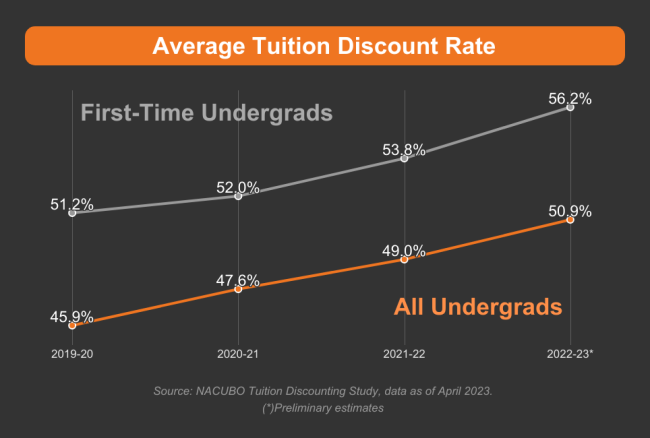
Tuition Discount Rates Hit New High — from insidehighered.com by Josh Moody According to a new NACUBO study, private college tuition discount rates hit a record 56.2 percent, continuing a pattern of annual increases.
If we do not find better ways to track college costs for students with different family financial circumstances, we will not easily know if that happened. Students and their families will continue to make one of the most important financial decisions of their lives half in the dark.
The average tuition discount rate for full-time first year students attending private nonprofit colleges reached a record high of 56.2% in the 2022-23 academic year, the National Association of College and University Business Officers said Monday.
This represents a more than 2 percentage point increase year over year. Average tuition discount rates for all private college undergraduate students also continued to rise, reaching another record high, 50.9%, that year, NACUBO said in its newly released annual report.
After adjusting for inflation, private colleges’ net tuition and fee revenue fell by 5.4% per first-time undergraduate and by 5.9% across all undergraduates, NACUBO found.
This week I spent a few days at the ASU/GSV conference and ran into 7,000 educators, entrepreneurs, and corporate training people who had gone CRAZY for AI.
No, I’m not kidding. This community, which makes up people like training managers, community college leaders, educators, and policymakers is absolutely freaked out about ChatGPT, Large Language Models, and all sorts of issues with AI. Now don’t get me wrong: I’m a huge fan of this. But the frenzy is unprecedented: this is bigger than the excitement at the launch of the i-Phone.
Second, the L&D market is about to get disrupted like never before. I had two interactive sessions with about 200 L&D leaders and I essentially heard the same thing over and over. What is going to happen to our jobs when these Generative AI tools start automatically building content, assessments, teaching guides, rubrics, videos, and simulations in seconds?
The answer is pretty clear: you’re going to get disrupted. I’m not saying that L&D teams need to worry about their careers, but it’s very clear to me they’re going to have to swim upstream in a big hurry. As with all new technologies, it’s time for learning leaders to get to know these tools, understand how they work, and start to experiment with them as fast as you can.
Speaking of the ASU+GSV Summit, see this posting from Michael Moe:
Last week, the 14th annual ASU+GSV Summit hosted over 7,000 leaders from 70+ companies well as over 900 of the world’s most innovative EdTech companies. Below are some of our favorite speeches from this year’s Summit…
High-quality tutoring is one of the most effective educational interventions we have – but we need both humans and technology for it to work. In a standing-room-only session, GSE Professor Susanna Loeb, a faculty lead at the Stanford Accelerator for Learning, spoke alongside school district superintendents on the value of high-impact tutoring. The most important factors in effective tutoring, she said, are (1) the tutor has data on specific areas where the student needs support, (2) the tutor has high-quality materials and training, and (3) there is a positive, trusting relationship between the tutor and student. New technologies, including AI, can make the first and second elements much easier – but they will never be able to replace human adults in the relational piece, which is crucial to student engagement and motivation.
ChatGPT, Bing Chat, Google’s Bard—AI is infiltrating the lives of billions.
The 1% who understand it will run the world.
Here’s a list of key terms to jumpstart your learning:
Being “good at prompting” is a temporary state of affairs.The current AI systems are already very good at figuring out your intent, and they are getting better. Prompting is not going to be that important for that much longer. In fact, it already isn’t in GPT-4 and Bing. If you want to do something with AI, just ask it to help you do the thing. “I want to write a novel, what do you need to know to help me?” will get you surprisingly far.
…
The best way to use AI systems is not to craft the perfect prompt, but rather to use it interactively. Try asking for something. Then ask the AI to modify or adjust its output. Work with the AI, rather than trying to issue a single command that does everything you want. The more you experiment, the better off you are. Just use the AI a lot, and it will make a big difference – a lesson my class learned as they worked with the AI to create essays.
From DSC: Agreed –> “Being “good at prompting” is a temporary state of affairs.” The User Interfaces that are/will be appearing will help greatly in this regard.
From DSC: Bizarre…at least for me in late April of 2023:
FaceTiming live with AI… This app came across the @ElunaAI Discord and I was very impressed with its responsiveness, natural expression and language, etc…
Feels like the beginning of another massive wave in consumer AI products.
The rise of AI-generated music has ignited legal and ethical debates, with record labels invoking copyright law to remove AI-generated songs from platforms like YouTube.
Tech companies like Google face a conundrum: should they take down AI-generated content, and if so, on what grounds?
Some artists, like Grimes, are embracing the change, proposing new revenue-sharing models and utilizing blockchain-based smart contracts for royalties.
The future of AI-generated music presents both challenges and opportunities, with the potential to create new platforms and genres, democratize the industry, and redefine artist compensation.
The Need for AI PD — from techlearning.com by Erik Ofgang Educators need training on how to effectively incorporate artificial intelligence into their teaching practice, says Lance Key, an award-winning educator.
“School never was fun for me,” he says, hoping that as an educator he could change that with his students. “I wanted to make learning fun.” This ‘learning should be fun’ philosophy is at the heart of the approach he advises educators take when it comes to AI.
At its 11th annual conference in 2023, educational company Coursera announced it is adding ChatGPT-powered interactive ed tech tools to its learning platform, including a generative AI coach for students and an AI course-building tool for teachers. It will also add machine learning-powered translation, expanded VR immersive learning experiences, and more.
Coursera Coach will give learners a ChatGPT virtual coach to answer questions, give feedback, summarize video lectures and other materials, give career advice, and prepare them for job interviews. This feature will be available in the coming months.
From DSC: Yes…it will be very interesting to see how tools and platforms interact from this time forth. The term “integration” will take a massive step forward, at least in my mind.
AutoGPT’s – Everything you need to know — from linusekenstam.substack.com by Linus Ekenstam What exactly are AutoGPT’s? Autonomous agents are here, and most likely to stay.
Technology has become the main driver for increasing access to justice, and there are huge opportunities for legal service providers to leverage both existing and emerging tech to reach new clients. Dennis and Tom welcome Natalie Knowlton to discuss the current state of legal services, the justice gap, and ways technology is helping attorneys provide better and more affordable services to consumers. As always, stay tuned for the parting shots, that one tip, website, or observation that you can use the second the podcast ends.
The survey, conducted in late-March by the Thomson Reuters Institute, gathered insight from more than 440 respondent lawyers at large and midsize law firms in the United States, United Kingdom, and Canada. The survey forms the basis of a new report, ChatGPT & Generative AI within Law Firms, which takes a deep look at the evolving attitudes towards generative AI and ChatGPT within law firms, measuring awareness and adoption of the technology as well as lawyers’ views on its potential risks.
The report also reveals several key findings that deserve special attention from law firm leaders and other legal professionals as ChatGPT and generative AI evolve from concept to reality for the vast majority of the legal industry participants. These findings include:
There are lots of tropes related to lawyers and law firms that frequently show up in works of fiction. The thing is, those tropes are tropes because they’re sort of old; they’ve been around for a long time. Now, however, modern technology can solve a heck of a lot of those issues. So, for this edition of the “Reference Manual of Lists,” we’re going to relay a trope, offer an example, and talk about how legal tech actually fixes the problem today.
If you made it this far, you should by now understand that ChatGPT is not by itself a search engine, nor an eDiscovery data reviewer, a translator, knowledge base, or tool for legal analytics. But it can contribute to these functionalities.
April 20, 2023 – Alternative dispute resolution (ADR), a common technique parties can use to settle disputes with the help of a third party, offers several unique benefits over traditional litigation. It is typically more cost-effective, confidential and generally a preferred method to resolving disputes. As a result, counsel and their clients often view ADR as a no-brainer. But the once simple decision to engage in ADR is now complicated by whether to proceed in-person, virtually or with a hybrid approach.
The emergence of ChatGPT comes with tremendous promise of increased automation and efficiency. But at what cost? In this blog post, we’ll explore the potential ethical time bomb of using ChatGPT and examine the responsibility of lawyers in the age of AI.
What are a few other straightforward moves an educational leader can make to ensure they can push break-the-mold, innovative changes needed in education today?
Is the culture of education simply too deep and unmovable to be creative and move forward?
I’ve had the unique privilege of moving between business and education throughout my career, including getting to work with some highly dynamic and influential business leaders in my community. One of the biggest differences between business leaders and school and district leaders has been how quickly and easily business gets to “yes” while education seems to wallow in the purgatory of the “yeah but…” and the “no.”
Thanks for dropping by my Learning Ecosystems blog!
My name is Daniel Christian and this blog seeks to cover the teaching and learning environments within the K-12 (including homeschooling, learning pods/micro-schools), collegiate, and corporate training spaces -- whether those environments be face-to-face, blended, hyflex, or 100% online.
Just as the organizations that we work for have their own learning ecosystems, each of us has our own learning ecosystem. We need to be very intentional about enhancing those learning ecosystems -- as we all need to be lifelong learners in order to remain marketable and employed. It's no longer about running sprints (i.e., getting a 4-year degree or going to a vocational school and then calling it quits), but rather, we are all running marathons now (i.e., we are into lifelong learning these days).