Cisco seeking to acquire Skype: TechCrunch — Yahoo News

WASHINGTON (AFP) – US networking giant Cisco has made an offer to acquire Internet communications firm Skype, technology blog TechCrunch said Monday. TechCrunch, citing what it described as “one of our more reliable sources,” said the San Jose, California-based Cisco is seeking to acquire Skype before the Internet telephony company makes an initial public offering or IPO.

“Google was also rumored to be sniffing around Skype,” TechCrunch said, “but antitrust concerns may have persuaded them not to make an actual offer.”

Addendum from 9/2/10:

Tagged with: • • • •  

Marshall McLuhan and web conferencing — from The Webinar Blog by Ken Molay

“The medium is the message.” One of the most quoted five-word phrases in the last 45 years. I’ll bet you think you know what it implies. I’ll bet you’re wrong.

I just finished reading an erudite and fascinating article by Mark Federman, Chief Strategist, McLuhan Program in Culture and Technology. The article has the unwieldy title of “What is the Meaning of The Medium is the Message?”

…

There are questions I see all the time from webinar creators and administrators. Some common ones include:

  • How long should a webinar be?
  • How do I hold my audience’s attention?
  • What’s a good audience size?

I see an underlying communications message in these questions that is based on a prior medium.

…

Webinars extend our communications reach to that audience in a new way. And the change in the medium changes the dynamics of the message between hosts, presenters, and audience members. There is no more sea of faces. There is a multitude of simultaneous one-to-one communications between a presenter and an individual listener.

…

So instead of concentrating on “How much time do I need to reserve before it is seen as worth the trip?” we need to ask “How much time do we really need in order to deliver the value we promised?” Don’t be afraid to end a session early. Or at least end the lecture quickly and move to audience-guided questions and discussion.

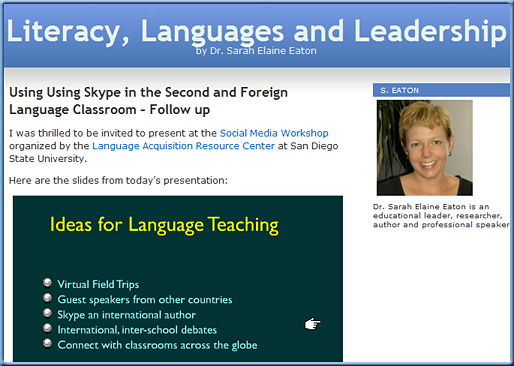
From Dr. Sarah Eaton: Using Skype in the second and foreign language classroom

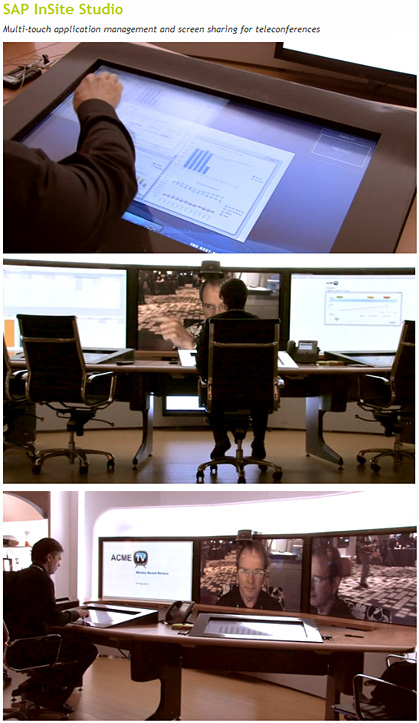
Stimulant's SAP Insite Studio

Online collaboration: New innovations pave the way for convergence — from prnewswire.com
Merger of television and computer takes giant step closer as innovative online tool suite is released

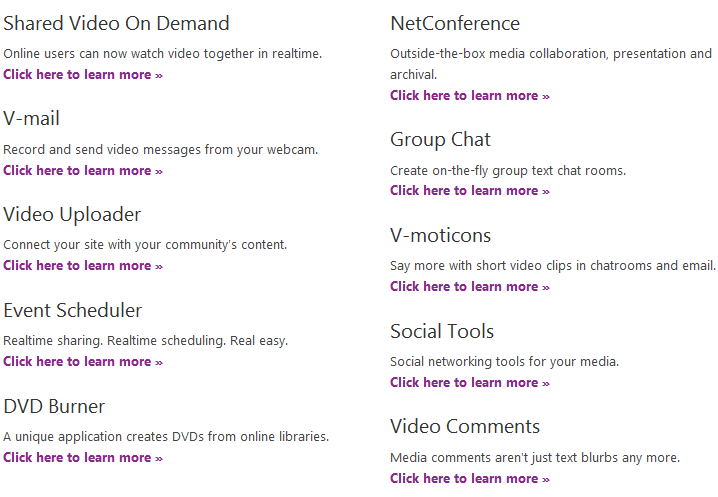
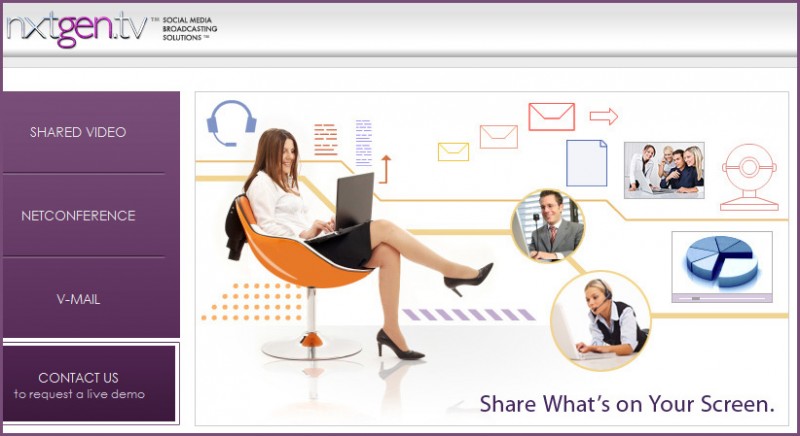
CALABASAS, Calif., Aug. 16 /PRNewswire/ — Anticipating the coming paradigm shift that will merge your television and your computer, NxtGenTV has just released the most cohesive system of online tools to facilitate the ultimate interactive communication platform. Four years of innovating has resulted in NetConference.com, an elegant, easy-to-use online meeting system that supports the diverse requirements of single users, small and medium size businesses as well as enterprise and nonprofit organizations. Creating a new opportunity for the global audience to interact online in even greater and more efficient ways is only one of the many benefits of building a social media broadcasting system that facilitates Communication, Collaboration, Presentation and Education.

An industry leader in online games, apps, widgets, banners and rich media development for major entertainment brands, The Illusion Factory created a new company, NxtGenTV to develop and patent cutting-edge online technologies such as shared synchronized visual media and other key innovations that will further blur the lines between computers and television. “We have been passionate about creating the cumulative new systems that will drive Convergence,” shares Brian Weiner, CEO of The Illusion Factory, “our creation of NxtGenTV will lead the push for truly interactive television.”
nxtgen.tv

.nxtgen.tv/products

Upcoming “Distinguished Lecture Series” from Wimba

Immersive Technology Training
Learn how UNCW has been able to get majority and late-adopting faculty and staff to utilize synchronous learning technologies by providing an immersive advanced training.
August 16, 2010 2:00 pm EDT
.
Wimba Study Break: Wimba Stretches Pedagogical Boundaries: Peer Teaching Across Two Institutions
Learn how two professors at different universities used Wimba Classroom to create optimal learning environment for students to interact through peer teaching.
September 29, 2010 1:00 pm EDT
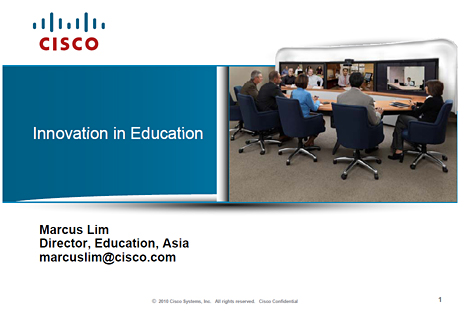
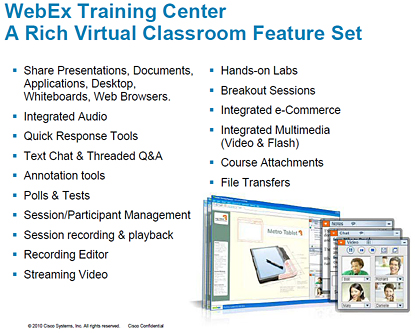
Here are some slides from a Cisco WebEx presentation by Marcus Lim

.


.

.

.

.

. .


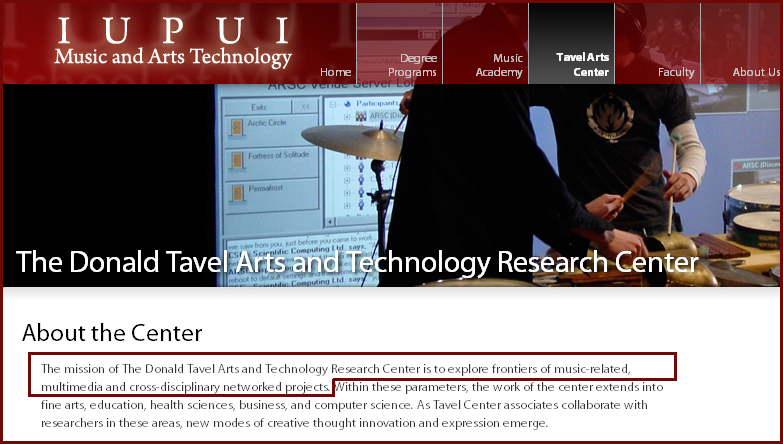
  • Multimedia
  • Cross-disciplinary
  • Networked projects
  • Music-related

Within these parameters, the work of the center extends into fine arts, education, health sciences, business, and computer science. As Tavel Center associates collaborate with researchers in these areas, new modes of creative thought innovation and expression emerge.

IUPUI Arts & Technology Research Center

The story of the Department of Music and Arts Technology began in the mid-1990s when the shared campus of Indiana University and Purdue University began offering what was the first United States-based master of science degree in music technology. The focus was on educating students on computer-based music technology, multimedia and interactive design, and multimedia production techniques.

Also see:
The technology that saved a university degree program
— from InsideHigherEd. by Dian Schaffhauser

Damaka introduces first complete iPhone multi-party video conferencing solution over WiFi, 3G and 4G networks — from Damaka
Two-way video calling, application sharing and instant messaging power real-time collaboration and improve productivity

RICHARDSON, Texas – July 19, 2010 – Damaka®, a technology pioneer in mobile unified communications and collaboration (UCC), today unveiled the industry.s first complete, real-time multi-party video conferencing solution for the Apple® iPhone® featuring support for WiFi, 3G and 4G networks.

The Damaka solution offers innovative features including live multi-party video, application and desktop sharing with voice and editing capability, Presence, Instant Messaging, audio conference participation and touch and zoom capabilities. Damaka’s Sweeping™ functionality allows users to “handoff” in-process collaboration sessions across networks and devices for streamlined communication while on the go. Video conference sessions can be conducted cross platform, with any other device using Damaka, including Android™, iPad™, Symbian™ and Windows Mobile® devices.

A story before bed dot com

From DSC:
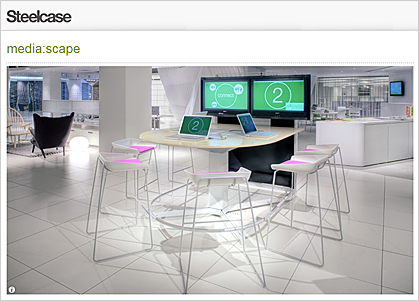
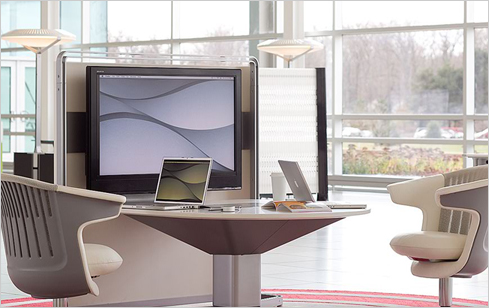
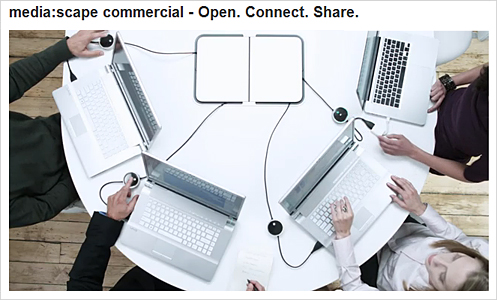
For those of you involved with creating learning labs, smart classrooms, group study areas, etc. — or for those who want to enable more efficient group collaboration within your classrooms — you need to check out Steelcase’s Media:Scape product line.

One of the pieces of this configuration that I love is that they have created an easy-to-use interface in a puck-like device. What I want to see happen is for students to pull up to a movable/reconfigurable table, connect their device, and click the puck to “play” their media for the class (without interrupting the flow of the class).

Also, one monitor on the “totem” can be used for one set of information/data — or even a remote speaker via videoconferencing for example — and the other monitor can be used for someone else’s data/desktop.

Here are some images for you:

Also see the Media:Scape ad/video:

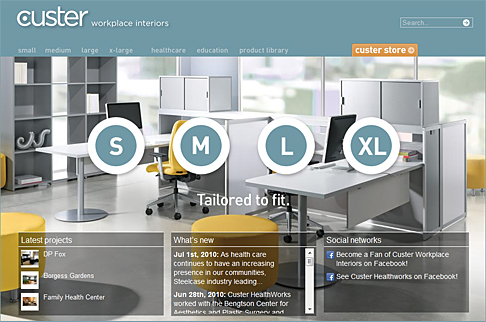
This product line is also available through Custer Workplace Interiors.

Custer Workplace Interiors

Bb+Elluminate+Wimba: What I’m hearing — from Bb’s Ray Henderson

From http://www.blackboard.com/sites/collaborate/index.htm

Today, we’ve announced that Elluminate, Wimba, and Blackboard will join forces to bring together the leading technology products for synchronous learning and collaboration – and the minds that created them – in what we hope will be a major step forward to pursue new innovation.

See also:

Videoconferencing Lesson Study: Learning from the Classroom — by Janine Lim

Poster Session: Amy Colucci, Jefferson County Public School with Jeremy Renner

Just stopped by a poster session on the way that Jefferson County Public Schools uses classroom-based videoconferencing systems to facilitate real-time lesson studies without interrupting the classroom instructional.

I talked to Pam Caudill, who is the videoconferencing contact supporting the project. It’s a really cool professional development model. (In case you’re interested, they are using Tandberg equipment.)

So imagine this:

  • The model teacher is in the classroom – and videoconferences back with a group of teachers at another site.
  • She explains the idea for the lesson; prep etc.
  • She teaches the lesson. The teachers at the other site are watching. A mic is on the teacher, and a room mic is used also. Someone in the room unobtrusively manages the camera so the far site sees everything going on.
  • After the lesson, the model teacher debriefs with the teachers at the far site.
  • THEN, the teachers at the far site learn how to use the technology tools they just saw used with the students.
© 2025 | Daniel Christian