In the 2030 and beyond world, employers will no longer be a separate entity from the education establishment. Pressures from both the supply and demand side are so large that employers and learners will end up, by default, co-designing new learning experiences, where all learning counts.


OBJECTIVES FOR CONVENINGS

  • Identify the skills everyone will need to navigate the changing relationship between machine intelligence and people over the next 10-12 years.
  • Develop implications for work, workers, students, working learners, employers, and policymakers.
  • Identify a preliminary set of actions that need to be taken now to best prepare for the changing work + learn ecosystem.

Three key questions guided the discussions:

  1. What are the LEAST and MOST essential skills needed for the future?
  2. Where and how will tomorrow’s workers and learners acquire the skills they really need?
  3. Who is accountable for making sure individuals can thrive in this new economy?

This report summarizes the experts’ views on what skills will likely be needed to navigate the work + learn ecosystem over the next 10–15 years—and their suggested steps for better serving the nation’s future needs.


In a new world of work, driven especially by AI, institutionally-sanctioned curricula could give way to AI-personalized learning. This would drastically change the nature of existing social contracts between employers and employees, teachers and students, and governments and citizens. Traditional social contracts would need to be renegotiated or revamped entirely. In the process, institutional assessment and evaluation could well shift from top-down to new bottom-up tools and processes for developing capacities, valuing skills, and managing performance through new kinds of reputation or accomplishment scores.


…

In October 2017, Chris Wanstrath, CEO of Github, the foremost code-sharing and social networking resource for programmers today, made a bold statement: “The future of coding is no coding at all.” He believes that the writing of code will be automated in the near future, leaving humans to focus on “higher-level strategy and design of software.” Many of the experts at the convenings agreed. Even creating the AI systems of tomorrow, they asserted, will likely require less human coding than is needed today, with graphic interfaces turning AI programming into a drag-and-drop operation.

Digital fluency does not mean knowing coding languages. Experts at both convenings contended that effectively “befriending the machine” will be less about teaching people to code and more about being able to empathize with AIs and machines, understanding how they “see the world” and “think” and “make decisions.” Machines will create languages to talk to one another.

…

Here’s a list of many skills the experts do not expect to see much of—if at all—in the future:

  • Coding. Systems will be self-programming.
  • Building AI systems. Graphic interfaces will turn AI programming into drag-and-drop operations.
  • Calendaring, scheduling, and organizing. There won’t be need for email triage.
  • Planning and even decision-making. AI assistants will pick this up.
  • Creating more personalized curricula. Learners may design more of their own personalized learning adventure.
  • Writing and reviewing resumes. Digital portfolios, personal branding, and performance reputation will replace resumes.
  • Language translation and localization. This will happen in real time using translator apps.
  • Legal research and writing. Many of our legal systems will be automated.
  • Validation skills. Machines will check people’s work to validate their skills.
  • Driving. Driverless vehicles will replace the need to learn how to drive.

Here’s a list of the most essential skills needed for the future:

  • Quantitative and algorithmic thinking.  
  • Managing reputation.  
  • Storytelling and interpretive skills.  
  • First principles thinking.  
  • Communicating with machines as machines.  
  • Augmenting high-skilled physical tasks with AI.
  • Optimization and debugging frame of mind.
  • Creativity and growth mindset.
  • Adaptability.
  • Emotional intelligence.
  • Truth seeking.
  • Cybersecurity.


The rise of machine intelligence is just one of the many powerful social, technological, economic, environmental, and political forces that are rapidly and disruptively changing the way everyone will work and learn in the future. Because this largely tech-driven force is so interconnected with other drivers of change, it is nearly impossible to understand the impact of intelligent agents on how we will work and learn without also imagining the ways in which these new tools will reshape how we live.


Benchmarking Higher Ed AV Staffing Levels — Revisited — from campustechnology.com by Mike Tomei
As AV-equipped classrooms on campus increase in both numbers and complexity, have AV departments staffed up accordingly? A recent survey sheds some light on how AV is managed in higher education.

Excerpt:

I think we can all agree that new AV system installs have a much higher degree of complexity compared to AV systems five or 10 years ago. The obvious culprits are active learning classrooms that employ multiple displays and matrix switching backends, and conferencing systems of varying complexity being installed in big and small rooms all over campus. But even if today’s standard basic classrooms are offering the same presentation functionality as they were five years ago, the backend AV technology running those systems has still increased in complexity. We’re trying to push very high resolution video signals around the room; copyright-protected digital content is coming into play; there are myriad BYOD devices and connectors that need to be supported; and we’re making a strong push to connect our AV devices to the enterprise network for monitoring and troubleshooting. This increase in AV system complexity just adds to the system design, installation and support burdens placed upon an AV department. Without an increase in FTE staff beyond what we’re seeing, there’s just no way that AV support can truly flourish on campuses.

Today we’re reopening the survey to continue to gather data about AV staffing levels, and we’ll periodically tabulate and publish the results for those that participate. Visit www.AV-Survey.com to take the survey. If you would like to request the full 2018 AV staffing survey results, including average AV department budgets, staffing levels by position, breakouts by public/private/community colleges and small/medium/large schools, please send an e-mail to me (mike@tomeiav.com) and to Craig Park from The Sextant Group (cpark@thesextantgroup.com).


MIT plans $1B computing college, AI research effort — from educationdive.com by James Paterson

Dive Brief (emphasis DSC):

  • The Massachusetts Institute of Technology is creating a College of Computing with the help of a $350 million gift from billionaire investor Stephen A. Schwarzman, who is the CEO and co-founder of the private equity firm Blackstone, in a move the university said is its “most significant reshaping” since 1950.
  • Featuring 50 new faculty positions and a new headquarters building, the $1 billion interdisciplinary initiative will bring together computer science, artificial intelligence (AI), data science and related programs across the institution. MIT will establish a new deanship for the college.
  • The new college…will explore and promote AI’s use in non-technology disciplines with a focus on ethical considerations, which are a growing concern as the technology becomes embedded in many fields.


Also see:

Alexa Sessions You Won’t Want to Miss at AWS re:Invent 2018 — from developer.amazon.com

Excerpts — with an eye towards where this might be leading in terms of learning spaces:

Alexa and AWS IoT — Voice is a natural interface to interact not just with the world around us, but also with physical assets and things, such as connected home devices, including lights, thermostats, or TVs. Learn how you can connect and control devices in your home using the AWS IoT platform and Alexa Skills Kit.

Connect Any Device to Alexa and Control Any Feature with the Updated Smart Home Skill API — Learn about the latest update to the Smart Home Skill API, featuring new capability interfaces you can use as building blocks to connect any device to Alexa, including those that fall outside of the traditional smart home categories of lighting, locks, thermostats, sensors, cameras, and audio/video gear. Start learning about how you can create a smarter home with Alexa.

Workshop: Build an Alexa Skill with Multiple Models — Learn how to build an Alexa skill that utilizes multiple interaction models and combines functionality into a single skill. Build an Alexa smart home skill from scratch that implements both custom interactions and smart home functionality within a single skill. Check out these resources to start learning:


7 Internet of Things examples that are super futuristic— from blog.hubspot.com by Caroline Forsey


Spray-on antennas will revolutionize the Internet of Things — from networkworld.com
Researchers at Drexel University have developed a method to spray on antennas that outperform traditional metal antennas, opening the door to faster and easier IoT deployments.


7 ways to keep your smart home from being hacked — from marketwatch.com


An open letter to Microsoft and Google’s Partnership on AI — from wired.com by Gerd Leonhard
In a world where machines may have an IQ of 50,000, what will happen to the values and ethics that underpin privacy and free will?

Excerpt:

This open letter is my modest contribution to the unfolding of this new partnership. Data is the new oil – which now makes your companies the most powerful entities on the globe, way beyond oil companies and banks. The rise of ‘AI everywhere’ is certain to only accelerate this trend. Yet unlike the giants of the fossil-fuel era, there is little oversight on what exactly you can and will do with this new data-oil, and what rules you’ll need to follow once you have built that AI-in-the-sky. There appears to be very little public stewardship, while accepting responsibility for the consequences of your inventions is rather slow in surfacing.


In a world where machines may have an IQ of 50,000 and the Internet of Things may encompass 500 billion devices, what will happen with those important social contracts, values and ethics that underpin crucial issues such as privacy, anonymity and free will?


My book identifies what I call the “Megashifts”. They are changing society at warp speed, and your organisations are in the eye of the storm: digitization, mobilisation and screenification, automation, intelligisation, disintermediation, virtualisation and robotisation, to name the most prominent. Megashifts are not simply trends or paradigm shifts, they are complete game changers transforming multiple domains simultaneously.


If the question is no longer about if technology can do something, but why…who decides this?

Gerd Leonhard


From DSC:
Though this letter was written 2 years ago back in October of 2016, the messages, reflections, and questions that Gerd puts on the table are very much still relevant today.  The leaders of these powerful companies have enormous power — power to do good, or to do evil. Power to help or power to hurt. Power to be a positive force for societies throughout the globe and to help create dreams, or power to create dystopian societies while developing a future filled with nightmares. The state of the human heart is extremely key here — though many will hate me saying that. But it’s true. At the end of the day, we need to very much care about — and be extremely aware of — the characters and values of the leaders of these powerful companies. 


Also relevant/see:

Spray-on antennas will revolutionize the Internet of Things — from networkworld.com by Patrick Nelson
Researchers at Drexel University have developed a method to spray on antennas that outperform traditional metal antennas, opening the door to faster and easier IoT deployments.

 From DSC:
Again, it’s not too hard to imagine in this arena that technologies can be used for good or for ill.


California enacts first law regulating Internet of Things devices — from iplawtrends.com by David Rice with thanks to my friend Justin Wagner for posting this on LinkedIn

Excerpt:

California has enacted the nation’s first law regulating Internet of Things (IoT) devices, which was signed by Governor Jerry Brown on September 28, 2018. IoT refers to the rapidly-expanding world of internet-connected objects such as home security systems, video monitors, enterprise devices that track packages and vehicles, health monitors, connected cars, smart city devices that manage traffic congestion, and smart meters for utilities.

IoT devices promise to bring efficiencies to a broad range of industries and improve lives. But these devices also collect vast troves of information, and this raises data security and privacy concerns. In 2016, a distributed denial of service (DDoS) attack on the internet infrastructure company Dyn was powered by millions of hacked IoT devices such as web cameras and connected refrigerators. Hackers have used baby monitors to view inside homes, with a prominent recent example being the widely-deployed Mi-Cam baby monitor. If hackers are able to get into critical IoT systems in first responder networks, then there could be public safety risks.


The law states that having a unique preprogrammed password for each IoT device or requiring the user to generate a new means of authentication before access to the device is granted for the first time is deemed to be a reasonable security feature.


The 11 coolest announcements Google made at its biggest product event of the year — from businessinsider.com by Dave Smith

Excerpt:

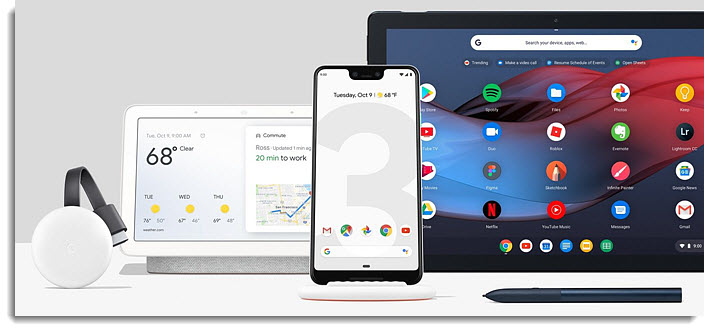
On Tuesday (10/9), Google invited journalists to New York City to debut its newest smartphone, the Pixel 3, among several other hardware goodies.

Google made dozens of announcements in its 75-minute event, but a handful of “wow” moments stole the show.

Here are the 11 coolest announcements Google made at its big hardware event…


Google’s Pixel 3 event in 6 minutes — from businessinsider.com


Google unveiled its new Home Hub but it might be ‘late to the market’ — from barrons.com by Emily Bary

Excerpt:

Alphabet ’s Google has sold millions of voice-enabled speakers, but it inched toward the future at a Tuesday launch event when it introduced the Home Hub smart screen.

Google isn’t the first company to roll out a screen-enabled home device with voice-assistant technology— Amazon.com released its Echo Show in July 2017. Meanwhile, Lenovo has gotten good reviews for its Smart Display, and Facebook introduced the Portal on Monday.

For the most part, though, consumers have stuck to voice-only devices, and it will be up to Google and its rivals to convince them that an added screen is worth paying for. They’ll also have to reassure consumers that they can trust big tech to maintain their privacy, an admittedly harder task these days after recent security issues at Google and Facebook.


Amazon was right to realize early on that consumers aren’t always comfortable buying items they can’t even see pictures of, and that it’s hard to remember directions you’ve heard but not seen.


Google has announced its first smart speaker with a screen — from businessinsider.com by Brandt Ranj

  • Google has announced the Google Hub, its first smart home speaker with a screen. It’s available for pre-order at Best Buy, Target, and Walmart for $149. The Hub will be released on October 22.
  • The Hub has a 7″ touchscreen and sits on a base with a built-in speaker and microphones, which you can use to play music, watch videos, get directions, and control smart home accessories with your voice.
  • Its biggest advantage is its ability to hook into Google’s first-party services, like YouTube and Google Maps, which none of its competitors can use.
  • If you’re an Android or Chromecast user, trust Google more than Amazon, or want a smaller smart home speaker with a screen, the Google Hub is now your best bet.


Google is shutting down Google+ for consumers following security lapse — from theverge.com by Ashley Carman

Excerpt:

Google is going to shut down the consumer version of Google+ over the next 10 months, the company writes in a blog post today. The decision follows the revelation of a previously undisclosed security flaw that exposed users’ profile data that was remedied in March 2018.


Google shutters Google+ after users’ personal data exposed — from cbsnews.com


Google+ is shutting down, and the site’s few loyal users are mourning – from cnbc.com by Jillian D’Onfro

  • Even though Google had diverted resources away from Google+, there’s a small loyal base of users devastated to see it go away.
  • One fan said the company is using its recently revealed security breach as an excuse to shutter the site.
  • Google said it will be closing Google+ in the coming months.


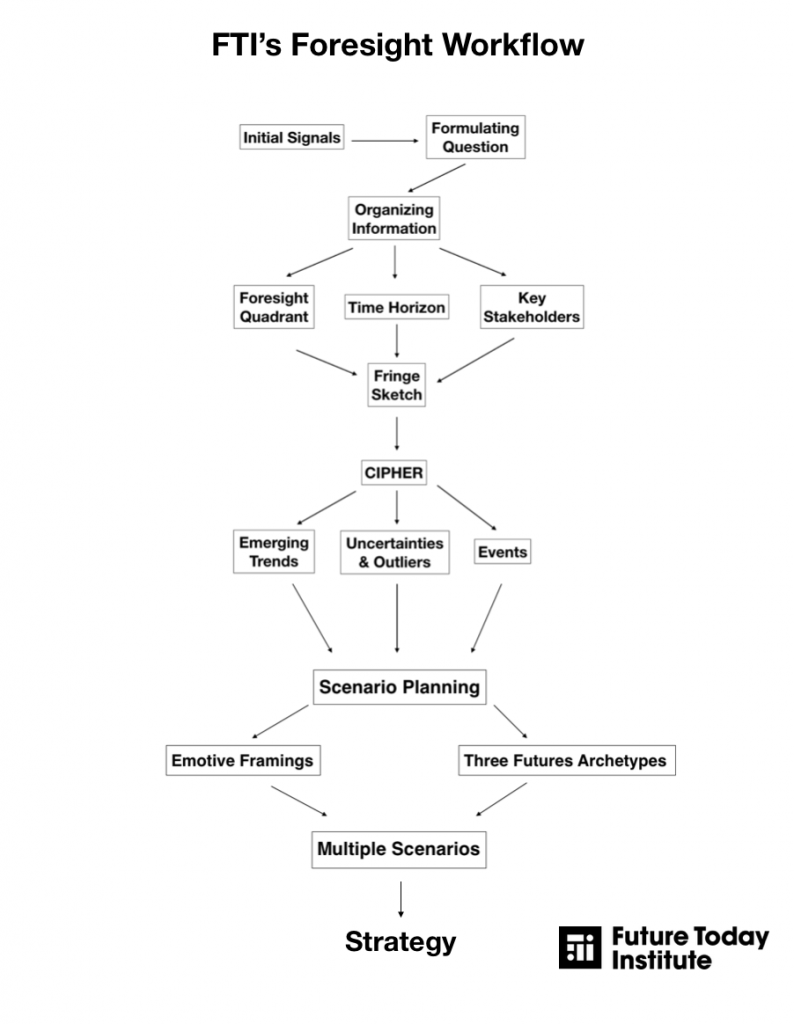
This is how the Future Today Institute researches, models & maps the future & develops strategies


This is how the Future Today Institute researches, models & maps the future & develops strategies


Also see what the Institute for the Future does in this regard

Foresight Tools
IFTF has pioneered tools and methods for building foresight ever since its founding days. Co-founder Olaf Helmer was the inventor of the Delphi Method, and early projects developed cross-impact analysis and scenario tools. Today, IFTF is methodologically agnostic, with a brimming toolkit that includes the following favorites…


From DSC:
How might higher education use this foresight workflow? How might we better develop a future-oriented mindset?

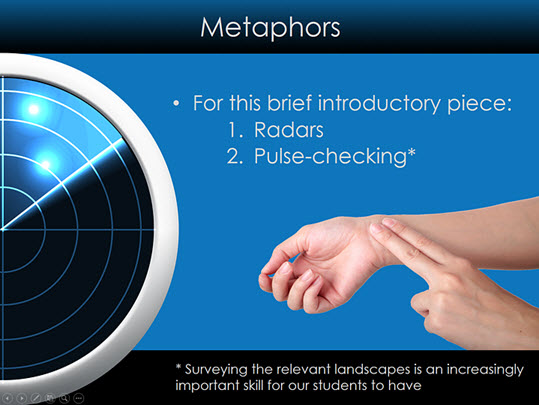
From my perspective, I think that we need to be pulse-checking a variety of landscapes, looking for those early signals. We need to be thinking about what should be on our radars. Then we need to develop some potential scenarios and strategies to deal with those potential scenarios if they occur. Graphically speaking, here’s an excerpted slide from my introductory piece for a NGLS 2017 panel that we did.


This resource regarding their foresight workflow was mentioned in  a recent e-newsletter from the FTI where they mentioned this important item as well:

  • Climate change: a megatrend that impacts us all
    Excerpt:
    Earlier this week, the United Nations’ scientific panel on climate change issued a dire report [PDF]. To say the report is concerning would be a dramatic understatement. Models built by the scientists show that at our current rate, the atmosphere will warm as much as 1.5 degrees Celsius, leading to a dystopian future of food shortages, wildfires, extreme winters, a mass die-off of coral reefs and more –– as soon as 2040. That’s just 20 years away from now.


But China also decided to ban the import of foreign plastic waste –– which includes trash from around the U.S. and Europe. The U.S. alone could wind up with an extra 37 million metric tons of plastic waste, and we don’t have a plan for what to do with it all.


Immediate Futures Scenarios: Year 2019

  • Optimistic: Climate change is depoliticized. Leaders in the U.S., Brazil and elsewhere decide to be the heroes, and invest resources into developing solutions to our climate problem. We understand that fixing our futures isn’t only about foregoing plastic straws, but about systemic change. Not all solutions require regulation. Businesses and everyday people are incentivized to shift behavior. Smart people spend the next two decades collaborating on plausible solutions.
  • Pragmatic: Climate change continues to be debated, while extreme weather events cause damage to our power grid, wreak havoc on travel, cause school cancellations, and devastate our farms. The U.S. fails to work on realistic scenarios and strategies to combat the growing problem of climate change. More countries elect far-right leaders, who shun global environmental accords and agreements. By 2029, it’s clear that we’ve waited too long, and that we’re running out of time to adapt.
  • Catastrophic: A chorus of voices calling climate change a hoax grows ever louder in some of the world’s largest economies, whose leaders choose immediate political gain over longer-term consequences. China builds an environmental coalition of 100 countries within the decade, developing both green infrastructure while accumulating debt service. Beijing sets global standards emissions––and it locks the U.S out of trading with coalition members. Trash piles up in the U.S., which didn’t plan ahead for waste management. By 2040, our population centers have moved inland and further north, our farms are decimated, our lives are miserable.

Watchlist: United Nations’ Intergovernmental Panel on Climate Change; European Geosciences Union; National Oceanic and Atmospheric Administration (NOAA); NASA; Department of Energy; Department of Homeland Security; House Armed Services Sub-committee on Emerging Threats and Capabilities; Environmental Justice Foundation; Columbia University’s Earth Institute; University of North Carolina at Wilmington; Potsdam Institute for Climate Impact Research; National Center for Atmospheric Research.


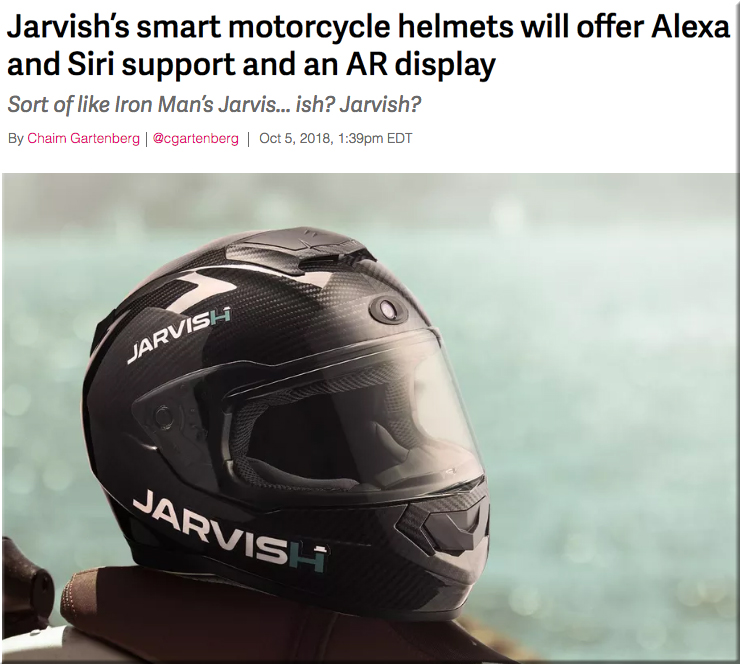
Jarvish’s smart motorcycle helmets will offer Alexa and Siri support and an AR display


Jarvish’s smart motorcycle helmets will offer Alexa and Siri support and an AR display — from the verge.com by Chaim Gartenberg

Excerpt:

The Jarvish X is the more basic of the two models. It offers integrated microphones and speakers for Siri, Google Assistant, and Alexa support so wearers have access things like directions, weather updates, and control music through voice control. There’s also a 2K, front-facing camera built into the helmet so you can record your ride. It’s set to cost $799 when it hits Kickstarter in January.


10 jobs that are safe in an AI world — from linkedin.com by Kai-Fu Lee

Excerpts:

Teaching
AI will be a great tool for teachers and educational institutions, as it will help educators figure out how to personalize curriculum based on each student’s competence, progress, aptitude, and temperament. However, teaching will still need to be oriented around helping students figure out their interests, teaching students to learn independently, and providing one-on-one mentorship. These are tasks that can only be done by a human teacher. As such, there will still be a great need for human educators in the future.

Criminal defense law
Top lawyers will have nothing to worry about when it comes to job displacement. reasoning across domains, winning the trust of clients, applying years of experience in the courtroom, and having the ability to persuade a jury are all examples of the cognitive complexities, strategies, and modes of human interaction that are beyond the capabilities of AI. However, a lot of paralegal and preparatory work like document review, analysis, creating contracts, handling small cases, packing cases, and coming up with recommendations can be done much better and more efficiently with AI. The costs of law make it worthwhile for AI companies to go after AI paralegals and AI junior lawyers, but not top lawyers.


From DSC:
In terms of teaching, I agree that while #AI will help personalize learning, there will still be a great need for human teachers, professors, and trainers. I also agree w/ my boss (and with some of the author’s viewpoints here, but not all) that many kinds of legal work will still need the human touch & thought processes. I diverge from his thinking in terms of scope — the need for human lawyers will go far beyond just lawyers involved in crim law.


Also see:

15 business applications for artificial intelligence and machine learning — from forbes.com

Excerpt:

Fifteen members of Forbes Technology Council discuss some of the latest applications they’ve found for AI/ML at their companies. Here’s what they had to say…


Choice: The key to reaching every student — from flr.flglobal.org by Terra Graves

Excerpt:

Who doesn’t like to have a choice?  This seems like a no-brainer to me. Whenever teachers can give their students choices in their learning process, everyone wins. When we have options, we tend to have more ownership of that experience. It also provides us with a sense of control, which most students do not experience in school. In her article on facultyfocus.com, Elizabeth Betsy Lasley EdD writes, “When students are asked to interpret, construct, and demonstrate their concepts or ideas regarding specific course concepts from a selection of product or performance options, content retention, commitment, motivation, and creativity increase.” Flipped Learning environments are ripe for offering choices to students in how they consume content and how they express their learning outcomes. Giving students choice allows us to reach every student, every day because it honors their individuality. Cassie Shoemaker explains it simply in her article Let it go: Giving students choices, “When teachers give students choices as to how they will show what they have learned, students become better problems solvers, more creative, and more engaged.” Problem-solving: It’s not just for math! Students NEED to have opportunities to make decisions in school to learn to make decisions in life. If we continue to spoonfeed and micromanage our students, they won’t learn to figure things out on their own.  Teachers by nature tend to be control freaks (including me). However, when we allow our students to try/fail/try again, we support their growth and confidence.


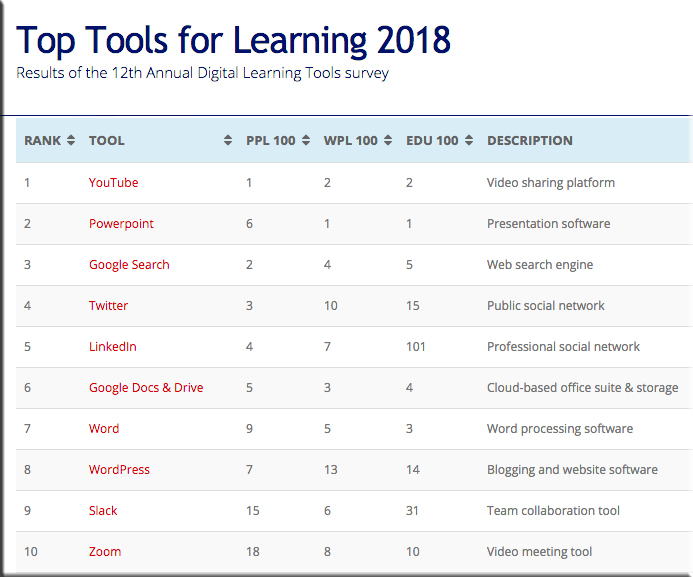
NEW: The Top Tools for Learning 2018 [Jane Hart]

The Top Tools for Learning 2018 from the 12th Annual Digital Learning Tools Survey -- by Jane Hart


The above was from Jane’s posting 10 Trends for Digital Learning in 2018 — from modernworkplacelearning.com by Jane Hart

Excerpt:

[On 9/24/18],  I released the Top Tools for Learning 2018 , which I compiled from the results of the 12th Annual Digital Learning Tools Survey.

I have also categorised the tools into 30 different areas, and produced 3 sub-lists that provide some context to how the tools are being used:

  • Top 100 Tools for Personal & Professional Learning 2018 (PPL100): the digital tools used by individuals for their own self-improvement, learning and development – both inside and outside the workplace.
  • Top 100 Tools for Workplace Learning (WPL100): the digital tools used to design, deliver, enable and/or support learning in the workplace.
  • Top 100 Tools for Education (EDU100): the digital tools used by educators and students in schools, colleges, universities, adult education etc.


3 – Web courses are increasing in popularity.
Although Coursera is still the most popular web course platform, there are, in fact, now 12 web course platforms on the list. New additions this year include Udacity and Highbrow (the latter provides daily micro-lessons). It is clear that people like these platforms because they can chose what they want to study as well as how they want to study, ie. they can dip in and out if they want to and no-one is going to tell them off – which is unlike most corporate online courses which have a prescribed path through them and their use is heavily monitored.


5 – Learning at work is becoming personal and continuous.
The most significant feature of the list this year is the huge leap up the list that Degreed has made – up 86 places to 47th place – the biggest increase by any tool this year. Degreed is a lifelong learning platform and provides the opportunity for individuals to own their expertise and development through a continuous learning approach. And, interestingly, Degreed appears both on the PPL100 (at  30) and WPL100 (at 52). This suggests that some organisations are beginning to see the importance of personal, continuous learning at work. Indeed, another platform that underpins this, has also moved up the list significantly this year, too. Anders Pink is a smart curation platform available for both individuals and teams which delivers daily curated resources on specified topics. Non-traditional learning platforms are therefore coming to the forefront, as the next point further shows.


From DSC:
Perhaps some foreshadowing of the presence of a powerful, online-based, next generation learning platform…?


How AI could help solve some of society’s toughest problems — from technologyreview.com by Charlotte Jee
Machine learning and game theory help Carnegie Mellon assistant professor Fei Fang predict attacks and protect people.

Excerpt:

Fei Fang has saved lives. But she isn’t a lifeguard, medical doctor, or superhero. She’s an assistant professor at Carnegie Mellon University, specializing in artificial intelligence for societal challenges.

At MIT Technology Review’s EmTech conference on Wednesday, Fang outlined recent work across academia that applies AI to protect critical national infrastructure, reduce homelessness, and even prevent suicides.


How AI can be a force for good — from science.sciencemag.org by Mariarosaria Taddeo & Luciano Floridi

Excerpts:

Invisibility and Influence
AI supports services, platforms, and devices that are ubiquitous and used on a daily basis. In 2017, the International Federation of Robotics suggested that by 2020, more than 1.7 million new AI-powered robots will be installed in factories worldwide. In the same year, the company Juniper Networks issued a report estimating that, by 2022, 55% of households worldwide will have a voice assistant, like Amazon Alexa.

As it matures and disseminates, AI blends into our lives, experiences, and environments and becomes an invisible facilitator that mediates our interactions in a convenient, barely noticeable way. While creating new opportunities, this invisible integration of AI into our environments poses further ethical issues. Some are domain-dependent. For example, trust and transparency are crucial when embedding AI solutions in homes, schools, or hospitals, whereas equality, fairness, and the protection of creativity and rights of employees are essential in the integration of AI in the workplace. But the integration of AI also poses another fundamental risk: the erosion of human self-determination due to the invisibility and influencing power of AI.

…

To deal with the risks posed by AI, it is imperative to identify the right set of fundamental ethical principles to inform the design, regulation, and use of AI and leverage it to benefit as well as respect individuals and societies. It is not an easy task, as ethical principles may vary depending on cultural contexts and the domain of analysis. This is a problem that the IEEE Global Initiative on Ethics of Autonomous and Intelligent Systems tackles with the aim of advancing public debate on the values and principles that should underpin ethical uses of AI.


Who’s to blame when a machine botches your surgery? — from qz.com by Robert Hart

Excerpt:

That’s all great, but even if an AI is amazing, it will still fail sometimes. When the mistake is caused by a machine or an algorithm instead of a human, who is to blame?

This is not an abstract discussion. Defining both ethical and legal responsibility in the world of medical care is vital for building patients’ trust in the profession and its standards. It’s also essential in determining how to compensate individuals who fall victim to medical errors, and ensuring high-quality care. “Liability is supposed to discourage people from doing things they shouldn’t do,” says Michael Froomkin, a law professor at the University of Miami.


Google Cloud’s new AI chief is on a task force for AI military uses and believes we could monitor ‘pretty much the whole world’ with drones — from businessinsider.in by Greg Sandoval

Excerpt:

“We could afford if we wanted to, and if we needed, to be surveilling pretty much the whole word with autonomous drones of various kinds,” Moore said. “I’m not saying we’d want to do that, but there’s not a technology gap there where I think it’s actually too difficult to do. This is now practical.”

…

Google’s decision to hire Moore was greeted with displeasure by at least one former Googler who objected to Project Maven.

“It’s worrisome to note after the widespread internal dissent against Maven that Google would hire Andrew Moore,” said one former Google employee. “Googlers want less alignment with the military-industrial complex, not more. This hire is like a punch in the face to the over 4,000 Googlers who signed the Cancel Maven letter.”


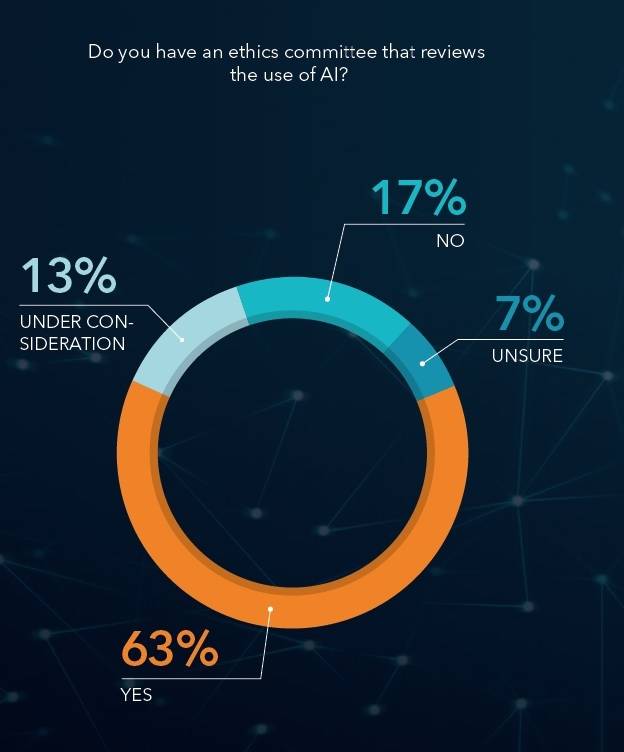
Organizations Are Gearing Up for More Ethical and Responsible Use of Artificial Intelligence, Finds Study — from businesswire.com
Ninety-two percent of AI leaders train their technologists in ethics; 74 percent evaluate AI outcomes weekly, says report from SAS, Accenture Applied Intelligence, Intel, and Forbes Insights

Excerpt:

AI oversight is not optional

Despite popular messages suggesting AI operates independently of human intervention, the research shows that AI leaders recognize that oversight is not optional for these technologies. Nearly three-quarters (74 percent) of AI leaders reported careful oversight with at least weekly review or evaluation of outcomes (less successful AI adopters: 33 percent). Additionally, 43 percent of AI leaders shared that their organization has a process for augmenting or overriding results deemed questionable during review (less successful AI adopters: 28 percent).


Do robots have rights? Here’s what 10 people and 1 robot have to say — from createdigital.org.au
When it comes to the future of technology, nothing is straightforward, and that includes the array of ethical issues that engineers encounter through their work with robots and AI.


© 2025 | Daniel Christian