30 Sites and Apps for Digital Storytelling — from cyber-kap.blogspot.com

Excerpt:

Digital Storytelling is the process of telling a story through the use of digital means. Also, it happens to be one the easiest ways to integrate technology into the classroom. Educators can use digital storytelling w/ almost any subject and can even “flip” their classroom by using mobile apps. Below is my comprehensive list of sites/apps that can be used for digital storytelling…


Why demand originality from students in online discussion forums? — from facultyfocus.com by Ronald Jones

Excerpt:

Tell me in your own words
Why demand originality? In relating to a traditional classroom discussion, do students respond to the professor’s question by opening up the textbook or searching for the answer on the Internet and then reading off the answer? Some might try, but by asking questions the professor is looking to see if the students grasp the discussed concept, not if they know how and where to find the answer.

Online students have the advantage of reflection time, along with having the textbook and Internet search engine open when responding to discussion questions. With a few simple clicks, virtually any question can be answered by searching the Internet. Once again, why demand originality? Classroom learning takes place when students are required to think; that’s a few steps beyond clicking copy and paste. As instructors, we should encourage our students to be resourceful and to learn the skills of locating and incorporating scholarly literature into their work. But we also must instill the learning value of synthesizing sources in such a manner that produces evidence of gained knowledge.


From DSC:
I like the idea of asking students to put it into their own words. Not just to get by the issue of copying/pasting or trying to stem plagiarism, but because it’s more along the line of journaling about our learning. We need to actually engage with some content in order to put that content into our own words. Not outsourcing our learning to others. Journaling can help us clarify what we’re understanding and where we still have questions and/or concerns.


Encouraging participation of all in the course: Moving from intact classes to individuals students — from scholarlyteacher.com by Todd Zakrajsek, University of North Carolina, Chapel Hill

Excerpts:

During every class session, read the room by watching individuals. Are students taking notes, nodding along as others speak, or even advancing the discussion by building on the comments of classmates? Are verbal responses merely defining terminology, or do they make connections between the text and real-world examples? Analyze the extent to which certain examples or content areas are received by individual students. Take note when student responses are merely noise to fill the void when you are not talking. Overall, look for individual characteristics that emerge within your course as a community of learning is being established.

Keep in mind that it is often less threatening to one’s ego to claim a lack of preparation for class than it is to admit that one is finding it difficult to understand the material. For those who need a bit of motivation to come prepared, a quiz at the beginning of class will help students to come to class ready to discuss the material for that day.


As all students are pressed for time these days, a quiz might be the added motivation that most students need. These quizzes do not need to be extremely challenging, but they should be challenging enough to ensure the required preparation is done. That is, one should not be able to get responses correct simply by guessing. For students who do not understand the material, quizzes will not prepare them to engage in class discussions or to answer your questions during a discussion lecture. For those students, failed quizzes might add additional pressure and cause less engagement with the material. Struggling students who are not prepared for class need assistance to understand the material. Carefully structured small group projects and discussions might be the best way to get their voices into the class. Ask increasingly difficult questions as part of the discussion, and when you know you have struggling students reserve some of the easier questions for those students.


Gen Zers look to teachers first, YouTube second for instruction — from campustechnology.com by Dian Schaffhauser

Excerpt:

Students in Generation Z would rather learn from YouTube videos than from nearly any other form of instruction. YouTube was designated as the preferred mode of learning by 59 percent of Gen Zers in a survey on the topic, compared to in-person group activities with classmates (mentioned by 57 percent), learning applications or games (47 percent) and printed books (also 47 percent). A majority (55 percent) believe that YouTube has “contributed to their education.” In fact, nearly half of survey participants (47 percent) reported spending three or more hours every day on YouTube.

The only method of instruction that beat out YouTube? Teachers. Almost four in five Gen Zers (78 percent) reported that their instructors “are very important to learning and development.” That’s nearly 20 percentage points higher than the YouTube option.

While Millennials also value teachers above all else for learning (chosen by 80 percent), that’s followed by printed books (60 percent), YouTube (55 percent), group activities (47 percent) and apps or games (41 percent).


Also, see the work from Pooja K. Agarwal | @PoojaAgarwal
Assistant Professor, Cognitive Scientist, & Former K-12 Teacher. Follow  and subscribe for teaching strategies at .

An example posting:

Retrieve, Space, Elaborate, and Transfer with Connection Notebooks — from retrievalpractice.org

Excerpts:

How can we encourage students to retrieve, elaborate, and connect with course content? Here’s a strategy called Connection Notebooks by James M. Lang, Professor at Assumption College. Connection Notebooks include retrieval practice, spacing, elaboration, and transfer – all in five minutes or less!

Ask students to dedicate a specific notebook as their Connection Notebook at the beginning of the semester (or provide one for them) and have them to bring it to class every day. Approximately once a week, ask students to take out their Connection Notebook and write a one-paragraph response to a “connection prompt” at the end of class. For example:

  • How does what you learned today connect to something you’ve learned in another class?
  • Have you ever encountered something you learned today in a TV show, movie, song, or book?
  • Have you ever experienced something you learned today in your life outside of school?


Connection Notebooks are effective for a few reasons:


Also, see the work from Learning Scientists | @AceThatTest | learningscientists.org

An example posting:


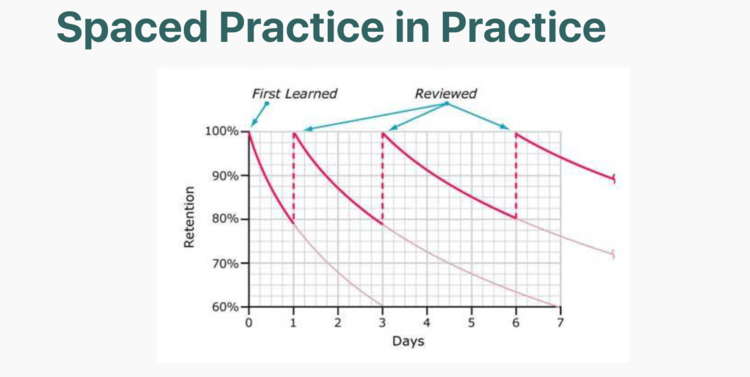
In this digest, we put together 5 blog posts by teachers that focus on implementing spaced practice in one specific subject at a time. For more of an overview of spaced practice, see this guest post by Jonathan Firth (@JW_Firth).


sapced practice in practice


Skype launches call recording across desktop, iOS, and Android — from windowscentral.com by Dan Thorp-Lancaster
Recording your Skype calls will now be much, much easier.


Microsoft's Skype now allows you to record your sessions


Excerpt:

Skype has been testing integrated call recording with preview users for some time, but it looks like the feature is now ready for primetime.  The Skype team announced today that call recording is now rolling out across its Android, iOS, and desktop apps, allowing you to capture your calls with a tap. “Call recording is completely cloud-based and is now available on the latest version of Skype and on most platforms, except Windows 10,” Microsoft says. “Call recording is coming to Windows 10 with the latest version of Skype releasing in the coming weeks.”


Also see:


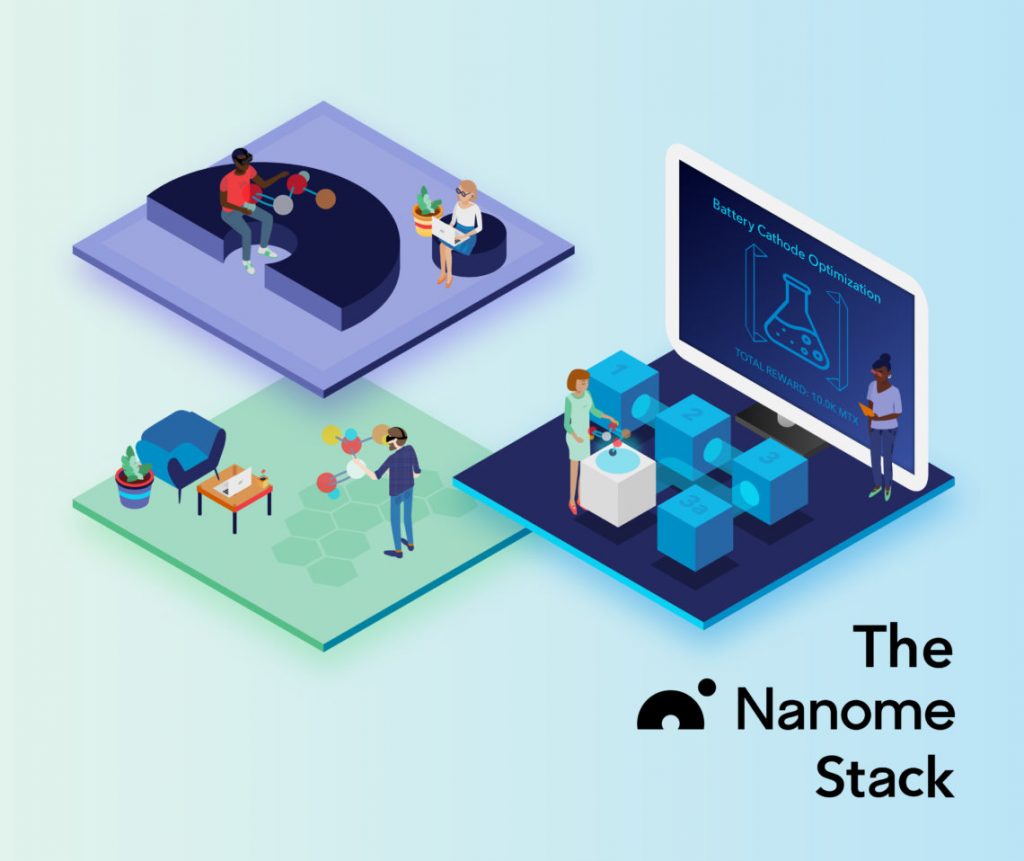
San Diego’s Nanome Inc. releases collaborative VR-STEM software for free — from vrscout.com by Becca Loux

Excerpt:

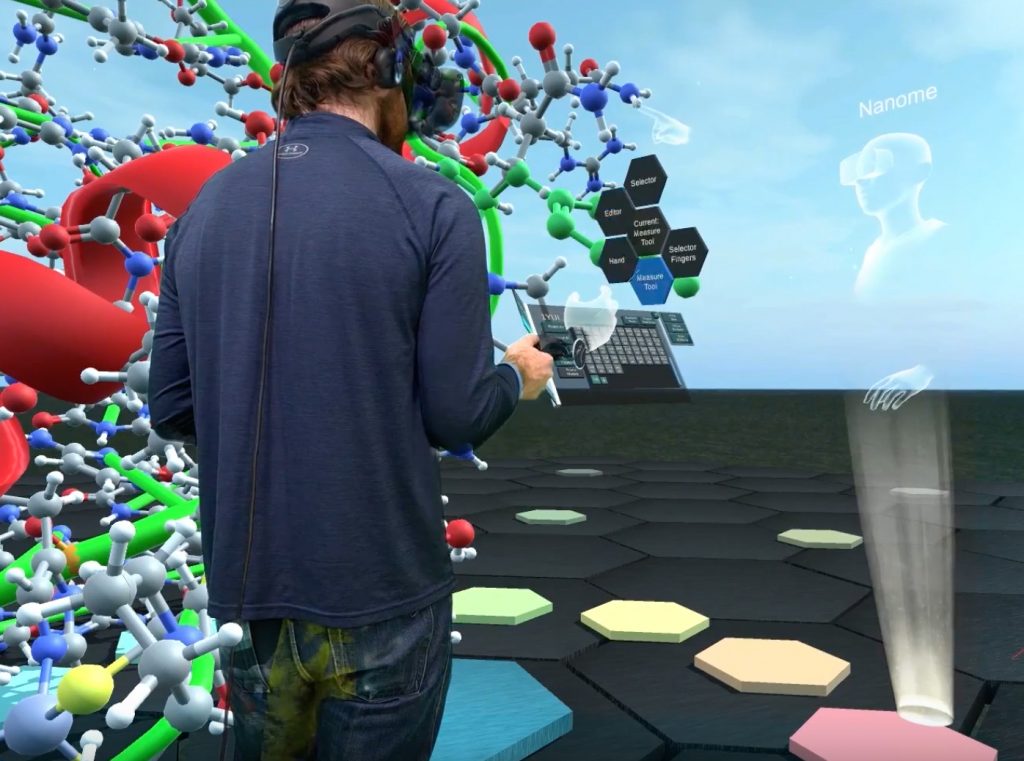
The first collaborative VR molecular modeling application was released August 29 to encourage hands-on chemistry experimentation.

The open-source tool is free for download now on Oculus and Steam.

Nanome Inc., the San Diego-based start-up that built the intuitive application, comprises UCSD professors and researchers, web developers and top-level pharmaceutical executives.


“With our tool, anyone can reach out and experience science at the nanoscale as if it is right in front of them. At Nanome, we are bringing the craftsmanship and natural intuition from interacting with these nanoscale structures at room scale to everyone,” McCloskey said.


San Diego’s Nanome Inc. Releases Collaborative VR-STEM Software For Free


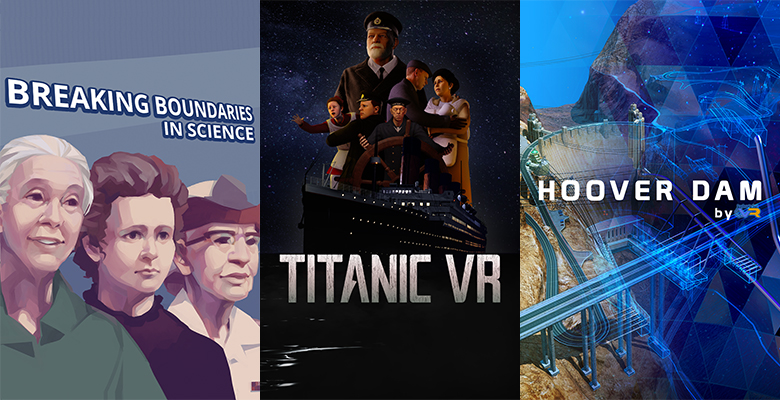
10 ways VR will change life in the near future — from forbes.com

Excerpts:

  1. Virtual shops
  2. Real estate
  3. Dangerous jobs
  4. Health care industry
  5. Training to create VR content
  6. Education
  7. Emergency response
  8. Distraction simulation
  9. New hire training
  10. Exercise


From DSC:
While VR will have its place — especially for timeswhen you need to completely immerse yourself into another environment — I think AR and MR will be much larger and have a greater variety of applications. For example, I could see where instructions on how to put something together in the future could use AR and/or MR to assist with that process. The system could highlight the next part that I’m looking for and then highlight the corresponding parts where it goes — and, if requested, can show me a clip on how it fits into what I’m trying to put together.


How MR turns firstline workers into change agents — from virtualrealitypop.com by Charlie Finkand
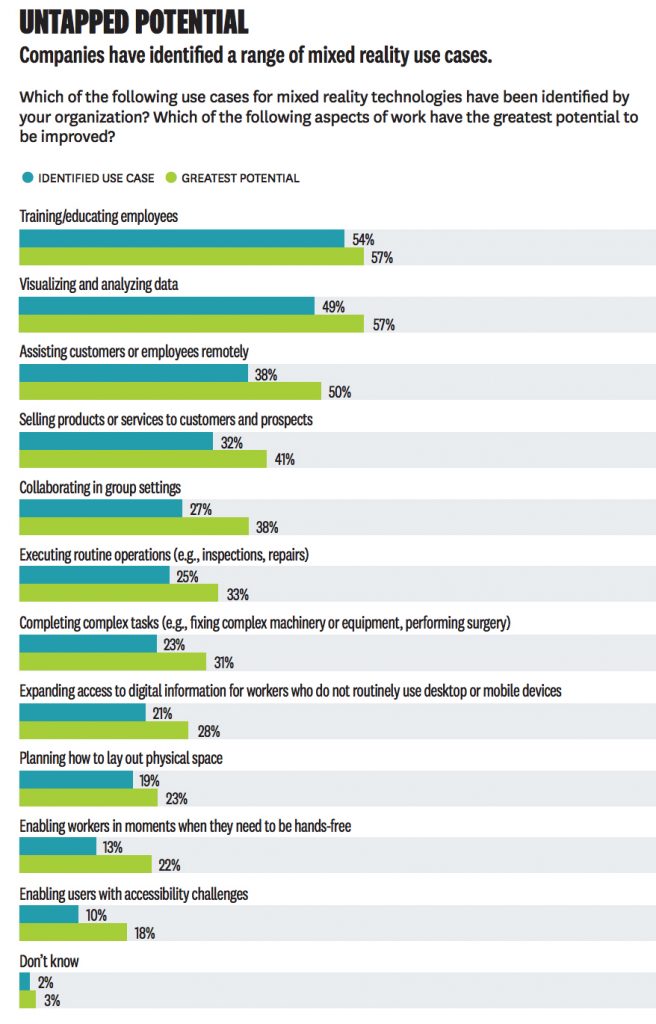
Mixed Reality, a new dimension of work — from Microsoft and Harvard Business Review

Excerpts:

Workers with mixed-reality solutions that enable remote assistance, spatial planning, environmentally contextual data, and much more,” Bardeen told me. With the HoloLens Firstline Workers workers conduct their usual, day-to-day activities with the added benefit of a heads-up, hands-free, display that gives them immediate access to valuable, contextual information. Microsoft says speech services like Cortana will be critical to control along with gesture, according to the unique needs of each situation.


Expect new worker roles. What constitutes an “information worker” could change because mixed reality will allow everyone to be involved in the collection and use of information. Many more types of information will become available to any worker in a compelling, easy-to-understand way. 


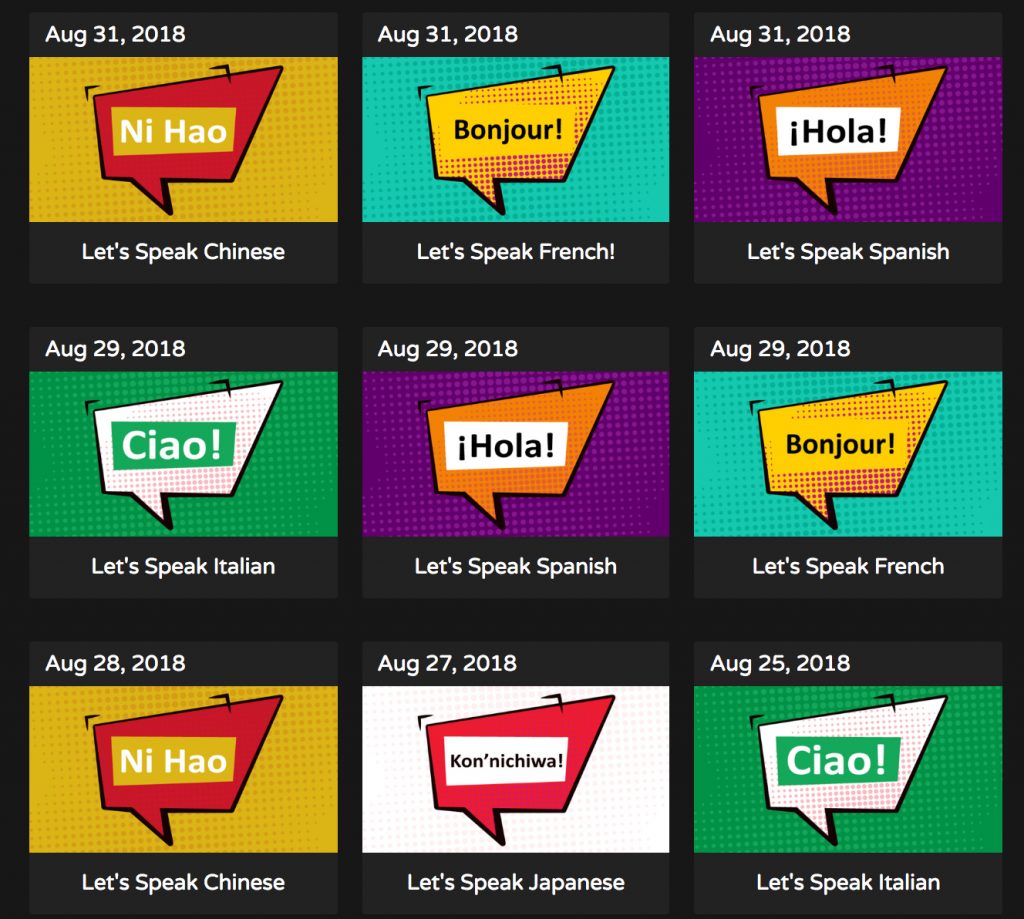
Let’s Speak: VR language meetups — from account.altvr.com


Smart Machines & Human Expertise: Challenges for Higher Education — from er.educause.edu by Diana Oblinger

Excerpts:

What does this mean for higher education? One answer is that AI, robotics, and analytics become disciplines in themselves. They are emerging as majors, minors, areas of emphasis, certificate programs, and courses in many colleges and universities. But smart machines will catalyze even bigger changes in higher education. Consider the implications in three areas: data; the new division of labor; and ethics.


Colleges and universities are challenged to move beyond the use of technology to deliver education. Higher education leaders must consider how AI, big data, analytics, robotics, and wide-scale collaboration might change the substance of education.


Higher education leaders should ask questions such as the following:

  • What place does data have in our courses?
  • Do students have the appropriate mix of mathematics, statistics, and coding to understand how data is manipulated and how algorithms work?
  • Should students be required to become “data literate” (i.e., able to effectively use and critically evaluate data and its sources)?

Higher education leaders should ask questions such as the following:

  • How might problem-solving and discovery change with AI?
  • How do we optimize the division of labor and best allocate tasks between humans and machines?
  • What role do collaborative platforms and collective intelligence have in how we develop and deploy expertise?


Higher education leaders should ask questions such as the following:

  • Even though something is possible, does that mean it is morally responsible?
  • How do we achieve a balance between technological possibilities and policies that enable—or stifle—their use?
  • An algorithm may represent a “trade secret,” but it might also reinforce dangerous assumptions or result in unconscious bias. What kind of transparency should we strive for in the use of algorithms?


Microsoft’s AI-powered Sketch2Code builds websites and apps from drawings — from alphr.com by Bobby Hellard
Microsoft Released on GitHub, Microsoft’s AI-powered developer tool can shave hours off web and app building

Excerpt:

Microsoft has developed an AI-powered web design tool capable of turning sketches of websites into functional HTML code.

Called Sketch2Code, Microsoft AI’s senior product manager Tara Shankar Jana explained that the tool aims to “empower every developer and every organisation to do more with AI”. It was born out of the “intrinsic” problem of sending a picture of a wireframe or app designs from whiteboard or paper to a designer to create HTML prototypes.


Google’s VR Labs provide STEM students with hands-on experience — from vrscout.com by Kyle Melnick

Excerpt:

STEM students engaged in scientific disciplines, such as biochemistry and neuroscience, are often required by their respective degrees to spend a certain amount of time engaged in an official laboratory environment. Unfortunately, crowded universities and the rise of online education have made it difficult for these innovators-in-training to access properly equipped labs and log their necessary hours.

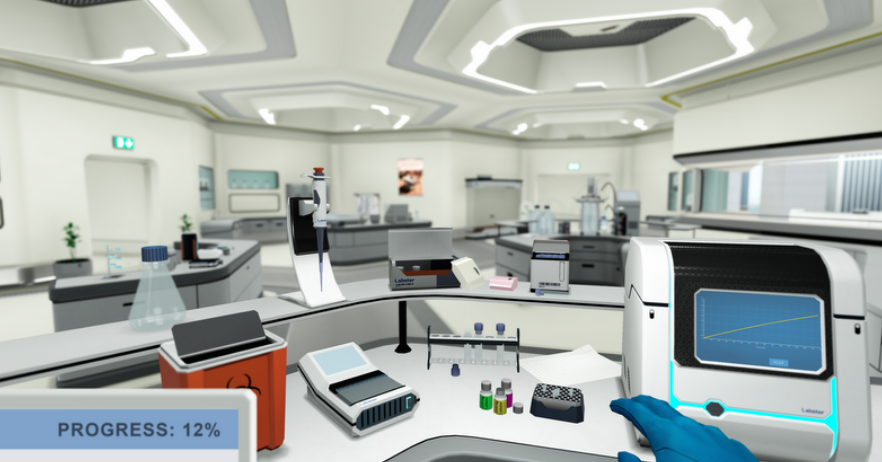
Cue Google VR Labs, a series of comprehensive virtual lab experiences available on the Google Daydream platform. Developed as part of partnership between Google and simulation education company Labster, the in-depth program boasts 30 interactive lab experiences in which biology students can engage in a series of hands-on scientific activities in a realistic environment.

These actions can include everything from the use of practical tools, such as DNA sequencers and microscopes, to reality-bending experiences only capable in a virtual environment, like traveling to the surface of the newly discovered Astakos IV exoplanet or examining and altering DNA on a molecular level.


Google’s VR Labs Provide STEM Students With Hands-On Experience


Also see:


Adobe Announces the 2019 Release of Adobe Captivate, Introducing Virtual Reality for eLearning Design — from theblog.adobe.com

Excerpt:

  • Immersive learning with VR experiences: Design learning scenarios that your learners can experience in Virtual Reality using VR headsets. Import 360° media assets and add hotspots, quizzes and other interactive elements to engage your learners with near real-life scenarios
  • Interactive videos: Liven up demos and training videos by making them interactive with the new Adobe Captivate. Create your own or bring in existing YouTube videos, add questions at specific points and conduct knowledge checks to aid learner remediation
  • Fluid Boxes 2.0: Explore the building blocks of Smart eLearning design with intelligent containers that use white space optimally. Objects placed in Fluid Boxes get aligned automatically so that learners always get fully responsive experience regardless of their device or browser.
  • 360° learning experiences: Augment the learning landscape with 360° images and videos and convert them into interactive eLearning material with customizable overlay items such as information blurbs, audio content & quizzes.


Blippar unveils indoor visual positioning system to anchor AR — from martechtoday.com by Barry Levine
Employing machine vision to recognize mapped objects, the company says it can determine which way a user is looking and can calculate positioning down to a centimeter.
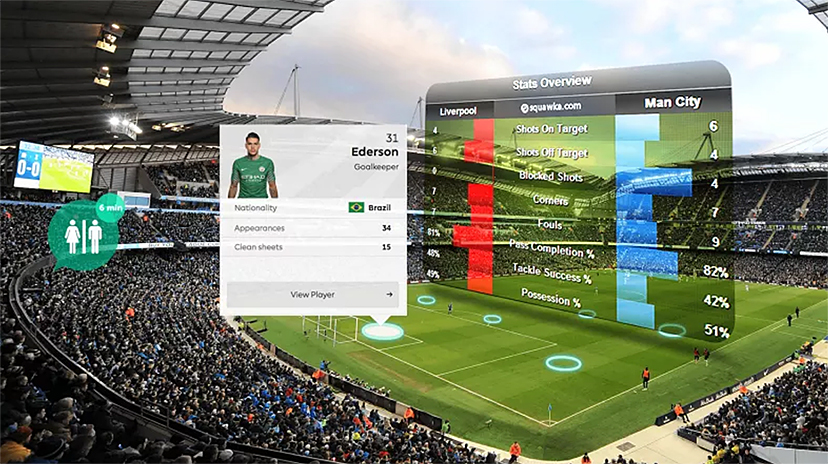
A Blippar visualization of AR using its new indoor visual positioning system


The Storyteller’s Guide to the Virtual Reality Audience — from medium.com by Katy Newton

Excerpt:

To even scratch the surface of these questions, we need to better understand the audience’s experience in VR — not just their experience of the technology, but the way that they understand story and their role within it.


Hospital introducing HoloLens augmented reality into the operating room — from medgadget.com

Excerpt:

HoloLens technology is being paired with Microsoft’s Surface Hub, a kind of digital whiteboard. The idea is that the surgical team can gather together around a Surface Hub to review patient information, discuss the details of a procedure, and select what information should be readily accessible during surgery. During the procedure, a surgeon wearing a HoloLens would be able to review a CT or MRI scan, access other data in the electronic medical records, and to be able to manipulate these so as to get a clear picture of what is being worked on and what needs to be done.


Raleigh Fire Department invests in virtual reality to enrich training — from vrfocus.com by Nikholai Koolon
New system allows department personnel to learn new skills through immersive experiences.

Excerpt:

The VR solution allows emergency medical services (EMS) personnel to dive into a rich and detailed environment which allows them to pinpoint portions of the body to dissect. This then allows them then see each part of the body in great detail along with viewing it from any angle. The goal is to allow for users to gain the experience to diagnose injuries from a variety of vantage points all where working within an virtual environment capable of displaying countless scenarios.


For another emerging technology, see:

Someday this tiny spider bot could perform surgery inside your body — from fastcompany.com by Jesus Diaz
The experimental robots could also fix airplane engines and find disaster victims.

Excerpt:

A team of Harvard University researchers recently achieved a major breakthrough in robotics, engineering a tiny spider robot using tech that could one day work inside your body to repair tissues or destroy tumors. Their work could not only change medicine–by eliminating invasive surgeries–but could also have an impact on everything from how industrial machines are maintained to how disaster victims are rescued.

Until now, most advanced, small-scale robots followed a certain model: They tend to be built at the centimeter scale and have only one degree of freedom, which means they can only perform one movement. Not so with this new ‘bot, developed by scientists at Harvard’s Wyss Institute for Biologically Inspired Engineering, the John A. Paulson School of Engineering and Applied Sciences, and Boston University. It’s built at the millimeter scale, and because it’s made of flexible materials–easily moved by pneumatic and hydraulic power–the critter has an unprecedented 18 degrees of freedom.


Plus some items from a few weeks ago


After almost a decade and billions in outside investment, Magic Leap’s first product is finally on sale for $2,295. Here’s what it’s like. — from

Excerpts (emphasis DSC):
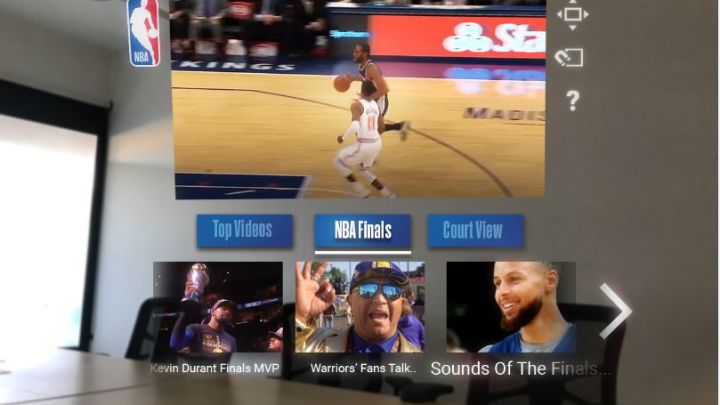
I liked that it gave a new perspective to the video clip I’d watched: It threw the actual game up on the wall alongside the kind of information a basketball fan would want, including 3-D renderings and stats. Today, you might turn to your phone for that information. With Magic Leap, you wouldn’t have to.

Abovitz also said that intelligent assistants will play a big role in Magic Leap’s future. I didn’t get to test one, but Abovitz says he’s working with a team in Los Angeles that’s developing high-definition people that will appear to Magic Leap users and assist with tasks. Think Siri, Alexa or Google Assistant, but instead of speaking to your phone, you’d be speaking to a realistic-looking human through Magic Leap. Or you might be speaking to an avatar of someone real.

“You might need a doctor who can come to you,” Abovitz said. “AI that appears in front of you can give you eye contact and empathy.”


And I loved the idea of being able to place a digital TV screen anywhere I wanted.


Magic Leap One Available For Purchase, Starting At $2,295 — from vrscout.com by Kyle Melnick

Excerpt:

December of last year U.S. startup Magic Leap unveiled its long-awaited mixed reality headset, a secretive device five years and $2.44B USD in the making.

This morning that same headset, now referred to as the Magic Leap One Creator Edition, became available for purchase in the U.S. On sale to creators at a hefty starting price of $2,275, the computer spatial device utilizes synthetic lightfields to capture natural lightwaves and superimpose interactive, 3D content over the real-world.
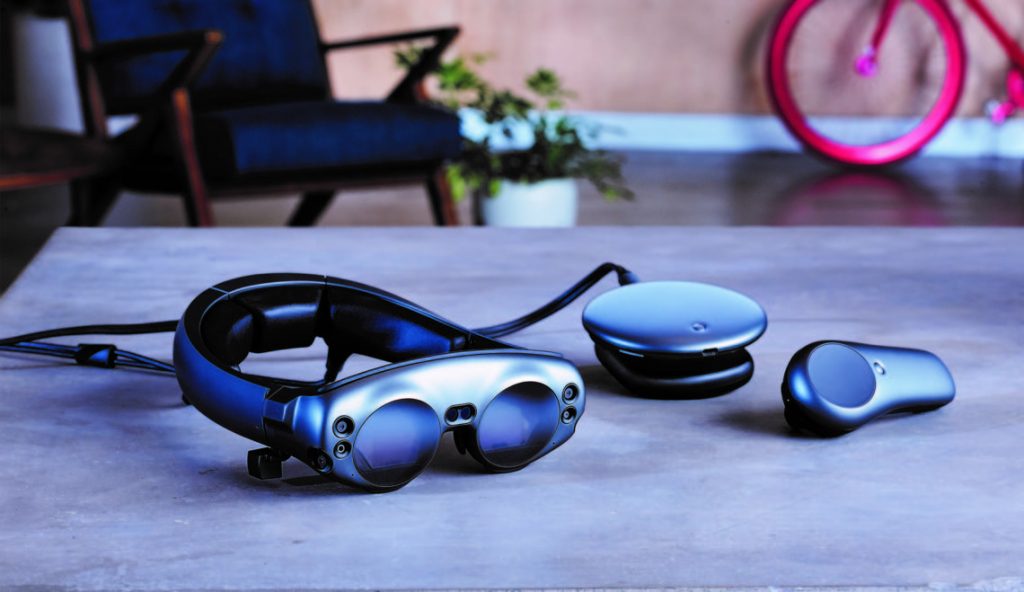


Magic Leap One First Hands-On Impressions for HoloLens Developers — from magic-leap.reality.news

Excerpt:

After spending about an hour with the headset running through set up and poking around its UI and a couple of the launch day apps, I thought it would be helpful to share a quick list of some of my first impressions as someone who’s spent a lot of time with a HoloLens over the past couple years and try to start answering many of the burning questions I’ve had about the device.


World Campus researches effectiveness of VR headsets and video in online classes — from news.psu.edu

Excerpt:

UNIVERSITY PARK, Pa. — Penn State instructional designers are researching whether using virtual reality and 360-degree video can help students in online classes learn more effectively.

Designers worked with professors in the College of Nursing to incorporate 360-degree video into Nursing 352, a class on Advanced Health Assessment. Students in the class, offered online through Penn State World Campus, were offered free VR headsets to use with their smartphones to create a more immersive experience while watching the video, which shows safety and health hazards in a patient’s home.

Bill Egan, the lead designer for the Penn State World Campus RN to BSN nursing program, said students in the class were surveyed as part of a study approved by the Institutional Review Board and overwhelmingly said that they enjoyed the videos and thought they provided educational value. Eighty percent of the students said they would like to see more immersive content such as 360-degree videos in their online courses, he said.


7 Practical Problems with VR for eLearning — from learnupon.com

Excerpt:

In this post, we run through some practical stumbling blocks that prevent VR training from being feasible for most.

There are quite a number of practical considerations which prevent VR from totally overhauling the corporate training world. Some are obvious, whilst others only become apparent after using the technology a number of times. It’s important to be made aware of these limitations so that a large investment isn’t made in tech that isn’t really practical for corporate training.


Augmented reality – the next big thing for HR? — from hrdconnect.com
Augmented reality (AR) could have a huge impact on HR, transforming long-established processes into engaging and exciting something. What will this look like? How can we shape this into our everyday working lives?

Excerpt (emphasis DSC):

AR also has the potential to revolutionise our work lives, changing the way we think about office spaces and equipment forever.

Most of us still commute to an office every day, which can be a time-consuming and stressful experience. AR has the potential to turn any space into your own customisable workspace, complete with digital notes, folders and files – even a digital photo of your loved ones. This would give you access to all the information and tools that you would typically find in an office, but wherever and whenever you need them.

And instead of working on a flat, stationary, two-dimensional screen, your workspace would be a customisable three-dimensional space, where objects and information are manipulated with gestures rather than hardware. All you would need is an AR headset.

AR could also transform the way we advertise brands and share information. Imagine if your organisation had an AR stand at a conference – how engaging would that be for potential customers? How much more interesting and fun would meetings be if we used AR to present information instead of slides on a projector?

AR could transform the on-boarding experience into something fun and interactive – imagine taking an AR tour of your office, where information about key places, company history or your new colleagues pops into view as you go from place to place. 


RETINA Are Bringing Augmented Reality To Air Traffic Control Towers — from vrfocus.com by Nikholai Koolonavi

Excerpt:

A new project is aiming to make it easier for staff in airport control towers to visualize information to help make their job easier by leveraging augmented reality (AR) technology. The project, dubbed RETINA, is looking to modernise Europe’s air traffic management for safer, smarter and even smoother air travel.


It’s time to address artificial intelligence’s ethical problems — from wired.co.uk by Abigail Beall
AI is already helping us diagnose cancer and understand climate change, but regulation and oversight are needed to stop the new technology being abused

Excerpt:

The potential for AI to do good is immense, says Taddeo. Technology using artificial intelligence will have the capability to tackle issues “from environmental disasters to financial crises, from crime, terrorism and war, to famine, poverty, ignorance, inequality, and appalling living standards,” she says.

Yet AI is not without its problems. In order to ensure it can do good, we first have to understand the risks.

The potential problems that come with artificial intelligence include a lack of transparency about what goes into the algorithms. For example, an autonomous vehicle developed by researchers at the chip maker Nvidia went on the roads in 2016, without anyone knowing how it made its driving decisions.


Three AI and machine learning predictions for 2019 — from forbes.com by Daniel Newman

Excerpt:

What could we potentially see next year? New and innovative uses for machine learning? Further evolution of human and machine interaction? The rise of AI assistants? Let’s dig deeper into AI and machine learning predictions for the coming months.


2019 will be a year of development for the AI assistant, showing us just how powerful and useful these tools are. It will be in more places than your home and your pocket too. Companies such as Kia and Hyundai are planning to include AI assistants in their vehicles starting in 2019. Sign me up for a new car! I’m sure that Google, Apple, and Amazon will continue to make advancements to their AI assistants making our lives even easier.


DeepMind AI matches health experts at spotting eye diseases — from endgadget.com by Nick Summers

Excerpt:

DeepMind has successfully developed a system that can analyze retinal scans and spot symptoms of sight-threatening eye diseases. Today, the AI division — owned by Google’s parent company Alphabet — published “early results” of a research project with the UK’s Moorfields Eye Hospital. They show that the company’s algorithms can quickly examine optical coherence tomography (OCT) scans and make diagnoses with the same accuracy as human clinicians. In addition, the system can show its workings, allowing eye care professionals to scrutinize the final assessment.


Microsoft and Amazon launch Alexa-Cortana public preview for Echo speakers and Windows 10 PCs — from venturebeat.com by Khari Johnson

Excerpt:

Microsoft and Amazon will bring Alexa and Cortana to all Echo speakers and Windows 10 users in the U.S. [on 8/15/18]. As part of a partnership between the Seattle-area tech giants, you can say “Hey Cortana, open Alexa” to Windows 10 PCs and “Alexa, open Cortana” to a range of Echo smart speakers.

The public preview bringing the most popular AI assistant on PCs together with the smart speaker with the largest U.S. market share will be available to most people today but will be rolled out to all users in the country over the course of the next week, a Microsoft spokesperson told VentureBeat in an email.

Each of the assistants brings unique features to the table. Cortana, for example, can schedule a meeting with Outlook, create location-based reminders, or draw on LinkedIn to tell you about people in your next meeting. And Alexa has more than 40,000 voice apps or skills made to tackle a broad range of use cases.


What Alexa can and cannot do on a PC — from venturebeat.com by Khari Johnson

Excerpt:

Whatever happened to the days of Alexa just being known as a black cylindrical speaker? Since the introduction of the first Echo in fall 2014, Amazon’s AI assistant has been embedded in a number of places, including car infotainment systems, Alexa smartphone apps, wireless headphones, Echo Show and Fire tablets, Fire TV Cube for TV control, the Echo Look with an AI-powered fashion assistant, and, in recent weeks, personal computers.

Select computers from HP, Acer, and others now make Alexa available to work seamlessly alongside Microsoft’s Cortana well ahead of the Alexa-Cortana partnership for Echo speakers and Windows 10 devices, a project that still has no launch date.


2018 NMC Horizon Report: The trends, challenges, and developments likely to influence ed tech

2018 NMC Horizon Report — from library.educause.edu

Excerpt:

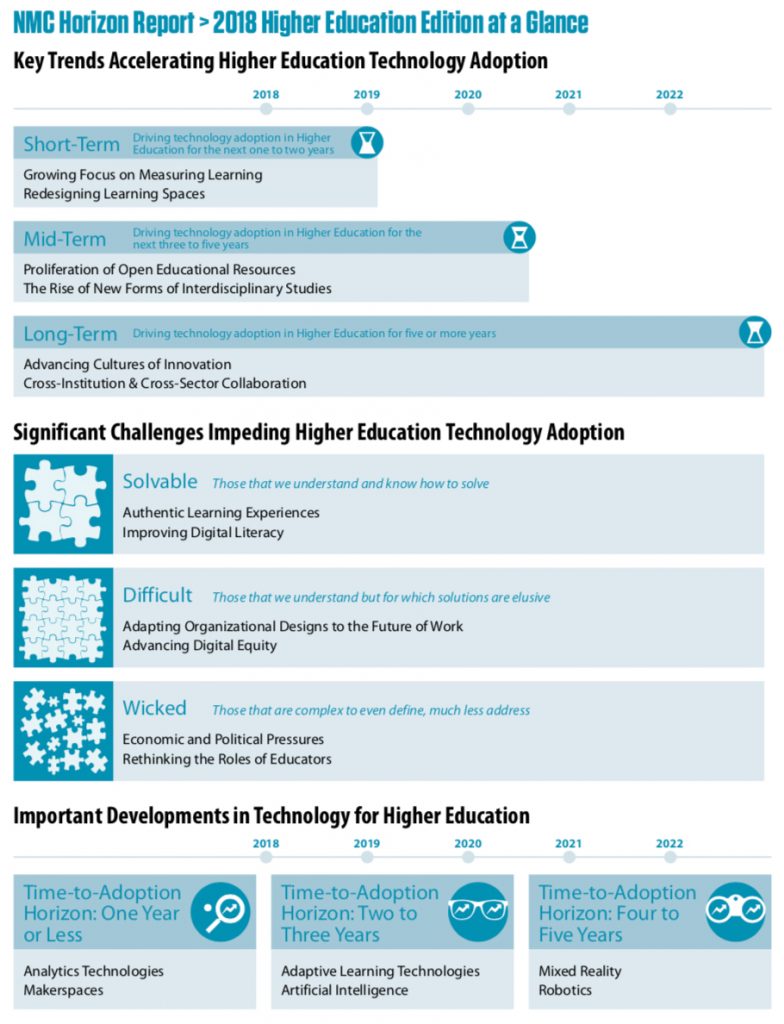
What is on the five-year horizon for higher education institutions? Which trends and technology developments will drive educational change? What are the critical challenges and how can we strategize solutions? These questions regarding technology adoption and educational change steered the discussions of 71 experts to produce the NMC Horizon Report: 2018 Higher Education Edition brought to you by EDUCAUSE. This Horizon Report series charts the five-year impact of innovative practices and technologies for higher education across the globe. With more than 16 years of research and publications, the Horizon Project can be regarded as one of education’s longest-running explorations of emerging technology trends and uptake.

Six key trends, six significant challenges, and six developments in educational technology profiled in this higher education report are likely to impact teaching, learning, and creative inquiry in higher education. The three sections of this report constitute a reference and technology planning guide for educators, higher education leaders, administrators, policymakers, and technologists.


2018 NMC Horizon Report -- a glance at the trends, challenges, and developments likely to influence ed tech -- visual graphic


Also see:


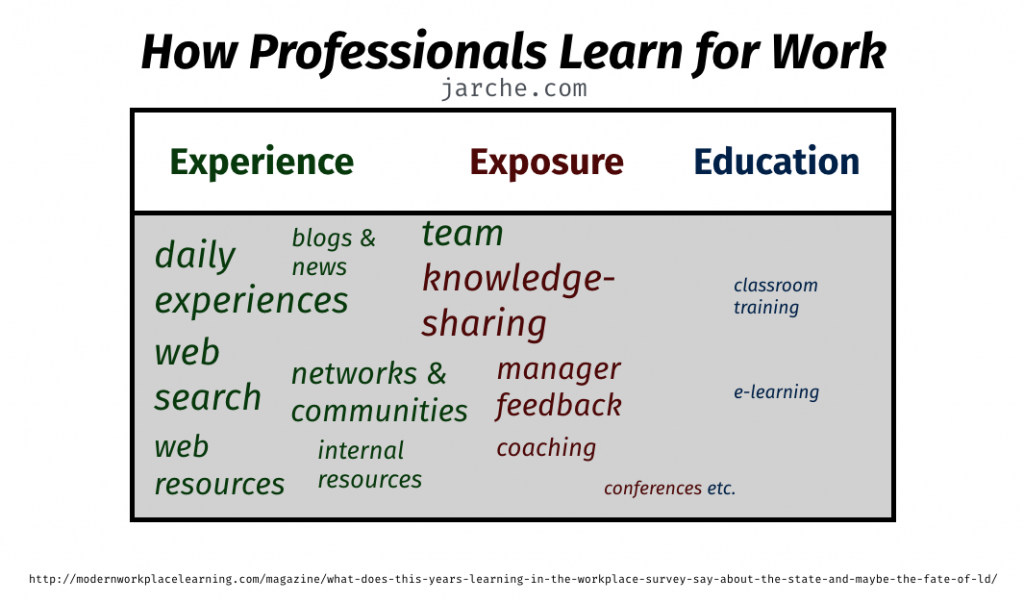
How professionals learn for work — from jarche.com by Harold Jarche

Excerpt:

On the image below the methods are colour-coded to Experience (70%), Exposure (20%), and Education (10%). The size of text indicates the importance as ranked by the survey respondents. Note that some of these methods cross boundaries, such as team knowledge sharing & conferences.


Also see:


Training strategies should consider the reality of how people learn; content should always be available remotely – increasingly via mobile – and at the learner’s convenience in bite-sized chunks, making use of video, gamification and collaboration.


Campus Technology recently announced the recipients of the 2018 Campus Technology Impact Awards.


Campus Technology recently announced the recipients of the 2018 Campus Technology Impact Awards.


Categories include:

  • Teaching and Learning
  • Education Futurists
  • Student Systems & Services
  • Administration
  • IT Infrastructure & Systems


From DSC:
Having served as one of the judges for these competitions during the last several years, I really appreciate the level of innovation that’s been displayed by many of the submissions and the individuals/institutions behind them. 


Why higher ed should do more with blockchain tech — from by Dian Schaffhauser
Oral Roberts University recently held a conference to persuade higher education institutions that it’s time to get on board the blockchain train. Its recommendations: Learn about the technology’s potential, test it out and collaborate.

Excerpt:

As CIO Michael Mathews, the event’s organizer, explained, blockchain will be as important to transforming education as the internet was. He said he believes those colleges and universities that jump on the secure public ledger concept early enough and begin testing it out will be the ones who could see the biggest benefits.

Mathews believes blockchain will have the “biggest payback” within an organization’s processes where trust is essential as part of a “value chain”: student application processing, transcript evaluations, articulation agreements. Blockchain “templates” that run in the cloud could replace “entire cumbersome processes”…


From DSC:
It could easily be that blockchain-based technologies and processes feed into cloud/web-based learner profiles in the future. That’s one aspect of the next generation learning platform that I’m pulse checking — I call it Learning from the Living [Class] Room.


Blockchain could be involved with cloud/web-based learner profiles in the future

Blockchain -- something to keep on our radars in higher education


Also, from a while back…

Oracle to Launch Blockchain Products This Month — from investopedia.com by Shobhit Seth

Excerpt:

Tech corporations are seeing big opportunities in the blockchain space, and are now in a closely contested race to seize them sooner rather than later.

Oracle Corp. has announced that it will unveil its blockchain software later this month, reports Bloomberg. Oracle will launch its platform-as-a-service blockchain product later this month, which will be followed by launch of the decentralized ledger-based applications next month.

The Redwood City, California-based software giant is already having clients on board for its blockchain offerings. Santiago-based Banco de Chile is one of the early clients that Oracle is working with to record inter-bank transactions on a hyperledger. The world’s second-largest software company is also working with the government of Nigeria, which is aiming to document customs and import duties on a blockchain. Oracle is also hopeful of offering solutions to a large number of pharmaceutical companies to efficiently track and locate batches of drugs to help them reduce the number of recalls. Thomas Kurian, president of product development, said that Oracle’s products will be compatible with other platforms.


8 great iPad audio recording apps for teachers & students — from educatorstechnology.com

Excerpt:

For those of you asking about audio recording apps to use on iPad, here is a list of some of the best options out there. Whether you want to record a lecture, an audio note, a memo, or simply capture ideas and thoughts as they happen, the apps below provide you with the necessary technology to do so, and in the easiest and most effective way.

 
© 2025 | Daniel Christian