DARPA is reportedly eyeing a high-tech contact lens straight out of ‘Mission: Impossible’ — from taskandpurpose.com by Jared Keller


Just because we can...does not mean we should.

Excerpt:

The Defense Advanced Research Projects Agency (DARPA) is reportedly interested in a new wirelessly-connected contact lens recently unveiled in France, the latest in the agency’s ongoing search for small-scale technology to augment U.S. service members’ visual capabilities in the field.


From DSC:
We may not be there yet (and in my mind, that’s a good thing). But when this tech gets further developed and gets its foot in the door — military style — it may then expand its reach and scope. Then it gets integrated into other areas of society. If many people were very uncomfortable having someone walk in a public place wearing/using a pair of Google Glasses, how will they/we feel about this one? Speaking for myself, I don’t like it.


How blockchain, virtual assistants and AI are changing higher ed — from educationdive.com by Ben Unglesbee

Dive Brief:

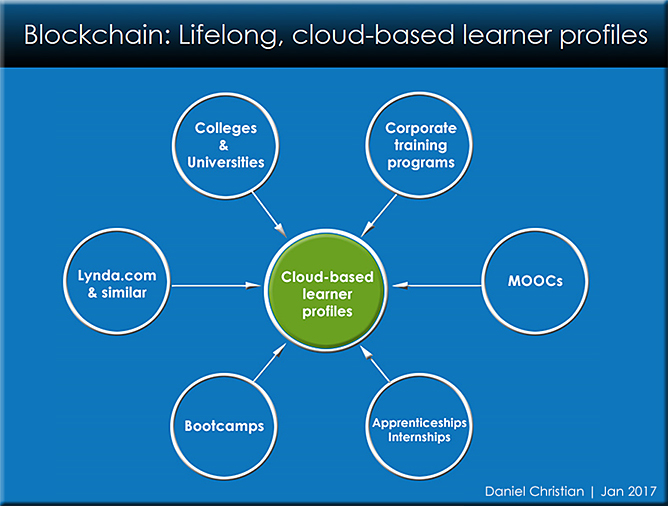
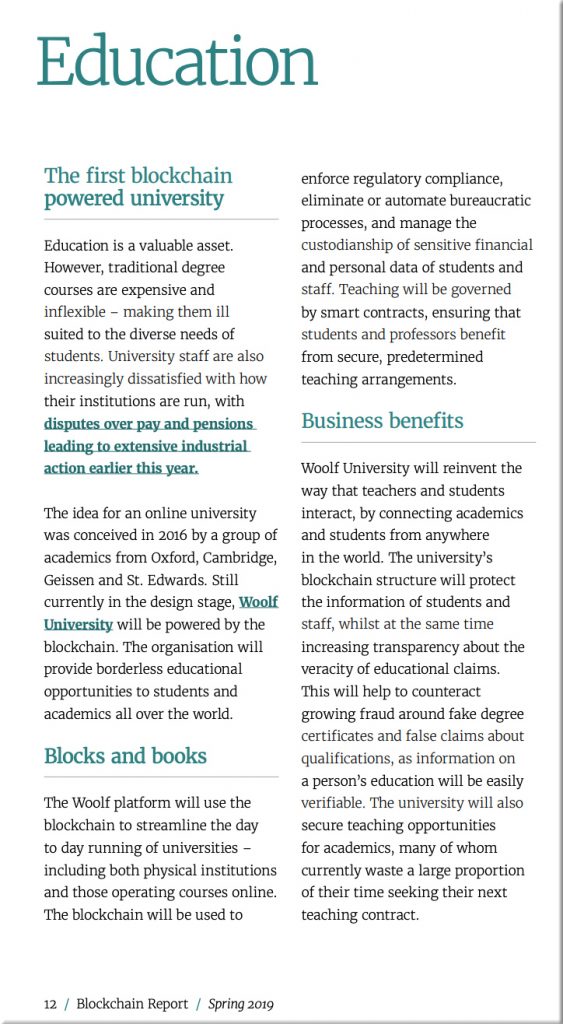
  • In the coming years, advanced technologies like mixed reality, artificial intelligence (AI), blockchain and virtual assistants could play a bigger role at colleges and universities, according to a new report from Educause, a nonprofit focused on IT’s role in higher ed.
  • The 2019 Horizon Report, based on a panel of higher ed experts, zeroes in on trends, challenges and developments in educational technology. Challenges range from the “solvable,” such as improving digital fluency and increasing demand for digital learning experiences, to the “wicked.” The latter includes rethinking teaching and advancing digital equity.
  • The panel contemplated blockchain’s use in higher ed for the first time in the 2019 report. Specifically, the authors looked at its potential for creating alternative forms of academic records that “could follow students from one institution to another, serving as verifiable evidence of learning and enabling simpler transfer of credits across institutions.”


An algorithm wipes clean the criminal pasts of thousands — from bbc.com by Dave Lee

Excerpt:

This month, a judge in California cleared thousands of criminal records with one stroke of his pen. He did it thanks to a ground-breaking new algorithm that reduces a process that took months to mere minutes. The programmers behind it say: we’re just getting started solving America’s urgent problems.


The finalized 2019 Horizon Report Higher Education Edition (from library.educause.edu) was just released on 4/23/19.

Excerpt:

Key Trends Accelerating Technology Adoption in Higher Education:

Short-TermDriving technology adoption in higher education for the next one to two years

  • Redesigning Learning Spaces
  • Blended Learning Designs

Mid-TermDriving technology adoption in higher education for the next three to five years

  • Advancing Cultures of Innovation
  • Growing Focus on Measuring Learning

Long-TermDriving technology adoption in higher education for five or more years

  • Rethinking How Institutions Work
  • Modularized and Disaggregated Degrees


5 Myths of AI — from thejournal.com by Dian Schaffhauser

Excerpt:

No, artificial intelligence can’t replace the human brain, and no, we’ll never really be able to make AI bias-free. Those are two of the 10 myths IT analyst and consulting firm Gartner tackled in its recent report, Debunking Myths and Misconceptions About Artificial Intelligence.”


From LinkedIn.com today:


Also see:


From DSC:
I don’t like this at all. If this foot gets in the door, vendor after vendor will launch their own hordes of drones. In the future, where will we go if we want some piece and quiet? Will the air be filled with swarms of noisy drones? Will we be able to clearly see the sun? An exaggeration..? Maybe…maybe not.

But, now what? What recourse do citizens have? Readers of this blog know that I’m generally pro-technology. But the folks — especially the youth — working within the FAANG companies (and the like) need to do a far better job asking, “Just because we can do something, should we do it?”

As I’ve said before, we’ve turned over the keys to the $137,000 Maserati to drivers who are just getting out of driving school. Then we wonder….”How did we get to this place?” 


If you owned this $137,000+ car, would you turn the keys of it over to your 16-25 year old?!


As another example, just because we can…

just because we can does not mean we should


…doesn’t mean we should.


just because we can does not mean we should


Minerva’s Innovative Platform Makes Quality Higher Ed Personal and Affordable — from linkedin.com by Tom Vander Ark

Excerpt:

The first external partner, the Hong Kong University of Science and Technology (HKUST), loved the course design and platform but told Nelson they couldn’t afford to teach 15 students at a time. The Minerva team realized that to be applicable at major universities, active learning needed to be scalable.

Starting this summer, a new version of Forum will be available for classes of up to 400 at a time. For students, it will still feel like a small seminar. They’ll see the professor, themselves, and a dozen other students. Forum will manage the movement of students from screen to screen. “Everybody thinks they are in the main room,” said Nelson.

Forum enables real-time polling and helps professors create and manage breakout groups.

Big Implications
With Forum, “For the first time you can deliver better than Ivy League education at absurdly low cost,” said Nelson.

Online courses and MOOCs just repackaged the same format and just offered it with less interaction. As new Forum partners will demonstrate, “It’s possible to deliver a year of undergraduate education that is vastly superior for under $5,000 per student,” added Nelson.

He’s excited to offer a turnkey university solution that, for partners like Oxford Teachers Academy, will allow new degree pathways for paraprofessionals that can work, learn, and earn a degree and certification.


Perhaps another piece of the puzzle is falling into place…


Another piece of the puzzle is coming into place...for the Learning from the Living Class Room vision


We Built an ‘Unbelievable’ (but Legal) Facial Recognition Machine — from nytimes.com by Sahil Chinoy

“The future of human flourishing depends upon facial recognition technology being banned,” wrote Woodrow Hartzog, a professor of law and computer science at Northeastern, and Evan Selinger, a professor of philosophy at the Rochester Institute of Technology, last year. ‘Otherwise, people won’t know what it’s like to be in public without being automatically identified, profiled, and potentially exploited.’ Facial recognition is categorically different from other forms of surveillance, Mr. Hartzog said, and uniquely dangerous. Faces are hard to hide and can be observed from far away, unlike a fingerprint. Name and face databases of law-abiding citizens, like driver’s license records, already exist. And for the most part, facial recognition surveillance can be set up using cameras already on the streets.” — Sahil Chinoy; per a weekly e-newsletter from Sam DeBrule at Machine Learnings in Berkeley, CA

Excerpt:

Most people pass through some type of public space in their daily routine — sidewalks, roads, train stations. Thousands walk through Bryant Park every day. But we generally think that a detailed log of our location, and a list of the people we’re with, is private. Facial recognition, applied to the web of cameras that already exists in most cities, is a threat to that privacy.

To demonstrate how easy it is to track people without their knowledge, we collected public images of people who worked near Bryant Park (available on their employers’ websites, for the most part) and ran one day of footage through Amazon’s commercial facial recognition service. Our system detected 2,750 faces from a nine-hour period (not necessarily unique people, since a person could be captured in multiple frames). It returned several possible identifications, including one frame matched to a head shot of Richard Madonna, a professor at the SUNY College of Optometry, with an 89 percent similarity score. The total cost: about $60.


From DSC:
What do you think about this emerging technology and its potential impact on our society — and on other societies like China? Again I ask…what kind of future do we want?

As for me, my face is against the use of facial recognition technology in the United States — as I don’t trust where this could lead.

This wild, wild, west situation continues to develop. For example, note how AI and facial recognition get their foot in the door via techs installed years ago:

The cameras in Bryant Park were installed more than a decade ago so that people could see whether the lawn was open for sunbathing, for example, or check how busy the ice skating rink was in the winter. They are not intended to be a security device, according to the corporation that runs the park.

So Amazon’s use of facial recognition is but another foot in the door. 

This needs to be stopped. Now.


Facial recognition technology is a menace disguised as a gift. It’s an irresistible tool for oppression that’s perfectly suited for governments to display unprecedented authoritarian control and an all-out privacy-eviscerating machine.

We should keep this Trojan horse outside of the city. (source)


AI’s white guy problem isn’t going away — from technologyreview.com by Karen Hao
A new report says current initiatives to fix the field’s diversity crisis are too narrow and shallow to be effective.

Excerpt:

The numbers tell the tale of the AI industry’s dire lack of diversity. Women account for only 18% of authors at leading AI conferences, 20% of AI professorships, and 15% and 10% of research staff at Facebook and Google, respectively. Racial diversity is even worse: black workers represent only 2.5% of Google’s entire workforce and 4% of Facebook’s and Microsoft’s. No data is available for transgender people and other gender minorities—but it’s unlikely the trend is being bucked there either.

This is deeply troubling when the influence of the industry has dramatically grown to affect everything from hiring and housing to criminal justice and the military. Along the way, the technology has automated the biases of its creators to alarming effect: devaluing women’s résumés, perpetuating employment and housing discrimination, and enshrining racist policing practices and prison convictions.


Along these lines, also see:

‘Disastrous’ lack of diversity in AI industry perpetuates bias, study finds — from by theguardian.com by Kari Paul
Report says an overwhelmingly white and male field has reached ‘a moment of reckoning’ over discriminatory systems

Excerpt:

Lack of diversity in the artificial intelligence field has reached “a moment of reckoning”, according to new findings published by a New York University research center. A “diversity disaster” has contributed to flawed systems that perpetuate gender and racial biases found the survey, published by the AI Now Institute, of more than 150 studies and reports.

The AI field, which is overwhelmingly white and male, is at risk of replicating or perpetuating historical biases and power imbalances, the report said. Examples cited include image recognition services making offensive classifications of minorities, chatbots adopting hate speech, and Amazon technology failing to recognize users with darker skin colors. The biases of systems built by the AI industry can be largely attributed to the lack of diversity within the field itself, the report said.


Collaborate in VR and AR with the Wild’s Revit Add-In — from revitiq.com by Gabe Paez

Excerpt:

Sharing your model in The Wild enables you to cohabitate the space with your collaborators. Anyone with access can join using their own virtual reality headset and explore the space with you, whether they’re located in the same building or across the world.


Addendum on 4/20/19:

Amazon is now making its delivery drivers take selfies — from theverge.com by Shannon Liao
It will then use facial recognition to double-check

From DSC:
I don’t like this piece re: Amazon’s use of facial recognition at all. Some organization like Amazon asserts that they need facial recognition to deliver services to its customers, and then, the next thing we know, facial recognition gets its foot in the door…sneaks in the back way into society’s house. By then, it’s much harder to get rid of. We end up with what’s currently happening in China. I don’t want to pay for anything with my face. Ever. As Mark Zuckerberg has demonstrated time and again, I don’t trust humankind to handle this kind of power. Plus, the developing surveillance states by several governments is a chilling thing indeed. China is using it to identify/track Muslims.

China using AI to track Muslims

Can you think of some “groups” that people might be in that could be banned from receiving goods and services? I can. 

The appalling lack of privacy that’s going on in several societies throughout the globe has got to be stopped. 


© 2025 | Daniel Christian