Learning ecosystems across the globe are going through massive changes! [Christian]

Learning ecosystems are going through massive changes!


From DSC:

Due to the impacts of the Coronavirus, learning ecosystems across the globe are going through massive changes!

Each of us has our own learning ecosystem, and the organizations that we work for have their own learning ecosystems as well. Numerous teachers, professors, and trainers around the world are now teaching online. Their toolboxes are expanding with the addition of several new tools and some new knowledge. I believe that will be one of the silver linings from the very tough situations/times that we find ourselves in.

Expanding our teaching toolboxes


At the WMU-Cooley Law School, our learning ecosystem is also fluid and continues to morph.
This blog posting speaks to those changes.

https://info.cooley.edu/blog/learning-ecosystem-simply-defined-sources-for-learning


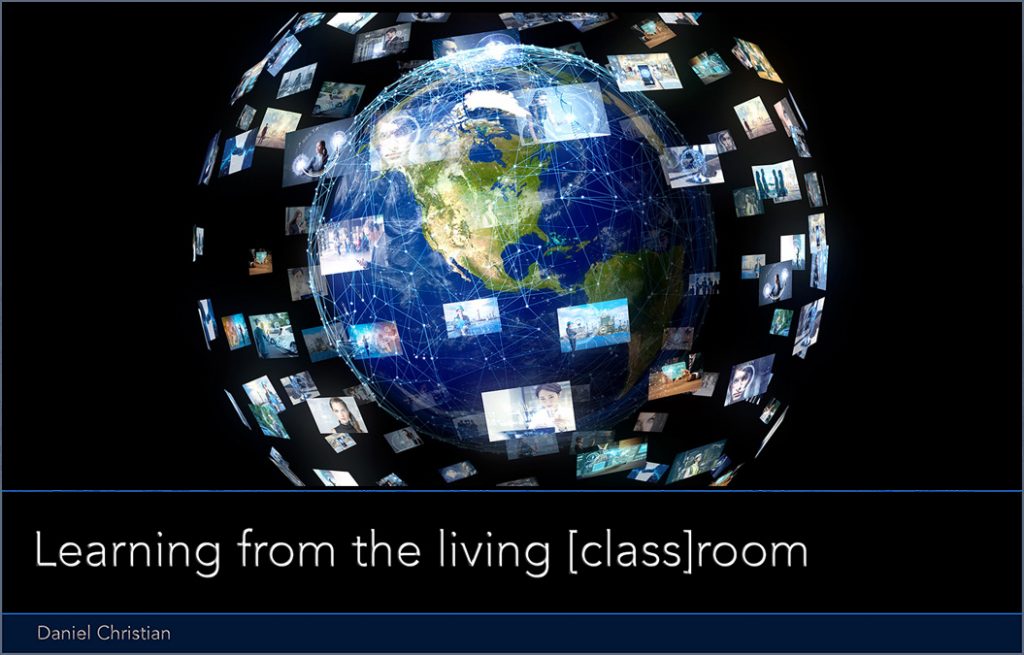
Learning from the Living [Class] Room: Due to the impacts from the Coronavirus, this is happening today across many countries. But this vision is just beginning to develop. We haven’t seen anything yet.


From DSC:
Below are some resources for teaching at home. And some of this (much of this?) is not typical homeschooling, just as much of what’s being done out there isn’t necessarily typical online-based learning. And some out there may not like such lists, and would prefer a detailed report on just one tool. But this last week was incredibly busy — and time is not a luxury I have right now. And these resources might provide someone out there with just the right tool or pedagogy that they’ve been looking for.

Also, I might suggest:

  • Creating a Google alert (google.com/alerts) on HSLDA, on homeschooling, on homeschoolers, and/or on related searches.
  • Create a Keyword Alert on an RSS aggregator such as Feedly
  • Follow relevant hashtags on Twitter such as #homeschooling

Some analog ideas:

  • Reading a book together
  • Watching a play, drama, or another type of program together
  • Taking a walk out in nature together
  • Gather together as a family and/or lingering over breakfast or dinner
  • Drawing
  • Painting
  • Taking pictures

And now is a great time to see what your child or children WANT TO LEARN ABOUT! Turn over the control to them for a while — and watch what happens when intrinsic motivation takes hold! 


Not a teacher but find yourself homeschooling? These educational apps are free — from parade.com by Stephanie Osmanski

  • This posting covers 25 Free Learning Apps

We are all homeschoolers now (podcast) — from cato.org featuring Kerry McDonald and Caleb Brown
Thanks to COVID-19, many parents find themselves with kids at home all day. What’s the best way to keep them engaged in their educations? Kerry McDonald, author of Unschooled, comments.

Getting Smart’s Getting Through

Free, Online Learning Resources When Coronavirus Closes Schools — from cato.org by Kerry McDonald

Homeschooling Mother and Author: 6 Ideas For Parents While Schools Are Closed — from fee.org by Kerry McDonald
Amid the Covid-19 lockdown, there are steps parents can take to make time at home with their children more rewarding and tolerable.

Apps for Special Needs Students—As School Buildings Shutter — from edutopia.org by Janey Clare
The coronavirus creates a unique challenge for special needs students—educators share recommendations for apps to support learning at home.

How to Support Home Learning in Elementary Grades — from edutopia.org by John Thomas
A first and second grade teacher shares his home learning plan for his students and how he is engaging their families.

6 Lessons Learned About Remote Learning During the Coronavirus Outbreak — from blogs.edweek.org by Mark Lieberman


Best Vlogging Camera in 2020 — from adventurerinyou.com

Excerpt (emphasis DSC):

Making videos for YouTube has become a profession. Video blogging today is not just a hobby. This is a way of earning, which has saved many from having to go to work. The so-called vlogs (short for “video blog“) have become extremely popular. But the most difficult question for beginners: what camera to use to shoot your first video? I have prepared a list of the best cameras for YouTube, given their cost, quality and popularity.


The Canon EOS M50 Popular Budget Vlogger Camera


Video blogging can be an interesting way to tell stories, gain recognition, or even make a living. If you want to make a video blog of your dreams or just want to shoot funny videos to entertain your friends, you can always find the right camera. And remember, if you find it difficult to make a decision, a rental service can be a good way to decide. Try working with different cameras before you invest in one. So you will be sure that you will get exactly what you need.


 Coronavirus has led to a rush of online teaching. Here’s some advice for newly remote instructors — from edsurge.com by Jeff Young & Bonni Stachowiak

Excerpt:

The simplest way to go online is to shift to a video conference platform
Stachowiak says that just lecturing to a webcam instead of an in-person class isn’t the best way to teach online, but it is the easiest way to switch. Under the circumstances, it is better than nothing. “I’d rather that you do that for your students, for yourself than to cancel all the classes,” she argues.

Think shorter
If it’s hard to hold students’ attention in person, it’s even harder online, says Stachowiak: “You’ll want to think about shortening that experience. The online environment tends to have shorter, more-compact opportunities and then other things to do that are more engaging than just sitting and listening.”


How innovations in voice technology are reshaping education — from edsurge.com by Diana Lee
Voice is the most accessible form you can think of when you think about any interface. In education, it’s already started to take off.

It could be basic questions about, “Am I taking a class to become X?” or “How strong are my skills relative to other people?” An assistant can help with that. It could potentially be a coach, something that follows you the rest of your life for education. I’m excited about that. People that can’t normally get access to this kind of information will get access to it. That’s the future.

From DSC:
The use of voice will likely be a piece of a next-generation learning platform.

Voice will likely be a piece of the next generation learning platform


Getting Campuses Ready for the Coronavirus — from insidehighered.com by Chuck Staben
What should leaders be doing to prepare their colleges if the situation worsens? Chuck Staben offers suggestions.

Colleges Prepare for Coronavirus Outbreaks on Campus — from wsj-com by Melissa Korn
Task forces map out prospects for quarantines, class cancellations as schools brace for virus spread

Teaching during a campus closure…— from linkedin.com by Bill Knapp
Here are some suggestions on preparing your on-campus students in the event of an unexpected campus closure (#COVID-19).

Coronavirus Forces Universities Online — from .insidehighered.com by Lindsay McKenzie
Compelled to close their campuses to limit the spread of coronavirus, U.S. universities with Chinese branches move at lightning speed to take teaching online.

NYU Response to Coronavirus Accelerates Digital Tool Adoption — from campustechnology.com by Dian Schaffhauser

Excerpt:

Instructors conducted some 700-plus sessions during the first week, using a multitude of tools to enable live feedback and interaction in both synchronous and asynchronous ways, including learning management system NYU Classes, media sharing service NYU Stream, web and audio conference tool NYU Zoom and commenting utility VoiceThread.

Keith Ross, dean of Engineering and Computer Science at NYU Shanghai, suggested that the health crisis has one silver lining: It’s bringing the faculty up to speed with online teaching tools in quick order. In a university article about the efforts, he mused that once the crisis has passed, faculty may choose to integrate the use of some of the tools into their traditional face-to-face courses.
…
NYU Stream and VoiceThread are letting students interact asynchronously. They can watch pre-recorded videos uploaded by instructors and then take quizzes, ask questions, make annotations and communicate with classmates using text, audio and video. Also available for use: NYU Web Publishing to publish and manage blogs; Slido and Piazza to conduct community voting and quizzes; Slack to support office hours; and Examity to proctor exams remotely.


How to Respond to Coronavirus: 6 Steps for Schools
— from edweek.org by Mark Lieberman

 

2020 EDUCAUSE Horizon Report™ | Teaching and Learning Edition — from library.educause.edu

Excerpt:

This report profiles key trends and emerging technologies and practices shaping the future of teaching and learning and envisions a number of scenarios and implications for that future. It is based on the perspectives and expertise of a global panel of leaders from across the higher education landscape.


2020 Horizon Report

This year’s report paints brief but evocative portraits of four possible future scenarios for postsecondary teaching and learning.


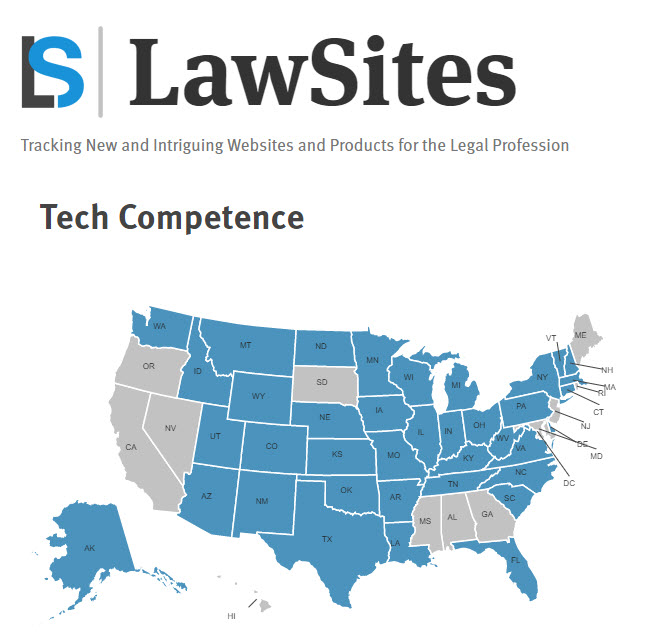
38 states have adopted the duty of technology competence — from lawsitesblog.com by Bob Ambrogi

Excerpt:

In 2012, something happened that I called a sea change in the legal profession: The American Bar Association formally approved a change to the Model Rules of Professional Conduct to make clear that lawyers have a duty to be competent not only in the law and its practice, but also in technology.

More specifically, the ABA’s House of Delegates voted to amend Comment 8 to Model Rule 1.1, which pertains to competence, to read as follows:

Maintaining Competence
To maintain the requisite knowledge and skill, a lawyer should keep abreast of changes in the law and its practice, including the benefits and risks associated with relevant technology, engage in continuing study and education and comply with all continuing legal education requirements to which the lawyer is subject. (Emphasis added.)


ACE receives ED funds to explore blockchain’s potential — from campustechnology.com by Rhea Kelly

Excerpt:

“This work is about exploring the potential of blockchain technology to give learners greater control over their educational records,” said Ted Mitchell, president of ACE, in a statement. “It’s about enabling more seamless transitions between and across K-12, higher education and the workforce. This initiative will explore how this nascent technology can break down barriers for opportunity seekers to fully unlock their learning and achievement.”


From DSC:
The items below are meant for those involved with digital transformation, developing strategy, and keeping one’s organization thriving into the future.


Strategy in the Digital Revolution with Ryan McManus — from dukece.com; with thanks to Laura Goodrich for this resource out on Twitter

Description of webinar:
Today, every business is focused on digital transformation, yet most organizations are struggling to realize value from their efforts and investments. Less than 20% of business leaders believe their digital transformation efforts have been successful. With unprecedented access to data and technology, how is it that firms and their leaders are experiencing such disappointing results?

At the root of the problem is the disconnect between how leaders understand strategy and the new rules of the digital revolution. Most leaders haven’t been taught how to think about a world that is very different from the one which gave rise to popular strategic concepts, and as a result, they apply outdated strategy models and thinking to the new world, trying to squeeze the competitive realities of the digital revolution into linear, analog strategic planning concepts.

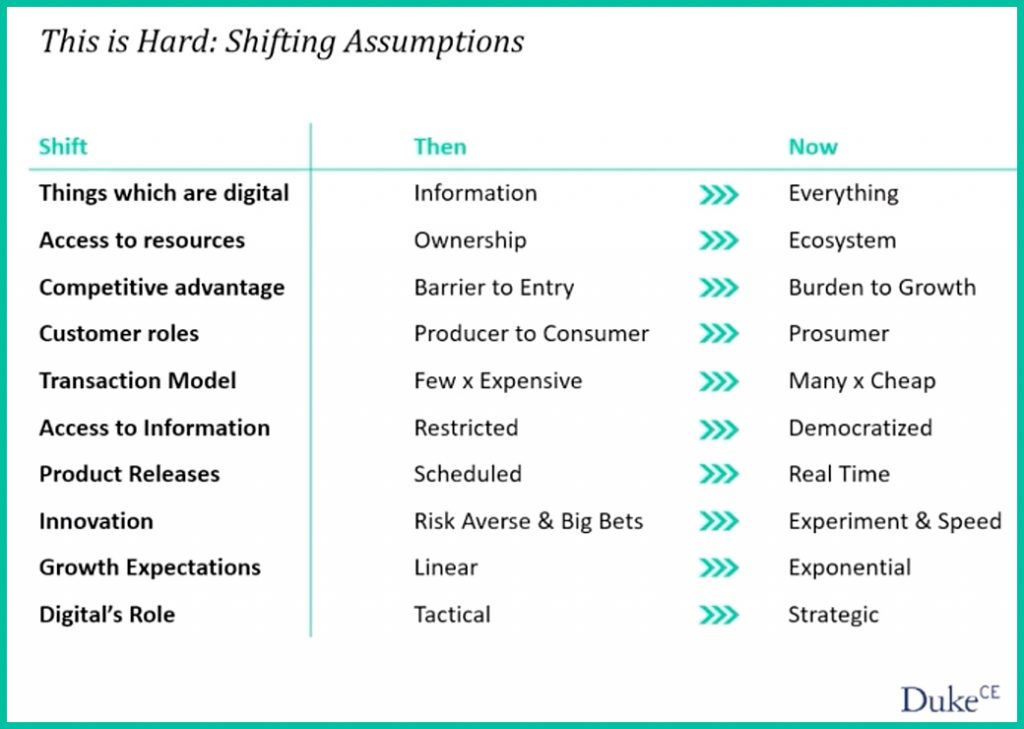
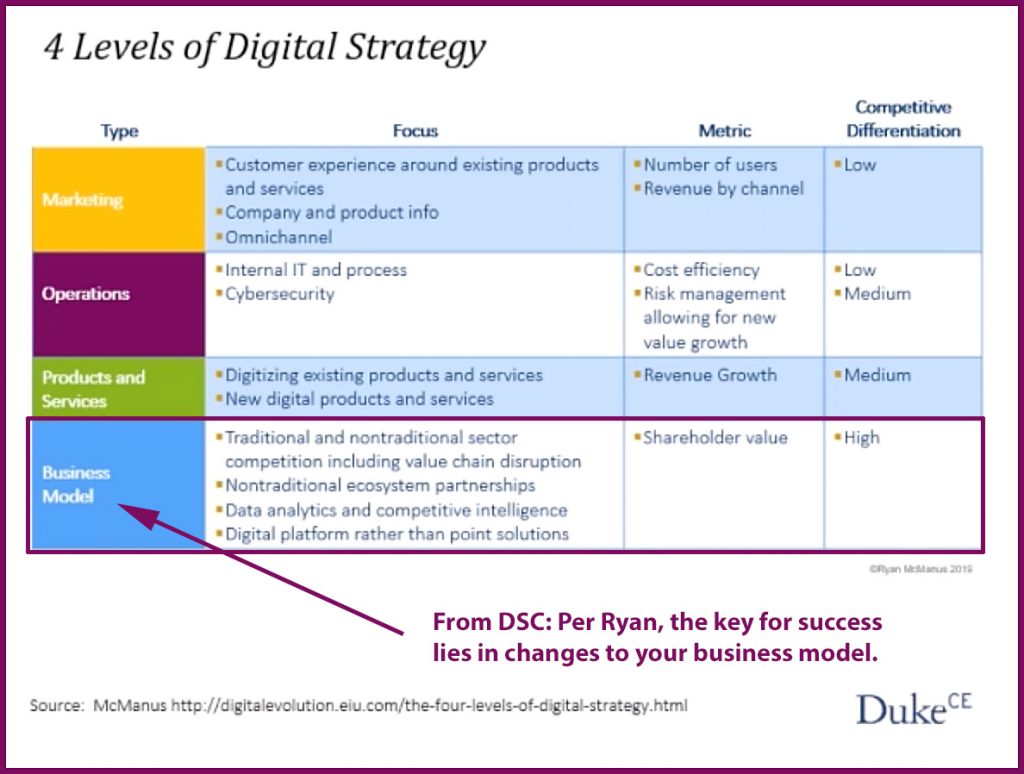
In this complimentary on-demand webinar, Ryan McManus, lecturer at Columbia University Business School and Duke Corporate Education, discusses the New Strategy Playbook, including:

  • The current state and evolution of the digital revolution, and what’s next
  • The four levels of digital strategy: how you can adapt your approach to win
  • Why traditional approaches to strategy have reached their limits
  • Implications for leadership development

Example slides:

Also see:

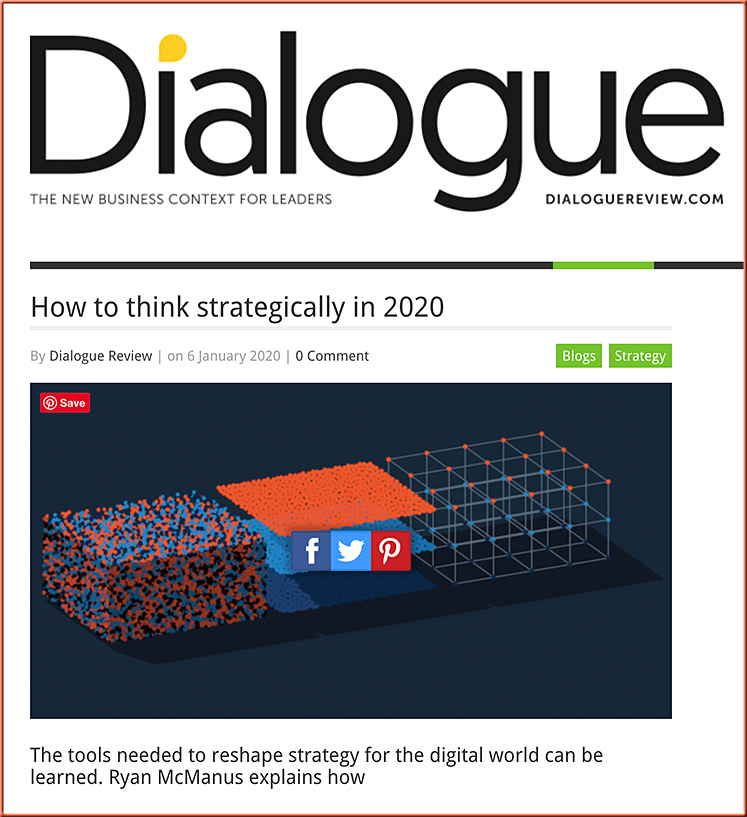
http://dialoguereview.com/how-to-think-strategically-in-2020/


Cost cutting algorithms are making your job search a living hell — from vice.com by Nick Keppler
More companies are using automated job screening systems to vet candidates, forcing jobseekers to learn new and absurd tricks to have their résumés seen by a human.

Excerpts:

Companies are increasingly using automated systems to select who gets ahead and who gets eliminated from pools of applicants. For jobseekers, this can mean a series of bizarre, time-consuming tasks demanded by companies who have not shown any meaningful consideration of them.
…
Maneuvering around algorithmic gatekeepers to reach an actual person with a say in hiring has become a crucial skill, even if the tasks involved feel duplicitous and absurd. ATS software can also enable a company to discriminate, possibly unwittingly, based on bias-informed data and culling of certain psychological traits.

Until he started as a legal writer for FreeAdvice.com last month, Johnson, 36, said he was at potential employers’ whims. “I can’t imagine I’d move to the next round if I didn’t do what they said,” he told Motherboard.


XRHealth launches first virtual reality telehealth clinic — from wearable-technologies.com by Sam Draper

Excerpt:

XRHealth (formerly VRHealth), a leading provider of extended reality and therapeutic applications, announced the first virtual reality (VR) telehealth clinic that will provide VR therapy to patients. VR telehealth clinicians providing care are currently certified in Massachusetts, Connecticut, Florida, Michigan, Washington D.C., Delaware, California, New York, and North Carolina and will be expanding their presence in additional states in the coming months. The XRHealth telehealth services are covered by Medicare and most major insurance providers.

 
© 2025 | Daniel Christian