From DSC — and with a shout out to Brad Sousa for this resource:
For those involved with creating/enhancing learning spaces as they relate to pedagogies:

https://www.avisystems.com/higher-education-trends-part-one

How Has Technology Impacted Higher Education?
In part one of this three-part series, AVI Systems CTO Brad Sousa talks with Jeff Day, Founder of North of 10 Advisors, to discuss the key ways education and, specifically, pedagogy differs from 10, 5, even 3 years ago.

Discussion Topics

  • The impact of active learning and the introduction of the internet of things (IoT) in the classroom
  • Recommendations for deploying modern learning environments with technology partners
  • Classroom systems design, then and now
Some timestamps (roughly speaking)
  • 5:15 — changes in pedagogy
  • 7:15 or so — active learning
  • 15:30 design needs around active learning
  • 17:15 DE rooms and active learning — software-controlled platform
  • 21:30 — advice; look to outcomes & expectations that want to achieve/meet; uses cases

Media controller w/ intuitive interface to mimic the way someone teaches / way a classroom goes:

  • “Class start” — chaotic; mics on everywhere
  • “Lecture” — gates /mics closed and focus shifts to the professor
  • “Class interaction” — presents roster of who’s there (20:00 mark roughly)

Also see this introductory posting re: the implications of active learning in the higher ed market.
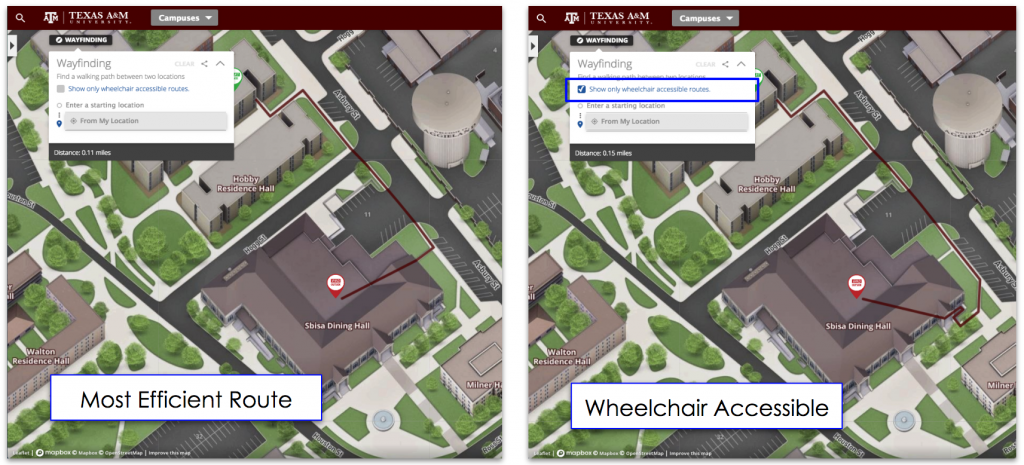
 

Concept3D introduces wheelchair wayfinding feature to support campus accessibility — from concept3d.echoscomm.com with thanks to Delaney Lanker for this resource
System makes wheelchair friendly campus routes easy to find and follow

Excerpt:

Concept3D, a leader in creating immersive online experiences with 3D modeling, interactive maps and virtual tour software, today announced the launch of a new wheelchair wayfinding feature that adds a new level of accessibility to the company’s interactive map and tour platform.

With the new wheelchair accessible route functionality, Concept3D clients are able to offer a separate set of wayfinding routes specifically designed to identify the most efficient and easiest routes.

Concept3D’s wayfinding system uses a weighted algorithm to determine the most efficient route between start and end points, and the new system was enhanced to factor in routing variables like stairs, curb cuts, steep inclines, and other areas that may impact accessibility.

Also see:

Wayfinding :: Wheelchair Accessible Routes — from concept3d.com

https://www.concept3d.com/blog/higher-ed/wayfinding-wheelchair-accessible-routes


Four Artificial Intelligence (AI) trends in 2020 — from consultancy.uk; though this is from the U.K., it’s also likely very true for the U.S. and for other nations as well

Excerpts:

  • Enter the AI ethicist
  • Catalyst – the 5G effect
  • Introducing AI-as-a-Service
  • Putting solutions at the centre
 

Online tool will help ‘Spot’ legal issues that people face — from .pewtrusts.org
Artificial intelligence can boost non-lawyers’ ability to navigate civil court system

Excerpt:

People looking for information on legal questions often start their searches online, without a good handle on the terminology. Today’s machine learning tools can help put nonlegal phrasing into context, using artificial intelligence to match people’s situations with specific legal issues, supplying accurate information and connections to potential services.

A team at the Legal Innovation and Technology (LIT) Lab at Suffolk University Law School in Boston, with funding from The Pew Charitable Trusts, is building an application programming interface, or API—known as Spot—that can serve as a computerized issue spotter. Spot could be used by legal services websites and others to help lay users, and its functionality will improve as it accumulates more data and real-life examples.


6 Ed Tech Trends to Watch in 2020 — from campustechnology.com by Rhea Kelly with:

  • Bridget Burns, Executive Director, University Innovation Alliance
  • James Frazee, Chief Academic Technology Officer and Associate VP, Instructional Technology Services, San Diego State University
  • Ernie Perez
    Director, Educational Technology, Digital Learning & Innovation, Boston University

This year’s top issues in education technology reflect the bigger picture of a student’s pathway from individual courses all the way to graduation and career.

Topics include:

1) Workforce Readiness
2) Artificial Intelligence and Chatbots
3) Extended Reality (XR)
4) Video and Accessibility
5) Predictive Analytics and Advising
6) Industry Partnerships


From DSC:
How’s this for your next gift for that person in your life who loves books!?! 🙂


The Bookwheel Allowed 16th-Century Scholars to Read Multiple Books at One Time — from interestingengineering.com by Trevor English
This contraption allowed engineers to read multiple books at the same time.


American Bar Assn. President criticizes U.S. legal system as backward, resistant to change — from forbes.com by Patricia Barnes

Excerpt (emphasis DSC):

Judy Perry Martinez, president of the American Bar Association (ABA), has issued an unusually frank plea calling upon the legal profession to support reform of America’s backward legal system to better serve the public.

“We need new ideas,” said Martinez. “We are one-fifth into the 21st century, yet we continue to rely on 20th-century processes, procedures and regulations. We need to retain 20th-century values but advance them using 21st-century approaches that can increase access to justice.”

Martinez’ comments are contained in a letter appearing in the February-March 2020 issue of the ABA’s monthly magazine, The ABA Journal.

Martinez expressed frustration with resistance in the legal profession to state-level efforts to innovate in the provision of legal services.

Martinez was particularly critical of the lack of access to civil justice in the United States. She cited the World Justice Project’s ranking of the U.S. in the bottom tier with respect to access to and affordability of civil justice. She said the U.S. is tied for 99th place out of 126 countries. Additionally, Martinez said research by the Legal Services Corp. found that low-income Americans received inadequate or no professional legal help for 86% of their civil legal problems, including child custody, debt collection, eviction and foreclosure. She did not spare the criminal justice system. In many states, Martinez says, “overwhelming caseloads and inadequate resources for public defenders severely hamper the Sixth Amendment right to counsel for indigent criminal defendants.


From DSC:
I congratulate Judy Perry Martinez for her stance here, as she’s ultimately fighting for our society — especially for access to justice. Though I don’t know Judy, I appreciate the courage that it must have taken to pen that letter.


The Internet of Things (IoT) and its impacts on consumer engagement [infographic] — from socialmediatoday.com by AJ Ghergich

Excerpts:

The Internet of Things enables a device to have more intelligence than it would as a stand-alone system.

Internet connectivity provides devices the capacity to share data, in order to power commands and processes that can help improve consumers’ lives.
…
And as this technology becomes more commonplace, the parts comprising such devices will become more financially accessible, algorithms will become more detailed and capable, and the internet of things will become even more powerful. This means the data from social media platforms, as well as from consumers’ daily lives, will be connected, and our devices will continue to make our world more streamlined. And that has significant implications for all sectors.

For a broader overview of the internet of things, and its growing impacts on how we live, check out this infographic from the team at Salesforce.


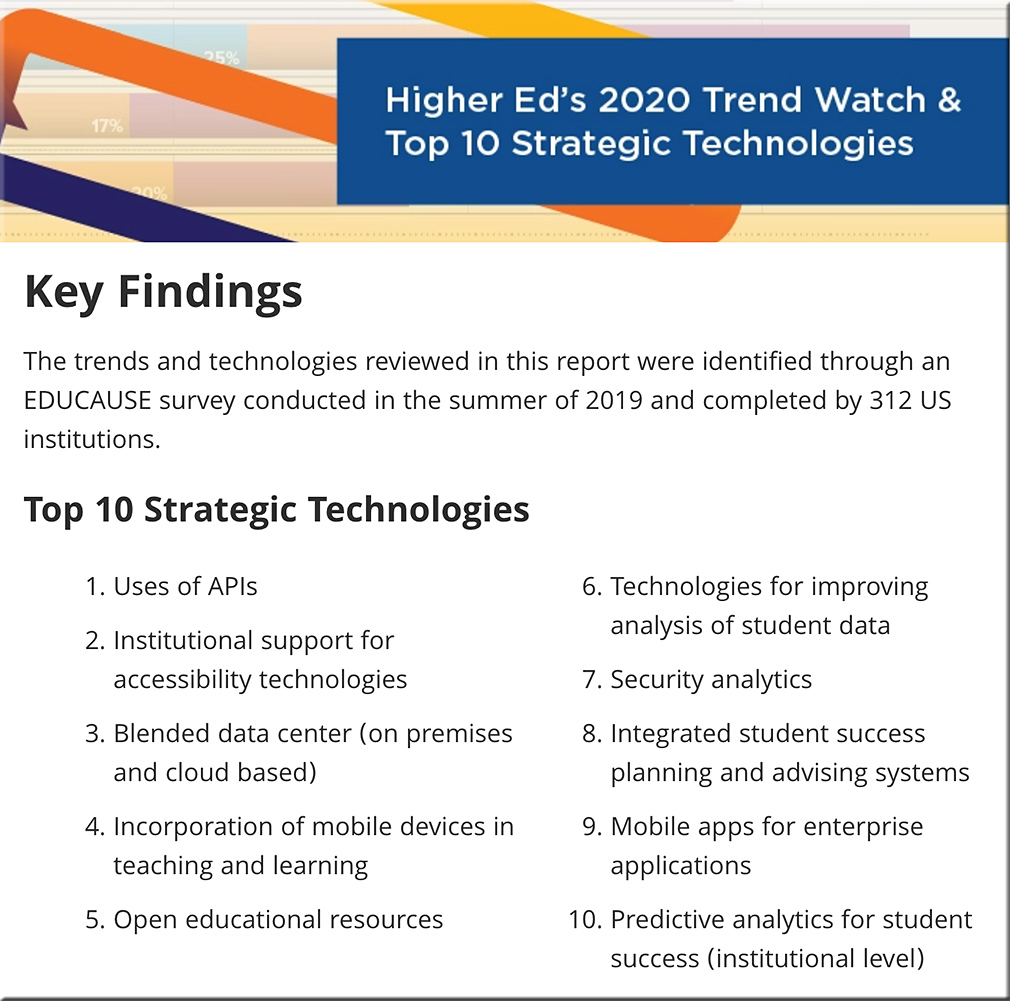
Key strategic technologies for higher education in 2020

Higher Education’s 2020 Trend Watch & Top 10 Strategic Technologies — from library.educause.edu

Excerpt:

Most Influential Trends
Six trends are influential at 61% or more of colleges and universities (listed below from highest to lowest level of influence):

  1. Growing complexity of security threats
  2. Student success focus/imperatives
  3. Data-informed decision-making
  4. Privacy
  5. Enterprise risk management
  6. Institution-wide data management and integrations


Artificial Intelligence is transforming the legal industry — from law.comby Christian A. Farmakis
Artificial intelligence (AI) is adding efficiencies and transforming businesses everywhere, and legal practices are no exception.

Excerpts:

How is AI technology disrupting the legal industry?
AI legal technology won’t replace lawyers, but these tools will drastically change the way lawyers provide services for their clients. While estimates vary, 23%t to 35% of a lawyer’s job could be automated. As a result, lawyers will need to be more strategic and supervisorial, able to act as project managers and supervise the information being fed into systems, and knowledgeable about the assumptions underlying the machine learning algorithms.
…
What will be the next wave of AI legal technology?
The next generation, which is starting to hit the market now, will be document automation and legal research and writing tools, as well as predictive technology tools. For example, a contract can be put through an algorithm in order to identify how risky it is. It could be used to determine how likely it is to go into litigation or if it complies with the company’s internal contract procedures and policies.

Another use is analytic tools that can measure efficiency and pricing of the legal services. E-billing and practice management tools could measure whether a service contract should cost $2,500, not the $7,500 that’s being charged. In other instances, AI could help firms do estimates for alternative fee arrangements.


Also see:

Live from Bett: What’s new in EDU–Free resources to boost engagement and collaboration — from the Microsoft Education Team on January 22, 2020

Excerpt (emphasis DSC):

In addition, on the day of a presentation, educators and students now can help every person in the classroom or audience understand what they’re saying by clicking on “Present Live.” Live Presentations enables every audience member to view the presentation on their own device, such as a laptop, tablet or phone. Each audience member can turn on live captioning and choose subtitles from more than 60 languages. They can even navigate between slides, so they don’t miss a single, important detail. The audience is engaged throughout the presentation and sends reactions in real-time. After the presentation, the audience can provide feedback on the content and delivery of the presentation, which educators and students can use to improve skills over time.

Live Presentations will be coming soon to PowerPoint for the web as part of Office Education, which educators and students can access for free. If you haven’t already done so, get started with Office 365 Education now.


From DSC:
Might this type of functionality be a solid component of a global, next generation learning platform? Hmmmm…


The Future of Education Technology (FETC) Conference…What did we learn this year? — from teachercast.net by Jeffrey Bradbury

“I couldn’t believe how many sessions this year revolved around audio or video creation.  I even counted more than 15 sessions that had the word Podcast in them (including mine).”


Things I Learned at Project Voice — from thejournal.com by Bradley Metrock, who produces the Project Voice conference, hosts This Week in Voice
Could 2020 be the year of the voice? These voice experts think so.

Excerpt:

Voice experience of the year for education, with these finalists:

Highlights took this category.

And voice developer of the year, with these finalists:

Bamboo Learning won this award.

Also see:

  • 12 Education Predictions for 2020 — by Dian Schaffhauser
    The learning and innovation in education never stops. Here’s what 12 education technology experts and observers expect for the new year in K-12.
 

Discovering millions of datasets on the web — from blog.google

Excerpt:

Across the web, there are millions of datasets about nearly any subject that interests you. If you’re looking to buy a puppy, you could find datasets compiling complaints of puppy buyers or studies on puppy cognition. Or if you like skiing, you could find data on revenue of ski resorts or injury rates and participation numbers. Dataset Search has indexed almost 25 million of these datasets, giving you a single place to search for datasets and find links to where the data is. Over the past year, people have tried it out and provided feedback, and now Dataset Search is officially out of beta.

Also see:

One of my favorite recent additions to the Google Search family is Dataset Search. Yes, you heard that right. You can search for datasets just like you can search for images!


© 2025 | Daniel Christian