Explore Revit models in VR with Unity Reflect — from by Nick Davis
Unity Reflect makes it easy to bring Building Information Modeling (BIM) data into virtual reality (VR). Learn how you can use the Unity Reflect VR Viewer to conduct immersive design reviews with Autodesk Revit models.

Excerpt (emphasis DSC):

The value of VR in the architecture, engineering, and construction (AEC) industry is well documented. It provides an unrivaled medium for gathering rich feedback, catching design flaws, and reducing the need for physical mockups. Studies have shown construction professionals are twice as likely to spot design errors when reviewing designs in VR versus PCs.

Today, 60% of AR and VR content is powered by Unity. Unity’s AEC customers use VR for a wide range of use cases, from conducting immersive walkthroughs that help their clients catch errors pre-construction and save hundreds of thousands of dollars on individual projects, to creating immersive training programs that lead to safer job sites.

 

Pearson Bets on Adaptive Learning (Again) With $25M Acquisition of Smart Sparrow — from edsurge.com by Tony Wan

Excerpt:

Smart Sparrow, which provides course-authoring tools for faculty and instructional designers to build adaptive courseware, has found a new home in a much bigger nest.

Last week, Pearson announced it paid $25 million to acquire Smart Sparrow’s technology, in a move that the publisher says will bolster the digital infrastructure that will soon support all its future higher-education offerings.

In recent years, Ben-Naim says his team has been building the next iteration of its adaptive course-creation tool. Called Aero, the platform has been in the works since 2017. And though Aero has not been publicly released or announced, that was the technology that attracted Pearson, he adds.


A.I. breakthroughs in natural-language processing are big for business — from fortune.com by Jeremy Kahn

Excerpt:

Over the past 18 months, though, computer scientists have made huge strides in creating algorithms with unprecedented abilities at a variety of language tasks. What’s more, these new algorithms are making the leap from the lab and into real products at a breakneck pace—already changing the way tech’s biggest players, and many other businesses, operate. The Natural Language Processing (NLP) revolution promises better search engines and smarter chatbots and digital assistants. It could lead to systems that automatically analyze—and maybe even compose— legal documents and medical records. But some believe the NLP revolution will do far more.


20 digital transformation leaders to follow on Twitter in 2020 — from enterprisersproject.com by David. F. Carr
Committed to digital transformation this year? Follow these people for perspective and emerging lessons

Excerpt:

One of our New Year’s resolutions was to refresh and expand our Twitter feed for digital transformation leaders, reviewing them not just for the use of the right hashtags but for the content they share.

There are a few repeats from a similar list we shared last year, but for the most part, we tried to give you new Twitter handles to follow. This year’s list includes CIOs, authors, consultants, and cloud computing leaders. Some only post on technology topics, while others share thoughts on family, culture, politics, and favorite movies.

The common denominator we looked for was a thoughtfully curated feed that’s not entirely self-promotional but adds to the conversation we’re all having about how to understand the potential of digital transformation and put it to work for our organizations.


From DSC:

While these types of lists invariably leave off a ton of extremely talented individuals and organizations who are worth following as well, such lists are a good starting point for:

  • Someone to use to begin tapping into streams of content in a given area
  • Observing the topics, issues, ideas being discussed
  • Building one’s network
  • Seeing who these folks follow and who they respect
  • …and more.

Searching for the top __ people of Twitter in subject XYZ is a solid way to enhance our [lifelong] learning ecosystems.


From DSC:
Very disturbing that citizens had no say in this. Legislators, senators, representatives, lawyers, law schools, politicians, engineers, programmers, professors, teachers, and more…please reflect upon our current situation here. How can we help create the kind of future that we can hand down to our kids and rest well at night…knowing we did all that we could to provide a dream — and not a nightmare — for them?


The Secretive Company That Might End Privacy as We Know It — from nytimes.com by Kashmir Hill
A little-known start-up helps law enforcement match photos of unknown people to their online images — and “might lead to a dystopian future or something,” a backer says.

His tiny company, Clearview AI, devised a groundbreaking facial recognition app. You take a picture of a person, upload it and get to see public photos of that person, along with links to where those photos appeared. The system — whose backbone is a database of more than three billion images that Clearview claims to have scraped from Facebook, YouTube, Venmo and millions of other websites — goes far beyond anything ever constructed by the United States government or Silicon Valley giants.


Excerpts:

“But without public scrutiny, more than 600 law enforcement agencies have started using Clearview in the past year…”

Clearview’s app carries extra risks because law enforcement agencies are uploading sensitive photos to the servers of a company whose ability to protect its data is untested.


From DSC:
If you are using a tool like Cisco Webex in your school, consider implementing the idea below.
I’d like to thank Mr. Steve Grant and Mr. Nelson Miller from the WMU-Cooley Law School for their work in implementing/recommending this approach.

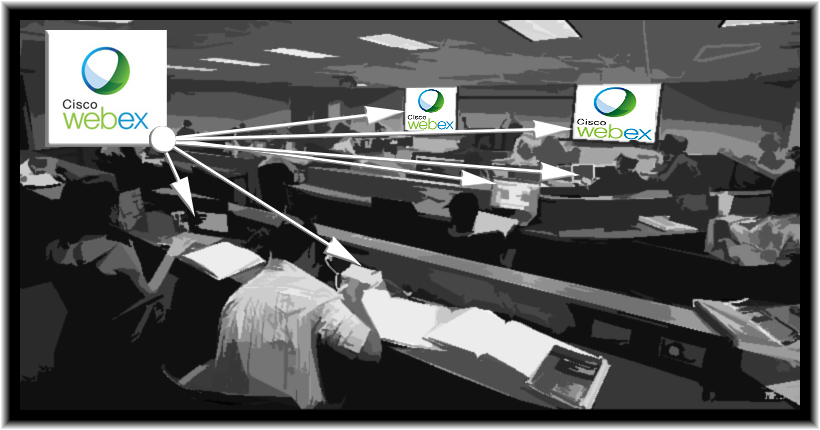
If you are using a tool like Cisco Webex, you can use it to share content to displays, laptops, smartphones, and tablets. If the professor starts a Cisco Webex Meeting Center session using their own personal room, the students can then join that meeting via their devices. (To eliminate noise and confusion — as well as to reduce bandwidth — the students should mute their microphones and choose not to send the video from their webcams.)

If you were doing a think-pair-share, for example, and you really liked what a certain pair of students had going on, one of the students could share their work with the rest of the class. By doing so, whatever was going on on that student’s device could be displayed by any projectors in the room, as well as on any other devices that were connected to the Cisco Webex Meeting Room.

“So you could project any student’s work as students proceed with in-class exercises. Projecting student work adds another level of accountability, excitement, and concentration to in-class exercises.” 

*********

Also, using the Cisco Webex Meeting Center in your face-to-face classroom not only opens up that sort of collaboration channel, but, via the chat feature, it can also open up a running backchannel to draw out your more introverted students, or those students who have questions but don’t want to have the spotlight thrown on them. 

*********


CES 2020: Finding reality in a deluge of utopia — from web-strategist.com by Jeremiah Owyang

Excerpts:

One of my strategies is to look past the products that were announced, and instead find the new technologies that will shed light on which products will emerge such as sensors and data types.

The trick to approaching CES: Look for what creates the data, then analyze how it will be used, therein lies the power/leverage/business model of the future.

Sharp’s augmented windows give us an interesting glimpse of what retail could look like if every window was a transparent screen…
…
Rivian, the new electric truck company, which is funded by both Ford and Amazon was featured at the Amazon booth, with a large crowd, each wheel has an independent motor and it’s Alexa integrated – watch out Cybertruck.
…
Caution: “Data leakage” (where your data ends up in places you didn’t expect) is frightening, and people will start to care. The amount of devices present, that offer data collection to unknown companies in unknown countries is truly astounding. Both from a personal, business, and national security perspective, consumers and businesses alike really don’t know the ramifications of all of this data sharing.

Also see:


DC: Precursor to a next gen learning platform…? Another piece is falling into place.


From DSC:
In the future, will this be happening more in the United States? I’d say yes, most likely. I’d also add consumers to this new type of online-based offering as well.


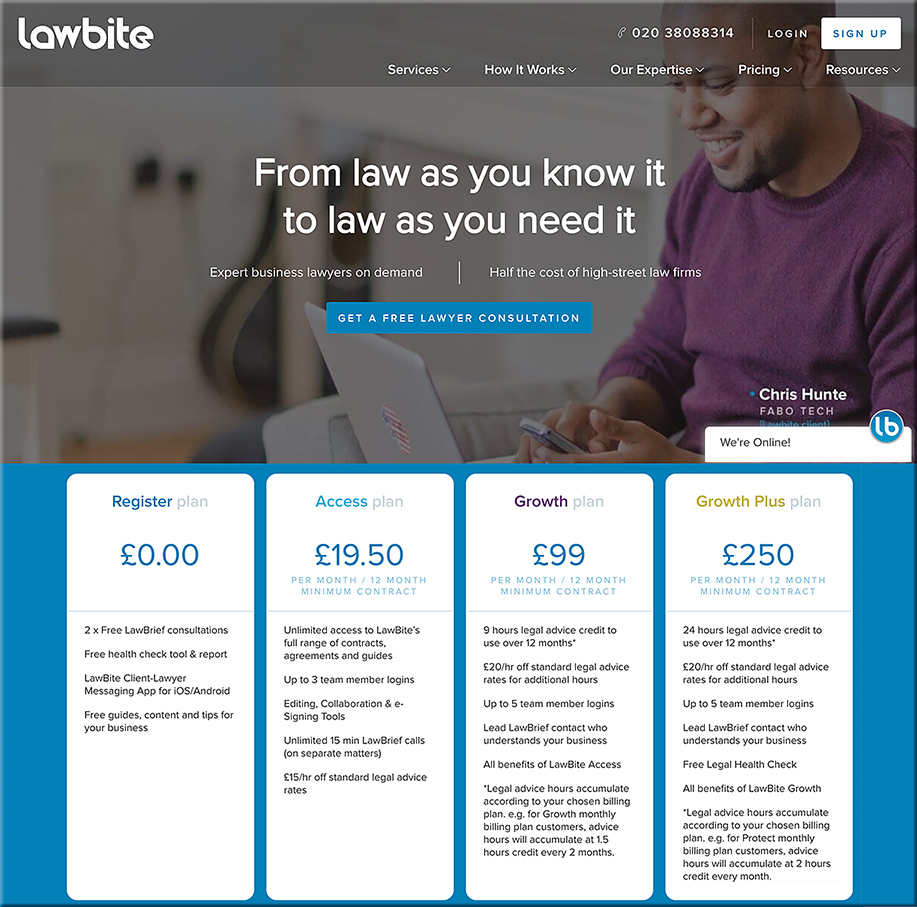
“LawBite is an online legal platform powering a fully SRA regulated UK law firm providing fast, expert, affordable legal services for businesses of all sizes.”

In the future, will this be happening more in the United States?


The inaugural winners of Training Magazine’s Network Choice Awards — from trainingmag.com
Training magazine reveals the winners of its inaugural crowd-sourced vendor awards program: the 2019 Training Magazine Network Choice Awards.

Categories include:

  • Authoring Tools
  • Custom Content/Program Development
  • Gamification
  • Learning Portal/Learning Management System (LMS)
  • Measurement, Testing, and Assessment


‘Fundamental shift’ is transforming the delivery of legal services, new report concludes — from abajournal.com by Debra Cassens Weiss

Excerpt:

“Revolutionary changes are afoot” in the market for legal services, according to a new report.

Clients are actively managing their relationships with outside counsel, nonlaw competitors are gaining ground, and law firms are responding to market changes in innovative ways, the report says.

The 2020 Report on the State of the Legal Market was released Monday by Georgetown Law’s Center on Ethics and the Legal Profession and Thomson Reuters Legal Executive Institute. It is available for download here.

However, taking that view is seeing only one side of the story. Over this same period, there has been mounting evidence that the underlying model itself is changing, that clients, non-law firm competitors, and even many law firms are now operating with very different assumptions about the role law firm services should play in the legal ecosystem and how such services should be delivered. In the past year or so, this evidence has grown to the point that it seems apparent that a fundamental shift is now well underway.

Also see:

Lori Lorenzo, research and insights leader of chief legal officer program, Deloitte: “Catching-up and keeping-up with tech advancements for the legal function will remain a top goal for chief legal officers in 2020. Of course, addressing legal team tech skills gaps may drive inclusion of professionals with diverse skillsets, like data scientists, automation experts and the like, into the legal function.”


Legal Tech’s Predictions for Artificial Intelligence in 2020 — from law.com by Zach Warren
We may not have robot lawyers, but lawyers and technologists agree that artificial intelligence will have a major impact on the legal profession in 2020.

Excerpts:

Alex Babin, CEO, Zero: “The biggest gains from automating legal practices will be time saved and improved workflow efficiencies as the AI ‘takes over’ more laborious tasks including litigation support, email, e-discovery, and the use of databases for case management. Lawyers will begin to trust in this process, letting AI perform these basic tasks such as auto-filing document and email for compliance. AI will enhance corporate and regulatory reporting and improves contract creation and management.”

Scott Forman, shareholder, Littler Mendelson and founder of Littler CaseSmart and Littler onDemand: “Data analytics and AI have already fundamentally changed the delivery of legal services, but I expect 2020 to bring a greater understanding of how these technologies enhance, rather than overtake, the work of lawyers. While robots and technology will never replace lawyers, they provide data and insight enabling lawyers to do their jobs faster and better. This includes automating aspects of the legal process—so that lawyers can focus on top-of-the-pyramid work—as well as synthesizing and serving up information that guides litigation strategy, identifies potential areas of risk and moves toward predicting legal outcomes.”


Some of the topics/items mentioned include:

  • Technologists join lawyers in creating the legal realm of the future.
  • Future lawyers will need to either have project managers on staff or be able to manage projects themselves.
  • Lifelong learning is now critically important. One doesn’t necessarily need to be able to code, but one needs to be constantly learning.
  • Need to understand legal principles but you will also need to have augmented skills (which will differ from person to person)
  • New business and delivery models. Don’t presuppose that the current model will always be around.
  • There will be fewer traditional roles/practices. Traditional roles are sunsetting; new skillsets are needed.
  • Students: Do your due diligence; read up on the industry and think about whether there’s a good fit. Learn your craft. Get experience. Be who you are. Bring your unique brand to the table.
 

Making Waves — from provideocoalition.com by Woody Woodhall
Interview with Midge Costin

Excerpt:

Making Waves – The Art of Cinematic Sound, is an outstanding achievement not only as a stand-alone documentary film, but also as one of the only films that is dedicated solely to the art of sound for film. As we all know, when films started, sound was either done live with musical accompaniment or was simply exhibited silently.

It is a huge challenge to tackle such a wide ranging and meaningful advancement for film storytelling and yet undeterred, Midge Costin, herself a working sound professional, took it on. We spoke at length about her work on the film and her work as a filmmaker with sound, and as an educator.

 
© 2025 | Daniel Christian