Web Technologies of the Year 2019 — from w3techs.com

Excerpts:
These are the technologies that gained most sites in 2019 in areas such as:

  • Content Management System of the Year 2019
  • Server-side Programming Language of the Year 2019
  • JavaScript Library of the Year 2019
  • Web Server of the Year 2019
  • Operating System of the Year 2019
  • Traffic Analysis Tool of the Year 2019
  • …and several more categories
 

AI arms race — insidehighered.com by Lilah Burke
More employers are using applicant tracking systems to hire employees. Some colleges are using new AI-based tools, like VMock, to help students keep up.

Excerpt:

When college students need help with their résumés, some now will be turning to algorithms rather than advisers.

In the last decade, a growing number of large companies have started hiring using applicant tracking systems, AI-based platforms that scan résumés for keywords and rank job candidates.

Similarly, video interviewing platforms that use algorithms to evaluate a candidate’s voice, gestures and emotions have become ubiquitous in some industries. HireVue, the most well-known of these platforms, has drawn accusations of being pseudoscientific and potentially exacerbating bias in hiring.

The frustration many job candidates voice when coming up against these platforms is that they have no way of knowing what they could have done better. The systems give no feedback to candidates.

So what if students, job seekers and career advisers could use the AI for themselves?

Boston University, in a document of VMock tips for students, also advised graphic design or other creative industry students to have two versions of their résumé, one with a conventional layout.

From DSC:
Per my nephew, who works in a recruiting type of position within HR for a Fortune 500 organization:

  • Without a doubt HR recruiting is using AI to help in the selection process.
  • Many companies use keyword scanners, but not everyone [and, in fact, his company did not].
  • HireVue is very important to use when it comes to understanding a person’s presentation skills since a lot of presenting is done via Skype/live video these days. So HireVue is not going away anytime soon. I think it’s a great system/product.
  • At the end of the day, a good recruiter will identify the best talent that has applied to a position. I think it’s important for students to really think about what position they’re applying for and be realistic with their applications. I think that’s where a lot of frustration happens with students that apply to positions and never get to the first round interview. They apply to 20-50 positions that don’t reflect their experience at all…so that’s where coaching and personal advisement is important


Learning from the living class room


Legal Tech Broke Investment Record in 2019 as Sector Matures — from biglawbusiness.com by Sam Skolnik

Excerpts:

  • Investments in legal tech soared past $1 billion in 2019
  • Key legal tech conference boasted record attendance

Legal technology deals and investments stayed on a fast track in 2019 as the sector becomes increasingly relevant to how Big Law firms and corporate legal divisions operate. Legal tech investments flew past the $1 billion mark by the end of the third quarter. It hit that mark for the first time the year before.

Also see:

“E-discovery sits at the intersection of two industries not known for diversity: legal and high-tech. Despite what can feel like major wins, statistics paint a bleak picture—most U.S. lawyers are white, managing partners are primarily male, and only 2% of partners in major firms are black; leadership at e-discovery companies has historically reflected this demographic. The next decade will see a major shift in focus for leadership and talent development at e-discovery providers as we join law firms and corporate legal departments in putting our money where our mouths are and deliver recruitment and retention programs that fight discrimination and actively recruit, retain, and promote women, minority, and underserved talent.” 

Sarah Brown, director of marketing, Inventus


Companies Say Blockchain Could Have Prevented College Admissions Scandal — from edsurge.com by Jeff Young

Excerpt:

One of the most eye-catching aspects of the recent Varsity Blues admissions scandal was that fake athletic profiles were created for students to help them get into highly-selective colleges through so-called “side doors.”

Now, several companies that sell student-record systems based on blockchain—the technology behind Bitcoin—are pitching their products as a way to prevent that kind of fraudulent record tampering in the future.


7 Artificial Intelligence Trends to Watch in 2020 — from interestingengineering.com by Christopher McFadden

Excerpts:

Per this article, the following trends were listed:

  1. Computer Graphics will greatly benefit from AI
  2. Deepfakes will only get better, er, worse
  3. Predictive text should get better and better
  4. Ethics will become more important as time goes by
  5. Quantum computing will supercharge AI
  6. Facial recognition will appear in more places
  7. AI will help in the optimization of production pipelines

Also, this article listed several more trends:

According to sources like The Next Web, some of the main AI trends for 2020 include:

  • The use of AI to make healthcare more accurate and less costly
  • Greater attention paid to explainability and trust
  • AI becoming less data-hungry
  • Improved accuracy and efficiency of neural networks
  • Automated AI development
  • Expanded use of AI in manufacturing
  • Geopolitical implications for the uses of AI

Artificial Intelligence offers great potential and great risks for humans in the future. While still in its infancy, it is already being employed in some interesting ways.

According to sources like Forbes, some of the next “big things” in technology include, but are not limited to:

  • Blockchain
  • Blockchain As A Service
  • AI-Led Automation
  • Machine Learning
  • Enterprise Content Management
  • AI For The Back Office
  • Quantum Computing AI Applications
  • Mainstreamed IoT

Also see:

Artificial intelligence predictions for 2020: 16 experts have their say — from verdict.co.uk by Ellen Daniel

Excerpts:

  • Organisations will build in processes and policies to prevent and address potential biases in AI
  • Deepfakes will become a serious threat to corporations
  • Candidate (and employee) care in the world of artificial intelligence
  • AI will augment humans, not replace them
  • Greater demand for AI understanding
  • Ramp up in autonomous vehicles
  • To fully take advantage of AI technologies, you’ll need to retrain your entire organisation
  • Voice technologies will infiltrate the office
  • IT will run itself while data acquires its own DNA
  • The ethics of AI
  • Health data and AI
  • AI to become an intrinsic part of robotic process automation (RPA)
  • BERT will open up a whole new world of deep learning use cases

The hottest trend in the industry right now is in Natural Language Processing (NLP). Over the past year, a new method called BERT (Bidirectional Encoder Representations from Transformers) has been developed for designing neural networks that work with text. Now, we suddenly have models that will understand the semantic meaning of what’s in text, going beyond the basics. This creates a lot more opportunity for deep learning to be used more widely.


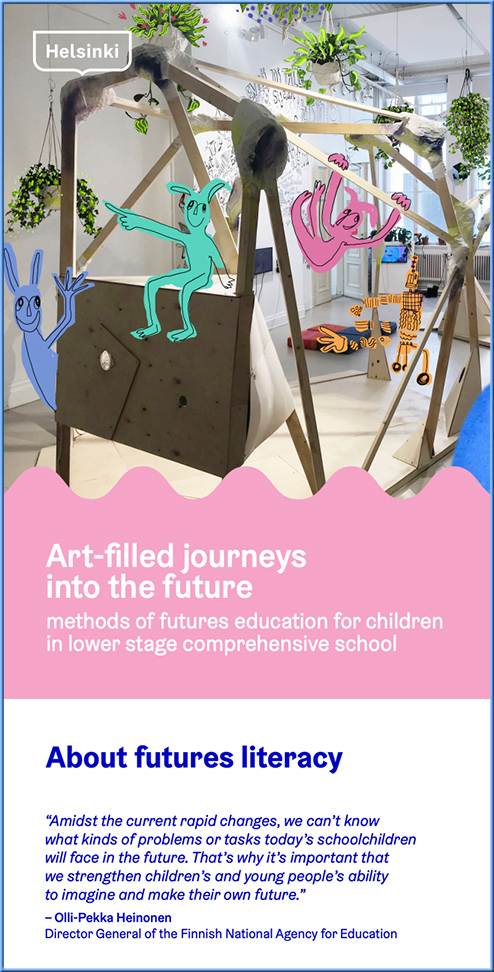
Art-filled journeys into the future — methods of futures education for children in lower stage comprehensive school — from kultus.fi by Ilpo Rybatzki and Otto Tähkäpää

Art-filled futures education


See this PDF file which contains the following excerpt:

In art, futures literacy plays a significant role. Art has the ability to point elsewhere; to fool and mess around with things and shake up conventions without needing to achieve measurable benefits (Varto, 2008). Art ensures a solid background for imagining alternative worlds. It is important to support a permissive atmosphere that supports experimentation! From the perspective of art pedagogy, activities focus on the idea of art experience as meeting place (Pääjoki, 2004) where people can see themselves in a new light beside another person’s thoughts and imagination. Strengthening futures literacy means supporting transformative learning that aims for change. Through this type of learning, we can question norms, roles, identities and the concept of what is ‘normal’ (Lehtonen et al., 2018).

When discussing the future, we are always discussing values: what kind of future is desirable for any one person? Artistic activity can produce materials through which human meanings can be communicated from one person to another and questions about values in life can be discussed (Varto, 2008; Valkeapää, 2012). Encounters create opportunities for dialogue and enriching one’s perspectives. Important aspects include creating safe settings, the individual expression of the participants, the courage to open up and thrown oneself into the centre of an experience, as well as the courage to question or even completely let go of presumptions. In the age of the environmental crisis, art has a critical role in all of society. We cannot solve difficult problems using the same kind of thinking that created the problems in the first place.


With thanks to Mr. Joe Byerwalter for this resource.


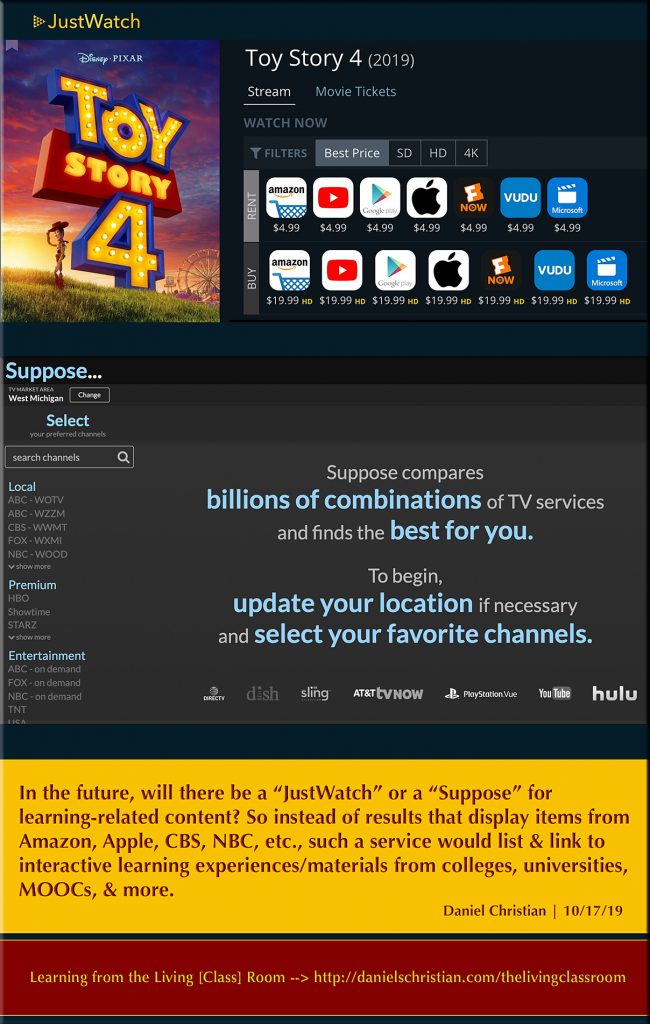
Coming down the pike: A next generation, global learning platform [Christian]

From DSC:
Though we aren’t quite there yet, the pieces continue to come together to build a next generation learning platform that will help people reinvent themselves quickly, efficiently, constantly, and cost-effectively.

Learning from the living class room


Learning from the living class room


Learning from the living class room


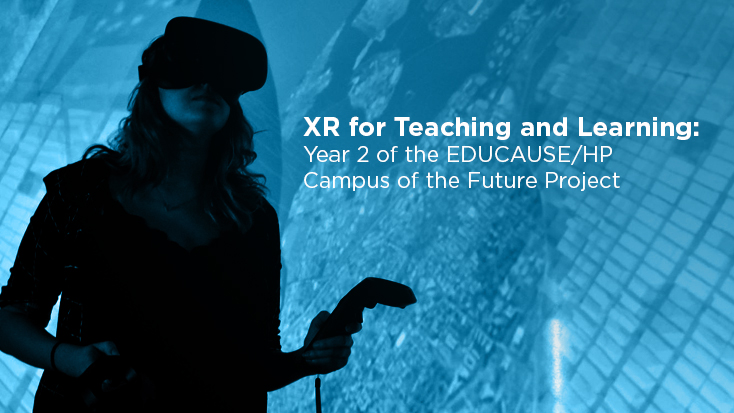
XR for Teaching and Learning — from educause

Key Findings

  • XR technologies are being used to achieve learning goals across domains.
  • Effective pedagogical uses of XR technologies fall into one of three large categories: (1) Supporting skills-based and competency-based teaching and learning, such as nursing education, where students gain practice by repeating tasks. (2) Expanding the range of activities with which a learner can gain hands-on experience—for example, by enabling the user to interact with electrons and electromagnetic fields. In this way, XR enables some subjects traditionally taught as abstract knowledge, using flat media such as illustrations or videos, to be taught as skills-based. (3) Experimenting by providing new functionality and enabling new forms of interaction. For example, by using simulations of materials or tools not easily available in the physical world, learners can explore the bounds of what is possible in both their discipline and with the XR technology itself.
  • Integration of XR into curricula faces two major challenges: time and skills.
  • The adoption of XR in teaching has two major requirements: the technology must fit into instructors’ existing practices, and the cost cannot be significantly higher than that of the alternatives already in use.
  • The effectiveness of XR technologies for achieving learning goals is influenced by several factors: fidelity, ease of use, novelty, time-on-task, and the spirit of experimentation.

XR for Teaching and Learning


120 AI predictions for 2020 — from forbes.com by Gil Press

Excerpt:

As for the universe, it is an open book for the 120 senior executives featured here, all involved with AI, delivering 2020 predictions for a wide range of topics: Autonomous vehicles, deepfakes, small data, voice and natural language processing, human and augmented intelligence, bias and explainability, edge and IoT processing, and many promising applications of artificial intelligence and machine learning technologies and tools. And there will be even more 2020 AI predictions, in a second installment to be posted here later this month.


From the American Bar Association: 2019 Solo and Small Firm Technology Usage Report

2019 Solo & Small Firm — from the American Bar Association (ABA)

Excerpt:

Solos and small firms are in a unique position to leverage technology in order to become more sustainable and competitive with larger firms and alternative legal service providers—they have the ability to be more agile than larger firms because of their size. There are numerous technology options available and many are solo and small firm budget-friendly. Consumers are demanding convenience, transparency, and efficiency from the legal profession. Attorneys must be adaptable to this driving force. The legal profession has some of the highest rates of addiction, depression, and suicide. Women are leaving the profession in droves and lawyers are struggling to find work-life balance. Technology use can reduce human error, increase efficiency, reduce overhead, provide flexibility, enhance attorney well-being, and better meet client needs.


AI and smart campuses are among higher ed tech to watch in 2020 — from edtechmagazine.com by Adam Stone
Early adopters tap emerging tools to achieve cost savings and improve learning outcomes.

Excerpt:

In parallel with the rise of municipal smart cities, higher education continues to push toward the smart campus, a vision of a digitally interconnected learning space in which data and devices combine to enhance the student experience. Colleges need to get smart to stay competitive.

Below is an excerpt from Deloitte’s report — Smart campus: The next-generation connected campus — which the above article links to.

Innovations used in smart banking, smart retail, smart digital workplaces, and smart venues like hospitals and stadiums could be extended to higher education campuses. These smart environments are enabling an easy and seamless experience by leveraging the most advanced and next-generation technologies available to them. And more importantly, they continually
modernize and adjust their practices to meet the needs of their constituents. To stay sustainable and relevant, institutions should employ technology and analytics-based insights to enhance the well-being of the communities in which they are rooted.


Virtual access to legal assistance becoming mainstream is hopefully not far off!

From DSC:
Along these lines, we’ll likely see more bots and virtual legal assistants that we will be able to ask questions of.

#A2J #AccessToJustice #legal #lawyers #society #legaltech #bots #videoconferencing #AI #bots #VirtualAssistants

Along these lines, also see:

Innovative and inspired: How this US law school is improving access to justice — from studyinternational.com

Excerpt:

Though court and other government websites in the US provide legal information, knowing what to search for and understanding legal jargon can be difficult for lay people.

Spot, software that is being developed at the LIT Lab, aims to fix this.

“You know you have a housing problem. But very few people think about their housing problems in terms of something like constructive eviction,” explains David Colarusso, who heads the LIT Lab. “The idea is to have the tool be able to spot those issues based upon people’s own language.”

Developed by Colarusso and students, Spot uses a machine-based algorithm to understand legal queries posed by lay persons. With Spot, entering a question in plain English like “My apartment is so moldy I can’t stay there anymore. Is there anything I can do?” brings up search results that would direct users to the right legal issue. In this case, the query is highly likely to be related to a housing issue or, more specifically, to the legal term “constructive eviction.”


Lastly, here’s an excerpt from INSIGHT: What’s ‘Innovative’ in BigLaw? It’s More Than the Latest Tech Tools — from news.bloomberglaw.com by Ryan Steadman and Mark Brennan

Top Innovation Factors for Success

  • The first step is always to observe and listen.
  • True innovation is about rigorously defining a client problem and then addressing it through a combination of workflow process, technology, and people.
  • Leave aside the goal of wholesale transformation and focus instead on specific client use cases.

Before revving the engines in the innovation process, the safety check comes first. Successful innovation requires a deliberate, holistic approach that takes into consideration people, process, and technology. Firms and vendors that listen and learn before implementing significant change will stand apart from competitors—and help ensure long-term success.

 
© 2025 | Daniel Christian