On 04/23/2020,
in Asia, Australia, Canada, Europe, innovation, Legal operations, legal technologies, legislatures / government / legal, productivity / tips and tricks, technology (general), tools, UK, United States,
by Daniel Christian
379 Innovations Added to Law Firm Innovation Catalog Version 1.03 — from legaltechlever.com by Daniel Linna

On 04/21/2020,
in 21st century, Access to Justice (A2J), career development, change, changing business models, cloud-based computing / apps / other cloud-related, collaboration, communities of practice, competency-based learning/education, corporate / business world, Cost of legal services - including access, experimentation, law schools, leadership, Legal operations, legal reform, legal technologies, legislatures / government / legal, new business models, online learning, podcasting, political science, presentations, productivity / tips and tricks, professional development, society, technology (general), telelegal, tools, vision/possibilities,
by Daniel Christian
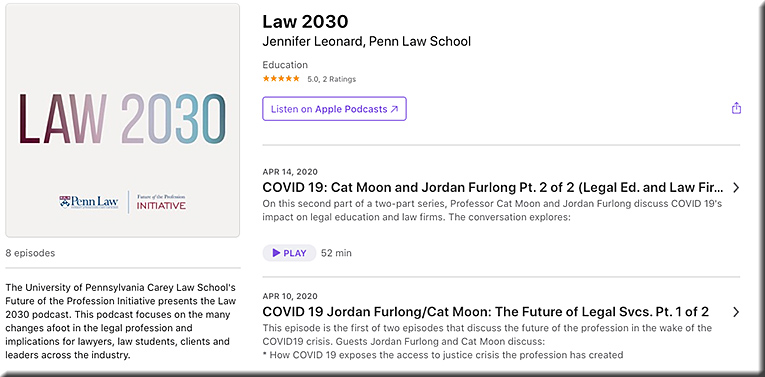
Jennifer Leonard, Jordan Long, and Cat Moon
Part I — 4/10/20

This episode is the first of two episodes that discuss the future of the profession in the wake of the COVID19 crisis. Guests Jordan Furlong and Cat Moon discuss:
- How COVID 19 exposes the access to justice crisis the profession has created
- Why the crisis offers the opportunity to leverage technology in new ways
- Why the structures and systems that have defined the profession have been so durable
- Whether lawyers view the crisis as a blip or a transformation
- How leaders can pivot toward innovation
From DSC:
At several points in the conversation, when Cat and Jordan were both referring to the importance of experimentation within the legal realm, I was reminded of this graphic that I did back in 2013:

I was reminded of it as well because Jennifer Leonard rightly (in my perspective), brought in higher education into the discussion at several points. There are some similarities — especially concerning power and privilege. Well, it’s now true in the legal realm as well (and probably has been true for a while…I’m just behind).
Experimentation. Experimentation. Experimentation. <– so key in the legal realm right now!
Other notes I took:
- Triage: Need to deal with essentials to keep afloat. Yourself, staff, clients, cash flow. Put out the fire.
- Reconstruction: In parallel, create “field hospitals.” Recession is going to have massive impacts on old systems. Need new systems. Start building institutions that work. Build as many of these as you can. Experiments. House isn’t going to be inhabitable after the fire. Need a new shelter — maybe start w/ a tent, then a cabin, then a house. Build on something small. Start building what’s going to replace the old systems.
- Power and privilege imbalance is why people haven’t been able to change things. “I can make you do something for me. You come here so I can dispense justice to you.” But not just judges…throughout the system.
- Public legal awareness and legal education. In high schools, universities, colleges, churches, mosques, synagogues, etc.
- Higher ed and legal services? Anything we can learn from each other?
- Systems created by people who rule the systems. Power imbalance exists in higher ed, but hubris is completely indefensible within the legal realm. Need much better access to legal information and legal understanding.
- OS on the Mac. Don’t have another OS for legal system to move to. We need to redesign our legal OS to serve more people.
- Law is society’s OS. Law is DOS-based…need Windows or Mac type of leap.
- Self protectionism. Hubris. Power imbalance. Power hungry.
- Yet many who enter legal profession come in wanting to make the world a better place. Why the move away from these ideals? Need more focus on developing professional identity. Structure, framework for how to be a lawyer. Students become more cynical as time goes by. Also, there’s “ladder pulling.” Pay your dues. Get hazed. I had to do it…now you have to do it. Bar Exam good example of this. Confirmation bias. It’s the way we’ve always done it.
Today, the following things ARE happening — so it CAN be done! The people in charge just didn’ want to do these things.
- lawyers working from home
- e-filing of documents to courts
- video hearings in court
- faster, cheaper, more convenient
Jennifer Leonard, Jordan Long, and Cat Moon
Part II – 4/14/20

On this second part of a two-part series, Professor Cat Moon and Jordan Furlong discuss COVID 19’s impact on legal education and law firms. The conversation explores:
- The “knock out effect” the crisis has on the various parts of the lawyer formation system
- Who might take ownership of coordinating the new landscape of lawyer accreditation
- The opportunities lifelong learning creates for law schools to be involved in the ongoing development of legal professionals
- How human-centered design and project-based learning offer ways to integrate the three sides of the Delta model of lawyer competency
- How small and solo law firms might be impacted by the crisis
Notes I took:
- The knock-out effect.
- How can we coordinate amongst the players in the system? Will be hard, because of the existing fiefdoms. Power and authority move back up the chain to those who did the delegating in the first place. If the power has been delegated to you, you are at a disadvantage. Jordan sees an assertion of authority from a central entity — legislatures most likely; possibly courts.
- This moment offers us an opportunity to experiment and to redesign our systems. Can find new ways to fulfill missions.
- Have no choice but to embrace the ambiguity of the moment.
- Triage, then try to build something better than what we had before.
- We have to build something different. “And look, the sky’s not falling!” Think big. Act boldly in these experiments. Expand what we think is possible.
- The repercussions of the Coronavirus will be with us for much longer than many think it will
- Legal principles/concepts/rules. Areas of practice. Professional formation (ethics, integrity, operational aspects, & more). Know the law, but also WHY we have the law and lawyers.
- Can learn “black letter law” asynchronously and via videoconferencing.
- Need to expand curriculum: Project/time management, customer service, financial and tech literacy
- Delta Model — a framework for developing lawyer competencies; starts in law schools; what are the skills and competencies; the foundation is the practice of law; research, issue spotting, PM, data analysis, understanding business; understanding people; wholistic approach. A lifelong journey of growth.
- Law schools — 3 years, then done. Not a productive way to do things. We need to keep people on top of their game throughout a career. Is legal education a place or a system/process that you enter and re-enter again and again throughout one’s career? Wouldn’t it be great if I could access ___ modules along the way?
- How are we going to create/design highly engaging online-based learning experiences? #1 on Cat’s priority list now. Got moved up the priority list.
- There are pros and cons for both F2F and online-based learning. Humanizing impact when your professors are teaching from their homes.
- Reframing legal education just as we are reframing courts as a service, not a place.
- Blended approach can be very effective/powerful.
- Need to collect data on what’s working and what’s not working.
- Fundamental business model of corporate side is likely at the end of its course; law firms will need a new model for generating profit. For smaller firms, prospects are more dire as their clients are going through major negative changes. Potential unsustainability of many practices.
- How can we provide different models that expand access to justice? That help develop happier and healthier lawyers?
- Per legalproblemsolving.org, human-centered design is:
- …a fluid framework for discovering problems, ideating solutions, and iterating to continuously improve solutions. HCD provides a methodology for considering both legal service delivery challenges, as well as clients’ legal problems. The HCD method also serves as a tool individual law students can use to craft a rewarding, successful legal career.
On 04/16/2020,
in health, innovation, law schools, legal reform, legal technologies, legislatures / government / legal, policy, society, technology (general), telecommunications, telelegal, United States,
by Daniel Christian
Desperate times call for innovation — from abovethelaw.com by Cori Robinson
New York expands standby guardian statute and permits video witnessing of estate planning documents.
Excerpt:
First online notarization, then the legalization of surrogacy, now an expansion of the standby guardian law and authorization of video witnessing of estate planning documents. Governor Andrew Cuomo of COVID-19-stricken New York is a gift not only to trusts and estates attorneys, but to all citizens.
On 04/03/2020,
in 21st century, 24x7x365 access, accessibility / UDL, Artificial Intelligence/Agents/LLMs/and Related, career development, change, changing business models, cloud-based computing / apps / other cloud-related, CMS/LMS, collaboration, colleges, communities of practice, community colleges, computer science, cost of getting a degree, data related items, digital learning, education, education technology, emerging technologies, engineering, experimentation, future of higher education, game-changing environment, global / globalization, higher education, human-computer interaction (HCI), ideas, India, intelligent systems, intelligent tutoring, learner profiles, learning, learning agents, learning ecosystem, Learning from the Living [Class] Room, learning preferences, MOOCs -- Massive Open Online Courses, morals/values, more voice more choice more control, new business models, personalized/customized learning, platforms, science, social learning / networks, society, STEAM-related, student-related, teaching & learning, technologies for your home, technology (general), tools, TVs, United States, universities,
by Daniel Christian
Why education is a ‘wicked problem’ for learning engineers to solve — from edsurge.com by Rebecca Koenig
Excerpts (emphasis DSC):
So, back to the wicked problem: How do we make education that’s both quality education and at the same time accessible and affordable?
“Now, we are building a new technology that we call Agent Smith. It’s another AI technology— and we’re very excited about it—that builds [a] Jill Watson for you. And Agent Smith can build a Jill Watson for you in less than 10 percent of the hours.”
…
So one question for online education is, can we build a new set of tools—and I think that’s where AI is going to go, that learning engineering is going to go—where AI is not helping individual humans as much as AI is helping human-human interaction.
Huge ethical issues and something that learning engineering has not yet started focusing on in a serious manner. We are still in a phase of, “Look ma, no hands, I can ride a bike without hands.”
…
Technology should not be left to technologists.

On 03/31/2020,
in Access to Justice (A2J), career development, change, changing business models, dangers of the status quo, Daniel S. Christian, ideas, law schools, legal technologies, legislatures / government / legal, platforms, society, surviving, technology (general), telecommunications, telepresence, television, tools, universities, vendors, videoconferencing,
by Daniel Christian
From DSC:
Given the attached graphic…what do you suppose, how might this type of thing impact #telelegal (i.e., akin to what’s currently building with #telemedicine for the healthcare industry)?
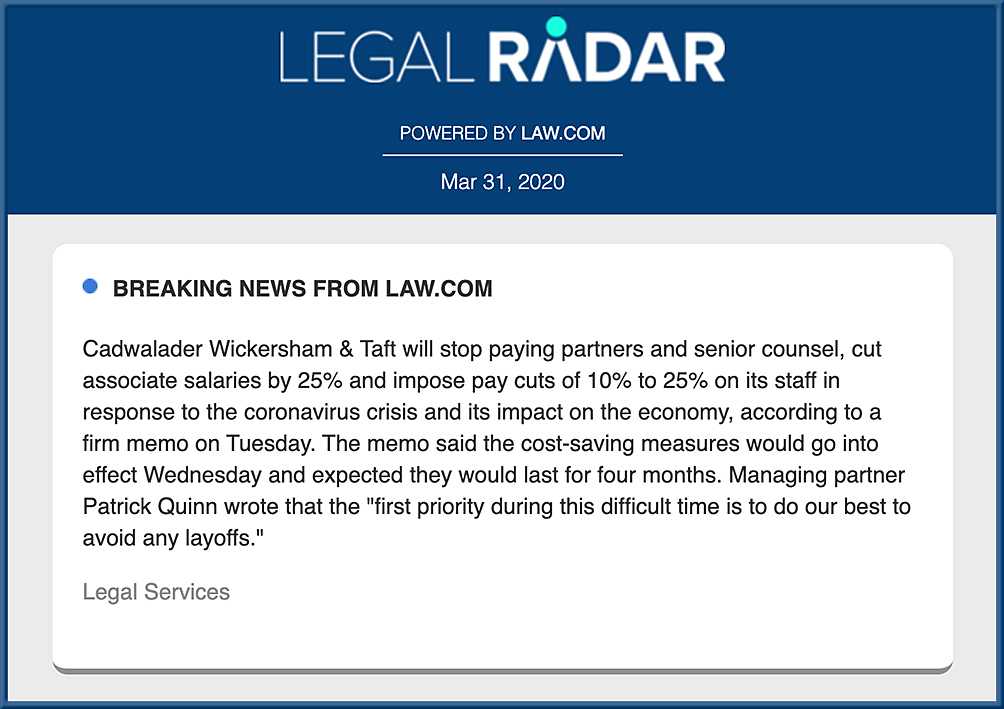
If things blow over in 3 weeks, not much will likely change within the legal realm. But if the impacts from the Coronavirus go on for 6 months or more (like we still have with tighter airport security resulting from what occurred on 9/11/2001), I’d say we’ll see more lawyers strike out on their own and/or join firms that support telelegal. Or, we’ll see fewer people go into law…which is NOT what our society needs given our current Access to Justice (#A2J) crisis involving civil law cases.
Another possibility could be an explosive growth in legaltech / cloud-based apps for providing legal services.
Regardless…this is what a wave looks like when it starts to build. Firms, individual lawyers, and even law schools can ride it or be crushed by it.
Addendum on 4/1 and this is NOT an April Fool’s joke:
Dam breaking on law firm layoffs. Many more to come. Also cuts to partner draws, cancelation of summer programs and other measures underway.
— Kent M. Zimmermann (@kentzimmermann) March 30, 2020
On 03/18/2020,
in 21st century, 3D, analytics, Artificial Intelligence/Agents/LLMs/and Related, Asia, Augmented Reality (AR), Australia, Blockchain, bots, business, Canada, career development, change, changing business models, cloud-based computing / apps / other cloud-related, computer science, education, global / globalization, ideas, India, learning, learning ecosystem, Learning from the Living [Class] Room, legislatures / government / legal, lifelong learning, media/film, memory, Natural Language Processing (NLP), new business models, platforms, science, smart classrooms, society, STEAM-related, strategy, technologies for your home, technology (general), the downsides of how people use tech, tools, trends, TVs, United States, user experience (UX), videoconferencing, virtual field trips, virtual K-12 schools, Virtual Reality (VR) / worlds / learning, virtual tutoring, voice recognition / voice enabled interfaces, web-based collaboration, workplace, youth,
by Daniel Christian
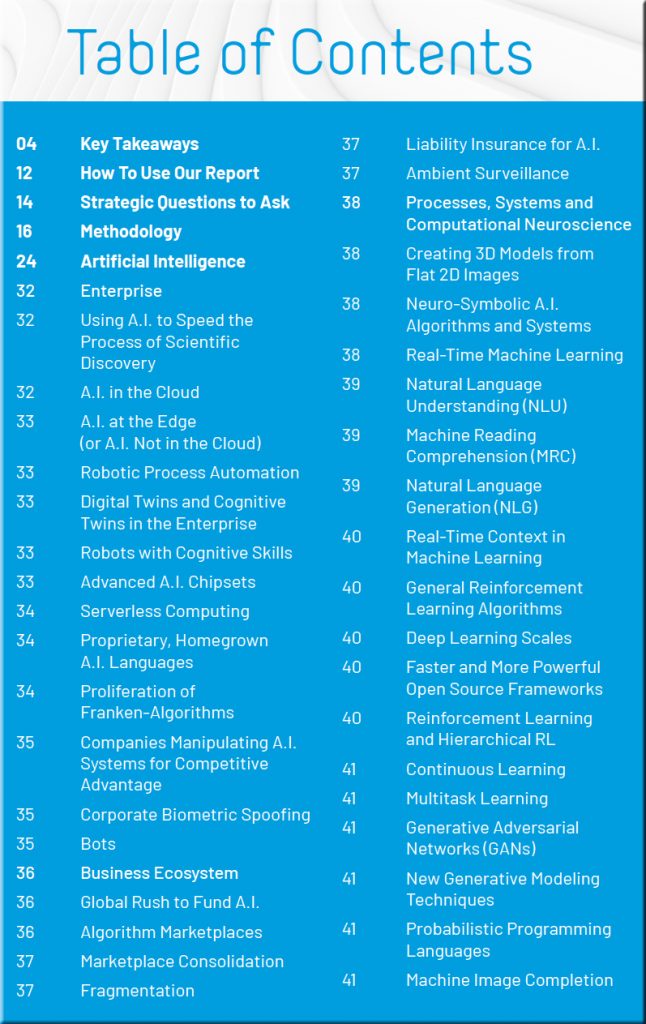
- Welcome to the Synthetic Decade.
- You’ll soon have augmented hearing and sight.
- A.I.-as-a-Service and Data-as-a-Service will reshape business.
- China has created a new world order.
- Home and office automation is nearing the mainstream.
- Everyone alive today is being scored.
- We’ve traded FOMO for abject fear.
- It’s the end of forgetting.
- Our new trust economy is being formed.
On 03/10/2020,
in law schools, legal technologies, legislatures / government / legal, technology (general), United States, universities,
by Daniel Christian
Georgetown Law announces two new degrees, including nation’s first “Master of Law and Technology” Program for non-lawyers — from law.georgetown.edu
Classes will start fall 2020 for new program designed to equip technologists, Hill staff, civil society advocates and other professionals with a foundation in technology law and policy
From DSC:
The legal realm will likely need to get rid of that phrase — “non-lawyers.”
On 02/28/2020,
in Access to Justice (A2J), law schools, legal reform, legal technologies, legislatures / government / legal, technology (general), tools, United States,
by Daniel Christian
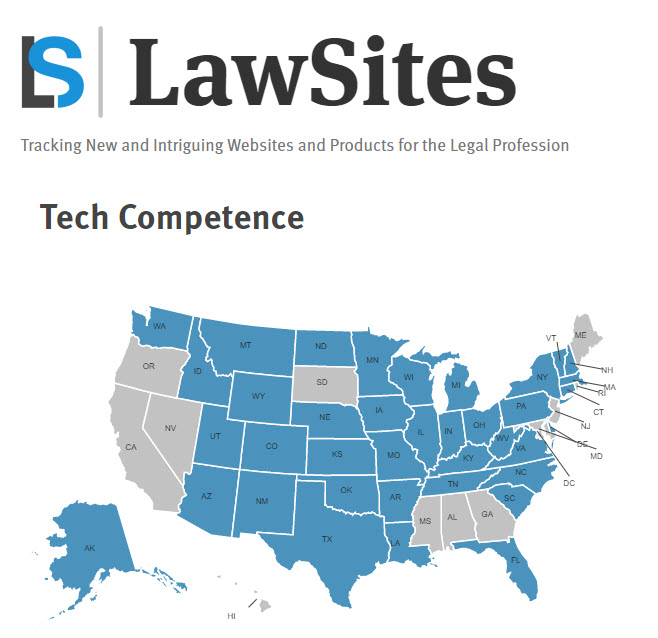
38 states have adopted the duty of technology competence — from lawsitesblog.com by Bob Ambrogi
Excerpt:
In 2012, something happened that I called a sea change in the legal profession: The American Bar Association formally approved a change to the Model Rules of Professional Conduct to make clear that lawyers have a duty to be competent not only in the law and its practice, but also in technology.
More specifically, the ABA’s House of Delegates voted to amend Comment 8 to Model Rule 1.1, which pertains to competence, to read as follows:
Maintaining Competence
To maintain the requisite knowledge and skill, a lawyer should keep abreast of changes in the law and its practice, including the benefits and risks associated with relevant technology, engage in continuing study and education and comply with all continuing legal education requirements to which the lawyer is subject. (Emphasis added.)
On 02/26/2020,
in business, business side of he, change, changing business models, corporate / business world, corporate universities / corporate training, disruption, future, game-changing environment, human-computer interaction (HCI), ideas, innovation, leadership, MBA, new business models, pace of change, platforms, presentations, professional development, reinvent, society, staying relevant, strategy, surviving, technology (general), tools, traditional / tradition, training / L&D, trends, United States, universities, vision/possibilities, workplace,
by Daniel Christian
From DSC:
The items below are meant for those involved with digital transformation, developing strategy, and keeping one’s organization thriving into the future.
Strategy in the Digital Revolution with Ryan McManus — from dukece.com; with thanks to Laura Goodrich for this resource out on Twitter
Description of webinar:
Today, every business is focused on digital transformation, yet most organizations are struggling to realize value from their efforts and investments. Less than 20% of business leaders believe their digital transformation efforts have been successful. With unprecedented access to data and technology, how is it that firms and their leaders are experiencing such disappointing results?
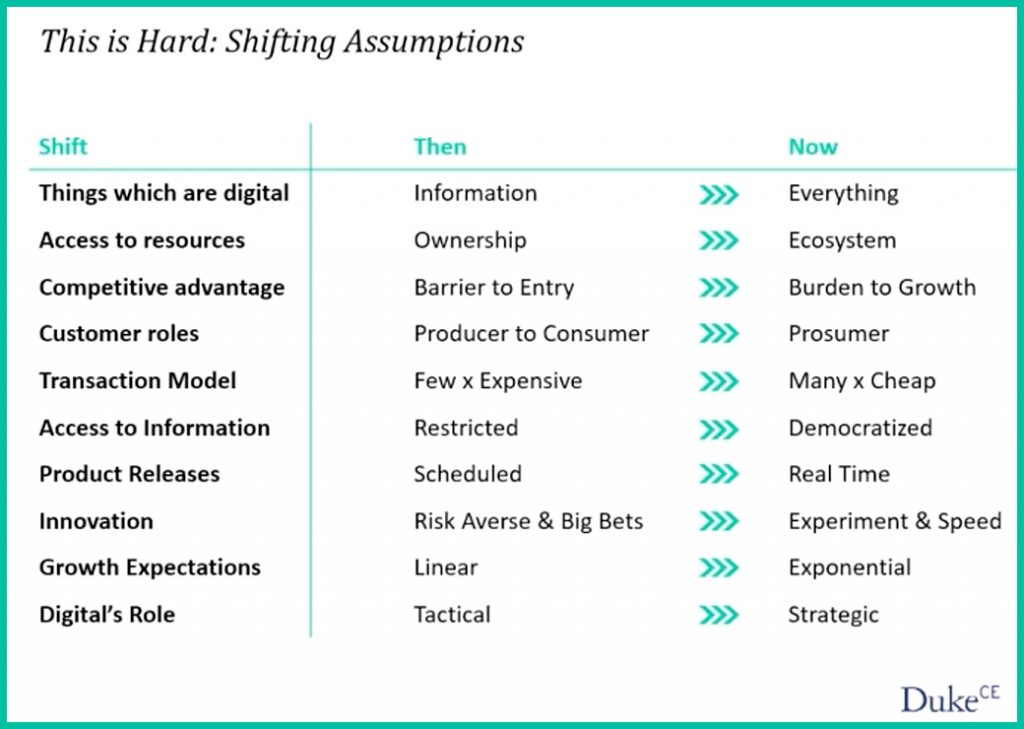
At the root of the problem is the disconnect between how leaders understand strategy and the new rules of the digital revolution. Most leaders haven’t been taught how to think about a world that is very different from the one which gave rise to popular strategic concepts, and as a result, they apply outdated strategy models and thinking to the new world, trying to squeeze the competitive realities of the digital revolution into linear, analog strategic planning concepts.
In this complimentary on-demand webinar, Ryan McManus, lecturer at Columbia University Business School and Duke Corporate Education, discusses the New Strategy Playbook, including:
- The current state and evolution of the digital revolution, and what’s next
- The four levels of digital strategy: how you can adapt your approach to win
- Why traditional approaches to strategy have reached their limits
- Implications for leadership development
Example slides:
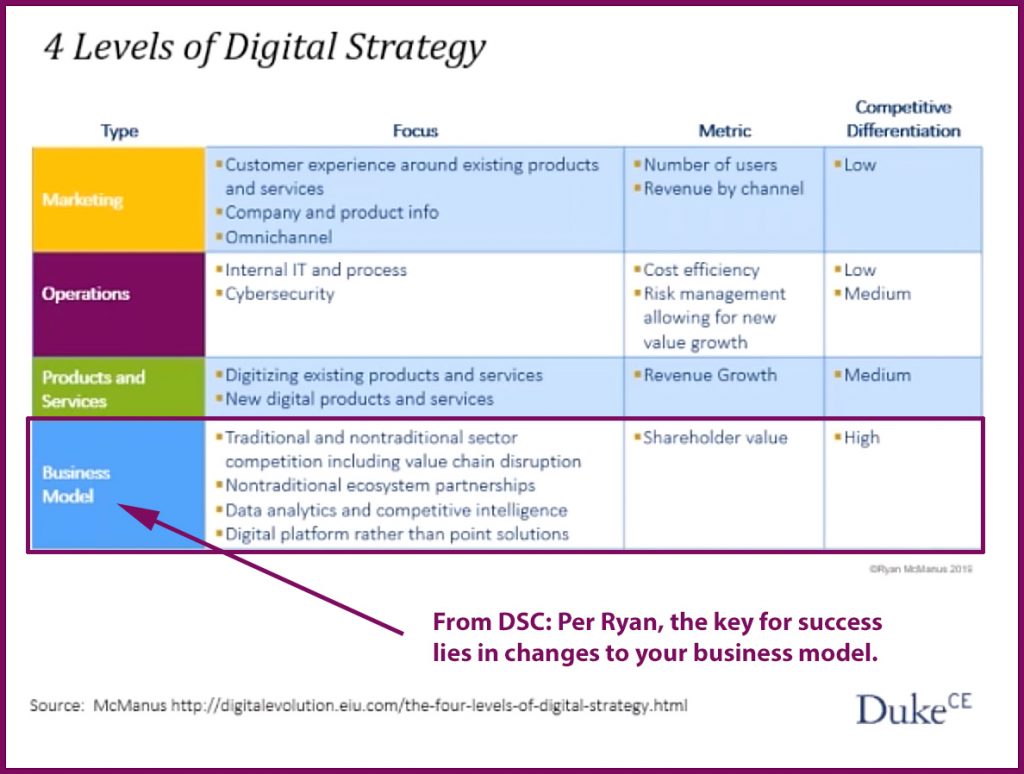
Also see:
On 02/26/2020,
in 21st century, Artificial Intelligence/Agents/LLMs/and Related, career development, change, changing business models, collaboration, communities of practice, computer science, Cost of legal services - including access, Daniel S. Christian, Europe, innovation, law schools, legal technologies, legislatures / government / legal, platforms, policy, social media, society, staying relevant, streams of content, technology (general), United States, universities,
by Daniel Christian

Also see:
EU Proposes Strict Regulations for AI — from futuretech360.com by John K. Waters
Excerpt:
The European Union this week unveiled its first proposed regulations for artificial intelligence (AI) technology, along with a strategy for handling personal digital data. The new regs provide guidance around such AI use cases as autonomous vehicles and biometric IDs.
Published online by the European Commission, the proposed regulations would apply to “high-risk” uses of AI in areas such as health care, transportation and criminal justice. The criteria to determine risk would include such considerations as whether a person might get hurt, say, by a self-driving car or a medical device, and how much influence a human has on an AI’s decision in areas like job recruiting and law enforcement.
From DSC:
Here are two other example of AI’s further integration into the legal realm:
Casetext is Automating Litigation — from businesswire.com
Casetext’s new litigation automation technology, Compose, automates substantive legal work — and a substantial number of billable hours
Excerpt:
SAN FRANCISCO–(BUSINESS WIRE)–Casetext, the legal technology company known for its groundbreaking A.I. legal research platform, today announces a new product that will define litigation automation: Compose. Compose, which automates the first draft of a legal brief, is poised to disrupt the $437 billion1 legal services industry and fundamentally change our understanding of what types of professional work are uniquely human.
UC Irvine School of Law To Integrate Blue J Legal’s AI-Enabled Tax Platform into Curriculum — from businesswire.com
First of its kind initiative aims to prepare graduate students for careers in tax law where AI will be integral to the decision-making process
The joint effort aims to demonstrate why advanced technological integration in higher education is important and how to leverage it, specifically in tax law.
DC: Given today’s pace of change, pulse-checking &putting things on our radars are key.I appreciate the power of “streams of content” 2enhance our personal learning ecosystems. Along these lines, I also like Feedly & subscribing to a variety of RSS feeds.https://t.co/SzvTBMXfQE pic.twitter.com/2FE4dX1skB
— Daniel Christian (@dchristian5) February 26, 2020
On 02/22/2020,
in design, internet, mobile learning, mobile technologies, platforms, productivity / tips and tricks, professional development, technology (general), tools, web design and production,
by Daniel Christian
The latest research for web designers, February 2020 — from webdesignerdepot.com by Suzanne Scacca