From DSC:
As the technologies get more powerful, so do the ramifications/consequences. And here’s the kicker. Just like we’re seeing with trying to deal with systemic racism in our country…like it or not, it all comes back to the state of the hearts and minds out there. I’m not trying to be preachy or to pretend that I’m better than anyone. I’m a sinner. I know that full well. And I view all of us as equals trying to survive and to make our way in this tough-to-live-in world. But the unfortunate truth is that technologies are tools, and how the tools are used depends upon one’s heart.

Proverbs 4:23 New International Version (NIV) — from biblegateway.com

23 Above all else, guard your heart,
    for everything you do flows from it.


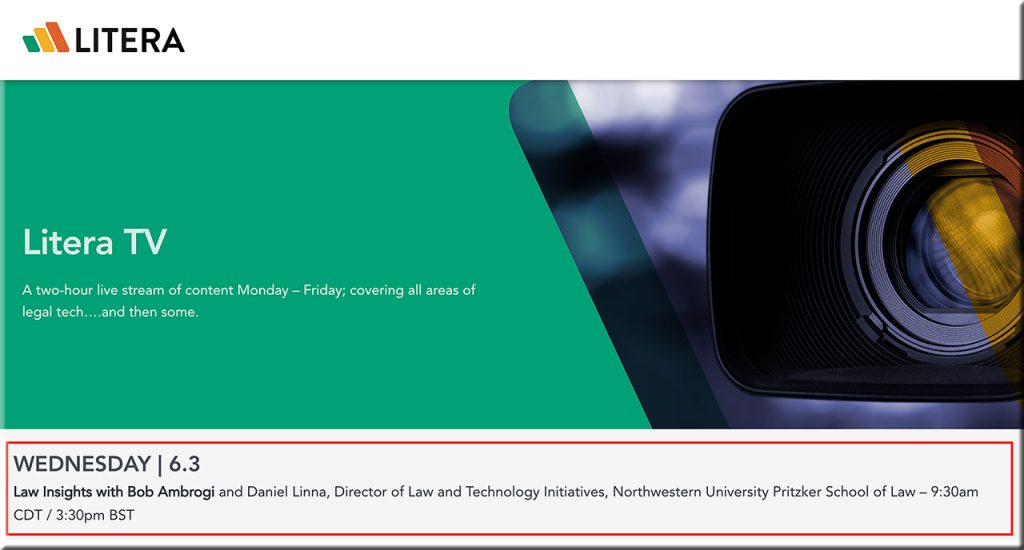
litera tv dot com -- Daniel Linna and Bob Ambrogi's conversation on June 3, 2020

WEDNESDAY | 6.3 | Law Insights with Bob Ambrogi and Daniel Linna, Director of Law and Technology Initiatives, Northwestern University Pritzker School of Law

Notes (emphasis DSC):

  • Trying to build community, collaborate, work together
  • How do you manage a team remotely? How build community online?
  • Spontaneous interactions still needed
  • In what ways does the online ecosystem ADD to what we are doing?
  • Jury trial – online; equalizer for those involved in trial; “all in same space on the screen”
  • Start with some basic/smaller things – landlord/tenant
  • Racism going on heavily this week – a second pandemic
  • Developing a quality movement in law (Linna)
  • We need quality metrics and we need to measure the value being provided. What makes something effective, high-quality, and valuable? Now apply that thinking to the delivery of legal services.
  • Project mgmt / quality movement – less defects, etc. in 1980’s / lean thinking / 6 sigma in GE / but haven’t seen this in the area of law
  • Empiricism in law – 100 years ago medicine and law were in the same spot; since then medicine started more testing, empirical work, data-driven practices; but law didn’t
  • Daniel Linna’s blog – https://www.legaltechlever.com/
  • Can we come up with metrics?
  • Dan worked with a lawyer-assisted program in Lansing, MI – what happened? What was duration of cases? Data-driven thinking; measure; make it more of a science
  • Bob asked isn’t law less scientific and perhaps more art than a science?
  • What kinds of metrics are we talking about in litigation?
  • Contracts – can we figure out what adds value and what makes a contract “better?” (Insert from DSC: Better for whom though?)
  • What actually matters to the client? Clauses that lawyers think that are important, businesspeople don’t think are important. Risk mitigation is not all the client thinks about.
  • Incomprehensible contracts – too hard to understand
  • Natural language generation – what inputs do we need? We don’t want many contracts to be the dataset that an algorithm gets trained on.
  • (Insert from DSC: Daniel relayed some information that reminded me of Clayton Christensen’s disruptive thinking: 80% of impoverished folks get NOTHING. Totally disconnected. Perhaps we don’t need perfection, but even something is much better than nothing. For example, provide an online legal aid booklet to those who are trying to represent themselves.)
  • Go for low-hanging fruit for more empirical
  • Ambrogi: How does the work you are doing impact access to justice (#A2J)? How could quality movement impact police procedures? Is there applicability in terms of what you are writing about?
  • Human-Centered Design – uncovering biases. Why would people TRUST the criminal system if they can’t trust the CIVIL system? Perhaps if landlords thought differently. Disconnected.
  • Innovate, improve, project management;
  • Way decisions are made vary greatly; need more open data from our courts; lack of transparency from courts.
  • Leadership – commitment to resolve issues. Lacking vision. What do we want our legal systems to look like/act like?

Call to action:

  • Have or develop a quality mindset
  • Leadership needs to paint a vision for what the future looks like
  • Training around legal operations
  • How to measure quality and value – be more data-driven

We need disruption AND continuous improvement – not one or the other.
–Daniel Linna


Surviving the Third Wave of COVID and Beyond — from eliterate.us by Michael Feldstein

Excerpts (emphasis DSC):

If such an idyll ever existed, its heyday coincided with an age when universities were bastions of race-, gender-, and class-based privilege, with a minute fraction of the population enrolled in higher education. — Gabriel Paquette

Rather, I am suggesting—and I believe Paquette is suggesting—that we take a good hard look at how much our standards may be influenced by hidden assumptions of privilege. Why should a “quality education” for the 21st-Century masses look identical to the “quality education” of the 19th-Century elites? Where do these ideas of quality come from? Whose goals do they serve? And what trade-offs do they entail?

Just as literacy is about more than employing the technology of the printed word, e-literacy is about more than EdTech. It’s about culture. It’s about understanding how we change ourselves—consciously or not—when we choose to depend on certain tools in certain ways. And it’s about making mindful choices. — Michael Feldstein


Tech conferences are going virtual, and it feels like Netflix content on demand — from .marketwatch.com by Jon Swartz

Excerpt:

Such is the new world of tech conferences in the age of COVID-19. They’ve gone all-digital, like Build and GTC Digital, and may never be the same. Absent a vaccine, the days of thousands of people herded into hotel ballrooms and convention centers like cattle, sharing cabs and eating in cramped quarters, are gone.

Far from crippling the tech industry, however, virtual shows could lead to democratization of what had once been an exclusive, pricey privilege for tech movers and shakers. In the new climate, consumers have free access to valuable technical content whenever they wish to view it.

“Last year, I paid several thousand dollars to attend, and if I was late for a session, I couldn’t rewind it. This year, I could.”


From DSC:
I, for one, am glad that we made the investments in the telecommunications and networking infrastructures, in the PCs, Macs, laptops, tablets, other items in the #edtech realm, as well as investing in a variety of technologies through the years. Given the need to move online due to the Coronavirus, I’d say such investments offered many a solid ROI throughout K-12, higher education, as well as in the corporate world. But I realize that not everyone has access to these things…which is something we must work on as a nation.

But had we not made those investments, where we would be now?

Also see:

Teaching during COVID-19: Why We’re Fortunate — from er.educause.edu by Gardner Campbell


Not in the Future—Now — from er.educause.edu by John O’Brien

Excerpts:

…technology can no longer be seen as a utility working quietly in the background. Now more than ever, technology is a strategic asset that is vital to the success of every higher education institution.

Digital transformation (Dx) can no longer be considered an aspirational concept. It must be understood as an imperative. And that well-worn, precious notion of campus technology professionals doing work that is noticed only when there is an outage? This too is a thing of the past.


[Technology] is not just a lifeline that got us through a tricky situation. It is and must increasingly be understood as an integral, strategic part of the successful college or university. Not in the future. Now.


Healthcare will never be the same: 8 experts on the future of medicine around the globe — from fastcompany.com by Ruth Reader and Ainsley Harris
The leaders of the Mayo Clinic, Cleveland Clinic, Doctors Without Borders, and more tell us how healthcare is being transformed by the COVID-19 pandemic.

The second thing is we’re seeing technology innovations, such as virtual rounding done on an iPad and virtual [visits]. Before COVID hit, we were doing 3,000 virtual visits a month. In March, we did 60,000.

As a nation, we have been promising and not delivering on telehealth now for several years, and that has had to do with licensure, regulation, billing, but also just healthcare’s reluctance to change. With those barriers removed, we’ve been able to move from maybe 400 to 35,000 virtual visits a week.

Mental health and well-being should be part of our education. One of the most important things is how to communicate with people, how to disagree with people, how to have productive relationships. And yet we don’t learn any of this.

#telehealth #telelegal #future #change #healthcare


Higher ed needs to build more mature Digital Learning Ecosystems

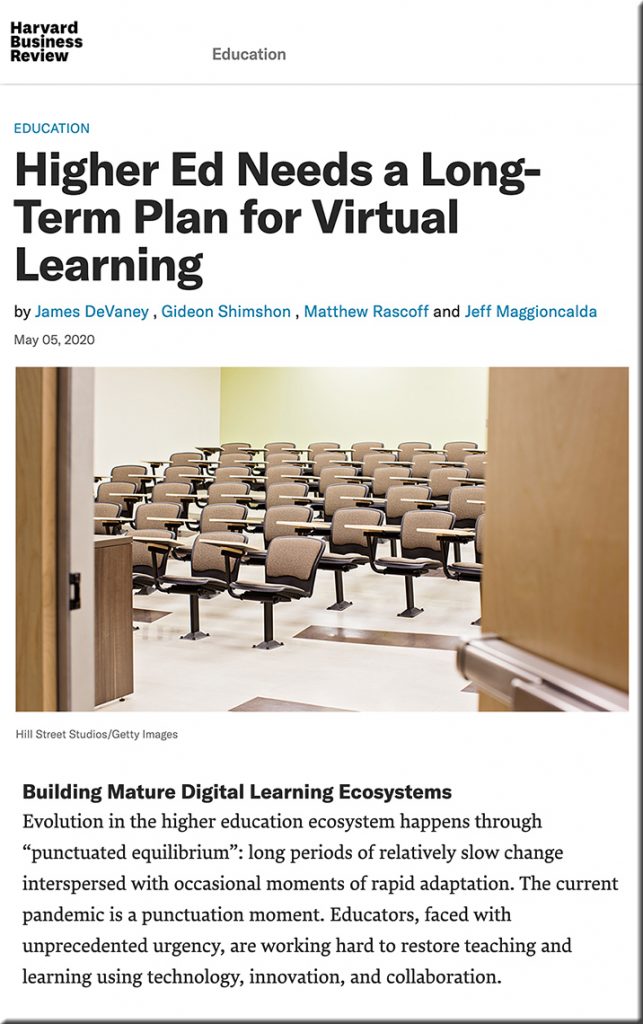
Higher Ed Needs a Long-Term Plan for Virtual Learning — from Harvard Business Review by James DeVaney, Gideon Shimshon, Matthew Rascoff, and Jeff Maggioncalda

Excerpts:

The staggering impact of Covid-19 on education systems around the world is unlike anything we have seen in the post-war era. More than 1.6 billion students have been affected, representing over 91% of all students in the world. Unsurprisingly, demand for online learning has skyrocketed. In the last 30 days, there were 10.3 million enrollments in courses on Coursera, up 644% from the same period last year.

As the emergency subsides but normal fails to return, higher ed institutions need to do more. There’s a good likelihood that virtual learning — in some capacity — will need to be a part of education for the foreseeable future. Higher ed institutions need a response framework that looks beyond the immediate actions. They have to prepare for an intermediate period of transition and begin future-proofing their institutions for the long term.


It’s gone ‘shockingly well’: America’s hospitals have embraced remote technology amid COVID-19 — from finance.yahoo.com by Daniel Howley

Excerpt:

To address that, Kapsner said that nurses and primary doctors who need to physically be in a room with a patient will still do so, but specialists and consulting physicians will remain outside, communicating with the primary doctor or nurse via Teams.

From DSC:
Can #telelegal be too far behind…?


From DSC:
When reading the article below…Wayne Gretzky’s quote comes to mind here:

The legal industry needs to skate to where the puck is going to be.

ANALYSIS: The New Normal—Law Firms May Never Be the Same — from news.bloomberglaw.comby Sara Lord

Excerpt:

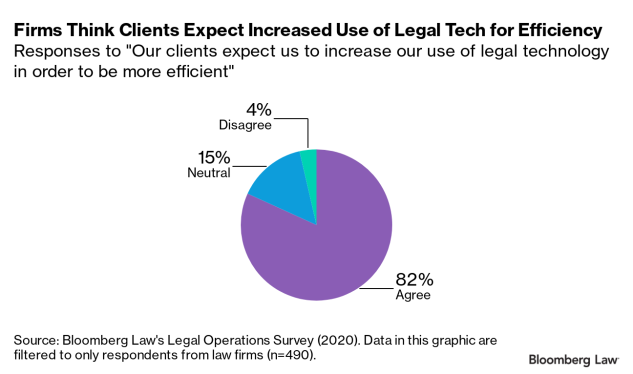
In our recent 2020 Legal Operations Survey, Bloomberg Law asked organizations including law firms, corporations, non-profit organizations, and academic institutions, a number of questions relating to their use of data and metrics. Included in our survey were questions relating to whether law firms measure the value of legal operations and legal technology. Responses indicated that two-thirds of law firms measure legal operations value and nearly one-quarter of law firms using legal technologies measure the value of that legal technology.

Firms think clients expect increased use of legal tech for efficiency


Dawn of the Age of Digital Learning [Moe & Rajendran]

Dawn of the Age of Digital Learning — from medium.com by Michael Moe and Vignesh Rajendran
An Acceleration of Trends That Have Been Building for Years

Excerpts:

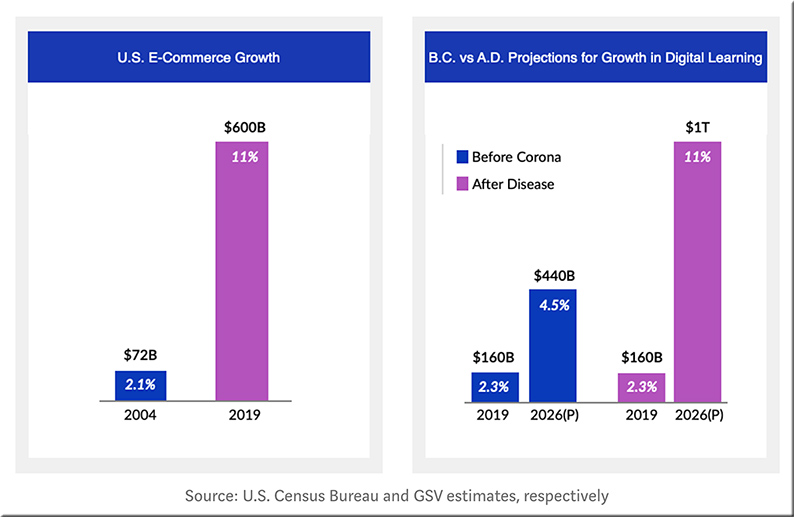
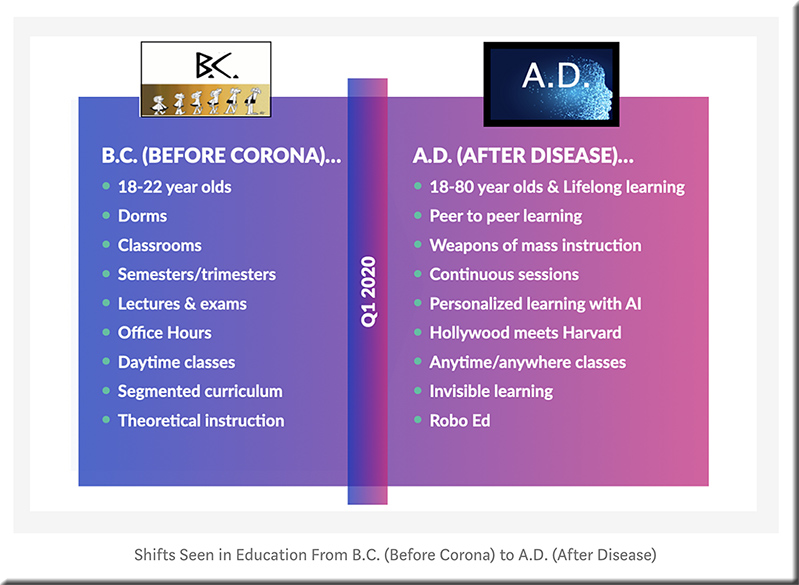
Some of these new online learners will sink. Some will crawl out of the pool and never go back in. But we believe most will get the hang of it, like it, and will no longer be confined to the shore. Effectively, the genie is not going back in the bottle… digital learning has come of age. We have a B.C. (Before Coronavirus) world transitioning to A.D. (After Disease).

The Coronavirus has brought forth the Dawn of the Age of Digital Learning — a time for builders to create the platforms, tools, and technology to propel society forward.

We now believe Digital Learning will reach 11% of the education market by 2026, representing a ~$1 Trillion market and a 30% CAGR, close to double the rate of growth projected in Before Covid-19


From DSC:
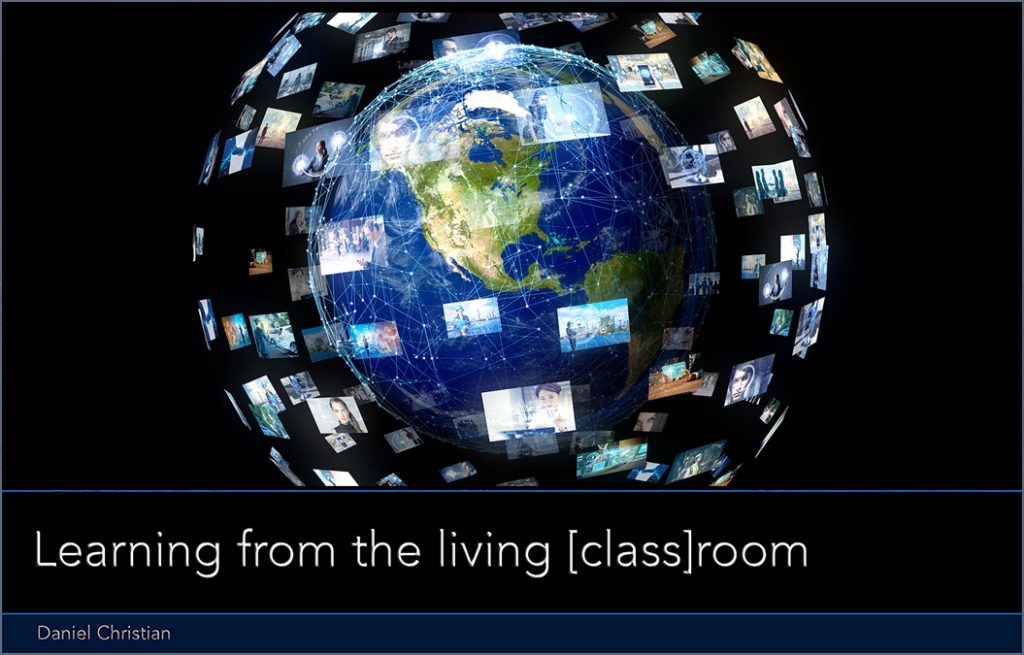
So many of the things in this article reminded me of the things, developments, trends, needs, and possibilities that I have been tracking for years in this vision of a next-generation, global learning platform that I have entitled:

We need a next gen learning platform -- I call this vision Learning from the Living Class Room

My guess is that the large, primarily online institutions/organizations will come out of this ordeal in much better shape than the majority of the traditional institutions of higher education. It won’t matter what faculty members at liberal arts institutions think about online learning. And as much as some faculty members won’t like to see or hear about it, students will no longer need for such faculty members to be sold on it. Students will come to realize that it was under those faculty members watch that their own enormous gorillas of debt were created. And they are beginning to witness and hear that it’s taking (or will take) older family members decades to pay down their debt.

So, I think that the market will decide the fate of many traditional institutions of higher education. Lifelong learners will vote with their feet — and fingers actually, by typing in a new URL — and simply move to the SNHU’s, ASU’s, UMass Online’s, WGU’s, and Liberty University’s of the world. After 5-10 years of investments in online learning, there will likely be some pretty amazing learning experiences out there.


OLC Innovate™ 2020 Conference Moves to June with All-Virtual Format — from prweb.com
Produced by the Online Learning Consortium, in partnership with MERLOT, OLC Innovate 2020 Virtual will gather digital learning leaders and practitioners, online, June 15-26, to focus on innovation in digital, blended and online learning.

Excerpt:

BOSTON (PRWEB) MAY 01, 2020
The Online Learning Consortium (OLC) announced today that its annual OLC Innovate™ Conference is moving to an all-virtual format for 2020. OLC and conference partner MERLOT will gather the digital learning community, online, June 15-26, for OLC Innovate™ 2020 Virtual Conference (#OLCInnovate). This year’s theme, “Building Bridges in Digital, Blended and Online Learning,” frames a 10-day online program that highlights inspiring innovators and thought leaders from higher education, K-12, military, health care and workforce education.


From DSC:
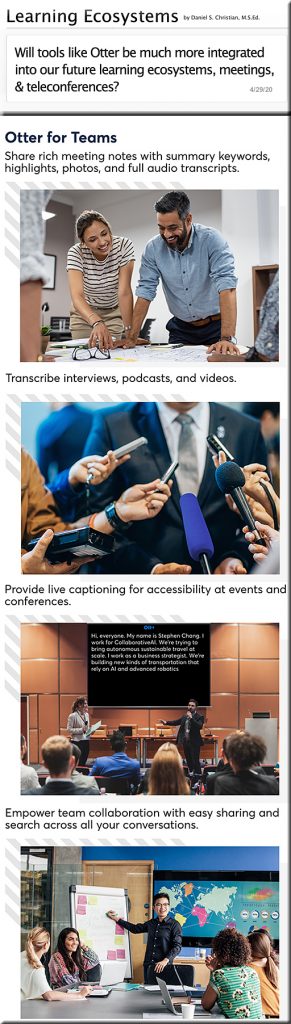
Some of the areas likely to see such tools integrated into their arenas, operations, and ecosystems:


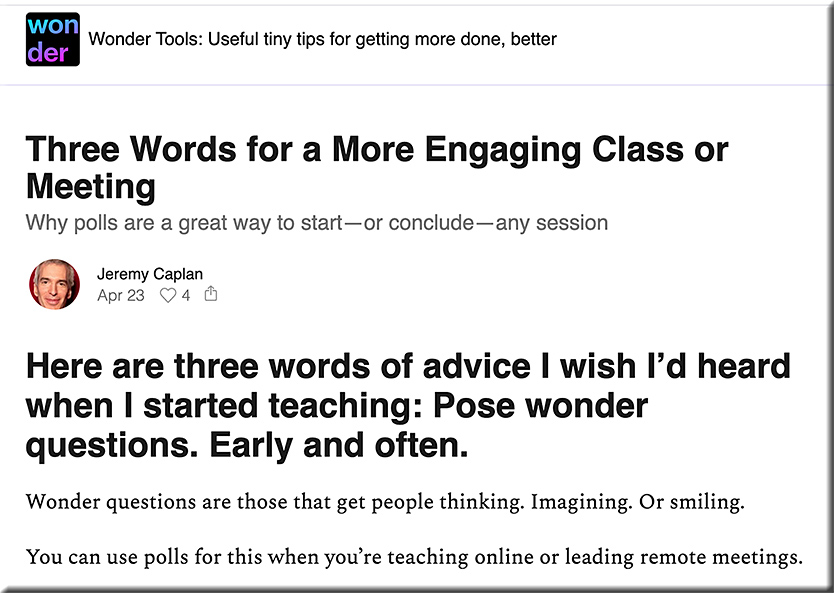
With thanks to my sister, Sue Ellen Christian, for forwarding me Jeremy Caplan’s site/newsletter.

Also see:

…and this one as well:

Three words of advice that I wish I had heard when I first started teaching


From DSC:

Will tools like Otter be much more integrated into our future learning ecosystems, meetings, & teleconferences?


EDUCAUSE COVID-19 QuickPoll Results: The Technology Workforce — from er.educause.edu by Susan Grajek

Excerpts:

Most of the survey respondents are working remotely and getting their work done. Although the work itself hasn’t changed much, workloads have increased, especially for IT leaders and people supporting teaching and learning. Most people have the technologies they need to work and to handle sensitive data, but many are struggling to maintain their physical, social, and emotional health. On the other hand, the newfound widespread ability to work productively from home is a silver lining, and respondents hope it can continue after the severe isolation of the pandemic eases.

Higher education institutions have had to change their cultures abruptly. Many respondents observed faster decision-making, greater focus, more collaboration, and more willingness to experiment and innovate.

The toothpaste is out of the tube: remote work works and should continue.

Greater compassion and support for work-life balance increases workforce engagement.

Values to keep: focus, communication, collaboration, and transparency.

The pandemic is accelerating digital transformation.

From DSC:
My health and work/family balance has been impacted, big time. A double whammy for me was that our local YMCA’s all closed down while the workloads increased even more. But as someone said, our ancestors had to deal with a lot worse than this with WWI and WWII, other wars/societal impacts, etc.

I, too, hope to be able to work more from home even after our workplaces are no longer off-limits. I get a lot done, my energy is better (not having to commute 2+ hours a day), my productivity to my employer has increased due to not having to commute –> the time I was in the car is time they get productivity-wise.


© 2025 | Daniel Christian