Are two teachers better than one? More schools say yes to team teaching — from hechingerreport.org by Neal Morton
Early research shows it cuts turnover and improves teachers’ job satisfaction

The model, known as team teaching, isn’t new. It dates back to the 1960s. But Arizona State University resurrected the approach, in which teachers share large groups of students, as a way to rebrand the teaching profession and make it more appealing to prospective educators.

In Mesa, teachers working on a team leave their profession at lower rates, receive higher evaluations and are more likely to recommend teaching to a friend.

Early research also indicates students assigned to educator teams made more growth in reading and passed Algebra I at higher rates than their peers.


Question: What Early Advice Had a Lasting Impact on Your Teaching? — from edutopia.org
Share the pivotal advice that shaped your teaching and learn from others in our community.


What Districts With the Worst Attendance Have in Common — from edweek.org by Sarah D. Sparks

It is tough to bring students back to the classroom once chronic absenteeism rates begin to climb. As more districts struggle with historically high absenteeism, new research suggests they may need a more systemic approach to reengaging students.

A new working paper on Michigan schools released by the Annenberg Center found most school districts with severe attendance problems did not directly address absenteeism when planning school improvement strategies. Among those that did focus on improving attendance, few coordinated their interventions across schools and aligned interventions to combat the specific barriers keeping students from school.

“If you think about the reasons that families are missing school, informing families about their children’s attendance is certainly important, but it’s not like the primary driver of absenteeism,” Singer said, “so there’s a disconnect.”


3 Strategies for Successfully Starting Your Career as a School Leader — from edutopia.org by Alexandra Auriemma
An assistant principal near the end of her second year in the job shares her advice for those moving into leadership roles.

However, I’ve learned that effective leadership isn’t about having all of the answers; it’s about knowing which questions to ask. Effective leaders listen deeply and ask questions that shape people’s thinking, moving the organization from where it is to where it needs to go. 


Building Better Schools: The art of leading change in education — from gettingsmart.com by Tyler Thigpen

Today’s K12 students are spending the vast majority of their time in classrooms listening to answers to questions they did not ask and following rules they did not have a hand in making. Given that this dynamic goes on for years, what is it doing to students’ minds and spirits? To their agency and empowerment? Are we unintentionally graduating dependent young adults?

But what if the opposite were true? What if schools empowered children to flourish? What if schools were the places where they could explore, identify, express, and develop their thoughts, feelings, and goals? There’s power in the uniqueness of every child. It’s time that school designs honor students’ unique calling, preferences, and goals, and encourage them to pursue those. It’s time to move fully into a new era for learning where learners can develop greater self-leadership than ever before.
 

Colleges are now closing at a pace of one a week. What happens to the students? — from hechingerreport.org by Jon Marcus
Most never finish their degrees, and alumni wonder about the value of degrees they’ve earned

About one university or college per week so far this year, on average, has announced that it will close or merge. That’s up from a little more than two a month last year, according to the State Higher Education Executive Officers Association, or SHEEO.

Most students at colleges that close give up on their educations altogether. Fewer than half transfer to other institutions, a SHEEO study found. Of those, fewer than half stay long enough to get degrees. Many lose credits when they move from one school to another and have to spend longer in college, often taking out more loans to pay for it.

Colleges are almost certain to keep closing. As many as one in 10 four-year colleges and universities are in financial peril, the consulting firm EY Parthenon estimates.

Students who transferlose an average of 43 percentof the credits they’ve already earned and paid for, the Government Accountability Office found in the most recent comprehensive study of this problem.

Also relevant:


Forbes 2024 AI 50 List: Top Artificial Intelligence Startups  — from forbes.com by Kenrick Cai

The artificial intelligence sector has never been more competitive. Forbes received some 1,900 submissions this year, more than double last year’s count. Applicants do not pay a fee to be considered and are judged for their business promise and technical usage of AI through a quantitative algorithm and qualitative judging panels. Companies are encouraged to share data on diversity, and our list aims to promote a more equitable startup ecosystem. But disparities remain sharp in the industry. Only 12 companies have women cofounders, five of whom serve as CEO, the same count as last year. For more, see our full package of coverage, including a detailed explanation of the list methodology, videos and analyses on trends in AI.


Adobe Previews Breakthrough AI Innovations to Advance Professional Video Workflows Within Adobe Premiere Pro — from news.adobe.com

  • New Generative AI video tools coming to Premiere Pro this year will streamline workflows and unlock new creative possibilities, from extending a shot to adding or removing objects in a scene
  • Adobe is developing a video model for Firefly, which will power video and audio editing workflows in Premiere Pro and enable anyone to create and ideate
    Adobe previews early explorations of bringing third-party generative AI models from OpenAI, Pika Labs and Runway directly into Premiere Pro, making it easy for customers to draw on the strengths of different models within the powerful workflows they use every day
  • AI-powered audio workflows in Premiere Pro are now generally available, making audio editing faster, easier and more intuitive

Also relevant see:


AWS, Educause partner on generative AI readiness tool — from edscoop.com by Skylar Rispens
Amazon Web Services and the nonprofit Educause announced a new tool designed to help higher education institutions gauge their readiness to adopt generative artificial intelligence.

Amazon Web Services and the nonprofit Educause on Monday announced they’ve teamed up to develop a tool that assesses how ready higher education institutions are to adopt generative artificial intelligence.

Through a series of curated questions about institutional strategy, governance, capacity and expertise, AWS and Educause claim their assessment can point to ways that operations can be improved before generative AI is adopted to support students and staff.

“Generative AI will transform how educators engage students inside and outside the classroom, with personalized education and accessible experiences that provide increased student support and drive better learning outcomes,” Kim Majerus, vice president of global education and U.S. state and local government at AWS, said in a press release. “This assessment is a practical tool to help colleges and universities prepare their institutions to maximize this technology and support students throughout their higher ed journey.”


Speaking of AI and our learning ecosystems, also see:

Gen Z Wants AI Skills And Businesses Want Workers Who Can Apply AI: Higher Education Can Help — from forbes.com by Bruce Dahlgren

At a moment when the value of higher education has come under increasing scrutiny, institutions around the world can be exactly what learners and employers both need. To meet the needs of a rapidly changing job market and equip learners with the technical and ethical direction needed to thrive, institutions should familiarize students with the use of AI and nurture the innately human skills needed to apply it ethically. Failing to do so can create enormous risk for higher education, business and society.

What is AI literacy?
To effectively utilize generative AI, learners will need to grasp the appropriate use cases for these tools, understand when their use presents significant downside risk, and learn to recognize abuse to separate fact from fiction. AI literacy is a deeply human capacity. The critical thinking and communication skills required are muscles that need repeated training to be developed and maintained.


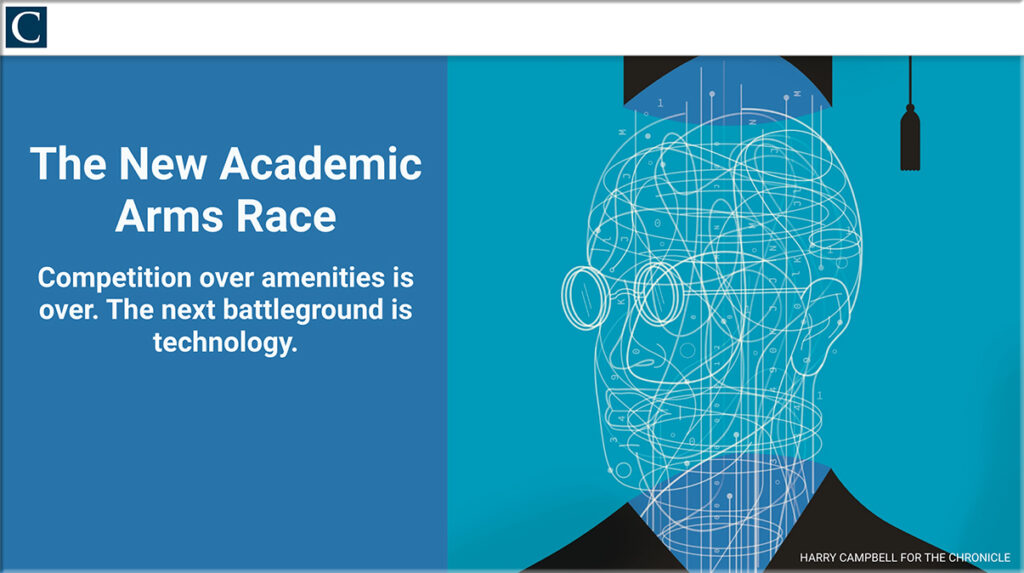
The New Academic Arms Race | Competition over amenities is over. The next battleground is technology. — from chronicle.com by Jeffrey J. Selingo

Now, after the pandemic, with the value of the bachelor’s degree foremost in the minds of students and families, a new academic arms race is emerging. This one is centered around academic innovation. The winners will be those institutions that in the decade ahead better apply technology in teaching and learning and develop different approaches to credentialing.

Sure, technology is often seen as plumbing on campuses — as long as it works, we don’t worry about it. And rarely do prospective students on a tour ever ask about academic innovations like extended reality or microcredentials. Campus tours prefer to show off the bells and whistles of residential life within dorms and dining halls.

That’s too bad.

The problem is not a lack of learners, but rather a lack of alignment in what colleges offer to a generation of learners surrounded by Amazon, Netflix, and Instagram, where they can stream entertainment and music anytime, anywhere.

From DSC:
When I worked for Calvin (then College, now University) from 2007-2017, that’s exactly how technologies and the entire IT Department were viewed — as infrastructure providers. We were not viewed as being able to enhance the core business/offerings of the institution. We weren’t relevant in that area. In fact, the IT Department was shoved down in the basement of the library. Our Teaching & Learning Digital Studio was sidelined in a part of the library where few students went to. The Digitial Studio’s marketing efforts didn’t help much, as faculty members didn’t offer assignments that called for multimedia-based deliverables. It was a very tough and steep hill to climb.

Also the Presidents and Provosts over the last couple of decades (not currently though) didn’t think much of online-based learning, and the top administrators dissed the Internet’s ability to provide 24/7 worldwide conversations and learning. They missed the biggest thing to come along in education in 500 years (since the invention of the printing press). Our Teaching & Learning Group provided leadership by starting a Calvin Online pilot. We had 13-14 courses built and inquiries from Christian-based high schools were coming in for dual enrollment scenarios, but when it came time for the College to make a decision, it never happened. The topic/vote never made it to the floor of the Faculty Senate. The faculty and administration missed an enormous opportunity.

When Calvin College became Calvin University in 2019, they were forced to offer online-based classes. Had they supported our T&L Group’s efforts back in the early to mid-2010’s, they would have dove-tailed very nicely into offering more courses to working adults. They would have built up the internal expertise to offer these courses/programs. But the culture of the college put a stop to online-based learning at that time. They now regret that decision I’m sure (as they’ve had to outsource many things and they now offer numerous online-based courses and even entire programs — at a high cost most likely).

My how times have changed.


For another item re: higher education at the 30,000-foot level, see:


Lifelong Learning Models for a Changing Higher Ed Marketplace — from changinghighered.com by Dr. Drumm McNaughton and Amrit Ahluwalia
Exploring the transformation of higher education into lifelong learning hubs for workforce development, with innovative models and continuing education’s role.

Higher education is undergoing transformational change to redefine its role as a facilitator of lifelong learning and workforce development. In this 200th episode of Changing Higher Ed, host Dr. Drumm McNaughton and guest Amrit Ahluwalia, incoming Executive Director for Continuing Studies at Western University, explore innovative models positioning universities as sustainable hubs for socioeconomic mobility.

The Consumer-Driven Educational Landscape
Over 60% of today’s jobs will be redefined by 2025, driving demand for continuous upskilling and reskilling to meet evolving workforce needs. However, higher education’s traditional model of imparting specific knowledge through multi-year degrees is hugely misaligned with this reality.

Soaring education costs have fueled a consumer mindset shift, with learners demanding a clear return on investment directly aligned with their career goals. The expectation is to see immediate skills application and professional impact from their educational investments, not just long-term outcomes years after completion.


…that doesn’t mean everyone is having an easy time of it. Some Americans feel increasingly pressured by the surge in the cost of carrying their debt. Delinquency rates on their credit card debt and auto loans are now at the highest in more than a decade.

Just a serious note of caution for you and for your future families. 


And speaking of youth and personal finances — and seeing as it’s tax time — also see:

Topic no. 501, Should I itemize?

Deductions reduce the amount of your taxable income. In general, individuals not in a trade or business or an activity for profit, may take a standard deduction or itemize their deductions.

You should itemize deductions on Schedule A (Form 1040), Itemized Deductions if the total amount of your allowable itemized deductions is greater than your standard deduction or if you must itemize deductions because you can’t use the standard deduction. You may also want to itemize deductions if your standard deduction is limited because another taxpayer claims you as a dependent. Itemized deductions, subject to certain dollar limitations, include amounts you paid, during the taxable year, for state and local income or sales taxes, real property taxes, personal property taxes, mortgage interest, disaster losses, gifts to charities, and part of the amount you paid for medical and dental expenses.


Amid explosive demand, America is running out of power — from washingtonpost.com by Evan Halper
AI and the boom in clean-tech manufacturing are pushing America’s power grid to the brink. Utilities can’t keep up.

Vast swaths of the United States are at risk of running short of power as electricity-hungry data centers and clean-technology factories proliferate around the country, leaving utilities and regulators grasping for credible plans to expand the nation’s creaking power grid.

A major factor behind the skyrocketing demand is the rapid innovation in artificial intelligence, which is driving the construction of large warehouses of computing infrastructure that require exponentially more power than traditional data centers. AI is also part of a huge scale-up of cloud computing. Tech firms like Amazon, Apple, Google, Meta and Microsoft are scouring the nation for sites for new data centers, and many lesser-known firms are also on the hunt.


The Obscene Energy Demands of A.I. — from newyorker.com by Elizabeth Kolbert
How can the world reach net zero if it keeps inventing new ways to consume energy?

“There’s a fundamental mismatch between this technology and environmental sustainability,” de Vries said. Recently, the world’s most prominent A.I. cheerleader, Sam Altman, the C.E.O. of OpenAI, voiced similar concerns, albeit with a different spin. “I think we still don’t appreciate the energy needs of this technology,” Altman said at a public appearance in Davos. He didn’t see how these needs could be met, he went on, “without a breakthrough.” He added, “We need fusion or we need, like, radically cheaper solar plus storage, or something, at massive scale—like, a scale that no one is really planning for.”


A generative AI reset: Rewiring to turn potential into value in 2024 — from mckinsey.com by Eric Lamarre, Alex Singla, Alexander Sukharevsky, and Rodney Zemmel; via Philippa Hardman
The generative AI payoff may only come when companies do deeper organizational surgery on their business.

  • Figure out where gen AI copilots can give you a real competitive advantage
  • Upskill the talent you have but be clear about the gen-AI-specific skills you need
  • Form a centralized team to establish standards that enable responsible scaling
  • Set up the technology architecture to scale
  • Ensure data quality and focus on unstructured data to fuel your models
  • Build trust and reusability to drive adoption and scale

AI Prompt Engineering Is Dead Long live AI prompt engineering — from spectrum.ieee.org

Since ChatGPT dropped in the fall of 2022, everyone and their donkey has tried their hand at prompt engineering—finding a clever way to phrase your query to a large language model (LLM) or AI art or video generator to get the best results or sidestep protections. The Internet is replete with prompt-engineering guides, cheat sheets, and advice threads to help you get the most out of an LLM.

However, new research suggests that prompt engineering is best done by the model itself, and not by a human engineer. This has cast doubt on prompt engineering’s future—and increased suspicions that a fair portion of prompt-engineering jobs may be a passing fad, at least as the field is currently imagined.


What the birth of the spreadsheet teaches us about generative AI — from timharford.com by Tim Harford; via Sam DeBrule

There is one very clear parallel between the digital spreadsheet and generative AI: both are computer apps that collapse time. A task that might have taken hours or days can suddenly be completed in seconds. So accept for a moment the premise that the digital spreadsheet has something to teach us about generative AI. What lessons should we absorb?

It’s that pace of change that gives me pause. Ethan Mollick, author of the forthcoming book Co-Intelligence, tells me “if progress on generative AI stops now, the spreadsheet is not a bad analogy”. We’d get some dramatic shifts in the workplace, a technology that broadly empowers workers and creates good new jobs, and everything would be fine. But is it going to stop any time soon? Mollick doubts that, and so do I.


From DSC:
I have had two instances recently where the phone-based systems (i.e., the Voice Response Units) haven’t worked…at all. They either wouldn’t let me do something as simple as updating my credit card number on file or checking on the status of a prescription. Human beings had to get involved to help me get the issues resolved. (Sounds a bit like the recent issues with the FAFSA forms, as I think about it.)

This is old hat, I know. This is common knowledge. But with AI, I’m increasingly concerned that the temptations are there for the MBAs/executives out there to lay off employees and boost their short-term profits (so that Wall Street will reward them and so that they can get their year-end bonuses).

The reminder/lesson for businesses and organizations of all types (including colleges and universities):

  • Unless you want to piss off and lose your customers, always allow your customers to stop using a VRU and go directly to a person that they can talk to.
  • Then empower those employees on the front lines as much as possible so that they can get the issues resolved for your customers.
  • Don’t think you are putting your MBA to good use by laying off your employees after you implement some new VRU system or AI-backed system. Don’t be too quick to think that you’re going to save all kinds of money by going with AI. This might be the case down the line, but I wouldn’t be too quick to get there yet. And even when you do get there, please allow us to talk to human beings.
 

To Fix U.S. Education, Free Our Teachers — from www-forbes-com.cdn.ampproject.org by Brandon Busteed

Teachers are the least empowered, most[-]disrespected, stressed and burned-out of all professions in the U.S. IMAGED CREATED BY DALL-E FOR BRANDON BUSTEED Teachers are the least empowered, most[-] disrespected, stressed and burned-out of all professions in the U.S. IMAGED CREATED BY DALL-E FOR BRANDON BUSTEED

If your goal was to create a miserable work environment where employees are stressed, burned out, disrespected and given no say in their job just look to U.S. schools for inspiration. They are our ‘best practice of miserable workplaces.’ And if you were looking for one major fix to education in America, you’d do everything in your power to ensure teachers are empowered.

Teacher engagement and empowerment may be the single most important national objective for improving education. Yet years of failed education policy combined with maligned attitudes about teaching have rendered teachers as among the least empowered and most disrespected professions in the country. This is a tragedy of unimaginable proportions. After all, teachers are the gateways to every profession because they are the ones we have tasked with teaching and motivating every young person in the country.

We need to free our teachers to do what they do best – to teach and inspire. Well-intentioned yet failed education policies that have overemphasized standardized testing and driven national and state-level ‘standardized’ curriculum have led to teacher disempowerment.


Transforming Communities Into K-12 Classrooms — from forbes.com by Kate Cassada

Putting The Public Back In Education
CommunityShare is an interesting nonprofit organization that has found a way to promote vibrant educational experiences by connecting students and educators to the skills, knowledge, and life experiences of community members.

Founded in 2015 in Tucson, Arizona, CommunityShare aims to reimagine the relationship between schools and communities. The organization’s vision is “a world where everyone sees themselves as a learner and educator working together to develop their community’s potential.”

Through CommunityShare, teachers and community partners, from artists to astronauts, co-design enriched learning projects that tap into students’ creativity, cultivate real-world skills, and expose students to available community assets.


An unexpected way to fight chronic absenteeism — from hechingerreport.org by Javeria Salman
School districts are having some success with using telemedicine and teletherapy to ensure more kids stay in school  

The telemedicine clinic is also a way to relieve the burden on working parents, Oakley said: Many parents in the district’s Title I schools work hourly wage jobs and rely on public transportation, making it difficult to pick up a sick child at school quickly.


How HBCUs are building a stronger Black teacher pipeline — from k12.dive.com by Anna Merod
As HBCUs produce 50% of all Black educators nationwide, a UNCF report illustrates best practices for recruitment efforts.

Dive Brief:

  • Amid ongoing efforts to diversify the K-12 teacher workforce, a United Negro College Fund report finds some historically Black colleges and universities are working to get Black students in the teacher pipeline by tapping into faculty networks, establishing relationships with school districts and using financial aid as a recruitment tool.
  • Additionally, HBCUs leveraged long-standing connections with their local Black church communities to promote teacher prep programs and financial aid offerings during religious services.
  • UNCF suggested higher ed institutions develop pipelines for Black educators beginning in high school by offering students opportunities to work with children and then maintaining relationships with them through their matriculation into college and eventual completion of a teacher certification.
 

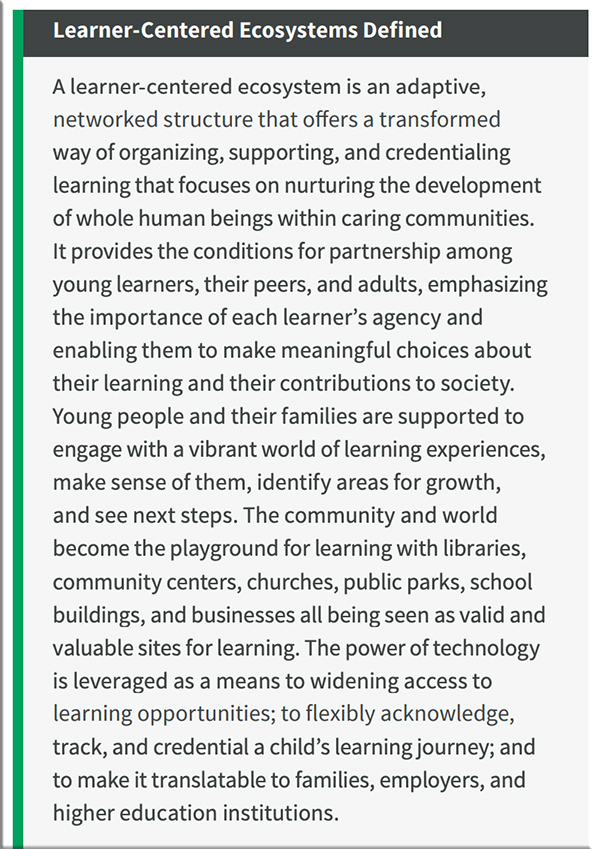
Ecosystems for the future of learning — from thebigidea.education-reimagined.org by Education Reimagined and the History Co:Lab

The intent of this report is to help communities build their capacity for transformation of education, advancing toward what our society needs most—a system that works for young people. It draws on the experiences and insights of innovators across the United States who are already answering this challenge—creating learner-centered, community-based ecosystems.

This report includes:

  • a landscape analysis of select communities creating learning ecosystems;
  • a framework that emerged from the analysis and can be used by communities to consider their readiness and appetite for this transformation;
  • an invitation to communities to explore and discover their own path for reimagining education; and
  • a call for national and regional institutions to listen, learn from, and create the conditions for communities to pursue their visions.

From DSC:
The above items was accessed via the article below:

Where Does Work to Imagine a Learner-Centered Ecosystem Begin? — from gettingsmart.com by Alin Bennett

Key Points

  • The Norris School District in Wisconsin exemplifies how learner profiles and community connections can enhance authentic learning experiences for young people, fostering a culture of belonging and responsibility.
  • Purdue Polytechnic High School demonstrates the importance of enabling conditions, such as creating microschools with access to shared services, to support a learner-centered approach while ensuring scalability and access to a variety of resources.
 

The Transformative Trends Reshaping Higher Education in 2024 — from evolllution.com by Janet Spriggs; via Amrit Ahluwalia on LinkedIn

  • Artificial Intelligence: Embrace It or Fall Behind
  • Reassessing Value: Tackling Confidence and ROI in Higher Education
  • Innovating for the Future: Adapting to Changing Needs
  • Fostering Strategic Partnerships: Collaboration for Progress
  • Leadership Matters: Driving Innovation and Inclusivity
 

Top 6 Use Cases of Generative AI in Education in 2024 — from research.aimultiple.com by Cem Dilmegani

Use cases included:

  1. Personalized Lessons
  2. Course Design
  3. Content Creation for Courses
  4. Data Privacy Protection for Analytical Models
  5. Restoring Old Learning Materials
  6. Tutoring

The Next Phase of AI in Education at the U.S. Department of Education — from medium.com by Office of Ed Tech

Why are we doing this work?
Over the past two years, the U.S. Department of Education has been committed to maintaining an ongoing conversation with educators, students, researchers, developers — and the educational community at large — related to the continuous progress of Artificial Intelligence (AI) development and its implications for teaching and learning.

Many educators are seeking resources clarifying what AI is and how it will impact their work and their students. Similarly, developers of educational technology (“edtech”) products seek guidance on what guardrails exist that can support their efforts. After the release of our May 2023 report Artificial Intelligence and the Future of Teaching and Learningwe heard the desire for more.


2024 EDUCAUSE AI Landscape Study — from library.educause.edu by Jenay Robert

Moving from reaction to action, higher education stakeholders are currently exploring the opportunities afforded by AI for teaching, learning, and work while maintaining a sense of caution for the vast array of risks AI-powered technologies pose. To aid in these efforts, we present this inaugural EDUCAUSE AI Landscape Study, in which we summarize the higher education community’s current sentiments and experiences related to strategic planning and readiness, policies and procedures, workforce, and the future of AI in higher education.


AI Update for K-16 Administrators: More People Need to Step-Up and Take the AI Bull By the Horns — from stefanbauschard.substack.com by Stefan Bauschard
AI capabilities are way beyond what most schools are aware of, and they will transform education and society over the next few years.

Educational administrators should not worry about every AI development, but should, instead focus on the big picture, as those big picture changes will change the entire world and the educational system.

AI and related technologies (robotics, synthetic biology, and brain-computer interfaces) will continue to impact society and the entire educational system over the next 10 years. This impact on the system will be greater than anything that has happened over the last 100 years, including COVID-19, as COVID-19 eventually ended and the disruptive force of these technologies will only continue to develop.

AI is the bull in the China Shop, redefining the world and the educational system. Students writing a paper with AI is barely a poke in the educational world relative to what is starting to happen (active AI teachers and tutors; AI assessment; AI glasses; immersive learning environments; young students able to start their own business with AI tools; AIs replacing and changing jobs; deep voice and video fakes; intelligence leveling; individualized instruction; interactive and highly intelligent computers; computers that can act autonomously; and more).


Denver middle schoolers can get a $1,000 debit card for extracurriculars in new experiment for school success — from coloradosun.com by Jennifer Brown
Middle school students in Denver Public Schools who qualify for free and reduced-price lunch are eligible to apply for debit cards loaded with $1,000 for sports, art and music activities

The offer — $1,000 on a restricted debit card that works at 127 organizations with after-school and summer programs — is called My Spark Denver, an experiment for Denver middle school students that organizers hope could one day expand to other age groups and other parts of the state.

The program is capped at 4,000 kids, and already, more than 1,000 have been approved. It’s first-come, first-served, and the only requirements are that the kids are in a Denver Public Schools middle school and that their family qualifies for free and reduced-price lunch, a measure of poverty.


OpenAI announces first partnership with a university — from cnbc.com by Hayden Field

Key Points:

  • OpenAI on Thursday announced its first partnership with a higher education institution.
  • Starting in February, Arizona State University will have full access to ChatGPT Enterprise and plans to use it for coursework, tutoring, research and more.
  • The partnership has been in the works for at least six months.
  • ASU plans to build a personalized AI tutor for students, allow students to create AI avatars for study help and broaden the university’s prompt engineering course.

A new collaboration with OpenAI charts the future of AI in higher education — from news.asu.edu

The collaboration between ASU and OpenAI brings the advanced capabilities of ChatGPT Enterprise into higher education, setting a new precedent for how universities enhance learning, creativity and student outcomes.

“ASU recognizes that augmented and artificial intelligence systems are here to stay, and we are optimistic about their ability to become incredible tools that help students to learn, learn more quickly and understand subjects more thoroughly,” ASU President Michael M. Crow said. “Our collaboration with OpenAI reflects our philosophy and our commitment to participating directly to the responsible evolution of AI learning technologies.”


AI <> Academia — from drphilippahardman.substack.com by Dr. Philippa Hardman
What might emerge from ASU’s pioneering partnership with OpenAI?

Phil’s Wish List #2: Smart Curriculum Development
ChatGPT assists in creating and updating course curricula, based on both student data and emerging domain and pedagogical research on the topic.

Output: using AI it will be possible to review course content and make data-informed automate recommendations based on latest pedagogical and domain-specific research

Potential Impact: increased dynamism and relevance in course content and reduced administrative lift for academics.


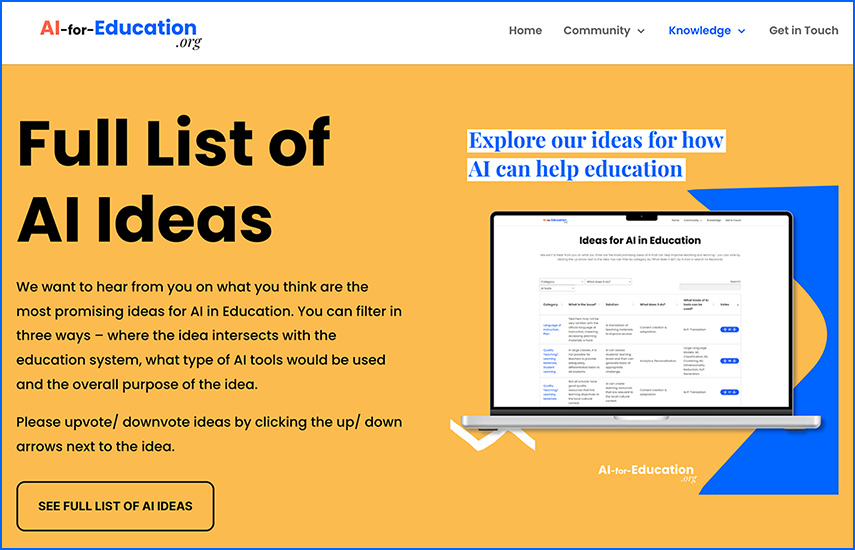
A full list of AI ideas from AI for Education dot org

A full list of AI ideas from AI-for-Education.org

You can filter by category, by ‘What does it do?’, by AI tool or search for keywords.


Navigating the new normal: Adapting in the age of AI and hybrid work models — from chieflearningofficer.com by Dr. Kylie Ensrud

Unlike traditional leadership, adaptable leadership is not bound by rigid rules and protocols. Instead, it thrives on flexibility. Adaptable leaders are willing to experiment, make course corrections, and pivot when necessary. Adaptable leadership is about flexibility, resilience and a willingness to embrace change. It embodies several key principles that redefine the role of leaders in organizations:

  1. Embracing uncertainty

Adaptable leaders understand that uncertainty is the new norm. They do not shy away from ambiguity but instead, see it as an opportunity for growth and innovation. They encourage a culture of experimentation and learning from failure.

  1. Empowering teams

Instead of dictating every move, adaptable leaders empower their teams to take ownership of their work. They foster an environment of trust and collaboration, enabling individuals to contribute their unique perspectives and skills.

  1. Continuous learning

Adaptable leaders are lifelong learners. They are constantly seeking new knowledge, stay informed about industry trends and encourage their teams to do the same. They understand that knowledge is a dynamic asset that must be constantly updated.


Major AI in Education Related Developments this week — from stefanbauschard.substack.com by Stefan Bauschard
ASU integrates with ChatGPT, K-12 AI integrations, Agents & the Rabbit, Uruguay, Meta and AGI, Rethinking curriculum

“The greatest risk is leaving school curriculum unchanged when the entire world is changing.”
Hadi Partovi, founder Code.org, Angel investor in Facebook, DropBox, AirBnb, Uber

Tutorbots in college. On a more limited scale, Georgia State University, Morgan State University, and the University of Central Florida are piloting a project using chatbots to support students in foundational math and English courses.


Pioneering AI-Driven Instructional Design in Small College Settings — from campustechnology.com by Gopu Kiron
For institutions that lack the budget or staff expertise to utilize instructional design principles in online course development, generative AI may offer a way forward.

Unfortunately, smaller colleges — arguably the institutions whose students are likely to benefit the most from ID enhancements — frequently find themselves excluded from authentically engaging in the ID arena due to tight budgets, limited faculty online course design expertise, and the lack of ID-specific staff roles. Despite this, recent developments in generative AI may offer these institutions a low-cost, tactical avenue to compete with more established players.


Google’s new AI solves math olympiad problems — from bensbites.beehiiv.com

There’s a new AI from Google DeepMind called AlphaGeometry that totally nails solving super hard geometry problems. We’re talking problems so tough only math geniuses who compete in the International Mathematical Olympiad can figure them out.


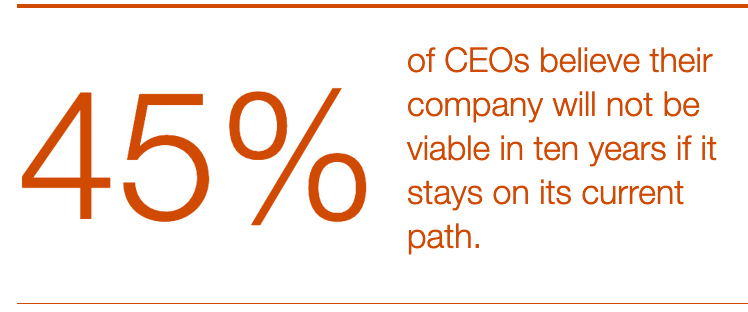
Thriving in an age of continuous reinvention — from pwc.com
As existential threats converge, many companies are taking steps to reinvent themselves. Is it enough? And what will it take to succeed?
.

.

 
© 2025 | Daniel Christian