Augmented Course Design: Using AI to Boost Efficiency and Expand Capacity — from er.educause.edu by Berlin Fang and Kim Broussard
The emerging class of generative AI tools has the potential to significantly alter the landscape of course development.

Using generative artificial intelligence (GenAI) tools such as ChatGPT, Gemini, or CoPilot as intelligent assistants in instructional design can significantly enhance the scalability of course development. GenAI can significantly improve the efficiency with which institutions develop content that is closely aligned with the curriculum and course objectives. As a result, institutions can more effectively meet the rising demand for flexible and high-quality education, preparing a new generation of future professionals equipped with the knowledge and skills to excel in their chosen fields.1 In this article, we illustrate the uses of AI in instructional design in terms of content creation, media development, and faculty support. We also provide some suggestions on the effective and ethical uses of AI in course design and development. Our perspectives are rooted in medical education, but the principles can be applied to any learning context.

Table 1 summarizes a few low-hanging fruits in AI usage in course development.
.

Table 1. Types of Use of GenAI in Course Development
Practical Use of AI Use Scenarios and Examples
Inspiration
  • Exploring ideas for instructional strategies
  • Exploring ideas for assessment
  • Course mapping
  • Lesson or unit content planning
Supplementation
  • Text to audio
  • Transcription for audio
  • Alt text auto-generation
  • Design optimization (e.g., using Microsoft PPT Design)
Improvement
  • Improving learning objectives
  • Improving instructional materials
  • Improving course content writing (grammar, spelling, etc.)
Generation
  • Creating a PowerPoint draft using learning objectives
  • Creating peripheral content materials (introductions, conclusions)
  • Creating decorative images for content
Expansion
  • Creating a scenario based on learning objectives
  • Creating a draft of a case study
  • Creating a draft of a rubric

.


Also see:

10 Ways Artificial Intelligence Is Transforming Instructional Design — from er.educause.edu by Rob Gibson
Artificial intelligence (AI) is providing instructors and course designers with an incredible array of new tools and techniques to improve the course design and development process. However, the intersection of AI and content creation is not new.

I have been telling my graduate instructional design students that AI technology is not likely to replace them any time soon because learning and instruction are still highly personalized and humanistic experiences. However, as these students embark on their careers, they will need to understand how to appropriately identify, select, and utilize AI when developing course content. Examples abound of how instructional designers are experimenting with AI to generate and align student learning outcomes with highly individualized course activities and assessments. Instructional designers are also using AI technology to create and continuously adapt the custom code and power scripts embedded into the learning management system to execute specific learning activities.Footnote1 Other useful examples include scripting and editing videos and podcasts.

Here are a few interesting examples of how AI is shaping and influencing instructional design. Some of the tools and resources can be used to satisfy a variety of course design activities, while others are very specific.


Taking the Lead: Why Instructional Designers Should Be at the Forefront of Learning in the Age of AI — from medium.com by Rob Gibson
Education is at a critical juncture and needs to draw leaders from a broader pool, including instructional designers

The world of a medieval stone cutter and a modern instructional designer (ID) may seem separated by a great distance, but I wager any ID who upon hearing the story I just shared would experience an uneasy sense of déjà vu. Take away the outward details, and the ID would recognize many elements of the situation: the days spent in projects that fail to realize the full potential of their craft, the painful awareness that greater things can be built, but are unlikely to occur due to a poverty of imagination and lack of vision among those empowered to make decisions.

Finally, there is the issue of resources. No stone cutter could ever hope to undertake a large-scale enterprise without a multitude of skilled collaborators and abundant materials. Similarly, instructional designers are often departments of one, working in scarcity environments, with limited ability to acquire resources for ambitious projects and — just as importantly — lacking the authority or political capital needed to launch significant initiatives. For these reasons, instructional design has long been a profession caught in an uncomfortable stasis, unable to grow, evolve and achieve its full potential.

That is until generative AI appeared on the scene. While the discourse around AI in education has been almost entirely about its impact on teaching and assessment, there has been a dearth of critical analysis regarding AI’s potential for impacting instructional design.

We are at a critical juncture for AI-augmented learning. We can either stagnate, missing opportunities to support learners while educators continue to debate whether the use of generative AI tools is a good thing, or we can move forward, building a transformative model for learning akin to the industrial revolution’s impact.

Too many professional educators remain bound by traditional methods. The past two years suggest that leaders of this new learning paradigm will not emerge from conventional educational circles. This vacuum of leadership can be filled, in part, by instructional designers, who are prepared by training and experience to begin building in this new learning space.


What Students Want When It Comes To AI — from onedtech.philhillaa.com by Glenda Morgan
The Digital Education Council Global AI Student Survey 2024

The Digital Education Council (DEC) this week released the results of a global survey of student opinions on AI. It’s a large survey with nearly 4,000 respondents conducted across 16 countries, but more importantly, it asks some interesting questions. There are many surveys about AI out there right now, but this one stands out. I’m going to go into some depth here, as the entire survey report is worth reading.

.

.


AI is forcing a teaching and learning evolution — from eschoolnews.com by Laura Ascione
AI and technology tools are leading to innovative student learning–along with classroom, school, and district efficiency

Key findings from the 2024 K-12 Educator + AI Survey, which was conducted by Hanover Research, include:

  • Teachers are using AI to personalize and improve student learning, not just run classrooms more efficiently, but challenges remain
  • While post-pandemic challenges persist, the increased use of technology is viewed positively by most teachers and administrators
  • …and more

From DSC:
I wonder…how will the use of AI in education square with the issues of using smartphones/laptops within the classrooms? See:

  • Why Schools Are Racing to Ban Student Phones — from nytimes.com by Natasha Singer; via GSV
    As the new school year starts, a wave of new laws that aim to curb distracted learning is taking effect in Indiana, Louisiana and other states.

A three-part series from Dr. Phillippa Hardman:

Part 1: Writing Learning Objectives  
The Results Part 1: Writing Learning Objectives

In this week’s post I will dive into the results from task 1: writing learning objectives. Stay tuned over the next two weeks to see all of the the results.

Part 2: Selecting Instructional Strategies.
The Results Part 2: Selecting an Instructional Strategy

Welcome back to our three-part series exploring the impact of AI on instructional design.

This week, we’re tackling a second task and a crucial aspect of instructional design: selecting instructional strategies. The ability to select appropriate instructional strategies to achieve intended objectives is a mission-critical skill for any instructional designer. So, can AI help us do a good job of it? Let’s find out!

Part 3: How Close is AI to Replacing Instructional Designers?
The Results Part 3: Creating a Course Outline

Today, we’re diving into what many consider to be the role-defining task of the instructional designer: creating a course design outline.


ChatGPT Cheat Sheet for Instructional Designers! — from Alexandra Choy Youatt EdD

Instructional Designers!
Whether you’re new to the field or a seasoned expert, this comprehensive guide will help you leverage AI to create more engaging and effective learning experiences.

What’s Inside?
Roles and Tasks: Tailored prompts for various instructional design roles and tasks.
Formats: Different formats to present your work, from training plans to rubrics.
Learning Models: Guidance on using the ADDIE model and various pedagogical strategies.
Engagement Tips: Techniques for online engagement and collaboration.
Specific Tips: Industry certifications, work-based learning, safety protocols, and more.

Who Can Benefit?
Corporate Trainers
Curriculum Developers
E-Learning Specialists
Instructional Technologists
Learning Experience Designers
And many more!

ChatGPT Cheat Sheet | Instructional Designer


5 AI Tools I Use Every Day (as a Busy Student) — from theaigirl.substack.com by Diana Dovgopol
AI tools that I use every day to boost my productivity.
#1 Gamma
#2 Perplexity
#3 Cockatoo

I use this AI tool almost every day as well. Since I’m still a master’s student at university, I have to attend lectures and seminars, which are always in English or German, neither of which is my native language. With the help of Cockatoo, I create scripts of the lectures and/or translations into my language. This means I don’t have to take notes in class and then manually translate them afterward. All I need to do is record the lecture audio on any device or directly in Cockatoo, upload it, and then you’ll have the audio and text ready for you.

…and more


Students Worry Overemphasis on AI Could Devalue Education — from insidehighered.com by Juliette Rowsell
Report stresses that AI is “new standard” and universities need to better communicate policies to learners.

Rising use of AI in higher education could cause students to question the quality and value of education they receive, a report warns.

This year’s Digital Education Council Global AI Student Survey, of more than 3,800 students from 16 countries, found that more than half (55 percent) believed overuse of AI within teaching devalued education, and 52 percent said it negatively impacted their academic performance.

Despite this, significant numbers of students admitted to using such technology. Some 86 percent said they “regularly” used programs such as ChatGPT in their studies, 54 percent said they used it on a weekly basis, and 24 percent said they used it to write a first draft of a submission.

Higher Ed Leadership Is Excited About AI – But Investment Is Lacking — from forbes.com by Vinay Bhaskara

As corporate America races to integrate AI into its core operations, higher education finds itself in a precarious position. I conducted a survey of 63 university leaders revealing that while higher ed leaders recognize AI’s transformative potential, they’re struggling to turn that recognition into action.

This struggle is familiar for higher education — gifted with the mission of educating America’s youth but plagued with a myriad of operational and financial struggles, higher ed institutions often lag behind their corporate peers in technology adoption. In recent years, this gap has become threateningly large. In an era of declining enrollments and shifting demographics, closing this gap could be key to institutional survival and success.

The survey results paint a clear picture of inconsistency: 86% of higher ed leaders see AI as a “massive opportunity,” yet only 21% believe their institutions are prepared for it. This disconnect isn’t just a minor inconsistency – it’s a strategic vulnerability in an era of declining enrollments and shifting demographics.


(Generative) AI Isn’t Going Anywhere but Up — from stefanbauschard.substack.com by Stefan Bauschard
“Hype” claims are nonsense.

There has been a lot of talk recently about an “AI Bubble.” Supposedly, the industry, or at least the generative AI subset of it, will collapse. This is known as the “Generative AI Bubble.” A bubble — a broad one or a generative one — is nonsense. These are the reasons we will continue to see massive growth in AI.


AI Readiness: Prepare Your Workforce to Embrace the Future — from learningguild.com by Danielle Wallace

Artificial Intelligence (AI) is revolutionizing industries, enhancing efficiency, and unlocking new opportunities. To thrive in this landscape, organizations need to be ready to embrace AI not just technologically but also culturally.

Learning leaders play a crucial role in preparing employees to adapt and excel in an AI-driven workplace. Transforming into an AI-empowered organization requires more than just technological adoption; it demands a shift in organizational mindset. This guide delves into how learning leaders can support this transition by fostering the right mindset attributes in employees.


Claude AI for eLearning Developers — from learningguild.com by Bill Brandon

Claude is fast, produces grammatically correct  text, and outputs easy-to-read articles, emails, blog posts, summaries, and analyses. Take some time to try it out. If you worry about plagiarism and text scraping, put the results through Grammarly’s plagiarism checker (I did not use Claude for this article, but I did send the text through Grammarly).


Survey: Top Teacher Uses of AI in the Classroom — from thejournal.com by Rhea Kelly

A new report from Cambium Learning Group outlines the top ways educators are using artificial intelligence to manage their classrooms and support student learning. Conducted by Hanover Research, the 2024 K-12 Educator + AI Survey polled 482 teachers and administrators at schools and districts that are actively using AI in the classroom.

More than half of survey respondents (56%) reported that they are leveraging AI to create personalized learning experiences for students. Other uses included providing real-time performance tracking and feedback (cited by 52% of respondents), helping students with critical thinking skills (50%), proofreading writing (47%), and lesson planning (44%).

On the administrator side, top uses of AI included interpreting/analyzing student data (61%), managing student records (56%), and managing professional development (56%).


Addendum on 8/14/24:


Forget everything you think you know about law firms — from jordanfurlong.substack.com by Jordan Furlong
Preface your strategic planning by explicitly rejecting all the accumulated conventions of the law firm model. The (legal) world has changed. Open up your strategic vistas. Prepare to start brand new.

Push aside the invisible guardrails of what’s been done before. Don’t take for granted any “normal” aspect — positive, negative, or neutral — of how your law firm looks and behaves, how it’s constituted, who it serves, who works there, how it creates value, how it competes, how it makes money. It’s all up for grabs.

But the real advantage now will belong to those strategic planners ready to go further and question all our assumptions about the law firm itself. You can’t conduct effective strategic planning or future-proofing for your firm unless you first shake yourself loose of every conventional “fact” about what law firms are, what they’re for, and how they operate. Those assumptions have become burdens. They will slow you down and compromise your strategy.

From DSC:
This advice seems appropriate for many businesses to do these days!


Students Speak Out: How to Make High Schools Places Where They Want to Learn — from the74million.org by Beth Fertig
Too many high school students complain that school is boring. Students share what makes school enjoyable.

.

Excerpts (emphasis DSC):

.
Solving chronic absenteeism involves tackling big structural problems like transportation and infrastructure. But we also have to make our schools places where young people want to learn. Too many teens, in particular, had negative feelings about school even before the pandemic. Yale researchers conducting a national survey of high school students found most teens spent their days “tired,” “stressed,” and “bored.” Fewer than 3 in 100 reported feeling interested while in school.

Decades of research prove that students learn more when they experience high levels of academic engagement and social belonging in school.

Students at all four schools experience internships, work-based learning and partnerships with community organizations, which they said make classwork feel more relevant. 


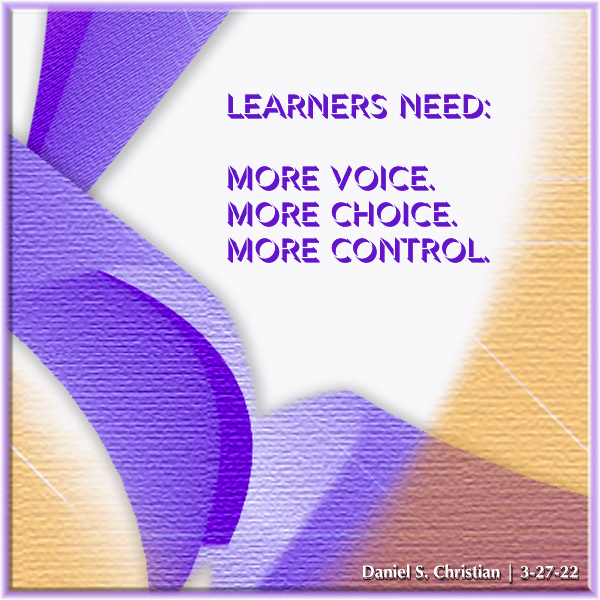
Learners need: More voice. More choice. More control. -- this image was created by Daniel Christian


The race against time to reinvent lawyers — from jordanfurlong.substack.com by Jordan Furlong
Our legal education and licensing systems produce one kind of lawyer. The legal market of the near future will need another kind. If we can’t close this gap fast, we’ll have a very serious problem.

Excerpt (emphasis DSC):

Lawyers will still need competencies like legal reasoning and analysis, statutory and contractual interpretation, and a range of basic legal knowledge. But it’s unhelpful to develop these skills through activities that lawyers won’t be performing much longer, while neglecting to provide them with other skills and prepare them for other situations that they will face. Our legal education and licensing systems are turning out lawyers whose competence profiles simply won’t match up with what people will need lawyers to do.

A good illustration of what I mean can be found in an excellent recent podcast from the Practising Law Institute, “Shaping the Law Firm Associate of the Future.” Over the course of the episode, moderator Jennifer Leonard of Creative Lawyers asked Professors Alice Armitage of UC Law San Francisco and Heidi K. Brown of New York Law School to identify some of the competencies that newly called lawyers and law firm associates are going to need in future. Here’s some of what they came up with:

  • Agile, nimble, extrapolative thinking
  • Collaborative, cross-disciplinary learning
  • Entrepreneurial, end-user-focused mindsets
  • Generative AI knowledge (“Their careers will be shaped by it”)
  • Identifying your optimal individual workflow
  • Iteration, learning by doing, and openness to failure
  • Leadership and interpersonal communication skills
  • Legal business know-how, including client standards and partner expectations
  • Receiving and giving feedback to enhance effectiveness

Legal Tech for Legal Departments – What In-House Lawyers Need to Know — from legal.thomsonreuters.com by Sterling Miller

Whatever the reason, you must understand the problem inside and out. Here are the key points to understanding your use case:

  • Identify the problem.
  • What is the current manual process to solve the problem?
  • Is there technology that will replace this manual process and solve the problem?
  • What will it cost and do you have (or can you get) the budget?
  • Will the benefits of the technology outweigh the cost? And how soon will those benefits pay off the cost? In other words, what is the return on investment?
  • Do you have the support of the organization to buy it (inside the legal department and elsewhere, e.g., CFO, CTO)?

2024-05-13: Of Legal AI — from emergentbehavior.co

Long discussion with a senior partner at a major Bay Area law firm:

Takeaways

A) They expect legal AI to decimate the profession…
B) Unimpressed by most specific legal AI offerings…
C) Generative AI error rates are acceptable even at 10–20%…
D) The future of corporate law is in-house…
E) The future of law in general?…
F) Of one large legal AI player…


2024 Legal Technology Survey Results — from lexology.com

Additional findings of the annual survey include:

  • 77 percent of firms have a formal technology strategy in place
  • Interest and intentions regarding generative A.I. remain high, with almost 80 percent of participating firms expecting to leverage it within the next five years. Many have either already begun or are planning to undertake data hygiene projects as a precursor to using generative A.I. and other automation solutions. Although legal market analysts have hypothesized that proprietary building of generative A.I. solutions remain out of reach for mid-sized firms, several Meritas survey respondents are making traction. Many other firms are also licensing third-party generative A.I. solutions.
  • The survey showed strong technology progression among several Meritas member firms, with most adopting a tech stack of core, foundational systems of infrastructure technology and adding cloud-based practice management, document management, time, billing, and document drafting applications.
  • Most firms reported increased adoption and utilization of options already available within their current core systems, such as Microsoft Office 365 Teams, SharePoint, document automation, and other native functionalities for increasing efficiencies; these functions were used more often in place of dedicated purpose-built solutions such as comparison and proofreading tools.
  • The legal technology market serving Meritas’ member firms continues to be fractured, with very few providers emerging as market leaders.

AI Set to Save Professionals 12 Hours Per Week by 2029 — from legalitprofessionals.com

Thomson Reuters, a global content and technology company, today released its 2024 Future of Professionals report, an annual survey of more than 2,200 professionals working across legal, tax, and risk & compliance fields globally. Respondents predicted that artificial intelligence (AI) has the potential to save them 12 hours per week in the next five years, or four hours per week over the upcoming year – equating to 200 hours annually.

This timesaving potential is the equivalent productivity boost of adding an extra colleague for every 10 team members on staff. Harnessing the power of AI across various professions opens immense economic opportunities. For a U.S. lawyer, this could translate to an estimated $100,000 in additional billable hours.*


Can Schools and Vendors Work Together Constructively on AI? A New Guide May Help — from edweek.org by Alyson Klein
The Education Department outlines key steps on AI development for schools

Educators need to work with vendors and tech developers to ensure artificial intelligence-driven innovations for schools go hand-in-hand with managing the technology’s risks, recommends guidance released July 8 by the U.S. Department of Education.

The guidance—called “Designing for Education with Artificial Intelligence: An Essential Guide for Developers“—includes extensive recommendations for both vendors and school district officials.


Also, on somewhat related notes see the following items:


Enrollment Planning in the Specter of Closure — from insidehighered.com by Mark Campbell and Rachel Schreiber; via GSV
Misunderstandings about enrollment management and changing student needs can make a bad situation worse, Mark Campbell and Rachel Schreiber write. 

Excerpts (emphasis DSC):

However, we find that many institutions provide little to no information to prospective students about actual outcomes for graduates. Examples include: What does applying to graduate school look like for graduates? Employment and earning potential? Average student loan debt? What do alumni say about their experience? What data do you have that is compelling to answer these and related questions? Families increasingly ask, “What is the ROI on this investment?”

Another important issue relates to the unwillingness of leaders to evolve the institution to meet market demands. We have too often seen that storied, historic institutions have cultures that are change averse, and this seems to be particularly true in the liberal arts. This statement might appear to be controversial—but only if misunderstood.

To be clear, the humanities and the arts are vital, critical aspects of our institutions. But today’s prospective students are highly focused on career outcomes, given the financial investment they and their families are being asked to make. We believe that curricular offerings can place a high value on the core principles of the humanities and liberal arts while also preparing students for careers.

By contrast, curricular innovation, alterations to long-held marketing practices, openness to self-reflection regarding out-of-date programs, practices and policies—in short, a willingness to change and adapt—are all key. Finally, vital and successful institutions develop long-term strategic enrollment plans that are tactical, realistic and assessable and for which there is clarity about accountability. Putting these practices in place now can avert catastrophe down the road.


Overcoming the ‘Entry Level’ Catch-22 in the Age of AI — from reachcapital.com by Shauntel Garvey

The New Entry-Level Job (and Skill)
In a world where AI can perform entry-level tasks, and employers are prioritizing experienced candidates, how can recent college graduates and job seekers find a job?

AI is the new entry-level skill. As AI permeates every industry, it’s becoming increasingly common for employers to ask candidates how they think about applying AI to their jobs. (We’ve started asking this here at Reach ourselves.) Even if the job is not technical and doesn’t list AI as a skill, candidates would do well to prepare. Journalists, for instance, are warming up to using AI to transcribe interviews and suggest headlines.

So it’s not just AI that may take your entry-level role, but rather the person who knows how to use it. Candidates who are bracing for this technological shift and proactively building their AI literacy and expertise will have a leg up.


On a related note, also see:

Make AI Literacy a Priority With These Free Resources — from gettingsmart.com by Tom Vander Ark

Key Points

  • Leading school systems are incorporating AI tools such as tutoring, chatbots, and teacher assistants, and promoting AI literacy among teachers and students to adapt to the evolving role of AI in education.


From DSC:
As I can’t embed his posting, I’m copying/pasting Jeff’s posting on LinkedIn:


According to Flighty, I logged more than 2,220 flight miles in the last 5 days traveling to three conferences to give keynotes and spend time with housing officers in Milwaukee, college presidents in Mackinac Island, MI, and enrollment and marketing leaders in Raleigh.

Before I rest, I wanted to post some quick thoughts about what I learned. Thank you to everyone who shared their wisdom these past few days:

  • We need to think about the “why” and “how” of AI in higher ed. The “why” shouldn’t be just because everyone else is doing it. Rather, the “why” is to reposition higher ed for a different future of competitors. The “how” shouldn’t be to just seek efficiency and cut jobs. Rather we should use AI to learn from its users to create a better experience going forward.
  • Residence halls are not just infrastructure. They are part and parcel of the student experience and critical to student success. Almost half of students living on campus say it increases their sense of belonging, according to research by the Association of College & University Housing Officers.
  • How do we extend the “residential experience”? More than half of traditional undergraduates who live on campus now take at least once course online. As students increasingly spend time off campus – or move off campus as early as their second year in college – we need to help continue to make the connections for them that they would in a dorm. Why? 47% of college students believe living in a college residence hall enhanced their ability to resolve conflicts.
  • Career must be at the core of the student experience for colleges to thrive in the future, says Andy Chan. Yes, some people might see that as too narrow of a view of higher ed or might not want to provide cogs for the wheel of the workforce, but without the job, none of the other benefits of college follow–citizenship, health, engagement.
  • A “triple threat grad”–someone who has an internship, a semester-long project, and an industry credential (think Salesforce or Adobe in addition to their degree–matters more in the job market than major or institution, says Brandon Busteed.
  • Every faculty member should think of themselves as an ambassador for the institution. Yes, care about their discipline/department, but that doesn’t survive if the rest of the institution falls down around them.
  • Presidents need to place bigger bets rather than spend pennies and dimes on a bunch of new strategies. That means to free up resources they need to stop doing things.
  • Higher ed needs a new business model. Institutions can’t make money just from tuition, and new products like certificates, are pennies on the dollars of degrees.
  • Boards aren’t ready for the future. They are over-indexed on philanthropy and alumni and not enough on the expertise needed for leading higher ed.

From DSC:
As I can’t embed his posting, I’m copying/pasting Jeff’s posting on LinkedIn:


It’s the stat that still gnaws at me: 62%.

That’s the percentage of high school graduates going right on to college. A decade ago it was around 70%. So for all the bellyaching about the demographic cliff in higher ed, just imagine if today we were close to that 70% number? We’d be talking a few hundred thousand more students in the system.

As I told a gathering of presidents of small colleges and universities last night on Mackinac Island — the first time I had to take [numerous modes of transportation] to get to a conference — being small isn’t distinctive anymore.

There are many reasons undergrad enrollment is down, but they all come down to two interrelated trends: jobs and affordability.

The job has become so central to what students want out of the experience. It’s almost as if colleges now need to guarantee a job.

These institutions will need to rethink the learner relationship with work. Instead of college with work on the side, we might need to move to more of a mindset of work with college on the side by:

  • Making campus jobs more meaningful. Why can’t we have accounting and finance majors work in the CFO office, liberal arts majors work in IT on platforms such as Salesforce and Workday, which are skills needed in the workplace, etc.?
  • Apprenticeships are not just for the trades anymore. Integrate work-based learning into the undergrad experience in a much bigger way than internships and even co-ops.
  • Credentials within the degree. Every graduate should leave college with more than just a BA but also a certified credential in things like data viz, project management, the Adobe suite, Alteryx, etc.
  • The curriculum needs to be more flexible for students to combine work and learning — not only for the experience but also money for college — so more availability of online courses, hybrid courses, and flexible semesters.

How else can we think about learning and earning?


The Musician’s Rule and GenAI in Education — from opencontent.org by David Wiley

We have to provide instructors the support they need to leverage educational technologies like generative AI effectively in the service of learning. Given the amount of benefit that could accrue to students if powerful tools like generative AI were used effectively by instructors, it seems unethical not to provide instructors with professional development that helps them better understand how learning occurs and what effective teaching looks like. Without more training and support for instructors, the amount of student learning higher education will collectively “leave on the table” will only increase as generative AI gets more and more capable. And that’s a problem.

From DSC:
As is often the case, David put together a solid posting here. A few comments/reflections on it:

  • I agree that more training/professional development is needed, especially regarding generative AI. This would help achieve a far greater ROI and impact.
  • The pace of change makes it difficult to see where the sand is settling…and thus what to focus on
  • The Teaching & Learning Groups out there are also trying to learn and grow in their knowledge (so that they can train others)
  • The administrators out there are also trying to figure out what all of this generative AI stuff is all about; and so are the faculty members. It takes time for educational technologies’ impact to roll out and be integrated into how people teach.
  • As we’re talking about multiple disciplines here, I think we need more team-based content creation and delivery.
  • There needs to be more research on how best to use AI — again, it would be helpful if the sand settled a bit first, so as not to waste time and $$. But then that research needs to be piped into the classrooms far better.
    .

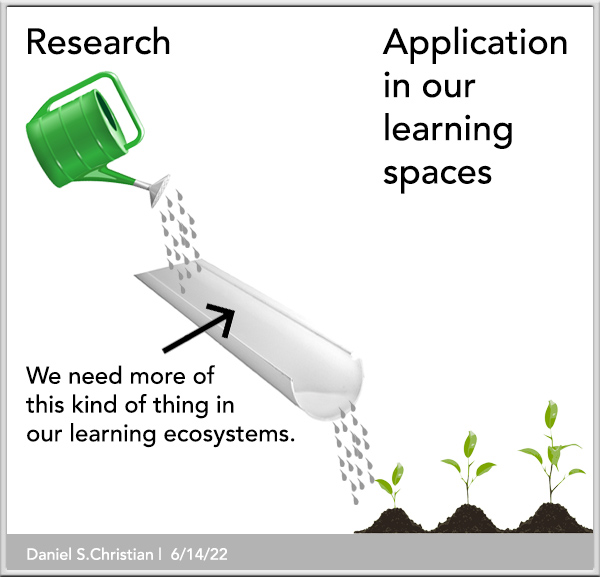
We need to take more of the research from learning science and apply it in our learning spaces.


NYC High School Reimagines Career & Technical Education for the 21st Century — from the74million.org by Andrew Bauld
Thomas A. Edison High School is providing students with the skills to succeed in both college and career in an unusually creative way.

From DSC:
Very interesting to see the mention of an R&D department here! Very cool.

Baker said ninth graders in the R&D department designed the essential skills rubric for their grade so that regardless of what content classes students take, they all get the same immersion into critical career skills. Student voice is now so integrated into Edison’s core that teachers work with student designers to plan their units. And he said teachers are becoming comfortable with the language of career-centered learning and essential skills while students appreciate the engagement and develop a new level of confidence.

The R&D department has grown to include teachers from every department working with students to figure out how to integrate essential skills into core academic classes. In this way, they’re applying one of the XQ Institute’s crucial Design Principles for innovative high schools: Youth Voice and Choice.
.

Learners need: More voice. More choice. More control. -- this image was created by Daniel Christian


Student Enterprise: Invite Learners to Launch a Media Agency or Publication — from gettingsmart.com by Tom Vander Ark

Key Points

  • Client-connected projects have become a focal point of the Real World Learning initiative, offering students opportunities to solve real-world problems in collaboration with industry professionals.
  • Organizations like CAPS, NFTE, and Journalistic Learning facilitate community connections and professional learning opportunities, making it easier to implement client projects and entrepreneurship education.

Important trend: client projects. Work-based learning has been growing with career academies and renewed interest in CTE. Six years ago, a subset of WBL called client-connected projects became a focal point of the Real World Learning initiative in Kansas City where they are defined as authentic problems that students solve in collaboration with professionals from industry, not-for-profit, and community-based organizations….and allow students to: engage directly with employers, address real-world problems, and develop essential skills.


Portrait of a Community to Empower Learning Transformation — from gettingsmart.com by Rebecca Midles and Mason Pashia

Key Points

  • The Community Portrait approach encourages diverse voices to shape the future of education, ensuring it reflects the needs and aspirations of all stakeholders.
  • Active, representative community engagement is essential for creating meaningful and inclusive educational environments.

The Portrait of a Graduate—a collaborative effort to define what learners should know and be able to do upon graduation—has likely generated enthusiasm in your community. However, the challenge of future-ready graduates persists: How can we turn this vision into a reality within our diverse and dynamic schools, especially amid the current national political tensions and contentious curriculum debates?

The answer lies in active, inclusive community engagement. It’s about crafting a Community Portrait that reflects the rich diversity of our neighborhoods. This approach, grounded in the same principles used to design effective learning systems, seeks to cultivate deep, reciprocal relationships within the community. When young people are actively involved, the potential for meaningful change increases exponentially.


Q&A: Why Schools Must Redesign Learning to Include All Students — from edtechmagazine.com by Taashi Rowe
Systems are broken, not children, says K–12 disability advocate Lindsay E. Jones.

Although Lindsay E. Jones came from a family of educators, she didn’t expect that going to law school would steer her back into the family business. Over the years she became a staunch advocate for children with disabilities. And as mom to a son with learning disabilities and ADHD who is in high school and doing great, her advocacy is personal.

Jones previously served as president and CEO of the National Center for Learning Disabilities and was senior director for policy and advocacy at the Council for Exceptional Children. Today, she is the CEO at CAST, an organization focused on creating inclusive learning environments in K–12. EdTech: Focus on K–12 spoke with Jones about how digital transformation, artificial intelligence and visionary leaders can support inclusive learning environments.

Our brains are all as different as our fingerprints, and throughout its 40-year history, CAST has been focused on one core value: People are not broken, systems are poorly designed. And those systems are creating a barrier that holds back human innovation and learning.


6 Ways State Policymakers Can Build More Future-Focused Education Systems — from gettingsmart.com by Jennifer Kabaker

Key Points

  • Guided by a vision – often captured as a Portrait of a Graduate – co-constructed with local leaders, community members, students, and families, state policymakers can develop policies that equitably and effectively support students and educators in transforming learning experiences.
  • The Aurora Institute highlights the importance of collaborative efforts in creating education systems that truly meet the diverse needs of every student.

The Aurora Institute has spent years working with states looking to advance competency-based systems, and has identified a set of key state policy levers that policymakers can put into action to build more personalized and competency-based systems. These shifts should be guided by a vision–co-constructed with local leaders, community members, students, and families–for what students need to know and be able to do upon graduating.


Career Pathways In A Rapidly Changing World: US Career Pathways Story — from gettingsmart.com by Paul Herdman

Key Points

  • There has been a move away from the traditional “Bachelor’s or Bust” mentality towards recognizing the value of diverse career pathways that may not necessarily require a four-year degree.
  • Local entities such as states, school districts, and private organizations have played a crucial role in implementing and scaling up career pathways programs.

While much has been written on this topic (see resources below), this post, in the context of our OECD study of five Anglophone countries, will attempt to provide a backdrop on what was happening at the federal level in the U.S. over the last several decades to help catalyze this shift in career pathways and offer a snapshot of how this work is evolving in two very different statesDelaware and Texas.


U.S. public, private and charter schools in 5 charts — from pewresearch.org by Katherine Schaeffer
.


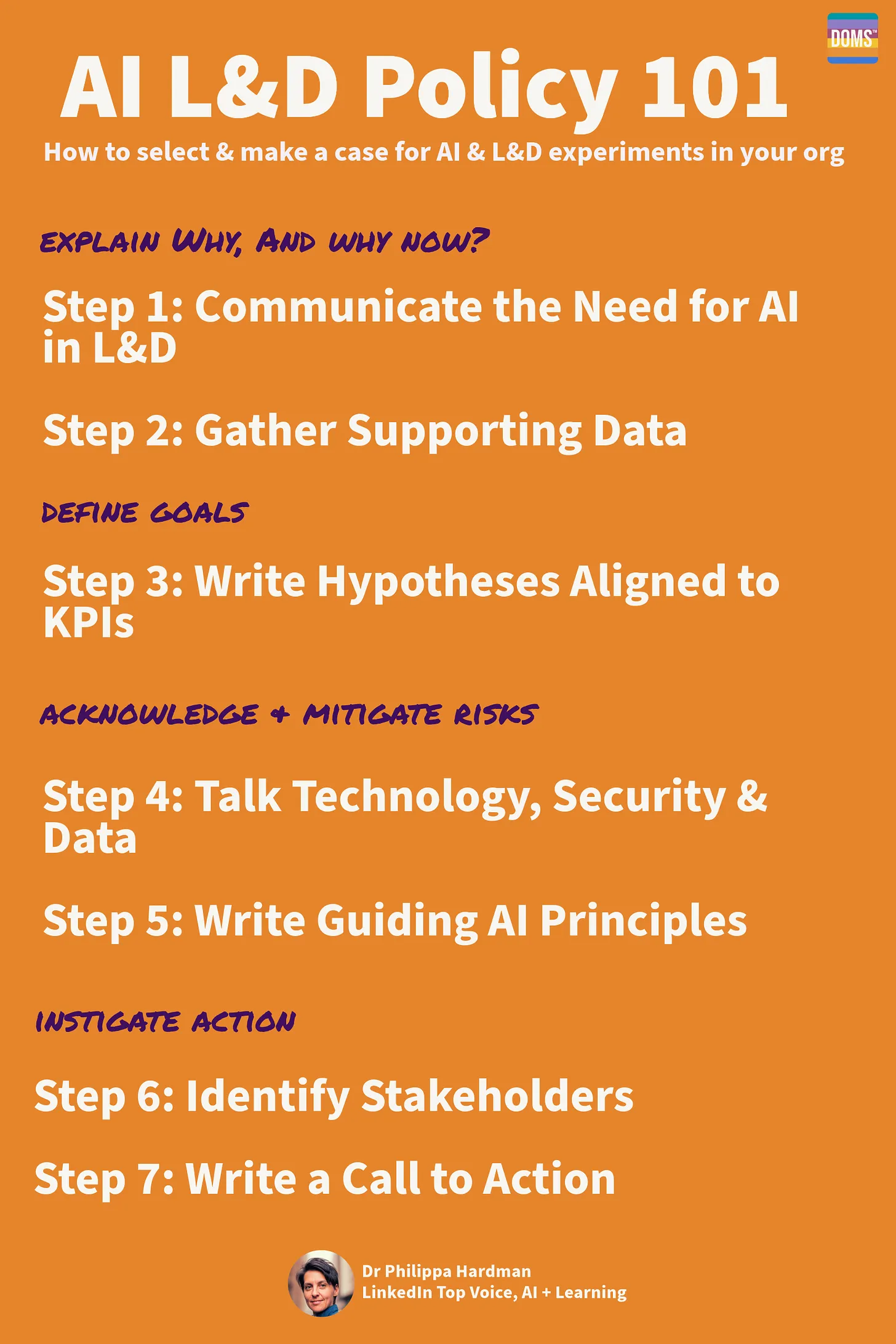
AI Policy 101: a Beginners’ Framework — from drphilippahardman.substack.com by Dr. Philippa Hardman
How to make a case for AI experimentation & testing in learning & development


6 AI Tools Recommended By Teachers That Aren’t ChatGPT — from forbes.com by Dan Fitzpatrick

Here are six AI tools making waves in classrooms worldwide:

  • Brisk Teaching
  • SchoolAI
  • Diffit
  • Curipod
  • Skybox by Blockade Labs in ThingLink
  • Ideogram

With insights from educators who are leveraging their potential, let’s explore them in more detail.


AI Is Speeding Up L&D But Are We Losing the Learning? — from learningguild.com by Danielle Wallace

The role of learning & development
Given these risks, what can L&D professionals do to ensure generative AI contributes to effective learning? The solution lies in embracing the role of trusted learning advisors, guiding the use of AI tools in a way that prioritizes achieving learning outcomes over only speed. Here are three key steps to achieve this:

1. Playtest and Learn About AI
2. Set the Direction for AI to Be Learner-Centered…
3. Become Trusted Learning Advisors…


Some other tools to explore:

Descript: If you can edit text, you can edit videos. — per Bloomberg’s Vlad Savov
Descript is the AI-powered, fully featured, end-to-end video editor that you already know how to use.

A video editor that works like docs and slides
No need to learn a new tool — Descript works like the tools you’ve already learned.

Audeze | Filter — per Bloomberg’s Vlad Savov


AI Chatbots in Schools Findings from a Poll of K-12 Teachers, Students, Parents, and College Undergraduates — from Impact Research; via Michael Spencer and Lily Lee

Key Findings

  • In the last year, AI has become even more intertwined with our education system. More teachers, parents, and students are aware of it and have used it themselves on a regular basis. It is all over our education system today.
  • While negative views of AI have crept up over the last year, students, teachers, and parents feel very positive about it in general. On balance they see positive uses for the technology in school, especially if they have used it themselves.
  • Most K-12 teachers, parents, and students don’t think their school is doing much about AI, despite its widespread use. Most say their school has no policy on it, is doing nothing to offer desired teacher training, and isn’t meeting the demand of students who’d like a career in a job that will need AI.
  • The AI vacuum in school policy means it is currently used “unauthorized,” while instead people want policies that encourage AI. Kids, parents, and teachers are figuring it out on their own/without express permission, whereas all stakeholders would rather have a policy that explicitly encourages AI from a thoughtful foundation.

The Value of AI in Today’s Classrooms — from waltonfamilyfoundation.org

There is much discourse about the rise and prevalence of AI in education and beyond. These debates often lack the perspectives of key stakeholders – parents, students and teachers.

In 2023, the Walton Family Foundation commissioned the first national survey of teacher and student attitudes toward ChatGPT. The findings showed that educators and students embrace innovation and are optimistic that AI can meaningfully support traditional instruction.

A new survey conducted May 7-15, 2024, showed that knowledge of and support for AI in education is growing among parents, students and teachers. More than 80% of each group says it has had a positive impact on education.


12 Shifts to Move from Teacher-Led to Student-Centered Environments — from gettingsmart.com by Kyle Wagner

Key Points

  • Despite modern technological advancements in classroom tools, many educational settings still center around a traditional model where the teacher is the primary source of information and students passively receive content.
  • Slowly, learning environments are inviting students to actively participate and take ownership of their learning through collaborative projects, inquiry-based experiences, and real-world problem-solving, thereby transforming traditional educational roles and practices.
 

Are Colleges Ready For an Online-Education World Without OPMs? — from edsurge.com by Robert Ubell (Columnist)
Online Program Management companies have helped hundreds of colleges build online degree programs, but the sector is showing signs of strain.

For more than 15 years, a group of companies known as Online Program Management providers, or OPMs, have been helping colleges build online degree programs. And most of them have relied on an unusual arrangement — where the companies put up the financial backing to help colleges launch programs in exchange for a large portion of tuition revenue.

As a longtime administrator of online programs at colleges, I have mixed feelings about the idea of shutting down the model. And the question boils down to this: Are colleges ready for a world without OPMs?


Guy Raz on Podcasts and Passion: Audio’s Ability to Spark Learning — from michaelbhorn.substack.com by Michael B. Horn

This conversation went in a bunch of unexpected directions. And that’s what’s so fun about it. After all, podcasting is all about bringing audio back and turning learning into leisure. And the question Guy and his partner Mindy Thomas asked a while back was: Why not bring kids in on the fun? Guy shared how his studio, Tinkercast, is leveraging the medium to inspire and educate the next generation of problem solvers.

We discussed the power of audio to capture curiosities and foster imagination, how Tinkercast is doing that in and out of the classroom, and how it can help re-engage students in building needed skills at a critical time. Enjoy!


April 2024 Job Cuts Announced by US-Based Companies Fall; More Cuts Attributed to TX DEI Law, AI in April — from challengergray.com

Excerpt (emphasis DSC):

Education
Companies in the Education industry, which includes schools and universities, cut the second-most jobs last month with 8,092 for a total of 17,892. That is a 635% increase from the 2,435 cuts announced during the first four months of 2023.

“April is typically the time school districts are hiring and setting budgets for the next fiscal year. Certainly, there are budgetary constraints, as labor costs rise, but school systems also have a retention and recruitment issue,” said Challenger.


Lifetime college returns differ significantly by major, research finds — from highereddive.com by Lilah Burke
Engineering and computer science showed the best return out of 10 fields of study that were examined.

Dive Brief:

  • The lifetime rate of return for a college education differs significantly by major, but it also varies by a student’s gender and race or ethnicity, according to new peer-reviewed research published in the American Educational Research Journal.
  • A bachelor’s degree in general provides a roughly 9% rate of return for men, and nearly 10% for women, researchers concluded. The majors with the best returns were computer science and engineering.
  • Black, Hispanic and Asian college graduates had slightly higher rates of return than their White counterparts, the study found.
 
© 2025 | Daniel Christian