For a true meritocracy, education must not be one-size-fits-all — from edsource.org by Eric Chung

What we can do is stop deciding who is educated, intelligent and successful based on only one type of student. Instead, we should recognize the value of all students, and offer more mainstream career and technical opportunities across K-12 education.

From DSC:
Note the power of CHOICE in this next excerpt:

There is another possibility. Consider Finland, which in the 1970s switched from the German model to one that teaches a combination of academic and technical subjects until age 16, when students choose a track. The vocational path for students interested in highly -skilled trades includes carpentry and culinary arts, but it also offers applied sciences, health care, and social services, which in the United States would require attending traditional academic universities.

.
Learners need: More voice. More choice. More control. -- this image was created by Daniel Christian


Skill-Based Training: Embrace the Benefits; Stay Wary of the Hype — from learningguild.com by Paige Yousey

1. Direct job relevance
One of the biggest draws of skill-based training is its direct relevance to employees’ daily roles. By focusing on teaching job-specific skills, this approach helps workers feel immediately empowered to apply what they learn, leading to a quick payoff for both the individual and the organization. Yet, while this tight focus is a major benefit, it’s important to consider some potential drawbacks that could arise from an overly narrow approach.

Be wary of:

  • Overly Narrow Focus: Highly specialized training might leave employees with little room to apply their skills to broader challenges, limiting versatility and growth potential.
  • Risk of Obsolescence: Skills can quickly become outdated, especially in fast-evolving industries. L&D leaders should aim for regular updates to maintain relevance.
  • Neglect of Soft Skills: While technical skills are crucial, ignoring soft skills like communication and problem-solving may lead to a lack of balanced competency.

2. Enhanced job performance…
3. Addresses skill gaps…

…and several more areas to consider


Another item from Paige Yousey

5 Key EdTech Innovations to Watch — from learningguild.com by Paige Yousey

AI-driven course design

Strengths

  • Content creation and updates: AI streamlines the creation of training materials by identifying resource gaps and generating tailored content, while also refreshing existing materials based on industry trends and employee feedback to maintain relevance.
  • Data-driven insights: Use AI tools to provide valuable analytics to inform course development and instructional strategies, helping learner designers identify effective practices and improve overall learning outcomes.
  • Efficiency: Automating repetitive tasks, such as learner assessments and administrative duties, enables L&D professionals to concentrate on developing impactful training programs and fostering learner engagement.

Concerns

  • Limited understanding of context: AI may struggle to understand the specific educational context or the unique needs of diverse learner populations, potentially hindering effectiveness.
  • Oversimplification of learning: AI may reduce complex educational concepts to simple metrics or algorithms, oversimplifying the learning process and neglecting deeper cognitive development.
  • Resistance to change: Learning leaders may face resistance from staff who are skeptical about integrating AI into their training practices.

Also from the Learning Guild, see:

Use Twine to Easily Create Engaging, Immersive Scenario-Based Learning — from learningguild.com by Bill Brandon

Scenario-based learning immerses learners in realistic scenarios that mimic real-world challenges they might face in their roles. These learning experiences are highly relevant and relatable. SBL is active learning. Instead of passively consuming information, learners actively engage with the content by making decisions and solving problems within the scenario. This approach enhances critical thinking and decision-making skills.

SBL can be more effective when storytelling techniques create a narrative that guides learners through the scenario to maintain engagement and make the learning memorable. Learners receive immediate feedback on their decisions and learn from their mistakes. Reflection can deepen their understanding. Branching scenarios add simulated complex decision-making processes and show the outcome of various actions through interactive scenarios where learner choices lead to different outcomes.

Embrace the Future: Why L&D Leaders Should Prioritize AI Digital Literacy — from learningguild.com by Dr. Erica McCaig

The role of L&D leaders in AI digital literacy
For L&D leaders, developing AI digital literacy within an organization requires a well-structured curriculum and development plan that equips employees with the knowledge, skills, and ethical grounding needed to thrive in an AI-augmented workplace. This curriculum should encompass a range of competencies that enhance technical understanding and foster a mindset ready for innovation and responsible use of AI. Key areas to focus on include:

  • Understanding AI Fundamentals: …
  • Proficiency with AI Tools: …
  • Ethical Considerations: …
  • Cultivating Critical Thinking: …
 

What’s a Special Education Aide Worth? A $9,607 Raise, to the Average Teacher — from educationnext.org by Virginia S. Lovison and Cecilia Hyunjung Mo
Survey evidence shows teachers would trade additional salary for expert support

Teachers’ preferences are clear: they want to work where they will have the support of full-time experts in special education and pediatric physical and mental health. An overwhelming majority describe these supports as “beneficial” or “extremely beneficial” when asked to rate special-education co-teachers (93 percent) and paraprofessionals (92 percent), as well as counselors (89 percent) and school nurses (88 percent).

These roles are so important that teachers are willing to forgo salary increases when asked to choose between the two. Our analysis shows the average teacher is willing to trade a 21 percent raise for the full-time support of a special-education co-teacher and an 18 percent raise for a full-time special-education aide.


Also from Education Next, see:

The Education Exchange: Hoover Institution Proposes Massive K–12 School Reform — from educationnext.org by Paul E. Peterson
Education Futures Council recommends putting teachers and principals in charge

Macke Raymond, a Distinguished Research Fellow at the Hoover Institution and director of the Center for Research on Education Outcomes (CREDO) at Stanford University, joins Paul E. Peterson to discuss a report from the Education Futures Council, which looks to identify and remove barriers to student success within the K-12 educational system.

From DSC:
I like the sound of putting teachers and principals in charge! As I just mentioned the other day, those on “the front line” (so to speak) know what’s working, what’s not working, and how best to fix things. Less legislators, more teachers.


7 Urgent Changes to Stop the Teacher Shortage Crisis — from teachingexpertise.com by Natalie Cates

In the past few years, the teacher shortage has reached critical levels. According to recent surveys, about 30% of teachers plan to leave their jobs in the next year, and 40% of those are considering leaving education altogether. Even more shocking is that only 16% of educators would strongly recommend the profession to others. This isn’t just a temporary problem; it’s a crisis that threatens the future of education. Teachers are burned out, undervalued, and overwhelmed by growing demands.

The question is: What needs to change? What will it take to stop the mass exodus from education and create an environment where teachers want to stay and thrive?

Below are the key areas that need urgent reform if we want to stop the teacher shortage and rebuild a sustainable, respected profession.

Micromanagement is a key contributor to teacher burnout. Teachers are bogged down with endless paperwork, restrictive policies, and constant oversight, leaving little room for creativity or autonomy in their classrooms. Instead of focusing on teaching, educators are often tied up with administrative tasks that serve little purpose in improving student outcomes.

“AMEN!! These are so accurate about what is needed in education.”, as what most teachers exclaimed. Teachers are professionals, and they deserve to be treated as such. Restoring autonomy is key to retaining talented educators.


From DSC:
I believe in giving those on the front lines — of anything (business, government, education, other) — as much control, autonomy, and power as possible. I hold this position because those are the folks who really know what’s going on, what’s working and what’s not working, and how best to fix things.

So I’m all in favor of trusting our teachers to tell us what they need and want to do. We need less input and control from legislators and more input and control from teachers.


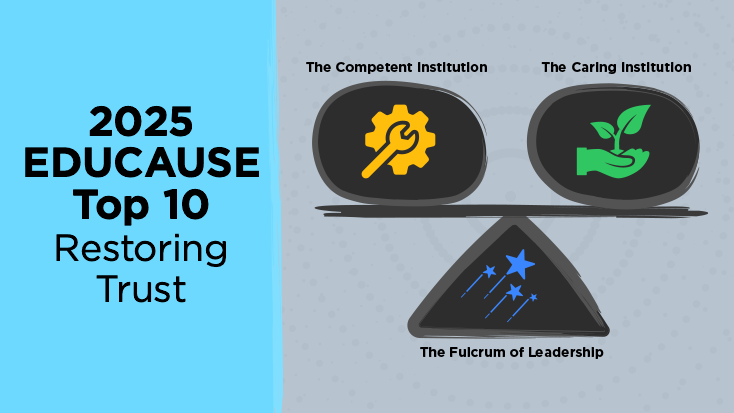
2025 EDUCAUSE Top 10: Restoring Trust — from educause.edu

Higher education has a trust problem. In the past ten years, the share of Americans who are confident in higher education has dropped from 57 percent to 36 percent.

Colleges and universities need to show that they understand and care about students, faculty, staff, and community members, AND they need to work efficiently and effectively.

Technology leaders can help. The 2025 EDUCAUSE Top 10 describes how higher education technology and data leaders and professionals can help to restore trust in the sector by building competent and caring institutions and, through radical collaboration, leverage the fulcrum of leadership to maintain balance between the two.

.


Most parents know AI will be crucial to their children’s future — from eschoolnews.com
A new survey from Samsung Solve for Tomorrow reveals an urgent need to address the looming AI knowledge gap in schools

Parents of Gen Alpha and Gen Z students are optimistic about the potential of artificial intelligence (AI) to enhance various aspects of education, according to a new Morning Consult survey commissioned by Samsung Solve for Tomorrow.

The survey notes that an overwhelming 88 percent of parents believe that knowledge of AI will be crucial in their child’s future education and career. However, despite this belief, 81 percent of parents either don’t believe or are not sure that AI is even part of their children’s curriculum. That disparity highlights a pressing need to raise awareness of and increase parental involvement in AI discussions, and advance the implementation of AI in American primary and secondary education.


Norway law decrees: Let childhood be childhood — from hechingerreport.org by Jackie Mader
In the Scandinavian country, early childhood education is a national priority, enshrined in law

Ullmann’s conclusion embodies one of Norway’s goals for its citizens: to build a nation of thriving adults by providing childhoods that are joyful, secure and inclusive. Perhaps nowhere is this belief manifested more clearly than in the nation’s approach to early child care. (In Norway, all education for children 5 and under is referred to as “barnehagen,” the local translation of “kindergarten.”) To an American, the Norwegian philosophy, both in policy and in practice, could feel alien. The government’s view isn’t that child care is a place to put children so parents can work, or even to prepare children for the rigors of elementary school. It’s about protecting childhood.

“A really important pillar of Norway’s early ed philosophy is the value of childhood in itself,” said Henrik D. Zachrisson, a professor at the Centre for Research on Equality in Education at the University of Oslo. “Early ed is supposed to be a place where children can be children and have the best childhood possible.”


Students need clarity on their postsecondary pathways — from eschoolnews.com by Laura Ascione
When it comes to planning for life after high school, a lack of career exposure is hindering many students’ abilities to envision a future

Key points:

Much emphasis is placed on college and career readiness, but too often, K-12 students aren’t exposed to career possibilities or career resources to form an idea of what their future may look like.


One left
byu/jim_andr inOpenAI


From DSC:
I’m not trying to gossip here. I post this because Sam Altman is the head of arguably one of the most powerful companies in the world today — at least in terms of introducing change to a variety of societies throughout the globe (both positive and negative). So when we’ve now seen almost the entire leadership team head out the door, this certainly gives me major pause. I don’t like it.
Items like the ones below begin to capture some of why I’m troubled and suspicious about these troubling moves.


Democrats and Republicans Agree Teacher Prep Needs to Change. But How? — from edweek.org by Libby Stanford
The programs have been designed “essentially to mass-produce identical educators,” a teachers college dean told lawmakers

The core problem, witnesses at the hearing said, is that teacher-preparation programs treat all teachers—and, by extension, students—the same, asking teachers to be “everything to everybody.”

“The current model of teaching where one teacher works individually with a group of learners in a classroom—or a small box inside of a larger box that we call school—promotes unrealistic expectations by assuming individual teachers working in isolation can meet the needs of all students,” said Greg Mendez, the principal of Skyline High School in Mesa, Ariz.

From DSC:
I’ve long thought teacher education programs could and should evolve (that’s why I have a “student teacher/teacher education” category on this blog). For example, they should inform their future teachers about the science of learning and how to leverage edtech/emerging technologies into their teaching methods.

But regardless of what happens in our teacher prep programs, the issues about the current PreK-12 learning ecosystem remain — and THOSE things are what we need to address. Or we will continue to see teachers leave the profession.

  • Are we straight-jacketing our teachers and administrators by having them give so many standardized tests and then having to teach to those tests? (We should require our legislators to teach in a classroom before they can draft any kind of legislation.)
  • Do teachers have the joy they used to have? The flexibility they used to have? Do students?
  • Do students have choice and voice?
  • etc.

Also, I highlighted the above excerpt because we can’t expect a teacher to do it all. They can’t be everything to everybody. It’s a recipe for burnout and depression. There are too many agendas coming at them.

We need to empower our current teachers and listen very carefully to the changes that they recommend. We should also listen very carefully to what our STUDENTS are recommending as well!


From DSC:
The cost of obtaining a degree is heavily on my mind this morning as I’m having to withdraw funds — again — to help our son get through his senior year of college. He’s a Marine Reservist and he continues to do his best to contribute to his expenses…but man o’ man, these expenses are just crazy.

So it’s no surprise this item caught my eye!  Anything colleges and universities can do to bring down the prices — as well as make the total prices more transparent and upfront — would be greatly appreciated by students and families alike.


Also related, see:

How Rising Higher Ed Costs Change Student Attitudes About College — from edsurge.com by Jeffrey R. Young

But she admits the issue is complicated. She said one of her own daughters, who is now 26, would have benefitted from a gap year. “The problem was the cost was a major factor,” Klein told me. “She was offered huge financial aid by a very good school, and I said, ‘We don’t know if you take a gap year if that offer is going to be on the table. And I can’t afford this school without that offer.’”


Horizon Three Learning — from gettingsmart.com
How might we build the nation’s new learning ecosystem together?

America’s education system was a groundbreaking effort to help a growing nation thrive in the 19th century. Now, 200 years later, the world has changed; the horizon looks drastically different. Collectively, we need to redesign our education system to enable all of our children — and, by extension, our nation —  to thrive today and tomorrow.

“Horizon Three” or “H3” names the future-ready system we need, one that is grounded in equity serving learners’ individual strengths and needs as well as the common good. This series provides a glimpse of where H3 is already being designed and built. It also includes provocations about how we might fundamentally reimagine learning for the future ahead.


Majoring in video games? A new wave of degrees underscores the pressures on colleges — from usatoday.com by Zachary Schermele
From degrees in AI to social media influencing, colleges are adapting to economic trends with new majors that emphasize the debate about getting students their money’s worth.

Majors like hers are part of a broader wave of less conventional, avant-garde majors, in specialties such as artificial intelligence, that are taking root in American higher education, as colleges grapple with changes in the economy and a shrinking pool of students.

The trend underscores the distinct ways schools are responding to growing concerns over which degrees provide the best return on investment. As college costs soared to new heights in recent years, saddling many students with crippling loan debt, that discourse has only become increasingly fraught, raising the stakes for schools to prove their degrees leave students better prepared and employable.

“I’m a big believer in the liberal arts, but universities don’t get to print money,” he said. “If enrollment interests are shifting, they have to be able to hire faculty to teach in those areas. Money has to come from someplace.”

From DSC:
Years ago, I remember having lunch with one of the finalists for the President position of a local university. He withdrew himself from the search because the institution’s culture would be like oil and water with him at the helm. He was very innovative, and this organization was not. I remember him saying, “The marketplace will determine what that organization ultimately does.” In other words, he was saying that higher education was market-driven. I agreed with him then, and I still agree with that perspective now.


Teens are losing interest in school, and say they hear about college ‘a lot’ — from npr.org by Cory Turner

This is not your standard back-to-school story, about school supplies or first-day butterflies.

It’s about how school-aged members of Gen Z — that’s 12- to 18-year-olds — are feeling about school and the future. And according to a new national survey, those feelings are a little worrying.

School engagement is down. The middle- and high-schoolers surveyed find school less interesting than they did just last year, and only about half believe they’re being challenged “in a good way.” The problem is especially acute for teens who say they don’t want to go to college right out of high school.

“The conversations that [K-12 schools are] having with middle-schoolers and high-schoolers are predominantly about college,” says Zach Hrynowski, a senior education researcher at Gallup. “Even the kids who are like, ‘I don’t want to go to college,’ what are they hearing the most about? College. We’re not talking to them about apprenticeships, internships, starting a business, entrepreneurial aspirations or jobs that don’t require a college degree.”


Augmented Course Design: Using AI to Boost Efficiency and Expand Capacity — from er.educause.edu by Berlin Fang and Kim Broussard
The emerging class of generative AI tools has the potential to significantly alter the landscape of course development.

Using generative artificial intelligence (GenAI) tools such as ChatGPT, Gemini, or CoPilot as intelligent assistants in instructional design can significantly enhance the scalability of course development. GenAI can significantly improve the efficiency with which institutions develop content that is closely aligned with the curriculum and course objectives. As a result, institutions can more effectively meet the rising demand for flexible and high-quality education, preparing a new generation of future professionals equipped with the knowledge and skills to excel in their chosen fields.1 In this article, we illustrate the uses of AI in instructional design in terms of content creation, media development, and faculty support. We also provide some suggestions on the effective and ethical uses of AI in course design and development. Our perspectives are rooted in medical education, but the principles can be applied to any learning context.

Table 1 summarizes a few low-hanging fruits in AI usage in course development.
.

Table 1. Types of Use of GenAI in Course Development
Practical Use of AI Use Scenarios and Examples
Inspiration
  • Exploring ideas for instructional strategies
  • Exploring ideas for assessment
  • Course mapping
  • Lesson or unit content planning
Supplementation
  • Text to audio
  • Transcription for audio
  • Alt text auto-generation
  • Design optimization (e.g., using Microsoft PPT Design)
Improvement
  • Improving learning objectives
  • Improving instructional materials
  • Improving course content writing (grammar, spelling, etc.)
Generation
  • Creating a PowerPoint draft using learning objectives
  • Creating peripheral content materials (introductions, conclusions)
  • Creating decorative images for content
Expansion
  • Creating a scenario based on learning objectives
  • Creating a draft of a case study
  • Creating a draft of a rubric

.


Also see:

10 Ways Artificial Intelligence Is Transforming Instructional Design — from er.educause.edu by Rob Gibson
Artificial intelligence (AI) is providing instructors and course designers with an incredible array of new tools and techniques to improve the course design and development process. However, the intersection of AI and content creation is not new.

I have been telling my graduate instructional design students that AI technology is not likely to replace them any time soon because learning and instruction are still highly personalized and humanistic experiences. However, as these students embark on their careers, they will need to understand how to appropriately identify, select, and utilize AI when developing course content. Examples abound of how instructional designers are experimenting with AI to generate and align student learning outcomes with highly individualized course activities and assessments. Instructional designers are also using AI technology to create and continuously adapt the custom code and power scripts embedded into the learning management system to execute specific learning activities.Footnote1 Other useful examples include scripting and editing videos and podcasts.

Here are a few interesting examples of how AI is shaping and influencing instructional design. Some of the tools and resources can be used to satisfy a variety of course design activities, while others are very specific.


Taking the Lead: Why Instructional Designers Should Be at the Forefront of Learning in the Age of AI — from medium.com by Rob Gibson
Education is at a critical juncture and needs to draw leaders from a broader pool, including instructional designers

The world of a medieval stone cutter and a modern instructional designer (ID) may seem separated by a great distance, but I wager any ID who upon hearing the story I just shared would experience an uneasy sense of déjà vu. Take away the outward details, and the ID would recognize many elements of the situation: the days spent in projects that fail to realize the full potential of their craft, the painful awareness that greater things can be built, but are unlikely to occur due to a poverty of imagination and lack of vision among those empowered to make decisions.

Finally, there is the issue of resources. No stone cutter could ever hope to undertake a large-scale enterprise without a multitude of skilled collaborators and abundant materials. Similarly, instructional designers are often departments of one, working in scarcity environments, with limited ability to acquire resources for ambitious projects and — just as importantly — lacking the authority or political capital needed to launch significant initiatives. For these reasons, instructional design has long been a profession caught in an uncomfortable stasis, unable to grow, evolve and achieve its full potential.

That is until generative AI appeared on the scene. While the discourse around AI in education has been almost entirely about its impact on teaching and assessment, there has been a dearth of critical analysis regarding AI’s potential for impacting instructional design.

We are at a critical juncture for AI-augmented learning. We can either stagnate, missing opportunities to support learners while educators continue to debate whether the use of generative AI tools is a good thing, or we can move forward, building a transformative model for learning akin to the industrial revolution’s impact.

Too many professional educators remain bound by traditional methods. The past two years suggest that leaders of this new learning paradigm will not emerge from conventional educational circles. This vacuum of leadership can be filled, in part, by instructional designers, who are prepared by training and experience to begin building in this new learning space.

 
© 2025 | Daniel Christian