From DSC:
First, some items regarding the enormous emphasis being put towards the use of robotics and automation:

  • $18.867 billion paid to acquire 50 robotics companies in 2016 — from robohub.org by Frank Tobe
    Excerpt:
    2016 was a banner year for acquisitions of companies involved in robotics and automation: 50 sold; 11 for amounts over $500 million; five were over a billion. 30 of the 50 companies disclosed transaction amounts which totaled up to a colossal $18.867 billion!
    .
  • 2017: The year people are forced to learn new skills… or join the Lost Generation — from enterpriseirregulars.com by Phil Fersht
    Excerpt (emphasis DSC):
    Let’s cut to the chase – there have never been times as uncertain as these in the world of business. There is no written rule-book to follow when it comes to career survival. The “Future of Work” is about making ourselves employable in a workforce where the priority of business leaders is to invest in automation and digital technology, more than training and developing their own workforces. As our soon-to-be-released State of Operations and Outsourcing 2017 study, conducted in conjunction with KPMG across 454 major enterprise buyers globally, shows a dramatic shift in priorities from senior managers (SVPs and above), where 43% are earmarking significant investment in robotic automation of processes, compared with only 28% placing a similar emphasis on training and change management. In fact, the same number of senior managers are as focused on cognitive computing as their own people… yes, folks, this is the singularity of enterprise operations, where cognitive computing now equals employees’ brains when it comes to investment!
    …
    My deep-seated fear for today’s workforce is that we’re in danger of becoming this “Lost Generation” of workers if we persist in relying on what we already know, versus avoiding learning new skills that business leaders now need. We have to become students again, put our egos aside, and broaden our capabilities to avoid the quicksand of legacy executives no longer worth employing.


Below are some other resources along these lines:


From DSC:
Given that these trends continue (i.e., to outsource work to software and to robots), what will the ramifications be for:

  • Society at large? Will enough people have enough income to purchase the products/services made by the robots and the software?
  • Will there be major civil unrest / instability? Will crime rates shoot through the roof as peoples’ desperation and frustration escalate?
  • How we should change our curricula within K-12?
  • How should we change our curricular within higher education?
  • How should corporate training & development departments/groups respond to these trends?
  • Is there some new criteria that we need to use (or increase the usage of) in selecting C-level executives?

People don’t want to hear about it. But if the only thing that the C-level suites out there care about is maximizing profits and minimizing costs — REGARDLESS of what happens to humankind — then we are likely going to be creating a very dangerous future. Capitalism will have gone awry. (By the way, the C-level suite is probably making their decisions based upon how their performance is judged by Wall Street and by shareholders. So I can’t really put all the blame on them. Perhaps the enemy is ourselves…?) 

Bottom line: We need to be careful which technologies we implement — and how they are implemented. We need to create a dream in our futures, not a nightmare. We need people at the helms who care about their fellow humankind, and who use the power of these technologies responsibly.


CES 2017: Intel’s VR visions — from jwtintelligence.com by Shepherd Laughlin
The company showed off advances in volumetric capture, VR live streaming, and “merged reality.”

Excerpt (emphasis DSC):

Live-streaming 360-degree video was another area of focus for Intel. Guests were able to watch a live basketball game being broadcast from Indianapolis, Indiana, choosing from multiple points of view as the action moved up and down the court. Intel “will be among the first technology providers to enable the live sports experience on multiple VR devices,” the company stated.

After taking a 3D scan of the room, Project Alloy can substitute virtual objects where physical objects stand.


From DSC:
If viewers of a live basketball game can choose from multiple points of view, why can’t remote learners do this as well with a face-to-face classroom that’s taking place at a university or college?  Learning from the Living [Class] Room.


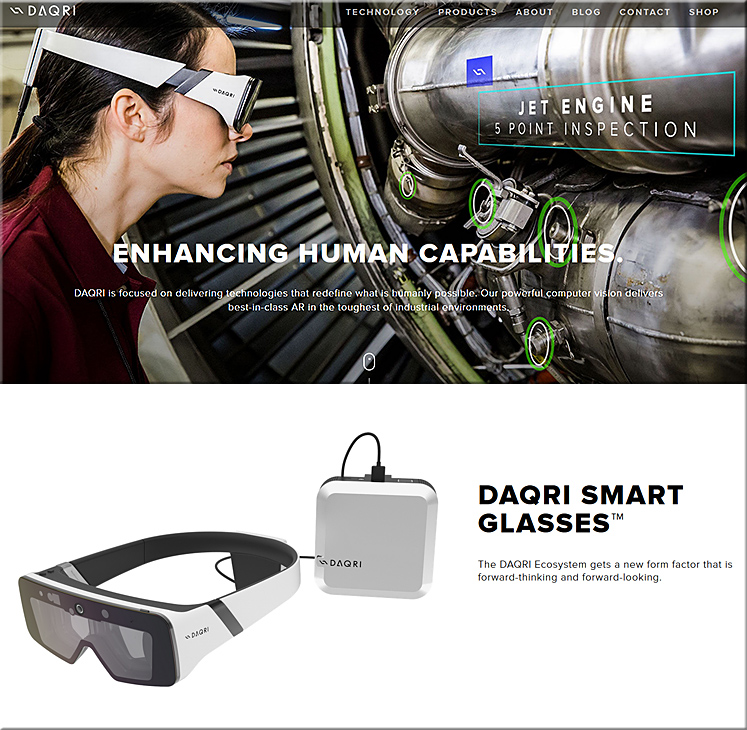
From CES 2017: Introducing DAQRI’s Smart Glasses™

Excerpt:

Data visualization, guided work instructions, remote expert — for use in a variety of industries: medical, aviation and aerospace, architecture and AEC, lean manufacturing, engineering, and construction.


Third-party Microsoft HoloLens-based mixed reality headsets coming soon, prices to start at $299 — from bgr.in by Deepali Moray
Microsoft has partnered with companies including Dell and Acer which will release their own HoloLens compatible devices.

Excerpt:

The company said that it is teaming up with the likes of Dell, HP, Lenovo and Acer, which will release headsets based on the HoloLens technology. “These new head-mounted displays will be the first consumer offerings utilizing the Mixed Reality capabilities of Windows 10 Creators Update,” a Microsoft spokesperson said. Microsoft’s partner companies for taking the HoloLens technology forward include Dell, HP, Lenovo, Acer, and 3 Glasses. Headsets by these manufacturers will work the same way as the original HoloLens but carry the design and branding of their respective companies. While the HoloLens developer edition costs a whopping $2999 (approximately Rs 2,00,000), the third-party headsets will be priced starting $299 (approximately Rs 20,000).


Verto Studio 3D App Makes 3D Modeling on HoloLens Easy — from winbuzzer.com by Luke Jones
The upcoming Verto Studio 3D application allows users to create 3D models and interact with them when wearing HoloLens. It is the first software of its kind for mixed reality.


Excerpt:
How is The Immersive Experience Delivered?

Tethered Headset VR – The user can participate in a VR experience by using a computer with a tethered VR headset (also known as a Head Mounted Display – HMD) like Facebook’s Oculus Rift, PlayStation VR, or the HTC Vive. The user has the ability to move freely and interact in the VR environment while using a handheld controller to emulate VR hands. But, the user has a limited area in which to move about because they are tethered to a computer.

Non-Tethered Headset VR/AR – These devices are headsets and computers built into one system, so users are free of any cables limiting their movement. These devices use AR to deliver a 360° immersive experience. Much like with Oculus Rift and Vive, the user would be able to move around in the AR environment as well as interact and manipulate objects. A great example of this headset is Microsoft’s HoloLens, which delivers an AR experience to the user through just a headset.

Mobile Device Inserted into a Headgear – To experience VR, the user inserts their mobile device into a Google Cardboard, Samsung Gear 360°, or any other type of mobile device headgear, along with headphones if they choose. This form of VR doesn’t require the user to be tethered to a computer and most VR experiences can be 360° photos, videos, and interactive scenarios.

Mobile VR – The user can access VR without any type of headgear simply by using a mobile device and headphones (optional). They can still have many of the same experiences that they would through Google Cardboard or any other type of mobile device headgear. Although they don’t get the full immersion that they would with headgear, they would still be able to experience VR. Currently, this version of the VR experience seems to be the most popular because it only requires a mobile device. Apps like Pokémon Go and Snapchat’s animated selfie lens only require a mobile device and have a huge number of users.

Desktop VR – Using just a desktop computer, the user can access 360° photos and videos, as well as other VR and AR experiences, by using the trackpad or computer mouse to move their field of view and become immersed in the VR scenario.

New VR – Non-mobile and non-headset platforms like Leap Motion use depth sensors to create a VR image of one’s hands on a desktop computer; they emulate hand gestures in real time. This technology could be used for anything from teaching assembly in a manufacturing plant to learning a step-by-step process to medical training.

VR/AR Solutions

  • Oculus Rift – www.oculus.com
  • HTC Vive – htcvive.com
  • Playstation VR – playstation.com
  • Samsung VR Gear – www.samsung.com
  • Google Daydream – https://vr.google.com/daydream/
  • Leap Motion – www.leapmotion.com
  • Magic Leap – www.magicleap.com
  • Most mobile devices


Goggles that are worn, while they are “Oh Myyy” awesome, will not be the final destination of VR/AR. We will want to engage and respond, without wearing a large device over our eyes. Pokémon Go was a good early predictor of how non-goggled experiences will soar.

Elliott Masie


Top 8 VR & AR predictions for 2017 — from haptic.al by Christine Hart

Excerpt:

Education will go virtual
Similar to VR for brand engagement, we’ve seen major potential for delivering hands-on training and distance education in a virtual environment. If VR can take a class on a tour of Mars, the current trickle of educational VR could turn into a flood in 2017.


Published on Dec 26, 2016
Top 10 Virtual Reality Predictions For 2017 In vTime. Its been an amazing year for VR and AR. New VR and AR headsets, ground breaking content and lots more. 2017 promises to be amazing as well. Here’s our top 10 virtual reality predictions for the coming year. Filmed in vTime with vCast. Sorry about the audio quality. We used mics on Rift and Vive which are very good on other platforms. We’ve reported this to vTime.


Addendums


  • 5 top Virtual Reality and Augmented Reality technology trends for 2017 — from marxentlabs.com by Joe Bardi
    Excerpt:
    So what’s in store for Virtual Reality and Augmented Reality in 2017? We asked Marxent’s talented team of computer vision experts, 3D artists and engineers to help us suss out what the year ahead will hold. Here are their predictions for the top Virtual Reality and Augmented Reality technology trends for 2017.


AR becomes the killer app for smartphones


Don’t discount the game-changing power of the morphing “TV” when coupled with AI, NLP, and blockchain-based technologies! [Christian]

From DSC:

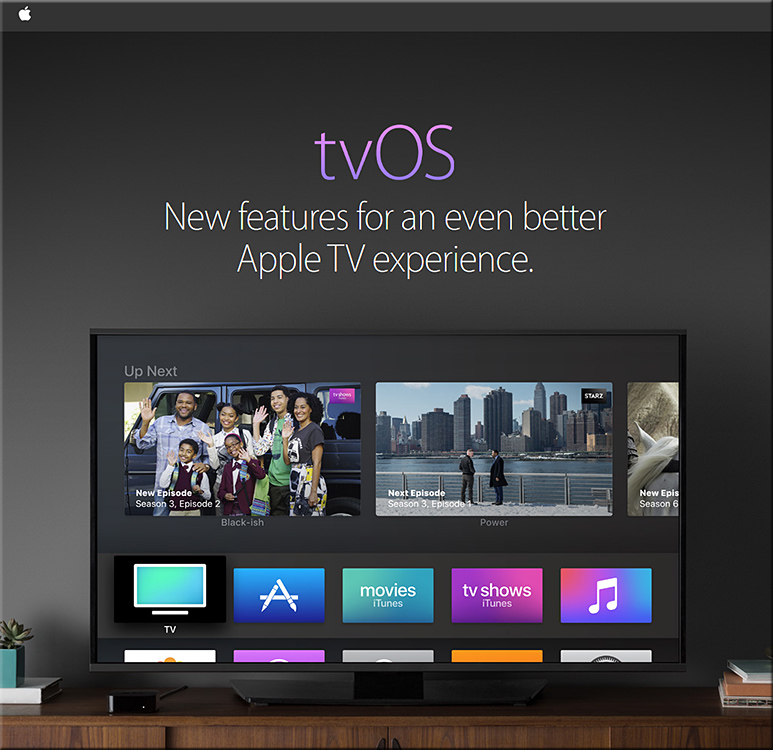
Don’t discount the game-changing power of the morphing “TV” when coupled with artificial intelligence (AI), natural language processing (NLP), and blockchain-based technologies!

When I saw the article below, I couldn’t help but wonder what (we currently know of as) “TVs” will morph into and what functionalities they will be able to provide to us in the not-too-distant future…?

For example, the article mentions that Seiki, Westinghouse, and Element will be offering TVs that can not only access Alexa — a personal assistant from Amazon which uses artificial intelligence — but will also be able to provide access to over 7,000 apps and games via the Amazon Fire TV Store.

Some of the questions that come to my mind:

  • Why can’t there be more educationally-related games and apps available on this type of platform?
  • Why can’t the results of the assessments taken on these apps get fed into cloud-based learner profiles that capture one’s lifelong learning? (#blockchain)
  • When will potential employers start asking for access to such web-based learner profiles?
  • Will tvOS and similar operating systems expand to provide blockchain-based technologies as well as the types of functionality we get from our current set of CMSs/LMSs?
  • Will this type of setup become a major outlet for competency-based education as well as for corporate training-related programs?
  • Will augmented reality (AR), virtual reality (VR), and mixed reality (MR) capabilities come with our near future “TVs”?
  • Will virtual tutoring be one of the available apps/channels?
  • Will the microphone and the wide angle, HD camera on the “TV” be able to be disconnected from the Internet for security reasons? (i.e., to be sure no hacker is eavesdropping in on their private lives)


Forget a streaming stick: These 4K TVs come with Amazon Fire TV inside — from techradar.com by Nick Pino

Excerpt:

The TVs will not only have access to Alexa via a microphone-equipped remote but, more importantly, will have access to the over 7,000 apps and games available on the Amazon Fire TV Store – a huge boon considering that most of these Smart TVs usually include, at max, a few dozen apps.


The Living [Class] Room -- by Daniel Christian -- July 2012 -- a second device used in conjunction with a Smart/Connected TV


Addendums


“I’ve been predicting that by 2030 the largest company on the internet is going to be an education-based company that we haven’t heard of yet,” Frey, the senior futurist at the DaVinci Institute think tank, tells Business Insider.

.

  • Once thought to be a fad, MOOCs showed staying power in 2016 — from educationdive.com
    Dive Brief:

    • EdSurge profiles the growth of massive online open courses in 2016, which attracted more than 58 million students in over 700 colleges and universities last year.
    • The top three MOOC providers — Coursera, Udacity and EdX — collectively grossed more than $100 million last year, as much of the content provided on these platforms shifted from free to paywall guarded materials.
    • Many MOOCs have moved to offering credentialing programs or nanodegree offerings to increase their value in industrial marketplaces.
 

The freelance economy: Top trends to watch in 2017 — from blog.linkedin.com

Excerpt:

Freelancers now account for nearly 35% of the U.S. workforce and the trend is only picking up speed with more professionals opting to create their own jobs in lieu of more traditional full-time employment.

As we head into the new year, we want to shed a bit more light on this burgeoning sector of the workforce. What kind of location, industry and demographic trends are surfacing among the freelance professionals of 2016? You might not know, for example, that a whopping 40% of our freelancers are concentrated in just four states: California, Texas, Florida and New York. Or that more senior men are most likely to take the leap into freelancing.

The time is ripe to be a freelancer in America so we’re revealing insider insights like these to help you learn more about this trending profession. Check out the report below – gleaned from a survey of more than 9,500 of our ProFinder professionals – to see what we discovered.


From DSC:
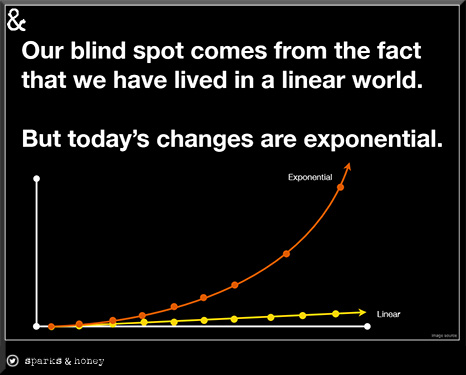
Besides the workforce moving towards the increased use of freelancers, the pace of change has moved from being more linear in nature to more of an exponential trajectory.


Some important questions, therefore, to ask are: 

  • Are our students ready to enter this type of workplace? 
  • Can they pivot quickly?
  • Do they know how to learn and are they ready to be lifelong learners? (Do they like learning enough to continue to pursue it? Peoples’ overall quality of life would be much higher if they enjoyed learning, rather than be forced to do so in order to keep the bread and butter on their tables.)
  • Are they able to communicate in a variety of ways?
  • How are their customer service skills coming along?
  • How are their problem-solving skills coming along?
  • Do they know how to maintain their businesses’ books and do their taxes?
  • Are they digitally literate and do they have an appreciation for the pluses and minuses of technology?

I sure hope so…but I have my serious doubts. That said, many institutions/organizations representing K-12 and higher education are not doing a great job of innovating either. Though there certainly exists some strong pockets of innovation in some of our institutions out there — and the ability to pivot — taken as a whole, our institutions and organizations haven’t been as responsive, nimble, and innovative as our students need them to be.

After all, we are trying to prepare students for their futures (with the externality effect being that we, too, will also be better prepared for that future).


From DSC:
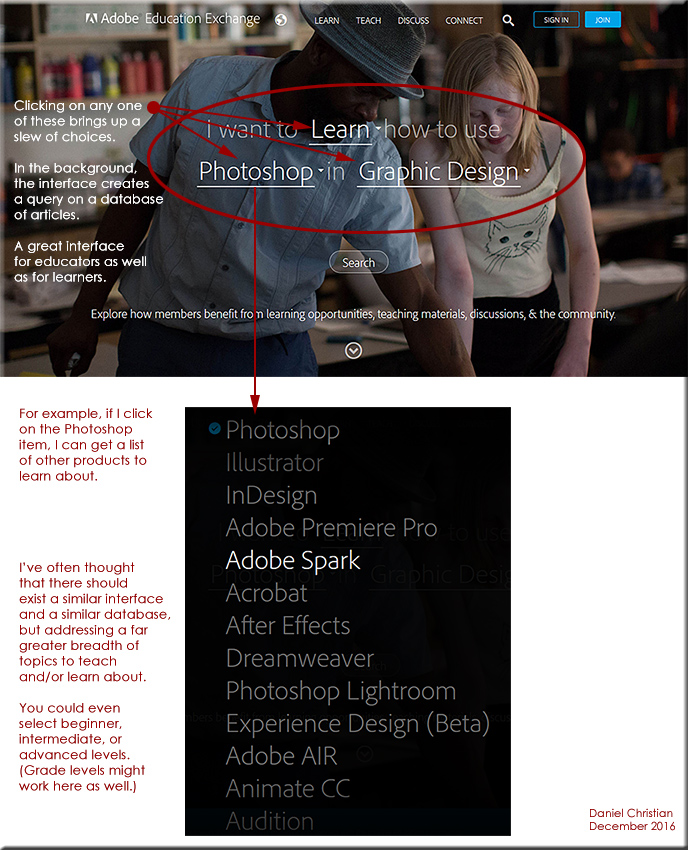
After seeing the sharp interface out at Adobe (see image below), I’ve often thought that there should exist a similar interface and a similar database for educators, trainers, and learners to use — but the database would address a far greater breadth of topics to teach and/or learn about.  You could even select beginner, intermediate, or advanced levels (grade levels might work here as well).

Perhaps this is where artificial intelligence will come in…not sure.


Explosive IoT growth could produce skills shortage — from rtinsights.com by Joe McKendrick

Excerpts:

CIO’s Sharon Florentine took a look at data from global freelance marketplace Upwork, based on annual job posting growth and skills demand. The following are leading IoT skills Florentine identified that will be demand as the IoT proliferates, with level the growth seen over a one-year period:

Circuit design (231% growth): Builds miniaturized circuit boards for sensors and devices.

Microcontroller programming (225% growth): Writes code that provides intelligence to microcontrollers, the embedded chips within IoT devices.

AutoCAD (216% growth): Designs the devices.

Machine learning (199% growth): Writes the algorithms that recognize data patterns within devices.

Security infrastructure (194% growth): Identifies and integrates the standards, protocols and technologies that protect devices, as well as the data inside.

Big data (183% growth): Data scientists and engineers “who can collect, organize, analyze and architect disparate sources of data.” Hadoop and Apache Spark are two areas with particularly strong demand.


Some reflections/resources on today’s announcements from Apple

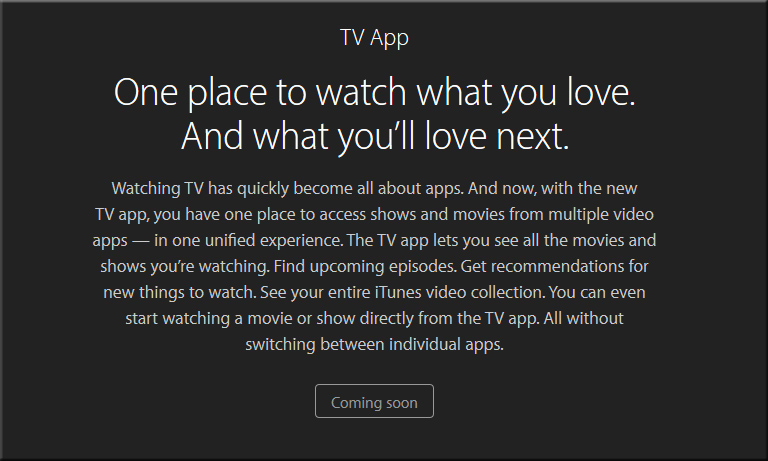
tv-app-apple-10-27-16


tv-app2-apple-10-27-16

From DSC:
How long before recommendation engines like this can be filtered/focused down to just display apps, channels, etc. that are educational and/or training related (i.e., a recommendation engine to suggest personalized/customized playlists for learning)?

That is, in the future, will we have personalized/customized playlists for learning on our Apple TVs — as well as on our mobile devices — with the assessment results of our taking the module(s) or course(s) being sent in to:

  • A credentials database on LinkedIn (via blockchain)
    and/or
  • A credentials database at the college(s) or university(ies) that we’re signed up with for lifelong learning (via blockchain)
    and/or
  • To update our cloud-based learning profiles — which can then feed a variety of HR-related systems used to find talent? (via blockchain)

Will participants in MOOCs, virtual K-12 schools, homeschoolers, and more take advantage of learning from home?

Will solid ROI’s from having thousands of participants paying a smaller amount (to take your course virtually) enable higher production values?

Will bots and/or human tutors be instantly accessible from our couches?

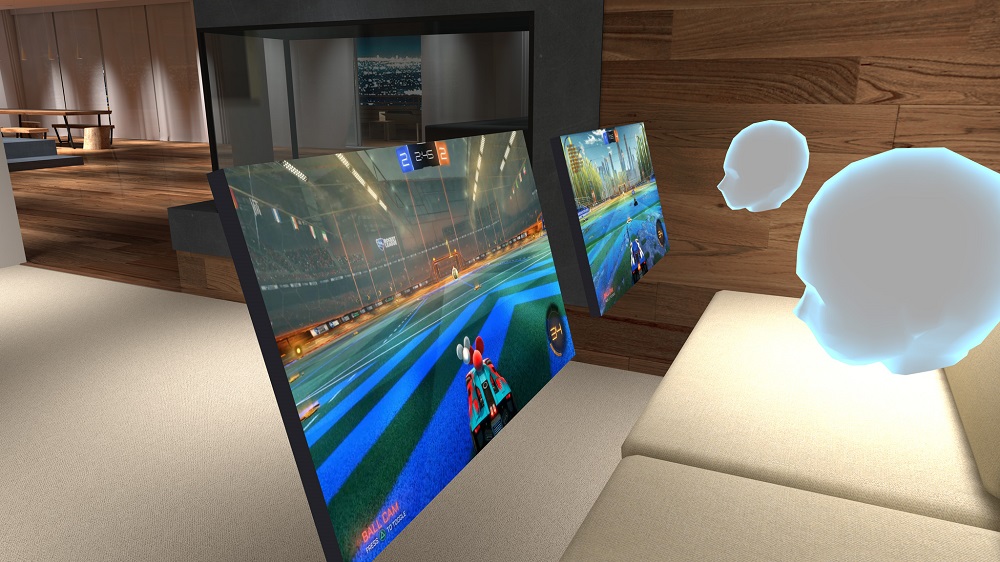
Will we be able to meet virtually via our TVs and share our computing devices?


bigscreen_rocket_league


The Living [Class] Room -- by Daniel Christian -- July 2012 -- a second device used in conjunction with a Smart/Connected TV


Other items on today’s announcements:


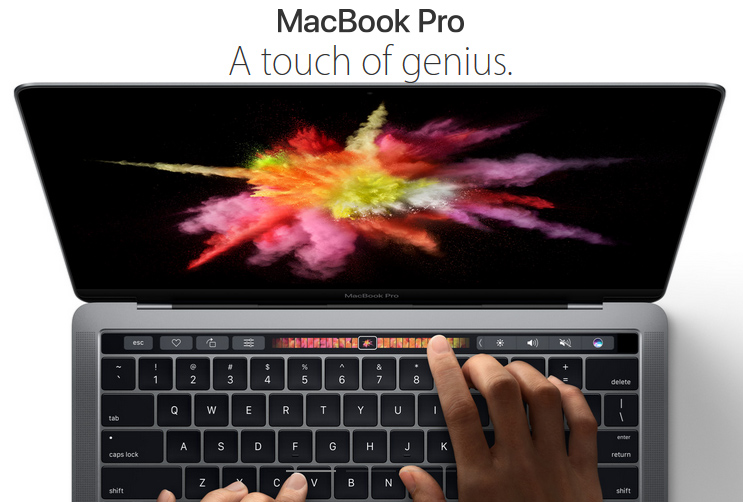
macbookpro-10-27-16


All the big announcements from Apple’s Mac event — from amp.imore.com by Joseph Keller

  • MacBook Pro
  • Final Cut Pro X
  • Apple TV > new “TV” app
  • Touch Bar


Apple is finally unifying the TV streaming experience with new app — from techradar.com by Nick Pino


How to migrate your old Mac’s data to your new Mac — from amp.imore.com by Lory Gil


MacBook Pro FAQ: Everything you need to know about Apple’s new laptops — from amp.imore.com by Serenity Caldwell


Accessibility FAQ: Everything you need to know about Apple’s new accessibility portal — from imore.com by Daniel Bader


Apple’s New MacBook Pro Has a ‘Touch Bar’ on the Keyboard — from wired.com by Brian Barrett


Apple’s New TV App Won’t Have Netflix or Amazon Video — from wired.com by Brian Barrett


Apple 5th Gen TV To Come With Major Software Updates; Release Date Likely In 2017 — from mobilenapps.com


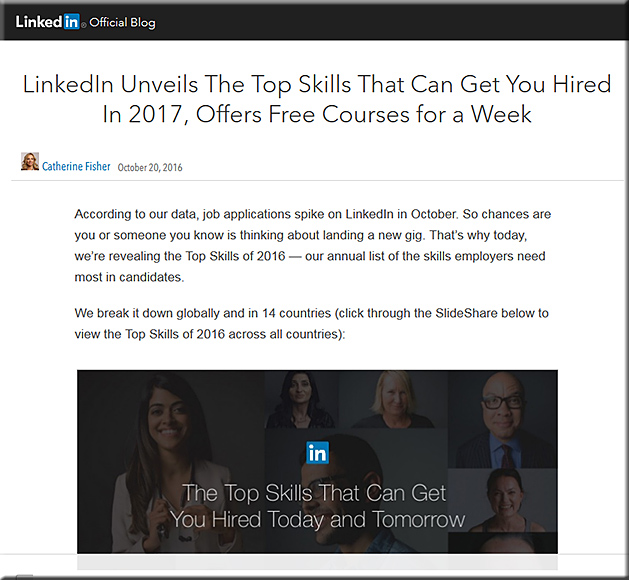
LinkedIn unveils the top skills that can get you hired in 2017

Excerpt:

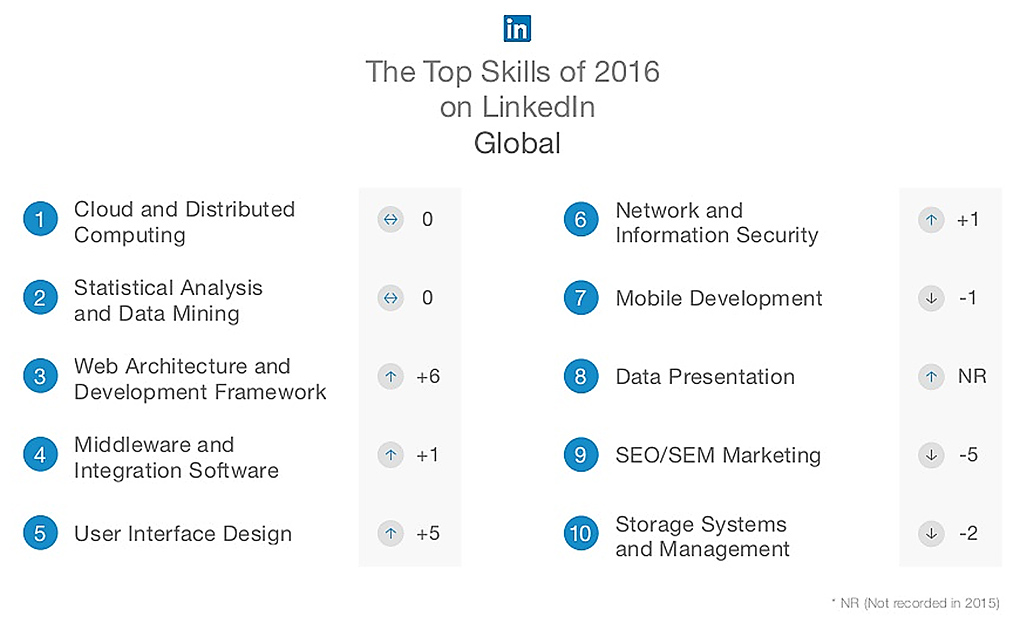
Data and cloud reign supreme: I smell a dynasty in the making! Cloud and distributed computing has remained in the #1 spot for the past two years and is the Top Skill on almost every list — including France, Germany, India, Ireland, Singapore, the U.S., and Spain. Following closely on its heels is statistical analysis and data mining, which came in #2 last year, and #1 in 2014. These skills are in such high demand because they’re at the cutting edge of technology. Employers need employees with cloud and distributed computing, statistical analysis and data mining skills to stay competitive.


linkedin-topskills2016


linkedin-topskillsglobal2016


From DSC:
The need for people who have “IT”-related skills is consistent across the globe.


From DSC:
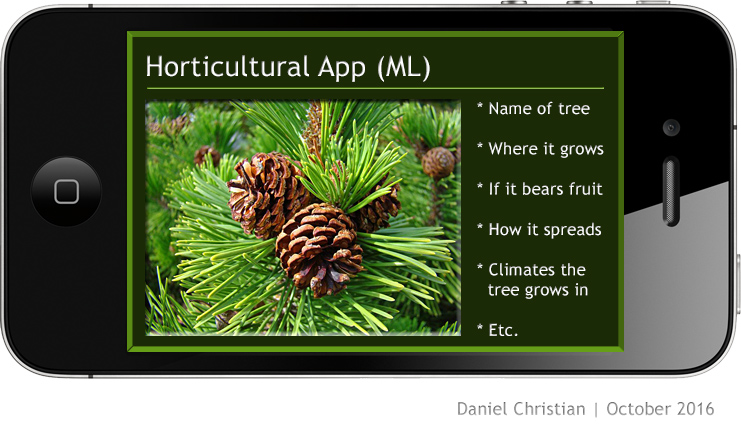
The other day I had posted some ideas in regards to how artificial intelligence, machine learning, and augmented reality are coming together to offer some wonderful new possibilities for learning (see: “From DSC: Amazing possibilities coming together w/ augmented reality used in conjunction w/ machine learning! For example, consider these ideas.”) Here is one of the graphics from that posting:


horticulturalapp-danielchristian

These affordances are just now starting to be uncovered as machines are increasingly able to ascertain patterns, things, objects…even people (which calls for a separate posting at some point).

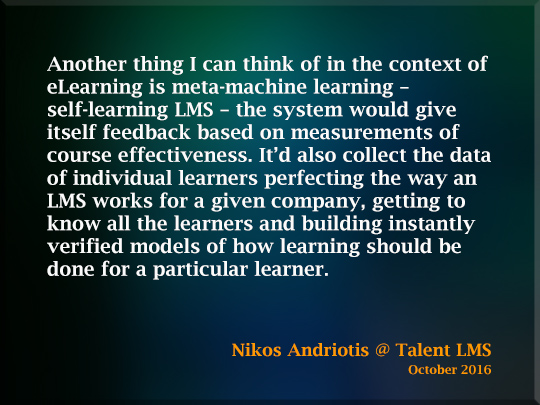
But mainly, for today, I wanted to highlight an excellent comment/reply from Nikos Andriotis @ Talent LMS who gave me permission to highlight his solid reflections and ideas:


nikosandriotisidea-oct2016

https://www.talentlms.com/blog/author/nikos-andriotis


From DSC:
Excellent reflection/idea Nikos — that would represent some serious personalized, customized learning!

Nikos’ innovative reflections also made me think about his ideas in light of their interaction or impact with web-based learner profiles, credentialing, badging, and lifelong learning.  What’s especially noteworthy here is that the innovations (that impact learning) continue to occur mainly in the online and blended learning spaces.

How might the ramifications of these innovations impact institutions who are pretty much doing face-to-face only (in terms of their course delivery mechanisms and pedagogies)?

Given:

  • That Microsoft purchased LinkedIn and can amass a database of skills and open jobs (playing a cloud-based matchmaker)
  • Everyday microlearning is key to staying relevant (RSS feeds and tapping into “streams of content” are important here, and so is the use of Twitter)
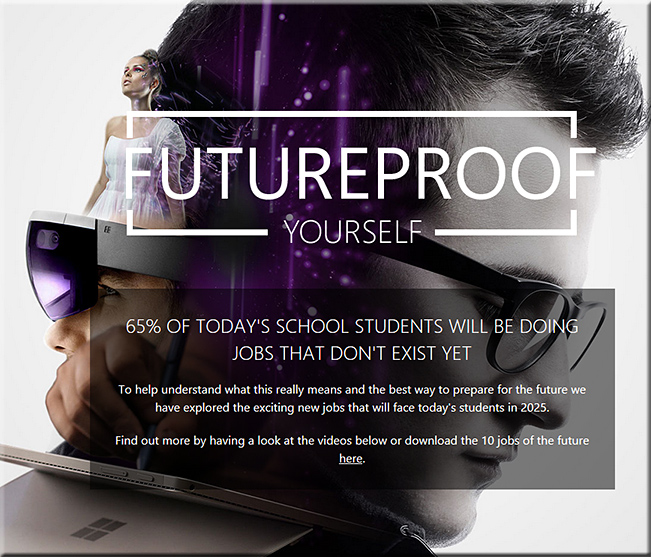
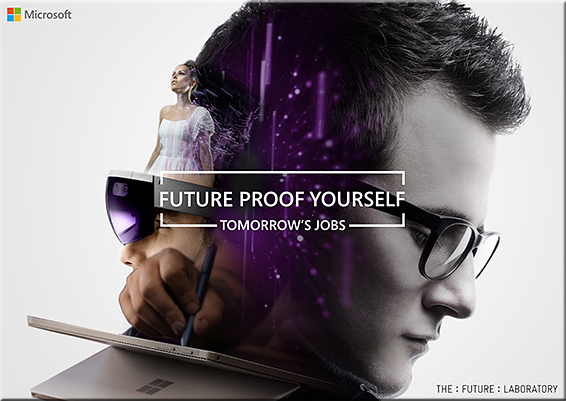
  • 65% of today’s students will be doing jobs that don’t even exist yet (per Microsoft & The Future Laboratory in 2016)


futureproofyourself-msfuturelab-2016

  • The exponential pace of technological change
  • The increasing level of experimentation with blockchain (credentialing)
  • …and more

…what do the futures look like for those colleges and universities that operate only in the face-to-face space and who are not innovating enough?


Coppell ISD becomes first district to use IBM, Apple format — from bizjournals.com by Shawn Shinneman

Excerpt:

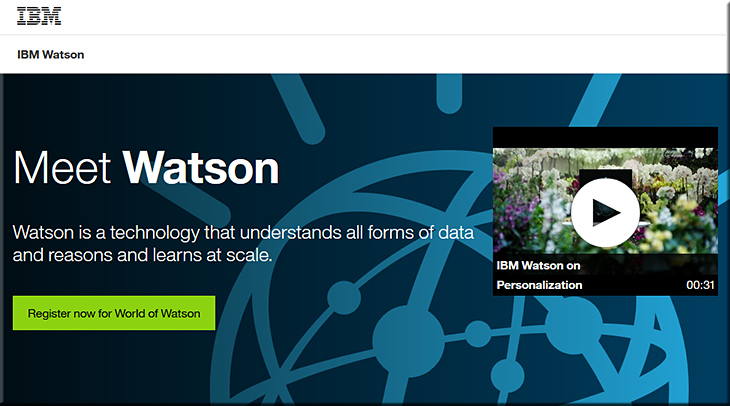
Teachers at Coppell Independent School District have become the first to use a new IBM and Apple technology platform built to aid personalized learning.

IBM Watson Element for Educators pairs IBM analytics and data tools such as cognitive computing with Apple design. It integrates student grades, interests, participation, and trends to help educators determine how a student learns best, the company says.
…
It also recommends learning content personalized to each student. The platform might suggest a reading assignment on astronomy for a young student who has shown an interest in space.


From DSC:
Technologies involved with systems like IBM’s Watson will likely bring some serious impact to the worlds of education and training & development. Such systems — and the affordances that they should be able to offer us — should not be underestimated.  The potential for powerful, customized, personalized learning could easily become a reality in K-20 as well as in the corporate training space. This is an area to keep an eye on for sure, especially with the growing influence of cognitive computing and artificial intelligence.

These kinds of technology should prove helpful in suggesting modules and courses (i.e., digital learning playlists), but I think the more powerful systems will be able to drill down far more minutely than that. I think these types of systems will be able to assist with all kinds of math problems and equations as well as analyze writing examples, correct language mispronunciations, and more (perhaps this is already here…apologies if so). In other words, the systems will “learn” where students can go wrong doing a certain kind of math equation…and then suggest steps to correct things when the system spots a mistake (or provide hints at how to correct mistakes).

This road takes us down to places where we have:

  • Web-based learner profiles — including learner’s preferences, passions, interests, skills
  • Microlearning/badging/credentialing — likely using blockchain
  • Learning agents/bots to “contact” for assistance
  • Guidance for lifelong learning
  • More choice, more control


ibmwatson-oct2016


Also see:

  • First IBM Watson Education App for iPad Delivers Personalized Learning for K-12 Teachers and Students — from prnewswire.com
    Educators at Coppell Independent School District in Texas first to use new iPad app to tailor learning experiences to student’s interests and aptitudes
    Excerpts:
    With increasing demands on educators, teachers need tools that will enable them to better identify the individual needs of all students while designing learning experiences that engage and hold the students’ interest as they master the content. This is especially critical given that approximately one third of American students require remedial education when they enter college today, and current college attainment rates are not keeping pace with the country’s projected workforce needs1.  A view of academic and day-to-day updates in real time can help teachers provide personalized support when students need it.
    …
    IBM Watson Element provides teachers with a holistic view of each student through a fun, easy-to-use and intuitive mobile experience that is a natural extension of their work. Teachers can get to know their students beyond their academic performance, including information about personal interests and important milestones students choose to share.  For example, teachers can input notes when a student’s highly anticipated soccer match is scheduled, when another has just been named president for the school’s World Affairs club, and when another has recently excelled following a science project that sparked a renewed interest in chemistry.The unique “spotlight” feature in Watson Element provides advanced analytics that enables deeper levels of communication between teachers about their students’ accomplishments and progress. For example, if a student is excelling academically, teachers can spotlight that student, praising their accomplishments across the school district. Or, if a student received a top award in the district art show, a teacher can spotlight the student so their other teachers know about it.
 

A new “MicroMasters” online learning program offered by major universities — from hechingerreport.org by Nichole Dobo
From Hong Kong to Holland, 14 institutions join MOOC partnership

Excerpt:

A new kind of credential has entered the crowded market for online learning.

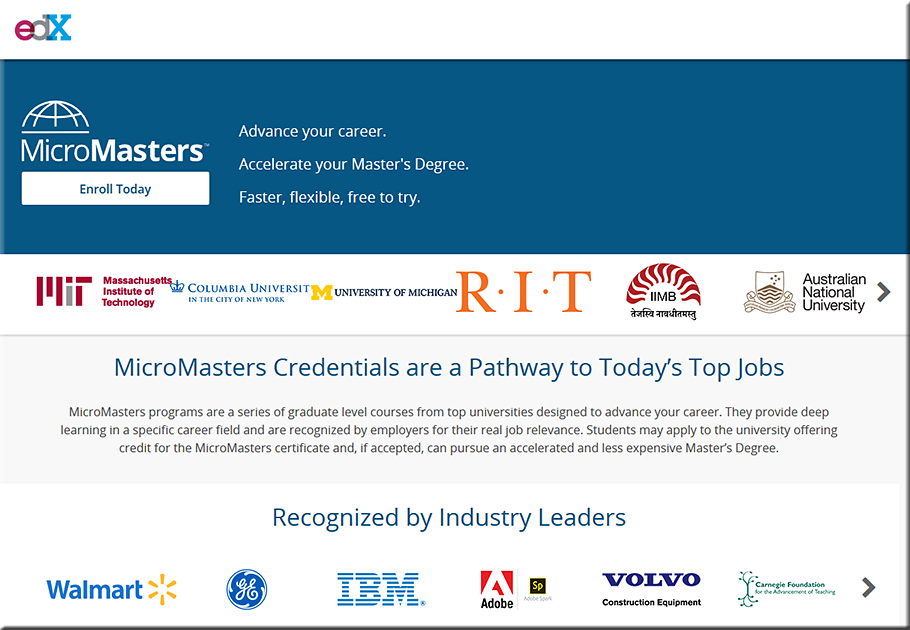
EdX, a Massachusetts-based nonprofit that provides online courses, announced last week the creation of 19 “MicroMasters” courses, a new type of online educational program. These courses are tailored master’s degree-level classes that can help students hone skills that will be immediately useful in the workplace.

“I think the MicroMasters is a big next step in the evolution of education,” Anant Agarwal, the CEO of edX and an MIT professor, said in an interview last week.

These courses – offered through 14 universities including Columbia, Arizona State University and the University of Michigan, as well as some in Australia, Europe and India – are open to anyone who wants to take them. No transcripts or prerequisites required. Students don’t even need a GED to enroll.

Anyone can learn in the MicroMasters program for free, although those who wish to receive a certificate of completion must pay a $1,000 fee. That money gives the student more than a piece of paper; it also pays for extra services, such as more attention from the instructor.


edx-micromasters-sept2016


Also somewhat related/see (emphasis DSC):

  • An Online Education Breakthrough? A Master’s Degree for a Mere $7,000 — from nytimes.com by Kevin Carey
    Excerpt:
    Georgia Tech rolled out its online master’s in computer science in 2014. It already had a highly selective residential master’s program that cost about the same as those of competitor colleges. Some may see online learning as experimental or inferior, something associated with downmarket for-profit colleges. But the nation’s best universities have fully embraced it. Syracuse, Johns Hopkins, U.S.C. and others have also developed online master’s degrees, for which they charge the same tuition as their residential programs.Georgia Tech decided to do something different. It charges online students the smallest amount necessary to cover its costs. That turned out to be $510 for a three-credit class. U.S.C. charges online students $5,535 for a three-credit class. (Both programs also charge small per-semester fees.)

    With one of the top 10 computer science departments in the nation, according to U.S. News & World Report, Georgia Tech had a reputation to uphold. So it made the online program as much like the residential program as possible.


If you doubt that we are on an exponential pace of change, you need to check these articles out! [Christian]

exponentialpaceofchange-danielchristiansep2016


From DSC:
The articles listed in
this PDF document demonstrate the exponential pace of technological change that many nations across the globe are currently experiencing and will likely be experiencing for the foreseeable future. As we are no longer on a linear trajectory, we need to consider what this new trajectory means for how we:

  • Educate and prepare our youth in K-12
  • Educate and prepare our young men and women studying within higher education
  • Restructure/re-envision our corporate training/L&D departments
  • Equip our freelancers and others to find work
  • Help people in the workforce remain relevant/marketable/properly skilled
  • Encourage and better enable lifelong learning
  • Attempt to keep up w/ this pace of change — legally, ethically, morally, and psychologically


PDF file here


One thought that comes to mind…when we’re moving this fast, we need to be looking upwards and outwards into the horizons — constantly pulse-checking the landscapes. We can’t be looking down or be so buried in our current positions/tasks that we aren’t noticing the changes that are happening around us.


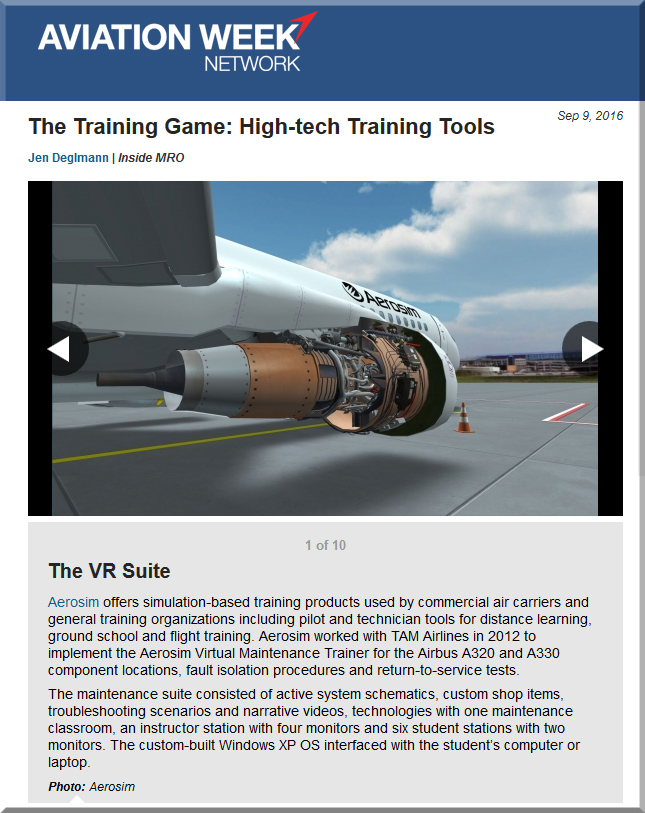
The Training Game: High-tech Training Tools — from aviationweek.com by Jen Deglmann
Software and technology companies are working with aviation schools and maintenance facilities to create customized training virtual reality and digital programs. See the technical specs for the systems and thoughts from some of the industry’s instructors and maintenance facility trainers. This is a more in-depth look at September’s MRO Links feature on all high-tech training technology tools.


hightechtrainingtools-sept2016


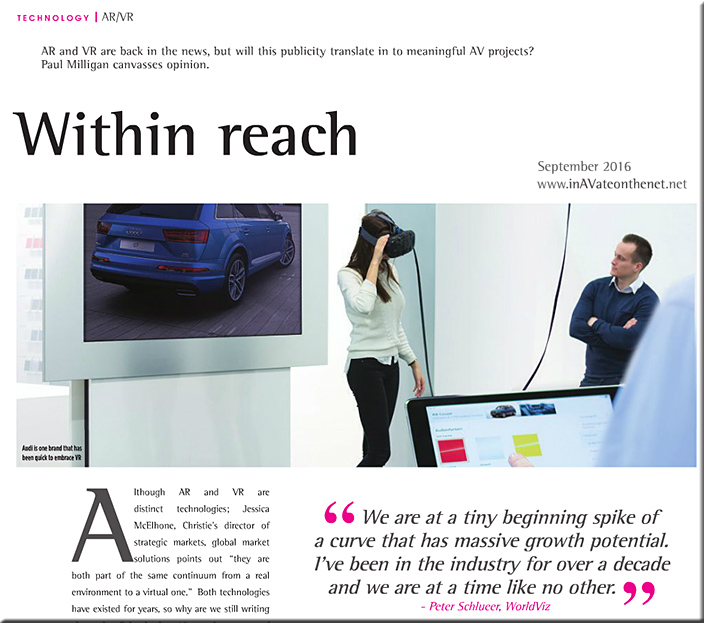
Also see:


arvr-in-reach-inavateonthenet-sep2016


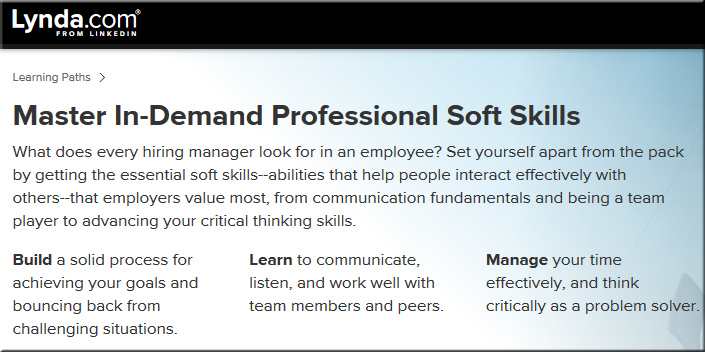
The ‘soft skills’ employers are looking for — from blogs.wsj.com by Kate Davidson
Communication, teamwork, punctuality and critical thinking are in high demand, an analysis of 2.3 million LinkedIn profiles shows

Excerpt (emphasis DSC):

Want to craft a standout resume? Try adding skills like communication, organization and punctuality.

Nearly 58% of employees who touted stellar communication skills were hired over the course of a year, according to an analysis of 2.3 million LinkedIn profiles for The Wall Street Journal.

Employers are increasingly looking for workers with strong soft skills—those traits that don’t show up in a job posting but are essential for succeeding in the workplace, like working well with others and taking initiative. But many employers say it has gotten harder to find those applicants as the labor market tightens.
…
Communication, at the top of the list, was followed by organization, teamwork, punctuality, critical thinking, social skills, creativity, interpersonal communication, adaptability and having a friendly personality.


lynda-softskills-2016


From DSC:
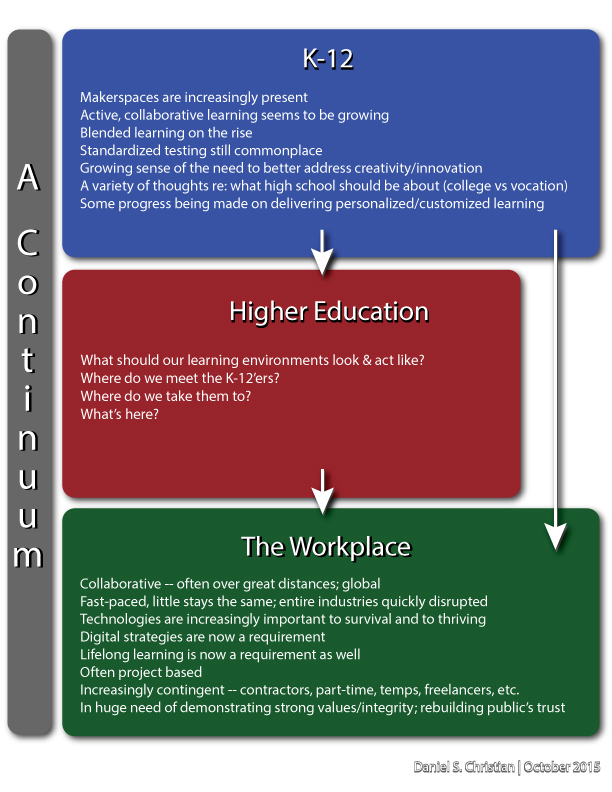
Looking at the list of top skills desired by employers, there seems to be a major breakdown in the entire spectrum/continuum.

Hmmm….standardized testing doesn’t really bring out the collaborative side of us, does it?  In fact, you would likely get shown the door if you tried to collaborate (or show social skills) on a test, right?  Teamwork.  Hmmm….again, not on the exam. Punctuality? Nope…not that either. Organization…perhaps…maybe a little bit on the exam, but not much.

Which set of goals are we pursuing? Standardized testing and all of what that means…or are we trying to produce students who have the soft skills mentioned above and who can reinvent themselves over and over again (to which I’d add entrepreneurship/innovation/ability to freelance, the ability to look up and out into the future, and the ability to keep the relevant landscapes on their radars).

The answer seems to be that we’re trying to do both.  That said, the corporate world seems to be saying that the standardized testing is winning out in this clash of goals.

This is why I try to pulse check the worlds of K-12, higher ed, and the corporate space all at the same time. We are not islands. What happens in earlier phases of people’s lives matters.  What’s currently happening in the earlier portions of the continuum matters.

DanielChristian-what-should-our-learning-environments-look-and-act-like


Addendum on 9/10/16:

The Unemployable Graduate Crisis and How We Can Fix It — from linkedin.com by Alistair Cox

Excerpt:

What is going wrong?

There remains a fundamental mismatch between market demand and supply of skills. The longstanding concerns around a drought of STEM and digital talent have been well publicised, but the issue extends beyond that. Students are graduating with degrees offering neither technical nor vocational knowledge, yet these are what employers are often looking for first.

Recent research in the US found that while 87% of recent graduates feel well prepared to hit the ground running in their new job, only half of hiring managers agreed. The shortfall across hard and soft skills is plain to see – one in four roles go unfilled due to the technical skills gap and hiring managers report worrying gaps in graduates’ critical thinking, communication and leadership skills. Around the world, many graduates simply aren’t employable in the roles being created today, yet will have spent at least 3 years racking up debt to study a course that will not help them find a relevant role.

If steps are not taken to address this, then I genuinely fear for our graduates, employers and the global economy. We are already seeing the skills gap widening into a skills chasm.


FutureProofYourself-MS-FutureLab-Aug2016


Future proof yourselves — from Microsoft & The Future Laboratory

Excerpt (emphasis DSC):

Executive Summary
Explore the world of work in 2025 in a revealing evidence-based report by future consultants The Future Laboratory and Microsoft, which identifies and investigates ten exciting, inspiring and astounding jobs for the graduates of tomorrow – but that don’t exist yet.

Introduction
Tomorrow’s university graduates will be taking a journey into the professional unknown guided by a single, mind-blowing statistic: 65% of today’s students will be doing jobs that don’t even exist yet.

Technological change, economic turbulence and societal transformation are disrupting old career certainties and it is increasingly difficult to judge which degrees and qualifications will be a passport to a well-paid and fulfilling job in the decades ahead.

A new wave of automation, with the advent of true artificial intelligence, robots and driverless cars, threatens the future of traditional jobs, from truck drivers to lawyers and bankers.

But, by 2025, this same technological revolution will open up inspiring and exciting new career opportunities in sectors that are only in their infancy today.

The trick for graduates is to start to develop the necessary skills today in order to ensure they future proof their careers.

This report by future consultants The Future Laboratory attempts to show them how to do just that in a research collaboration with Microsoft, whose Surface technology deploys the precision and versatility of pen and touch to power creative industries ranging from graphic design and photography to architecture and engineering.

In this study, we use extensive desk research and in-depth interviews with technologists, academics, industry commentators and analysts to unveil 10 new creative job categories that will be recruiting tomorrow’s university students.

These future jobs demonstrate a whole new world of potential applications for the technology of today, as we design astonishing virtual habitats and cure deadly diseases from the comfort of our own sofas. It is a world that will need a new approach to training and career planning.

Welcome to tomorrow’s jobs…


65% of today’s students will be doing jobs that don’t even exist yet.


One of the jobs mentioned was the Ethical Technology Advocate — check out this video clip:

Ethical-Technology-Advocate-MS-Aug2016-


“Over the next decade, the long-awaited era of robots will dawn and become part of everyday life. It will be important to set out the moral and ethical rules under which they operate…”


© 2025 | Daniel Christian