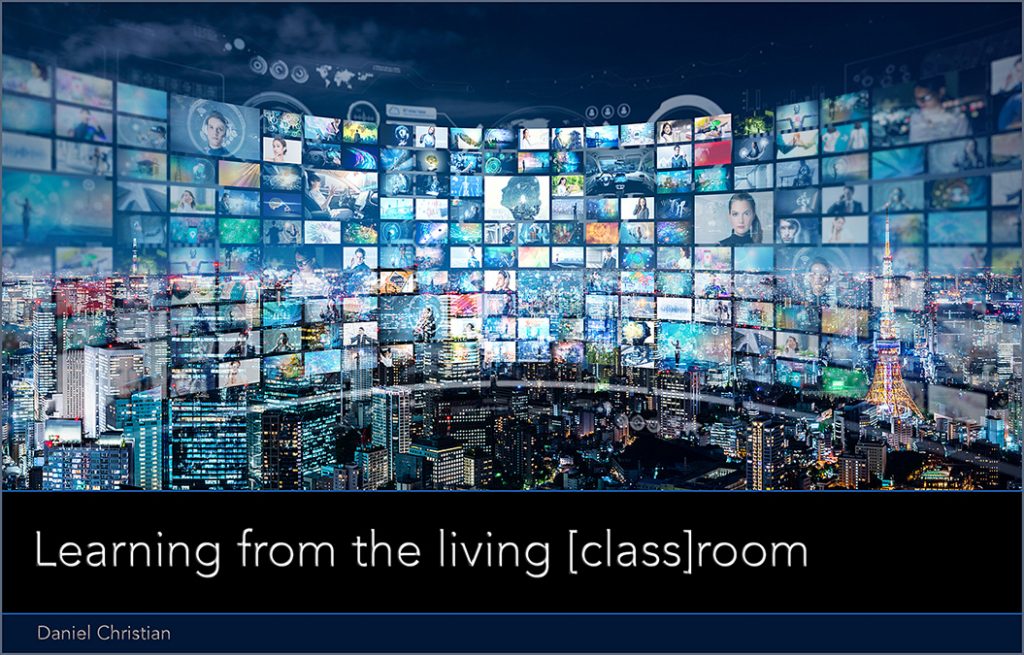
Turn Your Home Into A Mixed Reality Record Store With Spotify On Magic Leap — from vrscout.com by Kyle Melnick

“We see a time in the not too distant future when spatial computing will extend into the wider world of podcasts, audiobooks and storytelling,” continues Magic Leap in their post. “And this is just the beginning. The launch of Spotify marks an evolution in the way you can see, hear and experience the bands and artists that you love. It’s an exciting time for music. For musicians. For developers. And for music-lovers the world over.”


FTI 2020 Trend Report for Entertainment, Media, & Technology [FTI]


FTI 2020 Trend Report for Entertainment, Media, & Technology — from futuretodayinstitute.com

Our 3rd annual industry report on emerging entertainment, media and technology trends is now available.

  • 157 trends
  • 28 optimistic, pragmatic and catastrophic scenarios
  • 10 non-technical primers and glossaries
  • Overview of what events to anticipate in 2020
  • Actionable insights to use within your organization

KEY TAKEAWAYS

  • Synthetic media offers new opportunities and challenges.
  • Authenticating content is becoming more difficult.
  • Regulation is coming.
  • We’ve entered the post-fixed screen era.
  • Voice Search Optimization (VSO) is the new Search Engine Optimization (SEO).
  • Digital subscription models aren’t working.
  • Advancements in AI will mean greater efficiencies.


Emerging Tech Trend: Patient-Generated Health Data — from futuretodayinstitute.com — Newsletter Issue 124

Excerpt:

Near-Futures Scenarios (2023 – 2028):

Pragmatic: Big tech continues to develop apps that are either indispensably convenient, irresistibly addictive, or both, and we pay for them, not with cash, but with the data we (sometimes unwittingly) let the apps capture. But for the apps for health care and medical insurance, the stakes could literally be life-and-death. Consumers receive discounted premiums, co-pays, diagnostics and prescription fulfillment, but the data we give up in exchange leaves them more vulnerable to manipulation and invasion of privacy.

Catastrophic: Profit-driven drug makers exploit private health profiles and begin working with the Big Nine. They use data-based targeting to over prescribe patients, netting themselves billions of dollars. Big Pharma target and prey on people’s addictions, mental health predispositions and more, which, while undetectable on an individual level, take a widespread societal toll.

Optimistic: Health data enables prescient preventative care. A.I. discerns patterns within gargantuan data sets that are otherwise virtually undetectable to humans. Accurate predictive algorithms identifies complex combinations of risk factors for cancer or Parkinson’s, offers early screening and testing to high-risk patients and encourages lifestyle shifts or treatments to eliminate or delay the onset of serious diseases. A.I. and health data creates a utopia of public health. We happily relinquish our privacy for a greater societal good.

Watchlist: Amazon; Manulife Financial; GE Healthcare; Meditech; Allscripts; eClinicalWorks; Cerner; Validic; HumanAPI; Vivify; Apple; IBM; Microsoft; Qualcomm; Google; Medicare; Medicaid; national health systems; insurance companies.


Are smart cities the pathway to blockchain and cryptocurrency adoption? — from forbes.com by Chrissa McFarlane

Excerpts:

At the recent Blockchain LIVE 2019 hosted annually in London, I had the pleasure of giving a talk on Next Generation Infrastructure: Building a Future for Smart Cities. What exactly is a “smart city?” The term refers to an overall blueprint for city designs of the future. Already half the world’s population lives in a city, which is expected to grow to sixty-five percent in the next five years. Tackling that growth takes more than just simple urban planning. The goal of smart cities is to incorporate technology as an infrastructure to alleviate many of these complexities. Green energy, forms of transportation, water and pollution management, universal identification (ID), wireless Internet systems, and promotion of local commerce are examples of current of smart city initiatives.

What’s most important to a smart city, however, is integration. None of the services mentioned above exist in a vacuum; they need to be put into a single system. Blockchain provides the technology to unite them into a single system that can track all aspects combined.


From DSC:
There are many examples of the efforts/goals of creating smart cities (throughout the globe) in the above article. Also see the article below.


Announcing AI Business School for Education for leaders, BDMs and students — from educationblog.microsoft.com by Anthony Salcito

Excerpt:

Microsoft’s AI Business School now offers a learning path for education. Designed for education leaders, decision-makers and even students, the Microsoft AI Business School for Education helps learners understand how AI can enhance the learning environment for all students—from innovations in the way we teach and assess, to supporting accessibility and inclusion for all students, to institutional effectiveness and efficiency with the use of AI tools. The course is designed to empower learners to gain specific, practical knowledge to define and implement an AI strategy. Industry experts share insights on how to foster an AI-ready culture and teach them how to use AI responsibly and with confidence. The learning path is available on Microsoft Learn, a free platform to support learners of all ages and experience levels via interactive, online, self-paced learning.


From DSC:
The other day, I put this post out there.

Now, I’d like to add to that information with information from Mr. Joseph Byerwalter, who pointed me to the following videos re: LEGO BOOST!


LEGO® BOOST lets children create models with motors and sensors, and then bring their creations to life through simple, icon-based coding commands. The free LEGO BOOST tablet app includes easy step-by-step building instructions for creating and coding multifunctional models.

P.S. I am not getting paid by LEGO or anyone else here.
I just think learning should be engaging and fun!


LEGO BOOST


LEGO BOOST


LEGO BOOST


LEGO BOOST


LEGO BOOST


LEGO BOOST


LEGO BOOST


LEGO BOOST

Addendum on 10/18/19:


DC: In the future…will there be a “JustWatch” or a “Suppose” for learning-related content?

DC: In the future...will there be a JustWatch or a Suppose for learning-related content?


From DSC:
Is this only on Pixel 4? If so, too bad. It has a lot of potential — especially for students and lecture capture!

Speaking of lecture capture…Panopto offers an incredible search feature for searching text, audio, and video!

“With Panopto, you can search through your video library the same way you’d search across the internet, or through your email.

  • By any keyword spoken in your videos
  • By any word that ever appears on-screen or anywhere else in your video
  • By traditional and advanced metadata, including tags and titles, viewer notes and comments, and even speakers notes from your PowerPoint slides.
  • Panopto enables you to search across every video in your library…and get specific results that fast-forward to the exact moment the keyword occurs in your video.”


Students nationwide to join coding boot camp phase of 2019 National Cyber Robotics Coding Competition — from gocoderz.com

Excerpts:

During the first phase, a two-week boot camp, students and educators begin learning about coding and robotics in a virtual, highly scaffolded “sandbox” on the competition platform, the award-winning CoderZ Cyber Robotics Learning Environment. The cloud-based platform features a graphical simulation of LEGO Mindstorms EV3 robots; users activate the virtual robot, or “cyber-robot,” in game-like “missions” and watch the results in a real-time simulation.

Organized by ISCEF, the Intelitek STEM and CTE Education Foundation, the national CRCC is the first-of-its-kind, online coding and robotics tournament for students in grades 5-8 that enables schools, districts, after-school programs and clubs to engage students in STEM learning.


Also see:

Cyber Robotics 101 Course

Bring Cyber Robotics into your classroom. Use the appeal of robotics and gaming to introduce all your students to coding

The solution empowers all students to learn STEM.
Students learn how to code and operate virtual robots guided by a step-by-step instruction and gamified missions completely online. No need for expensive hardware or specialized training.

CoderZ is classroom ready, designed for teachers, and school friendly. The courseware can be teacher-led, self-paced or used in flipped classroom.

Level: Middle School (5 – 8th Grade). No previous knowledge is needed.
Length: 15 hours of courseware and programming exercises

Give students an in depth look at STEM and cyber robotics using all the available teacher resources…

Coding Robots

Introduce students to the concepts of Robots and Code with CoderZ, an online learning environment for programming real and virtual robots.

The Robotics & Coding STEM Curriculum brings your students up to speed with code and robotics in no time. This 45 hour program will teach your students to solve STEM problems through code, using math and engineering to overcome challenges. CoderZ uses engaging simulation so students will have immediate life-like feedback and can work from any computer, even from home, making sure all students get to code their robot even when time and resources are limited.

The Coding Robots STEM Curriculum brings your students up to speed with code and robotics in no time. This 45 hour program will teach your students to solve STEM problems through code, using math and engineering to overcome challenges. CoderZ helps get teachers started with robotics and bring the interdisciplinary value of STEM into the classroom. CoderZ uses engaging simulation so students will have immediate life-like feedback and can work from any computer, in class or at home, making sure all students get to code their robot even when time and resources are limited.

Learning Robotics and Coding with CoderZ

CoderZ is an online STEM learning environment where students worldwide engage in Robotics and Computer Science Education (CSEd) by coding virtual 3D robots.


Accessibility and Usability Resource site from Quality Matters


Meet AURS — Your go-to resource for addressing accessibility challenges — from wcetfrontiers.org and Quality Matters

Excerpt:

Accessibility is not only one of the main areas of focus for WCET, but a consistent issue and opportunity for higher education institutions. In order to support faculty, instructional designers, and others who work in the area, Quality Matters, a WCET member, created a new resource site for educators to get information on how to address key accessibility and usability concerns. Today’s post introduces the new website, AURS, and reviews the development process for the site and the resources.


Top eLearning Gamification Companies 2019 — from elearningindustry.com by Christopher Pappas

Excerpt:

The Top Performing eLearning Gamification Companies 2019
As community leaders, here at eLearning Industry, we have evaluated hundreds of eLearning content development companies in the past. As we are constantly on the lookout for new advancements and trends in the eLearning field that are relevant to the industry, we decided to take a very close look at outstanding providers of gamification. We have focused on prestige, influence, application of gamification tools, activity in the eLearning field, gamification innovations, and many more subcategories.

For the list of the Top eLearning Gamification Companies 2019, we chose and ranked the best gamification companies based on the following 7 criteria:

  • Gamification eLearning quality
  • Customer reviews
  • eLearning expertise
  • Niche specialization on gamification
  • Gamification industry innovation
  • Company’s social responsibility
  • Gamification features and capabilities
 

The 7 biggest technology trends in 2020 everyone must get ready for now — from forbes.com by Bernard Marr

Excerpts:

  • AI-as-a-service
  • 5G data networks
  • Autonomous Driving
  • Personalized and predictive medicine
  • Computer Vision
  • Extended Reality
  • Blockchain Technology


From DSC:
I appreciate this list from Bernard. I would also add voice-enabled interfaces/products (NLP) to this list, as well as more integration of AI into learning-related applications and services. 

For the federal agencies, state representatives, senators, law schools, students in law school, lawyers, legislators, CIO’s, and CEO’s etc. out there: Are you/we ready for these? Given the pace of exponential change, how are you seeking to keep a pulse-check on these types of emerging technologies and their impacts on our society? How are you/we guiding the development of these emerging technologies?


How augmented reality will overhaul our most crucial industries — from singularityhub.com by Peter Diamandis

Excerpts:

Healthcare
(1) Surgeons and physicians
(2) Assistance for those with disabilities
(3) Biometric displays

Retail & Advertising
(1) Virtual shopping
(2) Advertising

Education & Travel
(1) Customized, continuous learning

Within the classroom, Magic Leap One’s Lumin operating system allows multiple wearers to share in a digital experience, such as a dissection or historical map. And from a collaborative creation standpoint, students can use Magic Leap’s CAD application to join forces on 3D designs.

In success, AR’s convergence with biometric sensors and AI will give rise to an extraordinarily different education system: one comprised of delocalized, individually customizable, responsive, and accelerated learning environments.

(2) Training
(3) Travel

Manufacturing
(1) Design
(2) Supply chain optimization
(3) Quality assurance & accessible expertise

Transportation & Navigation
(1) Autonomous vehicles
(2) Navigation

Entertainment
(1) Gaming
(2) Art


Internet of Things in the World of School— from datafloq.com

Excerpt:

In this blog post, we’ll discuss the benefits of the IoT for education — the sphere that remains farther to the background in terms of the IoT application but can benefit from it at all stages. Besides, schools are meant to prepare students for entry into the adult world. As the IoT changes the landscape of their futures, it is crucial to change the space where students spend their formative years.


Information Technology (IT) skills and jobs are widely misunderstood to be housed primarily in the tech sector, and they are also thought to be inaccessible to all but a small minority of people who have focused intently on computer science. Building on our prior research efforts and mining a database of more than 150 million unique online U.S. job postings, Oracle Academy and Burning Glass Technologies produce new evidence that neither of these perceptions are borne out by data. To the contrary, 90% of IT skills and jobs are concentrated in 10 non-tech industries, leaving only 10% in the tech sector. The rapid growth of IT jobs is more than 50% greater in non-tech industries than in tech industries.

 
© 2025 | Daniel Christian