From DSC:
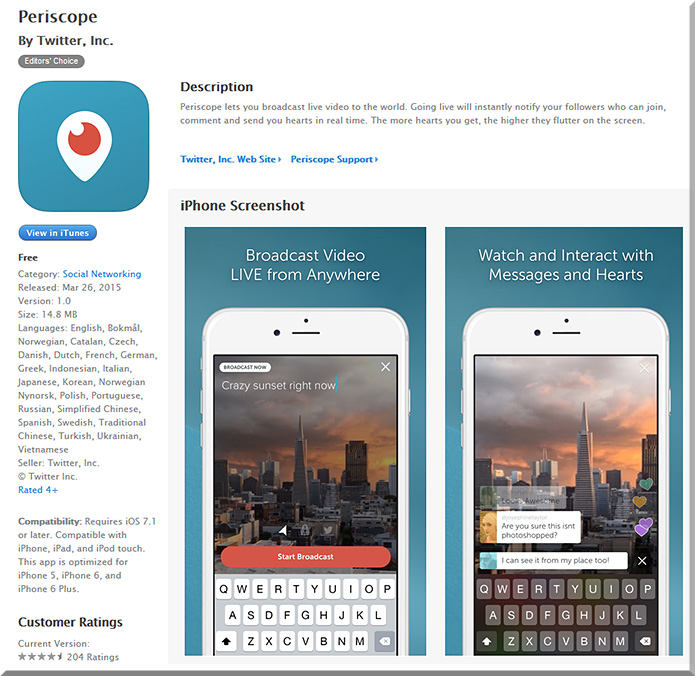
Given the introduction of Meerkat and Periscope — i.e., new apps that allow you to broadcast live to your Twitter feed — how much longer will it be before faculty members, teachers, trainers, and other subject matter experts are branding themselves and broadcasting their lectures to peoples’ mobile devices and to their Smart/Connected TVs?  (The higher quality broadcasts will likely employ a team-based approach.) Is it really that big of a stretch now?  Or is it not a stretch at all?

Other questions that come to my mind:

  • Will we see more interactive videos
  • Will analytics be used to feed educationally-related recommendation engines?
  • Will big data be used to build your personalized learning playlists?
  • Will services like Stackup.net help you earn nano-credentials while you are learning via these means?
  • What place will our Smart/Connected TV’s play within our overall learning ecosystems?
  • What devices will people prefer to learn on? Or will that not even matter?
  • Will second screen-based apps become more ubiquitous and useful, especially for online and remote learners?
  • What sorts of subscription and payment mechanisms will be behind these offerings?
  • Will the represented brands be based on institutions, individuals, or both?


periscope-march2015


Meerkat-April2015


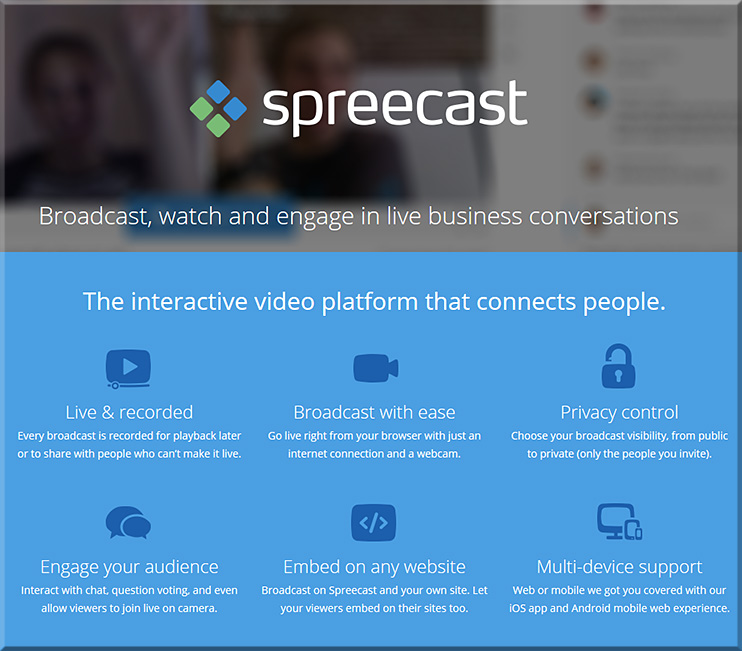
spreecast-jan2015


The Living [Class] Room -- by Daniel Christian -- July 2012 -- a second device used in conjunction with a Smart/Connected TV


From DSC:
Consider using one or more of the following tools to take your flipped classroom — and your learners’ understanding — to the next level via the creation of interactive videos.


Touchcast
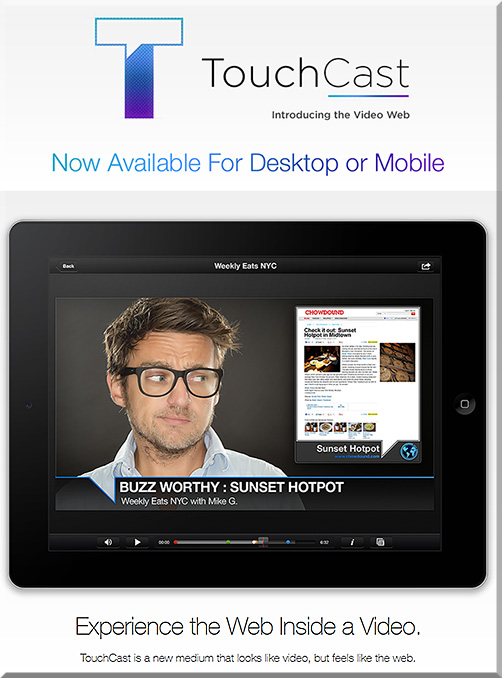
Video and the web are coming together. Experience both like never before with TouchCast- a new medium that looks like video, but feels more like the web.


Touchcast-April2015


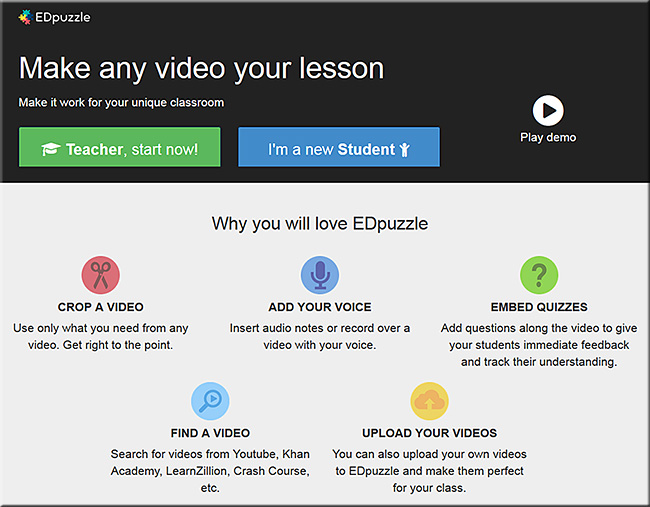
edpuzzle.com — a nice example of their product can be seen in their video entitled, The flipped classroom in 90 seconds


EDpuzzle-April2015


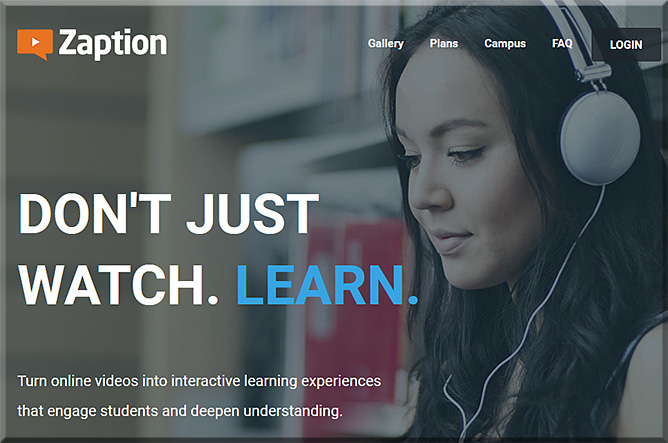
Zaption – Interact & Learn with Video Lessons
Don’t just watch. Learn! Zaption makes online video interactive and engaging for students and drives deeper learning.


Zaption-April2015


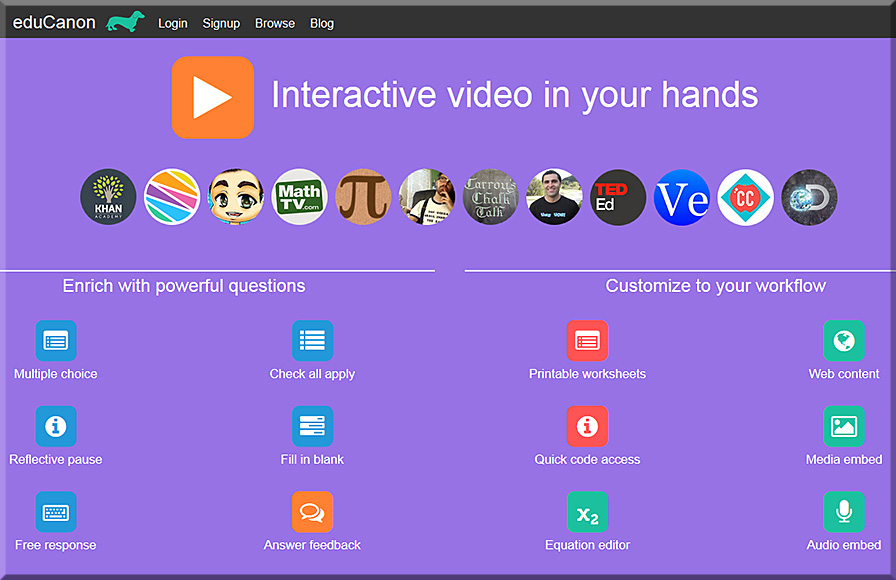
eduCanon
eduCanon is a free tool to embed rich, dynamic questions with explanations inside video. Use video to differentiate & engage. Promote self-paced learning with pause & rewind. Prevent skipping content not yet watched.


eduCanon-April2015


YouTube with new “Cards”:
Make your videos even more interactive with cards [3/16/15]

Excerpt:

As a creator, you’ve probably been using annotations to engage with your viewers for years. But one of the things you’ve told us is that you need more flexibility with the info you share through annotations, and—most importantly—you need it to work across screens and especially on mobile. That’s why today we’re introducing cards.

You can think of cards like an evolution of annotations. They can inform your viewers about other videos, merch, playlists, websites and more. They look as beautiful as your videos, are available anytime during the video and yes, they finally work on mobile.

Right now, you can choose from six types of cards: Merchandise, Fundraising, Video, Playlist, Associated Website and Fan Funding. You’ll find a new “Cards” tab in your Video Editor to create and edit them at any time.


 Addendum on 4/7/15:


Addendum on 4/23/15:

Also see:

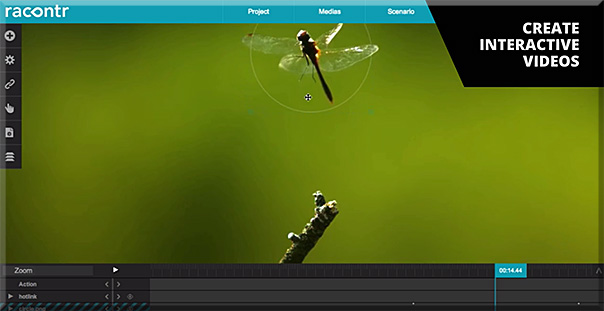
Racontor-April2015-interactivevids


Why Millennials understand the future of work better than anyone else — from fastcompany.com by Sara Horowitz
We can learn a lot about the future of work from how Millennials are approaching and redefining their careers.

From DSC:
Note the digital media literacies mentioned in the excerpt below — as well as how many times the topic of freelancing comes up:

Excerpt:

I call that traditional view, “Big Work,” and millennials intuitively understand that’s not where the future is. They are, in a sense, the first generation of freelance natives. They’re embracing freelancing in a way no other generation has. And now, they’re the majority of the workforce.

They are generation with markedly diverse interests––they’re into design, tech, activism, the arts, everything. They’ve been told their whole lives that they can and should pursue as many of those interests as they want. The Internet has opened more doors to this generation than any other.

That’s why the idea of a portfolio of work comes naturally to them. They’re doing web design for their mom’s coworkers after they’re done studying. They’re teaching themselves FinalCut and picking up video editing gigs to complement their shift at the bookstore. They’re aiming for a more meaningful work-life, not necessarily what their parents would call a “traditional career.”

That natural flexibility positions millennials to take advantage of this new economy without fear. They are the most likely age group to freelance––38% of millennials are freelancing, compared to 32% of all others, according to a national survey conducted last year by Freelancers Union and Elance-oDesk.

Millennials also expressed by far the most confidence about this new way of working, with 82% of young freelancers saying they’re optimistic about the future of freelancing.


From DSC:
We need to help students out by offering more courses on entrepreneurship, owning one’s own business, freelancing, basic accounting, basic marketing, social networking, etc.


Also see:


MIT study shows how educational videos could be better — from bostinno.streetwise.co by Clinton Nguyen

Excerpt:

Subgoal labeling turned out to be a big success for users, and that mode of thinking transferred to newer tasks beyond the initial one.

“Immediately [after the first task], we asked people to attempt another problem, and we found that the people who got the subgoal labels attempted more steps and got them right more often, and they also took less time,” said Mark Guzdial, a professor at Georgia Tech who’s who’s had a hand in similar research for the past five years.

“When we asked them to try a new problem that they’d never seen before, 50 percent of the subgoal people did it correctly, and less than 10 percent of the people who didn’t get subgoals did that correctly,” he said.


Tips for choosing and using educational videos in your classroom — from edtechreview.in by Prasanna Bharti

Excerpt:

No matter if you are an expert of technology or novice, there are a lot of ways by which you can use technology easily in teaching to make lecture more interesting and engaging, one of the best way is to use educational videos. However, you need to be thoughtful before choosing and using them.


Items on Meerkat* and Periscope*

Hashtag automatically uploads users’ Meerkat* posts to YouTube — from springwise.com
Meerkat users can now add #Katch to their Twitter posts and the service will automatically record their livestreams and post them on YouTube.

Excerpt:

One of the major successes of this month’s SXSW festival was Meerkat — a live streaming app which enables users to create and broadcast video footage in the moment. Videos are shared with the world, live, via the user’s own Twitter account, before disappearing forever into the ether of internet-past. That was until hacker Tarikh Korula launched #Katch, a simple hashtag which enables Meerkat users to auto upload their livestreams to YouTube, immortalizing them forever.


Want to save Meerkat* videos to YouTube? Katch’s hashtag wants to help — from mashable.com by Adario Strange


Twitter launches its own live video streaming app, Periscope — from talkingnewmedia.com by D.B. Hebbard
Periscope, which streams live video to your Twitter feed, launches a couple weeks after competitor Meerkat entered the App Store

* Meerkat and Periscope are tools to Tweet live video


periscope-march2015


Sharing TV Clips Socially (and Legally) with Whipclip — from adweek.com by Adam Flomenbaum

Excerpt (emphasis DSC):

Whipclip – an app that lets viewers splice and share (legally) TV clips – has launched today, and has secured partnerships with major broadcast networks, including Comedy Central, ABC, CBS, FOX, VH1, A&E and Lifetime, Bloomberg, OWN and truTV. In December, we wrote about the company raising $20 million to launch the service.

“The days of awkwardly holding your phone up to the TV to record and share your favorite moments may be coming to an end. Whipclip enables users to find and create their favorite TV and music clips and share them intimately with their closest friends or broadly across their entire social network,” said Richard Rosenblatt, co-founder, Chairman and CEO of Whipclip. “Not only benefitting the users but also providing the content owners with a viral user driven method to find new audiences.”

* From DSC:
What if we were talking about lectures on the TV…
what new affordances might there be?


Wipster and Adobe Voice — from markdubois.info by Mark DuBois

Excerpt:

I have been experimenting with the Wipster application for a few weeks. Essentially, this is a site where you post a video for others to review and approve. They can add comments in the video (as it plays). Although the service is not free, I am finding this to be very helpful for work I am doing with our student chapter of Web Professionals as well as within various courses I teach. What I find most beneficial is the use of Adobe Voice to generate short videos on a topic and then seek feedback via Wipster.


Also, though this isn’t just about video, I’m going to include it here anyway:

Sharing our inspiration from the Learning Technologies conference with links to all our liveblogs — from joitskehulsebosch.blogspot.com

Excerpt:

Sibrenne and myself arrived last Friday at Rotterdam airport with a head full of inspiration from the Learning Technologies conference and fresh air from our walk along the Thames. In this blogpost we compile some reflections and provide links to all our liveblogs, so that you may choose which ones to read. Something which struck us when we reflected on all different sessions.

If you’d like to read our liveblogs, choose one or several of the 13 liveblogs below:


Addendum on 3/29/15:


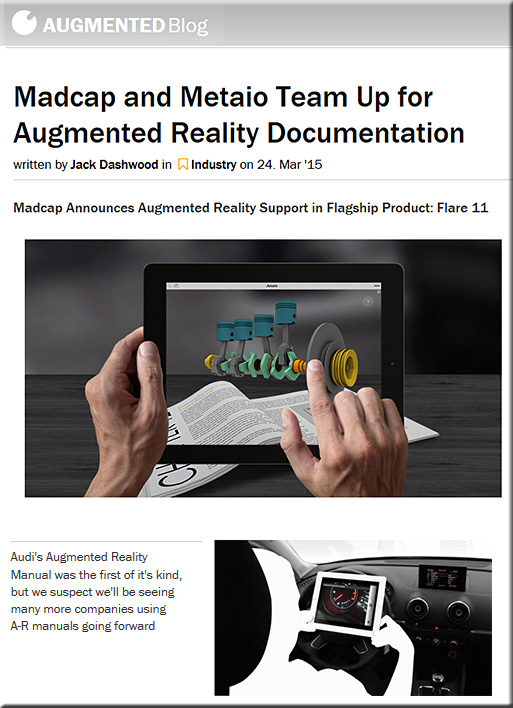
Madcap and Metaio team up for augmented reality documentation — from blog.metaio.com by Jack Dashwood

Excerpt:

Documentation is a huge industry and with humanity’s continuing pursuit of technology, it’s not slowing down. Instead, documentation methods are growing and diversifying into mediums beyond the traditional paper manual.

Madcap’s newest update, Madcap Flare 11, has taken documentation even further. By leveraging Metaio’s Augmented Reality technology, Flare is now able to export documentation with Augmented Reality content. In a world of increasingly complex and abstract concepts, Augmented Reality provides much needed simplicity, with intuitive 3D models, live video, and dynamic linking between static printed content and digital information.


MadcapMetaio-March2015


 A video of Audi’s Augmented Reality Manual, back from August 2013:


From DSC:
Also…what affordances might this present for educators, instructional designers, and the like?


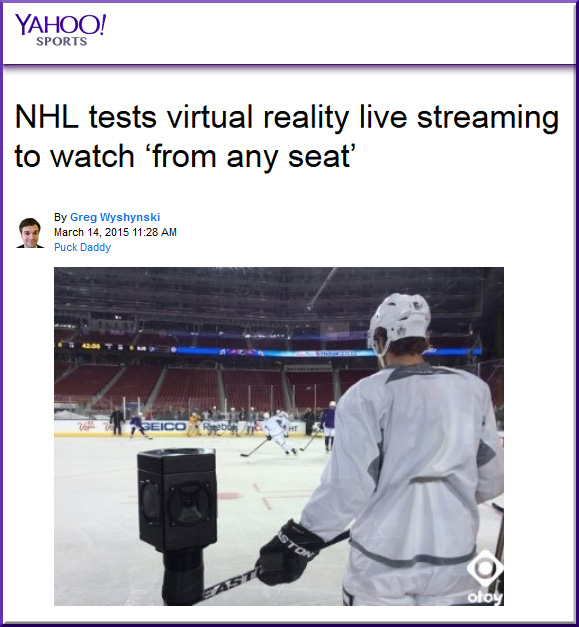
NHL-VirtualReality-WatchFromAnySeat-3-14-15

Excerpt:

AUSTIN, TX – Virtual reality is featured prominently at South By Southwest Sports this year, from using it to better train athletes with Oculus Rift to how it could transform the fan experience watching basketball, football and hockey at home.

The NHL had its first successful test of a 360-degree virtual reality experience at its Stadium Series game between the San Jose Sharks and Los Angeles Kings last month, mounting cameras around the glass that filmed HD images in the round.


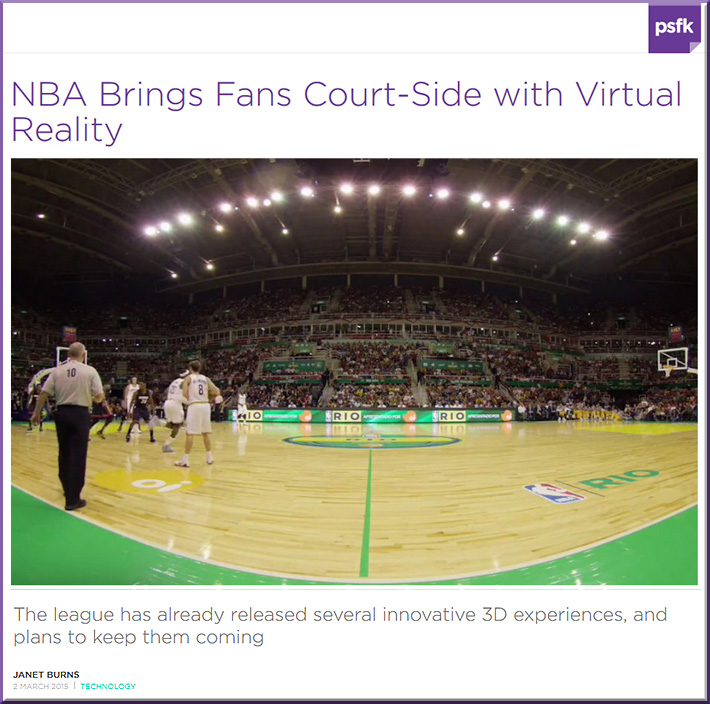
NBA-VirtualReality-WatchFromAnySeat-3-14-15

Excerpt:

When basketball lovers aren’t able to trek to stadiums near and far to follow their favorite teams, it’s possible that watching games on a bar’s widescreen TV from behind bowls of wings is the next best thing. This may no longer be true, however, as a wave of court-side, 3D virtual game experiences is becoming available to superfans with Oculus gear.

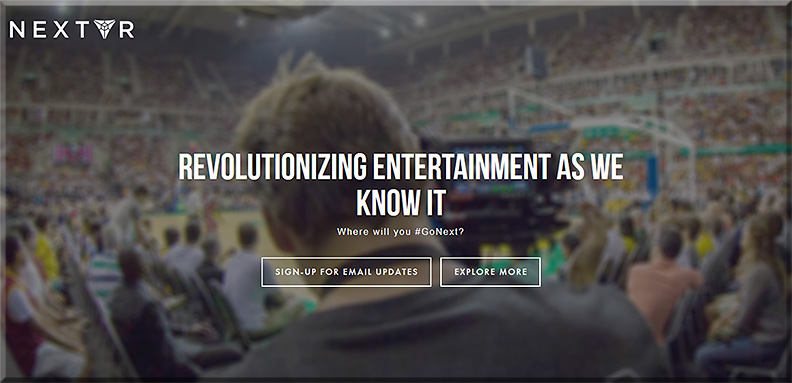
Earlier this month, NextVR showed off its new enhanced spectator experiences at the 2015 NBA All-Star Technology Summit with virtual reality (VR) footage of an October 2014 Miami Heat and Cleveland Cavaliers match-up in Rio de Janeiro. The NBA also already announced plans to record VR sessions of the NBA All-Star Game, the Foot Locker Three-Point Contest, and the Sprite Slam Dunk event and practice.


NEXTVR-March2015


OculusRift-InSportsSXSW-2015


From DSC:
In the future, will you be able to “pull up a seat” at any lecture — throughout the globe — that you want to?


Alternatively, another experiment might relate to second screening lectures — i.e., listening to the lecture on the main/large screen — in your home or office — and employing social-based learning/networking going on via a mobile device.

Consider this article:

TV-friendly social network Twitter is testing a new Social TV service on iPhones which provides users with content and interaction about only one TV show at a time.

The aim is to give users significantly better engagement with their favourite shows than they presently experience when they follow a live broadcast via a Twitter hashtag.

This radical innovation in Social TV design effectively curates just relevant content (screening out irrelevant tweets that use a show’s hashtag) and presents it in an easy-to-use interface.

If successful, the TV Timeline feature will better position Twitter as it competes with Facebook to partner with the television industry and tap advertising revenue related to TV programming.


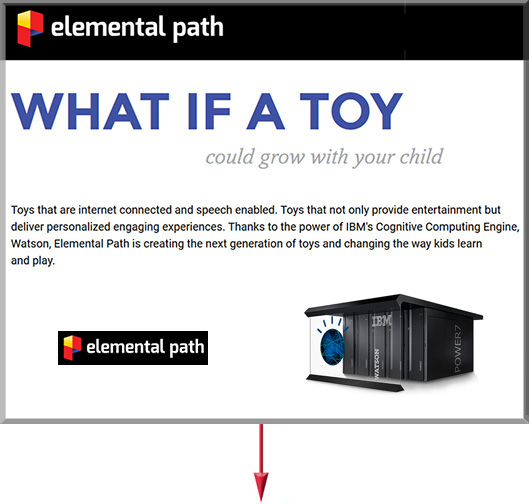
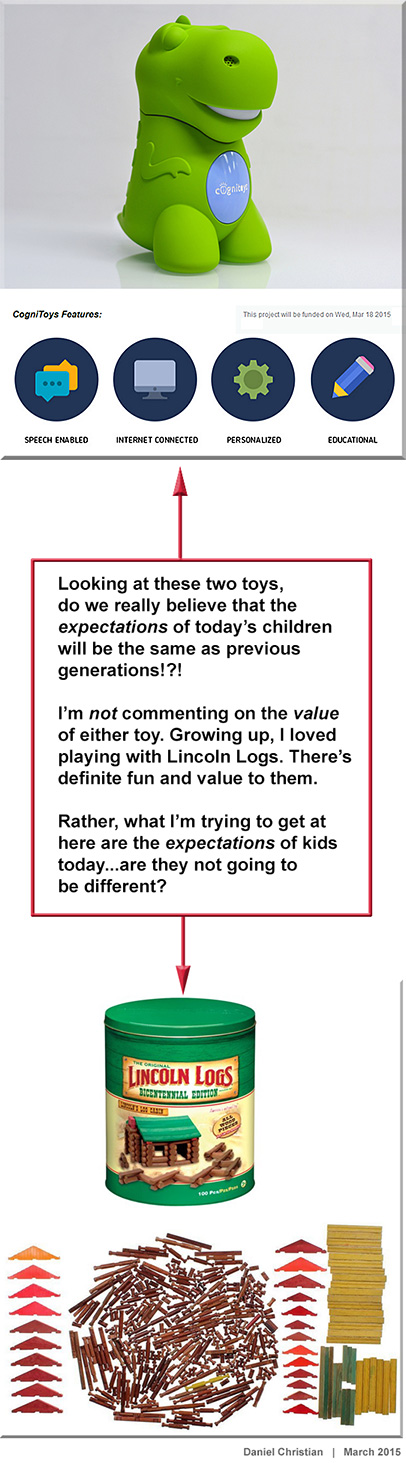
Cognitoy-ElementalPath-March2015
CognitoyFramed-March2015


From DSC:
Given the above…what are the ramifications of that in our/your work?


Also see:


A related addendum on 3/11/15
Look at the different expectations of the generations found in this article:


A related addendum on 3/17/15:

Excerpt:
The overall goal for DragonBot (which, as far as I can tell, is a common platform used for many different projects) is to develop “personalized learning companions” for children. In other words, MIT is finding ways in which robots like DragonBot can effectively help kids learn.

DragonBot isn’t intended to work like that IBM Watson-based dinosaur robot; it’s not a primary source of knowledge, and it’s not actively teaching a whole bunch of new facts to kids who use it. Rather, DragonBot is intended to help with the process of learning itself, encouraging kids to be interactively engaged in whatever they happen to be learning about.


Introducing the YouTube Kids app — from youtube.com

Published on Feb 23, 2015
Download YouTube Kids for free on your Android or iOS device.
Android: http://goo.gl/SsDTHh | iOS: http://goo.gl/P0cikI

The YouTube Kids app is designed for curious little minds to dive into a world of discovery, learning, and entertainment. This free app is easy to use and packed full of age-appropriate videos, channels and playlists. YouTube Kids features popular children’s programming, plus kid-friendly content from filmmakers, teachers, and creators all around the world. YouTube Kids is currently available in the U.S. only. For additional questions, please visit http://support.google.com/youtubekids


Video categories
At the top of the YouTube Kids home screen, you’ll see icons for video content by category:

  • Shows includes kid-friendly programming from popular YouTube creators.
  • Music includes songs to sing and dance along to, including nursery rhymes, popular music videos for kids, and clips from their favorite musicals.
  • Learning includes everything from ABCs and 123s to science lessons and language arts so children can engage, grow and learn.
  • Explore includes content that helps your child discover the world around them, develop new hobbies, and explore topics they’re interested in.


10 Great YouTube for Kids Channels — from teachercast.net by Jeff Bradbury


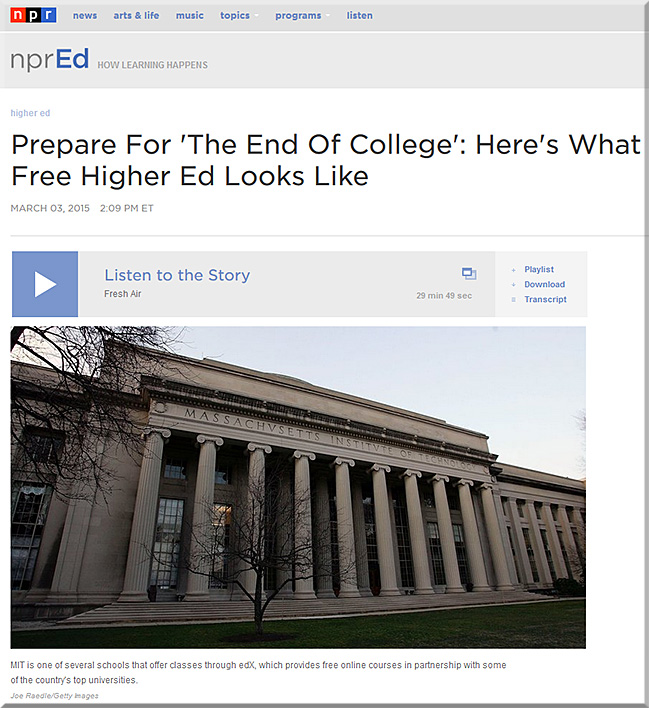
NPR-KevinCarey-FreeHigherEd-March2013


Interview: Kevin Carey, author of ‘The End Of College’ — from NPR Ed

Excerpt:

But author Kevin Carey argues that those problems might be overcome in the future with online higher education. Carey directs the Education Policy Program at the New America Foundation. In his new book, The End of College: Creating the Future of Learning and the University of Everywhere, Carey envisions a future in which “the idea of ‘admission’ to college will become an anachronism, because the University of Everywhere will be open to everyone” and “educational resources that have been scarce and expensive for centuries will be abundant and free.”

On the term “University of Everywhere”
The University of Everywhere is the university that I think my children and future generations will attend when they go to college. … They will look very different in some ways, although not in other ways, from the colleges that I went to and that many of us have become familiar with. This will be driven by advances in information technology: So whereas historically you went to college in a specific place and only studied with the other people who could afford to go [to] that place, in the future we’re going to study with people all over the world, interconnected over global learning networks and in organizations that in some cases aren’t colleges as we know them today, but rather 21st-century learning organizations that take advantage of all of the educational tools that are rapidly becoming available to offer great college experiences for much less money.


From DSC:
Though Kevin discusses various items in this interview, I wanted to focus on the topic of online learning and leveraging the Internet for lifelong learning.

Whether out of fear, self-preservation, or for some other reasons, there continues to exist within higher education a group of people who still discount the power of the Internet to offer opportunities for learning throughout one’s lifetime. They poo-poo online learning for example, looking down upon it and assert that such methods can’t measure up to the traditional face-to-face based learning experiences. Never mind that the majority of these folks — it not all of them — have never taught online nor have they taken a well-executed, formal online-based course. They don’t realize how far various technologies have come to provide powerful, effective, highly-convenient learning experiences. They just continue to poo-poo it:

Only 27.6% of chief academic officers reported that their faculty accepted online instruction in 2003. This proportion showed some improvement over time, reaching a high of 33.5% in 2007. The slow increase was short-lived, however. Today, the rate is nearly back to where it began; 28.0% of academic leaders say that their faculty accept the “value and legitimacy of online education.”

Grade Level: Tracking Online Education in the
United States by I. Elaine Allen and Jeff Seaman (2015)

Meanwhile, the world continues to change, pressing needs continue to amass, technologies continue to emerge and morph, and many outside of higher ed are starting to care less and less about what those stuck in traditional higher ed even have to say. They’re beginning to design other alternatives. See below for some examples.

With that said, there’s also a sizable group of us who are working hard to innovate and to leverage the power of the Internet — who seek to reduce the price of obtaining a degree, to make quality education more affordable and accessible to the masses, and who seek to provide a balance of the liberal arts/foundational skills with the skills that are needed out in the workplace.  Also see below for examples of this.


DSC:  I write these reflections down to urge those of us working within higher education NOT to be like the Smith Coronas of the world, NOT to be like the Blockbusters and Kodaks of the world — who, to their very dying day, clutched tightly to their beliefs/strategies/business plans, not seeing the tidal waves that were approaching them.


————–


The New Normal — from edtechdigest.wordpress.com by Victor Rivero
A dearth in practical technology skills calls for an online boot camp approach.

Excerpt:

The ecosystems of many companies are changing as baby boomers retire and workplaces are filled with a strange and not fully functioning blend of digital immigrants, with fresh new academic graduates. In many cases these graduates have invested considerable time and money in traditional offline learning and have come out overqualified yet drastically under skilled.

Many people who make the switch are ready for change and want it to happen quickly. Online training through technology boot camps for example, means they can pick up key technology skills, and as a result make a total career change; transitioning from being unemployed to becoming a busy productive freelancer in a matter of months. As a result, offline learning is losing ground while online learning is gaining traction by the second.


From DSC:
Can those of us working within higher ed offer such bootcamps?

Doing so would not only help learners of all ages but would also create new sources of (sorely-needed) revenue. Perhaps these sorts of bootcamps shouldn’t have to be vetted through the normal committees and mechanisms — as doing so will surely keep us from providing the level of responsiveness as the increasingly-fast-paced world now requires. Perhaps we leave those decisions up to the relevant, knowledgeable faculty members who can then team up with innovative staff and administrators to create and deliver these offerings.


————–


Udacity kicks off enrollment for its Swift-focused iOS developer ‘nanodegree’ — from techcrunch.com by Darrell Etherington

Excerpt:

If you’re looking for a way to gain the skills necessary to get a gig developing for iPhone and iPad, but unwilling to commit to a full-time college or university schedule, Udacity might have the answer. The online education platform debuted something called a “nanodegree” last year, and enrollment for the iOS developer edition of the same just opened to applicants today. Enrollment is open to anyone willing to spend $200 per month to participate (with a one-week free trial included) and closes at the end of March 10.


————–


IDEO Futures

C-Suite TV

Yyieldr

Lessons Go Where

Class Do

NYC Data Science Bootcamp

Hands-On Data Science & Engineering: A 5-Day Bootcamp

User Experience Design Immersive — A 10-Week, Full-Time Career Accelerator in Boston

Flatiron School

Python Programming for Beginners — set your own price

Eleven Fifty

Cybrary.it


————–


Re-imagining Learning & Credentialing in a Connected World — from etale.org by Bernard Bull

Excerpt (emphasis DSC):

What happens when we don’t think of these as three disconnected and unrelated learning pathways? What if we see this as representative of a city or region in which one travels on a lifelong learning journey? What possibilities does that create for us? Consider a model where credentials can be provided as people demonstrate competence through any of these stops along the way, whether it is the weekend workshop, the self-guided tour, the self-study stop, or a formal course. This is one of the interesting and exciting possibilities of micro-credentials and digital badges. Their affordances give us a greater ability to imagine such contexts, as evidenced by the cities of learning initiatives.


Screen Shot 2015-03-04 at 6.12.26 AM


Citiesoflearning


————–


ACE and Blackboard unveil research on alternative pathways to degree completion — from acenet.edu
Papers on Credit for Prior Learning and Competency-Based Education Practices to be Released

Excerpts:

New research released [on 2/20/15] will shed light on how two approaches to creating alternative pathways to college graduation for post-traditional students are working.

The first paper is “Credit for Prior Learning: Charting Institutional Practice for Sustainability,” which identifies and addresses some of the cultural barriers and successful strategies to institutions incorporating CPL.

The second paper is “The Currency of Higher Education: Credits and Competencies,” which explores the challenges in adapting the traditional credit hour to an information-age economy that relies on greater flexibility and productivity.


————–


Harvard Business School hopes to fundamentally change online education with its new $1,500 pre-MBA program — from businessinsider.com.au by Richard Feloni

Excerpt:

This week, Harvard Business School launched an innovative new online education program to the public that it thinks is so far ahead of free online courses that it’s worthy of a $US1,500 price tag.

The 11-week pre-MBA program called CORe accepts about 500 students and is taught in the school’s signature case-study method. The first official session started on Feb. 25, and applications are open for spring and summer sessions.

CORe is the flagship offering from HBS’s new digital platform, HBX, which aims to become a full-fledged branch of the school rather than a place to dump video recordings of classroom lectures.


————–


Constructionism 3.0 — from steve-wheeler.blogspot.com

Excerpt (emphasis DSC):

Listening to MIT’s Vijay Kumar speaking is always informative. Kumar has vast experience in research in online and digital learning environments, and he conveys his knowledge in an accessible style. He was keen to argue that the future of education has two fundamental characteristics – open and digital. His previously published book Opening Up Education explains the first in plenty of detail, but the second, digital, was uppermost in his keynote presentation at ELI 2015, the Saudi Arabian premier e-learning event. He said that it is at the intersection of digital and open that learning innovation occurs, and that education will be transformed if attention is paid to them both.


————–


Excerpts (emphasis DSC):

There are 37 million Americans like Joe who have some college but no degree. Many of them, like Joe, need to re-skill to be able to make a living. Many of them don’t have the time or money to be able to access a traditional certificate or degree program, even if it is online. In the language of disruption, they are non-consumers of traditional certificate and degree programs.

This emerging class of asynchronous online courses, both paid and free, is doing something similar by targeting primarily non-consumers—those not considering formal higher education (either again or for the first time). But these non-consumers are now improving their skills one competency at a time and certainly consuming education.

Traditional institutions of higher education are unlikely to fill this demand. Their institutions were not built to update and develop curriculum and short-term programs rapidly. Those best equipped to teach may be practitioners and real-world experts using online platforms that allow them to reach anyone instantly.

This is the sharing economy of education. Adults can choose the competencies they need, from pivot tables in Excel to training a new puppy, and learn them when they need them online, no longer tied to academic calendars or seminar dates.


————–


HEDLINE: Udemy’s Online Course Millionaires — from edukwest.com by Kirsten Winkler

Excerpt:

The top three Udemy instructors are currently:

Web Development – Rob Percival
Earnings: $2.8 million
Students: 120,000

Web Development – Victor Bastos
Earnings: $900,000
Students: 52,000

Personal Development – Alun Hill
Earnings: $650,000
Students: 47,000


————–
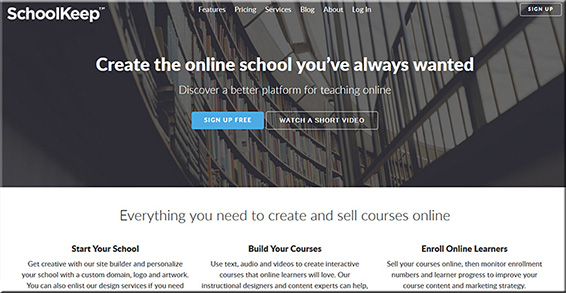
 

SchoolKeep-Oct2014


————–


LoudCloud Systems and FASTRAK: A non walled-garden approach to CBE — from mfeldstein.com by Phil Hill

Excerpt:

As competency-based education (CBE) becomes more and more important to US higher education, it would be worth exploring the learning platforms in use. While there are cases of institutions using their traditional LMS to support a CBE program, there is a new market developing specifically around learning platforms that are designed specifically for self-paced, fully-online, competency-framework based approaches.

…my interest here is not merely to review one company’s products, but rather to illustrate aspects of the growing CBE movement using the demo.


————–


As a whole new kind of college emerges, critics fret over standards — from hechingerreport.org by Matt Krupnick
Competency education offers credit for experience, but who decides? Critics worry whether competency-based education is growing too fast for standards to be set.


————–


Are prestigious private colleges worth the cost? — from The Wall Street Journal by Douglas Belkin
A high-school senior, a recruiting manager from Deloitte and a college professor weigh in

From DSC:
Even the very presence of this article in the Wall Street Journal should greatly concern those of us within higher education and this increasingly-common question should elicit a response at each of our institutions. It illustrates the pendulum swinging away from the strong public support of higher ed. Such support is weakening, as the price of higher ed has increased. And similar to the line in Jurassic Park, people will find a way.  If they can’t afford traditional higher education, alternatives are sure to appear. Several of the aforementioned items bear witness to this fact.


————–


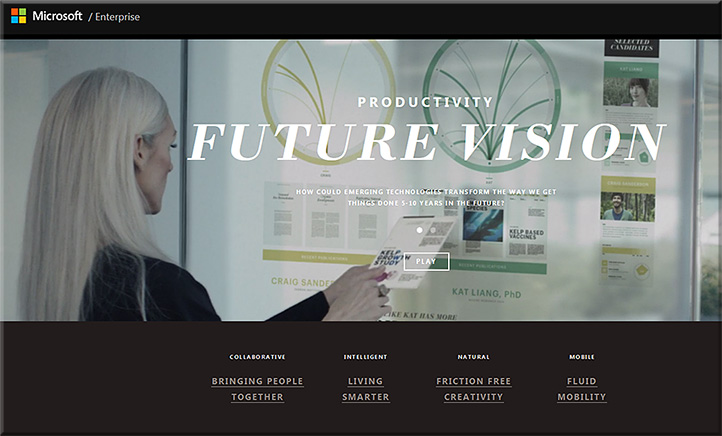
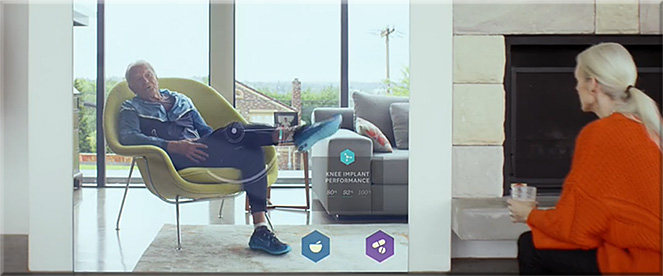
MicrosoftProductivityVision2015


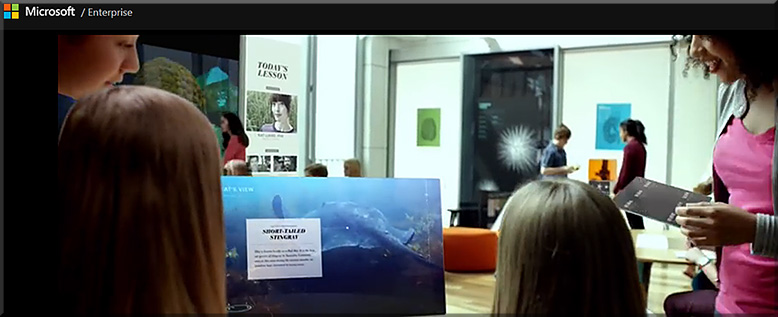
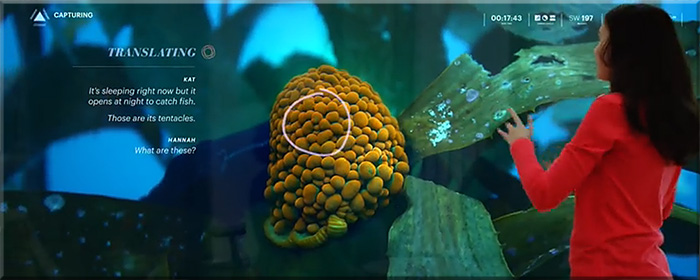
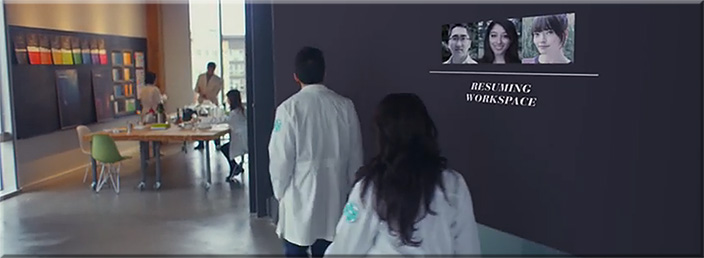
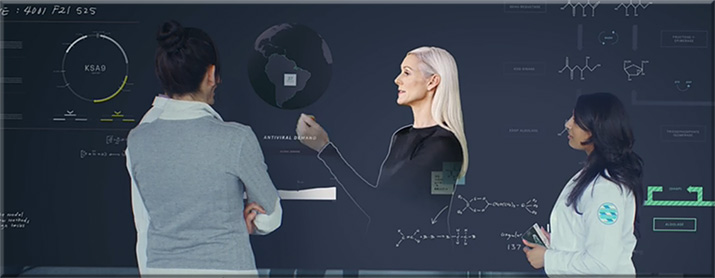
Example snapshots from
Microsoft’s Productivity Future Vision


MicrosoftProductivityVision2-2015


MicrosoftProductivityVision3-2015


MicrosoftProductivityVision5-2015


MicrosoftProductivityVision6-2015


MicrosoftProductivityVision7-2015


MicrosoftProductivityVision8-2015


MicrosoftProductivityVision4-2015


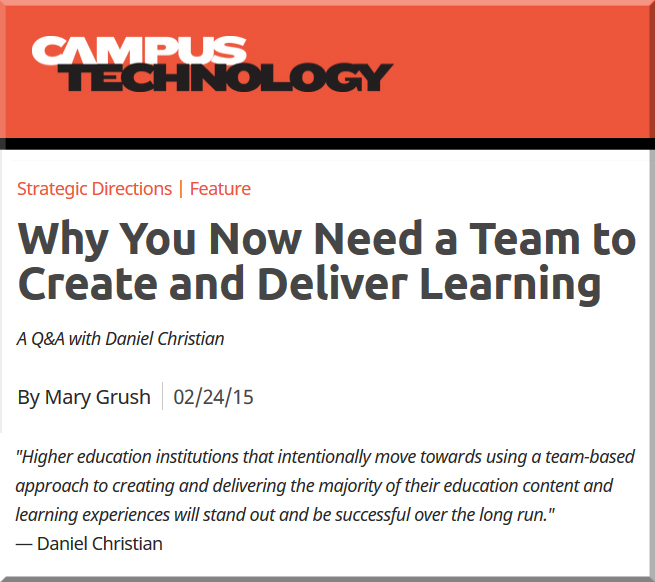
My thanks to Mary Grush at Campus Technology for her continued work in bringing relevant topics and discussions to light — so that our institutions of higher education will continue delivering on their missions well into the future. By doing so, learners will be able to continue to partake of the benefits of attending such institutions. But in order to do so, we must adapt, be responsive, and be willing to experiment. Towards that end, this Q&A with Mary relays some of my thoughts on the need to move more towards a team-based approach.

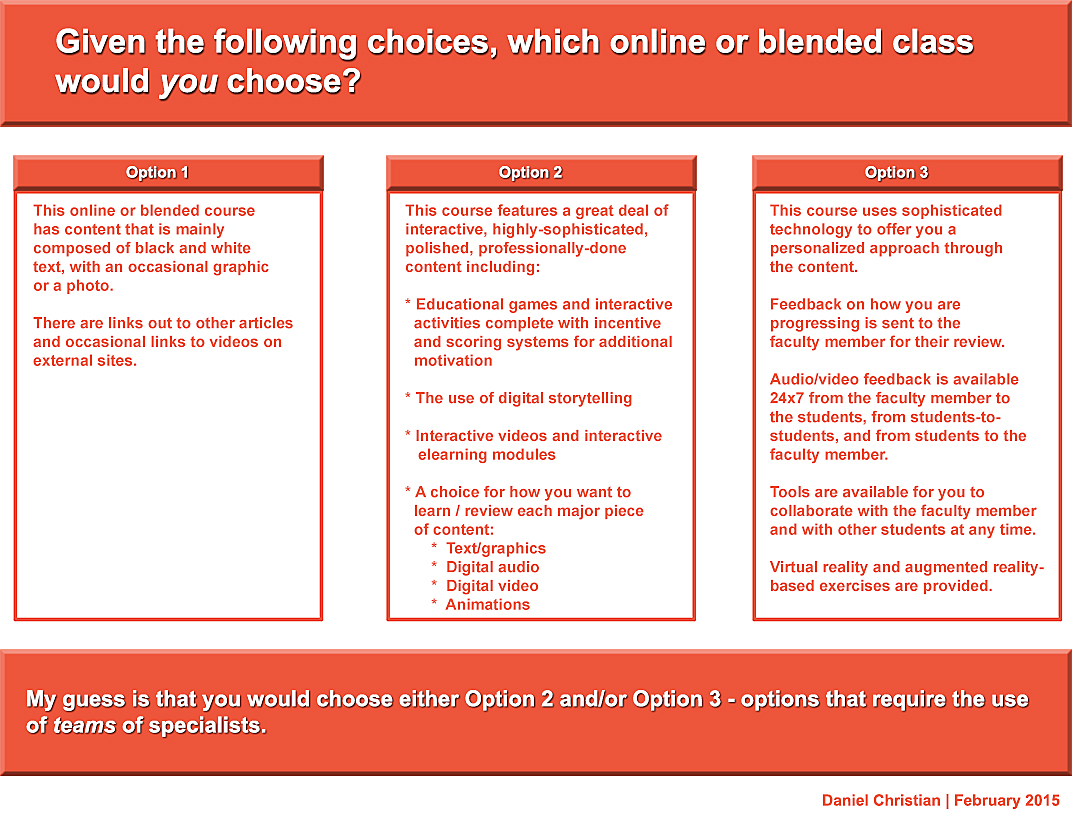
When you think about it, we need teams whether we’re talking about online learning, hybrid learning or face-to-face learning. In fact, I just came back from an excellent Next Generation Learning Space Conference and it was never so evident to me that you need a team of specialists to design the Next Generation Learning Space and to design/implement pedagogies that take advantage of the new affordances being offered by active learning environments.


DanielSChristian-CampusTechologyMagazine-2-24-15


DanielSChristian-CampusTechologyMagazine2-2-24-15


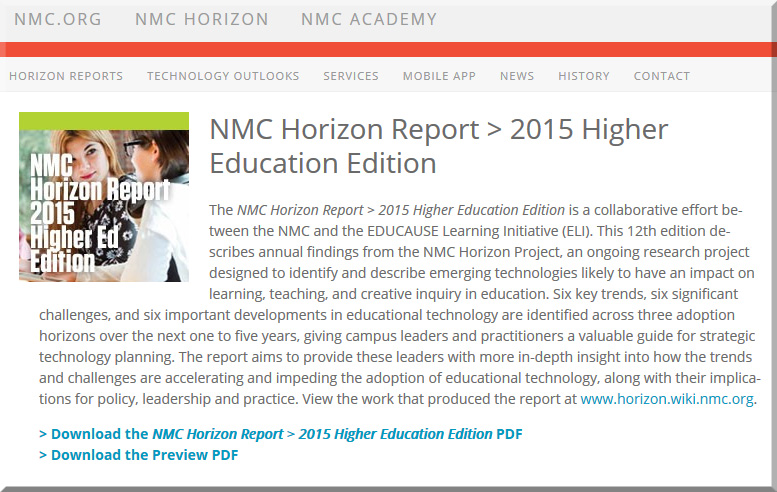
NMC Horizon Report > 2015 Higher Education Edition — from nmc.org

Excerpt:

What is on the five-year horizon for higher education institutions? Which trends and technologies will drive educational change? What are the challenges that we consider as solvable or difficult to overcome, and how can we strategize effective solutions? These questions and similar inquiries regarding technology adoption and educational change steered the collaborative research and discussions of a body of 56 experts to produce the NMC Horizon Report: 2015 Higher Education Edition, in partnership with the EDUCAUSE Learning Initiative (ELI). The NMC Horizon Report series charts the five-year horizon for the impact of emerging technologies in learning communities across the globe. With more than 13 years of research and publications, it can be regarded as the world’s longest-running exploration of emerging technology trends and uptake in education.


NMCHorizonReport-2015


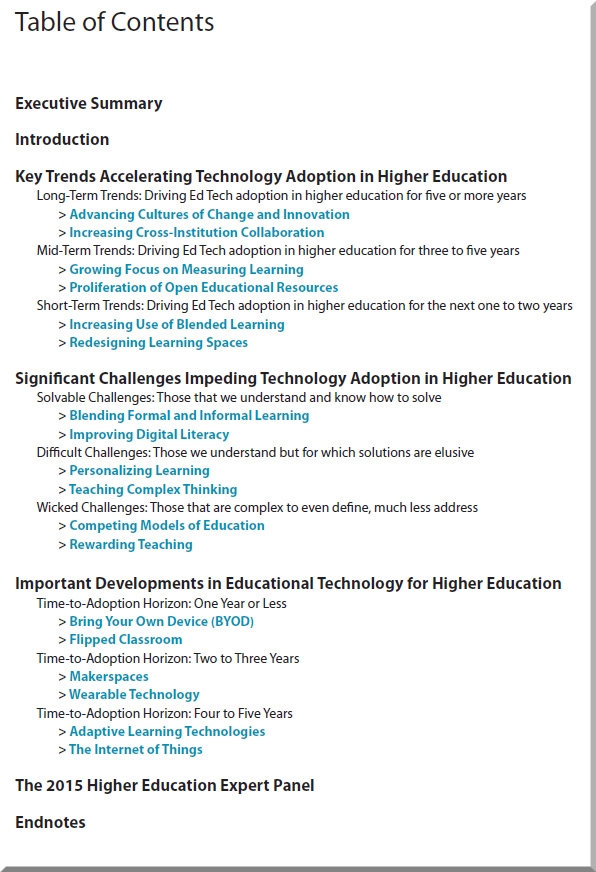
NMCHorizonReport-2015-toc


Internet access as vital as devices to boosting the learning experience — from thejournal.com by Dian Schaffhauser

Excerpt:

The project reported five key findings:

  • Access to a computing device and the Internet resulted in “greater student engagement in learning.” Eighty percent of the students said having the tablet “made learning more fun and interesting”; 72 percent reported they “were more engaged in their lessons.”
  • Sixty percent of students said they did more reading and writing during the school year because of having a tablet. In fact, teachers assigned more reading and writing homework because they knew home Internet access was available. “This resulted in increased reading and writing fluency, which is especially important for English Language Learners,” the report noted.
  • Internet access shot up. Nearly 80 percent of students reported accessing the Internet on a daily basis in fifth grade, up from 4 percent in fourth grade.
  • Students became more independent learners. Almost all said they “used their tablet regularly to look up information on the Internet when they had a question about something.”
  • With professional development, teachers changed their instructional practices. According to the report, this was evident “by the level of integration of the tablets into everyday instruction” and by “the new project based learning orientation within the classes.”

But the greatest difference overall, the researchers stated, occurred because students could access online information anytime, anywhere. That access “transformed the classroom environment by allowing both students and teachers to bring additional resources into the learning process, at just the right moment to have the greatest impact on learning.”


Five Minute Film Festival: Video Boot Camp — from edutopia.org by Bill Selak

Excerpt:

The rapid adoption of devices in the classroom has fundamentally changed the way we can create video. Every part of the creation process — writing, recording, editing, and distributing — is possible on the devices that can fit in our pocket. Vision is the most dominant of the five senses. Research shows that concepts are better remembered if they are taught visually. This is called the pictorial superiority effect, and it’s why video is such a powerful learning tool.

A video is created three times: when you write it, when you shoot it, and when you edit it. There are several formats that can be used to write a script for the classroom: a Google Doc, a dedicated app (ex: Storyboards), a Google Form, or a production organization document. Whichever format is used, emphasis should be placed on how it will be used in the classroom, and what the goal of the video is. When recording, it is important to incorporate basic rules of composition, such as the rule of thirds, into your video. Being aware of the environment (basic concepts like lighting and room tone) makes it easier to edit.

Curating content is another significant way to incorporate video into your classroom. If you don’t have the time or software to make a fancy video, odds are someone has already made it and shared it on YouTube. This Film Festival is equal parts curation and creation.


From DSC:
This is a nice collection of resources and tips to help you and your students further develop your new media literacy.


© 2025 | Daniel Christian