Augmented Reality – hype, or the future? — from mybroadband.co.za by EE Publishers
The concept of Augmented Reality has existed for many years now – and commentators have remained rigidly sceptical about whether it will truly materialise in our everyday lives.

Excerpts:

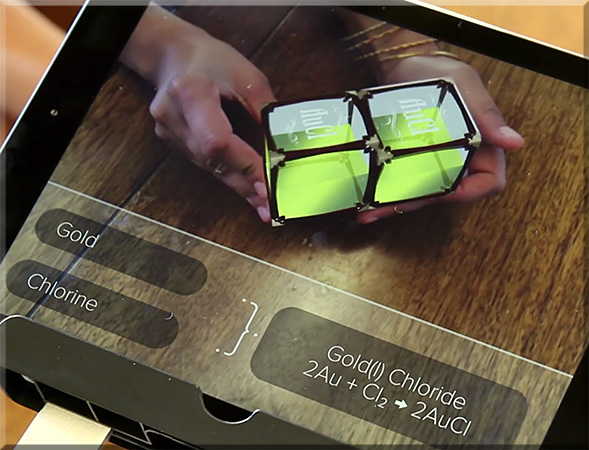
Essentially, AR describes the way in which a device (such as a smartphone camera, wearables like Google Glasses, or a videogame motion sensor) uses an application to “see” the real world around us, and overlay augmented features onto that view.

These augmented features are aimed at adding value to the user’s experience of their physical environment.

We predict there will be three primary areas in which we will initially engage with AR:

The way we consume information: Imagine going to a library or museum and being able to have a “conversation” with key people throughout history, or instantly transform the world around to you resemble a bygone era.

The fields of product development, marketing and customer engagement: Overlaying new digital services into retail environments opens up a host of new possibilities for organisations to tailor products to their consumers.

Back office/operational functions within the organisation: Companies are already finding ways to use AR in their supply chain, logistics and warehousing environments. Find out, for example, if a particular unit is missing from a shelf.


From DSC:
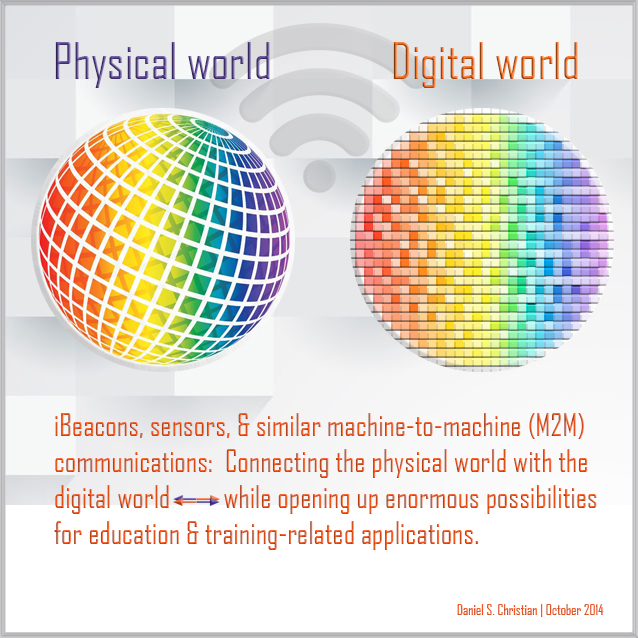
I wonder how Machine-to-Machine communications, beacons, GPS, and more will come into play here…? The end result, I think is a connection between the physical world and the digital world:


DanielChristian-Combining-Digital-Physical-Worlds-Oct2014


What should graduates look like in 10 years?

Excerpt (emphasis DSC):

Superintendent Richard Carranza of San Francisco Unified School District and the board of education considered, for instance, that graduates will need to develop and manage their local, global, and digital identities, and be comfortable separating and switching between the three. Graduates will benefit from being bilingual or multilingual; a 2025 graduate must be technologically fluent as well as college and career ready, with the added challenge that many of those careers have yet to be created.

Community participants looked at trends and data to create a 2025 “Graduate Profile.” They also, in large and small groups, engaged creatively with each other, with research and with information gathered from field trip observations to design possible future learning environments.

Then they started a pilot program to begin to bring that vision to life — starting in first grade.


Do you see what I see? Smart glasses, VR, and telepresence robots — from arstechnica.com by Megan Geuss
Heightened reality will hit industry and gaming before it changes anyone’s day-to-day.


Oculus VR unveils the version of Oculus Rift you’ll actually buy — from mashable.com by JP Mangalindan

Excerpt:

Oculus VR finally debuted the long-awaited consumer version of Oculus Rift, the virtual reality headset, at a media event in San Francisco on Thursday [6/11/15].

“For the first time we’ll finally be on the inside of the game,” Oculus CEO Brendan Iribe said onstage. “Gamers have been dreaming of this. We’ve all been dreaming of this for decades.”

Oculus Touch


Virtual reality apps market set to explode — from netguide.co.nz by

Excerpt:

Augmented Reality (AR) apps in the mobile games market will generate 420 million downloads annually by 2019, up from 30 million in 2014, according to Juniper Research’s research titled Augmented Reality: Consumer, Enterprise and Vehicles 2015-2019.

The emergence of Head Mounted Devices (HMDs) used in the home, such as Microsoft’s Hololens, will bring a surge in interest for AR games over the next five years, according to Juniper.

For the time being however, most AR downloads will occur via smartphones and tablets.


What the Surreal Vision acquisition means for Oculus — from fortune.com by  John Gaudiosi
Oculus now has the technology to blend augmented reality with virtual reality.

Excerpt:

Oculus VR last week acquired Surreal Vision, a company creating real-time 3D scene reconstruction technology that will allow users to move around the room and interact with real-world objects while immersed in VR.


Microsoft pulls back curtain on Surface hub collaboration screen — from by Shira Ovide

Excerpt:

Microsoft announced on Wednesday [6/10/15] the price tag for a piece of audio-visual equipment that it first showed off in January. Surface Hub, which will cost up to $20,000 for a model with an 84-inch screen, is like the merger of a high-end video conference system, electronic whiteboard and Xbox.

The product plunges Microsoft headlong into competition with Cisco and other traditional providers of conference room audio-visual systems.

Microsoft is pitching Surface Hub as the best audio-video conference
equipment and collaboration tool a company can buy. It costs up to $20,000.
[From DSC: There will also be a $7,000, 55-inch version].


Bluescape launches new hardware program with MultiTaction, Planar Systems, and 3M — from Bluescape
Bluescape Showcases MultiTaction’s and Planar’s Interactive Displays Running Its Visual Collaboration Software at Booth #1690 at InfoComm 2015

Excerpt:

SAN CARLOS, CA–(Jun 15, 2015) – Bluescape, a persistent cloud-based platform for real-time visual collaboration, today announced the new Bluescape Hardware Program. Companies in the program offer hardware that complements the Bluescape experience and has been extensively tested and validated to work well with Bluescape’s platform. As collaboration spans across an entire enterprise, Bluescape strives to support a range of hardware options to allow an organization’s choice in hardware to fit different workspaces. The first three companies are market-leading interactive display vendors MultiTaction, Planar, and 3M.

MultiTaction, a leading developer of interactive display systems, offers advanced tracking performance that identifies fingers, hands, objects, 2D bar codes and IR pens. The unparalleled responsiveness of MultiTaction’s systems scales to an unlimited number of concurrent users and the displays are highly customizable to fit any existing corporate space. MultiTaction’s advanced interactive hardware combined with Bluescape’s software allows teams to connect content and people in one place, enabling deeper insights, meaningful innovation, and simultaneous collaboration across global time zones.


BlueScape-2015


7 things you should know about developments in Instructional Design — from educause.edu

Excerpt:

What is it?
In recent years, instructional design has been undergoing significant changes resulting from developments in areas including pedagogy, learning science, and technology. Whereas instructional design had often been somewhat circumscribed, almost templatized, the complexity of the learning environment is turning instructional design into a more dynamic activity, responding to changing educational models and expectations. The science of learning is showing us how people learn, leading to new educational activities, such as active learning and peer learning. Flipped classrooms, makerspaces, and competency-based learning are changing how instructors work with students, how students work with course content, and how mastery is verified. Mobile computing, cloud computing, and data-rich repositories have altered ideas about where and how learning takes place. Now anyone with a mobile device can photograph a leaf, submit the image to a database for matching, and receive prompt plant identification. In this complex climate, instructional designers face unfamiliar challenges and explore new opportunities.
What are the implications for teaching and learning?
Developments in the role of the instructional designer in higher education have the potential to benefit both teachers and learners in important ways. By helping align educational activities with a growing understanding of the conditions, tools, and techniques that enable better learning, instructional designers can help higher education take full advantage of new and emerging models of education. Instructional designers bring a cross-disciplinary approach to their work, showing faculty how learning activities used in particular subject areas might be effective in others. In this way, instructional designers can cultivate a measure of consistency across courses and disciplines in how educational strategies and techniques are incorporated. Designers can also facilitate the creation of inclusive learning environments that offer choices to students with varying strengths and preferences. In these and other ways, instructional designers are becoming an important part of face-to-face as well as online and blended learning environments.


Alternatives to traditional higher education continue to develop:


Google partners with Udacity to launch Android development nanodegree — from techcrunch.com by Frederic Lardinois

Excerpt:

At its I/O developer conference in San Francisco, Google announced [on 5/28/15] that it has partnered with Udacity to launch a six-course Android development nanodegree.

The idea here is to help developers learn how to write apps for Google’s mobile operating system “the right way” up to the point where they could potentially be hired by Google itself.


Udemy alternatives for selling video courses online — from robcubbon.com

Excerpt:

Udemy is currently the leading online learning platform. Their top 10 instructors all made over $500,000 last year and the top earner makes over $8 million. I make $4000+ each month by selling courses on Udemy.


16 startups poised to disrupt the education market — from inc.com by Ilan Mochari
Colleges and universities are facing new competition for customers–students and their parents–from startups delivering similar goods (knowledge, credentials, prestige) more affordably and efficiently. Here’s a rundown of some of those startups.
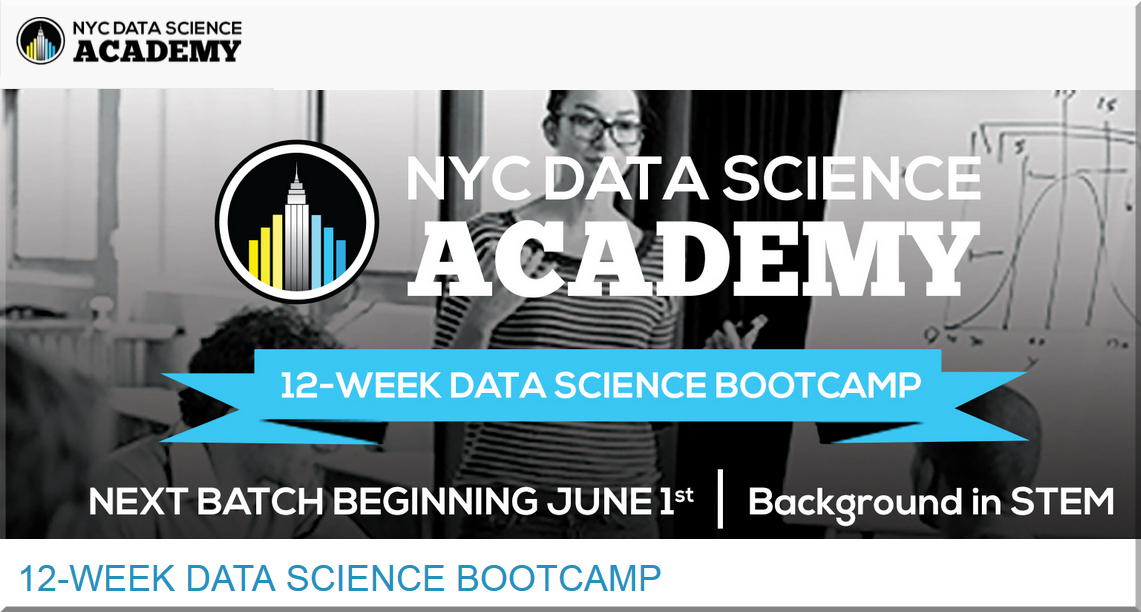


bootcamp-datascience-NY-june2015


datasciencedojo-summer2015


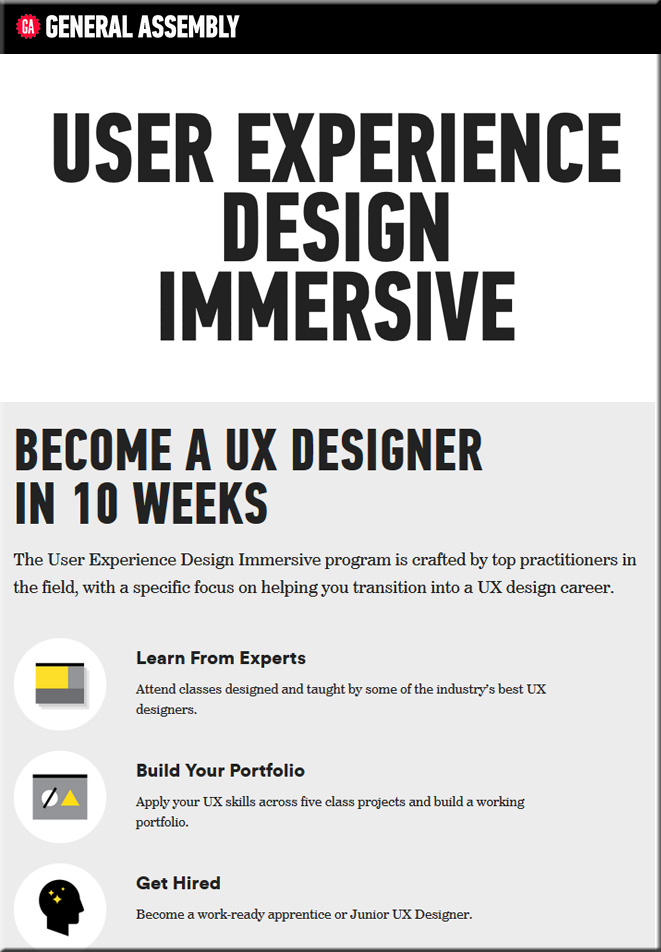
UX-10-WeekImmersiveTraining-OCt2014


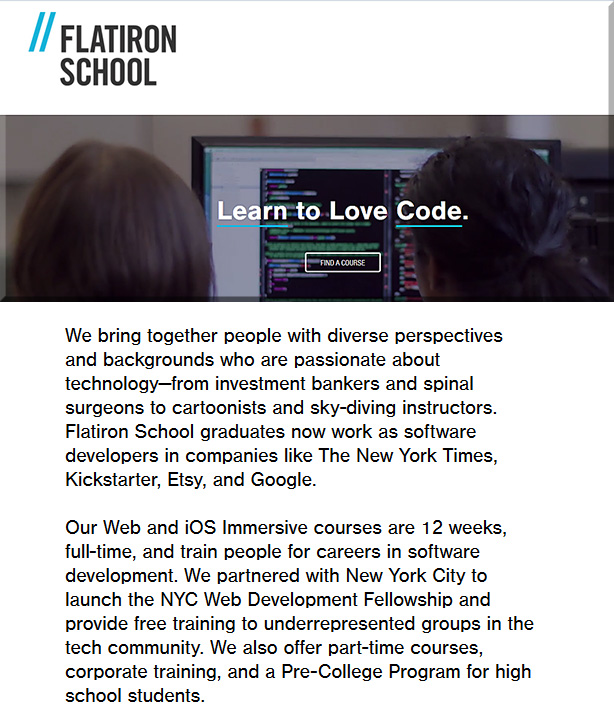
FlatironSchool


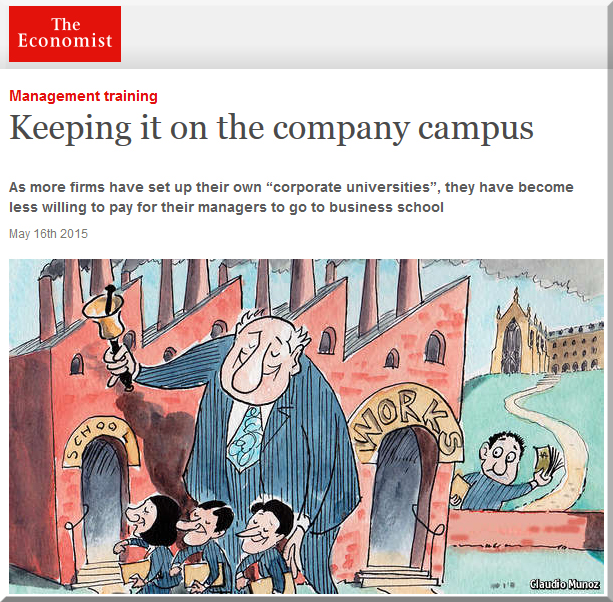
CorpUnivs-May2015


.

PayWhatYouWantBootcamp-Jan2015


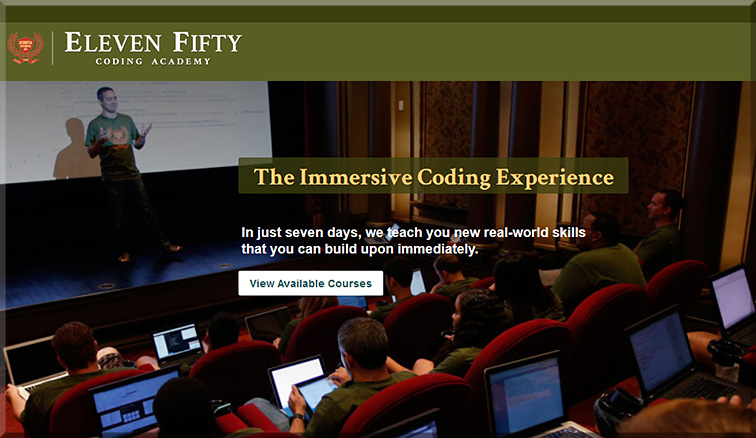
ElevenFifty-CodingAcademy-Jan2015


New MOOC Platform Provides Free IT Certification Courses — from campustechnology.com by Rhea Kelly


Cybrary-IT-Jan2015


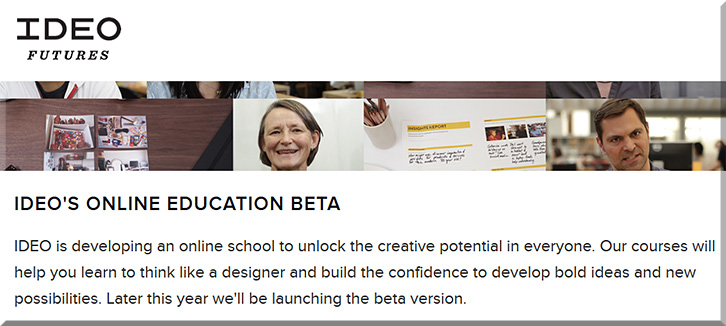
Ideo U

IDEO-Online-EducationBeta-Oct2014


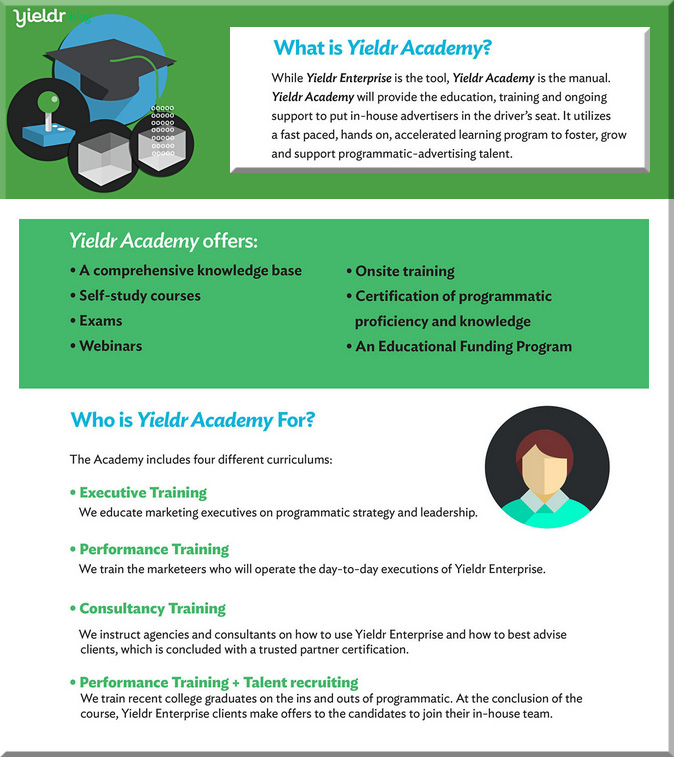
Yieldr Academy

YieldrAcademy-Sept2014


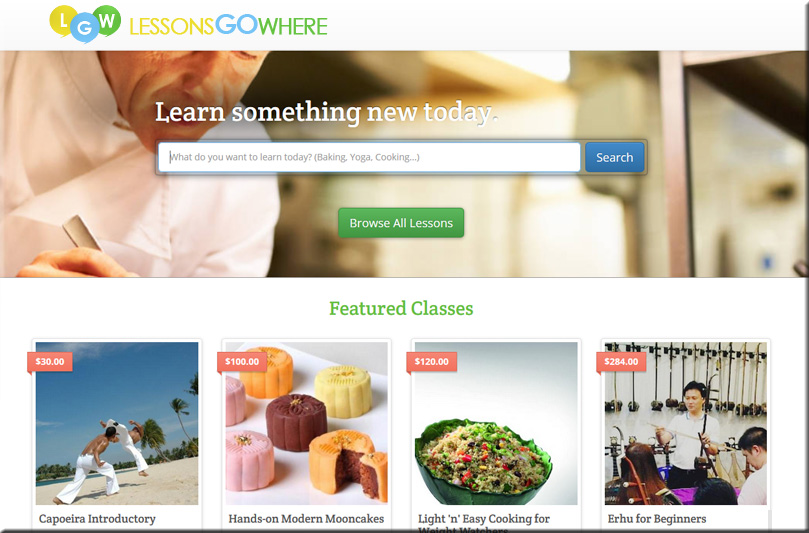
Lessons Go Where

LessonsGoWhere


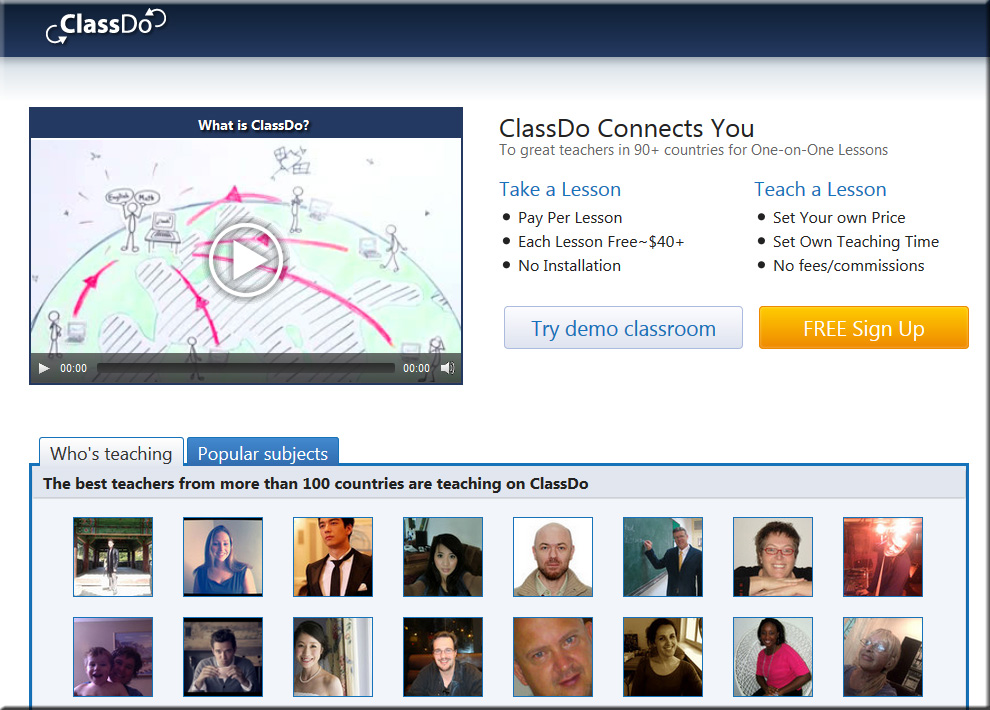
ClassDo

ClassDo


Udemy

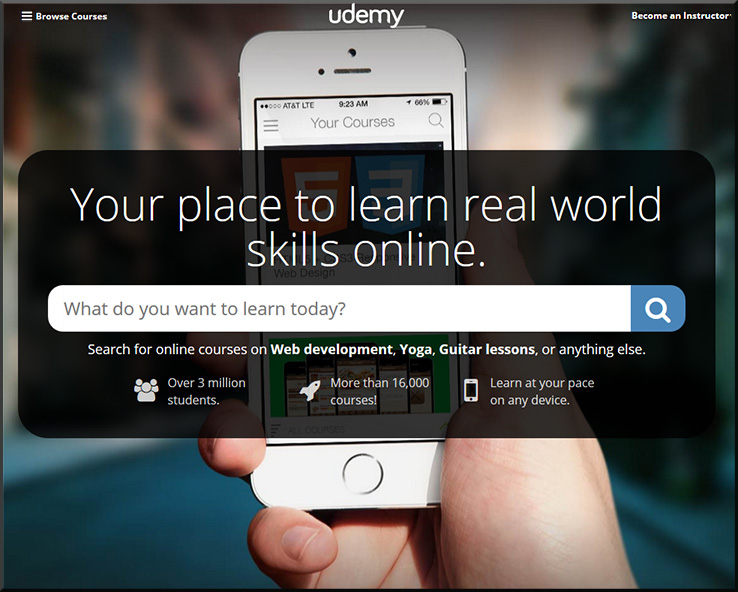
udemy


C-Suite TV.com

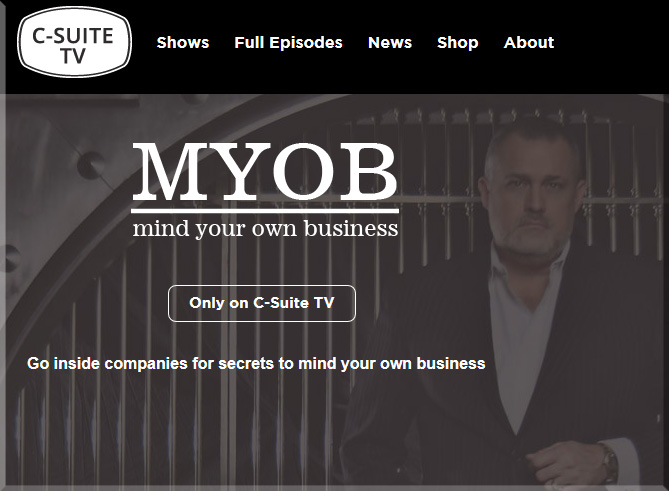
MYOB-July2014


Simon & Schuster to sell online courses taught by popular authors — from nytimes.com by Alexandra Alter; with thanks to Sidneyeve Matrix for her Tweet on this

Excerpt:

Simon & Schuster is making a push into paid online video, with a new website offering online courses from popular health, finance and self-help authors.

The cost of the first batch of online courses ranges from $25 to $85, and includes workbooks and access to live question-and-answer sessions with three authors: Dr. David B. Agus, the best-selling author of “The End of Illness”; Zhena Muzyka, who wrote the self-help book “Life by the Cup”; and Tosha Silver, the author of the spiritual advice book “Outrageous Openness.” The courses will be available on the authors’ individual websites and on the company’s new site, SimonSays.

.

 

Simon-Schuster-OnlineCourses-Jan2015

But there is a new wave of online competency-based learning providers that has absolutely nothing to do with offering free, massive, or open courses. In fact, they’re not even building courses per se, but creating a whole new architecture of learning that has serious implications for businesses and organizations around the world.

It’s called online competency-based education, and it’s going to revolutionize the workforce.

The key distinction is the modularization of learning.

Here’s why business leaders should care: the resulting stackable credential reveals identifiable skillsets and dispositions that mean something to an employer. As opposed to the black box of the diploma, competencies lead to a more transparent system that highlights student-learning outcomes.


CanvasDotNet-April2015


worldacademy.tv

WorldAcademyDotTV-May2015


Addendum on 6/3/15:

Disrupting Higher Education — from Campus Technology
Can colleges and universities break out of traditional models and compete with the disruptive forces changing the nature of higher ed?

Excerpts:

Also, traditional colleges and universities have turned away from the growing population of “nonconsumers” who need workforce skills. Only one in five freshmen actually have that residential college experience that we tend to glorify, she said. Close to 71 percent of students are what we now call non-traditional students, but which are fast becoming the norm.

These kinds of students are “overserved” by those bundled services of traditional brick-and-mortar institutions, she said. Many feel underprepared for the workforce, and they’re looking for something different.

“Higher education institutions are now competing with organizations they have never even heard of,” Weise said. “These are organizations that are really getting at the inadequacies of the system…. things like coding boot camps, where you can pay $10,000 to $20,000, spend six to 12 weeks learning to code, and get recruited by places like Google or Facebook and start earning about six figures…. Your shot at getting a job is better than if you went to law school.

“This is just to emphasize that it’s not who you think you’re competing with,” she said.

Per Michelle Weise  p. 8 pf 45

IBM-Affiliated Brooklyn School Graduates Its First Students Ahead of Schedule With Both High School & College STEM Degrees — from finance.yahoo.com and the PR Newswire
Young trailblazers pave way for national education model for tens of thousands of students

Excerpt:

BROOKLYN, N.Y., June 2, 2015 /PRNewswire/ — Six students from Brooklyn are graduating from P-TECH (Pathways in Technology Early College High School) two years early with both their high school diplomas and college degrees in computer systems technology, fast tracking through the nation’s first school that blends public high school, community college, and work experience into one.

Addendums on 7/1/15:

  • Boot camp classes may offer a peek at the future of higher ed — from cnbc.com by Bob Sullivan
    Excerpt (emphasis DSC): 
    Udacity has abandoned the idea of giving classes away to huge numbers of people in favor of “nanodegrees”—boot-camp style, short-term programs with a laser-like focus on preparing students for a career. Nanodegree subjects include Web developer, Android developer, iOS developer … you get the picture.

What you don’t get is a huge student loan debt. Udacity classes start at $1,200 for a six-month program. The fees have actually helped with online classes’ biggest problem: High dropout rates. Turns out, more people stick with classes if they have to pay for them.


  • Are small, private online courses the future of higher education in America? — from theweek.com by James Poulos
    Excerpt:
    Rather than trying to get universities to shape up, we should recognize that the SPOC (Small and Private Online Courses) model will flourish best outside the confines of today’s campus environment. In small, private forums, pioneers who want to pursue wisdom can find a radically alternate education — strikingly contemporary, yet deeply rooted in the ancient practice of conversational exegesis.


Addendum on 7/24/15:

HowZone Collaborative Learning Communities
Connecting you with people from around the world who are passionate about the same topics as you.

What We Do:
HowZone connects people around topics of shared interest and gives them tools to help each other learn. Beginners get the foundational knowledge they need and experts get special ways to take their expertise as far as they want to go.

Addendums on 7/24/15 — with thanks to Thomas Frey for his posting mentioning these resources

.
 

geekdom-july2015


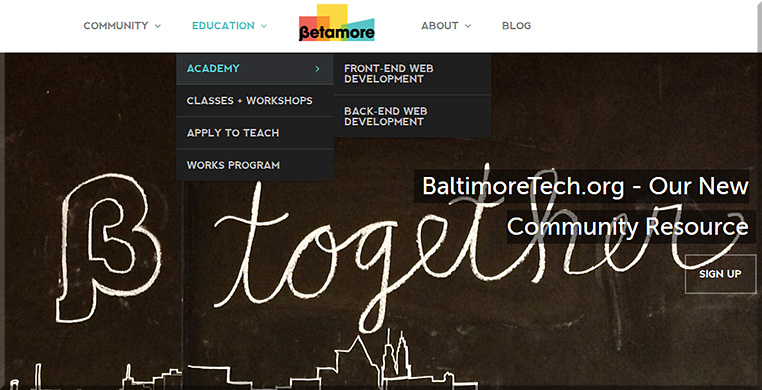
betamore-july2015


Addendum 8/7/15:


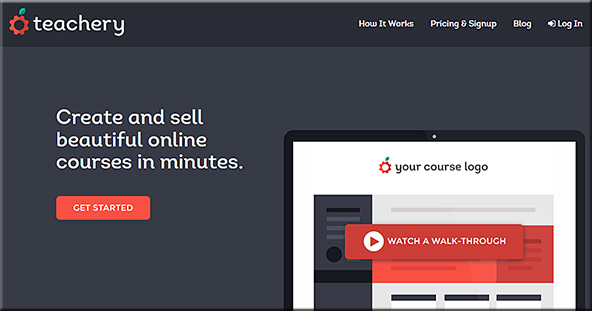
teachery-2015


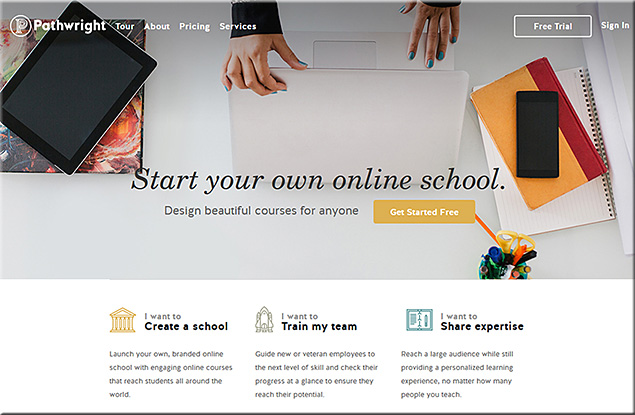
Pathwright-2015


Addendums on 8/26/15:


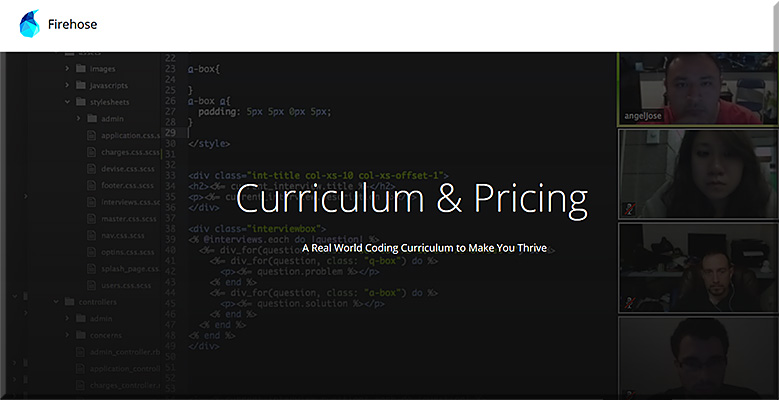
TheFireHoseProject-bootcamp-2015


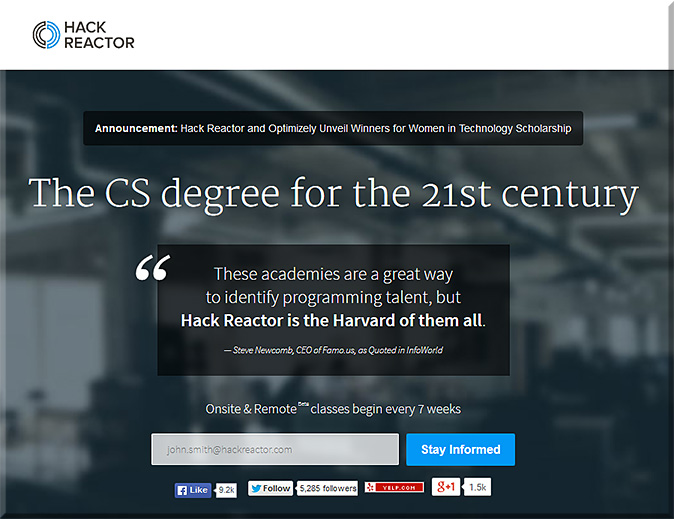
HackReactor-2015


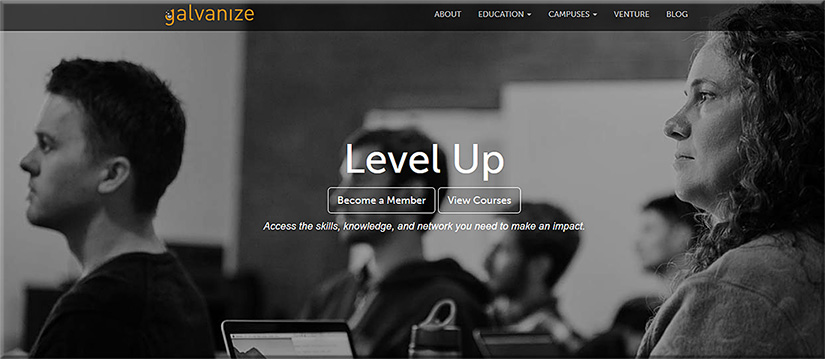
galvanize-2015


Addendum on 10/15/15:



From DSC:
In watching the video below, note how this presenter is able to initiate cameras/feeds/effects with a touch of a button (so to speak). What if recording studios could be setup for professors, teachers, and trainers to use like this?  It could be sharp — especially given the movement towards flipping the classroom and implementing active learning based environments.


LinkedIn’s Blockbuster deal w/ Lynda.com: What it means to the online learning industry — from forbes.com by Stephen Meyer

Excerpt:

The press coverage of LinkedIn’s recent acquisition of Lynda.com for $1.5 billion has largely overlooked a key aspect of the deal. Yes, it integrates learning into a powerful social media site. Yes, per LinkedIn CEO Jeff Weiner, it’ll “connect our members to opportunity,” giving them access to skills training that will enhance their careers.

But what does it mean to corporate e-learning? Lynda.com, based in Carpinteria, CA, used to be strictly a consumer company, but its strategy for the past couple years has clearly been to muscle into workplace training. What does the acquisition mean to market leader Skillsoft and other providers of online corporate learning? (Disclosure: I am the CEO of Rapid Learning Institute, an e-learning company)

Well, it’s an atomic bomb.

What’s different is that Lynda.com’s “content producers” know they’re creating a video, a medium that operates under a different set of rules from traditional learning vehicles. Content producers know that an instructionally sound e-learning module fails if people don’t watch it.

The most important thing Lynda.com does is find credentialed subject matter experts who speak comfortably in front of a camera. That’s a one-in-20 quality. Ivy League professors who excel in a classroom often look wooden on camera. You don’t have to be pretty. In fact, actors usually bomb in e-learning. You need to be credible and hold people’s attention by combining tight scripts and captivating delivery. Lynda.com’s e-learning, especially their soft-skills content, does it better than Skillsoft and other major players in the industry.

The message for corporate e-learning insiders is clear: The quality of content matters.


Ed Tech World on Notice: Miami U disability discrimination lawsuit could have major effect — from mfeldstein.com by Phil Hill

Excerpt:

This week the US Department of Justice, citing Title II of ADA, decided to intervene in a private lawsuit filed against Miami University of Ohio regarding disability discrimination based on ed tech usage. Call this a major escalation and just ask the for-profit industry how big an effect DOJ intervention can be. From the complaint:

Miami University uses technologies in its curricular and co-curricular programs, services, and activities that are inaccessible to qualified individuals with disabilities, including current and former students who have vision, hearing, or learning disabilities. Miami University has failed to make these technologies accessible to such individuals and has otherwise failed to ensure that individuals with disabilities can interact with Miami University’s websites and access course assignments, textbooks, and other curricular and co-curricular materials on an equal basis with non-disabled students. These failures have deprived current and former students and others with disabilities a full and equal opportunity to participate in and benefit from all of Miami University’s educational opportunities.


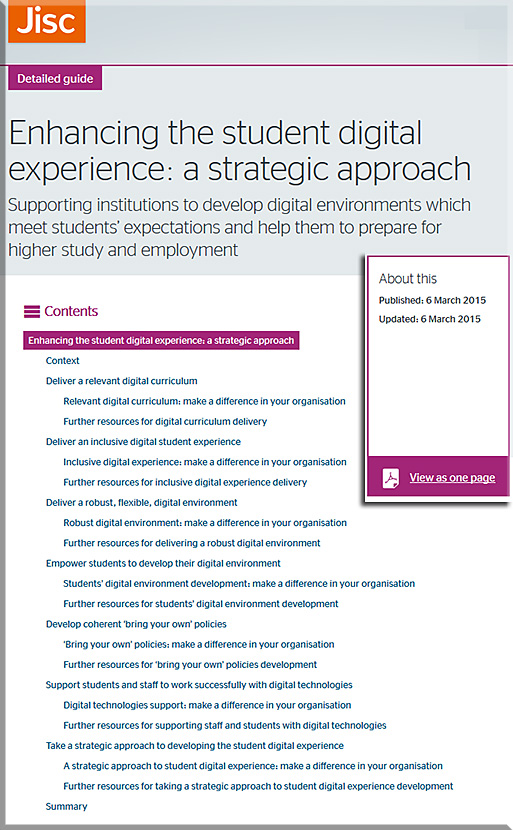
50 exemplars of effective practice in support of students’ digital experiences — from jisc.ac.uk

These 50 exemplars explore how colleges and universities are responding to the challenges of supporting the digital student experience. They show the importance of involving students not only in improving infrastructure and provision but in designing relevant curriculum activities.

Sections include:

  • Prepare and support students to study successfully with digital technologies
  • Deliver a relevant digital curriculum
  • Ensure an inclusive student experience, using technology to overcome disadvantage
  • Provide a robust, flexible digital environment
  • Develop coherent policies for ‘Bring Your Own’
  • Engage students in dialogue about their digital experience and empower them to make changes
  • Take a strategic, whole-institution approach to the digital student experience


Also see:


JISC-EnhancingStudentExp-Apr2015


From DSC:
What applications and implications might this type of setup mean for libraries? For classrooms?


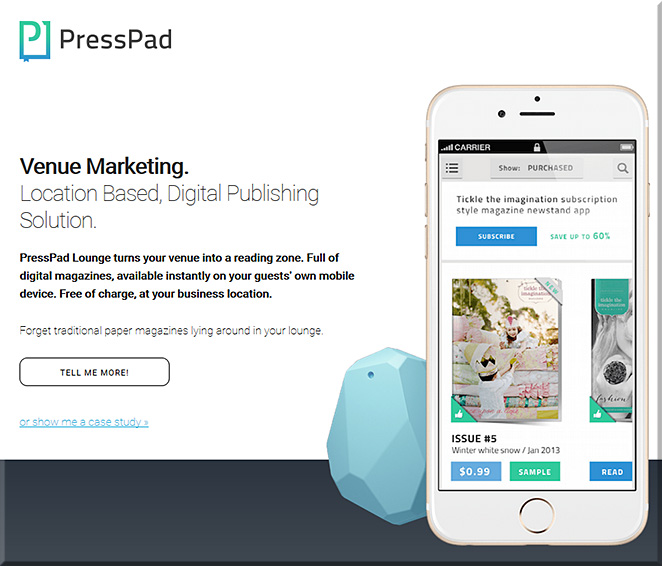
PressPad Lounge: new digital press corner that utilizes iBeacon technology — from talkingnewmedia.com by D.B. Hebbard

Excerpt:

The idea behind PressPad Lounge is that the service allows a business to turn a space into a reading zone, allowing those with mobile devices to access digital publications for free.


PPLounge-1


Also see:
PressPad-April2015

Excerpt:

With PressPad Lounge, people visiting your venue are able to install the magazine app of their choice, and read every issue for free while remaining PHYSICALLY within your venue.

Whether it’s a hotel lobby, a shopping mall, restaurant or a booth, PressPad Lounge enables a slick marriage of digital publishing with location marketing. People located within the range of the reading zone will be able to read magazines on their mobile devices, for free.


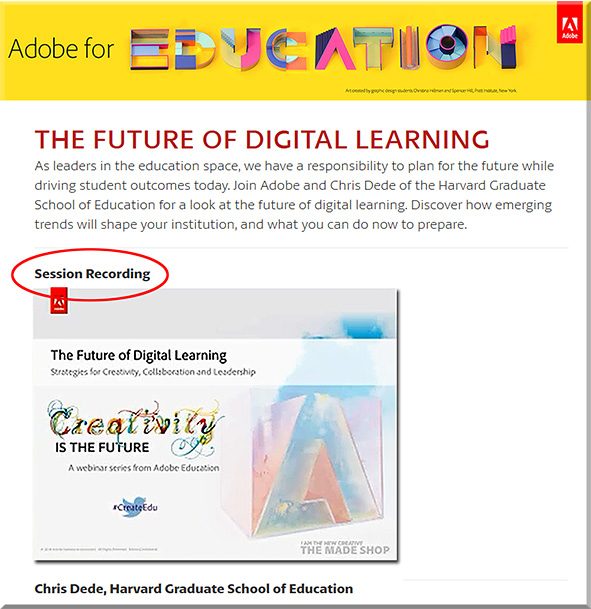
FutureDigitalLearningDede-Adobe-April2015


From DSC:
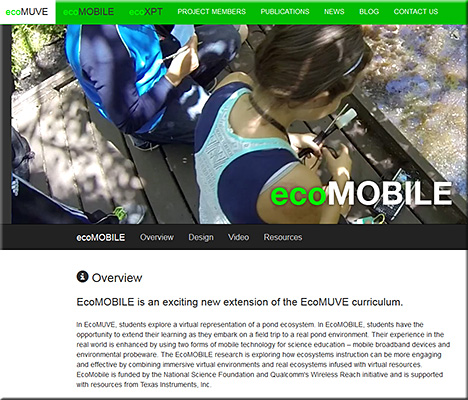
Chris uses ecoMOBILE and ecoMUVE to highlight the powerful partnerships that can exist between tools and teachers — to the benefits of the students, who can enjoy personalized learning that they can interact with.  Pedagogical approaches such as active learning are discussed and methods of implementing active learning are touched upon.

Chris pointed out the National Research Council’s book from 2012 entitled, “Education for Life and Work: Developing Transferable Knowledge & Skills in the 21st Century” as he spoke about the need for all of us to be engaged in lifelong learning (Chris uses the term “life-wide” learning).

Also, as Chris mentioned, we often teach as we were taught…so we need communities that are able to UNlearn as well as to learn.


ecomobile-april2015


Also see:


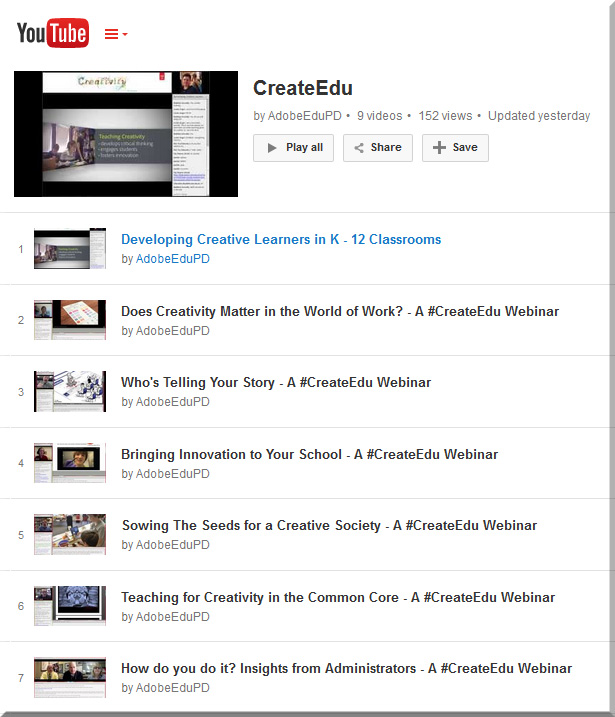
AdobeCreate-YouTubeChannel


FinallyAdoptHTML5


7 powerful reminders to finally adopt HTML5 in corporate eLearning  — from elearningindustry.com by Alfredo Leone

Excerpt:

Mobility, ubiquity and portability are key requirements for any type of learning as the market fully embraces to the demand of learners to access knowledge when and where is needed. Learners today expect access to relevant and useful information on various types of mobile devices connected via networks of ever cheaper and faster bandwidth.

This trend toward multi-device and multi-access learning is solidifying day after day, making responsive content design one of the most critical components of any production process for online training material. The premise today is for learning to “follow” the person and not the other way around.

In this dynamic online learning scenario, HTML5 is finally going mainstream as the leading technology to structure and present learning content online. Here are some powerful reasons to adopt HTML5 today even when legacy constrains seem to favor a “wait and see” approach:


———–


Also see:

2015 Business eLearning Trends Infographic — from elearninginfographics.com


Addendum on 4/28/15:

How soon is now for the mobile web? — from visionmobile.com by Matt Asay

Excerpt:

That’s one primary takeaway from VisionMobile’s “How Can HTML5 Compete With Native?” report. As report author Dimitris Michalakos concludes, “The question is no longer *whether* HTML5 can produce quality apps, but *how* easy it is to create quality web apps.” Given that “HTML5 is like driving a car without a dashboard,” the key is to deliver better dashboards, or tools, to make it easier to build great web apps.


From DSC:
The articles below illustrate the continued convergence of multiple technologies and means of communication. For example, what we consider “TV” is changing rapidly. As this space changes, I’m looking for new opportunities and affordances that would open up exciting new approaches and avenues for educationally-related learning experiences.


Hootsuite and Tagboard team up to power social TV workflow — from adweek.com by Kimberlee Morrison

Excerpt (emphasis DSC):

More and more TV viewers are engaging with second screen devices while they watch broadcasts. A new partnership between Hootsuite and Tagboard hopes to bridge the gap between television and second screen social experiences.

Tagboard is a social media aggregation and curation platform that allows users to manage incoming social media posts for display, either on television broadcasts, or on screens at live events, and Hootsuite is a social media campaign management program. Their partnership enables integration for mutual users for real-time engagement.


Capture social content on display and TV with Hootsuite and Tagboard — from blog.hootsuite.com

Excerpt:

Adding social content to live TV broadcasts and sports games is a proven way to capture and keep your audience’s attention.

But the process isn’t that easy. For one, digital teams need to ensure that they review each piece of content (to keep it safe for the big screen), and this can create complicated and slow social media workflows.

To help streamline this process, Hootsuite has integrated with Tagboard, an innovative social media display tool, to provide an easy way to capture social content and incorporate it into on-air broadcasts, live event screens, or on digital platforms.

With the Tagboard app for Hootsuite, your team can put relevant and timely social content on air within seconds—when it matters most to the viewer.

KUSA Weather Touchscreen 2 women anchors.png


Introducing the Tagboard App for Hootsuite — from blog.tagboard.com
Social TV is easier than ever with Tagboard’s new app for Hootsuite


The Living [Class] Room -- by Daniel Christian -- July 2012 -- a second device used in conjunction with a Smart/Connected TV


New from Educause:
Higher Ed IT Buyers Guide


HEITBuyersGuideEducauseApril2015


Excerpt:

Quickly search 50+ product and service categories, access thousands of IT solutions specific to the higher ed community, and send multiple RFPs—all in one place. This new Buyers Guide provides a central, go-to online resource for supporting your key purchasing decisions as they relate to your campus’s strategic IT initiatives.

Find the Right Vendors for Higher Education’s Top Strategic Technologies

Three of the Top 10 Strategic Technologies identified by the higher education community this year are mobile computing, business intelligence, and business performance analytics.* The new Buyers Guide connects you to many of the IT vendors your campus can partner with in the following categories related to these leading technologies, as well as many more.

View all 50+ product and service categories.


TeachingInADigitalAge-TonyBates-April2015

Teaching in a Digital Age
A.W. (Tony) Bates
Guidelines for designing teaching and learning for a digital age

The book examines the underlying principles that guide effective teaching in an age when everyone, and in particular the students we are teaching, are using technology.  A framework for making decisions about your teaching is provided, while understanding that every subject is different, and every instructor has something unique and special to bring to their teaching. The book enables teachers and instructors to help students develop the knowledge and skills they will need in a digital age: not so much the IT skills, but the thinking and attitudes to learning that will bring them success.


As Tony mentions here, his intended audience is primarily:

  • college and university instructors anxious to improve their teaching or facing major challenges in the classroom,
  • school teachers, particularly in secondary or high schools anxious to ensure their students are ready for either post-secondary education or a rapidly changing and highly uncertain job market.


An example chapter:
Chapter 7: Pedagogical differences between media


© 2025 | Daniel Christian