From DSC:
Ever notice how effective Ted Talks begin? They seek to instantly grab your attention with a zinger question, a somewhat shocking statement, an interesting story, a joke, an important problem or an issue, a personal anecdote or experience, a powerful image/photo/graphic, a brief demonstration, and the like.

Grabbing someone’s attention is a key first step in getting a piece of information into someone’s short-term memory — what I call getting through “the gate.” If we can’t get through the gate into someone’s short-term memory, we have zero (0) chance of having them actually process that information and to think about and engage with that piece of content. If we can’t make it into someone’s short-term memory, we can’t get that piece of information into their long-term memory for later retrieval/recall. There won’t be any return on investment (ROI) in that case.
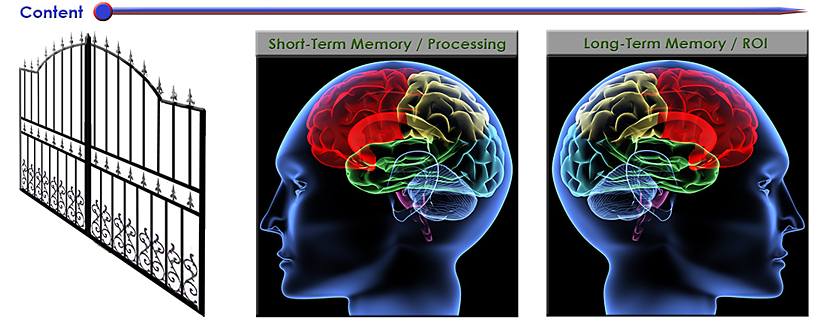


So why not try starting up one of your classes this week with a zinger question, a powerful image/photo/video, or a story from your own work experience? I’ll bet you’ll grab your students’ attentions instantly! Then you can move on into the material for a greater ROI. From there, offering frequent, low-stakes quizzes will hopefully help your students slow down their forgetting curves and help them practice recalling/retrieving that information. By the way, that’s why stories are quite powerful. We often remember them better. So if you can weave an illustrative story into your next class, your students might really benefit from it come final test time!

Also relevant/see:

Ready, set, speak: 5 strong ways to start your next presentation — from abovethelaw.com by Olga Mack, with thanks to Mr. Otto Stockmeyer for this resource
No matter which of these five ways you decide to launch your presentation, ensure that you make it count, and make it memorable.

Excerpts:

  1. Tell a captivating story
  2. Ask thought-provoking questions to the audience
  3. State a shocking headline or statistic
  4. Use a powerful quote
  5. Use silence
    When delivering a speech, a pause of about three or even as many as 10 seconds will allow your audience to sit and quiet down. Because most people always expect the speaker to start immediately, this silence will thus catch the attention of the audience. They will be instinctively more interested in what you had to say, and why you took your time to say it. This time will also help you gather your nerves and prepare to speak.


Reflections on “Inside Amazon’s artificial intelligence flywheel” [Levy]

Inside Amazon’s artificial intelligence flywheel — from wired.com by Steven Levy
How deep learning came to power Alexa, Amazon Web Services, and nearly every other division of the company.

Excerpt (emphasis DSC):

Amazon loves to use the word flywheel to describe how various parts of its massive business work as a single perpetual motion machine. It now has a powerful AI flywheel, where machine-learning innovations in one part of the company fuel the efforts of other teams, who in turn can build products or offer services to affect other groups, or even the company at large. Offering its machine-learning platforms to outsiders as a paid service makes the effort itself profitable—and in certain cases scoops up yet more data to level up the technology even more.

It took a lot of six-pagers to transform Amazon from a deep-learning wannabe into a formidable power. The results of this transformation can be seen throughout the company—including in a recommendations system that now runs on a totally new machine-learning infrastructure. Amazon is smarter in suggesting what you should read next, what items you should add to your shopping list, and what movie you might want to watch tonight. And this year Thirumalai started a new job, heading Amazon search, where he intends to use deep learning in every aspect of the service.

“If you asked me seven or eight years ago how big a force Amazon was in AI, I would have said, ‘They aren’t,’” says Pedro Domingos, a top computer science professor at the University of Washington. “But they have really come on aggressively. Now they are becoming a force.”

Maybe the force.


From DSC:
When will we begin to see more mainstream recommendation engines for learning-based materials? With the demand for people to reinvent themselves, such a next generation learning platform can’t come soon enough!

  • Turning over control to learners to create/enhance their own web-based learner profiles; and allowing people to say who can access their learning profiles.
  • AI-based recommendation engines to help people identify curated, effective digital playlists for what they want to learn about.
  • Voice-driven interfaces.
  • Matching employees to employers.
  • Matching one’s learning preferences (not styles) with the content being presented as one piece of a personalized learning experience.
  • From cradle to grave. Lifelong learning.
  • Multimedia-based, interactive content.
  • Asynchronously and synchronously connecting with others learning about the same content.
  • Online-based tutoring/assistance; remote assistance.
  • Reinvent. Staying relevant. Surviving.
  • Competency-based learning.


The Living [Class] Room -- by Daniel Christian -- July 2012 -- a second device used in conjunction with a Smart/Connected TV


We’re about to embark on a period in American history where career reinvention will be critical, perhaps more so than it’s ever been before. In the next decade, as many as 50 million American workers—a third of the total—will need to change careers, according to McKinsey Global Institute. Automation, in the form of AI (artificial intelligence) and RPA (robotic process automation), is the primary driver. McKinsey observes: “There are few precedents in which societies have successfully retrained such large numbers of people.”

Bill Triant and Ryan Craig


Also relevant/see:

Online education’s expansion continues in higher ed with a focus on tech skills — from educationdive.com by James Paterson

Dive Brief:

  • Online learning continues to expand in higher ed with the addition of several online master’s degrees and a new for-profit college that offers a hybrid of vocational training and liberal arts curriculum online.
  • Inside Higher Ed reported the nonprofit learning provider edX is offering nine master’s degrees through five U.S. universities — the Georgia Institute of Technology, the University of Texas at Austin, Indiana University, Arizona State University and the University of California, San Diego. The programs include cybersecurity, data science, analytics, computer science and marketing, and they cost from around $10,000 to $22,000. Most offer stackable certificates, helping students who change their educational trajectory.
  • Former Harvard University Dean of Social Science Stephen Kosslyn, meanwhile, will open Foundry College in January. The for-profit, two-year program targets adult learners who want to upskill, and it includes training in soft skills such as critical thinking and problem solving. Students will pay about $1,000 per course, though the college is waiving tuition for its first cohort.


In the 2030 and beyond world, employers will no longer be a separate entity from the education establishment. Pressures from both the supply and demand side are so large that employers and learners will end up, by default, co-designing new learning experiences, where all learning counts.


OBJECTIVES FOR CONVENINGS

  • Identify the skills everyone will need to navigate the changing relationship between machine intelligence and people over the next 10-12 years.
  • Develop implications for work, workers, students, working learners, employers, and policymakers.
  • Identify a preliminary set of actions that need to be taken now to best prepare for the changing work + learn ecosystem.

Three key questions guided the discussions:

  1. What are the LEAST and MOST essential skills needed for the future?
  2. Where and how will tomorrow’s workers and learners acquire the skills they really need?
  3. Who is accountable for making sure individuals can thrive in this new economy?

This report summarizes the experts’ views on what skills will likely be needed to navigate the work + learn ecosystem over the next 10–15 years—and their suggested steps for better serving the nation’s future needs.


In a new world of work, driven especially by AI, institutionally-sanctioned curricula could give way to AI-personalized learning. This would drastically change the nature of existing social contracts between employers and employees, teachers and students, and governments and citizens. Traditional social contracts would need to be renegotiated or revamped entirely. In the process, institutional assessment and evaluation could well shift from top-down to new bottom-up tools and processes for developing capacities, valuing skills, and managing performance through new kinds of reputation or accomplishment scores.


…

In October 2017, Chris Wanstrath, CEO of Github, the foremost code-sharing and social networking resource for programmers today, made a bold statement: “The future of coding is no coding at all.” He believes that the writing of code will be automated in the near future, leaving humans to focus on “higher-level strategy and design of software.” Many of the experts at the convenings agreed. Even creating the AI systems of tomorrow, they asserted, will likely require less human coding than is needed today, with graphic interfaces turning AI programming into a drag-and-drop operation.

Digital fluency does not mean knowing coding languages. Experts at both convenings contended that effectively “befriending the machine” will be less about teaching people to code and more about being able to empathize with AIs and machines, understanding how they “see the world” and “think” and “make decisions.” Machines will create languages to talk to one another.

…

Here’s a list of many skills the experts do not expect to see much of—if at all—in the future:

  • Coding. Systems will be self-programming.
  • Building AI systems. Graphic interfaces will turn AI programming into drag-and-drop operations.
  • Calendaring, scheduling, and organizing. There won’t be need for email triage.
  • Planning and even decision-making. AI assistants will pick this up.
  • Creating more personalized curricula. Learners may design more of their own personalized learning adventure.
  • Writing and reviewing resumes. Digital portfolios, personal branding, and performance reputation will replace resumes.
  • Language translation and localization. This will happen in real time using translator apps.
  • Legal research and writing. Many of our legal systems will be automated.
  • Validation skills. Machines will check people’s work to validate their skills.
  • Driving. Driverless vehicles will replace the need to learn how to drive.

Here’s a list of the most essential skills needed for the future:

  • Quantitative and algorithmic thinking.  
  • Managing reputation.  
  • Storytelling and interpretive skills.  
  • First principles thinking.  
  • Communicating with machines as machines.  
  • Augmenting high-skilled physical tasks with AI.
  • Optimization and debugging frame of mind.
  • Creativity and growth mindset.
  • Adaptability.
  • Emotional intelligence.
  • Truth seeking.
  • Cybersecurity.


The rise of machine intelligence is just one of the many powerful social, technological, economic, environmental, and political forces that are rapidly and disruptively changing the way everyone will work and learn in the future. Because this largely tech-driven force is so interconnected with other drivers of change, it is nearly impossible to understand the impact of intelligent agents on how we will work and learn without also imagining the ways in which these new tools will reshape how we live.


Benchmarking Higher Ed AV Staffing Levels — Revisited — from campustechnology.com by Mike Tomei
As AV-equipped classrooms on campus increase in both numbers and complexity, have AV departments staffed up accordingly? A recent survey sheds some light on how AV is managed in higher education.

Excerpt:

I think we can all agree that new AV system installs have a much higher degree of complexity compared to AV systems five or 10 years ago. The obvious culprits are active learning classrooms that employ multiple displays and matrix switching backends, and conferencing systems of varying complexity being installed in big and small rooms all over campus. But even if today’s standard basic classrooms are offering the same presentation functionality as they were five years ago, the backend AV technology running those systems has still increased in complexity. We’re trying to push very high resolution video signals around the room; copyright-protected digital content is coming into play; there are myriad BYOD devices and connectors that need to be supported; and we’re making a strong push to connect our AV devices to the enterprise network for monitoring and troubleshooting. This increase in AV system complexity just adds to the system design, installation and support burdens placed upon an AV department. Without an increase in FTE staff beyond what we’re seeing, there’s just no way that AV support can truly flourish on campuses.

Today we’re reopening the survey to continue to gather data about AV staffing levels, and we’ll periodically tabulate and publish the results for those that participate. Visit www.AV-Survey.com to take the survey. If you would like to request the full 2018 AV staffing survey results, including average AV department budgets, staffing levels by position, breakouts by public/private/community colleges and small/medium/large schools, please send an e-mail to me (mike@tomeiav.com) and to Craig Park from The Sextant Group (cpark@thesextantgroup.com).


MIT plans $1B computing college, AI research effort — from educationdive.com by James Paterson

Dive Brief (emphasis DSC):

  • The Massachusetts Institute of Technology is creating a College of Computing with the help of a $350 million gift from billionaire investor Stephen A. Schwarzman, who is the CEO and co-founder of the private equity firm Blackstone, in a move the university said is its “most significant reshaping” since 1950.
  • Featuring 50 new faculty positions and a new headquarters building, the $1 billion interdisciplinary initiative will bring together computer science, artificial intelligence (AI), data science and related programs across the institution. MIT will establish a new deanship for the college.
  • The new college…will explore and promote AI’s use in non-technology disciplines with a focus on ethical considerations, which are a growing concern as the technology becomes embedded in many fields.


Also see:

Alexa Sessions You Won’t Want to Miss at AWS re:Invent 2018 — from developer.amazon.com

Excerpts — with an eye towards where this might be leading in terms of learning spaces:

Alexa and AWS IoT — Voice is a natural interface to interact not just with the world around us, but also with physical assets and things, such as connected home devices, including lights, thermostats, or TVs. Learn how you can connect and control devices in your home using the AWS IoT platform and Alexa Skills Kit.

Connect Any Device to Alexa and Control Any Feature with the Updated Smart Home Skill API — Learn about the latest update to the Smart Home Skill API, featuring new capability interfaces you can use as building blocks to connect any device to Alexa, including those that fall outside of the traditional smart home categories of lighting, locks, thermostats, sensors, cameras, and audio/video gear. Start learning about how you can create a smarter home with Alexa.

Workshop: Build an Alexa Skill with Multiple Models — Learn how to build an Alexa skill that utilizes multiple interaction models and combines functionality into a single skill. Build an Alexa smart home skill from scratch that implements both custom interactions and smart home functionality within a single skill. Check out these resources to start learning:


Three shifts as big as print to digital — from gettingsmart.com by Tom Vander Ark

Excerpts (emphasis DSC):

We just lived through the biggest shift in learning since the printing press—a 25-year shift from print to digital. While it extended access and options to billions, it didn’t prove as transformational as many of us expected. It did, however, set the stage for three shifts that will change what and how people learn.

  1. Basic to broader aims.
  2. Passive to active learning.
  3. Time to demonstrated learning.


ABA doubles online learning hours — page 6 of 40 from the National Jurist

Excerpt:

Law schools will have the option of offering up to 30 hours of online learning in their J.D. programs, doubling the previous limit of 15, under a new measure approved by the ABA in August. Also, for the first time, first year students will be permitted to take online classes — as many as 10 hours. The ABA has allowed a small number of variances in the past for schools to offer more robust online offerings. Mitchell Hamline School of Law in St. Paul, Minn., launched the nation’s first hybrid J.D. program in 2015. Southwestern Law School in Los Angeles and Syracuse University College of Law in upstate New York have received ABA approval for similar programs.

Such programs have been applauded because they allow for more non-traditional students to get law school educations. Students are only required to be on campus for short periods of time. That means they don’t have to live near the law school.


From DSC:
In 1998 Davenport University Online began offering 100% online-based courses. I joined them 3 years later, and I was part of a group of people who took DUO to the place where — when I left DUO in March 2007, we were offering ~50% of the total credit hours of the university in a 100% online-based format. Again, that was 15-20 years ago. DUO was joined by many other online-based programs from other community colleges and universities.

So what gives w/ the legal education area? 

Well…the American Bar Association (ABA) comes to mind.

The ABA has been very restrictive on the use of online learning. Mounting pressure surely must be on the ABA to allow all kinds of variances in this area. Given the need for legal education to better deal with the exponential pace of technological innovation, the ABA has a responsibility to society to up their game and become far more responsive to the needs of law students. 


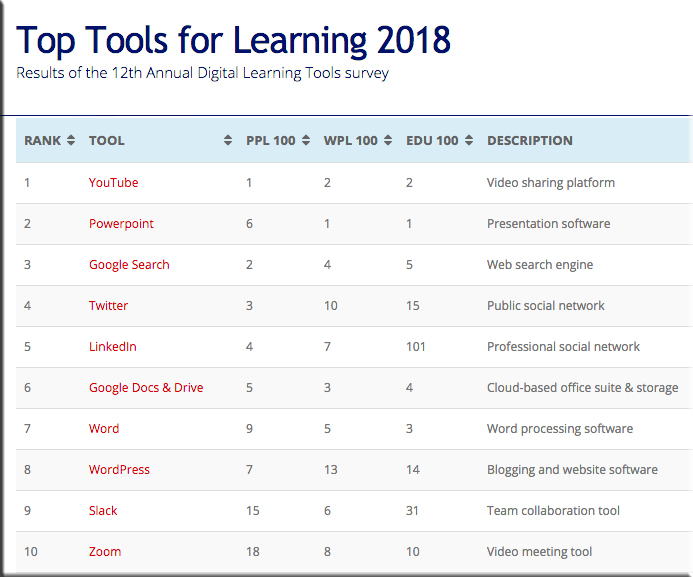
NEW: The Top Tools for Learning 2018 [Jane Hart]

The Top Tools for Learning 2018 from the 12th Annual Digital Learning Tools Survey -- by Jane Hart


The above was from Jane’s posting 10 Trends for Digital Learning in 2018 — from modernworkplacelearning.com by Jane Hart

Excerpt:

[On 9/24/18],  I released the Top Tools for Learning 2018 , which I compiled from the results of the 12th Annual Digital Learning Tools Survey.

I have also categorised the tools into 30 different areas, and produced 3 sub-lists that provide some context to how the tools are being used:

  • Top 100 Tools for Personal & Professional Learning 2018 (PPL100): the digital tools used by individuals for their own self-improvement, learning and development – both inside and outside the workplace.
  • Top 100 Tools for Workplace Learning (WPL100): the digital tools used to design, deliver, enable and/or support learning in the workplace.
  • Top 100 Tools for Education (EDU100): the digital tools used by educators and students in schools, colleges, universities, adult education etc.


3 – Web courses are increasing in popularity.
Although Coursera is still the most popular web course platform, there are, in fact, now 12 web course platforms on the list. New additions this year include Udacity and Highbrow (the latter provides daily micro-lessons). It is clear that people like these platforms because they can chose what they want to study as well as how they want to study, ie. they can dip in and out if they want to and no-one is going to tell them off – which is unlike most corporate online courses which have a prescribed path through them and their use is heavily monitored.


5 – Learning at work is becoming personal and continuous.
The most significant feature of the list this year is the huge leap up the list that Degreed has made – up 86 places to 47th place – the biggest increase by any tool this year. Degreed is a lifelong learning platform and provides the opportunity for individuals to own their expertise and development through a continuous learning approach. And, interestingly, Degreed appears both on the PPL100 (at  30) and WPL100 (at 52). This suggests that some organisations are beginning to see the importance of personal, continuous learning at work. Indeed, another platform that underpins this, has also moved up the list significantly this year, too. Anders Pink is a smart curation platform available for both individuals and teams which delivers daily curated resources on specified topics. Non-traditional learning platforms are therefore coming to the forefront, as the next point further shows.


From DSC:
Perhaps some foreshadowing of the presence of a powerful, online-based, next generation learning platform…?


Microsoft's conference room of the future


From DSC:
Microsoft’s conference room of the future “listens” to the conversations of the team and provides a transcript of the meeting. It also is using “artificial intelligence tools to then act on what meeting participants say. If someone says ‘I’ll follow up with you next week,’ then they’ll get a notification in Microsoft Teams, Microsoft’s Slack competitor, to actually act on that promise.”

This made me wonder about our learning spaces in the future. Will an #AI-based device/cloud-based software app — in real-time — be able to “listen” to the discussion in a classroom and present helpful resources in the smart classroom of the future (i.e., websites, online-based databases, journal articles, and more)?

Will this be a feature of a next generation learning platform as well (i.e., addressing the online-based learning realm)? Will this be a piece of an intelligent tutor or an intelligent system?

Hmmm…time will tell.


Also see this article out at Forbes.com entitled, “There’s Nothing Artificial About How AI Is Changing The Workplace.” 

Here is an excerpt:

The New Meeting Scribe: Artificial Intelligence

As I write this, AI has already begun to make video meetings even better. You no longer have to spend time entering codes or clicking buttons to launch a meeting. Instead, with voice-based AI, video conference users can start, join or end a meeting by simply speaking a command (think about how you interact with Alexa).

Voice-to-text transcription, another artificial intelligence feature offered by Otter Voice Meeting Notes (from AISense, a Zoom partner), Voicefox and others, can take notes during video meetings, leaving you and your team free to concentrate on what’s being said or shown. AI-based voice-to-text transcription can identify each speaker in the meeting and save you time by letting you skim the transcript, search and analyze it for certain meeting segments or words, then jump to those mentions in the script. Over 65% of respondents from the Zoom survey said they think AI will save them at least one hour a week of busy work, with many claiming it will save them one to five hours a week.


To higher ed: When the race track is going 180mph, you can’t walk or jog onto the track. [Christian]

From DSC:
When the race track is going 180mph, you can’t walk or jog onto the track.  What do I mean by that? 

Consider this quote from an article that Jeanne Meister wrote out at Forbes entitled, “The Future of Work: Three New HR Roles in the Age of Artificial Intelligence:”*

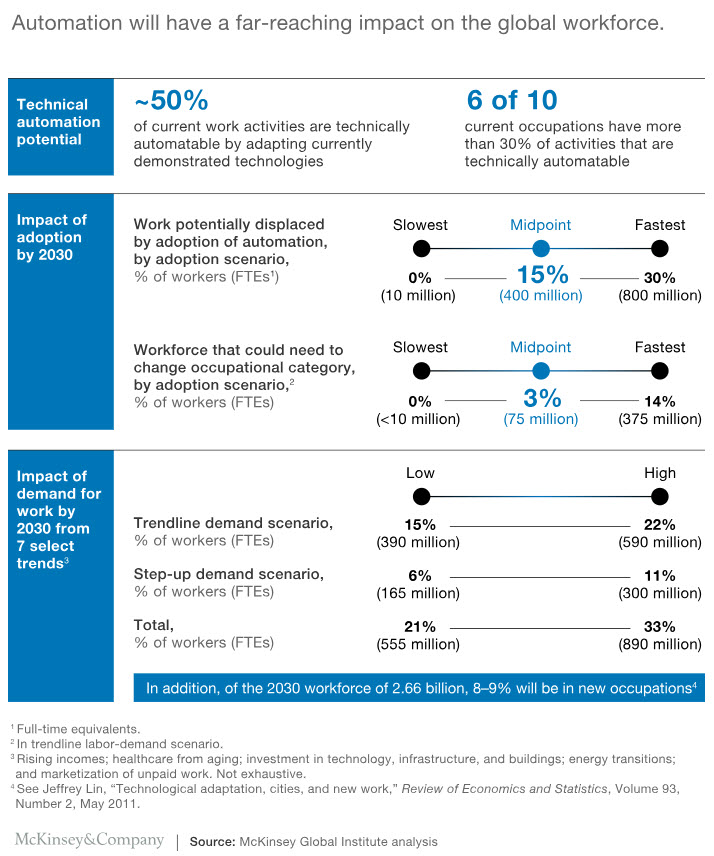
This emphasis on learning new skills in the age of AI is reinforced by the most recent report on the future of work from McKinsey which suggests that as many as 375 million workers around the world may need to switch occupational categories and learn new skills because approximately 60% of jobs will have least one-third of their work activities able to be automated.

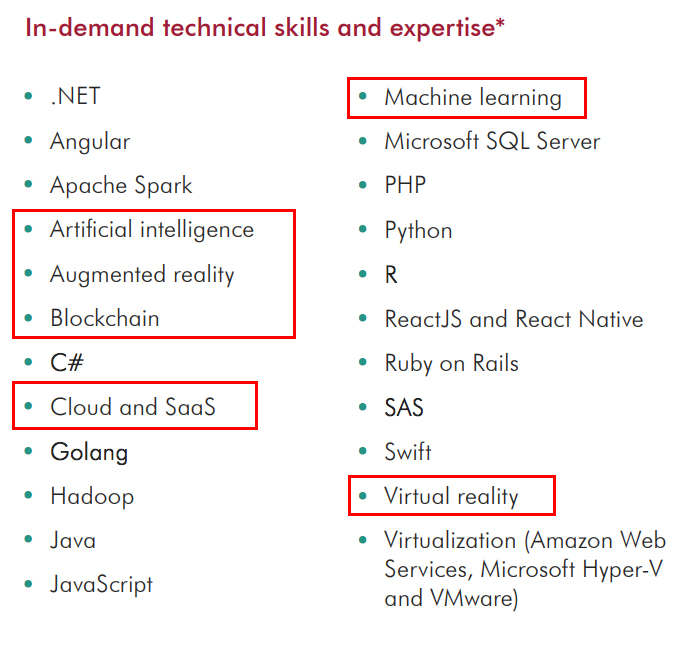
Go scan the job openings and you will likely see many that have to do with technology, and increasingly, with emerging technologies such as artificial intelligence, deep learning, machine learning, virtual reality, augmented reality, mixed reality, big data, cloud-based services, robotics, automation, bots, algorithm development, blockchain, and more. 


From Robert Half’s 2019 Technology Salary Guide 


How many of us have those kinds of skills? Did we get that training in the community colleges, colleges, and universities that we went to? Highly unlikely — even if you graduated from one of those institutions only 5-10 years ago. And many of those institutions are often moving at the pace of a nice leisurely walk, with some moving at a jog, even fewer are sprinting. But all of them are now being asked to enter a race track that’s moving at 180mph. Higher ed — and society at large — are not used to moving at this pace. 

This is why I think that higher education and its regional accrediting organizations are going to either need to up their game hugely — and go through a paradigm shift in the required thinking/programming/curricula/level of responsiveness — or watch while alternatives to institutions of traditional higher education increasingly attract their learners away from them.

This is also, why I think we’ll see an online-based, next generation learning platform take place. It will be much more nimble — able to offer up-to-the minute, in-demand skills and competencies. 


The below graphic is from:
Jobs lost, jobs gained: What the future of work will mean for jobs, skills, and wages


* Three New HR Roles To Create Compelling Employee Experiences
These new HR roles include:

  1. IBM: Vice President, Data, AI & Offering Strategy, HR
  2. Kraft Heinz Senior Vice President Global HR, Performance and IT
  3. SunTrust Senior Vice President Employee Wellbeing & Benefits

What do these three roles have in common? All have been created in the last three years and acknowledge the growing importance of a company’s commitment to create a compelling employee experience by using data, research, and predictive analytics to better serve the needs of employees. In each case, the employee assuming the new role also brought a new set of skills and capabilities into HR. And importantly, the new roles created in HR address a common vision: create a compelling employee experience that mirrors a company’s customer experience.


An excerpt from McKinsey Global Institute | Notes from the Frontier | Modeling the Impact of AI on the World Economy 

Workers.
A widening gap may also unfold at the level of individual workers. Demand for jobs could shift away from repetitive tasks toward those that are socially and cognitively driven and others that involve activities that are hard to automate and require more digital skills.12 Job profiles characterized by repetitive tasks and activities that require low digital skills may experience the largest decline as a share of total employment, from some 40 percent to near 30 percent by 2030. The largest gain in share may be in nonrepetitive activities and those that require high digital skills, rising from some 40 percent to more than 50 percent. These shifts in employment would have an impact on wages. We simulate that around 13 percent of the total wage bill could shift to categories requiring nonrepetitive and high digital skills, where incomes could rise, while workers in the repetitive and low digital skills categories may potentially experience stagnation or even a cut in their wages. The share of the total wage bill of the latter group could decline from 33 to 20 percent.13 Direct consequences of this widening gap in employment and wages would be an intensifying war for people, particularly those skilled in developing and utilizing AI tools, and structural excess supply for a still relatively high portion of people lacking the digital and cognitive skills necessary to work with machines.


Production Values for Audio Podcasts, Part I — from learningsolutionsmag.com by Jeff D’Anza

Excerpts:

There are a number of production values that narrative podcasters find effective for grabbing listener attention and keeping their audiences engaged in the story; you could think of these as technical elements of professional audio quality. They range from techniques for improving content when applied to script writing to methods applied to audio recording and editing. The most successful professional podcasters use these elements to create immersion in the audio environment and to eliminate audio distraction. The result is the creation of a kind of audio theater. Here are four basic practices to embrace while creating your narrative podcasts.

  1. Set the scene first
  2. Hook the audience
  3. Vary character voices
  4. Talk like real people


Production Values for Audio Podcasts, Part II — from learningsolutionsmag.com by Jeff D’Anza

Excerpts:

In this article, I will continue with more production tricks that can substantially increase the quality of your narrative podcasts.

Use music to reset scenes
It’s not revolutionary to suggest that learners tend to have short attention spans, and the case is no different when it comes to narrative podcasts. Every so often you need to reset your learners’ brains in order to keep their attention level high.

One excellent way to accomplish this is through the use of musical breaks. Music breaks can function as a type of auditory palate cleanser, allowing the brain a few moments to stop focusing on information that is being presented and prepare the learner to be ready for the next section of content.

Also:

  • Host/producer structure
  • Get out of the studio
  • Don’t fear insignificant details


From DSC:

Seems to me there’s some wisdom here for instructional designers as well as professors, teachers, and trainers who are creating learning/training related content and/or who are flipping their classrooms.


Aligning the business model of college with student needs: How WGU is disrupting higher education — from christenseninstitute.org by Alana Dunagan

Excerpt:

Since its inception, Western Governors University (WGU) has aimed to serve learners otherwise shut out of the traditional system. Now, the groundbreaking institution has both graduated 100,000 students and has over 100,000 students currently enrolled. These milestones demonstrate WGU’s ability to scale its high-quality, low-cost model, signaling a momentous shift in the higher education landscape.

In the mid-1990s, governors of 19 states across the western United States were concerned about bringing accessible college education to rural populations, especially working adults.These governors, led by Utah Governor Mike Leavitt, decided to explore building a new university to address the challenge. As the memorandum of understanding between those governors that officially marked the founding of WGU stated, “The strength and well-being of our states and the nation depend increasingly on a strong higher education system that helps individuals adapt to our rapidly changing economy and society. States must look to telecommunications and information technologies to provide greater access and choice to a population that increasingly must have affordable education and training opportunities and the certification of competency throughout their lives.”


Now in its third decade, WGU has students in every U.S. state and has over 100,000 enrolled students—a 230% increase since 2011. 


Excerpts from their paper:

The potential of competency-based education
Competency-based education is an approach to learning that allows students to determine the pace of their learning and move ahead once they demonstrate mastery in a concept. As described by Clayton Christensen and Michelle Weise:

Competency-based programs have no time-based unit. Learning is fixed, and time is variable; pacing is flexible. Students cannot move on until they have demonstrated proficiency and mastery of each competency but are encouraged to try as many times as necessary to demonstrate their proficiency. Although skeptics may question the “rigor” behind an experience that allows students to keep trying until they have mastered a competency, this model is actually far more rigorous than the traditional model, as students are not able to flunk or get away with a merely average understanding of the material; they must demonstrate mastery—and therefore dedicated work toward gaining mastery—in any competency.

Competency-based education first took hold in the K-12 education system, but it is also growing in higher education. As of fall 2015, roughly 600 institutions were using or exploring competency-based programs in higher education.13 However, only a handful of institutions are using competency-based education exclusively and have designed their business models around it.

…

WGU offers programs across four industry areas: education, business, information technology, and healthcare. All of these programs are offered online; unlike most higher education institutions, WGU has no physical campus. Instead, it has invested heavily in a technology platform that allows it to deliver curriculum asynchronously, to wherever students are. In addition to its online platform, another unique aspect of WGU’s resources is its approach to faculty. In traditional institutions, faculty are responsible for academic research, course development, teaching, assessment, and advising students. Alternatively, WGU’s model unbundles the faculty role into component parts, with specialists in each role.


Coursera’s CEO on the Evolving Meaning of ‘MOOC’ — from by Dian Schaffhauser
When you can bring huge numbers of students together with lots of well-branded universities and global enterprises seeking a highly skilled workforce, could those linkages be strong enough to forge a new future for massive open online courses?

Excerpts:

Campus Technology: Coursera used to be a MOOC operator, but now it’s a tech company, an LMS company, a virtual bootcamp and more. So how are you describing Coursera these days?

Maggioncalda: As a learning platform. We like to say to our universities, “Coursera is a platform for your global campus.”

You have [traditional universities] teaching with some of the world’s best professors, with some of the most cutting-edge research, to a population of people who have sat right here in front of you, on a small parcel of land, and who pay a lot of money to do that. It’s been very high quality that’s been available to the very few.

What we’re interested in doing is taking that quality of education and making it available to a vast group of people. When you think about our business model, I like to think about it as an ecosystem of learners, educators and employers. What we do is we link them together. We have 34 million learners from around the world. Our biggest country represented is the United States, followed by India, followed by China, followed by Mexico, followed by Brazil. A lot of the emerging markets and the learners there are coming to Coursera to learn and prosper.

…

[Editor’s note: Coursera currently hosts 10 online degree programs. And most recently, in July 2018, the University of Pennsylvania announced that it was launching its first fully online master’s degree, delivered through Coursera and priced at about a third of the cost of its on-campus equivalent.]…

…

CT: Let’s talk about the University of Pennsylvania deal. Do you think that’s going to put some competitive pressure on the other Tier 1 schools to jump into the fray?

Maggioncalda: This is a very well-regarded program. The University of Pennsylvania is a very well-regarded university. I think it’s causing a lot of people to re-evaluate what they were imagining their future might look like: Maybe learners really do want to have access that’s more convenient and lower cost and they don’t have to quit their jobs to take. And maybe there is literally a world of learners who can’t come to campus, in India and Europe and Latin America and Russia and Asia Pacific and China.


As a learning platform. We like to say to our universities, “Coursera is a platform for your global campus.”

Jeff Maggioncalda, Coursera CEO


In two years we’ve had over 1,400 companies hire Coursera to deliver university courses at work to their employees.

Now we’re starting to link the 34 million learners out there to the employers who are looking for people who have certain skills, saying, “Look, if you’re on Coursera learning about this thing, there might be companies who want to hire people that know the thing that you just learned.”

Jeff Maggioncalda, Coursera CEO


The Living [Class] Room -- by Daniel Christian -- July 2012

Learning from the Living [Class] Room:
A global, powerful, next generation learning platform — meant to help people
reinvent themselves quickly, cost-effectively, conveniently, & consistently

  • A new, global, collaborative learning platform that offers more choice, more control to learners of all ages – 24×7 – and could become the organization that futurist Thomas Frey discusses here with Business Insider:
    • “I’ve been predicting that by 2030 the largest company on the internet is going to be an education-based company that we haven’t heard of yet,” Frey, the senior futurist at the DaVinci Institute think tank, tells Business Insider.
  • A learner-centered platform that is enabled by – and reliant upon – human beings but is backed up by a powerful suite of technologies that work together in order to help people reinvent themselves quickly, conveniently, and extremely cost-effectively
  • A customizable learning environment that will offer up-to-date streams of regularly curated content (i.e., microlearning) as well as engaging learning experiences
  • Along these lines, a lifelong learner can opt to receive an RSS feed on a particular topic until they master that concept; periodic quizzes (i.e., spaced repetition) determine that mastery. Once mastered, the system will ask the learner as to whether they still want to receive that particular stream of content or not.
  • A Netflix-like interface to peruse and select plugins to extend the functionality of the core product
  • An AI-backed system of analyzing employment trends and opportunities will highlight those courses and “streams of content” that will help someone obtain the most in-demand skills
  • A system that tracks learning and, via Blockchain-based technologies, feeds all completed learning modules/courses into learners’ web-based learner profiles
  • A learning platform that provides customized, personalized recommendation lists – based upon the learner’s goals
  • A platform that delivers customized, personalized learning within a self-directed course (meant for those content creators who want to deliver more sophisticated courses/modules while moving people through the relevant Zones of Proximal Development)
  • Notifications and/or inspirational quotes will be available upon request to help provide motivation, encouragement, and accountability – helping learners establish habits of continual, lifelong-based learning
  • (Potentially) An online-based marketplace, matching learners with teachers, professors, and other such Subject Matter Experts (SMEs)
  • (Potentially) Direct access to popular job search sites
  • (Potentially) Direct access to resources that describe what other companies do/provide and descriptions of any particular company’s culture (as described by current and former employees and freelancers)
  • (Potentially) Integration with one-on-one tutoring services


30 Sites and Apps for Digital Storytelling — from cyber-kap.blogspot.com

Excerpt:

Digital Storytelling is the process of telling a story through the use of digital means. Also, it happens to be one the easiest ways to integrate technology into the classroom. Educators can use digital storytelling w/ almost any subject and can even “flip” their classroom by using mobile apps. Below is my comprehensive list of sites/apps that can be used for digital storytelling…


Why one London university is now offering degrees in VR — from techrepublic.com by Conner Forrest
London College of Communication, UAL is launching a master’s degree in virtual reality for the 2018-19 academic year.

The big takeaways for tech leaders:

  • London College of Communication, UAL is launching a Master of Arts in VR degree for the 2018-19 academic year.
  • The demand for VR professionals is growing in the film and media industries, where these technologies are being used most frequently.


From DSC:
Collaboration/videoconferencing tools like Webex, Blackboard Collaborate, Zoom, Google Hangouts, Skype, etc. are being used in a variety of scenarios. That platform has been well established. It will be interesting to see how VR might play into web-based collaboration, training, and learning.


© 2025 | Daniel Christian