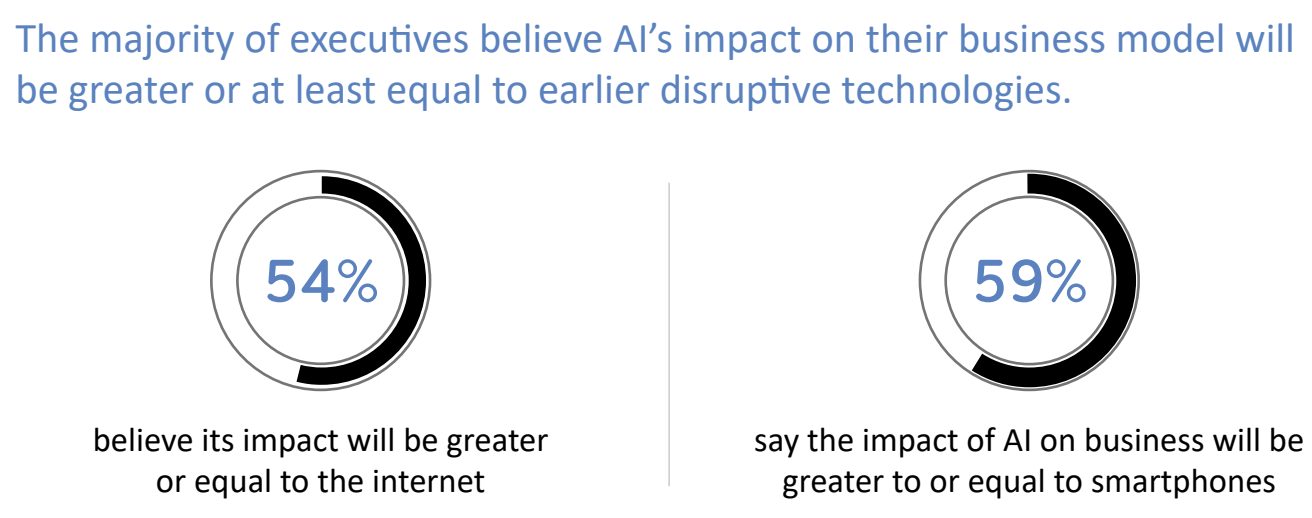
Provosts Are a ‘Release Valve’ for Campus Controversy — from insidehighered.com by Emma Whitford
According to former Western Michigan provost Julian Vasquez Heilig, provosts are stuck driving change with few, if any, allies, while simultaneously playing crisis manager for the university.

After two years, he stepped down, and he now serves as a professor of educational leadership, research and technology at Western Michigan. His frustrations with the provost role had less to do with Western Michigan and more to do with how the job is designed, he explained. “Each person sees the provost a little differently. The faculty see the provost as administration, although, honestly, around the table at the cabinet, the provost is probably the only faculty member,” Heilig said. “The trustees—they see the provost as a middle manager below the president, and the president sees [the provost] as a buffer from issues that are arising.”

Inside Higher Ed sat down with Heilig to talk about the provost job and all he’s learned about the role through years of education leadership research, conversations with colleagues and his own experience.


Brandeis University launches a new vision for American higher education, reinventing liberal arts and emphasizing career development — from brandeis.edu

Levine unveiled “The Brandeis Plan to Reinvent the Liberal Arts,” a sweeping redesign of academic structures, curricula, degree programs, teaching methods, career education, and student support systems. Developed in close partnership with Brandeis faculty, the plan responds to a rapidly shifting landscape in which the demands on higher education are evolving at unprecedented speed in a global, digital economy.

“We are living through a time of extraordinary change across technology, the economy, and society,” Levine said. “Today’s students need more than knowledge. They need the skills, experiences, and confidence to lead in a world we cannot yet predict. We are advancing a new model. We need reinvention. And that’s exactly what Brandeis is establishing.”

The Brandeis Plan transforms the student experience by integrating career preparation into every stage of a student’s education, requiring internships or apprenticeships, sustaining career counseling, and implementing a core curriculum built around the skills that employers value most. The plan also reimagines teaching. It will be more experiential and practical, and introduce new ways to measure and showcase student learning and growth over time.


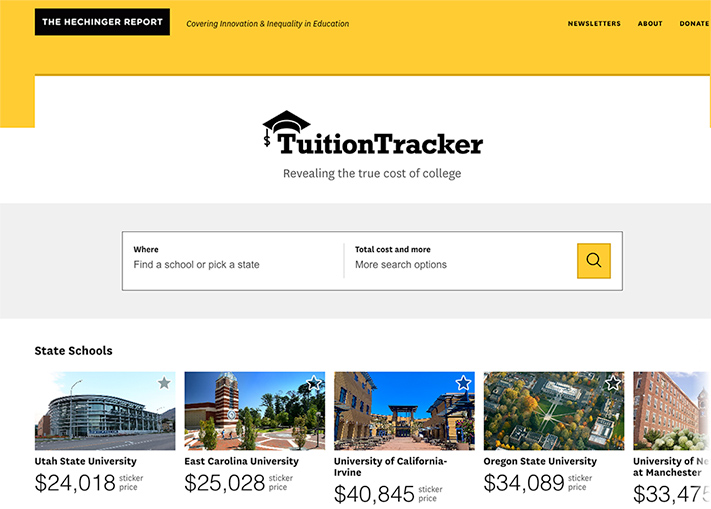
Tuition Tracker from the Hechinger Report


How to Navigate Customer Service — from marketoonist.com by Tom Fishburne


3 Work Trends – Issue 87 — from the World Economic Forum

1. #AI adoption is delivering real results for early movers
Three years into the generative AI revolution, a small but growing group of global companies is demonstrating the tangible potential of AI. Among firms with revenues of $1 billion or more:

  • 17% report cost savings or revenue growth of at least 10% from AI.
  • Almost 80% say their AI investments have met or exceeded expectations.
  • Half worry they are not moving fast enough and could fall behind competitors.

The world’s first AI cabinet member — from therundown.ai by Zach Mink, Rowan Cheung, Shubham Sharma, Joey Liu & Jennifer Mossalgue
PLUS: Startup produces 3,000 AI podcast episodes weekly

The details:

  • Prime Minister Edi Rama unveiled Diella during a cabinet announcement this week, calling her the first member “virtually created by artificial intelligence”.
  • The AI avatar will evaluate and award all public tenders where the government contracts private firms.
  • Diella already serves citizens through Albania’s digital services portal, processing bureaucratic requests via voice commands.
  • Rama claims the AI will eliminate bribes and threats from decision-making, though the government hasn’t detailed what human oversight will exist.

The Rundown AI’s article links to:


Anthropic Economic Index report: Uneven geographic and enterprise AI adoption — from anthropic.com

In other words, a hallmark of early technological adoption is that it is concentrated—in both a small number of geographic regions and a small number of tasks in firms. As we document in this report, AI adoption appears to be following a similar pattern in the 21st century, albeit on shorter timelines and with greater intensity than the diffusion of technologies in the 20th century.

To study such patterns of early AI adoption, we extend the Anthropic Economic Index along two important dimensions, introducing a geographic analysis of Claude.ai conversations and a first-of-its-kind examination of enterprise API use. We show how Claude usage has evolved over time, how adoption patterns differ across regions, and—for the first time—how firms are deploying frontier AI to solve business problems.


How human-centric AI can shape the future of work — from weforum.org by Sapthagiri Chapalapalli

  • Last year, use of AI in the workplace increased by 5.5% in Europe alone.
  • AI adoption is accelerating, but success depends on empowering people, not just deploying technology.
  • Redesigning roles and workflows to combine human creativity and critical thinking with AI-driven insights is key.

The transformative potential of AI on business

Organizations are having to rapidly adapt their business models. Image: TCS


Using ChatGPT to get a job — from linkedin.com by Ishika Rawat


GRCC students to use AI to help businesses solve ‘real world’ challenges in new course — from www-mlive-com.cdn.ampproject.org by Brian McVicar; via Patrick Bailey on LinkedIn

GRAND RAPIDS, MI — A new course at Grand Rapids Community College aims to help students learn about artificial intelligence by using the technology to solve real-world business problems.

In a release, the college said its grant application was supported by 20 local businesses, including Gentex, TwistThink and the Grand Rapids Public Museum. The businesses have pledged to work with students who will use business data to develop an AI project such as a chatbot that interacts with customers, or a program that automates social media posts or summarizes customer data.

“This rapidly emerging technology can transform the way businesses process data and information,” Kristi Haik, dean of GRCC’s School of Science, Technology, Engineering and Mathematics, said in a statement. “We want to help our local business partners understand and apply the technology. We also want to create real experiences for our students so they enter the workforce with demonstrated competence in AI applications.”

As Patrick Bailey said on LinkedIn about this article:

Nice to see a pedagogy that’s setting a forward movement rather than focusing on what could go wrong with AI in a curriculum.


Forecast for Learning and Earning in 2025-2026 report — from pages.asugsvsummit.com by Jennifer Lee and Claire Zau

In this look ahead at the future of learning and work, we aim to define:

  • Major thematic observations
  • What makes this moment an inflection point
  • Key predictions (and their precedent)
  • Short- and long-term projected impacts


The LMS at 30: From Course Management to Learning Management (At Last) — from onedtech.philhillaa.com; a guest post from Matthew Pittinsky, Ph.D.

As a 30 year observer and participant, it seems to me that previous technology platform shifts like SaaS and mobile did not fundamentally change the LMS. AI is different. We’re standing at the precipice of LMS 2.0, where the branding change from Course Management System to Learning Management System will finally live up to its name. Unlike SaaS or mobile, AI represents a technology platform shift that will transform the way participants interact with learning systems – and with it, the nature of the LMS itself.

Given the transformational potential of AI, it is useful to set the context and think about how we got here, especially on this 30th anniversary of the LMS.

LMS at 30 Part 2: Learning Management in the AI Era — from onedtech.philhillaa.com; a guest post from Matthew Pittinsky, Ph.D.

Where AI is disruptive is in its ability to introduce a whole new set of capabilities that are best described as personalized learning services. AI offers a new value proposition to the LMS, roughly the set of capabilities currently being developed in the AI Tutor / agentic TA segment. These new capabilities are so valuable given their impact on learning that I predict they will become the services with greatest engagement within a school or university’s “enterprise” instructional platform.

In this way, by LMS paradigm shift, I specifically mean a shift from buyers valuing the product on its course-centric and course management capabilities, to valuing it on its learner-centric and personalized learning capabilities.


AI and the future of education: disruptions, dilemmas and directions — from unesdoc.unesco.org

This anthology reveals how the integration of AI in education poses profound philosophical, pedagogical, ethical and political questions. As this global AI ecosystem evolves and becomes increasingly ubiquitous, UNESCO and its partners have a shared responsibility to lead the global discourse towards an equity- and justice-centred agenda. The volume highlights three areas in which UNESCO will continue to convene and lead a global commons for dialog and action particularly in areas on AI futures, policy and practice innovation, and experimentation.

  1. As guardian of ethical, equitable human-centred AI in education.
  2. As thought leader in reimagining curriculum and pedagogy
  3. As a platform for engaging pluralistic and contested dialogues

AI, copyright and the classroom: what higher education needs to know — from timeshighereducation.com by Cayce Myers
As artificial intelligence reshapes teaching and research, one legal principle remains at the heart of our work: copyright. Understanding its implications isn’t just about compliance – it’s about protecting academic integrity, intellectual property and the future of knowledge creation. Cayce Myers explains


The School Year We Finally Notice “The Change” — from americanstogether.substack.com by Jason Palmer

Why It Matters
A decade from now, we won’t say “AI changed schools.” We’ll say: this was the year schools began to change what it means to be human, augmented by AI.

This transformation isn’t about efficiency alone. It’s about dignity, creativity, and discovery, and connecting education more directly to human flourishing. The industrial age gave us schools to produce cookie-cutter workers. The digital age gave us knowledge anywhere, anytime. The AI age—beginning now—gives us back what matters most: the chance for every learner to become infinitely capable.

This fall may look like any other—bells ringing, rows of desks—but beneath the surface, education has begun its greatest transformation since the one-room schoolhouse.


How should universities teach leadership now that teams include humans and autonomous AI agents? — from timeshighereducation.com by Alex Zarifis
Trust and leadership style are emerging as key aspects of teambuilding in the age of AI. Here are ways to integrate these considerations with technology in teaching

Transactional and transformational leaderships’ combined impact on AI and trust
Given the volatile times we live in, a leader may find themselves in a situation where they know how they will use AI, but they are not entirely clear on the goals and journey. In a teaching context, students can be given scenarios where they must lead a team, including autonomous AI agents, to achieve goals. They can then analyse the situations and decide what leadership styles to apply and how to build trust in their human team members. Educators can illustrate this decision-making process using a table (see above).

They may need to combine transactional leadership with transformational leadership, for example. Transactional leadership focuses on planning, communicating tasks clearly and an exchange of value. This works well with both humans and automated AI agents.


From Content To Capability: How AI Agents Are Redefining Workplace Learning — from forbes.com by Nelson Sivalingam

Real, capability-building learning requires three key elements: content, context and conversation. 

The Rise Of AI Agents: Teaching At Scale
The generative AI revolution is often framed in terms of efficiency: faster content creation, automated processes and streamlined workflows. But in the world of L&D, its most transformative potential lies elsewhere: the ability to scale great teaching.

AI gives us the means to replicate the role of an effective teacher across an entire organization. Specifically, AI agents—purpose-built systems that understand, adapt and interact in meaningful, context-aware ways—can make this possible. These tools understand a learner’s role, skill level and goals, then tailor guidance to their specific challenges and adapt dynamically over time. They also reinforce learning continuously, nudging progress and supporting application in the flow of work.

More than simply sharing knowledge, an AI agent can help learners apply it and improve with every interaction. For example, a sales manager can use a learning agent to simulate tough customer scenarios, receive instant feedback based on company best practices and reinforce key techniques. A new hire in the product department could get guidance on the features and on how to communicate value clearly in a roadmap meeting.

In short, AI agents bring together the three essential elements of capability building, not in a one-size-fits-all curriculum but on demand and personalized for every learner. While, obviously, this technology shouldn’t replace human expertise, it can be an effective tool for removing bottlenecks and unlocking effective learning at scale.


AI firm Anthropic reaches landmark $1.5B copyright deal with book authors — from washingtonpost.com by Will Oremus; this is a gifted article
The authors hailed the settlement as a win for human creators after they alleged the company downloaded millions of books without permission.

Anthropic, the artificial intelligence company behind the popular chatbot Claude, will pay $1.5 billion to settle a class-action lawsuit brought by book publishers and authors, according to documents filed in federal court Friday.

The settlement allows Anthropic to avoid going to trial over claims that it violated copyrights by downloading millions of books without permission and storing digital copies of them. The company will not admit wrongdoing.


Expanding economic opportunity with AI — from openai.com; via The Neuron Daily

First, we’re working to build out the OpenAI Jobs Platform.

If you’re a business looking to hire an AI-savvy employee, or you just need help with a specific task, finding the right person can be hit-or-miss. The OpenAI Jobs Platform will have knowledgeable, experienced candidates at every level, and opportunities for anyone looking to put their skills to use. And we’ll use AI to help find the perfect matches between what companies need and what workers can offer.

We also realize that anyone looking to hire, whether it’s through the Jobs Platform or elsewhere, needs to trust that candidates are actually fluent in AI. Most businesses, including small businesses, think AI is the key to their future. And most of the companies we talk to want to make sure their employees know how to use our tools.

That’s the idea behind our new OpenAI Certifications.

Studies show? that AI-savvy workers are more valuable, more productive, and are paid more than workers without AI skills. That’s why, earlier this year, we launched the OpenAI Academy, a free, online learning platform that has helped connect more than 2 million people with the resources, workshops, and communities they need to master AI tools.


PODCAST: The AI that’s making lawyers 100x better (and it’s not ChatGPT) — from theneurondaily.com by Matthew Robinson
How Thomson Reuters solved AI hallucinations in legal work

Bottom line: The best engineers became 100x better with AI coding tools. Now the same transformation is hitting law. Joel [the CTO at Thomson Reuters] predicts the best attorneys who master these tools will become 100x more powerful than before.


Legal Tech at a Turning Point: What 2025 Has Shown Us So Far — from community.nasscom.in by Elint AI

4. Legal Startups Reshape the Market for Judges and Practitioners
Legal services are no longer dominated by traditional providers. Business Insider reports on a new wave of nimble “Law Firm 2.0” entities—AI-enabled startups offering fixed cost services for specific tasks such as contract reviews or drafting. The LegalTech Lab is helping launch such disruptors with funding and guidance.

At the same time, alternative legal service providers or ALSPs are integrating generative AI, moving beyond cost-efficient support to providing legal advice and enhanced services—often on subscription models.

In 2025 so far, legal technology has moved from incremental adoption to integral transformation. Generative AI, investments, startups, and regulatory readiness are reshaping the practice of law—for lawyers, judges, and the rule of law.


Insights On AI And Its Impact On Legal, Part One — from abovethelaw.com by Stephen Embry
AI will have lasting impact on the legal profession.

I recently finished reading Ethan Mollick‘s excellent book on artificial intelligence, entitled Co-Intelligence: Living and Working with AI. He does a great job of explaining what it is, how it works, how it best can be used, and where it may be headed.

The first point that resonated with me is that artificial intelligence tools can take those with poor skills in certain areas and significantly elevate their output. For example, Mollick cited a study that demonstrated that the performance of law students at the bottom of their class got closer to that of the top students with the use of AI.

Lawyers and law firms need to begin thinking and planning for how the coming skill equalization will impact competition and potentially profitability. They need to consider how the value of what they provide to their clients will be greater than their competition. They need to start thinking about what skill will set them apart in the new AI driven world. 


267 | AI First Drafts: What Your Clients Aren’t Telling You (and Why It Matters) — from thebrainyacts.beehiiv.com by Brainyacts

Welcome to the new normal: the AI First Draft.
Clients—from everyday citizens to solo entrepreneurs to sophisticated in-house counsel—are increasingly using AI to create the first draft of legal documents before outside counsel even enters the conversation. Contracts, memos, emails, issue spotters, litigation narratives: AI can now do it all.

This means outside counsel is now navigating a very different kind of document review and client relationship. One that comes with hidden risks, awkward conversations, and new economic pressures.

Here are the three things every lawyer needs to start thinking about when reviewing client-generated work product.

1. The Prompt Problem: What Was Shared, and With Whom?…
2. The Confidence Barrier: When AI Sounds Right, But Isn’t…
3. The Economic Shift: Why AI Work Can Cost More, Not Less…


How HR is adapting as AI agents join the workforce — from hrexecutive.com by Jill Barth

Business leaders across the world are grappling with a reality that would have seemed like science fiction just a few decades ago: Artificial intelligence systems dubbed AI agents are becoming colleagues, not just tools. At many organizations, HR pros are already developing balanced and thoughtful machine-people workforces that meet business goals.

At Skillsoft, a global corporate learning company, Chief People Officer Ciara Harrington has spent the better part of three years leading digital transformation in real time. Through her front-row seat to CEO transitions, strategic pivots and the rapid acceleration of AI adoption, she’s developed a strong belief that organizations must be agile with people operations.

‘No role that’s not a tech role’
Under these modern conditions, she says, technology is becoming a common language in the workplace. “There is no role that’s not a tech role,” Harrington said during a recent discussion about the future of work. It’s a statement that gets at the heart of a shift many HR leaders are still coming to terms with.

But a key question remains: Who will manage the AI agents, specifically, HR leaders or someone else?


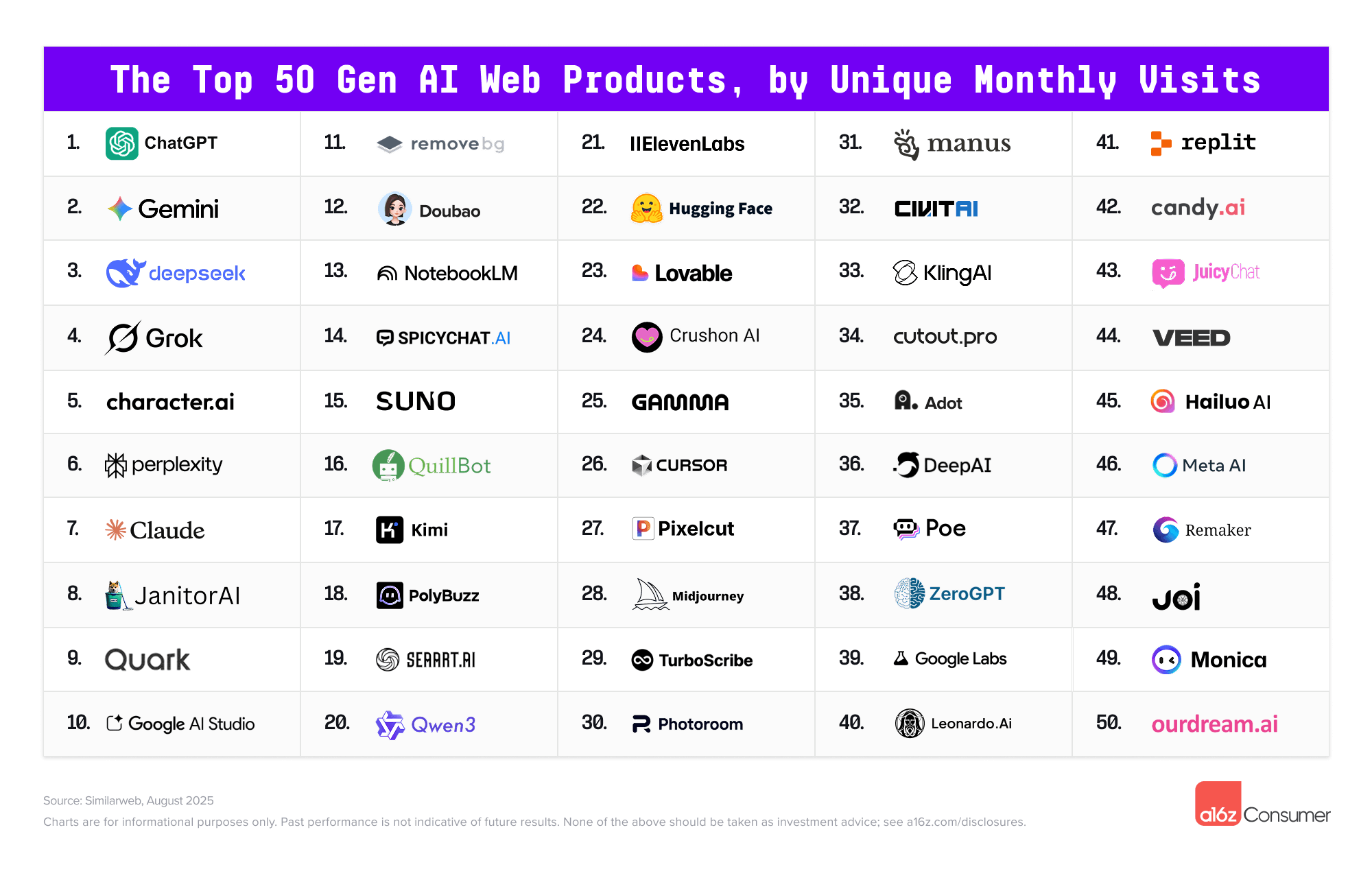
The Top 100 [Gen AI] Consumer Apps 5th edition — from a16z.com


And in an interesting move by Microsoft and Samsung:

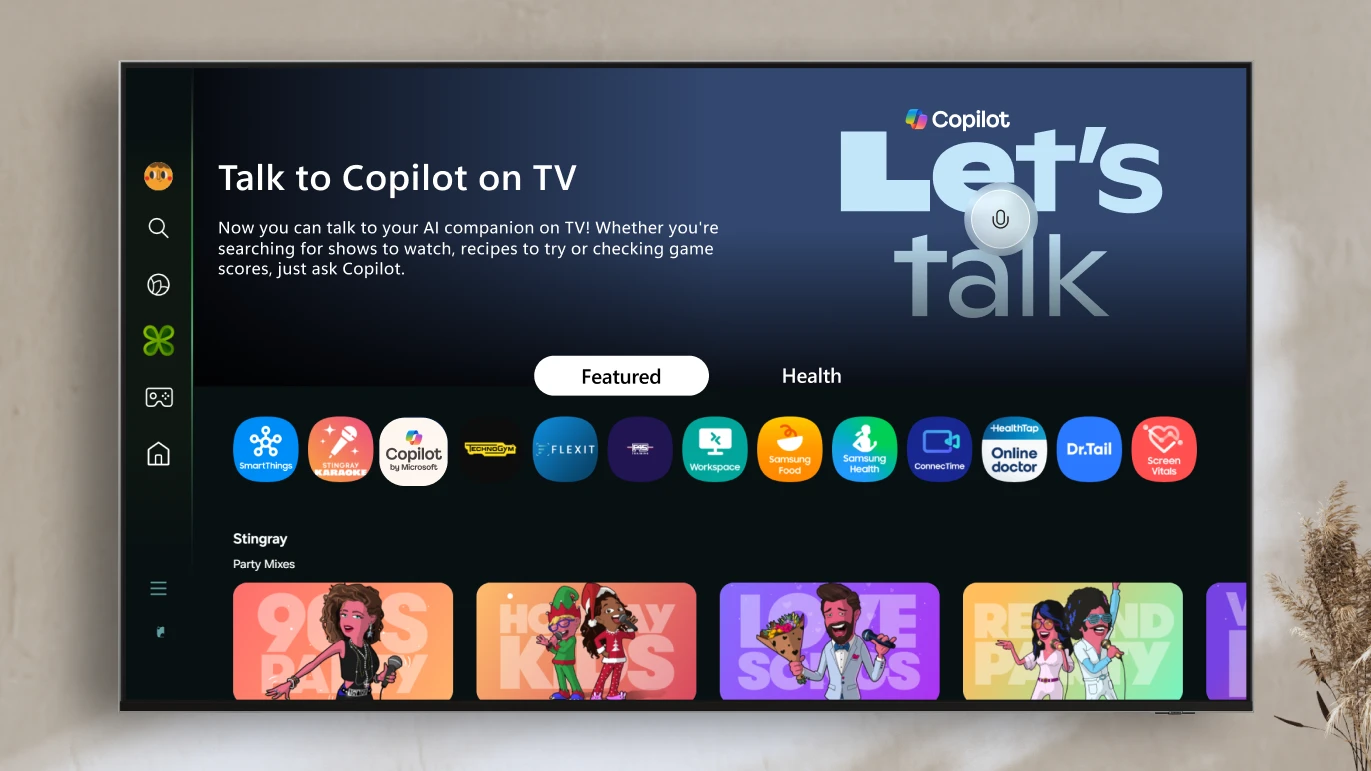
A smarter way to talk to your TV: Microsoft Copilot launches on Samsung TVs and monitors — from microsoft.com

Voice-powered AI meets a visual companion for entertainment, everyday help, and everything in between. 

Redmond, Wash., August 27—Today, we’re announcing the launch of Copilot on select Samsung TVs and monitors, transforming the biggest screen in your home into your most personal and helpful companion—and it’s free to use.

Copilot makes your TV easier and more fun to use with its voice-powered interface, friendly on-screen character, and simple visual cards. Now you can quickly find what you’re looking for and discover new favorites right from your living room.

Because it lives on the biggest screen in the home, Copilot is a social experience—something you can use together with family and friends to spark conversations, help groups decide what to watch, and turn the TV into a shared space for curiosity and connection.


There Is Now Clearer Evidence AI Is Wrecking Young Americans’ Job Prospects — from wsj.com by Justin Lahart; this article is behind a paywall
Young workers face rising AI competition in fields like software development, but some also benefit from AI as a helper, new research shows

Young workers are getting hit in fields where generative-AI tools such as ChatGPT can most easily automate tasks done by humans, such as software development, according to a paper released Tuesday by three Stanford University economists. They crunched anonymized data on millions of employees at tens of thousands of firms, including detailed information on workers’ ages and jobs, making this one of clearest indicators yet of AI’s disruptive impact.

Young workers in jobs where AI could act as a helper, rather than a replacement, actually saw employment growth, economists found.


ILTACON 2025: The Wild, Wild West of legal tech — from abajournal.com by Nicole Black

On the surface, ILTACON 2025, the International Legal Technology Association’s largest annual legal technology event, had all the makings of a great conference. But despite the thought-provoking sessions and keynotes, networking opportunities and PR fanfare, I couldn’t shake the sense that we were in the midst of a seismic shift in legal tech, surrounded by the restless energy of a boomtown.

The gold rush
It wasn’t ILTACON that bothered me; it was the heady, gold-rushed, “anything goes and whatever sticks works” environment that was unsettling. While this year’s conference was pirate-themed, it felt more like the Wild West to me.

This attitude permeated the conference, driven largely by the frenzied, frontier-style artificial intelligence revolution. The AI train is hurtling forward at lightning speed, destination unknown, and everyone is trying to cash in before it derails.

Two themes emerged from my discussions. First, no matter who you spoke to, “agentic AI,” meaning AI that autonomously takes purposeful actions, was a buzzword that cropped up often, whether during press briefings or over drinks. Another key trend was the race to become the generative AI home base for legal professionals.

— Nicole Black

“We are at the start of the biggest disruption to the legal profession in its history.”

— Steve Hasker, Thomson Reuters president and CEO


Also see:

Fresh Voices on Legal Tech with Bridget McCormack — from legaltalknetwork.com

Is AI the technology that will finally force lawyer tech competence? With rapid advances and the ability to address numerous problems and pain points in our legal systems, AI simply can’t be ignored. Dennis & Tom welcome Bridget McCormack to discuss her perspectives on current AI trends and other exciting new tech applications in legal…

Top Legal Tech Jobs on the Rise: Who Employers Are Looking For in 2025 — from lawyer-monthly.com

For professionals, this means one thing: dozens of new career paths are appearing on the horizon that did not exist five years ago.


The future of L&D is here, and it’s powered by AI. — from linkedin.com by Josh Cavalier


4 Ways I Use AI to Think Better — from wondertools.substack.com by Jeremy Caplan
How AI helps me learn, decide, and create

Learn something new.
Map out a personalized curriculum

Try this: Give an AI assistant context about what you want to learn, why, and how.

  • Detail your rationale and motivation, which may impact your approach.
  • Note your current knowledge or skill level, ideally with examples.

Summarize your learning preferences

  • Note whether you prefer to read, listen to, or watch learning materials.
  • Mention if you like quizzes, drills, or exercises you can do while commuting or during a break at work.
  • If you appreciate learning games, task your AI assistant with generating one for you, using its coding capabilities detailed below.
  • Ask for specific book, textbook, article, or learning path recommendations using the Web search or Deep Research capabilities of PerplexityChatGPT, Gemini or Claude. They can also summarize research literature about effective learning tactics.
  • If you need a human learning partner, ask for guidance on finding one or language you can use in reaching out.

The Ends of Tests: Possibilities for Transformative Assessment and Learning with Generative AI


GPT-5 for Instructional Designers — from drphilippahardman.substack.com by Dr Philippa Hardman
10 Hacks to Work Smarter & Safer with OpenAI’s Latest Model

The TLDR is that as Instructional Designers, we can’t afford to miss some of the very real benefits of GPT-5’s potential, but we also can’t ensure our professional standards or learner outcomes if we blindly accept its outputs without due testing and validation.

For this reason, I decided to synthesise the latest GPT-5 research—from OpenAI’s technical documentation to independent security audits to real-world user testing—into 10 essential reality checks for using GPT-5 as an Instructional Designer.

These aren’t theoretical exercises; they’re practical tests designed to help you safely unlock GPT-5’s benefits while identifying and mitigating its most well-documented limitations.


Grammarly launches new specialist AI agents providing personalized assistance for students — from edtechinnovationhub.com by Rachel Lawler
Grammarly, an AI communication tool, has announced the launch of eight new specialized AI agents. The new assistants can support specific writing challenges such as finding credible sources and checking originality. 

Students will now be offered “responsible AI support” through Grammarly, with the eight new agents:

  • Reader Reactions agent …
  • AI Grader agent …
  • Citation Finder agent …
  • Expert Review agent …
  • Proofreader agent …
  • AI Detector agent …
  • Plagiarism Checker agent …
  • Paraphraser agent …


Why Perplexity AI Is My Go-To Research Tool as a Higher Education CIO — from mikekentz.substack.com; a guest post from Michael Lyons, CIO at MassBay Community College

While I regularly use tools like ChatGPT, Grammarly, Microsoft Copilot, and even YouTube Premium (I would cancel Netflix before this), Perplexity has earned a top spot in my toolkit. It blends AI and real-time web search into one seamless, research-driven platform that saves time and improves the quality of information I rely on every day.


21 Ways People Are Using A.I. at Work — from nytimes.com by Larry Buchanan and Francesca Paris; this is a gifted article

  1. Select wines for restaurant menus
  2. Digitize a herbarium
  3. Make everything look better
  4. Create lesson plans that meet educational standards
  5. Make a bibliography
  6. Write up therapy plans
  7. …and many more

The GPT-5 fallout, explained… — from theneurondaily.com by Grant Harvey
PLUS: Who knew ppl loved 4o so much!?

The GPT-5 Backlash, Explained: OpenAI users revolted against GPT-5… then things got weird.
What a vibe shift a day or two makes, huh? As you all know by now, GPT-5 dropped last Thursday, and at first, it seemed like a pretty successful launch.

Early testers loved it. Sam Altman called it “the most powerful AI model ever made.”

Then the floodgates opened to 700 million users.. and all hell broke loose.

Here’s what happened: Within hours, Reddit and Twitter turned into digital pitchforks. The crime? OpenAI had quietly sunset GPT-4o—the model everyone apparently loved more than their morning coffee—without warning. Users weren’t just mad. They were devastated.


ChatGPT Changes — from getsuperintel.com by Kim “Chubby” Isenberg
4o is back, and Plus users get 3000 reasoning requests per week with GPT-5!

Who would have thought that the “smartest model ever” would trigger one of the loudest user revolts in AI history? The return of GPT-4o after only 24 hours shows how attached people are to the personality of their AI—and how quickly trust crumbles when expectations are not met. In this issue, we not only look at OpenAI’s response, but also at how the balance of power between developers and the community is shifting.


GPT-5 doesn’t dislike you—it might just need a benchmark for emotional intelligence — from link.wired.com by
Welcome to another AI Lab!

The backlash over the more emotionally neutral GPT-5 shows that the smartest AI models might have striking reasoning, coding, and math skills, but advancing their psychological intelligence safely remains very much unsolved.

Since the all-new ChatGPT launched on Thursday, some users have mourned the disappearance of a peppy and encouraging personality in favor of a colder, more businesslike one (a move seemingly designed to reduce unhealthy user behavior.) The backlash shows the challenge of building artificial intelligence systems that exhibit anything like real emotional intelligence.

Researchers at MIT have proposed a new kind of AI benchmark to measure how AI systems can manipulate and influence their users—in both positive and negative ways—in a move that could perhaps help AI builders avoid similar backlashes in the future while also keeping vulnerable users safe.


ChatGPT is bringing back 4o as an option because people missed it — from theverge.com by Emma Roth
Many ChatGPT users were frustrated by OpenAI’s decision to make GPT-5 the default model.

OpenAI is bringing back GPT-4o in ChatGPT just one day after replacing it with GPT-5. In a post on X, OpenAI CEO Sam Altman confirmed that the company will let paid users switch to GPT-4o after ChatGPT users mourned its replacement.

“We will let Plus users choose to continue to use 4o,” Altman says. “We will watch usage as we think about how long to offer legacy models for.”

For months, ChatGPT fans have been waiting for the launch of GPT-5, which OpenAI says comes with major improvements to writing and coding capabilities over its predecessors. But shortly after the flagship AI model launched, many users wanted to go back.


AI Agent Trends of 2025: A Transformative Landscape — from marktechpost.com by Asif Razzaq

This articles focuses on five core AI agent trends for 2025: Agentic Retrieval-Augmented Generation (RAG), Voice Agents, AI Agent Protocols, DeepResearch Agents, Coding Agents, and Computer Using Agents (CUA).


© 2025 | Daniel Christian