Artificial intelligence will transform universities. Here’s how. — from weforum.org by Mark Dodgson & David Gann

Excerpt:

The most innovative AI breakthroughs, and the companies that promote them – such as DeepMind, Magic Pony, Aysadi, Wolfram Alpha and Improbable – have their origins in universities. Now AI will transform universities.

We believe AI is a new scientific infrastructure for research and learning that universities will need to embrace and lead, otherwise they will become increasingly irrelevant and eventually redundant.

Through their own brilliant discoveries, universities have sown the seeds of their own disruption. How they respond to this AI revolution will profoundly reshape science, innovation, education – and society itself.
…
As AI gets more powerful, it will not only combine knowledge and data as instructed, but will search for combinations autonomously. It can also assist collaboration between universities and external parties, such as between medical research and clinical practice in the health sector.

The implications of AI for university research extend beyond science and technology.
…
When it comes to AI in teaching and learning, many of the more routine academic tasks (and least rewarding for lecturers), such as grading assignments, can be automated. Chatbots, intelligent agents using natural language, are being developed by universities such as the Technical University of Berlin; these will answer questions from students to help plan their course of studies.

Virtual assistants can tutor and guide more personalized learning. As part of its Open Learning Initiative (OLI), Carnegie Mellon University has been working on AI-based cognitive tutors for a number of years. It found that its OLI statistics course, run with minimal instructor contact, resulted in comparable learning outcomes for students with fewer hours of study. In one course at the Georgia Institute of Technology, students could not tell the difference between feedback from a human being and a bot.


Also see:

Digital audio assistants in teaching and learning — from blog.blackboard.com by Szymon Machajewski

Excerpts:

I built an Amazon Alexa skill called Introduction to Computing Flashcards. In using the skill, or Amazon Alexa app, students are able to listen to Alexa and then answer questions. Alexa helps students prepare for an exam by speaking definitions and then waiting for their identification. In addition to quizzing the student, Alexa is also keeping track of the correct answers. If a student answers five questions correctly, Alexa shares a game code, which is worth class experience points in the course gamification My Game app.

…

Certainly, exam preparation apps are one way to use digital assistants in education. As development and publishing of Amazon Alexa skills becomes easier, faculty will be able to produce such skills just as easily as they now create PowerPoints. Given the basic code available through Amazon tutorials, it takes 20 minutes to create a new exam preparation app. Basic voice experience Amazon Alexa skills can take as much as five minutes to complete.

Universities can publish their campus news through the Alexa Flash Briefing. This type of a skill can publish news, success stories, and other events associated with the campus.

…

If you are a faculty member, how can you develop your first Amazon Alexa skill? You can use any of the tutorials already available. You can also participate in an Amazon Alexa classroom training provided by Alexa Dev Days. It is possible that schools or maker spaces near you offer in-person developer sessions. You can use meetup.com to track these opportunities.


The Business of Artificial Intelligence — from hbr.org by Erik Brynjolfsson & Andrew McAfee

Excerpts (emphasis DSC):

The most important general-purpose technology of our era is artificial intelligence, particularly machine learning (ML) — that is, the machine’s ability to keep improving its performance without humans having to explain exactly how to accomplish all the tasks it’s given. Within just the past few years machine learning has become far more effective and widely available. We can now build systems that learn how to perform tasks on their own.

Why is this such a big deal? Two reasons. First, we humans know more than we can tell: We can’t explain exactly how we’re able to do a lot of things — from recognizing a face to making a smart move in the ancient Asian strategy game of Go. Prior to ML, this inability to articulate our own knowledge meant that we couldn’t automate many tasks. Now we can.

Second, ML systems are often excellent learners. They can achieve superhuman performance in a wide range of activities, including detecting fraud and diagnosing disease. Excellent digital learners are being deployed across the economy, and their impact will be profound.

In the sphere of business, AI is poised have a transformational impact, on the scale of earlier general-purpose technologies. Although it is already in use in thousands of companies around the world, most big opportunities have not yet been tapped. The effects of AI will be magnified in the coming decade, as manufacturing, retailing, transportation, finance, health care, law, advertising, insurance, entertainment, education, and virtually every other industry transform their core processes and business models to take advantage of machine learning. The bottleneck now is in management, implementation, and business imagination.

…

The machine learns from examples, rather than being explicitly programmed for a particular outcome.


Let’s start by exploring what AI is already doing and how quickly it is improving. The biggest advances have been in two broad areas: perception and cognition. …For instance, Aptonomy and Sanbot, makers respectively of drones and robots, are using improved vision systems to automate much of the work of security guards. 


Machine learning is driving changes at three levels: tasks and occupations, business processes, and business models. 


You may have noticed that Facebook and other apps now recognize many of your friends’ faces in posted photos and prompt you to tag them with their names.


Amazon’s Alexa passes 15,000 skills, up from 10,000 in February — from techcrunch.com by Sarah Perez

Excerpt:

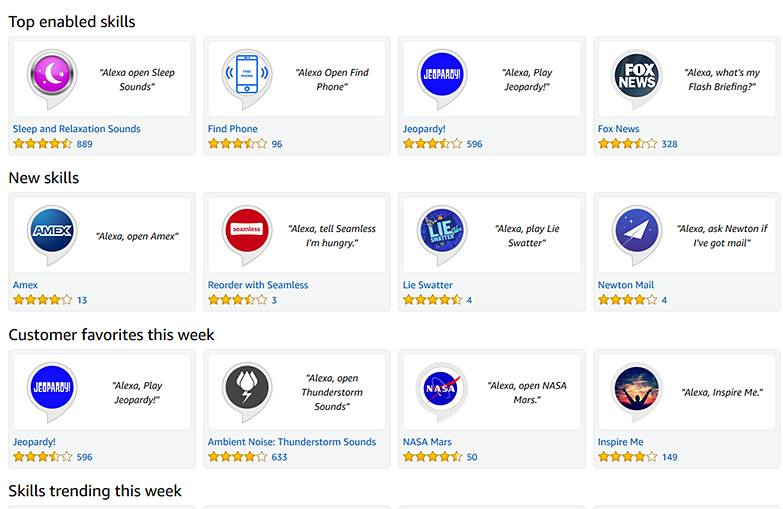
Amazon’s Alexa voice platform has now passed 15,000 skills — the voice-powered apps that run on devices like the Echo speaker, Echo Dot, newer Echo Show and others. The figure is up from the 10,000 skills Amazon officially announced back in February, which had then represented a 3x increase from September.

The new 15,000 figure was first reported via third-party analysis from Voicebot, and Amazon has now confirmed to TechCrunch that the number is accurate.

According to Voicebot, which only analyzed skills in the U.S., the milestone was reached for the first time on June 30, 2017. During the month of June, new skill introductions increased by 23 percent, up from the less than 10 percent growth that was seen in each of the prior three months.

The milestone also represents a more than doubling of the number of skills that were available at the beginning of the year, when Voicebot reported there were then 7,000 skills. That number was officially confirmed by Amazon at CES.


From DSC:
Again, I wonder…what are the implications for learning from this new, developing platform?


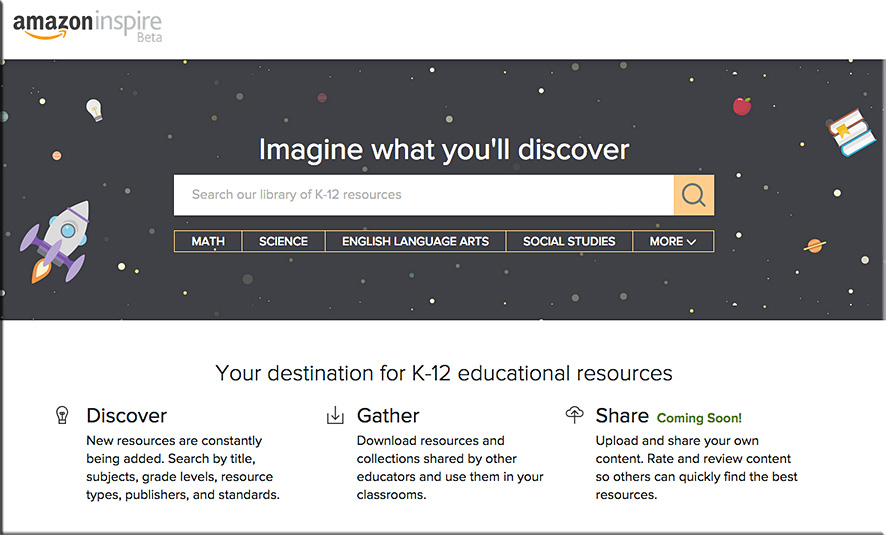
Amazon relaunches Inspire after a year of re-tooling — from edscoop.com/ by Emily Tate
The content repository offers tens of thousands of downloadable educational resources. The “upload and share” feature is expected to follow soon.

Excerpts:

More than a year after Amazon debuted — and then suddenly retracted — its free library of open educational resources, Amazon Inspire is back.

The content repository — seen by many as Amazon’s first major attempt to edge into the competitive education technology space that tech giants like Google and Microsoft now comfortably occupy — was quietly reintroduced to educators on Monday [7/17/17] as a way to store and find tens of thousands of downloadable educational materials that teachers can use in their classrooms.

Over the last year, groups across the country have been working with Amazon to vet digital content to ensure it complies with state standards, quality indicators and, perhaps most importantly, intellectual property and copyright laws.
…
Similarly, if you want to teach a lesson on Romeo and Juliet, for example, you could search Inspire by grade, subject, content format and standards to begin pulling “ingredients,” or resources, off the shelves and putting them in your “grocery cart,” or your collection.


The case for a next generation learning platform [Grush & Christian]


The case for a next generation learning platform — from campustechnology.com by Mary Grush & Daniel Christian

Excerpt (emphasis DSC):

Grush: Then what are some of the implications you could draw from metrics like that one?

Christian: As we consider all the investment in those emerging technologies, the question many are beginning to ask is, “How will these technologies impact jobs and the makeup of our workforce in the future?”

While there are many thoughts and questions regarding the cumulative impact these technologies will have on our future workforce (e.g., “How many jobs will be displaced?”), the consensus seems to be that there will be massive change.

Whether our jobs are completely displaced or if we will be working alongside robots, chatbots, workbots, or some other forms of AI-backed personal assistants, all of us will need to become lifelong learners — to be constantly reinventing ourselves. This assertion is also made in the aforementioned study from McKinsey: “AI promises benefits, but also poses urgent challenges that cut across firms, developers, government, and workers. The workforce needs to be re-skilled to exploit AI rather than compete with it…”


A side note from DSC:
I began working on this vision prior to 2010…but I didn’t officially document it until 2012.


The Living [Class] Room -- by Daniel Christian -- July 2012 -- a second device used in conjunction with a Smart/Connected TV


Learning from the Living [Class] Room:

A global, powerful, next generation learning platform


What does the vision entail?

  • A new, global, collaborative learning platform that offers more choice, more control to learners of all ages – 24×7 – and could become the organization that futurist Thomas Frey discusses here with Business Insider:

“I’ve been predicting that by 2030 the largest company on the internet is going to be an education-based company that we haven’t heard of yet,” Frey, the senior futurist at the DaVinci Institute think tank, tells Business Insider.

  • A learner-centered platform that is enabled by – and reliant upon – human beings but is backed up by a powerful suite of technologies that work together in order to help people reinvent themselves quickly, conveniently, and extremely cost-effectively
  • A customizable learning environment that will offer up-to-date streams of regularly curated content (i.e., microlearning) as well as engaging learning experiences
  • Along these lines, a lifelong learner can opt to receive an RSS feed on a particular topic until they master that concept; periodic quizzes (i.e., spaced repetition) determines that mastery. Once mastered, the system will ask the learner whether they still want to receive that particular stream of content or not.
  • A Netflix-like interface to peruse and select plugins to extend the functionality of the core product
  • An AI-backed system of analyzing employment trends and opportunities will highlight those courses and streams of content that will help someone obtain the most in-demand skills
  • A system that tracks learning and, via Blockchain-based technologies, feeds all completed learning modules/courses into learners’ web-based learner profiles
  • A learning platform that provides customized, personalized recommendation lists – based upon the learner’s goals
  • A platform that delivers customized, personalized learning within a self-directed course (meant for those content creators who want to deliver more sophisticated courses/modules while moving people through the relevant Zones of Proximal Development)
  • Notifications and/or inspirational quotes will be available upon request to help provide motivation, encouragement, and accountability – helping learners establish habits of continual, lifelong-based learning
  • (Potentially) An online-based marketplace, matching learners with teachers, professors, and other such Subject Matter Experts (SMEs)
  • (Potentially) Direct access to popular job search sites
  • (Potentially) Direct access to resources that describe what other companies do/provide and descriptions of any particular company’s culture (as described by current and former employees and freelancers)
  • (Potentially) Integration with one-on-one tutoring services

Further details here >>


Addendum from DSC (regarding the resource mentioned below):
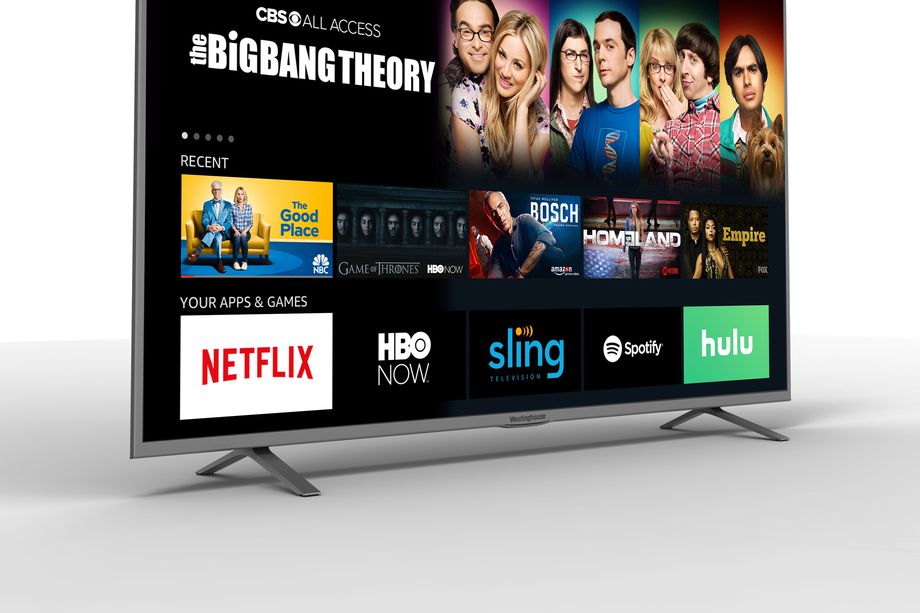
Note the voice recognition/control mechanisms on Westinghouse’s new product — also note the integration of Amazon’s Alexa into a “TV.”


Westinghouse’s Alexa-equipped Fire TV Edition smart TVs are now available — from theverge.com by Chaim Gartenberg


The key selling point, of course, is the built-in Amazon Fire TV, which is controlled with the bundled Voice Remote and features Amazon’s Alexa assistant.


Finally…also see:

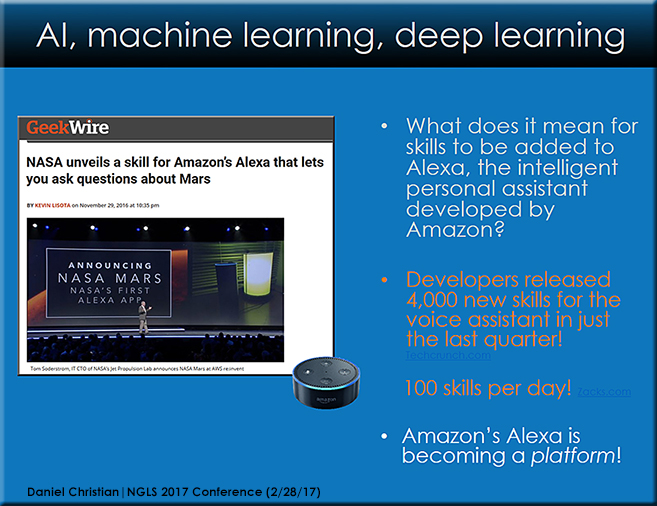
  • NASA unveils a skill for Amazon’s Alexa that lets you ask questions about Mars — from geekwire.com by Kevin Lisota
  • Holographic storytelling — from jwtintelligence.com
    The stories of Holocaust survivors are brought to life with the help of interactive 3D technologies.
    New Dimensions in Testimony is a new way of preserving history for future generations. The project brings to life the stories of Holocaust survivors with 3D video, revealing raw first-hand accounts that are more interactive than learning through a history book.  Holocaust survivor Pinchas Gutter, the first subject of the project, was filmed answering over 1000 questions, generating approximately 25 hours of footage. By incorporating natural language processing from the USC Institute for Creative Technologies (ICT), people are able to ask Gutter’s projected image questions that trigger relevant responses.


Winner takes all — from by Michael Moe, Luben Pampoulov, Li Jiang, Nick Franco, & Suzee Han


We did a lot of things that seemed crazy at the time. Many of those crazy things now have over a billion users, like Google Maps, YouTube, Chrome, and Android.

— Larry Page, CEO, Alphabet


Excerpt:

An alphabet is a collection of letters that represent language. Alphabet, accordingly, is a collection of companies that represent the many bets Larry Page is making to ensure his platform is built to not only survive, but to thrive in a future defined by accelerating digital disruption. It’s an “Alpha” bet on a diversified platform of assets.

If you look closely, the world’s top technology companies are making similar bets.


Technology in general and the Internet in particular is all about a disproportionate gains to the leader in a category. Accordingly, as technology leaders like Facebook, Alphabet, and Amazon survey the competitive landscape, they have increasingly aimed to develop and acquire emerging technology capabilities across a broad range of complementary categories.


How Amazon’s purchase of Whole Foods highlights the hybrid, ‘omnichannel’ future of higher ed — from edsurge.com by Sean Gallagher

Excerpt:

The expectation that students can integrate their learning experiences across channels is now arriving in higher education. Online education has reached a tipping point where almost 30 percent of all students in U.S. higher education are enrolled in at least one online college course. A significant number of students are already blending their experience across online and offline channels—and numerous data points speak to the evolving value of blending online delivery with physical presence, as suggested by Amazon.

In national surveys of prospective adult students that we have conducted regularly at Northeastern University over recent years, we have consistently found that 60 percent of students prefer a blended or hybrid learning experience. In other words, the majority of the higher education student market is neglected by today’s dominant approach that focuses on offering either online or in-person programs.
…
Like Amazon, the colleges and universities that are able to deliver across channels—leveraging the combination of physical presence and online algorithms—will be uniquely positioned to take advantage of the in-demand, destination nature of studying in certain cities; the local sourcing of faculty; and proximity to key employers, industries, and job opportunities.


Over the next decade, growth and competitive success in higher education will not be a function of who is able to offer online programs. Instead, the successful institutions will be those who can symbiotically integrate their placed-based educational operations and experiences with software-driven analytics, learning science, and machine learning to create a more personalized experience. A more Amazon-like experience.


From DSC:
A few side comments here:

  1. The future won’t be kind to those institutions who haven’t built up their “street cred” in the digital/virtual space. For example, if you are working at a traditional institution of higher education that doesn’t have online-based programs — nor does it have plans to create such programs in the future — you should get your resume up-to-date and start looking…now.
    .
  2. For data/analytics to have a significant impact and inform strategic or pedagogical decisions, one needs to collect the data. This is not hard to do online. But it’s very difficult — at least at a granular level — to do in a face-to-face environment.
    .
  3. Coursera’s MeetUps around the world — where their learners are encouraged to join study and discussion groups related to their online-only courses — make me wonder about the future of learning spaces and whether your local Starbucks might morph into a learning hub.


What a future, powerful, global learning platform will look & act like [Christian]


Learning from the Living [Class] Room:
A vision for a global, powerful, next generation learning platform

By Daniel Christian

NOTE: Having recently lost my Senior Instructional Designer position due to a staff reduction program, I am looking to help build such a platform as this. So if you are working on such a platform or know of someone who is, please let me know: danielchristian55@gmail.com.

I want to help people reinvent themselves quickly, efficiently, and cost-effectively — while providing more choice, more control to lifelong learners. This will become critically important as artificial intelligence, robotics, algorithms, and automation continue to impact the workplace.


The Living [Class] Room -- by Daniel Christian -- July 2012 -- a second device used in conjunction with a Smart/Connected TV


Learning from the Living [Class] Room:
A global, powerful, next generation learning platform


What does the vision entail?

  • A new, global, collaborative learning platform that offers more choice, more control to learners of all ages – 24×7 – and could become the organization that futurist Thomas Frey discusses here with Business Insider:

“I’ve been predicting that by 2030 the largest company on the internet is going to be an education-based company that we haven’t heard of yet,” Frey, the senior futurist at the DaVinci Institute think tank, tells Business Insider.

  • A learner-centered platform that is enabled by – and reliant upon – human beings but is backed up by a powerful suite of technologies that work together in order to help people reinvent themselves quickly, conveniently, and extremely cost-effectively
  • An AI-backed system of analyzing employment trends and opportunities will highlight those courses and “streams of content” that will help someone obtain the most in-demand skills
  • A system that tracks learning and, via Blockchain-based technologies, feeds all completed learning modules/courses into learners’ web-based learner profiles
  • A learning platform that provides customized, personalized recommendation lists – based upon the learner’s goals
  • A platform that delivers customized, personalized learning within a self-directed course (meant for those content creators who want to deliver more sophisticated courses/modules while moving people through the relevant Zones of Proximal Development)
  • Notifications and/or inspirational quotes will be available upon request to help provide motivation, encouragement, and accountability – helping learners establish habits of continual, lifelong-based learning
  • (Potentially) An online-based marketplace, matching learners with teachers, professors, and other such Subject Matter Experts (SMEs)
  • (Potentially) Direct access to popular job search sites
  • (Potentially) Direct access to resources that describe what other companies do/provide and descriptions of any particular company’s culture (as described by current and former employees and freelancers)

Further details:
While basic courses will be accessible via mobile devices, the optimal learning experience will leverage two or more displays/devices. So while smaller smartphones, laptops, and/or desktop workstations will be used to communicate synchronously or asynchronously with other learners, the larger displays will deliver an excellent learning environment for times when there is:

  • A Subject Matter Expert (SME) giving a talk or making a presentation on any given topic
  • A need to display multiple things going on at once, such as:
  • The SME(s)
  • An application or multiple applications that the SME(s) are using
  • Content/resources that learners are submitting in real-time (think Bluescape, T1V, Prysm, other)
  • The ability to annotate on top of the application(s) and point to things w/in the app(s)
  • Media being used to support the presentation such as pictures, graphics, graphs, videos, simulations, animations, audio, links to other resources, GPS coordinates for an app such as Google Earth, other
  • Other attendees (think Google Hangouts, Skype, Polycom, or other videoconferencing tools)
  • An (optional) representation of the Personal Assistant (such as today’s Alexa, Siri, M, Google Assistant, etc.) that’s being employed via the use of Artificial Intelligence (AI)

This new learning platform will also feature:

  • Voice-based commands to drive the system (via Natural Language Processing (NLP))
  • Language translation (using techs similar to what’s being used in Translate One2One, an earpiece powered by IBM Watson)
  • Speech-to-text capabilities for use w/ chatbots, messaging, inserting discussion board postings
  • Text-to-speech capabilities as an assistive technology and also for everyone to be able to be mobile while listening to what’s been typed
  • Chatbots
    • For learning how to use the system
    • For asking questions of – and addressing any issues with – the organization owning the system (credentials, payments, obtaining technical support, etc.)
    • For asking questions within a course
  • As many profiles as needed per household
  • (Optional) Machine-to-machine-based communications to automatically launch the correct profile when the system is initiated (from one’s smartphone, laptop, workstation, and/or tablet to a receiver for the system)
  • (Optional) Voice recognition to efficiently launch the desired profile
  • (Optional) Facial recognition to efficiently launch the desired profile
  • (Optional) Upon system launch, to immediately return to where the learner previously left off
  • The capability of the webcam to recognize objects and bring up relevant resources for that object
  • A built in RSS feed aggregator – or a similar technology – to enable learners to tap into the relevant “streams of content” that are constantly flowing by them
  • Social media dashboards/portals – providing quick access to multiple sources of content and whereby learners can contribute their own “streams of content”

In the future, new forms of Human Computer Interaction (HCI) such as Augmented Reality (AR), Virtual Reality (VR), and Mixed Reality (MR) will be integrated into this new learning environment – providing entirely new means of collaborating with one another.

Likely players:

  • Amazon – personal assistance via Alexa
  • Apple – personal assistance via Siri
  • Google – personal assistance via Google Assistant; language translation
  • Facebook — personal assistance via M
  • Microsoft – personal assistance via Cortana; language translation
  • IBM Watson – cognitive computing; language translation
  • Polycom – videoconferencing
  • Blackboard – videoconferencing, application sharing, chat, interactive whiteboard
  • T1V, Prsym, and/or Bluescape – submitting content to a digital canvas/workspace
  • Samsung, Sharp, LCD, and others – for large displays with integrated microphones, speakers, webcams, etc.
  • Feedly – RSS aggregator
  • _________ – for providing backchannels
  • _________ – for tools to create videocasts and interactive videos
  • _________ – for blogs, wikis, podcasts, journals
  • _________ – for quizzes/assessments
  • _________ – for discussion boards/forums
  • _________ – for creating AR, MR, and/or VR-based content


2017 Internet Trends Report — from kpcb.com by Mary Meeker


Mary Meeker’s 2017 internet trends report: All the slides, plus analysis — from recode.net by Rani Molla
The most anticipated slide deck of the year is here.

Excerpt:

Here are some of our takeaways:

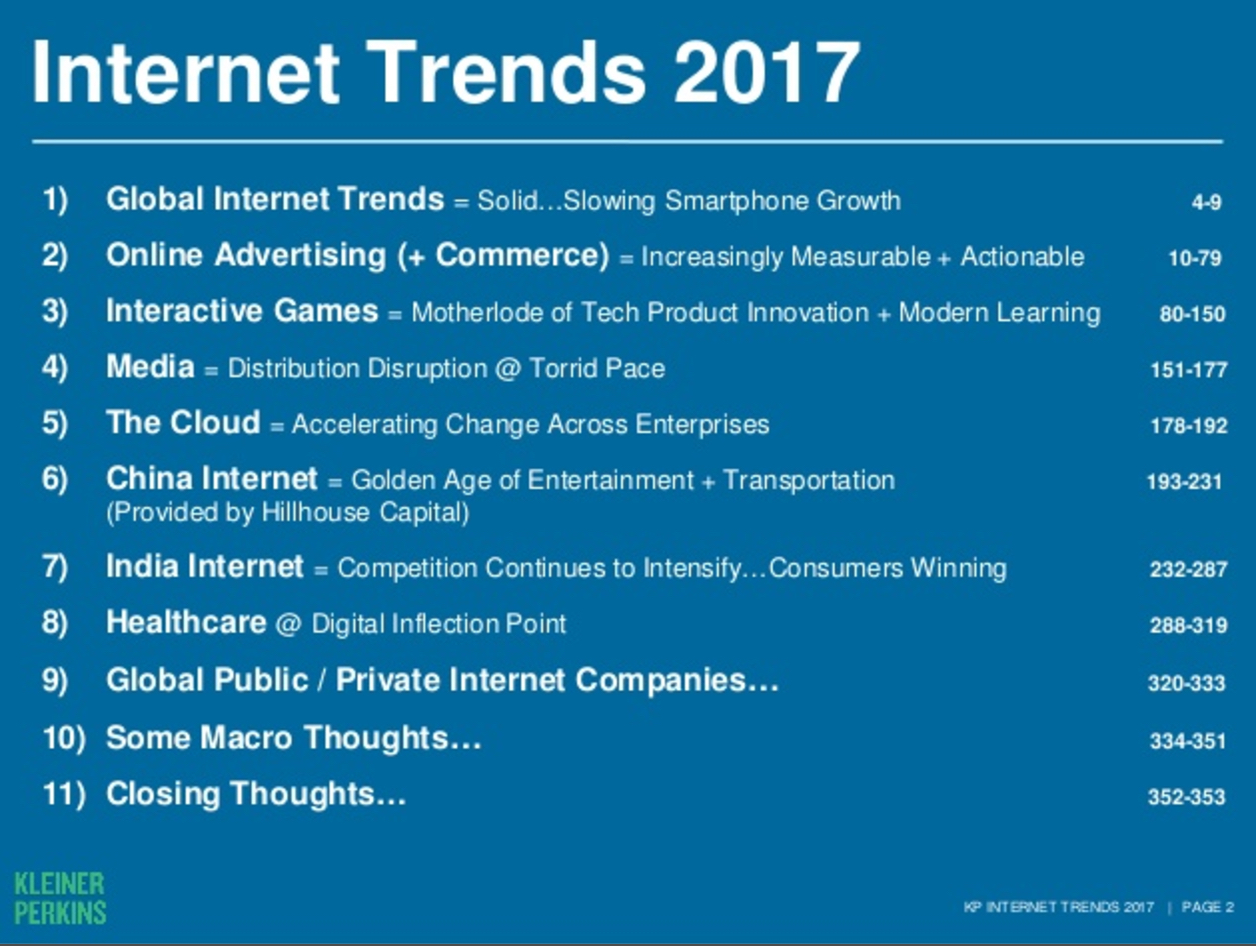
  • Global smartphone growth is slowing: Smartphone shipments grew 3 percent year over year last year, versus 10 percent the year before. This is in addition to continued slowing internet growth, which Meeker discussed last year.
  • Voice is beginning to replace typing in online queries. Twenty percent of mobile queries were made via voice in 2016, while accuracy is now about 95 percent.
  • In 10 years, Netflix went from 0 to more than 30 percent of home entertainment revenue in the U.S. This is happening while TV viewership continues to decline.
  • China remains a fascinating market, with huge growth in mobile services and payments and services like on-demand bike sharing. (More here: The highlights of Meeker’s China slides.)


Read Mary Meeker’s essential 2017 Internet Trends report — from techcrunch.com by Josh Constine

Excerpt:

This is the best way to get up to speed on everything going on in tech. Kleiner Perkins venture partner Mary Meeker’s annual Internet Trends report is essentially the state of the union for the technology industry. The widely anticipated slide deck compiles the most informative research on what’s getting funded, how Internet adoption is progressing, which interfaces are resonating, and what will be big next.

You can check out the 2017 report embedded below, and here’s last year’s report for reference.


The Higher Education Technology Paradox — from edtechmagazine.com by Hank Lucas
The academic rewards system will continue to stymie technology adoption unless higher ed administrators promote organizational change.

Excerpts:

The number one paradox in higher education is that technology is both transforming and disrupting universities around the world. Institutions that adapt to the technology and become content producers will survive and flourish; those confined to being content consumers will struggle to stay in business.
…
What does it take for a university to develop the kind of materials described above? Obviously, it requires money, but more than money it needs a motivated and committed faculty. The reward system in most institutions and the inherent conservatism of faculty members create a huge barrier to adopting new technologies for education. (Many faculty members are in denial that the technology can improve student learning and that it will be widely implemented.)

How does the reward system impact technology adoption?

  • Assistant professors at research universities are rewarded for publishing scholarly articles and books, which they must do to be granted tenure. They cannot risk the time needed to master the new technologies.
  • Tenured faculty can largely do what they want, and by the time they have received tenure have fallen into a rhythm of research and teaching; once tenured they are expected to undertake more service to the institution. Where does the time come from to adopt a new approach to the classroom?
  • Non-tenure track instructors are employed because they are good, or at least adequate, teachers. Adopting new technology in the classroom is risky and could result in lower student evaluations, which in turn could affect their employment status.


From DSC:
This is one of the reasons why I believe that a new organization will arise in the future that uses a solid, team-based approach from day 1. They will have teams of experts from a variety of fields/disciplines — and they will have the types of incentive systems that one would expect to see in startup companies. They will value innovation and will see to it that ideas can be grown and supported.

Anybody come to mind? How about Amazon.com? 

Also, faculty members — like all of us — have a limited amount of time and energy. The current workplace has loaded up faculty members’ job plates — they don’t have much time to experiment with new technologies. Also — again, like all of us — they have a variety of skills and interests. Many times, those skills and interest don’t involve working with technology. 

Look for more team-based approaches to dominate the future of higher education.


16 Voice Control Terms You Need To Know  — from medium.com by Josh.AI

Excerpt:

Voice control is now becoming a popular interface with hands-free capabilities making daily tasks easier and quicker. How exactly does this innovative technology work for your home to magically respond to your every command? Here are 16 voice control keywords that will help explain how it all works.


From DSC:
There are now more than 12,000+ skills on Amazon’s new platform — Alexa.  I continue to wonder…what will this new platform mean/deliver to societies throughout the globe?


From this Alexa Skills Kit page:

What Is an Alexa Skill?
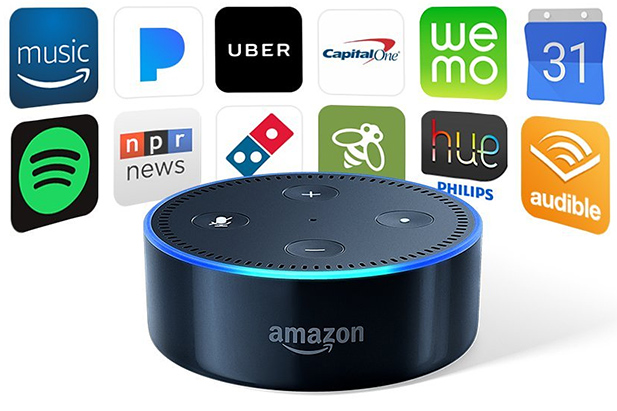
Alexa is Amazon’s voice service and the brain behind millions of devices including Amazon Echo. Alexa provides capabilities, or skills, that enable customers to create a more personalized experience. There are now more than 12,000 skills from companies like Starbucks, Uber, and Capital One as well as innovative designers and developers.

What Is the Alexa Skills Kit?
With the Alexa Skills Kit (ASK), designers, developers, and brands can build engaging skills and reach millions of customers. ASK is a collection of self-service APIs, tools, documentation, and code samples that makes it fast and easy for you to add skills to Alexa. With ASK, you can leverage Amazon’s knowledge and pioneering work in the field of voice design.

You can build and host most skills for free using Amazon Web Services (AWS).


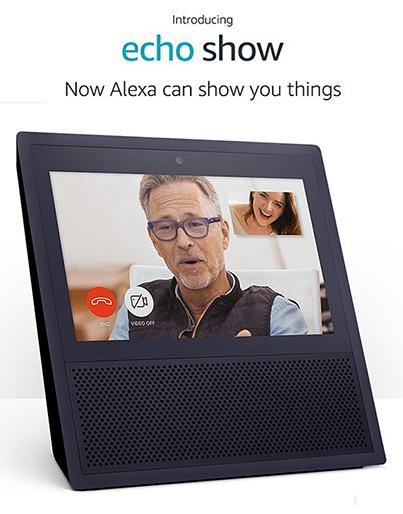
Amazon introduces Echo Show

The description reads:

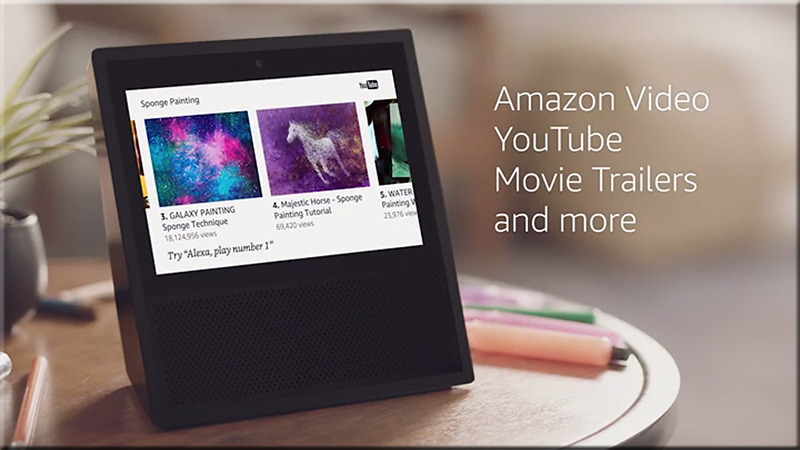
  • Echo Show brings you everything you love about Alexa, and now she can show you things. Watch video flash briefings and YouTube, see music lyrics, security cameras, photos, weather forecasts, to-do and shopping lists, and more. All hands-free—just ask.
  • Introducing a new way to be together. Make hands-free video calls to friends and family who have an Echo Show or the Alexa App, and make voice calls to anyone who has an Echo or Echo Dot.
  • See lyrics on-screen with Amazon Music. Just ask to play a song, artist or genre, and stream over Wi-Fi. Also, stream music on Pandora, Spotify, TuneIn, iHeartRadio, and more.
  • Powerful, room-filling speakers with Dolby processing for crisp vocals and extended bass response
  • Ask Alexa to show you the front door or monitor the baby’s room with compatible cameras from Ring and Arlo. Turn on lights, control thermostats and more with WeMo, Philips Hue, ecobee, and other compatible smart home devices.
  • With eight microphones, beam-forming technology, and noise cancellation, Echo Show hears you from any direction—even while music is playing
  • Always getting smarter and adding new features, plus thousands of skills like Uber, Jeopardy!, Allrecipes, CNN, and more


From DSC:

Now we’re seeing a major competition between the heavy-hitters to own one’s living room, kitchen, and more. Voice controlled artificial intelligence. But now, add the ability to show videos, text, graphics, and more. Play music. Control the lights and the thermostat. Communicate with others via hands-free video calls.

Hmmm….very interesting times indeed.


Developers and corporates released 4,000 new skills for the voice assistant in just the last quarter. (source)


…with the company adding about 100 skills per day. (source)


The Living [Class] Room -- by Daniel Christian -- July 2012 -- a second device used in conjunction with a Smart/Connected TV


Addendum on 5/10/17:


Microsoft Cortana-Powered Speaker Challenges Amazon’s Echo With Skype Calls — from foxbusiness.com by y Jay Greene

Excerpt:

Microsoft Corp. is hoping to challenge Amazon.com Inc.’s Echo smart speaker for a spot on the kitchen counter with a device from Samsung Electronics Co. that can make phone calls. The Invoke, which will debut this fall, comes more two years after the release of the Echo, which has sold more 11 million units through late last year, according to estimates by Morgan Stanley. It also will compete with Alphabet Inc.’s Google Home, which was released last fall. The voice-controlled Invoke, made by Samsung’s Harman Kardon unit, will use Microsoft’s Cortana digital assistant to take commands.


Microsoft Screams ‘Me Too’ With Cortana-Powered Rival to Amazon Echo and Google Home — from gizmodo.com by Alex Cranz

Excerpt:

With Microsoft’s Build developer conference just two days away, the company has revealed one of the most anticipated announcements from the event: A new Cortana-powered speaker made by German audio giant Harman Kardon.

Now, it’s fair to see this speaker for what it is: An answer to the Google Home and Amazon Echo. Both assistant-powered speakers are already in homes across our great nation, listening to your noises, noting your habits, and in general invading your lives under the guise of smart home helpfulness. The new Microsoft speaker, dubbed “Invoke,” one will presumably do the good stuff, let giving you updates on the weather and letting you turn on some soothing jazz for your dog with just a spoken command. Microsoft is also hoping that partnering with Harmon Kardon means its speaker can avoid one of the bigger problems with these devices—their tendency to sound cheap and tinny.


Harman Kardon’s Invoke speaker is a Cortana-powered take on an Amazon Echo — from theverge.com by Chaim Gartenberg

Excerpt:

As teased earlier, the Invoke speaker will offer 360-degree speakers, Skype calling, and smart home control all through voice commands. Design-wise, the Invoke strongly resembles Amazon’s Echo that its meant to compete with: both offer a similar cylindrical aluminum shape, light ring, and a seven-microphone array. That said, Harmon Kardon seems to be taking the “speaker” portion of its functionality more seriously than Amazon does, with the Invoke offering three woofers and three tweeters (compared to the Echo, which offers just a single of each driver). Microsoft is also highlighting the Invoke’s ability to make and receive Skype calls to other Skype devices as well as cellphones and landlines, which is an interesting addition to a home assistant.


From DSC:
Here we see yet another example of the increasing use of voice as a means of communicating with our computing-related devices. AI-based applications continue to develop.


From DSC:
This type of technology could be good, or it could be bad…or, like many technologies, it could be both — depends upon how it’s used. The resources below mention some positive applications, but also some troubling applications.


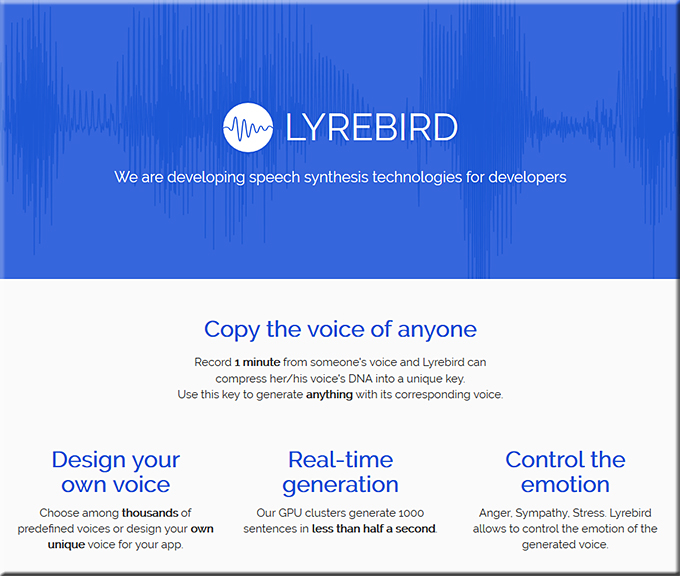
Lyrebird claims it can recreate any voice using just one minute of sample audio — from theverge.com by James Vincent
The results aren’t 100 percent convincing, but it’s a sign of things to come

Excerpt:

Artificial intelligence is making human speech as malleable and replicable as pixels. Today, a Canadian AI startup named Lyrebird unveiled its first product: a set of algorithms the company claims can clone anyone’s voice by listening to just a single minute of sample audio.


Also see:


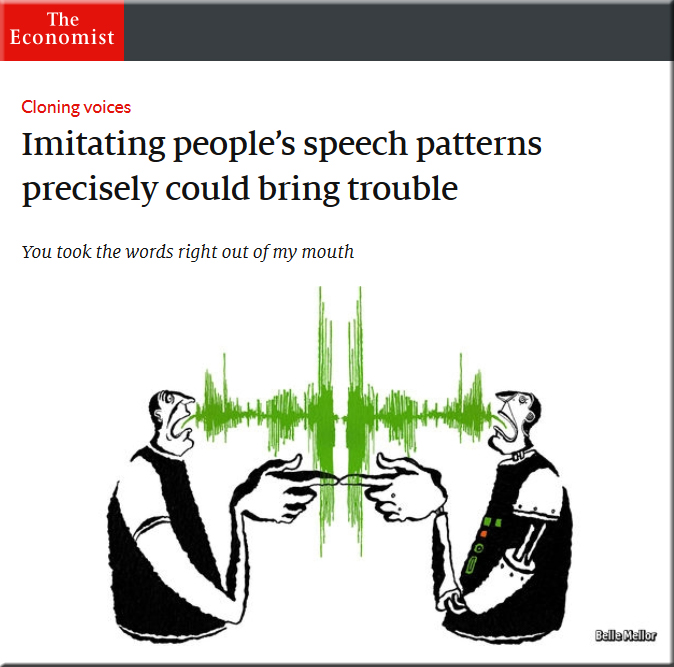
Imitating people’s speech patterns precisely could bring trouble — from economist.com by
You took the words right out of my mouth

Excerpt:

UTTER 160 or so French or English phrases into a phone app developed by CandyVoice, a new Parisian company, and the app’s software will reassemble tiny slices of those sounds to enunciate, in a plausible simulacrum of your own dulcet tones, whatever typed words it is subsequently fed. In effect, the app has cloned your voice. The result still sounds a little synthetic but CandyVoice’s boss, Jean-Luc Crébouw, reckons advances in the firm’s algorithms will render it increasingly natural. Similar software for English and four widely spoken Indian languages, developed under the name of Festvox, by Carnegie Mellon University’s Language Technologies Institute, is also available. And Baidu, a Chinese internet giant, says it has software that needs only 50 sentences to simulate a person’s voice.

Until recently, voice cloning—or voice banking, as it was then known—was a bespoke industry which served those at risk of losing the power of speech to cancer or surgery.
…
More troubling, any voice—including that of a stranger—can be cloned if decent recordings are available on YouTube or elsewhere. Researchers at the University of Alabama, Birmingham, led by Nitesh Saxena, were able to use Festvox to clone voices based on only five minutes of speech retrieved online. When tested against voice-biometrics software like that used by many banks to block unauthorised access to accounts, more than 80% of the fake voices tricked the computer.


Per Candyvoice.com:

Expert in digital voice processing, CandyVoice offers software to facilitate and improve vocal communication between people and communicating objects. With applications in:

Health
Customize your devices of augmentative and alternative vocal communication by integrating in them your users’ personal vocal model

Robots & Communicating objects
Improve communication with robots through voice conversion, customized TTS, and noise filtering

Video games
Enhance the gaming experience by integrating vocal conversion of character’s voice in real time, and the TTS customizing


Also related:


From DSC:
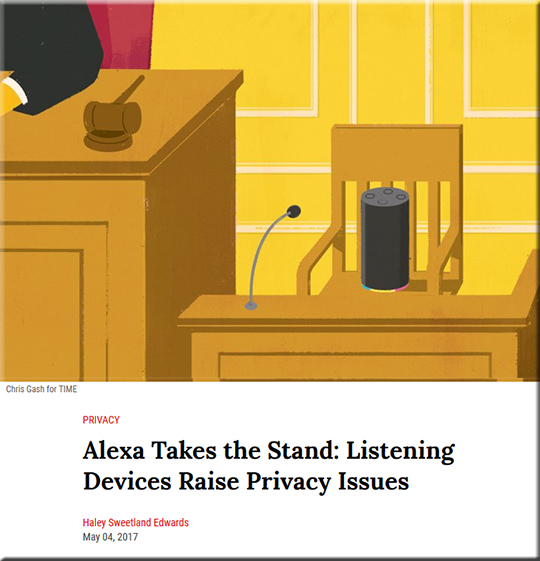
Given this type of technology, what’s to keep someone from cloning a voice, putting together whatever you wanted that person to say, and then making it appear that Alexa recorded that other person’s voice?


© 2025 | Daniel Christian