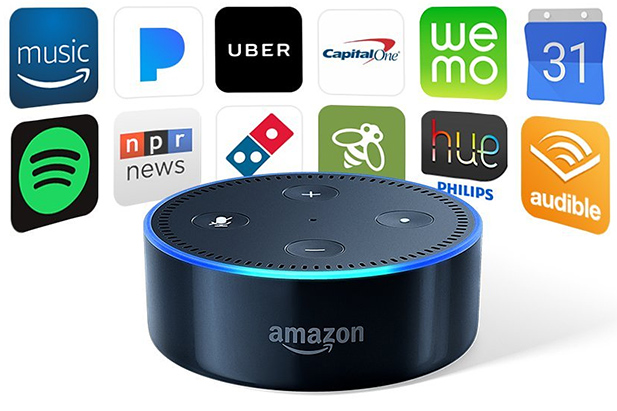
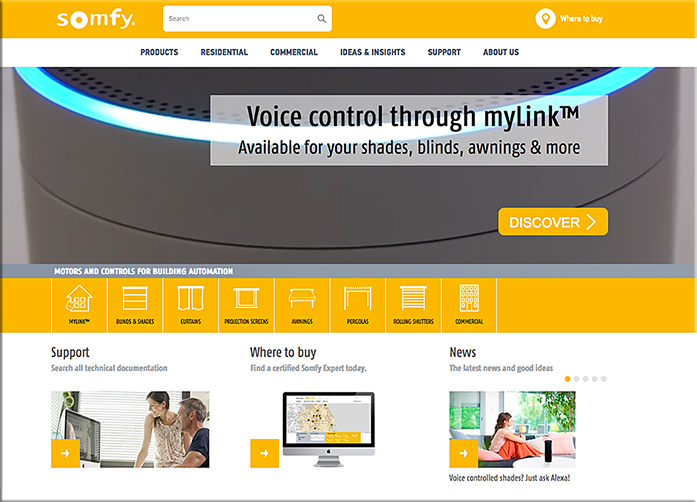
How soon before teachers/professors/trainers can quickly reconfigure their rooms’ settings via their voices? For example, faculty members will likely soon be able to quickly establish lighting, volume levels, blinds, or other types of room setups with their voices. This could be in addition to the use of beacons and smartphones that automatically recognize who just walked into the room and how that person wants the room to be configured on startup.
This functionality is probably already here…I just don’t know about it yet.
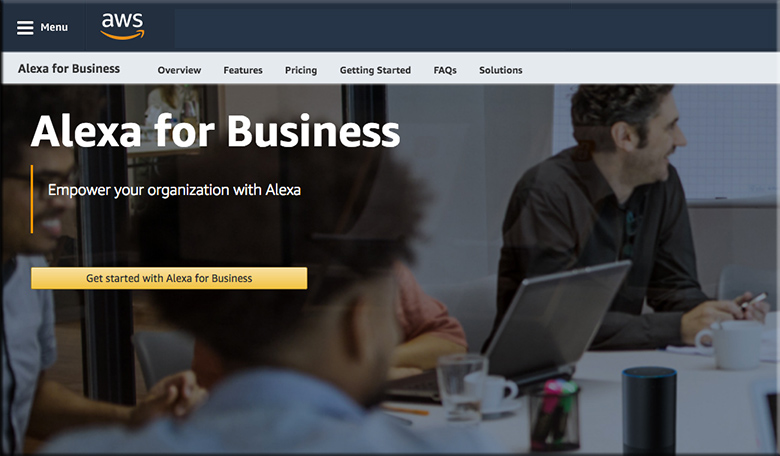
Amazon Web Services today announced Alexa for Business, a new service that provides voice control for office tasks. The Alexa intelligent assistant can help start conference calls, control conference room equipment, schedule meetings, keep track of tasks, notify IT of an equipment issue or reorder supplies, the company noted in a news announcement. The service can also be customized to voice-enable an organization’s specific IT applications and office systems.
Also see:
EDUCAUSE 2017: Microsoft VP Praises the Power of Artificial Intelligence — from edtechmagazine.com Artificial intelligence and connected systems advancements are creating a foundation where higher education can use insights and data to drive more efficient campus management, Microsoft’s Anthony Salcito explains.
Analysts and AI: A winning combination — from information-age.com Artificial intelligence is crucial in helping analysts achieve more in day-to-day operations, and drive innovation
Excerpt:
A Capgemini and LinkedIn study of 1,000 companies with revenue of $500 million+ reported that 2 in 3 jobs being created as a result of AI were at management level, and of those that have implemented the technology at scale, 89% believe complex jobs will be made easier, and 88% say humans and machines will co-exist within their business.
Yet as Amazon and Google seek greater riches by infusing the world with artificial intelligence, they’ve started their own consulting operations, lending out some of their prized AI talent to customers. The reason: Those other businesses lack the expertise to take advantage of techniques such as machine learning.
…
The expertise shortage upsets the usual dynamic of the cloud market, where Amazon, Google, and others mostly compete on price and technical features. “If you’re a random manufacturing company in the midwest you may have money, but it’s hard to attract a $250,000-a-year Stanford PhD to work for you,” says Diego Oppenheimer, whose Google-backed startup provides tools that help companies deploy machine-learning software. Companies in that situation may be more swayed by an offer of help building AI, than pricing and performance, he says.
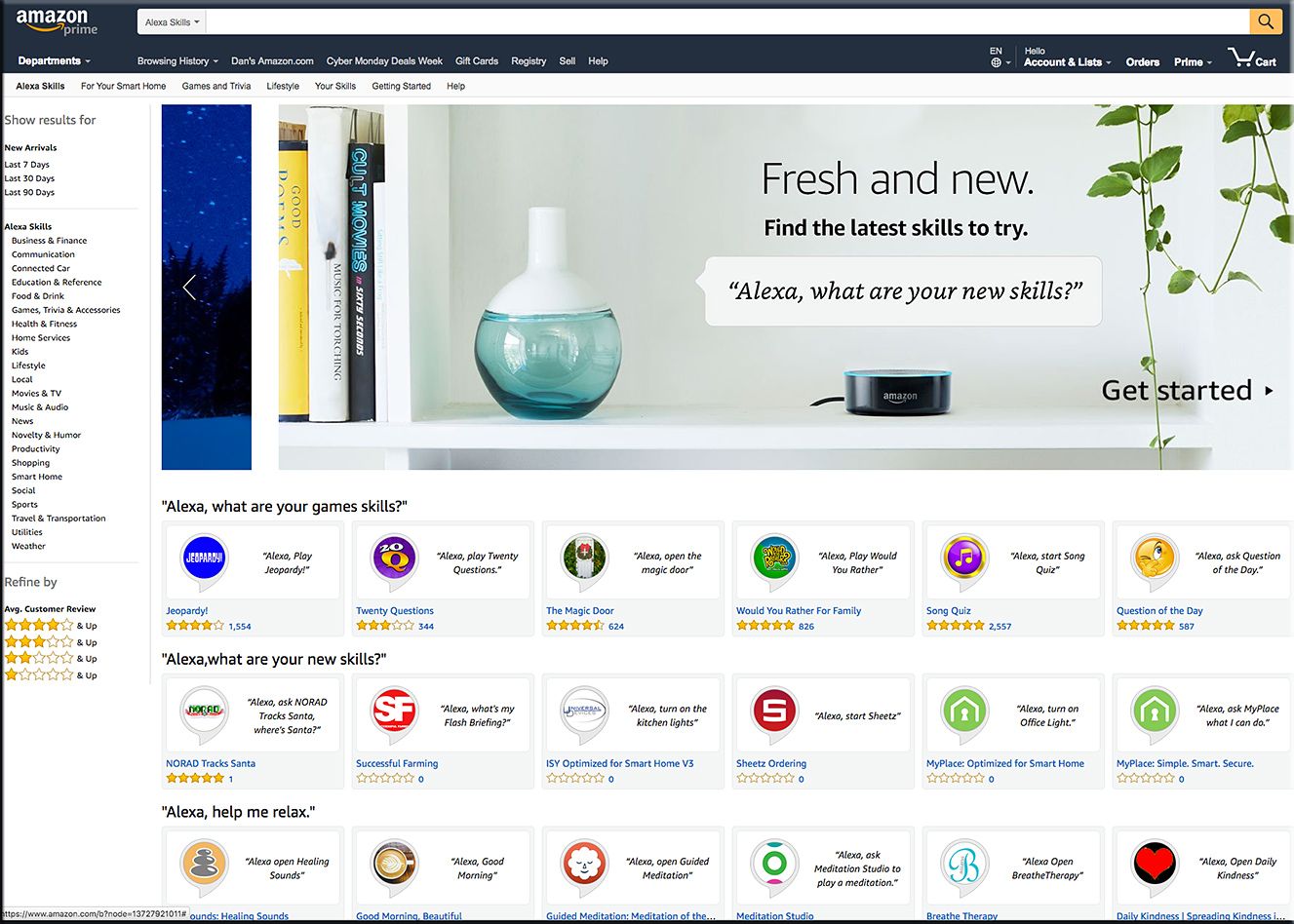
2017 has turned out to be the year of voice. Amazon Alexa passed over 10 million unit sales earlier in the year and there are over 24,000 Skills in the store. With the addition of new devices like the Echo Show, Echo Plus, improved Echo Dot, and a new form factor for the Echo, there’s an option for everyone’s budget. Google is right there as well with the addition of the Google Mini to go along with the original Google Home. Apple’s efforts with Siri and HomePod, Samsung’s Bixby, and Microsoft’s Cortana round out the major tech firms efforts in this space.
A new Forrester Research report, Predictions 2018: Automation Alters The Global Workforce, outlines 10 predictions about the impact of AI and automation on jobs, work processes and tasks, business success and failure, and software development, cybersecurity, and regulatory compliance.
We will see a surge in white-collar automation, half a million new digital workers (bots) in the US, and a shift from manual to automated IT and data management. “Companies that master automation will dominate their industries,” Forrester says. Here’s my summary of what Forrester predicts will be the impact of automation in 2018:
Automation will eliminate 9% of US jobs but will create 2% more. In 2018, 9% of US jobs will be lost to automation, partly offset by a 2% growth in jobs supporting the “automation economy.”Specifically impacted will be back-office and administrative, sales, and call center employees. A wide range of technologies, from robotic process automation and AI to customer self-service and physical robots will impact hiring and staffing strategies as well as create a need for new skills.
Your next entry-level compliance staffer will be a robot.
From DSC:
Are we ready for a net loss of 7% of jobs in our workforce due to automation — *next year*? Last I checked, it was November 2017, and 2018 will be here before we know it.
***Are we ready for this?! ***
AS OF TODAY, can we reinvent ourselves fast enough given our current educational systems, offerings, infrastructures, and methods of learning?
My answer: No, we can’t. But we need to be able to — and very soon!
There are all kinds of major issues and ramifications when people lose their jobs — especially this many people and jobs! The ripple effects will be enormous and very negative unless we introduce new ways for how people can learn new things — and quickly!
That’s why I’m big on trying to establish a next generation learning platform, such as the one that I’ve been tracking and proposing out at Learning from the Living [Class] Room. It’s meant to provide societies around the globe with a powerful, next generation learning platform — one that can help people reinvent themselves quickly, cost-effectively, conveniently, & consistently! It involves providing, relevant, up-to-date streams of content that people can subscribe to — and drop at any time. It involves working in conjunction with subject matter experts who work with teams of specialists, backed up by suites of powerful technologies. It involves learning with others, at any time, from any place, at any pace. It involves more choice, more control. It involves blockchain-based technologies to feed cloud-based learner profiles and more.
But likely, bringing such a vision to fruition will require a significant amount of collaboration. In my mind, some of the organizations that should be at the table here include:
Some of the largest players in the tech world, such as Amazon, Google, Apple, IBM, Microsoft, and/or Facebook
Some of the vendors that already operate within the higher ed space — such as Salesforce.com, Ellucian, and/or Blackboard
Some of the most innovative institutions of higher education — including their faculty members, instructional technologists, instructional designers, members of administration, librarians, A/V specialists, and more
The U.S. Federal Government — for additional funding and the development of policies to make this vision a reality
Artificial intelligence is predicted to fundamentally alter the nature of society by 2040. Investment in AI start-ups was estimated at $6-$9 billion in 2016, up from US$415 million four years earlier. While futurist Ray Kurzweil argues that AI will help us to address the grand challenges facing humanity, Elon Musk warns us that artificial intelligence will be our “biggest existential threat.” Others argue that artificial intelligence is the future of growth. Everything depends on how we manage the transition to this AI-era.
In 2016 the Obama administration released a national strategic plan for artificial intelligence and, while we do not all suddenly now need a plan for artificial intelligence, we do need to stay up to date on how AI is being implemented. Much of AI’s potential is yet to be realized, but AI is already running our lives, from Siri to Netflix recommendations to automated air traffic control. We all need to become more aware of how we are algorithmically shaped by our tools.
This Australian discussion paper on the implications of AI, automation and 21st-century skills, shows how AI will not just affect blue-collar truck drivers and cleaners, it will also affect white-collar lawyers and doctors. Automated pharmacy systems with robots dispensing medication exist, Domino’s pizza delivery by drone has already occurred, and a fully automated farm is opening in Japan.
Education reformers need to plan for our AI-driven future and its implications for education, both in schools and beyond. The never-ending debate about the sorts of skills needed in the future and the role of schools in teaching and assessing them is becoming a whole lot more urgent and intense.
The right to due process was inscribed into the US constitution with a pen. A new report from leading researchers in artificial intelligence cautions it is now being undermined by computer code.
Public agencies responsible for areas such as criminal justice, health, and welfare increasingly use scoring systems and software to steer or make decisions on life-changing events like granting bail, sentencing, enforcement, and prioritizing services. The report from AI Now, a research institute at NYU that studies the social implications of artificial intelligence, says too many of those systems are opaque to the citizens they hold power over.
The AI Now report calls for agencies to refrain from what it calls “black box” systems opaque to outside scrutiny. Kate Crawford, a researcher at Microsoft and cofounder of AI Now, says citizens should be able to know how systems making decisions about them operate and have been tested or validated. Such systems are expected to get more complex as technologies such as machine learning used by tech companies become more widely available.
“We should have equivalent due-process protections for algorithmic decisions as for human decisions,” Crawford says. She says it can be possible to disclose information about systems and their performance without disclosing their code, which is sometimes protected intellectual property.
“We announce the appointment of a minister for artificial intelligence. The next global wave is artificial intelligence and we want the UAE to be more prepared for it.”
Tech Giants Are Paying Huge Salaries for Scarce A.I. Talent— from nytimes.com by Cade Metz Nearly all big tech companies have an artificial intelligence project, and they are willing to pay experts millions of dollars to help get it done.
Excerpt:
Tech’s biggest companies are placing huge bets on artificial intelligence, banking on things ranging from face-scanning smartphones and conversational coffee-table gadgets to computerized health care and autonomous vehicles. As they chase this future, they are doling out salaries that are startling even in an industry that has never been shy about lavishing a fortune on its top talent.
Typical A.I. specialists, including both Ph.D.s fresh out of school and people with less education and just a few years of experience, can be paid from $300,000 to $500,000 a year or more in salary and company stock, according to nine people who work for major tech companies or have entertained job offers from them. All of them requested anonymity because they did not want to damage their professional prospects.
With so few A.I. specialists available, big tech companies are also hiring the best and brightest of academia. In the process, they are limiting the number of professors who can teach the technology.
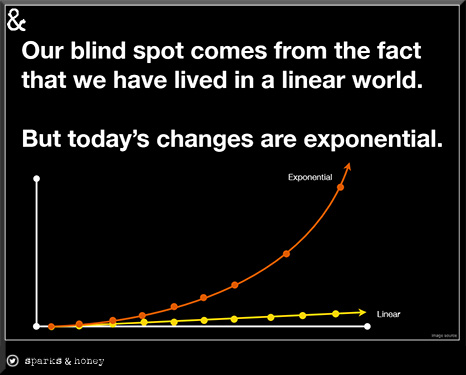
From DSC: In Part I, I looked at the new, exponential pace of change that colleges, community colleges and universities now need to deal with – observing the enormous changes that are starting to occur throughout numerous societies around the globe. If we were to plot out the rate of change, we would see that we are no longer on a slow, steady, incremental type of linear pathway; but, instead, we would observe that we are now on an exponential trajectory (as the below graphic from sparks & honey very nicely illustrates).
How should colleges and universities deal with this new, exponential pace of change?
1) I suggest that you ensure that someone in your institution is lifting their gaze and peering out into the horizons, to see what’s coming down the pike. That person – or more ideally, persons – should also be looking around them, noticing what’s going on within the current landscapes of higher education. Regardless of how your institution tackles this task, given that we are currently moving at an incredibly fast pace, this trend analysis is very important. The results from this analysis should immediately be integrated into your strategic plan. Don’t wait 3-5 years to integrate these new findings into your plan. The new, exponential pace of change is going to reward those organizations who are nimble and responsive.
2) I recommend that you look at what programs you are offering and consider if you should be developing additional programs such as those that deal with:
Artificial Intelligence (Natural Language Processing, deep learning, machine learning, bots)
New forms of Human Computer Interaction such as Augmented Reality, Virtual Reality, and Mixed Reality
User Experience Design, User Interface Design, and/or Interaction Design
Big data, data science, working with data
The Internet of Things, machine-to-machine communications, sensors, beacons, etc.
3) If you are not already doing so, I recommend that you immediately move to offer a robust lineup of online-based programs. Why do I say this? Because:
Without them, your institution may pay a heavy price due to its diminishing credibility.Your enrollments could decline if learners (and their families) don’t think they will get solid jobs coming out of your institution. If the public perceives you as a dinosaur/out of touch with what the workplace requires, your enrollment/admissions groups may find meeting their quotas will get a lot harder as the years go on. You need to be sending some cars down the online/digital/virtual learning tracks. (Don’t get me wrong. We still need the liberal arts. However, even those institutions who offer liberal arts lineups will still need to have a healthy offering of online-based programs.)
Online-based learning methods can expand the reach of your faculty members while offering chances for individuals throughout the globe to learn from you, and you from them
Online-based learning programs can increase your enrollments, create new revenue streams, and develop/reach new markets
Online-based learning programs have been proven to offer the same learning gains – and sometimes better learning results than – what’s being achieved in face-to-face based classrooms
The majority of pedagogically-related innovations are occurring within the online/digital/virtual realm, and you will want to have built the prior experience, expertise, and foundations in order to leverage and benefit from them
Faculty take their learning/experiences from offering online-based courses back into their face-to-face courses
Due to the increasing price of obtaining a degree, students often need to work to help get them (at least part of the way) through school; thus, flexibility is becoming increasingly important and necessary for students
An increasing number of individuals within the K-12 world as well as the corporate world are learning via online-based means. This is true within higher education as well, as, according to a recent report from Digital Learning Compass states that “the number of higher education students taking at least one distance education course in 2015 now tops six million, about 30% of all enrollments.”
Families are looking very closely at their return on investments being made within the world of higher education. They want to see that their learners are being prepared for the ever-changing future that they will encounter. If people in the workforce often learn online, then current students should be getting practice in that area of their learning ecosystems as well.
As the (mostly) online-based Amazon.com is thriving and retail institutions such as Sears continue to close, people are in the process of forming more generalized expectations that could easily cross over into the realm of higher education. By the way, here’s how our local Sears building is looking these days…or what’s left of it.
4) I recommend that you move towards offering more opportunities for lifelong learning, as learners need to constantly add to their skillsets and knowledge base in order to remain marketable in today’s workforce. This is where adults greatly appreciate – and need – the greater flexibility offered by online-based means of learning. I’m not just talking about graduate programs or continuing studies types of programs here. Rather, I’m hoping that we can move towards providing streams of up-to-date content that learners can subscribe to at any time (and can drop their subscription to at any time). As a relevant side note here, keep your eyes on blockchain-based technologies here.
5) Consider the role of consortia and pooling resources. How might that fit into your strategic plan?
6) Consider why bootcamps continue to come onto the landscape. What are traditional institutions of higher education missing here?
7) And lastly, if one doesn’t already exist, form a small, nimble, innovative group within your organization — what I call a TrimTab Group — to help identify what will and won’t work for your institution.
From DSC: I know Quentin Schultze from our years working together at Calvin College, in Grand Rapids, Michigan (USA). I have come to greatly appreciate Quin as a person of faith, as an innovative/entrepreneurial professor, as a mentor to his former students, and as an excellent communicator.
Quin has written a very concise, wisdom-packed book that I would like to recommend to those people who are seeking to be better communicators, leaders, and servants. But I would especially like to recommend this book to the leadership at Google, Amazon, Apple, Microsoft, IBM, Facebook, Nvidia, the major companies developing robots, and other high-tech companies. Why do I list these organizations? Because given the exponential pace of technological change, these organizations — and their leaders — have an enormous responsibility to make sure that the technologies that they are developing result in positive changes for societies throughout the globe. They need wisdom, especially as they are working on emerging technologies such as Artificial Intelligence (AI), personal assistants and bots, algorithms, robotics, the Internet of Things, big data, blockchain and more. These technologies continue to exert an increasingly powerful influence on numerous societies throughout the globe today. And we haven’t seen anything yet! Just because we can develop and implement something, doesn’t mean that we should. Again, we need wisdom here.
But as Quin states, it’s not just about knowledge, the mind and our thoughts. It’s about our hearts as well. That is, we need leaders who care about others, who can listen well to others, who can serve others well while avoiding gimmicks, embracing diversity, building trust, fostering compromise and developing/exhibiting many of the other qualities that Quin writes about in his book. Our societies desperately need leaders who care about others and who seek to serve others well.
I highly recommend you pick up a copy of Quin’s book. There are few people who can communicate as much in as few words as Quin can. In fact, I wish that more writing on the web and more articles/research coming out of academia would be as concisely and powerfully written as Quin’s book, Communicate Like a True Leader: 30 Days of Life-Changing Wisdom.
To lead is to accept responsibility and act responsibly.
— Quentin Schultze
AWS and Microsoft announce Gluon, making deep learning accessible to all developers — from news.microsoft.com New open source deep learning interface allows developers to more easily and quickly build machine learning models without compromising training performance. Jointly developed reference specification makes it possible for Gluon to work with any deep learning engine; support for Apache MXNet available today and support for Microsoft Cognitive Toolkit coming soon.
Excerpt:
SEATTLE and REDMOND, Wash. — Oct. 12, 2017 — On Thursday, Amazon Web Services Inc. (AWS), an Amazon.com company (NASDAQ: AMZN), and Microsoft Corp. (NASDAQ: MSFT) announced a new deep learning library, called Gluon, that allows developers of all skill levels to prototype, build, train and deploy sophisticated machine learning models for the cloud, devices at the edge and mobile apps. The Gluon interface currently works with Apache MXNet and will support Microsoft Cognitive Toolkit (CNTK) in an upcoming release. With the Gluon interface, developers can build machine learning models using a simple Python API and a range of prebuilt, optimized neural network components. This makes it easier for developers of all skill levels to build neural networks using simple, concise code, without sacrificing performance. AWS and Microsoft published Gluon’s reference specification so other deep learning engines can be integrated with the interface. To get started with the Gluon interface, visit https://github.com/gluon-api/gluon-api/.
Microsoft and Amazon announced a surprise partnership on Thursday in which they were jointly releasing for free a new software tool for developers called Gluon.
Gluon makes it easier for developers to build AI/machine learning systems, aka apps that can learn.
But there’s another, more important reason this partnership is interesting: it challenges Google in its one big area of dominance.
ASU students have set up Echo Dots, a hands-free, voice-controlled device the size of a hockey puck, in engineering residence halls.
Students can ask questions about topics ranging from the weather to campus sporting events to library hours to exam schedules.
“We’re continuing to add content as we’re learning what students want to learn about,” Rome said. “So there’s this feedback loop of what students want, and we monitor what questions are being asked.”
…
Amazon donated about 1,600 Dots to engineering students at ASU, so the technology belongs to the students, not to the school. The students can choose to use them or not, said John German, director for media relations and research communications.
“We have the largest engineering school in the country, and one of the things we’re trying to do is teach students the most advanced technology, the kinds of technology that are going to make them competitive in the job market when they get their degrees,” German said. “And voice technology is a field that’s growing. It’s going to play a role in the future.”
“Voice is becoming the new mobile of 10 years ago,” Rome said. “We’ve decided to be an early adopter of this technology.” … “There’s going to come some day when students can interact [with ASU’s student portal] via webpage or microphone on their mobile phones,” he said. “We think that’s inevitable.”
From DSC: I just wanted to include some excerpts (see below) from Gartner’s 100 Data and Analytics Predictions Through 2021 report. I do so to illustrate how technology’s impact continues to expand/grow in influence throughout many societies around the globe, as well as to say that if you want a sure thing job in the next 1-15 years, I would go into studying data science and/or artificial intelligence!
Excerpts:
As evidenced by its pervasiveness within our vast array of recently published Predicts 2017 research, it is clear that data and analytics are increasingly critical elements across most industries, business functions and IT disciplines. Most significantly, data and analytics are key to a successful digital business. This collection of more than 100 data-and-analytics-related Strategic Planning Assumptions (SPAs) or predictions through 2021, heralds several transformations and challenges ahead that CIOs and data and analytics leaders should embrace and include in their planning for successful strategies. Common themes across the discipline in general, and within particular business functions and industries, include:
Artificial intelligence (AI) is emerging as a core business and analytic competency. Beyond yesteryear’s hard-coded algorithms and manual data science activities, machine learning (ML) promises to transform business processes, reconfigure workforces, optimize infrastructure behavior and blend industries through rapidly improved decision making and process optimization.
Natural language is beginning to play a dual role in many organizations and applications as a source of input for analytic and other applications, and a variety of output, in addition to traditional analytic visualizations.
Information itself is being recognized as a corporate asset (albeit not yet a balance sheet asset), prompting organizations to become more disciplined about monetizing, managing and measuring it as they do with other assets. This includes “spending” it like cash, selling/licensing it to others, participating in emerging data marketplaces, applying asset management principles to improve its quality and availability, and quantifying its value and risks in a variety of ways.
Smart devices that both produce and consume Internet of Things (IoT) data will also move intelligent computing to the edge of business functions, enabling devices in almost every industry to operate and interact with humans and each other without a centralized command and control. The resulting opportunities for innovation are unbounded.
Trust becomes the watchword for businesses, devices and information, leading to the creation of digital ethics frameworks, accreditation and assessments. Most attempts at leveraging blockchain as a trust mechanism fail until technical limitations, particularly performance, are solved.
…
Education
Significant changes to the global education landscape have taken shape in 2016, and spotlight new and interesting trends for 2017 and beyond. “Predicts 2017: Education Gets Personal” is focused on several SPAs, each uniquely contributing to the foundation needed to create the digitalized education environments of the future. Organizations and institutions will require new strategies to leverage existing and new technologies to maximize benefits to the organization in fresh and
innovative ways.
By 2021, more than 30% of institutions will be forced to execute on a personalization strategy to maintain student enrollment.
By 2021, the top 100 higher education institutions will have to adopt AI technologies to stay competitive in research.
…
Artificial Intelligence
Business and IT leaders are stepping up to a broad range of opportunities enabled by AI, including autonomous vehicles, smart vision systems, virtual customer assistants, smart (personal) agents and natural-language processing. Gartner believes that this new general-purpose technology is just beginning a 75-year technology cycle that will have far-reaching implications for every industry. In “Predicts 2017: Artificial Intelligence,” we reflect on the near-term opportunities, and the potential burdens and risks that organizations face in exploiting AI. AI is changing the way in which organizations innovate and communicate their processes, products and services.
Practical strategies for employing AI and choosing the right vendors are available to data and analytics leaders right now.
By 2019, more than 10% of IT hires in customer service will mostly write scripts for bot interactions.
Through 2020, organizations using cognitive ergonomics and system design in new AI projects will achieve long-term success four times more often than others.
By 2020, 20% of companies will dedicate workers to monitor and guide neural networks.
By 2019, startups will overtake Amazon, Google, IBM and Microsoft in driving the AI economy with disruptive business solutions.
By 2019, AI platform services will cannibalize revenues for 30% of market-leading companies. “Predicts 2017: Drones”
By 2020, the top seven commercial drone manufacturers will all offer analytical software packages.
“Predicts 2017: The Reinvention of Buying Behavior in Vertical-Industry Markets”
By 2021, 30% of net new revenue growth from industry-specific solutions will include AI technology.
…
Advanced Analytics and Data Science
Advanced analytics and data science are fast becoming mainstream solutions and competencies in most organizations, even supplanting traditional BI and analytics resources and budgets. They allow more types of knowledge and insights to be extracted from data. To become and remain competitive, enterprises must seek to adopt advanced analytics, and adapt their business models, establish specialist data science teams and rethink their overall strategies to keep pace with the competition. “Predicts 2017: Analytics Strategy and Technology” offers advice on overall strategy, approach and operational transformation to algorithmic business that leadership needs to build to reap the benefits.
By 2018, deep learning (deep neural networks [DNNs]) will be a standard component in 80% of data scientists’ tool boxes.
By 2020, more than 40% of data science tasks will be automated, resulting in increased productivity and broader usage by citizen data scientists.
By 2019, natural-language generation will be a standard feature of 90% of modern BI and analytics platforms.
By 2019, 50% of analytics queries will be generated using search, natural-language query or voice, or will be autogenerated.
By 2019, citizen data scientists will surpass data scientists in the amount of advanced analysis
produced.
By 2020, 95% of video/image content will never be viewed by humans; instead, it will be vetted by machines that provide some degree of automated analysis.
Through 2020, lack of data science professionals will inhibit 75% of organizations from achieving the full potential of IoT.
Amazon and tech training app Codecademy have collaborated to create a series of free courses. Available today, the courses are meant to train developers as well as beginners how to create skills, the voice apps that interact with Alexa.
Since opening Alexa to third-party developers in 2015, more than 20,000 skills have been made available in the Alexa Skills Store.
Tap through the app’s catalogue of over 2,000 products—nearly the company’s full collection of umlauted sofas, armchairs, coffee tables, and storage units—then hold up your phone and use the camera to place the digital furniture anywhere in a room. Want to see how the Strandmon winged chair looks by the window? Done. Can you really squeeze in that 7-foot-long area rug? Open the app, point your camera at the floor, and watch it appear at scale. You can even place a futon where it would go in the guest room, then see what it looks like when it unfolds into a bed.
Ikea built the app with Apple’s ARKit, a developer toolkit created to usher in the augmented reality revolution on iOS devices. The app is free and available now, as long as your iPhone is updated to iOS 11.
One of the biggest features to come to iOS 11 is ARKit, enabling developers to open up your world to a whole new kind of gaming and discovery system. Instead of being limited to the screen, you can play on surfaces big and small and you can play with others. The only thing limiting you right now is not knowing which ARKit apps are out there right now, so you can dive in and see which apps are your new favorite.
Searching Apple’s massive App Store can take a long time, so we’ve compiled a big friendly list for you to pick out the real winners!
The majority of these apps are still at the demo stage for now, but it’s not difficult to see the potential. Games can take place in the real world, whether that’s on your living room floor or around your neighborhood, while you’ll be able to imagine anything from a new sofa to a new house extension through your phone’s camera.
Further down the line you’ll be able to point your phone at anything and get information overlaid about what you’re seeing with a whole new level of accuracy—the distance to the pin on a golf course, the current stats for players out on a baseball field, or precise directions to the store you need in the mall you’ve just got lost in. You can measure distances, land a rocket in your backyard, and so much more.
Of course AR (or “mixed reality”) headsets are going to provide a much more immersive experience and are a more natural fit than having to hold your phone or tablet in front of you to see anything in AR land. Until those headsets hit the mainstream though, ARKit and ARCore are about to introduce millions of people to the potential of augmented reality. Instead of looking down at your phone you’re going to be holding it up to access all the information of the internet with a swipe.
Amazon’s first wearable device will be a pair of smart glasses with the Alexa voice assistant built in, according to a report in the Financial Times. The device will reportedly look like a regular pair of glasses and use bone-conduction technology so that the user can hear Alexa without the need for earphones or conventional speakers. It won’t, however, likely have a screen or camera, although Google Glass founder Babak Parviz has apparently been working on the project following his hiring by Amazon in 2014.
What does Google want with HTC’s smartphone business?— from theguardian.com by Samuel Gibbs Google is acquiring a $1bn chunk of HTC’s smartphone arm, including 2,000 employees and access to intellectual property, as it bets big on hardware
Google isn’t buying the whole of HTC, just a relatively large part of the Taipei-based company’s smartphone business and not itsVive virtual reality headset business. Google gains half of HTC’s research and development team – about 2,000 people – and a non-exclusive license for HTC’s intellectual property, allowing it to take advantage of some of HTC’s advances in smartphone technology.
HTC gets a cash injection, which will help it survive in some very competitive markets, and Google gets to continue its “big bet on hardware” according to Rick Osterloh, the company’s senior vice president for hardware.
It’s “a business decision to have access to one of the best R&D teams”, said Neil Shah, research director at Counterpoint Technology Market Research. But it’s also “a sort of emotional decision to save its close partners”.
The Washington Post today announced the launch of its first embedded augmented reality story. The Post built an industry-first embed code that lets users trigger an augmented reality experience with 3D visuals and audio narration.
“We were excited to be the first news publisher to support augmented reality in a news application, but for our second iteration in our iconic building series we needed to make augmented reality even simpler,” said Jeremy Gilbert, director of strategic initiatives at The Post. “We’ve been working to reduce the friction to make augmented reality as easily accessible as a photo gallery or a video—those are played inline and augmented reality should be too.”
You can get a sense for what this expansion means in the video below. Ford has already been using HoloLens to help design new cars; bringing 3D models into the real world using the augmented reality headset. Now, however, the company is introducing new processes, like overlaying new features onto existing car models and creating guided tours of cars using voice recording. The company also says it’s developing new apps for better collaboration in AR.
Manufacturers have thus far incorporated the voice assistant into speakers, phones, thermostats, and more — but being incorporated into a wearable device is a first for Alexa.
The headphones will let users tap a button to launch the voice assistant, which will connect to the device through the user’s mobile phone and the Bragi app. They will let a wearer engage with the voice assistant while on the go, searching for basic information, shopping for goods on Amazon, or calling for a vehicle from ride-hailing services like Uber, among other possibilities. While all of these capabilities are already possible using a phone, enabling hands-free voice control brings a new level of convenience.
Amazon is expanding its efforts in the education technology space [on 8/23/17] with the launch of a new curriculum from TenMarks, the company it acquired several years ago which previously only focused on math lessons and related activities. Now, the business is offering an online curriculum for teachers designed to help students learn how to be better writers. The program includes a writing coach that leverages natural language processing, a variety of resources for teachers, and something called “bursts,” which are short writing prompts kids will be familiar with because of their use of mobile apps.
These bursts, which can be used by teachers as warm-ups or supplemental activities, make writing seem less intimidating for students, as they’re similar to what kids might do online or on their smartphones.
…
TenMarks is only one way that Amazon is aiming to insert itself into the classroom. The company also runs Amazon Inspire, still in beta, a collection of K-12 curriculum resources. Currently, educators can browse the content library and download those they want to use, but a sharing feature that will support uploads is soon to launch.




![The Living [Class] Room -- by Daniel Christian -- July 2012 -- a second device used in conjunction with a Smart/Connected TV](http://danielschristian.com/learning-ecosystems/wp-content/uploads/2012/07/The-Living-Class-Room-Daniel-S-Christian-July-2012.jpg)