Addendum on 2/12/22:


The metaverse: three legal issues we need to address — from theconversation.com by Pin Lean Lau

Excerpt:

The “metaverse” seems to be the latest buzzword in tech. In general terms, the metaverse can be viewed as a form of cyberspace. Like the internet, it’s a world – or reality, even – beyond our physical world on Earth.

The difference is that the metaverse allows us to immerse a version of ourselves as avatars in its environment, usually through augmented reality (AR) or virtual reality (VR), which people are and will increasingly be able to access using tools like VR goggles.

While it all seems very exciting, a curious lawyer like me is inclined to ask: who or what governs the metaverse? The way I see it, there are three key areas which, at this stage, are legally murky.

From DSC:
There are a lot more than three legal issues to be addressed with the metaverse, especially as it further develops. That said, I posted this in the hopes of raising the level of awareness within the legal arena on this particular area of emerging technologies. 


The US is testing robot patrol dogs on its borders. Should we worry? — from interestingengineering.com by Loukia Papadopoulos
Bow-wow just got darker.

However, we can’t shake the feeling that their deployment is creating a dystopian future, one we are not sure is a completely safe one especially if the dogs are trained to operate autonomously. That is a capability we are not sure the robots yet have. Will this be the next stop for border control? If so, how can we trust machines with rifles? Time will tell how this situation evolves.
 

Skill assessments: The future of personalization in learning — from edyoucated.org by Julian Rasch

The future of personalization in professional online learning lies in detailed, but fast and effective skill assessments. Here’s how we do it at edyoucated.


22 Augmented Reality Trends to Keep an Eye on for 2022 — from linkedin.com by Tom Emrich

Excerpts:

#1 Metaverse remains at peak hype as the next iteration of the Internet feels so close but is actually much further away

#2 The smartphone continues to become an even more powerful augmented reality machine with advancements in chips, displays and connectivity

#3 Early consumer smartglasses reinforce the need for smartphones rather than attempt to replace them

The metaverse is defined differently by different people but for me, the metaverse is an aha moment. It is a realization by industry that the next wave of computing is comprised of a stack of emerging technologies (including blockchain, AI, IoT, AR and VR) that will all work together to create a fundamental shift in our relationship with technology. 


Also see:


Why The Metaverse Is More Than Hype — from linkedin.com by Amy LaMeyer

Excerpt:

There are fundamental reasons why there is more to the current Metaverse enthusiasm than hype. As an angel investor, start-up advisor and fund manager, I’ve been studying this space for almost six years, have ridden the trough of disillusionment, and have seen the shift that promises signs of growth. In particular, it is not about the virtual worlds themselves,  although content is very important, it is the growth in the surrounding technology ecosystem that is supporting and signaling an accelerated virtual future. I’ll highlight those building blocks below.

Also relevant/see:

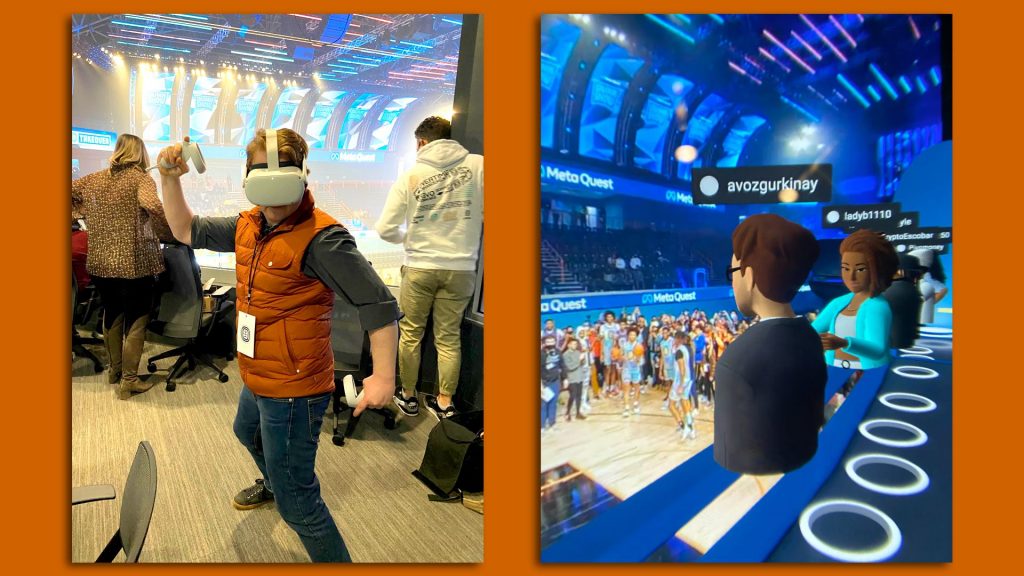
My night in the metaverse — from axios.com by Thomas Wheatley

Two images -- on left is person wearing a VR headset. On right side, image of being in a virtual place..

Excerpt:

Sports teams and brands are cannonballing into the metaverse, giving fans new ways to experience games in a way TV can’t offer.

Why it matters: Boosters of the virtual reality realm say the metaverse could create a new economy, new experiences, new relationships — essentially a whole new life, and a new revenue source for the brands, teams, bands and companies that want to be there when the crowds arrive.


Both of the items below are from Sam DeBrule’s Machine Learnings e-newsletter:


Also see:


Discovery Education Introduces Free Augmented Reality App for Students and Educators — from thejournal.com by Kristal Kuykendall
Sandbox AR Lets Users Create Virtual Worlds or Augment Their Own — All Linked to Real World Knowledge

Excerpt:

Once a user has their Sandbox AR scene built to their satisfaction, they can take photos or record a video walkthrough with their own voiceover, to introduce their classmates or their teacher to what they created or what they learned, for example.

To help educators leverage the power of AR wherever learning takes place, Discovery Education has made the Sandbox AR iPad app available for free in the Apple App Store.

See a demo here.


The biggest tech trends of 2022, according to over 40 experts — from fastcompany.com by Mark Sullivan
Startup founders, Big Tech execs, VCs, and tech scholars offer their predictions on how Web3, the metaverse, and other emerging ideas will shape the next year.

We asked startup founders, Big Tech execs, VCs, scholars, and other experts to speculate on the coming year within their field of interest. Altogether, we collected more than 40 predictions about 2022. Together, they offer a smart composite look at the things we’re likely to be talking about by this time next year.


Shorter Training, Better Skills: Three Predictions For The Future Of Career And Technical Education — from forbes.com by Jeremy Wheaton; with thanks to Ryan Craig for this resource

But in the face of an entrenched and growing skills gap, young people are increasingly questioning the status quo and looking for shorter, less expensive, more direct-to-career options.

Excerpts:

Here [is the first of] three predictions for how the rest of the 2020s will continue to be defined by career education:

  1. The four-year degree will no longer be seen as the default postsecondary education option.


Arizona State wants to reach 100M learners by 2030. Can it meet its goal? — from highereddive.com by Natalie Schwartz

Dive Brief:

  • Arizona State University launched an initiative Thursday that aims to reach 100 million learners worldwide in an online global management and entrepreneurship certificate program by 2030.
  • The certificate program, which will be translated into 40 languages, will be offered through Arizona State’s Thunderbird School of Global Management. An initial donation of $25 million is helping to fund the program, which will make the certificates free to learners through full scholarships.
  • Learners will receive a badge after completing each of five graduate-level courses in the program. Completion of all the courses leads to a certificate granting 15 credit hours that can be applied to degrees at Thunderbird, Arizona State and other institutions, according to a program brochure.

Also see:


From Web3 to Ed3 – Reimagining Education in a Decentralized World — from mirror.xyz by Scott David Meyer; with thanks to Bryan Alexander for posting this resource out on LinkedIn

Excerpt:

Ed3 as a Source of Human Flourishing
Education is a right, and a cornerstone for human flourishing. The more we are able to teach our students, the better prepared they will be to enter the Knowledge Economy and leave their mark on the world.

We are at the beginning of the web3 wave. Entire industries are being re-imagined with a focus on participation and ownership. Education can, and should, follow suit.

By welcoming this new era of ed3, more students will be able to access, afford, and accredit a dynamic education that helps them flourish and leave their mark on the world.


5 brands already boldly embracing the metaverse — from thedrum.com by Dani Gibson
As part of The Drum’s Metaverse Deep Dive, we round up some of the best examples of brands causing a stir within the virtual online world by creating out of this world experiences.

Marketing in the metaverse — from thedrum.com

Marketing in the metaverse -- The Drum immerses itself in future of the internet

 
© 2025 | Daniel Christian